Guru Gobind Singh College of Engineering
and Research Centre
Engineering Mathematics- I
2024-25 As per NEP
By: Dr. Megha Kothawade
1
Introduction
of
Engineering Mathematics- I
ESC101
Teaching Scheme:
TH : 03 Hr/week
TU : 01 Hr/Week
Credits 04
Examination Scheme:
Comprehensive Continuous
CCE: 30 Marks
End-Semester : 70 Marks
TW : 25 Marks
➢ Prerequisite Courses:
Differentiation,
Integration,
Trignometric functions,
Maxima and Minima,
Matrices and Determinants.
Course Objectives:
1. To familiarize the students with concepts and
techniques in Calculus, Fourier series and Linear
Algebra.
2. The aim is to equip them with the techniques to
understand advanced level mathematics
3. To understand the applications of Engineering
Mathematics that would enhance analytical thinking
power, useful in their disciplines.
Course Outcomes:
At the end of course students will be able to
CO1: Apply mean value theorems and its generalizations leading to
Taylors and McLaurin’s series useful in the analysis of engineering
problems.
CO2:Determine the Fourier series representation and harmonic
analysis for design and analysis of periodic continuous and discrete
systems.
CO3: Compute derivative of functions of several variables that are
essential in various branches of Engineering.
Course Outcomes:
At the end of course students will be able to
• CO4: Apply the concept of Jacobian to find partial
derivatives of implicit function and functional dependence.
Use of partial derivatives in estimating errors &
approximations and finding extreme values of the function.
• CO5: Apply the essential tool of matrices and linear algebra
in a comprehensive manner for analysis of system of linear
equations, finding linear and orthogonal transformations,
Eigen values & Eigen vectors and Quadratic forms applicable
to engineering problems.
Unit I
Single Variable Calculus
(8Hrs)
Unit II
Multivariable Calculus-
Partial Differentiation
(08 Hrs)
Unit III
Applications of Partial
Differentiation
(08 Hrs)
Unit IV
Linear Algebra – Matrices
and System of Linear
Equations
(08 Hrs)
Unit V
Linear Algebra - Eigen
Values, Eigen Vectors and
Diagonalization
(08 Hrs)
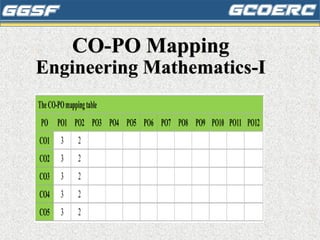
CO-PO Mapping
Engineering Mathematics-I
Books & Other Resources:
1. Higher Engineering Mathematics by B. V.
Ramana (Tata McGraw Hill)
2. Higher Engineering Mathematics by B. S.
Grewal
(Khanna Publication)
Note: All Books are available in GCOERC library
Reference Books:
1. Advanced Engineering Mathematics by Erwin Kreyszig (Wiley
Eastern Ltd.)
2. Advanced Engineering Mathematics by M. D. Greenberg (Pearson
Education)
3. Advanced Engineering Mathematics by Peter V. O’Neil (Thomson
Learning)
4. Thomas’ Calculus by George B. Thomas, (Addison-Wesley, Pearson)
5. Applied Mathematics (Vol. I & Vol. II) by P. N. Wartikar and J. N.
Wartikar Vidyarthi Griha Prakashan, Pune.
6. Elementary Linear Algebra. by Ron Larson and David C. Falvo
(Houghton Mifflin Harcourt Publishing Company)
Note: All Books are available in GCOERC library
List of Tutorials
Following ten tutorials are compulsory. Each unit
consist of two tutorials.
1. Rolle’s Theorem, Mean Value Theorems, Taylor's
and Maclaurin's Series, Indeterminate Forms.
2. Full range and Half rage Fourier series, Harmonic
analysis.
3. Euler's Theorem on Homogeneous functions, Total
Derivative
4. Partial derivative of Composite Function, Total
Derivative
5. Jacobian and its applications, Errors and
Approximations
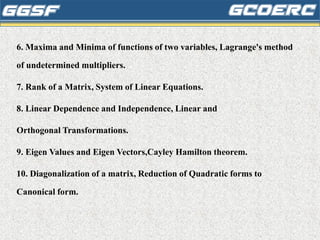
6. Maxima and Minima of functions of two variables, Lagrange's method
of undetermined multipliers.
7. Rank of a Matrix, System of Linear Equations.
8. Linear Dependence and Independence, Linear and
Orthogonal Transformations.
9. Eigen Values and Eigen Vectors,Cayley Hamilton theorem.
10. Diagonalization of a matrix, Reduction of Quadratic forms to
Canonical form.
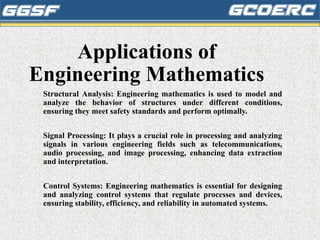
Applications of
Engineering Mathematics
Structural Analysis: Engineering mathematics is used to model and
analyze the behavior of structures under different conditions,
ensuring they meet safety standards and perform optimally.
Signal Processing: It plays a crucial role in processing and analyzing
signals in various engineering fields such as telecommunications,
audio processing, and image processing, enhancing data extraction
and interpretation.
Control Systems: Engineering mathematics is essential for designing
and analyzing control systems that regulate processes and devices,
ensuring stability, efficiency, and reliability in automated systems.
Thank You

Engineering Mathematics-I as per NEP 2020.pdf

  • 1.
    Guru Gobind SinghCollege of Engineering and Research Centre Engineering Mathematics- I 2024-25 As per NEP By: Dr. Megha Kothawade 1
  • 2.
    Introduction of Engineering Mathematics- I ESC101 TeachingScheme: TH : 03 Hr/week TU : 01 Hr/Week Credits 04
  • 3.
    Examination Scheme: Comprehensive Continuous CCE:30 Marks End-Semester : 70 Marks TW : 25 Marks
  • 4.
    ➢ Prerequisite Courses: Differentiation, Integration, Trignometricfunctions, Maxima and Minima, Matrices and Determinants.
  • 5.
    Course Objectives: 1. Tofamiliarize the students with concepts and techniques in Calculus, Fourier series and Linear Algebra. 2. The aim is to equip them with the techniques to understand advanced level mathematics 3. To understand the applications of Engineering Mathematics that would enhance analytical thinking power, useful in their disciplines.
  • 6.
    Course Outcomes: At theend of course students will be able to CO1: Apply mean value theorems and its generalizations leading to Taylors and McLaurin’s series useful in the analysis of engineering problems. CO2:Determine the Fourier series representation and harmonic analysis for design and analysis of periodic continuous and discrete systems. CO3: Compute derivative of functions of several variables that are essential in various branches of Engineering.
  • 7.
    Course Outcomes: At theend of course students will be able to • CO4: Apply the concept of Jacobian to find partial derivatives of implicit function and functional dependence. Use of partial derivatives in estimating errors & approximations and finding extreme values of the function. • CO5: Apply the essential tool of matrices and linear algebra in a comprehensive manner for analysis of system of linear equations, finding linear and orthogonal transformations, Eigen values & Eigen vectors and Quadratic forms applicable to engineering problems.
  • 8.
    Unit I Single VariableCalculus (8Hrs)
  • 9.
  • 10.
    Unit III Applications ofPartial Differentiation (08 Hrs)
  • 11.
    Unit IV Linear Algebra– Matrices and System of Linear Equations (08 Hrs)
  • 12.
    Unit V Linear Algebra- Eigen Values, Eigen Vectors and Diagonalization (08 Hrs)
  • 13.
  • 14.
    Books & OtherResources: 1. Higher Engineering Mathematics by B. V. Ramana (Tata McGraw Hill) 2. Higher Engineering Mathematics by B. S. Grewal (Khanna Publication) Note: All Books are available in GCOERC library
  • 15.
    Reference Books: 1. AdvancedEngineering Mathematics by Erwin Kreyszig (Wiley Eastern Ltd.) 2. Advanced Engineering Mathematics by M. D. Greenberg (Pearson Education) 3. Advanced Engineering Mathematics by Peter V. O’Neil (Thomson Learning) 4. Thomas’ Calculus by George B. Thomas, (Addison-Wesley, Pearson) 5. Applied Mathematics (Vol. I & Vol. II) by P. N. Wartikar and J. N. Wartikar Vidyarthi Griha Prakashan, Pune. 6. Elementary Linear Algebra. by Ron Larson and David C. Falvo (Houghton Mifflin Harcourt Publishing Company) Note: All Books are available in GCOERC library
  • 16.
    List of Tutorials Followingten tutorials are compulsory. Each unit consist of two tutorials. 1. Rolle’s Theorem, Mean Value Theorems, Taylor's and Maclaurin's Series, Indeterminate Forms. 2. Full range and Half rage Fourier series, Harmonic analysis. 3. Euler's Theorem on Homogeneous functions, Total Derivative 4. Partial derivative of Composite Function, Total Derivative 5. Jacobian and its applications, Errors and Approximations
  • 17.
    6. Maxima andMinima of functions of two variables, Lagrange's method of undetermined multipliers. 7. Rank of a Matrix, System of Linear Equations. 8. Linear Dependence and Independence, Linear and Orthogonal Transformations. 9. Eigen Values and Eigen Vectors,Cayley Hamilton theorem. 10. Diagonalization of a matrix, Reduction of Quadratic forms to Canonical form.
  • 18.
    Applications of Engineering Mathematics StructuralAnalysis: Engineering mathematics is used to model and analyze the behavior of structures under different conditions, ensuring they meet safety standards and perform optimally. Signal Processing: It plays a crucial role in processing and analyzing signals in various engineering fields such as telecommunications, audio processing, and image processing, enhancing data extraction and interpretation. Control Systems: Engineering mathematics is essential for designing and analyzing control systems that regulate processes and devices, ensuring stability, efficiency, and reliability in automated systems.
  • 19.