MATERIALS SCIENCE
SSP 2412
INTRODUCTION TO MATERIALS SCIENCE
Prof. Dr. Samsudi Sakrani
Physics Dept. Faculty of Science
Universiti Teknologi Malaysia

1
Introduction
• Historical Perspective
Stone

Bronze

Iron

Advanced materials

• What is Materials Science (and Engineering) ?
Processing

Structure

Properties

Performance

• Classification of Materials
Metals, Ceramics, Polymers, Semiconductors

• Advanced Materials
Electronic materials, superconductors, etc.

• Modern Material's Needs, Material of Future
Biodegradable materials, Nanomaterials, “Smart” materials
2
Historical Perspective
• Beginning of the Material Science - People began to make
tools from stone – Start of the Stone Age about two
million years ago.
Natural materials: stone, wood, clay, skins, etc.

• The Stone Age ended about 5000 years ago with
introduction of Bronze in the Far East. Bronze is an alloy
(a metal made up of more than one element), copper + <
25% of tin + other elements.
Bronze: can be hammered or cast into a variety of shapes,
can be made harder by alloying, corrode only slowly after
a surface oxide film forms.
3
•The Iron Age began about 3000 years ago and continues today.
Use of iron and steel, a stronger and cheaper material changed
drastically daily life of a common person.
•Age of Advanced materials: throughout the Iron Age many new
types of materials have been introduced (ceramic,
semiconductors, polymers, composites…). Understanding of the
relationship among structure, properties, processing, and
performance of materials. Intelligent design of new materials.
A better understanding of structure-composition-properties relations has
lead to a remarkable progress in properties of materials. Example is the
dramatic progress in the strength to density ratio of materials, that
resulted in a wide variety of new products, from dental materials to
tennis racquets.
4
Strength to Density Ratio of Materials

5
What is Materials Science?
Processing
Materials
Optimization Loop

Structure
Observational

Properties

Material science is the investigation of
the relationship among processing,
structure, properties, and performance
of materials.
6
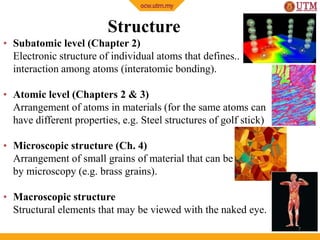
Structure
• Subatomic level (Chapter 2)
Electronic structure of individual atoms that defines..
interaction among atoms (interatomic bonding).
• Atomic level (Chapters 2 & 3)
Arrangement of atoms in materials (for the same atoms can
have different properties, e.g. Steel structures of golf stick)
• Microscopic structure (Ch. 4)
Arrangement of small grains of material that can be identified
by microscopy (e.g. brass grains).
• Macroscopic structure
Structural elements that may be viewed with the naked eye.
7
Length-scales; Units
Angstrom = 1Å = 1/10,000,000,000 meter = 10-10 m
Nanometer = 10 nm = 1/1,000,000,000 meter = 10-9 m

Micrometer = 1µm = 1/1,000,000 meter = 10-6 m
Millimeter = 1mm = 1/1,000 meter = 10-3 m

 Interatomic distance ~ a few Å
 A human hair is ~ 50 µm
 Elongated bumps that make up the data track on CD
are ~ 0.5 µm wide, minimum 0.83 µm long, and 125
nm high
8
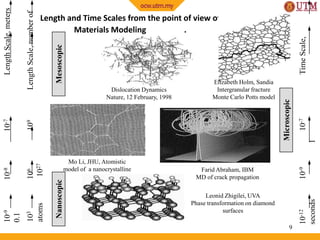
Nanoscopic

Time Scale,
1

10-7
10-9

Farid Abraham, IBM
MD of crack propagation
Leonid Zhigilei, UVA
Phase transformation on diamond
surfaces

10-12
seconds

Mo Li, JHU, Atomistic
model of a nanocrystalline

Microscopic

Mesoscopic

Length Scale, number of

Elizabeth Holm, Sandia
Intergranular fracture
Monte Carlo Potts model

109

Dislocation Dynamics
Nature, 12 February, 1998

106
1027
103
atoms

Length Scale, meters
10-7
10-8
10-9
0.1

Length and Time Scales from the point of view of
Materials Modeling
.

9
1 meter (m)

10-1 m

Cat
~ 0.3 m

100 m

0.1 m
100 mm

10-2 m

Bee
~ 15 mm

0.01 m
1 cm
10 mm

10-3 m

Monarch butterfly
~ 0.1 m

1 millimeter (mm)

Dust mite
300 m

10-4 m

Microelectronics
MEMS (MicroElectroMechanical Systems) Devices
10 -100 m wide

0.01 mm
10 m

The
Microworld

Fly ash
~ 10-20 m

Objects fashioned from
metals, ceramics, glasses, polymers ...
Head of a pin
1-2 mm

0.1 mm
100 m

10-5 m

Human hair
~ 50 m wide

Things Manmade
Progress in miniaturization

Things Natural

Red blood cells
Pollen grain

ATP synthase

10 nm
Cell membrane

DNA
~2 nm wide

Atoms of silicon
spacing ~tenths of nm

Visible
spectrum

1 micrometer ( m)

10-7 m

10-8 m

0.01 m
10 nm

Indium arsenide
quantum dot

Quantum dot array -germanium dots on silicon

0.1 m
100 nm

The
Nanoworld

Schematic, central core

Red blood cells
with white cell
~ 2-5 m

Progress in atomic-level understanding

10-6 m
Magnetic domains garnet film
11 m wide stripes

10-9 m

10-10 m

Biomotor using ATP

Self-assembled
“mushroom”

1 nanometer (nm)

0.1 nm

Quantum corral of 48 iron atoms on copper surface
positioned one at a time with an STM tip
Corral diameter 14 nm

10

The 21st century challenge -- Fashion materials at the nanoscale with desired properties and functionality

THE SCALE OF THINGS
Properties
Properties are the way the material responds to the environment and external
forces.
Mechanical properties – response to mechanical forces, strength, etc.
Electrical and magnetic properties - response electrical and magnetic fields,
conductivity, etc.
Thermal properties are related to transmission of heat and heat capacity.
Optical properties include to absorption, transmission and scattering of light.
Chemical stability in contact with the environment - corrosion resistance.

11
Classes of Materials
• Polymers
• Plastics
• Liquid crystals
• Adhesives

• Metals/Alloys
• All metals
• Mixed of different metals

• Electronic Materials /Semiconductors
• Silicon and Germanium
• III-V Compounds (e.g. GaAs)
• Photonic materials (solid-state lasers, LEDs)

• Composites
• Particulate composites (small particles embedded in a different material)
• Laminate composites (golf club shafts, tennis rackets, Damaskus swords)
• Fiber reinforced composites (e.g. fiberglass)

• Biomaterials (really using previous 5, but bio-mimetic)
• Man-made proteins (cytoskeletal protein rods or “artificial bacterium”)
• Biosensors (Au-nanoparticles stabilized by encoded DNA for anthrax detection)
• Drug-delivery colloids (polymer based)
12
General Properties of Materials
Let us classify materials according to the way the atoms are bound together

Metals: valence electrons are detached from atoms, and spread in an 'electron sea'
that "glues" the ions together. Strong, ductile, conduct electricity and heat well, are
shiny if polished.
Semiconductors: the bonding is covalent (electrons are shared between atoms).
Their electrical properties depend strongly on minute proportions of contaminants.
Examples: Si, Ge, GaAs.
Ceramics: atoms behave like either positive or negative ions, and are bound by
Coulomb forces. They are usually combinations of metals or semiconductors with
oxygen, nitrogen or carbon (oxides, nitrides, and carbides). Hard, brittle, insulators.
Examples: glass, porcelain.
Polymers: are bound by covalent forces and also by weak van der Waals forces,
and usually based on C and H. They decompose at moderate temperatures (100 –
400 C), and are lightweight. Examples: plastics rubber.

13
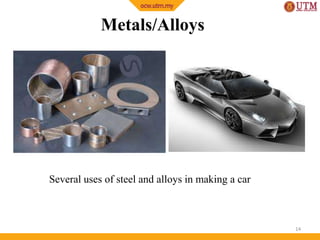
Metals/Alloys

Several uses of steel and alloys in making a car

14
Semiconductors/Devices

Micro/nano chips electronic devices
(monitor, camera, mobile phone, etc.
15
Ceramics/Composites

Microstructures of ceramics; Examples of ceramics/composites
materials ranging from household to aerospace applications.

16
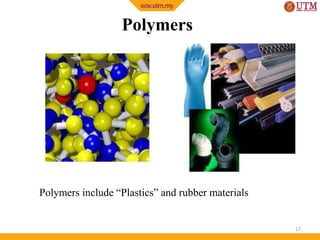
Polymers

Polymers include “Plastics” and rubber materials

17
Criteria for materials selection
•In-service conditions must be characterized
•Deterioration of properties must be evaluated
•The consideration of economics

18
Materials and Failure
Without the right material, a good engineering design is
wasted. Need the right material for the right job!
• Materials properties then are responsible for helping
achieve engineering advances.
• Failures advance understanding and material’s design.
• Some examples to introduce topics we will learn.

19
Example-World Trade Center Collapse
•
•
•
•

CNN

Tubular constructed building.
Well designed and strong.
Strong but not from buckling.
Supports lost at crash site, and the
floor supported inner and outer
tubular structures.
• Heat from burning fuel adds to
loss of structural support from
softening of steel (strength vs. T,
stress-strain behavior).
• Building “pancakes” due to
enormous buckling loads.

20
Future of materials science
Design of materials having specific desired characteristics directly from our
knowledge of atomic structure.
• Miniaturization: “Nanostructured" materials, with microstructure that has length
scales between 1 and 100 nanometers with unusual properties. Electronic
components, materials for quantum computing.
• Smart materials: airplane wings that deice themselves, buildings that stabilize
themselves in earthquakes…
• Environment-friendly materials: biodegradable or photodegradable plastics,
advances in nuclear waste processing, etc.
• Learning from Nature: shells and biological hard tissue can be as strong as the
most advanced laboratory-produced ceramics, mollusces produce biocompatible
adhesives that we do not know how to reproduce…
• Materials for lightweight batteries with high storage densities, for turbine blades
that can operate at 2500 C, room-temperature superconductors? chemical sensors
(artificial nose) of extremely high sensitivity, cotton shirts that never require
ironing…
21

Utm intro to materials science

  • 1.
    MATERIALS SCIENCE SSP 2412 INTRODUCTIONTO MATERIALS SCIENCE Prof. Dr. Samsudi Sakrani Physics Dept. Faculty of Science Universiti Teknologi Malaysia 1
  • 2.
    Introduction • Historical Perspective Stone Bronze Iron Advancedmaterials • What is Materials Science (and Engineering) ? Processing Structure Properties Performance • Classification of Materials Metals, Ceramics, Polymers, Semiconductors • Advanced Materials Electronic materials, superconductors, etc. • Modern Material's Needs, Material of Future Biodegradable materials, Nanomaterials, “Smart” materials 2
  • 3.
    Historical Perspective • Beginningof the Material Science - People began to make tools from stone – Start of the Stone Age about two million years ago. Natural materials: stone, wood, clay, skins, etc. • The Stone Age ended about 5000 years ago with introduction of Bronze in the Far East. Bronze is an alloy (a metal made up of more than one element), copper + < 25% of tin + other elements. Bronze: can be hammered or cast into a variety of shapes, can be made harder by alloying, corrode only slowly after a surface oxide film forms. 3
  • 4.
    •The Iron Agebegan about 3000 years ago and continues today. Use of iron and steel, a stronger and cheaper material changed drastically daily life of a common person. •Age of Advanced materials: throughout the Iron Age many new types of materials have been introduced (ceramic, semiconductors, polymers, composites…). Understanding of the relationship among structure, properties, processing, and performance of materials. Intelligent design of new materials. A better understanding of structure-composition-properties relations has lead to a remarkable progress in properties of materials. Example is the dramatic progress in the strength to density ratio of materials, that resulted in a wide variety of new products, from dental materials to tennis racquets. 4
  • 5.
    Strength to DensityRatio of Materials 5
  • 6.
    What is MaterialsScience? Processing Materials Optimization Loop Structure Observational Properties Material science is the investigation of the relationship among processing, structure, properties, and performance of materials. 6
  • 7.
    Structure • Subatomic level(Chapter 2) Electronic structure of individual atoms that defines.. interaction among atoms (interatomic bonding). • Atomic level (Chapters 2 & 3) Arrangement of atoms in materials (for the same atoms can have different properties, e.g. Steel structures of golf stick) • Microscopic structure (Ch. 4) Arrangement of small grains of material that can be identified by microscopy (e.g. brass grains). • Macroscopic structure Structural elements that may be viewed with the naked eye. 7
  • 8.
    Length-scales; Units Angstrom =1Å = 1/10,000,000,000 meter = 10-10 m Nanometer = 10 nm = 1/1,000,000,000 meter = 10-9 m Micrometer = 1µm = 1/1,000,000 meter = 10-6 m Millimeter = 1mm = 1/1,000 meter = 10-3 m  Interatomic distance ~ a few Å  A human hair is ~ 50 µm  Elongated bumps that make up the data track on CD are ~ 0.5 µm wide, minimum 0.83 µm long, and 125 nm high 8
  • 9.
    Nanoscopic Time Scale, 1 10-7 10-9 Farid Abraham,IBM MD of crack propagation Leonid Zhigilei, UVA Phase transformation on diamond surfaces 10-12 seconds Mo Li, JHU, Atomistic model of a nanocrystalline Microscopic Mesoscopic Length Scale, number of Elizabeth Holm, Sandia Intergranular fracture Monte Carlo Potts model 109 Dislocation Dynamics Nature, 12 February, 1998 106 1027 103 atoms Length Scale, meters 10-7 10-8 10-9 0.1 Length and Time Scales from the point of view of Materials Modeling . 9
  • 10.
    1 meter (m) 10-1m Cat ~ 0.3 m 100 m 0.1 m 100 mm 10-2 m Bee ~ 15 mm 0.01 m 1 cm 10 mm 10-3 m Monarch butterfly ~ 0.1 m 1 millimeter (mm) Dust mite 300 m 10-4 m Microelectronics MEMS (MicroElectroMechanical Systems) Devices 10 -100 m wide 0.01 mm 10 m The Microworld Fly ash ~ 10-20 m Objects fashioned from metals, ceramics, glasses, polymers ... Head of a pin 1-2 mm 0.1 mm 100 m 10-5 m Human hair ~ 50 m wide Things Manmade Progress in miniaturization Things Natural Red blood cells Pollen grain ATP synthase 10 nm Cell membrane DNA ~2 nm wide Atoms of silicon spacing ~tenths of nm Visible spectrum 1 micrometer ( m) 10-7 m 10-8 m 0.01 m 10 nm Indium arsenide quantum dot Quantum dot array -germanium dots on silicon 0.1 m 100 nm The Nanoworld Schematic, central core Red blood cells with white cell ~ 2-5 m Progress in atomic-level understanding 10-6 m Magnetic domains garnet film 11 m wide stripes 10-9 m 10-10 m Biomotor using ATP Self-assembled “mushroom” 1 nanometer (nm) 0.1 nm Quantum corral of 48 iron atoms on copper surface positioned one at a time with an STM tip Corral diameter 14 nm 10 The 21st century challenge -- Fashion materials at the nanoscale with desired properties and functionality THE SCALE OF THINGS
  • 11.
    Properties Properties are theway the material responds to the environment and external forces. Mechanical properties – response to mechanical forces, strength, etc. Electrical and magnetic properties - response electrical and magnetic fields, conductivity, etc. Thermal properties are related to transmission of heat and heat capacity. Optical properties include to absorption, transmission and scattering of light. Chemical stability in contact with the environment - corrosion resistance. 11
  • 12.
    Classes of Materials •Polymers • Plastics • Liquid crystals • Adhesives • Metals/Alloys • All metals • Mixed of different metals • Electronic Materials /Semiconductors • Silicon and Germanium • III-V Compounds (e.g. GaAs) • Photonic materials (solid-state lasers, LEDs) • Composites • Particulate composites (small particles embedded in a different material) • Laminate composites (golf club shafts, tennis rackets, Damaskus swords) • Fiber reinforced composites (e.g. fiberglass) • Biomaterials (really using previous 5, but bio-mimetic) • Man-made proteins (cytoskeletal protein rods or “artificial bacterium”) • Biosensors (Au-nanoparticles stabilized by encoded DNA for anthrax detection) • Drug-delivery colloids (polymer based) 12
  • 13.
    General Properties ofMaterials Let us classify materials according to the way the atoms are bound together Metals: valence electrons are detached from atoms, and spread in an 'electron sea' that "glues" the ions together. Strong, ductile, conduct electricity and heat well, are shiny if polished. Semiconductors: the bonding is covalent (electrons are shared between atoms). Their electrical properties depend strongly on minute proportions of contaminants. Examples: Si, Ge, GaAs. Ceramics: atoms behave like either positive or negative ions, and are bound by Coulomb forces. They are usually combinations of metals or semiconductors with oxygen, nitrogen or carbon (oxides, nitrides, and carbides). Hard, brittle, insulators. Examples: glass, porcelain. Polymers: are bound by covalent forces and also by weak van der Waals forces, and usually based on C and H. They decompose at moderate temperatures (100 – 400 C), and are lightweight. Examples: plastics rubber. 13
  • 14.
    Metals/Alloys Several uses ofsteel and alloys in making a car 14
  • 15.
    Semiconductors/Devices Micro/nano chips electronicdevices (monitor, camera, mobile phone, etc. 15
  • 16.
    Ceramics/Composites Microstructures of ceramics;Examples of ceramics/composites materials ranging from household to aerospace applications. 16
  • 17.
  • 18.
    Criteria for materialsselection •In-service conditions must be characterized •Deterioration of properties must be evaluated •The consideration of economics 18
  • 19.
    Materials and Failure Withoutthe right material, a good engineering design is wasted. Need the right material for the right job! • Materials properties then are responsible for helping achieve engineering advances. • Failures advance understanding and material’s design. • Some examples to introduce topics we will learn. 19
  • 20.
    Example-World Trade CenterCollapse • • • • CNN Tubular constructed building. Well designed and strong. Strong but not from buckling. Supports lost at crash site, and the floor supported inner and outer tubular structures. • Heat from burning fuel adds to loss of structural support from softening of steel (strength vs. T, stress-strain behavior). • Building “pancakes” due to enormous buckling loads. 20
  • 21.
    Future of materialsscience Design of materials having specific desired characteristics directly from our knowledge of atomic structure. • Miniaturization: “Nanostructured" materials, with microstructure that has length scales between 1 and 100 nanometers with unusual properties. Electronic components, materials for quantum computing. • Smart materials: airplane wings that deice themselves, buildings that stabilize themselves in earthquakes… • Environment-friendly materials: biodegradable or photodegradable plastics, advances in nuclear waste processing, etc. • Learning from Nature: shells and biological hard tissue can be as strong as the most advanced laboratory-produced ceramics, mollusces produce biocompatible adhesives that we do not know how to reproduce… • Materials for lightweight batteries with high storage densities, for turbine blades that can operate at 2500 C, room-temperature superconductors? chemical sensors (artificial nose) of extremely high sensitivity, cotton shirts that never require ironing… 21