Chapter 1 - 1
MSE 101: Introduction to Materials
Science & Engineering
Course Objective...
To introduce students to a wide range of modern
materials engineering topics.
You will learn about:
• material structure
• how structure dictates properties
• the impact of materials on society
This course will help you to:
• use materials properly
• realize new design opportunities
with materials
Chapter 1 - 2
Syllabus
Chapter 1 - 3
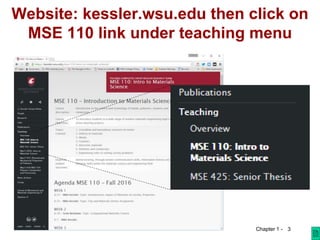
Website: kessler.wsu.edu then click on
MSE 110 link under teaching menu
Chapter 1 - 4
Introduction
• What is materials science?
• Why should we know about it?
• Materials drive our society
– Stone Age
– Bronze Age
– Iron Age
– Now?
• Silicon Age?
• Polymer Age?
Chapter 1 - 5
Theme of Materials Science
Chapter 1 - 6
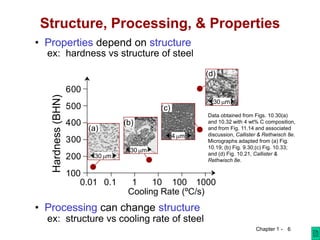
ex: hardness vs structure of steel
• Properties depend on structure
Data obtained from Figs. 10.30(a)
and 10.32 with 4 wt% C composition,
and from Fig. 11.14 and associated
discussion, Callister & Rethwisch 8e.
Micrographs adapted from (a) Fig.
10.19; (b) Fig. 9.30;(c) Fig. 10.33;
and (d) Fig. 10.21, Callister &
Rethwisch 8e.
ex: structure vs cooling rate of steel
• Processing can change structure
Structure, Processing, & Properties
Hardness
(BHN)
Cooling Rate (ºC/s)
100
200
300
400
500
600
0.01 0.1 1 10 100 1000
(d)
30 mm
(c)
4 mm
(b)
30 mm
(a)
30 mm
Chapter 1 - 7
Types of Materials
• Metals:
– Strong, ductile
– High thermal & electrical conductivity
– Opaque, reflective.
• Polymers/plastics: Covalent bonding  sharing of e’s
– Soft, ductile, low strength, low density
– Thermal & electrical insulators
– Optically translucent or transparent.
• Ceramics: ionic bonding – compounds of metallic & non-
metallic elements (oxides, carbides, nitrides, sulfides)
– Brittle, glassy, elastic
– Non-conducting (insulators)
Chapter 1 - 8
1. Pick Application Determine required Properties
Processing: changes structure and overall shape
ex: casting, sintering, vapor deposition, doping
forming, joining, annealing.
Properties: mechanical, electrical, thermal,
magnetic, optical, deteriorative.
Material: structure, composition.
2. Properties Identify candidate Material(s)
3. Material Identify required Processing
The Materials Selection Process
Chapter 1 - 9
ELECTRICAL
• Electrical Resistivity of Copper:
• Adding “impurity” atoms to Cu increases resistivity.
• Deforming Cu increases resistivity.
Adapted from Fig. 18.8, Callister &
Rethwisch 8e. (Fig. 18.8 adapted
from: J.O. Linde, Ann Physik 5, 219
(1932); and C.A. Wert and R.M.
Thomson, Physics of Solids, 2nd
edition, McGraw-Hill Company, New
York, 1970.)
T (ºC)
-200 -100 0
1
2
3
4
5
6
Resistivity,
r
(10
-8
Ohm-m)
0
Chapter 1 - 10
THERMAL
• Space Shuttle Tiles:
-- Silica fiber insulation
offers low heat conduction.
• Thermal Conductivity
of Copper:
-- It decreases when
you add zinc!
Adapted from
Fig. 19.4W, Callister
6e. (Courtesy of
Lockheed Aerospace
Ceramics Systems,
Sunnyvale, CA)
(Note: "W" denotes fig.
is on CD-ROM.)
Adapted from Fig. 19.4, Callister & Rethwisch
8e. (Fig. 19.4 is adapted from Metals Handbook:
Properties and Selection: Nonferrous alloys and
Pure Metals, Vol. 2, 9th ed., H. Baker,
(Managing Editor), American Society for Metals,
1979, p. 315.)
Composition (wt% Zinc)
Thermal
Conductivity
(W/m-K)
400
300
200
100
0
0 10 20 30 40
100mm
Adapted from chapter-
opening photograph,
Chapter 17, Callister &
Rethwisch 3e. (Courtesy
of Lockheed
Missiles and Space
Company, Inc.)
Chapter 1 - 11
MAGNETIC
• Magnetic Permeability
vs. Composition:
-- Adding 3 atomic % Si
makes Fe a better
recording medium!
Adapted from C.R. Barrett, W.D. Nix, and
A.S. Tetelman, The Principles of
Engineering Materials, Fig. 1-7(a), p. 9,
1973. Electronically reproduced
by permission of Pearson Education, Inc.,
Upper Saddle River, New Jersey.
Fig. 20.23, Callister & Rethwisch 8e.
• Magnetic Storage:
-- Recording medium
is magnetized by
recording head.
Magnetic Field
Magnetization
Fe+3%Si
Fe
Chapter 1 - 12
• Transmittance:
-- Aluminum oxide may be transparent, translucent, or
opaque depending on the material structure.
Adapted from Fig. 1.2,
Callister & Rethwisch 8e.
(Specimen preparation,
P.A. Lessing; photo by S.
Tanner.)
single crystal
polycrystal:
low porosity
polycrystal:
high porosity
OPTICAL
Chapter 1 - 13
DETERIORATIVE
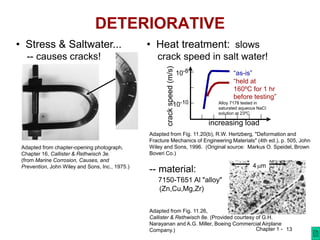
• Stress & Saltwater...
-- causes cracks!
Adapted from chapter-opening photograph,
Chapter 16, Callister & Rethwisch 3e.
(from Marine Corrosion, Causes, and
Prevention, John Wiley and Sons, Inc., 1975.) 4 mm
-- material:
7150-T651 Al "alloy"
(Zn,Cu,Mg,Zr)
Adapted from Fig. 11.26,
Callister & Rethwisch 8e. (Provided courtesy of G.H.
Narayanan and A.G. Miller, Boeing Commercial Airplane
Company.)
• Heat treatment: slows
crack speed in salt water!
Adapted from Fig. 11.20(b), R.W. Hertzberg, "Deformation and
Fracture Mechanics of Engineering Materials" (4th ed.), p. 505, John
Wiley and Sons, 1996. (Original source: Markus O. Speidel, Brown
Boveri Co.)
“held at
160ºC for 1 hr
before testing”
increasing load
crack
speed
(m/s)
“as-is”
10-10
10-8
Alloy 7178 tested in
saturated aqueous NaCl
solution at 23ºC
Chapter 1 -
Example/Demo: Environmental
Stress Cracking
14
Chapter 1 - 15
• Use the right material for the job.
• Understand the relation between properties,
structure, and processing.
• Recognize new design opportunities offered
by materials selection.
Course Goals:
SUMMARY

Week 1-day-1-2

  • 1.
    Chapter 1 -1 MSE 101: Introduction to Materials Science & Engineering Course Objective... To introduce students to a wide range of modern materials engineering topics. You will learn about: • material structure • how structure dictates properties • the impact of materials on society This course will help you to: • use materials properly • realize new design opportunities with materials
  • 2.
    Chapter 1 -2 Syllabus
  • 3.
    Chapter 1 -3 Website: kessler.wsu.edu then click on MSE 110 link under teaching menu
  • 4.
    Chapter 1 -4 Introduction • What is materials science? • Why should we know about it? • Materials drive our society – Stone Age – Bronze Age – Iron Age – Now? • Silicon Age? • Polymer Age?
  • 5.
    Chapter 1 -5 Theme of Materials Science
  • 6.
    Chapter 1 -6 ex: hardness vs structure of steel • Properties depend on structure Data obtained from Figs. 10.30(a) and 10.32 with 4 wt% C composition, and from Fig. 11.14 and associated discussion, Callister & Rethwisch 8e. Micrographs adapted from (a) Fig. 10.19; (b) Fig. 9.30;(c) Fig. 10.33; and (d) Fig. 10.21, Callister & Rethwisch 8e. ex: structure vs cooling rate of steel • Processing can change structure Structure, Processing, & Properties Hardness (BHN) Cooling Rate (ºC/s) 100 200 300 400 500 600 0.01 0.1 1 10 100 1000 (d) 30 mm (c) 4 mm (b) 30 mm (a) 30 mm
  • 7.
    Chapter 1 -7 Types of Materials • Metals: – Strong, ductile – High thermal & electrical conductivity – Opaque, reflective. • Polymers/plastics: Covalent bonding  sharing of e’s – Soft, ductile, low strength, low density – Thermal & electrical insulators – Optically translucent or transparent. • Ceramics: ionic bonding – compounds of metallic & non- metallic elements (oxides, carbides, nitrides, sulfides) – Brittle, glassy, elastic – Non-conducting (insulators)
  • 8.
    Chapter 1 -8 1. Pick Application Determine required Properties Processing: changes structure and overall shape ex: casting, sintering, vapor deposition, doping forming, joining, annealing. Properties: mechanical, electrical, thermal, magnetic, optical, deteriorative. Material: structure, composition. 2. Properties Identify candidate Material(s) 3. Material Identify required Processing The Materials Selection Process
  • 9.
    Chapter 1 -9 ELECTRICAL • Electrical Resistivity of Copper: • Adding “impurity” atoms to Cu increases resistivity. • Deforming Cu increases resistivity. Adapted from Fig. 18.8, Callister & Rethwisch 8e. (Fig. 18.8 adapted from: J.O. Linde, Ann Physik 5, 219 (1932); and C.A. Wert and R.M. Thomson, Physics of Solids, 2nd edition, McGraw-Hill Company, New York, 1970.) T (ºC) -200 -100 0 1 2 3 4 5 6 Resistivity, r (10 -8 Ohm-m) 0
  • 10.
    Chapter 1 -10 THERMAL • Space Shuttle Tiles: -- Silica fiber insulation offers low heat conduction. • Thermal Conductivity of Copper: -- It decreases when you add zinc! Adapted from Fig. 19.4W, Callister 6e. (Courtesy of Lockheed Aerospace Ceramics Systems, Sunnyvale, CA) (Note: "W" denotes fig. is on CD-ROM.) Adapted from Fig. 19.4, Callister & Rethwisch 8e. (Fig. 19.4 is adapted from Metals Handbook: Properties and Selection: Nonferrous alloys and Pure Metals, Vol. 2, 9th ed., H. Baker, (Managing Editor), American Society for Metals, 1979, p. 315.) Composition (wt% Zinc) Thermal Conductivity (W/m-K) 400 300 200 100 0 0 10 20 30 40 100mm Adapted from chapter- opening photograph, Chapter 17, Callister & Rethwisch 3e. (Courtesy of Lockheed Missiles and Space Company, Inc.)
  • 11.
    Chapter 1 -11 MAGNETIC • Magnetic Permeability vs. Composition: -- Adding 3 atomic % Si makes Fe a better recording medium! Adapted from C.R. Barrett, W.D. Nix, and A.S. Tetelman, The Principles of Engineering Materials, Fig. 1-7(a), p. 9, 1973. Electronically reproduced by permission of Pearson Education, Inc., Upper Saddle River, New Jersey. Fig. 20.23, Callister & Rethwisch 8e. • Magnetic Storage: -- Recording medium is magnetized by recording head. Magnetic Field Magnetization Fe+3%Si Fe
  • 12.
    Chapter 1 -12 • Transmittance: -- Aluminum oxide may be transparent, translucent, or opaque depending on the material structure. Adapted from Fig. 1.2, Callister & Rethwisch 8e. (Specimen preparation, P.A. Lessing; photo by S. Tanner.) single crystal polycrystal: low porosity polycrystal: high porosity OPTICAL
  • 13.
    Chapter 1 -13 DETERIORATIVE • Stress & Saltwater... -- causes cracks! Adapted from chapter-opening photograph, Chapter 16, Callister & Rethwisch 3e. (from Marine Corrosion, Causes, and Prevention, John Wiley and Sons, Inc., 1975.) 4 mm -- material: 7150-T651 Al "alloy" (Zn,Cu,Mg,Zr) Adapted from Fig. 11.26, Callister & Rethwisch 8e. (Provided courtesy of G.H. Narayanan and A.G. Miller, Boeing Commercial Airplane Company.) • Heat treatment: slows crack speed in salt water! Adapted from Fig. 11.20(b), R.W. Hertzberg, "Deformation and Fracture Mechanics of Engineering Materials" (4th ed.), p. 505, John Wiley and Sons, 1996. (Original source: Markus O. Speidel, Brown Boveri Co.) “held at 160ºC for 1 hr before testing” increasing load crack speed (m/s) “as-is” 10-10 10-8 Alloy 7178 tested in saturated aqueous NaCl solution at 23ºC
  • 14.
    Chapter 1 - Example/Demo:Environmental Stress Cracking 14
  • 15.
    Chapter 1 -15 • Use the right material for the job. • Understand the relation between properties, structure, and processing. • Recognize new design opportunities offered by materials selection. Course Goals: SUMMARY