Piezoelectric
Materials
Direct Piezoelectric Effect
Piezoelectric Material will generate electric potential
when subjected to some kind of mechanical stress.
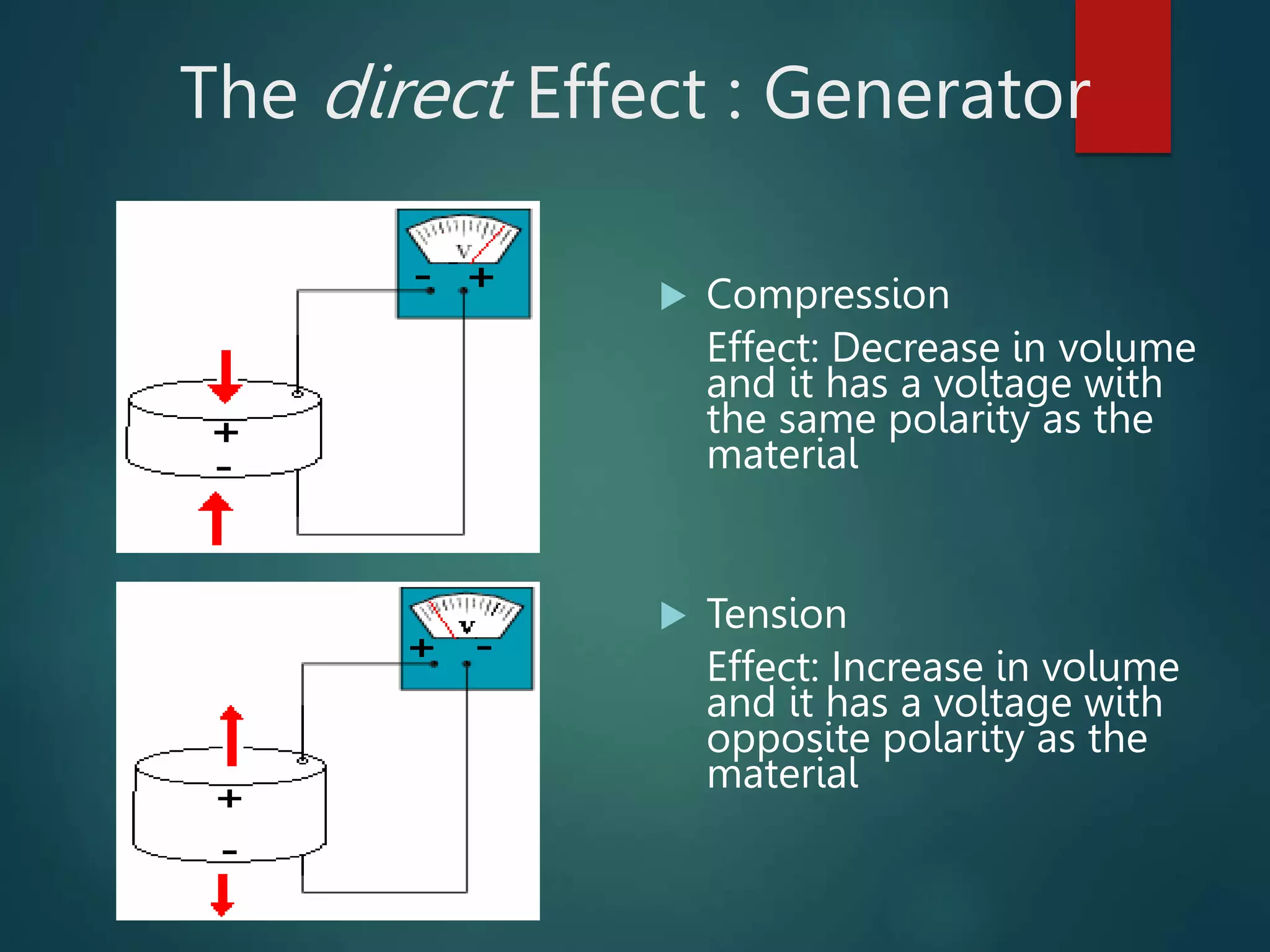
The direct Effect : Generator
 Compression
Effect: Decrease in volume
and it has a voltage with
the same polarity as the
material
 Tension
Effect: Increase in volume
and it has a voltage with
opposite polarity as the
material
F
F
Inverse Piezoelectric Effect
If the piezoelectric material is exposed to an electric
field (voltage) it consequently lengthens or shortens
proportional to the voltage.
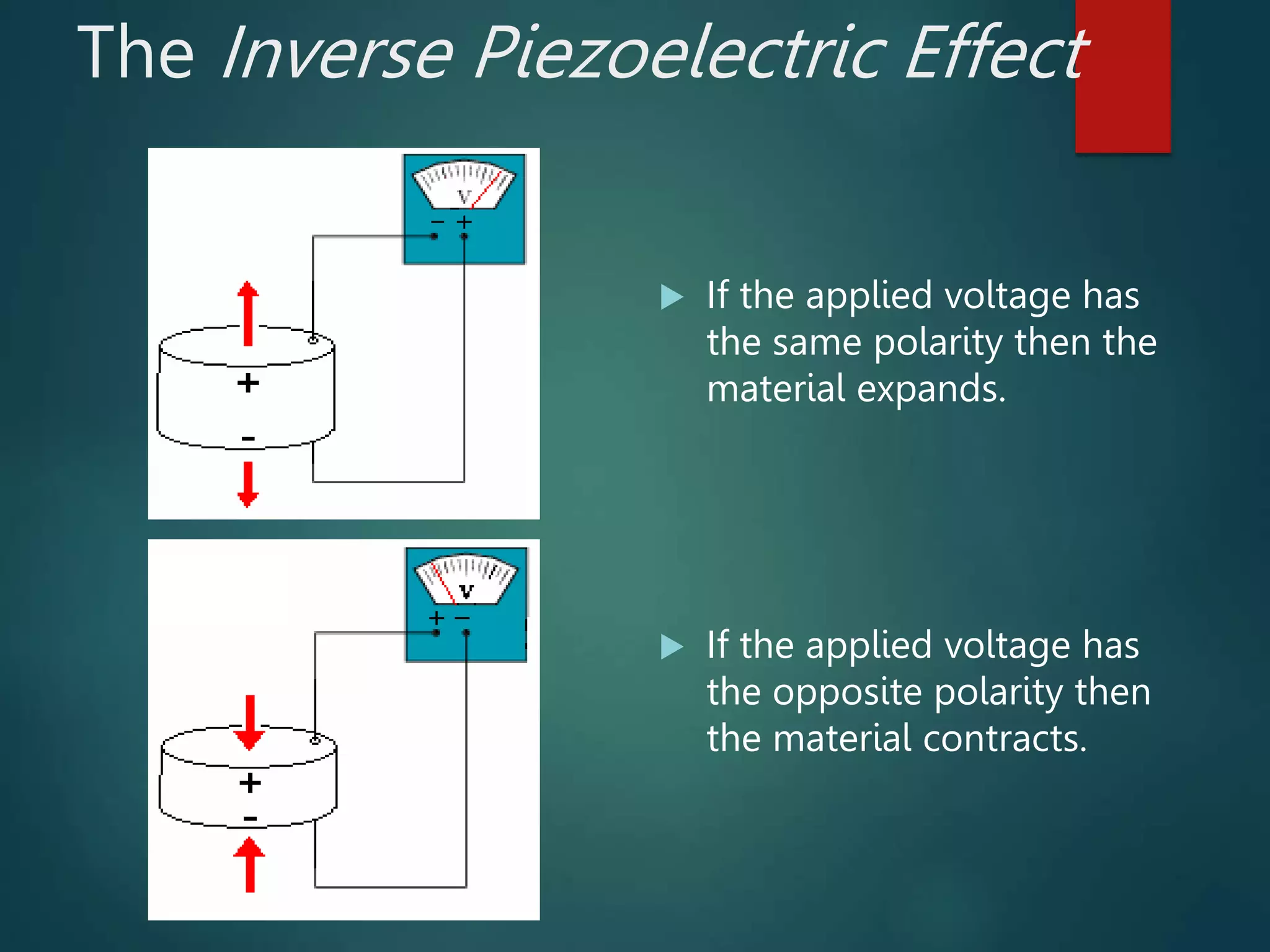
The Inverse Piezoelectric Effect
 If the applied voltage has
the same polarity then the
material expands.
 If the applied voltage has
the opposite polarity then
the material contracts.
The History of Piezo
 The name Piezo
originates from the
Greek word piezein,
which means to
squeeze or press.
 The piezoelectric
effect was first proven
in 1880 by the
brothers Pierre and
Jacques Curie.
Developing theories…
 Pierre and Jacques Curie predicted and
demonstrated the piezoelectric effect using tinfoil,
glue, wire, magnets, and a jeweler’s saw.
 They showed that crystals of tourmaline, quartz,
topaz, cane sugar, and Rochelle salt generate
electrical polarization from mechanical stress.
 The converse effect was mathematically derived by
Gabriel Lippman in 1881 using fundamental
thermodynamic principles and was later
experimentally confirmed by the Curies.
How are Piezoelectric
ceramics made?
 Fine powders of the component metal oxides are
mixed in specific proportions, then heated to
form a uniform powder.
 The powder is mixed with an organic binder and
is formed into structural elements.
 The elements are fired according to a specific
time and temperature program, during which the
powder particles sinter and the material attains a
dense crystalline structure.
 The elements are cooled, then shaped or trimmed
to specifications. Electrodes are applied to a
conducting material, which is connected to the
elements.
Crystal Structure and
Dipole Moments
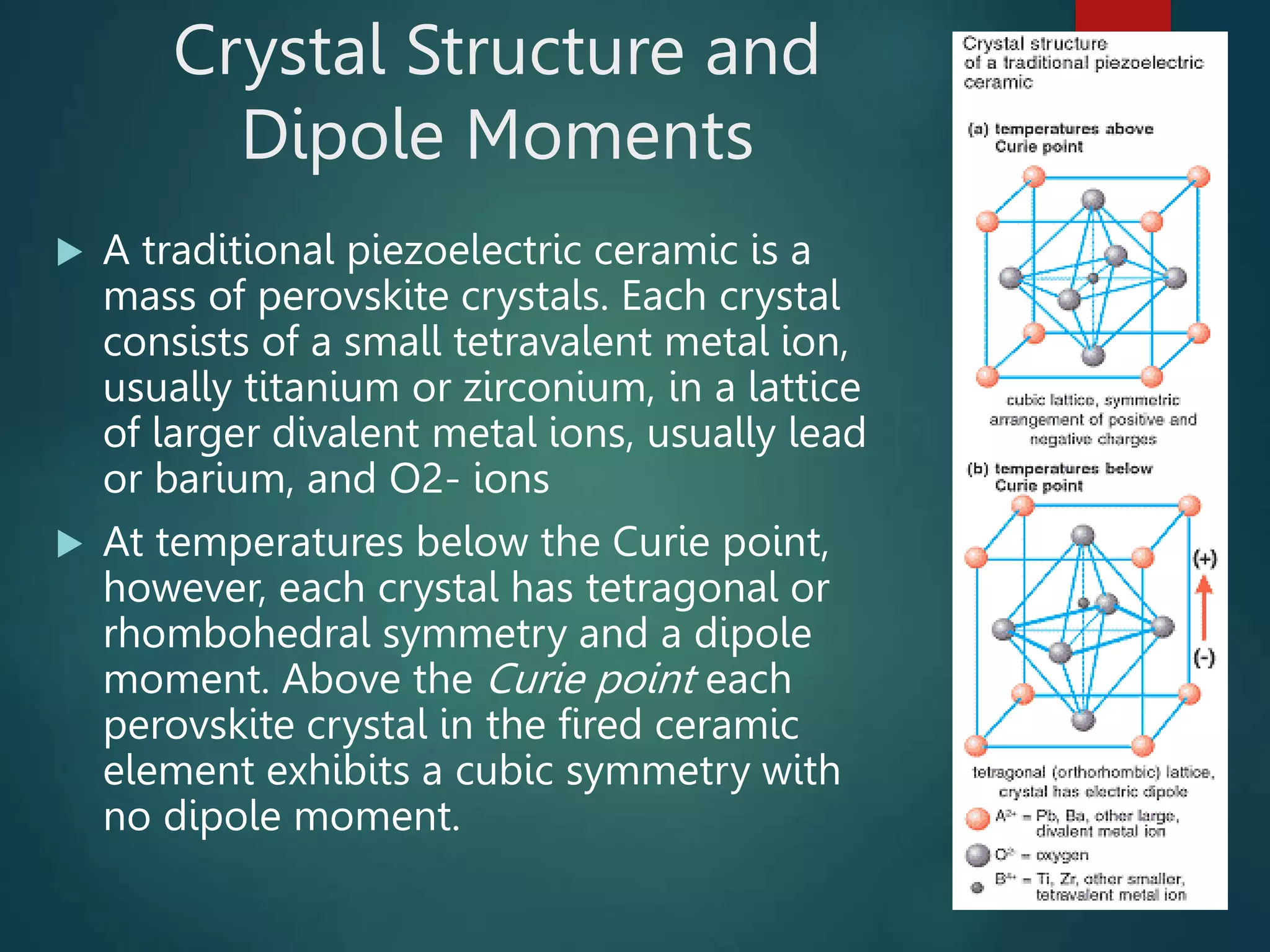
 A traditional piezoelectric ceramic is a
mass of perovskite crystals. Each crystal
consists of a small tetravalent metal ion,
usually titanium or zirconium, in a lattice
of larger divalent metal ions, usually lead
or barium, and O2- ions
 At temperatures below the Curie point,
however, each crystal has tetragonal or
rhombohedral symmetry and a dipole
moment. Above the Curie point each
perovskite crystal in the fired ceramic
element exhibits a cubic symmetry with
no dipole moment.
Polarizing Piezoelectric Material
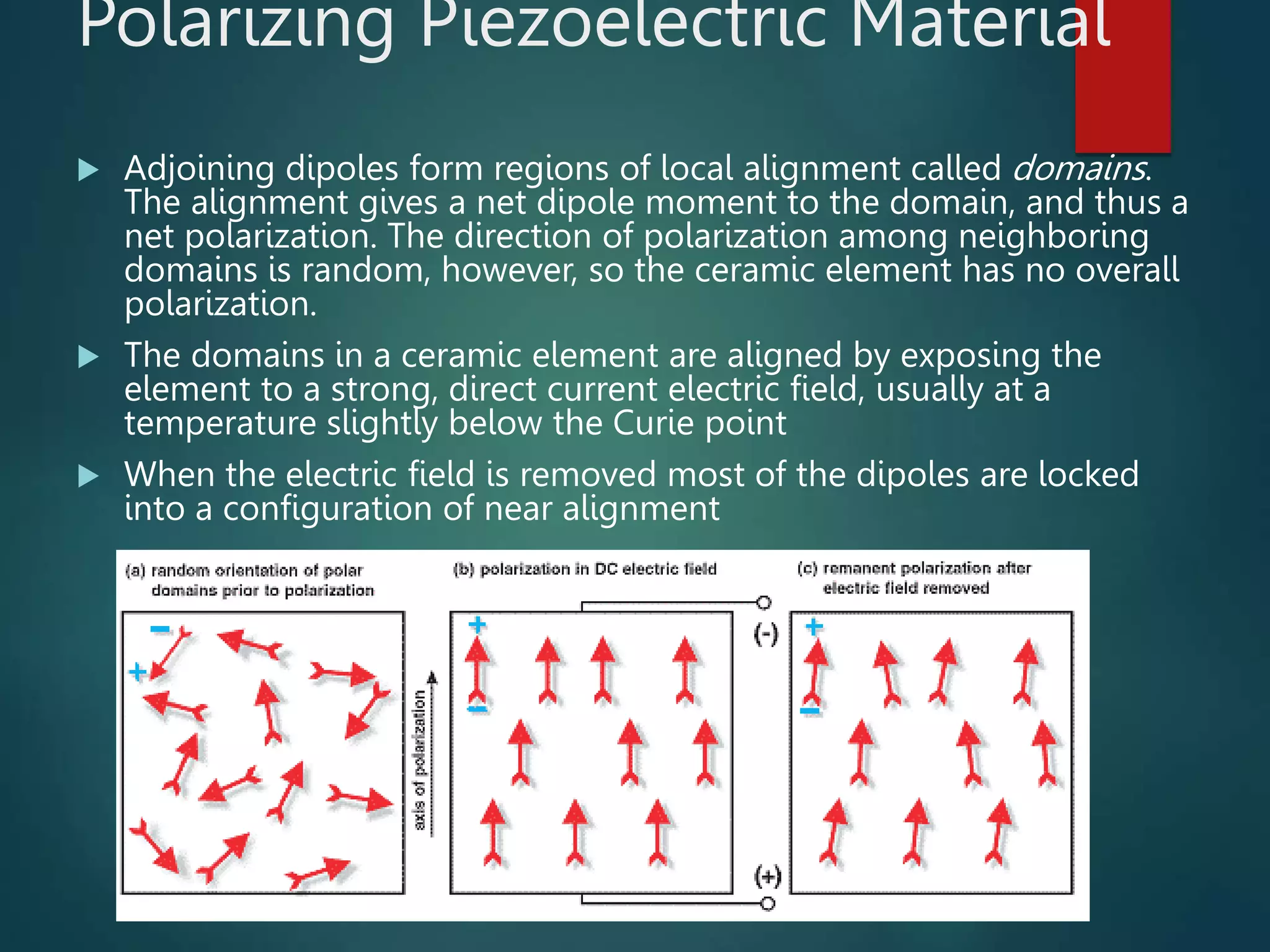
 Adjoining dipoles form regions of local alignment called domains.
The alignment gives a net dipole moment to the domain, and thus a
net polarization. The direction of polarization among neighboring
domains is random, however, so the ceramic element has no overall
polarization.
 The domains in a ceramic element are aligned by exposing the
element to a strong, direct current electric field, usually at a
temperature slightly below the Curie point
 When the electric field is removed most of the dipoles are locked
into a configuration of near alignment
Types of Piezoelectric
Materials
 Naturally occurring crystals:
Berlinite (AlPO4), cane sugar, Quartz, Rochelle salt, Topaz,
Tourmaline Group Minerals, and dry bone (apatite crystals)
 Man-made crystals:
Gallium orthophosphate (GaPO4), Langasite (La3Ga5SiO14)
 Man-made ceramics:
Barium titanate (BaTiO3), Lead titanate (PbTiO3), Lead zirconate
titanate (Pb[ZrxTi1-x]O3 0<x<1) - More commonly known as PZT,
Potassium niobate (KNbO3), Lithium niobate (LiNbO3), Lithium
tantalate (LiTaO3), Sodium tungstate (NaxWO3), Ba2NaNb5O5,
Pb2KNb5O15
 Polymers:
Polyvinylidene fluoride (PVDF)
Sonic and Ultrasonic Applications
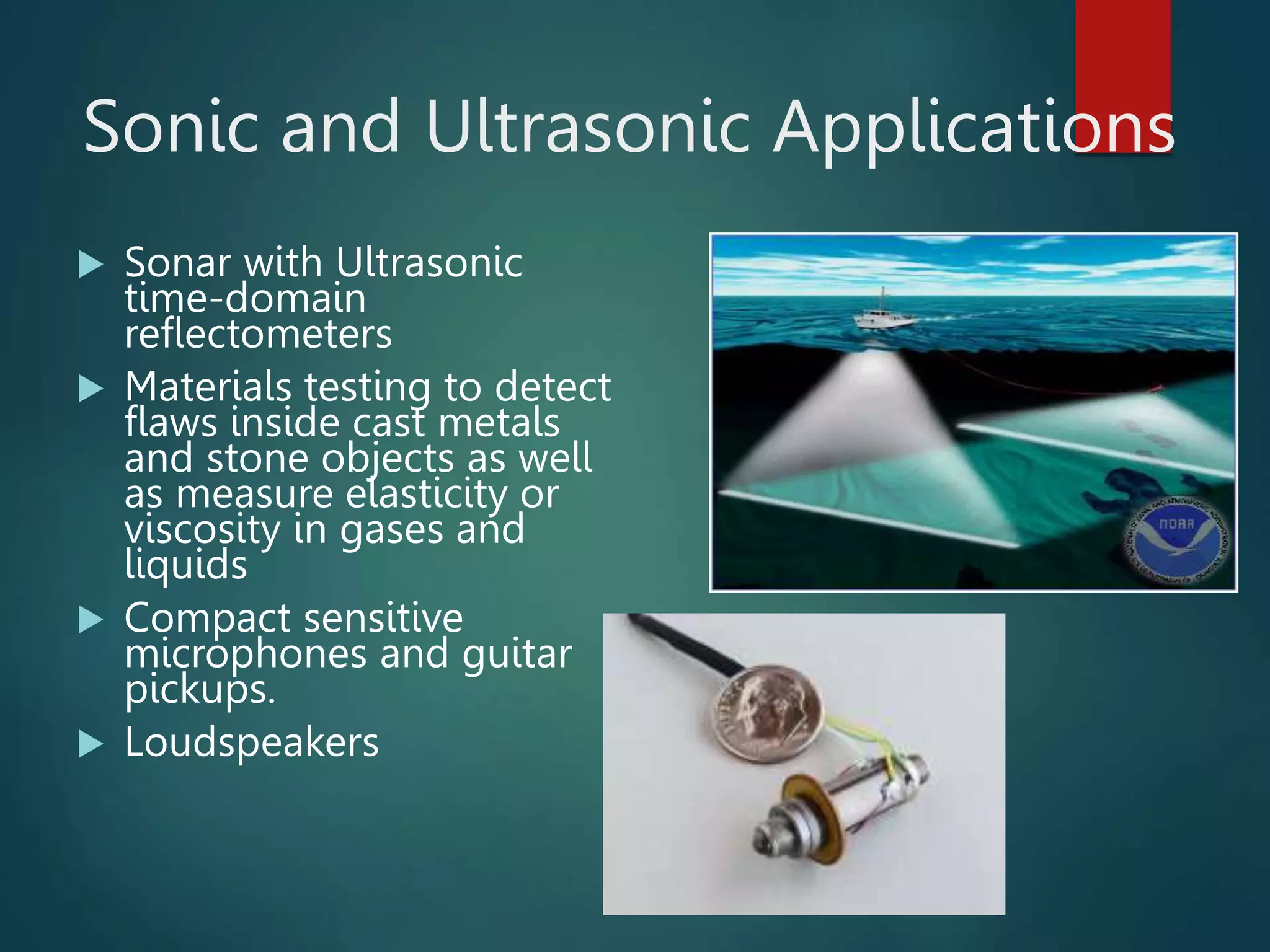
 Sonar with Ultrasonic
time-domain
reflectometers
 Materials testing to detect
flaws inside cast metals
and stone objects as well
as measure elasticity or
viscosity in gases and
liquids
 Compact sensitive
microphones and guitar
pickups.
 Loudspeakers
Pressure Applications
 Transient pressure measurement to
study explosives, internal combustion
engines (knock sensors), and any
other vibrations, accelerations, or
impacts.
 Piezoelectric microbalances are used
as very sensitive chemical and
biological sensors.
 Transducers are used in electronic
drum pads to detect the impact of the
drummer's sticks.
 Energy Harvesting from impact on the
ground
 Atomic force and scanning tunneling
microscopes.
 Electric igniters and cigarette lighters
Consumer Electronics Applications
 Quartz crystals resonators as
frequency stabilizers for
oscillators in all computers.
 Phonograph pick-ups
 Accelerometers: In a
piezoelectric accelerometer a
mass is attached to a spring
that is attached to a
piezoelectric crystal. When
subjected to vibration the
mass compresses and
stretches the piezo electric
crystal. (iPhone)
Motor Applications
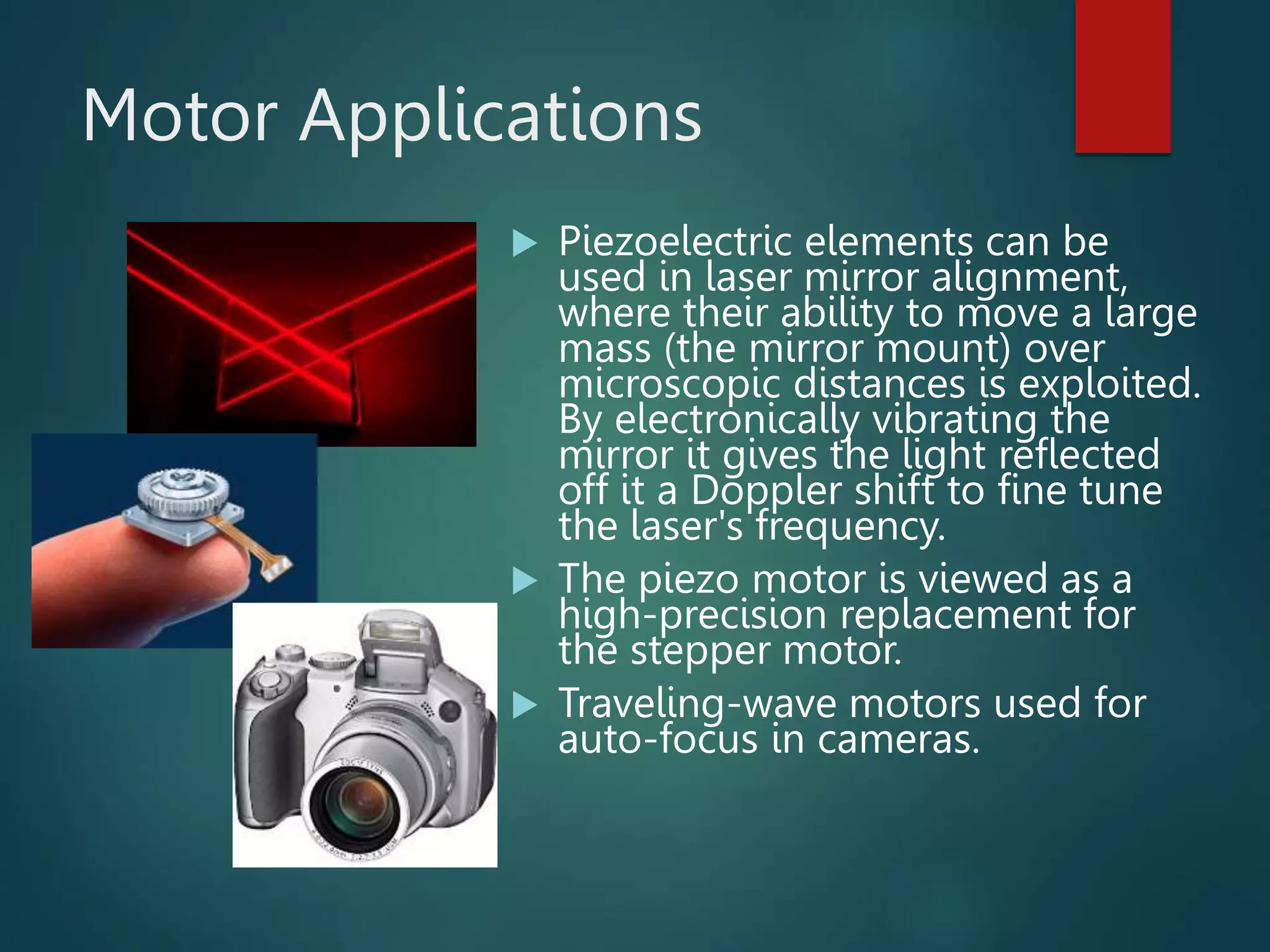
 Piezoelectric elements can be
used in laser mirror alignment,
where their ability to move a large
mass (the mirror mount) over
microscopic distances is exploited.
By electronically vibrating the
mirror it gives the light reflected
off it a Doppler shift to fine tune
the laser's frequency.
 The piezo motor is viewed as a
high-precision replacement for
the stepper motor.
 Traveling-wave motors used for
auto-focus in cameras.

Piezo-electric Materials.ppt

  • 1.
  • 2.
    Direct Piezoelectric Effect PiezoelectricMaterial will generate electric potential when subjected to some kind of mechanical stress.
  • 3.
    The direct Effect: Generator  Compression Effect: Decrease in volume and it has a voltage with the same polarity as the material  Tension Effect: Increase in volume and it has a voltage with opposite polarity as the material F F
  • 4.
    Inverse Piezoelectric Effect Ifthe piezoelectric material is exposed to an electric field (voltage) it consequently lengthens or shortens proportional to the voltage.
  • 5.
    The Inverse PiezoelectricEffect  If the applied voltage has the same polarity then the material expands.  If the applied voltage has the opposite polarity then the material contracts.
  • 6.
    The History ofPiezo  The name Piezo originates from the Greek word piezein, which means to squeeze or press.  The piezoelectric effect was first proven in 1880 by the brothers Pierre and Jacques Curie.
  • 7.
    Developing theories…  Pierreand Jacques Curie predicted and demonstrated the piezoelectric effect using tinfoil, glue, wire, magnets, and a jeweler’s saw.  They showed that crystals of tourmaline, quartz, topaz, cane sugar, and Rochelle salt generate electrical polarization from mechanical stress.  The converse effect was mathematically derived by Gabriel Lippman in 1881 using fundamental thermodynamic principles and was later experimentally confirmed by the Curies.
  • 8.
    How are Piezoelectric ceramicsmade?  Fine powders of the component metal oxides are mixed in specific proportions, then heated to form a uniform powder.  The powder is mixed with an organic binder and is formed into structural elements.  The elements are fired according to a specific time and temperature program, during which the powder particles sinter and the material attains a dense crystalline structure.  The elements are cooled, then shaped or trimmed to specifications. Electrodes are applied to a conducting material, which is connected to the elements.
  • 9.
    Crystal Structure and DipoleMoments  A traditional piezoelectric ceramic is a mass of perovskite crystals. Each crystal consists of a small tetravalent metal ion, usually titanium or zirconium, in a lattice of larger divalent metal ions, usually lead or barium, and O2- ions  At temperatures below the Curie point, however, each crystal has tetragonal or rhombohedral symmetry and a dipole moment. Above the Curie point each perovskite crystal in the fired ceramic element exhibits a cubic symmetry with no dipole moment.
  • 10.
    Polarizing Piezoelectric Material Adjoining dipoles form regions of local alignment called domains. The alignment gives a net dipole moment to the domain, and thus a net polarization. The direction of polarization among neighboring domains is random, however, so the ceramic element has no overall polarization.  The domains in a ceramic element are aligned by exposing the element to a strong, direct current electric field, usually at a temperature slightly below the Curie point  When the electric field is removed most of the dipoles are locked into a configuration of near alignment
  • 11.
    Types of Piezoelectric Materials Naturally occurring crystals: Berlinite (AlPO4), cane sugar, Quartz, Rochelle salt, Topaz, Tourmaline Group Minerals, and dry bone (apatite crystals)  Man-made crystals: Gallium orthophosphate (GaPO4), Langasite (La3Ga5SiO14)  Man-made ceramics: Barium titanate (BaTiO3), Lead titanate (PbTiO3), Lead zirconate titanate (Pb[ZrxTi1-x]O3 0<x<1) - More commonly known as PZT, Potassium niobate (KNbO3), Lithium niobate (LiNbO3), Lithium tantalate (LiTaO3), Sodium tungstate (NaxWO3), Ba2NaNb5O5, Pb2KNb5O15  Polymers: Polyvinylidene fluoride (PVDF)
  • 12.
    Sonic and UltrasonicApplications  Sonar with Ultrasonic time-domain reflectometers  Materials testing to detect flaws inside cast metals and stone objects as well as measure elasticity or viscosity in gases and liquids  Compact sensitive microphones and guitar pickups.  Loudspeakers
  • 13.
    Pressure Applications  Transientpressure measurement to study explosives, internal combustion engines (knock sensors), and any other vibrations, accelerations, or impacts.  Piezoelectric microbalances are used as very sensitive chemical and biological sensors.  Transducers are used in electronic drum pads to detect the impact of the drummer's sticks.  Energy Harvesting from impact on the ground  Atomic force and scanning tunneling microscopes.  Electric igniters and cigarette lighters
  • 14.
    Consumer Electronics Applications Quartz crystals resonators as frequency stabilizers for oscillators in all computers.  Phonograph pick-ups  Accelerometers: In a piezoelectric accelerometer a mass is attached to a spring that is attached to a piezoelectric crystal. When subjected to vibration the mass compresses and stretches the piezo electric crystal. (iPhone)
  • 15.
    Motor Applications  Piezoelectricelements can be used in laser mirror alignment, where their ability to move a large mass (the mirror mount) over microscopic distances is exploited. By electronically vibrating the mirror it gives the light reflected off it a Doppler shift to fine tune the laser's frequency.  The piezo motor is viewed as a high-precision replacement for the stepper motor.  Traveling-wave motors used for auto-focus in cameras.