Introduction to functionalceramic
materials. Structure, properties,
preparation and applications
Vincenzo Buscaglia
Istituto per l’Energetica e le Interfasi
Consiglio Nazionale delle Ricerche
Via De Marini 6, 16149 Genoa
v.buscaglia@ge.ieni.cnr.it
2.
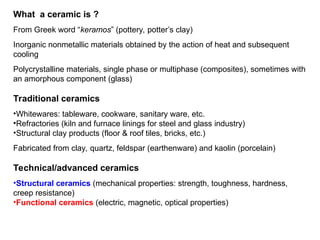
What a ceramicis ?
From Greek word “keramos” (pottery, potter’s clay)
Inorganic nonmetallic materials obtained by the action of heat and subsequent
cooling
Polycrystalline materials, single phase or multiphase (composites), sometimes with
an amorphous component (glass)
Traditional ceramics
•Whitewares: tableware, cookware, sanitary ware, etc.
•Refractories (kiln and furnace linings for steel and glass industry)
•Structural clay products (floor & roof tiles, bricks, etc.)
Fabricated from clay, quartz, feldspar (earthenware) and kaolin (porcelain)
Technical/advanced ceramics
•Structural ceramics (mechanical properties: strength, toughness, hardness,
creep resistance)
•Functional ceramics (electric, magnetic, optical properties)
3.
Ceramic Si3N4 bearingparts
Radial rotor made from Si3N4
for a gas turbine engine
The Porsche Carrera GT's
silicon carbide disk brake
Two Kyocera ceramic knives
(Y:ZrO2)
Ceramic body armour plates
(Al2O3, SiC)
Structural ceramics
4.
Functionality Material Applications
ResistorsSiC, MoSi2, LaCrO3 Heating elements for high temperature
furnaces
Thermistors
(NTCR & PTCR)
Spinels
BaTiO3
Temperature sensors, self-regulating
heating elements
Dielectrics with very low
losses (r = 3 -10)
Al2O3, AlN,
cordierite
Substrates for electronic circuits and
chip packaging
Dielectrics for microwave
applications (r = 30-80)
BaTi4O9,
Zr(Ti,Sn)O4,
BaMg1/3Ta2/3O3,
(Ba,Sr)TiO3,
MW resonators, filters and antennas for
mobile communications and GPS
devices, tunable MW devices
Temperature stable dielectrics
(r 100)
CaTiO3, BaO-
Nd2O3-TiO2
Capacitors with temperature-
independent capacitance
Dielectrics with very high
dielectric constant (r 3000)
BaTiO3 Multilayer ceramic capacitors
Piezoelectric ceramics Pb(Zr,Ti)O3 (PZT) Transducers, actuators and resonators
Pyroelectric ceramics Pb(Zr,Ti)O3 IR radiation detection and imaging
Functional ceramics
5.
Functionality Material Applications
Ferroelectric
ceramics
Pb(Zr,Ti)O3
SrBi2Ta2O9
Ferroelectricmemories (FeRAMs)
Electrostrictive
ceramics
PbMg1/3Nb2/3O3 -PbTiO3
(PMN-PT)
Actuators
Magnetic ceramics Spinels (Ni,Zn)Fe2O4
BaFe12O19
Y3Fe5O12 (YIG)
Inductors
Permanent magnets
Microwave devices (radars)
Ionic conductors Y:ZrO2 (YSZ)
Gd:CeO2
β-alumina
Electrolytes for solid-oxide fuel cells
(SOFCs), oxygen sensors
Na-Batteries
Superconductors YBa2Cu3O7-x (YBCO)
MgB2
Superconducting cables for magnets
Transparent
ceramics
Al2O3, MgAl2O4, Y3Al5O12
(YAG)
Phosphors, optical materials for lenses
and laser systems, nose cones for heat-
seeking missiles, high-pressure sodium
street lamps
Optoelectronic
materials
LiNbO3
PLZT
Waveguides, frequency doublers,
voltage-controlled optical switches,
modulators
Functional ceramics
6.
Thick (left) andthin (right) substrates (alumina)
Pressed and extruded parts (alumina, mullite, zirconia)
Ferrites cores Microwave dielectric components
Outlook of thecourse
Introduction. Why a course on functional ceramics? (Introduction.ppt)
Processing of ceramic materials: forming and sintering (Processing.ppt).
Structure and properties of grain boundaries. Nanoceramics (GrainBoundaries.ppt).
Ceramics for electronics: ferroelectric and piezoelectric ceramics, dielectrics with
high dielectric constants (BaTiO3, PbZrxTi1-xO3, (K,Na)NbO3)
(Ferroelectrics.ppt, Piezoelectrics.ppt)
-Multilayer ceramic capacitors. Miniaturization of devices and related issues.
-Piezoelectric actuators and transducers.
-Lead-free materials.
Multiferroic materials (BiFeO3, magnetoelectric composites): a challenge for
materials science. (Multiferroics.ppt)
Ceramics for energy: (SOFC.ppt, MIEC.ppt)
-Ionic and mixed high-temperature conductors (Y:ZrO2, Gd:CeO2, (La,Sr)MnO3)
-Solid-oxide fuel cells.
12.
Required background
Generalbackground in physics, chemistry and materials science.
Knowledge of most common crystal structures (fluorite, spinel, perovskite).
Perovskites.ppt
Defects and defect chemistry in oxides, extended defects, doping, p- and n- type
semicondutors, defect chemistry and electrical conductivity.
Defects.ppt
Electric and dielectric properties of crystalline solids: polarization, complex
dielectric permittivity, ac dielectric properties, impedance, dielectric relaxation.
Dielectrics.ppt
Fundamentals of solid-state magnetism
13.
Suggested readings
Books
A.J.Moulson & J.M. Herbert, Electroceramics, Chapman & Hall.
W.D. Kingery, H.K. Bowen, D.R. Uhlmann, Introduction to Ceramics, John Wiley & Sons.
Review papers
F. Ernst, O. Kienzle and M. Rühle, Structure and Composition of Grain Boundaries in Ceramics, J.
Europ. Ceram. Soc. 19,665-673 (1999).
S. von Alfthan et al., The Structure of Grain Boundaries in Strontium Titanate: Theory, Simulation and
Electron Microscopy, Annu. Rev. Mater. Res. 40,557–99 (2010).
G. H. Haertling, Ferroelectric Ceramics: History and Technology, J. Am. Ceram. Soc. 82,797–818 (1999).
D. Damjanovic, Ferroelectric, dielectric and piezoelectric properties of ferroelectric thin films and
ceramics, Rep. Prog. Phys. 61,1267–1324 (1998).
L. Jin, F. Li, S. Zhang, Decoding the Fingerprint of Ferroelectric Loops: Comprehension of the Material
Properties and Structures, J. Am. Ceram. Soc. 97,1–27 (2014)
A.K. Tagantsev et al., Ferroelectric Materials for Microwave Tunable Applications, J. Electroceramics 11,
5–66 (2003).
S. Zhang & F. Li, High performance ferroelectric relaxor-PbTiO3 single crystals: Status and perspective,
J. Appl. Phys. 111,031301 (2012).
J. Rodel et al., Perspective on the Development of Lead-free Piezoceramics, J. Am. Ceram. Soc. 92,
1153-1177 (2009)
T. R. Shrout & S. J. Zhang, Lead-free piezoelectric ceramics: Alternatives for PZT?, J. Electroceram.
19,111–124 (2007)
14.
C.A. Randallet al., High Strain Piezoelectric Multilayer Actuators—A Material Science and Engineering
Challenge, J. Electroceramics 14,177-191 (2005).
M. Fiebig, Revival of the Magnetoelectric Effect, J. Phys. D.: Appl. Phys. 38,R123-R152 (2005)
C.A.F. Vaz et al., Magnetoelectric Coupling Effects in Multiferroic Complex Oxide Composite Structures,
Adv. Mat. 22,2900-2918 (2010).
J. van den Brink, D. I. Khomskii, Multiferroicity due to charge ordering, J. Phys.: Condens. Matter
20,434217 (2008)
M. Winter & M.J. Brodd, What Are Batteries, Fuel Cells, and Supercapacitors?, Chem. Rev. 104,4245-
4269 (2004).
A. J. Jacobson, Materials for Solid Oxide Fuel Cells, Chem. Mater. 22,660-674 (2010).
A. Orera & P. R. Slater, New Chemical Systems for Solid Oxide Fuel Cells, Chem. Mater. 22,675-690
(2010).
J. Sunarso et al., Mixed ionic–electronic conducting (MIEC) ceramic-based membranes for oxygen
separation, J. Membrane Science 320,13–41 (2008)
S. Baumann et al., Manufacturing strategies for asymmetric ceramic membranes for efficient separation
of oxygen from air, J. Europ. Ceram. Soc. 33,1251-1261 (2013).
A. Feteira, Negative Temperature Coefficient Resistance (NTCR) Ceramic Thermistors: An Industrial
Perspective, J. Am. Ceram. Soc., 92, 967–983 (2009).
W. Wersing, Microwave ceramics for resonators and filters, Current Opinion in Solid State & Materials
Science 1,715-731 (1996.)
I. Reaney & D. Iddles, Microwave Dielectric Ceramics for Resonators and Filters in Mobile Phone
Networks, J. Am. Ceram. Soc. 89,2063–2072 (2006).