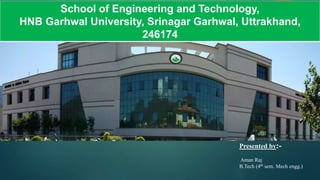
School of Engineering and Technology,
HNB Garhwal University, Srinagar Garhwal, Uttrakhand,
246174
Presented by:-
Aman Raj
B.Tech (4th sem. Mech engg.)
Engineering Materials &
Recent Advances
Engineering materials:-
All the substances/ materials used in engineering field are termed as
engineering materials.
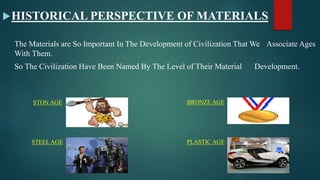
HISTORICAL PERSPECTIVE OF MATERIALS
The Materials are So Important In The Development of Civilization That We Associate Ages
With Them.
So The Civilization Have Been Named By The Level of Their Material Development.
BRONZE AGE
PLASTIC AGESTEEL AGE
STON AGE
Properties of These Materials
 Mechanical properties :-
► Strength
► Ductility
► Toughness
► Hardness
► Brittleness
► Creep
► Fatigue
► Impacts Loads
► Elasticity Etc.
 Physical Properties
 Chemical Properties
 Thermal properties
 Manufacturing properties:-
► Forming(cold, hot..)
► Casting
► Machining
► Welding
►Finishing
► Joining process
► Powder methods
MODERN PERSPECTIVE OF MATERIALS:
Civil Engineering Mechanical Engineering Electrical Engineering
●Cement Concrete(CC) To
Polymer Reinforced
Concrete(PRC)
●Cork Walls (7 Times Faster
Then Normal Construction)
●Cltra Rope(made Of Carbon
Fibre )
●Pure Metals To Duplex Stainless
Steel(DSS).
●Spark Ignition 50cc Engine
With 2 Stroke Switching During
Its Operation.
●Roll Acted Bearing.
●Quarter Valves System For
Gasoline And Diesel Engines
etc.
●Green Energy Electrical
Power
Converter.
●Smart Electrical Grids.
●Eye Tracking Technology.
●Wireless Wearable Tech.
●Personal Flying Cars.
●40 Gb Wi-fi etc.
Importance of Material Science In Inter Disciplinary
Subjects:
The Study Of Inter Disciplinary Subjects Like Metallurgy, Ceramics, Polymers
Science, Manufacturing Technology Etc. Also Needs The Concepts, Rules &
Observation Of Material Science.
● A Metal As Alloying Element In An Alloy.
● To Find The Utility Of Clay With Graphite To Make A Pencil Etc…
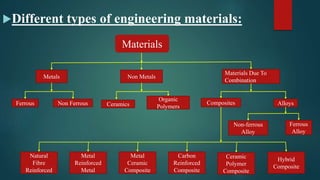
Different types of engineering materials:
Materials
Metals Non Metals
Materials Due To
Combination
Ferrous Non Ferrous Ceramics
Organic
Polymers
Composites Alloys
Non-ferrous
Alloy
Ferrous
Alloy
Hybrid
Composite
Ceramic
Polymer
Composite
Carbon
Reinforced
Composite
Metal
Ceramic
Composite
Metal
Reinforced
Metal
Natural
Fibre
Reinforced
Materials And Their Properties:
Metals Non-ferrous Ceramics Organic
Polymers
Alloys Composites
●Hard
●High Density
●High Tensile
Strength
●High Melting
Point
●Good
Conductor Of
Heat And
Electricity.
●Do Not Contain
Iron And
Carbon In
Appreciable
Amount.
●Low Weight
●Resistance To
Corrosion
●High Strength
●High Fracture
Toughness
●High
Hardness
●Excellent
Wear
Resistance
●Anti Static
●Low Density
●Low
Coefficient Of
Friction
●Good
Corrosion
Resistance
●Poor Tensile
Strength
●Economical
●Good Mould
Ability
●Better Then
Normal
Metals
●High
Toughness
●Mostly Used
Then Pure
Metals.
●Light Weight
●Fire Resistance
●Design Flexibility
●Low Thermal
Conductivity
●Manufacturing
Economy.
Structure sensitive properties Structure-insensitive properties
● Yield Stress.
● Creep Strength.
● Fracture Strength.
● Electrical Conductivity.
●Semiconducting Properties.
● Density.
● Specific heat.
● Melting point.
● Elastic constant.
● Coefficient of thermal expansion.
Different Levels Of Materials Structure
▄ Macro Structure
The Macro Structure Can Be
Observed With Naked Eyes,
Using An Optical
Microscope.
▄ Micro Structure
The Human Can’t Be See
The Structure With Naked
Eyes, Or Can’t Cross The
Human Eye Resolution Limit
(0.1mm)…
►Micro Structure:-
The microstructure of a material (such as metals, polymers, ceramics or
composites) can strongly influence physical properties such as strength,
toughness, ductility, hardness, corrosion resistance, high/low temperature
behavior or wear resistance.
 The micro structural-level may further classified as below:-
●Sub-structure ●Crystal Structure
●Electron Structure ●Nuclear Structure
►Surface Related Properties:-
some properties are surface related and some are related to inside details
of material.
Ex:-
● hardness : depends on the nature of its surface.
● toughness : depends on the inside structure.
The structure of a material can also be of vivid nature such as given below:-
1. crystalline 2. semi-crystalline
3. non-crystalline (amorphous).
►Factors To Be Considered For Selection of Materials:-
1. Elasticity Resistance. 2. Service Condition
3. Operational Need 4. Process Control
5. Economy 6. Durability
7. Dimensional Stability 8. Resistance To Cavitation
9. Chemical Resistance 10. Corrosion Resistance
11. Moisture Resistance 12. Radiation Resistance
13. Flame Resistance 14. Impact Resistance
15. Fabricational Ease. 16. Surface Wear Resistance
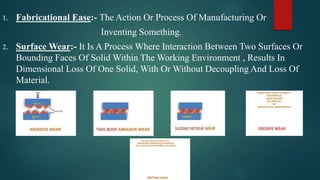
1. Fabricational Ease:- The Action Or Process Of Manufacturing Or
Inventing Something.
2. Surface Wear:- It Is A Process Where Interaction Between Two Surfaces Or
Bounding Faces Of Solid Within The Working Environment , Results In
Dimensional Loss Of One Solid, With Or Without Decoupling And Loss Of
Material.
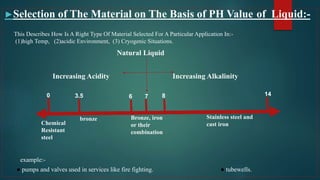
►Selection of The Material on The Basis of PH Value of Liquid:-
Natural Liquid
Increasing Acidity Increasing Alkalinity
example:-
● pumps and valves used in services like fire fighting. ● tubewells.
3.50 6 7 8 14
Stainless steel and
cast iron
bronze Bronze, iron
or their
combination
Chemical
Resistant
steel
This Describes How Is A Right Type Of Material Selected For A Particular Application In:-
(1)high Temp, (2)acidic Environment, (3) Cryogenic Situations.
► Industrial Progress In Future Will Depend On The
Ability To Procedure Newer Materials.
Arias:-
● Robotics
● Biomedical
● Levigated trains – (black panther)
● Green materials
● Fast breeder(nuclear) reactors ☼
► Recent Advances In Materials Technology:-
This Is A Very Fast Process, They Are Acquiring Nano-dimentions, While
In Other They Are Showing Peculiar Behaviour.
Fields of study:-
● Nanotechnology ● Smart Materials
● Functionally Graded Materials(FGM) ● Whiskers
● Bio-materials ● Photonic Materials
● Metamaterials ● Left Handed Materials
● Photo-refractive Materials.
Biomedical Materials
purpose Specific Use
For The Load Transmission And Stress Distribution Such As In Bone Replacement
Control Of Blood And Fluid Flow Such As In Artificial Heart
Electrical Stimuli Such As Pacemaker
Articulation To Allow Moment Such As In Artificial Knee Joint
Light Transmission Such As Implanted Lenses
Space Filling Such As In Cosmetic Surgery
Sound Transmission Such As In Cochlear Implant
The Nanotechnology
☻Computer Stream
(1) in Super Computers Nano Wires.
(2) in Chips And ICs.
☻Medical Science
(1) Cancer Treatment.
(2) Disease Detecting Devices.
☻Industries
(1) Nanotechnology Based Paints.
(2) Nanotechnology Based Clothes.
Functionally Graded Materials (FGM)
APPLICATIONS:-
☻thermal protection system
(1) Space re-entry vehicles:- normally a nose cone with a
graded SiC protection interlayer on a C/C* composite exposed
to high temperature supersonic gas flow exhibits improved
thermal protection.
(1) Gas turbine blades:- made of superalloy and coated with
bond coat of NiCrA/Y and heat- insulating layer of diesel ZrO , considerably improves the resistance of the coating.
(1) Thermal barrier coating:- by using a 2mm thick graded TBC on pistons crowns and cylinder head of diesel
engine, about 5% reduction in fuel consumption can be achieved.
☻Wear protection
☻Medical implants etc..
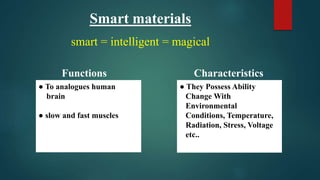
Functions Characteristics
Smart materials
smart = intelligent = magical
● To analogues human
brain
● slow and fast muscles
● They Possess Ability
Change With
Environmental
Conditions, Temperature,
Radiation, Stress, Voltage
etc..
Limitations of The Smart Materials :-
● Smart Materials Are Very Expensive.
● They Are Not Easily Available In Market.
● They Are Very Sensible So They Need Proper Care During Storage.
● They Need A Proper Skill To Recognise Among Other Materials.
Field of application of smart materials :-
● Medical Technology.
● Automobile Engineering.
● Civil Engineering.
● Aerospace.
● Mechatronic.
Nasa morphing Aircrafts:- NASA's Mighty Morphing Wings Make for More Efficient
Flying. MIT's newly developed wing architecture could greatly simplify the manufacturing process and
reduce fuel consumption by improving the wing's aerodynamics.
WHAT ARE THE MORPHING WINGS
Wings that can morph their shape during flight could reduce fuel consumption by improving
the wing's aerodynamics
S.No Smart Material Charactistics Example Application
1.
Piezoelectric
ceramic
Linear and shear deformation occur along
longitudinal, transvers and thickness
directions.
Quartz, Pb ,Zr,
titanate
Aircraft aerofoils,
identifying braille
alphabet(an aid for blinds)
2.
Viscoelastic(VE)
They relax any stress produced in it by
external strain.
Damping in space- crafts,
earthquake prone
structures , aircrafts.
3.
Electro
rheological(ER)
Fluids
These are like suspended fine polarisable
particles cohesive, and tend too coalesce. they
forms new chains even when old chains are
broken.
Zeolite in
silicone oil,
starch in corn
oil.
In filling of graphite-
epoxy beams to variable
stiffness in them.
4
Shape memory
alloys (SMA)
Below a critical transition temperature, they
can deform plastically to their memorized
valves , robotics shape.
Ni, Ti (nitinol)
Fire alarm due to change
of shape at transition
temperature
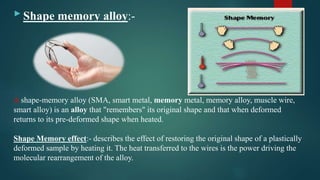
► Shape memory alloy:-
A shape-memory alloy (SMA, smart metal, memory metal, memory alloy, muscle wire,
smart alloy) is an alloy that "remembers" its original shape and that when deformed
returns to its pre-deformed shape when heated.
Shape Memory effect:- describes the effect of restoring the original shape of a plastically
deformed sample by heating it. The heat transferred to the wires is the power driving the
molecular rearrangement of the alloy.
The Shape Memory Effect Is Currently Being Implemented In
Following Applications:-
Car vent Bio-medical
Hydraulic fitting of aeroplanes
Summery
☻ Historical Perspective Of Materials.
☻ Properties Of Materials.
☻ Modern Perspective Of Materials.
☻ Importance Of Material Science In Interdisciplinary Subjects.
☻ Different Type Of Engineering Materials.
☻ Materials And There Properties.
☻ Different Levels Of Materials Structure.
☻ Structure Sensitive Properties.
☻ Surface Related Properties.
☻Factors To Be Consider On The Selection Of The Materials.
☻ Selection Of Materials Based On The Ph Value.
☻ Industrial View.
☻ Advances In Materials Technology.
☻ Smart Materials.
☻ Shape Memory Alloy & Shape Memory Effect.
Engineering materials & recent advances

Engineering materials & recent advances

  • 1.
    School of Engineeringand Technology, HNB Garhwal University, Srinagar Garhwal, Uttrakhand, 246174 Presented by:- Aman Raj B.Tech (4th sem. Mech engg.)
  • 2.
    Engineering Materials & RecentAdvances Engineering materials:- All the substances/ materials used in engineering field are termed as engineering materials.
  • 3.
    HISTORICAL PERSPECTIVE OFMATERIALS The Materials are So Important In The Development of Civilization That We Associate Ages With Them. So The Civilization Have Been Named By The Level of Their Material Development. BRONZE AGE PLASTIC AGESTEEL AGE STON AGE
  • 4.
    Properties of TheseMaterials  Mechanical properties :- ► Strength ► Ductility ► Toughness ► Hardness ► Brittleness ► Creep ► Fatigue ► Impacts Loads ► Elasticity Etc.
  • 5.
     Physical Properties Chemical Properties  Thermal properties  Manufacturing properties:- ► Forming(cold, hot..) ► Casting ► Machining ► Welding ►Finishing ► Joining process ► Powder methods
  • 6.
    MODERN PERSPECTIVE OFMATERIALS: Civil Engineering Mechanical Engineering Electrical Engineering ●Cement Concrete(CC) To Polymer Reinforced Concrete(PRC) ●Cork Walls (7 Times Faster Then Normal Construction) ●Cltra Rope(made Of Carbon Fibre ) ●Pure Metals To Duplex Stainless Steel(DSS). ●Spark Ignition 50cc Engine With 2 Stroke Switching During Its Operation. ●Roll Acted Bearing. ●Quarter Valves System For Gasoline And Diesel Engines etc. ●Green Energy Electrical Power Converter. ●Smart Electrical Grids. ●Eye Tracking Technology. ●Wireless Wearable Tech. ●Personal Flying Cars. ●40 Gb Wi-fi etc.
  • 7.
    Importance of MaterialScience In Inter Disciplinary Subjects: The Study Of Inter Disciplinary Subjects Like Metallurgy, Ceramics, Polymers Science, Manufacturing Technology Etc. Also Needs The Concepts, Rules & Observation Of Material Science. ● A Metal As Alloying Element In An Alloy. ● To Find The Utility Of Clay With Graphite To Make A Pencil Etc…
  • 8.
    Different types ofengineering materials: Materials Metals Non Metals Materials Due To Combination Ferrous Non Ferrous Ceramics Organic Polymers Composites Alloys Non-ferrous Alloy Ferrous Alloy Hybrid Composite Ceramic Polymer Composite Carbon Reinforced Composite Metal Ceramic Composite Metal Reinforced Metal Natural Fibre Reinforced
  • 9.
    Materials And TheirProperties: Metals Non-ferrous Ceramics Organic Polymers Alloys Composites ●Hard ●High Density ●High Tensile Strength ●High Melting Point ●Good Conductor Of Heat And Electricity. ●Do Not Contain Iron And Carbon In Appreciable Amount. ●Low Weight ●Resistance To Corrosion ●High Strength ●High Fracture Toughness ●High Hardness ●Excellent Wear Resistance ●Anti Static ●Low Density ●Low Coefficient Of Friction ●Good Corrosion Resistance ●Poor Tensile Strength ●Economical ●Good Mould Ability ●Better Then Normal Metals ●High Toughness ●Mostly Used Then Pure Metals. ●Light Weight ●Fire Resistance ●Design Flexibility ●Low Thermal Conductivity ●Manufacturing Economy.
  • 10.
    Structure sensitive propertiesStructure-insensitive properties ● Yield Stress. ● Creep Strength. ● Fracture Strength. ● Electrical Conductivity. ●Semiconducting Properties. ● Density. ● Specific heat. ● Melting point. ● Elastic constant. ● Coefficient of thermal expansion.
  • 11.
    Different Levels OfMaterials Structure ▄ Macro Structure The Macro Structure Can Be Observed With Naked Eyes, Using An Optical Microscope. ▄ Micro Structure The Human Can’t Be See The Structure With Naked Eyes, Or Can’t Cross The Human Eye Resolution Limit (0.1mm)…
  • 12.
    ►Micro Structure:- The microstructureof a material (such as metals, polymers, ceramics or composites) can strongly influence physical properties such as strength, toughness, ductility, hardness, corrosion resistance, high/low temperature behavior or wear resistance.  The micro structural-level may further classified as below:- ●Sub-structure ●Crystal Structure ●Electron Structure ●Nuclear Structure
  • 13.
    ►Surface Related Properties:- someproperties are surface related and some are related to inside details of material. Ex:- ● hardness : depends on the nature of its surface. ● toughness : depends on the inside structure. The structure of a material can also be of vivid nature such as given below:- 1. crystalline 2. semi-crystalline 3. non-crystalline (amorphous).
  • 14.
    ►Factors To BeConsidered For Selection of Materials:- 1. Elasticity Resistance. 2. Service Condition 3. Operational Need 4. Process Control 5. Economy 6. Durability 7. Dimensional Stability 8. Resistance To Cavitation 9. Chemical Resistance 10. Corrosion Resistance 11. Moisture Resistance 12. Radiation Resistance 13. Flame Resistance 14. Impact Resistance 15. Fabricational Ease. 16. Surface Wear Resistance
  • 15.
    1. Fabricational Ease:-The Action Or Process Of Manufacturing Or Inventing Something. 2. Surface Wear:- It Is A Process Where Interaction Between Two Surfaces Or Bounding Faces Of Solid Within The Working Environment , Results In Dimensional Loss Of One Solid, With Or Without Decoupling And Loss Of Material.
  • 16.
    ►Selection of TheMaterial on The Basis of PH Value of Liquid:- Natural Liquid Increasing Acidity Increasing Alkalinity example:- ● pumps and valves used in services like fire fighting. ● tubewells. 3.50 6 7 8 14 Stainless steel and cast iron bronze Bronze, iron or their combination Chemical Resistant steel This Describes How Is A Right Type Of Material Selected For A Particular Application In:- (1)high Temp, (2)acidic Environment, (3) Cryogenic Situations.
  • 17.
    ► Industrial ProgressIn Future Will Depend On The Ability To Procedure Newer Materials. Arias:- ● Robotics ● Biomedical ● Levigated trains – (black panther) ● Green materials ● Fast breeder(nuclear) reactors ☼
  • 18.
    ► Recent AdvancesIn Materials Technology:- This Is A Very Fast Process, They Are Acquiring Nano-dimentions, While In Other They Are Showing Peculiar Behaviour. Fields of study:- ● Nanotechnology ● Smart Materials ● Functionally Graded Materials(FGM) ● Whiskers ● Bio-materials ● Photonic Materials ● Metamaterials ● Left Handed Materials ● Photo-refractive Materials.
  • 19.
    Biomedical Materials purpose SpecificUse For The Load Transmission And Stress Distribution Such As In Bone Replacement Control Of Blood And Fluid Flow Such As In Artificial Heart Electrical Stimuli Such As Pacemaker Articulation To Allow Moment Such As In Artificial Knee Joint Light Transmission Such As Implanted Lenses Space Filling Such As In Cosmetic Surgery Sound Transmission Such As In Cochlear Implant
  • 20.
    The Nanotechnology ☻Computer Stream (1)in Super Computers Nano Wires. (2) in Chips And ICs. ☻Medical Science (1) Cancer Treatment. (2) Disease Detecting Devices. ☻Industries (1) Nanotechnology Based Paints. (2) Nanotechnology Based Clothes.
  • 21.
    Functionally Graded Materials(FGM) APPLICATIONS:- ☻thermal protection system (1) Space re-entry vehicles:- normally a nose cone with a graded SiC protection interlayer on a C/C* composite exposed to high temperature supersonic gas flow exhibits improved thermal protection. (1) Gas turbine blades:- made of superalloy and coated with bond coat of NiCrA/Y and heat- insulating layer of diesel ZrO , considerably improves the resistance of the coating. (1) Thermal barrier coating:- by using a 2mm thick graded TBC on pistons crowns and cylinder head of diesel engine, about 5% reduction in fuel consumption can be achieved. ☻Wear protection ☻Medical implants etc..
  • 22.
    Functions Characteristics Smart materials smart= intelligent = magical ● To analogues human brain ● slow and fast muscles ● They Possess Ability Change With Environmental Conditions, Temperature, Radiation, Stress, Voltage etc..
  • 23.
    Limitations of TheSmart Materials :- ● Smart Materials Are Very Expensive. ● They Are Not Easily Available In Market. ● They Are Very Sensible So They Need Proper Care During Storage. ● They Need A Proper Skill To Recognise Among Other Materials.
  • 24.
    Field of applicationof smart materials :- ● Medical Technology. ● Automobile Engineering. ● Civil Engineering. ● Aerospace. ● Mechatronic.
  • 25.
    Nasa morphing Aircrafts:-NASA's Mighty Morphing Wings Make for More Efficient Flying. MIT's newly developed wing architecture could greatly simplify the manufacturing process and reduce fuel consumption by improving the wing's aerodynamics. WHAT ARE THE MORPHING WINGS Wings that can morph their shape during flight could reduce fuel consumption by improving the wing's aerodynamics
  • 26.
    S.No Smart MaterialCharactistics Example Application 1. Piezoelectric ceramic Linear and shear deformation occur along longitudinal, transvers and thickness directions. Quartz, Pb ,Zr, titanate Aircraft aerofoils, identifying braille alphabet(an aid for blinds) 2. Viscoelastic(VE) They relax any stress produced in it by external strain. Damping in space- crafts, earthquake prone structures , aircrafts. 3. Electro rheological(ER) Fluids These are like suspended fine polarisable particles cohesive, and tend too coalesce. they forms new chains even when old chains are broken. Zeolite in silicone oil, starch in corn oil. In filling of graphite- epoxy beams to variable stiffness in them. 4 Shape memory alloys (SMA) Below a critical transition temperature, they can deform plastically to their memorized valves , robotics shape. Ni, Ti (nitinol) Fire alarm due to change of shape at transition temperature
  • 27.
    ► Shape memoryalloy:- A shape-memory alloy (SMA, smart metal, memory metal, memory alloy, muscle wire, smart alloy) is an alloy that "remembers" its original shape and that when deformed returns to its pre-deformed shape when heated. Shape Memory effect:- describes the effect of restoring the original shape of a plastically deformed sample by heating it. The heat transferred to the wires is the power driving the molecular rearrangement of the alloy.
  • 28.
    The Shape MemoryEffect Is Currently Being Implemented In Following Applications:- Car vent Bio-medical Hydraulic fitting of aeroplanes
  • 29.
    Summery ☻ Historical PerspectiveOf Materials. ☻ Properties Of Materials. ☻ Modern Perspective Of Materials. ☻ Importance Of Material Science In Interdisciplinary Subjects. ☻ Different Type Of Engineering Materials. ☻ Materials And There Properties. ☻ Different Levels Of Materials Structure. ☻ Structure Sensitive Properties. ☻ Surface Related Properties. ☻Factors To Be Consider On The Selection Of The Materials. ☻ Selection Of Materials Based On The Ph Value. ☻ Industrial View. ☻ Advances In Materials Technology. ☻ Smart Materials. ☻ Shape Memory Alloy & Shape Memory Effect.