DES 523 :
MATERIALS AND FABRICATION PROCESSES
Unit I
Introduction to materials and behavior of materials and Metal
processes.
Unit II
Properties and processing of metal powders, ceramics and glass.
Unit III
Joining and fastening process and Automation of manufacturing.
Unit IV
Plastics material structures and its properties and Thermoplastics
and its processes.
Unit V
Thermo set plastics its processes and Polymeric composite
materials and finishes in plastics.
DES 523 : MATERIALS AND FABRICATION PROCESSES Lecture 1
Unit VI
Adhesion, environmental and design aspects of plastics and
Surface finishing techniques.
DES 523 : MATERIALS AND FABRICATION PROCESSES Lecture 1
Manufacturing
Product design and Concurrent engineering
Design for manufacture
Design principles for economic production
Green Design and Sustainable manufacturing
Product life cycle(plc)
Ferrous & Non-Ferrous Metals and their Uses
DES 523 : MATERIALS AND FABRICATION PROCESSES Lecture
3
Manufacturing
In broadest sense it is the process of converting raw materials in to
products.
It encompasses the design and manufacturing of goods using various
production methods and techniques.
The word manufacturing is derived from the Latin “Manu factus”,
meaning “Made by hand”(first appeared in 1567)
Note: Even in today’s world we use this word for production.
DES 523 : MATERIALS AND FABRICATION PROCESSES Lecture
3
Product design and Concurrent engineering
Product design is a critical activity, because it has been estimated
generally 70 to 80% of cost of product development and manufacture is
determined at initial Design stages.
Design process of a particular product first requires a clear
understanding of functions and the performance expected of that
product.
Traditionally Design and manufacture are a sequential process, but the
current trend is concurrent engineering or simultaneous engineering .
The basic goals of concurrent engineering minimize time and costs
involved in taking the product from design concept to production and
introduction of the product in to the market place.
Note: you can relate this to parallel processing
DES 523 : MATERIALS AND FABRICATION PROCESSES Lecture 3
Design for manufacture
The concept of Design for manufacture is a comprehensive approach to
production of goods.
It Integrates Design process with materials, manufacturing methods,
process planning ,assembly, testing and quality assurance.
Effectively implementing Design for manufacture requires that designers
acquire fundamental understanding of the characteristics, capabilities,
and limitations of materials, production methods and related operations
machinery and equipments.
DES 523 : MATERIALS AND FABRICATION PROCESSES Lecture
3
Design principles for economic production
Design should be as simple as possible to manufacture assemble a,
dissemble service and recycle
Materials should be chosen for the appropriate Design and
manufacturing characteristics as well as for their service life.
Dimensional accuracy and surface finish specifications should be as
broad as permissible.
Secondary finishing and operations, should be avoided or minimized,
because they can add significantly to the cost.
DES 523 : MATERIALS AND FABRICATION PROCESSES Lecture 3
Green Design and Sustainable manufacturing
Sustainable manufacturing refers to the realization, that natural resources are vital
to economic activity. Energy and material management are essential to ensure that
the resources are available for future generations.
In design stage (before manufacturing) a thorough analysis of product is conducted,
on materials used, manufacturing process and the Practices employed.
The basic Guide lines followed are:
Reducing waste of materials at their source by refinements in product design and
the amount of materials used.
Reducing the use of hazardous materials in products and process.
Ensuring proper handling and disposal of waste.
Making improvements in waste treatment and in recycling and reuse of materials.
Environmentally friendly material can be either be part of biological cycle (paper and jute
bags), or industrial cycle.(Beverage can)
DES 523 : MATERIALS AND FABRICATION PROCESSES Lecture 3
Product life cycle(plc)
Product life cycle consists of stages that a product go through
from Design, Development, Production, Distribution and use, t o
its ultimate disposal and recycling.
A product typically goes through five stages:
Product development stage,
Market introduction stage
Growth stage
Maturation stage
Decline stage
DES 523 : MATERIALS AND FABRICATION PROCESSES Lecture 3
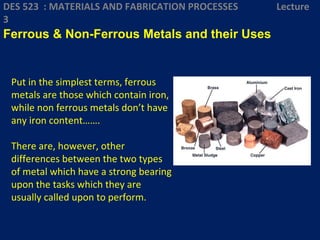
Put in the simplest terms, ferrous
metals are those which contain iron,
while non ferrous metals don’t have
any iron content…….
There are, however, other
differences between the two types
of metal which have a strong bearing
upon the tasks which they are
usually called upon to perform.
DES 523 : MATERIALS AND FABRICATION PROCESSES Lecture
3
Ferrous & Non-Ferrous Metals and their Uses
Ferrous Metals
The following are ferrous metals and the kind of uses to which
they are usually put:
• Mild Steel – Carbon content of 0.1 to 0.3% and Iron content of
99.7 – 99.9%. Used for engineering purposes and in general, none
specialized metal products.
• Carbon steel – Carbon content of 0.6 to 1.4% and Iron content of
98.6 to 99.4 %. Used to make cutting tools such as drill bits.
• Stainless Steel – Made up of Iron, nickel and chromium. Resists
staining and corrosion and is therefore used for the likes of
cutlery and surgical instrumentation.
DES 523 : MATERIALS AND FABRICATION PROCESSES Lecture 3
• Cast Iron – carbon 2 – 6% and Iron at 94 to 98%. Very strong but
brittle. Used to manufacture items such as engine blocks and
manhole covers.
• Wrought Iron – Composed of almost 100% iron. Used to make
items such as ornamental gates and fencing. Has fallen out of
use somewhat.
DES 523 : MATERIALS AND FABRICATION PROCESSES Lecture 3
Non Ferrous Metals
Following are the non ferrous metals and their uses:
• Aluminum – An alloy of aluminum, copper and manganese. Very
lightweight and easily worked. Used in aircraft manufacture,
window frames and some kitchen ware.
• Copper – Copper is a natural occurring substance. The fact that
it conducts heat and electricity means that it is used for wiring,
tubing and pipe work.
• Brass – A combination of copper and zinc, usually in the
proportions of 65% to 35% respectively. Is used for ornamental
purposes and within electrical fittings.
DES 523 : MATERIALS AND FABRICATION PROCESSES Lecture 3
• Silver – Mainly a natural substance, but mixing with copper
creates sterling silver. Used for decorative impact in jewellery
and ornaments, and also to solder different metals together.
• Lead – Lead is a naturally occurring substance. It is heavy and
very soft and is often used in roofing, in batteries and to make
pipes.
DES 523 : MATERIALS AND FABRICATION PROCESSES Lecture 3

Material and Fabrication Process

  • 1.
    DES 523 : MATERIALSAND FABRICATION PROCESSES
  • 2.
    Unit I Introduction tomaterials and behavior of materials and Metal processes. Unit II Properties and processing of metal powders, ceramics and glass. Unit III Joining and fastening process and Automation of manufacturing. Unit IV Plastics material structures and its properties and Thermoplastics and its processes. Unit V Thermo set plastics its processes and Polymeric composite materials and finishes in plastics. DES 523 : MATERIALS AND FABRICATION PROCESSES Lecture 1
  • 3.
    Unit VI Adhesion, environmentaland design aspects of plastics and Surface finishing techniques. DES 523 : MATERIALS AND FABRICATION PROCESSES Lecture 1
  • 4.
    Manufacturing Product design andConcurrent engineering Design for manufacture Design principles for economic production Green Design and Sustainable manufacturing Product life cycle(plc) Ferrous & Non-Ferrous Metals and their Uses DES 523 : MATERIALS AND FABRICATION PROCESSES Lecture 3
  • 5.
    Manufacturing In broadest senseit is the process of converting raw materials in to products. It encompasses the design and manufacturing of goods using various production methods and techniques. The word manufacturing is derived from the Latin “Manu factus”, meaning “Made by hand”(first appeared in 1567) Note: Even in today’s world we use this word for production. DES 523 : MATERIALS AND FABRICATION PROCESSES Lecture 3
  • 6.
    Product design andConcurrent engineering Product design is a critical activity, because it has been estimated generally 70 to 80% of cost of product development and manufacture is determined at initial Design stages. Design process of a particular product first requires a clear understanding of functions and the performance expected of that product. Traditionally Design and manufacture are a sequential process, but the current trend is concurrent engineering or simultaneous engineering . The basic goals of concurrent engineering minimize time and costs involved in taking the product from design concept to production and introduction of the product in to the market place. Note: you can relate this to parallel processing DES 523 : MATERIALS AND FABRICATION PROCESSES Lecture 3
  • 7.
    Design for manufacture Theconcept of Design for manufacture is a comprehensive approach to production of goods. It Integrates Design process with materials, manufacturing methods, process planning ,assembly, testing and quality assurance. Effectively implementing Design for manufacture requires that designers acquire fundamental understanding of the characteristics, capabilities, and limitations of materials, production methods and related operations machinery and equipments. DES 523 : MATERIALS AND FABRICATION PROCESSES Lecture 3
  • 8.
    Design principles foreconomic production Design should be as simple as possible to manufacture assemble a, dissemble service and recycle Materials should be chosen for the appropriate Design and manufacturing characteristics as well as for their service life. Dimensional accuracy and surface finish specifications should be as broad as permissible. Secondary finishing and operations, should be avoided or minimized, because they can add significantly to the cost. DES 523 : MATERIALS AND FABRICATION PROCESSES Lecture 3
  • 9.
    Green Design andSustainable manufacturing Sustainable manufacturing refers to the realization, that natural resources are vital to economic activity. Energy and material management are essential to ensure that the resources are available for future generations. In design stage (before manufacturing) a thorough analysis of product is conducted, on materials used, manufacturing process and the Practices employed. The basic Guide lines followed are: Reducing waste of materials at their source by refinements in product design and the amount of materials used. Reducing the use of hazardous materials in products and process. Ensuring proper handling and disposal of waste. Making improvements in waste treatment and in recycling and reuse of materials. Environmentally friendly material can be either be part of biological cycle (paper and jute bags), or industrial cycle.(Beverage can) DES 523 : MATERIALS AND FABRICATION PROCESSES Lecture 3
  • 10.
    Product life cycle(plc) Productlife cycle consists of stages that a product go through from Design, Development, Production, Distribution and use, t o its ultimate disposal and recycling. A product typically goes through five stages: Product development stage, Market introduction stage Growth stage Maturation stage Decline stage DES 523 : MATERIALS AND FABRICATION PROCESSES Lecture 3
  • 11.
    Put in thesimplest terms, ferrous metals are those which contain iron, while non ferrous metals don’t have any iron content……. There are, however, other differences between the two types of metal which have a strong bearing upon the tasks which they are usually called upon to perform. DES 523 : MATERIALS AND FABRICATION PROCESSES Lecture 3 Ferrous & Non-Ferrous Metals and their Uses
  • 12.
    Ferrous Metals The followingare ferrous metals and the kind of uses to which they are usually put: • Mild Steel – Carbon content of 0.1 to 0.3% and Iron content of 99.7 – 99.9%. Used for engineering purposes and in general, none specialized metal products. • Carbon steel – Carbon content of 0.6 to 1.4% and Iron content of 98.6 to 99.4 %. Used to make cutting tools such as drill bits. • Stainless Steel – Made up of Iron, nickel and chromium. Resists staining and corrosion and is therefore used for the likes of cutlery and surgical instrumentation. DES 523 : MATERIALS AND FABRICATION PROCESSES Lecture 3
  • 13.
    • Cast Iron– carbon 2 – 6% and Iron at 94 to 98%. Very strong but brittle. Used to manufacture items such as engine blocks and manhole covers. • Wrought Iron – Composed of almost 100% iron. Used to make items such as ornamental gates and fencing. Has fallen out of use somewhat. DES 523 : MATERIALS AND FABRICATION PROCESSES Lecture 3
  • 14.
    Non Ferrous Metals Followingare the non ferrous metals and their uses: • Aluminum – An alloy of aluminum, copper and manganese. Very lightweight and easily worked. Used in aircraft manufacture, window frames and some kitchen ware. • Copper – Copper is a natural occurring substance. The fact that it conducts heat and electricity means that it is used for wiring, tubing and pipe work. • Brass – A combination of copper and zinc, usually in the proportions of 65% to 35% respectively. Is used for ornamental purposes and within electrical fittings. DES 523 : MATERIALS AND FABRICATION PROCESSES Lecture 3
  • 15.
    • Silver –Mainly a natural substance, but mixing with copper creates sterling silver. Used for decorative impact in jewellery and ornaments, and also to solder different metals together. • Lead – Lead is a naturally occurring substance. It is heavy and very soft and is often used in roofing, in batteries and to make pipes. DES 523 : MATERIALS AND FABRICATION PROCESSES Lecture 3