Pathophysiology of blood loss
and massive transfusion
Presenter: DR. Getaye S.(ACCPMR2)
9/8/2022 1
Outlines
Objectives
Introduction
 Hemostatic Monitoring
Massive blood transfusion and MTPs
Massive transfusion complications and their
managements
References
9/8/2022 2
Objectives
understand mechanism of blood loss and
hemostasis
Know indications MBT, associated complications
and their management.
Summarize the institutions protocols for massive
blood transfusion.
9/8/2022 3
Introduction
Hemostasis
an ordered enzymatic process involving cellular
and biochemical components
preserve the integrity of the circulatory system
after injury
The ultimate goal:
 limit blood loss,
 maintain intravascular blood flow,
promote revascularization after thrombosis.
9/8/2022 4
Cont,
is a constant balance between procoagulation
processes and inhibition of uncontrolled thrombus
propagation.
Vascular endothelium, platelets, and plasma
coagulation proteins play equally important roles
in this process.
Healthy endothelial cells possess antiplatelet,
anticoagulant, and profibrinolytic effects to inhibit
unprovoked clot formation
9/8/2022 5
Cont,
Vascular endothelial injury—mechanical or
biochemical—leads to:
a) Vascular constrictions
b) platelet deposition at the injury site… primary
hemostasis(platelet mediated).
 this initial platelet plug may prove adequate for a minor
injury,
c) control of more significant bleeding needs stable clot
formation crosslinked with fibrin… secondary
hemostasis
9/8/2022 6
Cont,
9/8/2022 7
Cont,
Intrinsic Anticoagulant Mechanisms
Once coagulation is activated, regulation of hemostasis
essential to limit clot propagation
Flowing blood and hemodilution…early
more robust counter-regulatory mechanisms
Derangements in this delicate system can lead to
either excessive bleeding or pathologic thrombus
formation.
9/8/2022 8
Cont,
9/8/2022 9
Cont,
Blood loss
Blood loss is effusion of blood from
cardiovascular structures
It may be to the external or internal
Classes of Hemorrhage….
For the purpose of early detection and intervention,
ACS developed 4 classes of hemorrhage based on the
volume of blood loss and the physiologic responses
that follow
9/8/2022 10
Cont,
9/8/2022 11
Cont,
significant hemorrhage will cause
Imbalance oxygen delivery and oxygen consumption.
hemodynamic instability
decreased oxygen delivery and cellular hypoxia.
Hemorrhagic shock is a common and treatable
cause of death in trauma & other critical care
setting
second only to traumatic brain injury as the leading
cause of death from trauma
9/8/2022 12
Cont,
9/8/2022 13
Cont,
Physiologic response to blood loss
Early compensatory responses to blood loss occurs at
macrocirculatory level
Mediated by neuroendocrine system w/c include
progressive vasoconstriction of cutaneous, muscular,
and visceral vessels
The usual response to acute circulating volume
depletion is an increase in heart rate in an attempt to
preserve CO.
tachycardia is the earliest measurable circulatory
sign of shock.
9/8/2022 14
Cont,
The release of endogenous catecholamines
increases SVR, which in turn increase DBP and
reduces pulse pressure.
However, this does little to increase organ
perfusion and tissue oxygenation.
 Pain, haemorrhage, and cortical perception lead
to the release of hormones and other
inflammatory mediators
 sets the stage for the microcirculatory response.
9/8/2022 15
Cont,
For patients in early hemorrhagic shock,
venous return is preserved to some degree.
But the compensatory responses &Volume
repletion will allow recovery from the shock
state only when the bleeding has stopped.
9/8/2022 16
Cont,
At the cellular level, inadequately perfused
and poorly oxygenated cells are deprived of
essential substrates for normal aerobic
metabolism.
shift to anaerobic metabolism.
 subsequent end-organ damage and multiple
organ dysfunction may result.
9/8/2022 17
Compensatory
sympathetic
discharge
9/8/2022 18
Cont,
Trauma-induced coagulopathy.
clinical syndrome caused by the imbalance between
the clotting, anticoagulation and fibrinolysis
processes
Characterized with early hypercoagulation state
followed by hyperfibrinolysis
Closely related to the outcome of trauma patients
(associated with at least a twofold to fourfold
increase in mortality)
Nearly 1/3rd of patients present with TIC
9/8/2022 19
Cont,
TIC is the sum of two distinct processes:
a) Acute coagulopathy of trauma
due to activation of endogenous coagulations factors
b) Resuscitation-induced coagulopathy
Due to resuscitation processes and metabolic changes
So Coagulopathy develops from:
Consumption/loss of coagulation factors via
hemorrhage,
 hemodilution with resuscitation fluids,
Coagul. dysfunction from acidosis and hypothermia.
9/8/2022 20
Cont,
Trauma-induced coagulopathy is acutely
worsened by the presence of acidosis and
hypothermia.
The activity of coagulation factors, fibrinogen, and
platelet quantity are all adversely affected by
acidosis
9/8/2022 21
Early response
Subsequent response
9/8/2022 22
Cont,
9/8/2022 23
Cont,
Measurement of Blood Loss
important for assessing the need for both the initial and
subsequent blood transfusions
A standard approach includes a combination of
visualization and gravimetric measurements based on
weight differences between dry and blood-soaked
gauze pads.
 The accuracy of measurements is not uniformly
consistent and no “gold standard” for blood loss
quantification exists
9/8/2022 24
Cont,
ASSESSMENT OF THE HEMOSTATIC function
Given the importance of coagulopathy in the bleeding pts,
assessment of the hemostatic system is essential
Includes
taking medical history,
doing targeted clinical evaluation,
standard laboratory-based coagulation tests,
and viscoelastic monitoring
Standard coagulation lab. tests typically include PT, INR,
aPTT, and platelet count(some settings fibrinog level and
TT)
Limitations?
9/8/2022 25
Cont,
A recent meta analysis concluded that standard
plasma coagulation tests are not supported by strong
evidence for the management of perioperative
coagulopathic bleeding.
This is where viscoelastic monitoring brings added
value.
Viscoelastic coagulation monitoring devices like
RapidTEG and ROTEM assess the whole coagulation
process
significantly improve the coagulation ass.t and mngmt of a
pt
9/8/2022 26
9/8/2022 27
Cont,
Advantages viscoelastic testing
Short turnaround time
Can detect hyperfibrinolysis
Assess all phases of coagulation
Can be performed at the patients own
temperature
9/8/2022 28
Cont,
Bleeding will be called major if:
Result in drop of Hbn by>=2g/dl
Requires blood transfusion(>= 2u PRBC)
Bleeding into critical closed spaces
Bleeding that require surgical intervention
In general a bleeding resulting in
hemodynamic instability is major bleeding
9/8/2022 29
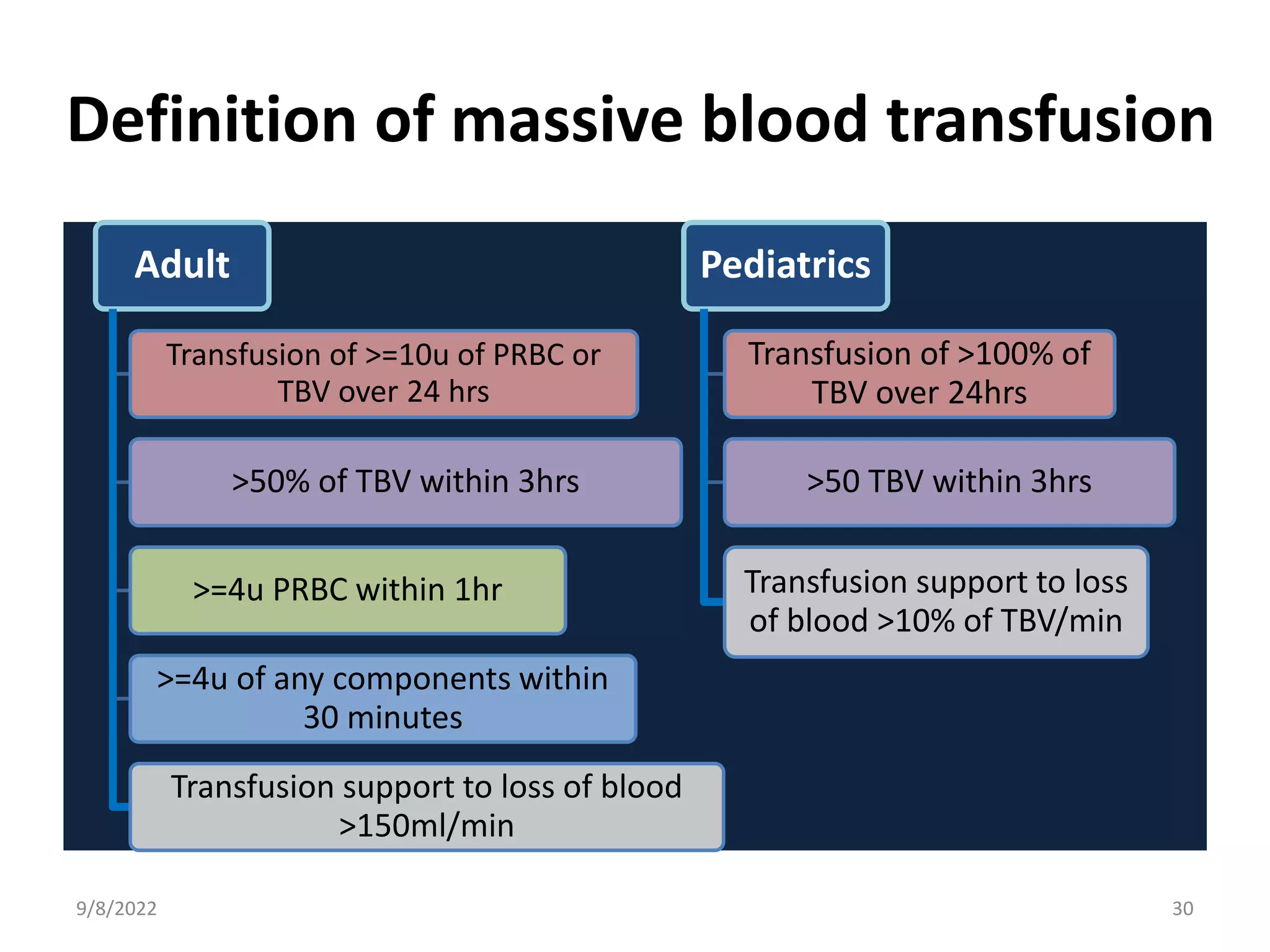
Definition of massive blood transfusion
Adult
Transfusion of >=10u of PRBC or
TBV over 24 hrs
>50% of TBV within 3hrs
>=4u PRBC within 1hr
>=4u of any components within
30 minutes
Transfusion support to loss of blood
>150ml/min
Pediatrics
Transfusion of >100% of
TBV over 24hrs
>50 TBV within 3hrs
Transfusion support to loss
of blood >10% of TBV/min
9/8/2022 30
Cont,
Indications
Trauma
Surgery
Cardiovascular
hepatic surgery
Obstetric hemorrhages
GI bleeding with liver diseases
Contraindications
no absolute contraindications for MT .
9/8/2022 31
Activate MTP if one or more of
the f/f:
1
• ABC score of two or more
2
• Persistent hemodynamic instability or
blood transfusion in the trauma bay
3
• Active bleeding requiring operation or
angioembolization
9/8/2022 32
Cont,
Assessment of blood consumption(ABC) score
Pulse rate>120bpm
SBP<90mmHg
Positive FAST scan
Penetrating injury to the Torso
9/8/2022 33
Cont,
Revised assessment of bleeding and
transfusion(RABT) score
Penetrating truncal trauma
Shock index>=1
Positive FAST
Pelvic fracture
9/8/2022 34
Cont,
If MT triggers are met:
 Begin universal blood product infusion rather
than crystalloid or colloid solutions
Transfuse RBC and plasma in a ratio between 1:1
and 1:2 (plasma to RBC)
9/8/2022 35
APPROACH TO VOLUME AND BLOOD
REPLACEMENT
requires careful and ongoing consideration of
complex physiologic relationships.
Priorities in MBT
Restoring blood volume and thereby improving
tissue perfusion and oxygenation
Secure hemostasis
Arrest any source of active bleeding
Treat coagulopathy with blood components
Correct hypothermia and acidosis
9/8/2022 36
Crystalloid versus blood products
Correction of a deficit in blood volume with
crystalloids and volume expanders works well for
most mildly and moderately ill or injured patients.
However, large volume resuscitation with
crystalloid alone in severe trauma with massive
blood loss can lead to
 dilutional coagulopathy
severe tissue edema
stiff lungs and abdominal compartment syndrome.
9/8/2022 37
Cont,
For more severely injured or massively
bleeding patients, there has been a shift to:
Early use of blood components for volume
resuscitation
 with avoidance of aggressive crystalloid
resuscitation.
9/8/2022 38
Whole blood vs components
 there is strong evidence from medical &
military experience demonstrating positive
outcomes when fresh WB is transfused to
trauma patients.
And transfusing with fresh WB would seem
ideal but the time required to conduct safety
tests on blood is long
9/8/2022 39
Ratio of component transfusion
9/8/2022 40
2012-2013
Cont,
9/8/2022 41
Key principles of management of
hemorrhage
• Control compressible active bleeding
1
• Minimize the use of intravenous IV fluid
2
• Transfuse as soon as the need is recognized
3
• Apply balanced component transfusion/use Whole blood
4
• Mobilize resources needed & apply point of care coagulation
assessment
5
9/8/2022 42
Cont,
9/8/2022 43
Massive transfusion protocol
Many institutions have created protocols for
massive transfusion using knowledge from
interprofessional teams.
Which facilitate ordering blood products and
receiving them expeditiously from the blood bank.
While these protocols vary between institutions,
many MTP focus on delivering PRBCs in addition
to plt and FFP.
9/8/2022 44
Cont,
Led to the concept of mimicking whole blood
during massive transfusion
still controversial regarding the best ratio
Many experts & studies advocate for a 1:1:1
ratio of FFP, platelets, and PRBCs.
The use of cryopr, fibrinogen conc., and rFVIIIa
have been used with mixed results.
Incorporation of TXA into MTP?
9/8/2022 45
9/8/2022 46
9/8/2022 47
9/8/2022 48
9/8/2022 49
Other haemostatic strategies
Activated factor VII:
The role is unclear.
can be considered as a rescue therapy in patients with
life-threatening bleeding that is unresponsive to
standard haemostatic therapy.
with dose is 35-70 μg/kg
 Antifibrinolytic agents:
useful in bleeding complicated by fibrinolysis such as
cardiac surgery, prostatectomy
Early administration of TXA in bleeding Pts has been
shown to significantly reduce mortality
9/8/2022 50
Cont,
Early use of tranexamic acid in severely
bleeding pts reduce mortality and cost
9/8/2022 51
Cont,
Autologous Blood transfusion:
First gained popularity because of the rising
risk of transfusion-transmitted viral infections.
 Includes :
a) preoperative autologous blood donation (PAD)
b) acute normovolemic hemodilution (ANH)
c) perioperative blood cell salvage
 useful in unanticipated blood loss and in pts with rare BGs.
 generally reserved for massive blood loss in OR
9/8/2022 52
Cont,
Targets of massive transfusion
• Mean arterial pressure (MAP) of >60 mm Hg
and SBP:80-100mmHg
• INR less than 1.5
• aPTT<1.5* normal value
• Hemoglobin 7 to 9 g/dL
• Fibrinogen greater than 1.5 to 2 g/L
• pH 7.35 to 7.45
• Platelets greater than 50K
• Core temperature greater than 35 C
9/8/2022 53
Pediatric MT
Limited data is available for pediatric MT
In majority of the institution a single MT protocol
is used for adult and paediatric
Balanced component transfusion is yet the choice,
Whole blood transfusion?
9/8/2022 54
Obstetric hemorrhage
Pregnancy and the postpartum period are
hypercoagulable states with compensatory
increased fibrinolysis.
When vascular disruption leads to massive
bleeding, those with low fibrinogen are at
increased risk for bleeding.
Most guidelines supports to maintain fibrinogen
≥200 mg/dL .
use of a 1:1:1 ratio for treating massive
hemorrhage in obstetric patients is suggested.
9/8/2022 55
Liver disease
Liver disease
reduced production of coagulation factors and
dysfunctional v.t K-dependent factors and fibrinog.
 reduced hepatic clearance of activation fragments
 In patients with severe liver disease and active
hemorrhage, attempts to normalize platelet
number and plasma coagulation factor conc.
1:1:1 ratio of blood component for treating
massive hemorrhage in pts.
9/8/2022 56
Blood Transfusion reactions
9/8/2022 57
Complications of massive transfusions
Non-fatal complications have been seen in more
than 50% of pts when more than 5 units of blood
products are transfused
Immediate
 secondary to volume resuscitation
 Inadequate resuscitation
Overzealous resuscitation
Dilutional problems:
Problems related to transfusion of large volume of
stored blood
9/8/2022 58
Cont,
Late complications
Transfusion related acute lung injury (TRALI)
SIRS, Sepsis,Thrombotic complication
Generally Specific complications to MT
Metabolic
Hemostatic
Hypothermia
9/8/2022 59
Metabolic complications
Citrate toxicity
 normally blood is anticoagulated with sodium
citrate and citric acid
Each 450 ml of blood contain 9mmol of citrate(too
much in the setting of MT)
Infusion of citrate can lead clinically significant fall
of ionized Ca
9/8/2022 60
Cont,
The liver metabilize 3gm of citrate every 5min
infusion of more than 1 unit of blood every 5
minutes can lead to decreasing ionized Ca2+
levels.
So risks for citrate toxicity increases in two
situations:
Rapid infusion of blood products
Impaired or immature liver functions
9/8/2022 61
Cont,
Ca is important for coagulation, platlet fun and
cardiac and smooth muscle activity
50% of hospital admissions and & 70-100% of
trauma patients have already low Ca(even before
transfusion)
And MT will worsen hypocalcemia thereby
dysrhythmia and hypotension
RXs: for those with hypocalcemia with
symptoms/ECG changes, for MT suppl, ionized
Ca<0.9mmol/L
With Cacl/Calcium gluconate
9/8/2022 62
Cont,
 Hypomagnesemia
 Due to infusion of magnesium poor fluid and high citrate content
during MT
 Hyperkalemia
 Due to hemolysis of RBCS and transfusion of RBCs of long storage
duration, infused through central access and at high speeds
 hyperkalemia results from high-volume transfusion, especially
when infusion rates exceed 100 to 150 mL/min.
 Neonates and pts with underlying cardiac and renal disease are prone
 Prevention:
• Use younger & washed RBCs
• Treatment based on the level
 Hypokalemia
 Due to entry to the transfused RBC
 the alkalosis
9/8/2022 63
Cont,
 Metabolic alkalosis
 Due to citrate overload
 Each unit of blood can generate a total of 23 mEq of bicarbonate
 This can result in a metabolic alkalosis if impaired kidneys fun.
 Acidosis
 Hypoperfusion and liver diseases risks
 Patients requiring a massive transfusion are often acidotic even
before transfusion begins.
 Prolonged states of hypoperfusion lead to acidosis.
 Once acidosis has set in, it further interferes with coagulation by
reducing the assembly of coagulation factors.
9/8/2022 64
.
Days of storage
0 7 14 21 35
% of viable cells 24 hours posttransfusion 100 98 85 80 79
Plasma pH at 37°C 7.20 7.00 6.89 6.84 6.80
2,3 DPG (% initial value) 100 99 80 44 <10
P50 (oxygen affinity) 23.5 23 20 17
Plasma Na+ 168 166 163 156 155
Plasma K+ 4.2 11.9 17.2 21 27.3
9/8/2022 65
Cont,
Hypothermia
Many patients with acute blood-loss susceptible
to hypothermia.
Infusion of cold fluid and blood products, wide
opening of body cavities, decreased heat
production and impaired thermal control
Lower ambient temperatures can further
exacerbate it
Infants and neonates are vulnerable
9/8/2022 66
Cont,
Transfusion of 6u of blood at a T0 of 4C0
reduce body temperature by 1C0
Transfusion of10u cold blood and 1 hr of
surgery leads 3 C0 body tempreture drops
management
Warm room tempreture
Using warm blanket or drapes
Warming iv fluids
High capacity blood warmer
9/8/2022 67
Cont,
Coagulopathy in MT
Due to massive bleeding, coagulation factors are often
being consumed in patients who require massive
transfusion.
 Additionally, dilution of the remaining coagulation
components in addition to hypothermia and acidosis
can lead to coagulopathy and altered hemostasis.
The decreased ability to stop bleeding leads to further
hypothermia and acidosis, creating a positive
feedback loop
9/8/2022 68
9/8/2022 69
cont,
 Plasma(FFP)
 If the PT and/or aPTT are >1.5 times control due to
dilutional coagulopathy, 2 to 8 units of plasma should be
given.
 Each unit of plasma might be expected to increase the
clotting protein levels of 2.5 percent
 Cryoprecipitate/virally inactivated fibrinogen concenc.
 used when fibrinogen levels are critically low (<100 mg/dL)
 Platelets
 4-6u of WB-derived platelets or one apheresis unit should
be given if the platelet count is <50,000/microL.
9/8/2022 70
cont,
Trauma-associated coagulopathy
diagnosed when there is microvascular oozing,
prolongation of the PT and aPTT more than expected by
dilution, significant thrombocytopenia, low fibrinogen
levels, and increased D-dimer levels.
sometimes referred to as traumatic DIC, but it differs from
DIC by:
Is not truly disseminated, not truly intravascular, not truly
coagulation (it is bleeding)
Is effectively treated with antifibrinolytic agents
 No single laboratory test can definitively diagnose or exclude it
 Acidosis and hypothermia can both interfere with the
normal clotting and hemostasis
9/8/2022 71
Cont,
Transfusion related acute lung injury(TRALI)
The mechanism is poorly understood
 incidence of TRALI increases as the number of blood
products given.
rapid onset of hypoxemia within 6 hours of a
transfusion
Patients clinically will look very similar to those with
acute respiratory distress syndrome (ARDS)
Management: stop transfusion & provide supportive
9/8/2022 72
Cont,
Transfusion
associated circulatory
overload (TACO)
 Acute respiratory
distress within 6 hours of
transfusion with features
of left heart failure
including increased CVP
or increased BNP.
 Additional risks in MT
includes pts with CHF,
diuretic dependence,
and renal faillure
 Management: supportive
treatment + diuresis
9/8/2022 73
References
9/8/2022 74
Thank you!
9/8/2022 75

massive transfusion.pptx

  • 1.
    Pathophysiology of bloodloss and massive transfusion Presenter: DR. Getaye S.(ACCPMR2) 9/8/2022 1
  • 2.
    Outlines Objectives Introduction  Hemostatic Monitoring Massiveblood transfusion and MTPs Massive transfusion complications and their managements References 9/8/2022 2
  • 3.
    Objectives understand mechanism ofblood loss and hemostasis Know indications MBT, associated complications and their management. Summarize the institutions protocols for massive blood transfusion. 9/8/2022 3
  • 4.
    Introduction Hemostasis an ordered enzymaticprocess involving cellular and biochemical components preserve the integrity of the circulatory system after injury The ultimate goal:  limit blood loss,  maintain intravascular blood flow, promote revascularization after thrombosis. 9/8/2022 4
  • 5.
    Cont, is a constantbalance between procoagulation processes and inhibition of uncontrolled thrombus propagation. Vascular endothelium, platelets, and plasma coagulation proteins play equally important roles in this process. Healthy endothelial cells possess antiplatelet, anticoagulant, and profibrinolytic effects to inhibit unprovoked clot formation 9/8/2022 5
  • 6.
    Cont, Vascular endothelial injury—mechanicalor biochemical—leads to: a) Vascular constrictions b) platelet deposition at the injury site… primary hemostasis(platelet mediated).  this initial platelet plug may prove adequate for a minor injury, c) control of more significant bleeding needs stable clot formation crosslinked with fibrin… secondary hemostasis 9/8/2022 6
  • 7.
  • 8.
    Cont, Intrinsic Anticoagulant Mechanisms Oncecoagulation is activated, regulation of hemostasis essential to limit clot propagation Flowing blood and hemodilution…early more robust counter-regulatory mechanisms Derangements in this delicate system can lead to either excessive bleeding or pathologic thrombus formation. 9/8/2022 8
  • 9.
  • 10.
    Cont, Blood loss Blood lossis effusion of blood from cardiovascular structures It may be to the external or internal Classes of Hemorrhage…. For the purpose of early detection and intervention, ACS developed 4 classes of hemorrhage based on the volume of blood loss and the physiologic responses that follow 9/8/2022 10
  • 11.
  • 12.
    Cont, significant hemorrhage willcause Imbalance oxygen delivery and oxygen consumption. hemodynamic instability decreased oxygen delivery and cellular hypoxia. Hemorrhagic shock is a common and treatable cause of death in trauma & other critical care setting second only to traumatic brain injury as the leading cause of death from trauma 9/8/2022 12
  • 13.
  • 14.
    Cont, Physiologic response toblood loss Early compensatory responses to blood loss occurs at macrocirculatory level Mediated by neuroendocrine system w/c include progressive vasoconstriction of cutaneous, muscular, and visceral vessels The usual response to acute circulating volume depletion is an increase in heart rate in an attempt to preserve CO. tachycardia is the earliest measurable circulatory sign of shock. 9/8/2022 14
  • 15.
    Cont, The release ofendogenous catecholamines increases SVR, which in turn increase DBP and reduces pulse pressure. However, this does little to increase organ perfusion and tissue oxygenation.  Pain, haemorrhage, and cortical perception lead to the release of hormones and other inflammatory mediators  sets the stage for the microcirculatory response. 9/8/2022 15
  • 16.
    Cont, For patients inearly hemorrhagic shock, venous return is preserved to some degree. But the compensatory responses &Volume repletion will allow recovery from the shock state only when the bleeding has stopped. 9/8/2022 16
  • 17.
    Cont, At the cellularlevel, inadequately perfused and poorly oxygenated cells are deprived of essential substrates for normal aerobic metabolism. shift to anaerobic metabolism.  subsequent end-organ damage and multiple organ dysfunction may result. 9/8/2022 17
  • 18.
  • 19.
    Cont, Trauma-induced coagulopathy. clinical syndromecaused by the imbalance between the clotting, anticoagulation and fibrinolysis processes Characterized with early hypercoagulation state followed by hyperfibrinolysis Closely related to the outcome of trauma patients (associated with at least a twofold to fourfold increase in mortality) Nearly 1/3rd of patients present with TIC 9/8/2022 19
  • 20.
    Cont, TIC is thesum of two distinct processes: a) Acute coagulopathy of trauma due to activation of endogenous coagulations factors b) Resuscitation-induced coagulopathy Due to resuscitation processes and metabolic changes So Coagulopathy develops from: Consumption/loss of coagulation factors via hemorrhage,  hemodilution with resuscitation fluids, Coagul. dysfunction from acidosis and hypothermia. 9/8/2022 20
  • 21.
    Cont, Trauma-induced coagulopathy isacutely worsened by the presence of acidosis and hypothermia. The activity of coagulation factors, fibrinogen, and platelet quantity are all adversely affected by acidosis 9/8/2022 21
  • 22.
  • 23.
  • 24.
    Cont, Measurement of BloodLoss important for assessing the need for both the initial and subsequent blood transfusions A standard approach includes a combination of visualization and gravimetric measurements based on weight differences between dry and blood-soaked gauze pads.  The accuracy of measurements is not uniformly consistent and no “gold standard” for blood loss quantification exists 9/8/2022 24
  • 25.
    Cont, ASSESSMENT OF THEHEMOSTATIC function Given the importance of coagulopathy in the bleeding pts, assessment of the hemostatic system is essential Includes taking medical history, doing targeted clinical evaluation, standard laboratory-based coagulation tests, and viscoelastic monitoring Standard coagulation lab. tests typically include PT, INR, aPTT, and platelet count(some settings fibrinog level and TT) Limitations? 9/8/2022 25
  • 26.
    Cont, A recent metaanalysis concluded that standard plasma coagulation tests are not supported by strong evidence for the management of perioperative coagulopathic bleeding. This is where viscoelastic monitoring brings added value. Viscoelastic coagulation monitoring devices like RapidTEG and ROTEM assess the whole coagulation process significantly improve the coagulation ass.t and mngmt of a pt 9/8/2022 26
  • 27.
  • 28.
    Cont, Advantages viscoelastic testing Shortturnaround time Can detect hyperfibrinolysis Assess all phases of coagulation Can be performed at the patients own temperature 9/8/2022 28
  • 29.
    Cont, Bleeding will becalled major if: Result in drop of Hbn by>=2g/dl Requires blood transfusion(>= 2u PRBC) Bleeding into critical closed spaces Bleeding that require surgical intervention In general a bleeding resulting in hemodynamic instability is major bleeding 9/8/2022 29
  • 30.
    Definition of massiveblood transfusion Adult Transfusion of >=10u of PRBC or TBV over 24 hrs >50% of TBV within 3hrs >=4u PRBC within 1hr >=4u of any components within 30 minutes Transfusion support to loss of blood >150ml/min Pediatrics Transfusion of >100% of TBV over 24hrs >50 TBV within 3hrs Transfusion support to loss of blood >10% of TBV/min 9/8/2022 30
  • 31.
    Cont, Indications Trauma Surgery Cardiovascular hepatic surgery Obstetric hemorrhages GIbleeding with liver diseases Contraindications no absolute contraindications for MT . 9/8/2022 31
  • 32.
    Activate MTP ifone or more of the f/f: 1 • ABC score of two or more 2 • Persistent hemodynamic instability or blood transfusion in the trauma bay 3 • Active bleeding requiring operation or angioembolization 9/8/2022 32
  • 33.
    Cont, Assessment of bloodconsumption(ABC) score Pulse rate>120bpm SBP<90mmHg Positive FAST scan Penetrating injury to the Torso 9/8/2022 33
  • 34.
    Cont, Revised assessment ofbleeding and transfusion(RABT) score Penetrating truncal trauma Shock index>=1 Positive FAST Pelvic fracture 9/8/2022 34
  • 35.
    Cont, If MT triggersare met:  Begin universal blood product infusion rather than crystalloid or colloid solutions Transfuse RBC and plasma in a ratio between 1:1 and 1:2 (plasma to RBC) 9/8/2022 35
  • 36.
    APPROACH TO VOLUMEAND BLOOD REPLACEMENT requires careful and ongoing consideration of complex physiologic relationships. Priorities in MBT Restoring blood volume and thereby improving tissue perfusion and oxygenation Secure hemostasis Arrest any source of active bleeding Treat coagulopathy with blood components Correct hypothermia and acidosis 9/8/2022 36
  • 37.
    Crystalloid versus bloodproducts Correction of a deficit in blood volume with crystalloids and volume expanders works well for most mildly and moderately ill or injured patients. However, large volume resuscitation with crystalloid alone in severe trauma with massive blood loss can lead to  dilutional coagulopathy severe tissue edema stiff lungs and abdominal compartment syndrome. 9/8/2022 37
  • 38.
    Cont, For more severelyinjured or massively bleeding patients, there has been a shift to: Early use of blood components for volume resuscitation  with avoidance of aggressive crystalloid resuscitation. 9/8/2022 38
  • 39.
    Whole blood vscomponents  there is strong evidence from medical & military experience demonstrating positive outcomes when fresh WB is transfused to trauma patients. And transfusing with fresh WB would seem ideal but the time required to conduct safety tests on blood is long 9/8/2022 39
  • 40.
    Ratio of componenttransfusion 9/8/2022 40 2012-2013
  • 41.
  • 42.
    Key principles ofmanagement of hemorrhage • Control compressible active bleeding 1 • Minimize the use of intravenous IV fluid 2 • Transfuse as soon as the need is recognized 3 • Apply balanced component transfusion/use Whole blood 4 • Mobilize resources needed & apply point of care coagulation assessment 5 9/8/2022 42
  • 43.
  • 44.
    Massive transfusion protocol Manyinstitutions have created protocols for massive transfusion using knowledge from interprofessional teams. Which facilitate ordering blood products and receiving them expeditiously from the blood bank. While these protocols vary between institutions, many MTP focus on delivering PRBCs in addition to plt and FFP. 9/8/2022 44
  • 45.
    Cont, Led to theconcept of mimicking whole blood during massive transfusion still controversial regarding the best ratio Many experts & studies advocate for a 1:1:1 ratio of FFP, platelets, and PRBCs. The use of cryopr, fibrinogen conc., and rFVIIIa have been used with mixed results. Incorporation of TXA into MTP? 9/8/2022 45
  • 46.
  • 47.
  • 48.
  • 49.
  • 50.
    Other haemostatic strategies Activatedfactor VII: The role is unclear. can be considered as a rescue therapy in patients with life-threatening bleeding that is unresponsive to standard haemostatic therapy. with dose is 35-70 μg/kg  Antifibrinolytic agents: useful in bleeding complicated by fibrinolysis such as cardiac surgery, prostatectomy Early administration of TXA in bleeding Pts has been shown to significantly reduce mortality 9/8/2022 50
  • 51.
    Cont, Early use oftranexamic acid in severely bleeding pts reduce mortality and cost 9/8/2022 51
  • 52.
    Cont, Autologous Blood transfusion: Firstgained popularity because of the rising risk of transfusion-transmitted viral infections.  Includes : a) preoperative autologous blood donation (PAD) b) acute normovolemic hemodilution (ANH) c) perioperative blood cell salvage  useful in unanticipated blood loss and in pts with rare BGs.  generally reserved for massive blood loss in OR 9/8/2022 52
  • 53.
    Cont, Targets of massivetransfusion • Mean arterial pressure (MAP) of >60 mm Hg and SBP:80-100mmHg • INR less than 1.5 • aPTT<1.5* normal value • Hemoglobin 7 to 9 g/dL • Fibrinogen greater than 1.5 to 2 g/L • pH 7.35 to 7.45 • Platelets greater than 50K • Core temperature greater than 35 C 9/8/2022 53
  • 54.
    Pediatric MT Limited datais available for pediatric MT In majority of the institution a single MT protocol is used for adult and paediatric Balanced component transfusion is yet the choice, Whole blood transfusion? 9/8/2022 54
  • 55.
    Obstetric hemorrhage Pregnancy andthe postpartum period are hypercoagulable states with compensatory increased fibrinolysis. When vascular disruption leads to massive bleeding, those with low fibrinogen are at increased risk for bleeding. Most guidelines supports to maintain fibrinogen ≥200 mg/dL . use of a 1:1:1 ratio for treating massive hemorrhage in obstetric patients is suggested. 9/8/2022 55
  • 56.
    Liver disease Liver disease reducedproduction of coagulation factors and dysfunctional v.t K-dependent factors and fibrinog.  reduced hepatic clearance of activation fragments  In patients with severe liver disease and active hemorrhage, attempts to normalize platelet number and plasma coagulation factor conc. 1:1:1 ratio of blood component for treating massive hemorrhage in pts. 9/8/2022 56
  • 57.
  • 58.
    Complications of massivetransfusions Non-fatal complications have been seen in more than 50% of pts when more than 5 units of blood products are transfused Immediate  secondary to volume resuscitation  Inadequate resuscitation Overzealous resuscitation Dilutional problems: Problems related to transfusion of large volume of stored blood 9/8/2022 58
  • 59.
    Cont, Late complications Transfusion relatedacute lung injury (TRALI) SIRS, Sepsis,Thrombotic complication Generally Specific complications to MT Metabolic Hemostatic Hypothermia 9/8/2022 59
  • 60.
    Metabolic complications Citrate toxicity normally blood is anticoagulated with sodium citrate and citric acid Each 450 ml of blood contain 9mmol of citrate(too much in the setting of MT) Infusion of citrate can lead clinically significant fall of ionized Ca 9/8/2022 60
  • 61.
    Cont, The liver metabilize3gm of citrate every 5min infusion of more than 1 unit of blood every 5 minutes can lead to decreasing ionized Ca2+ levels. So risks for citrate toxicity increases in two situations: Rapid infusion of blood products Impaired or immature liver functions 9/8/2022 61
  • 62.
    Cont, Ca is importantfor coagulation, platlet fun and cardiac and smooth muscle activity 50% of hospital admissions and & 70-100% of trauma patients have already low Ca(even before transfusion) And MT will worsen hypocalcemia thereby dysrhythmia and hypotension RXs: for those with hypocalcemia with symptoms/ECG changes, for MT suppl, ionized Ca<0.9mmol/L With Cacl/Calcium gluconate 9/8/2022 62
  • 63.
    Cont,  Hypomagnesemia  Dueto infusion of magnesium poor fluid and high citrate content during MT  Hyperkalemia  Due to hemolysis of RBCS and transfusion of RBCs of long storage duration, infused through central access and at high speeds  hyperkalemia results from high-volume transfusion, especially when infusion rates exceed 100 to 150 mL/min.  Neonates and pts with underlying cardiac and renal disease are prone  Prevention: • Use younger & washed RBCs • Treatment based on the level  Hypokalemia  Due to entry to the transfused RBC  the alkalosis 9/8/2022 63
  • 64.
    Cont,  Metabolic alkalosis Due to citrate overload  Each unit of blood can generate a total of 23 mEq of bicarbonate  This can result in a metabolic alkalosis if impaired kidneys fun.  Acidosis  Hypoperfusion and liver diseases risks  Patients requiring a massive transfusion are often acidotic even before transfusion begins.  Prolonged states of hypoperfusion lead to acidosis.  Once acidosis has set in, it further interferes with coagulation by reducing the assembly of coagulation factors. 9/8/2022 64
  • 65.
    . Days of storage 07 14 21 35 % of viable cells 24 hours posttransfusion 100 98 85 80 79 Plasma pH at 37°C 7.20 7.00 6.89 6.84 6.80 2,3 DPG (% initial value) 100 99 80 44 <10 P50 (oxygen affinity) 23.5 23 20 17 Plasma Na+ 168 166 163 156 155 Plasma K+ 4.2 11.9 17.2 21 27.3 9/8/2022 65
  • 66.
    Cont, Hypothermia Many patients withacute blood-loss susceptible to hypothermia. Infusion of cold fluid and blood products, wide opening of body cavities, decreased heat production and impaired thermal control Lower ambient temperatures can further exacerbate it Infants and neonates are vulnerable 9/8/2022 66
  • 67.
    Cont, Transfusion of 6uof blood at a T0 of 4C0 reduce body temperature by 1C0 Transfusion of10u cold blood and 1 hr of surgery leads 3 C0 body tempreture drops management Warm room tempreture Using warm blanket or drapes Warming iv fluids High capacity blood warmer 9/8/2022 67
  • 68.
    Cont, Coagulopathy in MT Dueto massive bleeding, coagulation factors are often being consumed in patients who require massive transfusion.  Additionally, dilution of the remaining coagulation components in addition to hypothermia and acidosis can lead to coagulopathy and altered hemostasis. The decreased ability to stop bleeding leads to further hypothermia and acidosis, creating a positive feedback loop 9/8/2022 68
  • 69.
  • 70.
    cont,  Plasma(FFP)  Ifthe PT and/or aPTT are >1.5 times control due to dilutional coagulopathy, 2 to 8 units of plasma should be given.  Each unit of plasma might be expected to increase the clotting protein levels of 2.5 percent  Cryoprecipitate/virally inactivated fibrinogen concenc.  used when fibrinogen levels are critically low (<100 mg/dL)  Platelets  4-6u of WB-derived platelets or one apheresis unit should be given if the platelet count is <50,000/microL. 9/8/2022 70
  • 71.
    cont, Trauma-associated coagulopathy diagnosed whenthere is microvascular oozing, prolongation of the PT and aPTT more than expected by dilution, significant thrombocytopenia, low fibrinogen levels, and increased D-dimer levels. sometimes referred to as traumatic DIC, but it differs from DIC by: Is not truly disseminated, not truly intravascular, not truly coagulation (it is bleeding) Is effectively treated with antifibrinolytic agents  No single laboratory test can definitively diagnose or exclude it  Acidosis and hypothermia can both interfere with the normal clotting and hemostasis 9/8/2022 71
  • 72.
    Cont, Transfusion related acutelung injury(TRALI) The mechanism is poorly understood  incidence of TRALI increases as the number of blood products given. rapid onset of hypoxemia within 6 hours of a transfusion Patients clinically will look very similar to those with acute respiratory distress syndrome (ARDS) Management: stop transfusion & provide supportive 9/8/2022 72
  • 73.
    Cont, Transfusion associated circulatory overload (TACO) Acute respiratory distress within 6 hours of transfusion with features of left heart failure including increased CVP or increased BNP.  Additional risks in MT includes pts with CHF, diuretic dependence, and renal faillure  Management: supportive treatment + diuresis 9/8/2022 73
  • 74.
  • 75.