
CRRT in ICU – AKI
What is the Evidence?
Mohammed Abdel Gawad
Nephrology Specialist
Kidney & Urology Center (KUC)
Alexandria – EGY
drgawad@gmail.com
The Annual Egyptian Dialysis Conference
10-11, September, 2015
To download the lecture please
contact me on drgawad@gmail.com
For more lectures please visit
www.NephroTubeCNE.com
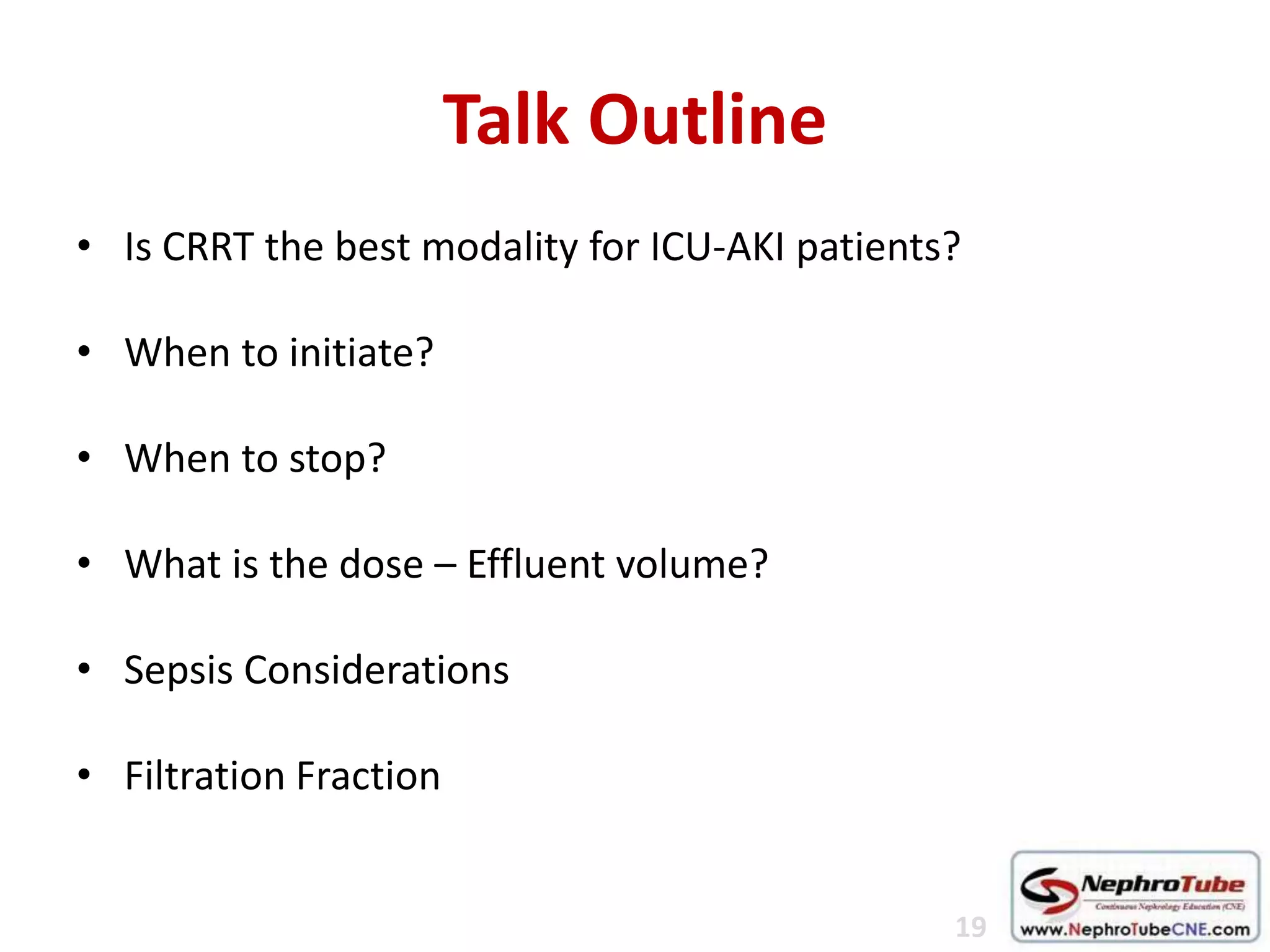
Talk Outline
• Is CRRT the best modality for ICU-AKI patients?
• When to initiate?
• When to stop?
• What is the dose – Effluent volume?
• Sepsis Considerations
• Filtration Fraction
19
Talk Outline
• Is CRRT the best modality for ICU-AKI patients?
• When to initiate?
• When to stop?
• What is the dose – Effluent volume?
• Sepsis Considerations
• Filtration Fraction
19
Marshall MR, Golper TA. Semin Dial. 2011;24:142-148.Marshall MR, Golper TA. Semin Dial. 2011;24:142-148.
Talk Outline
• Is CRRT the best modality for ICU-AKI patients?
• When to initiate?
• When to stop?
• What is the dose – Effluent volume?
• Sepsis Considerations
• Filtration Fraction
Haemodynamic Stability !!!
ICP !!! 19
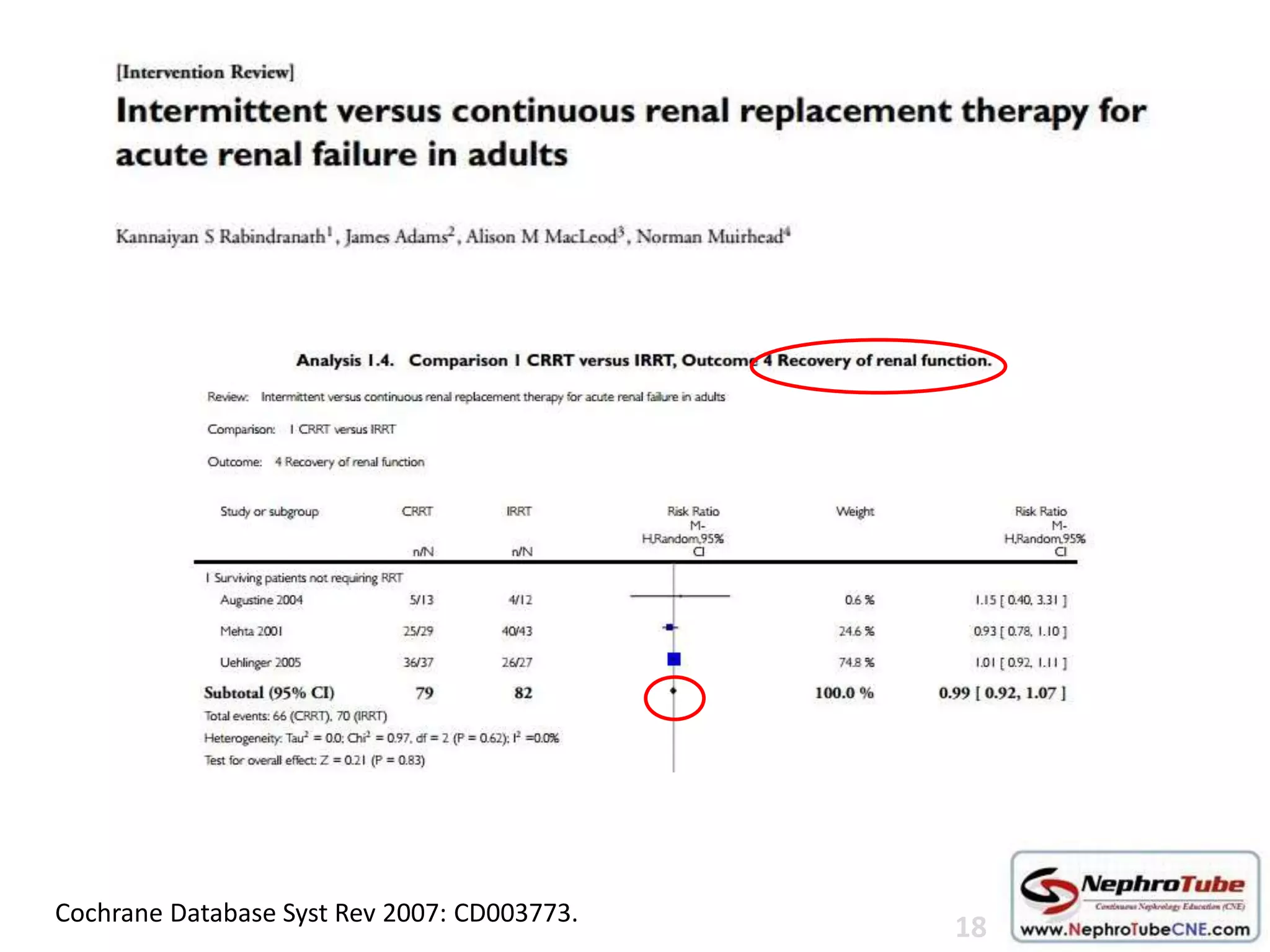
Analyzing 15 RCTs in 1550 AKI patients
CRRT vs IRRT
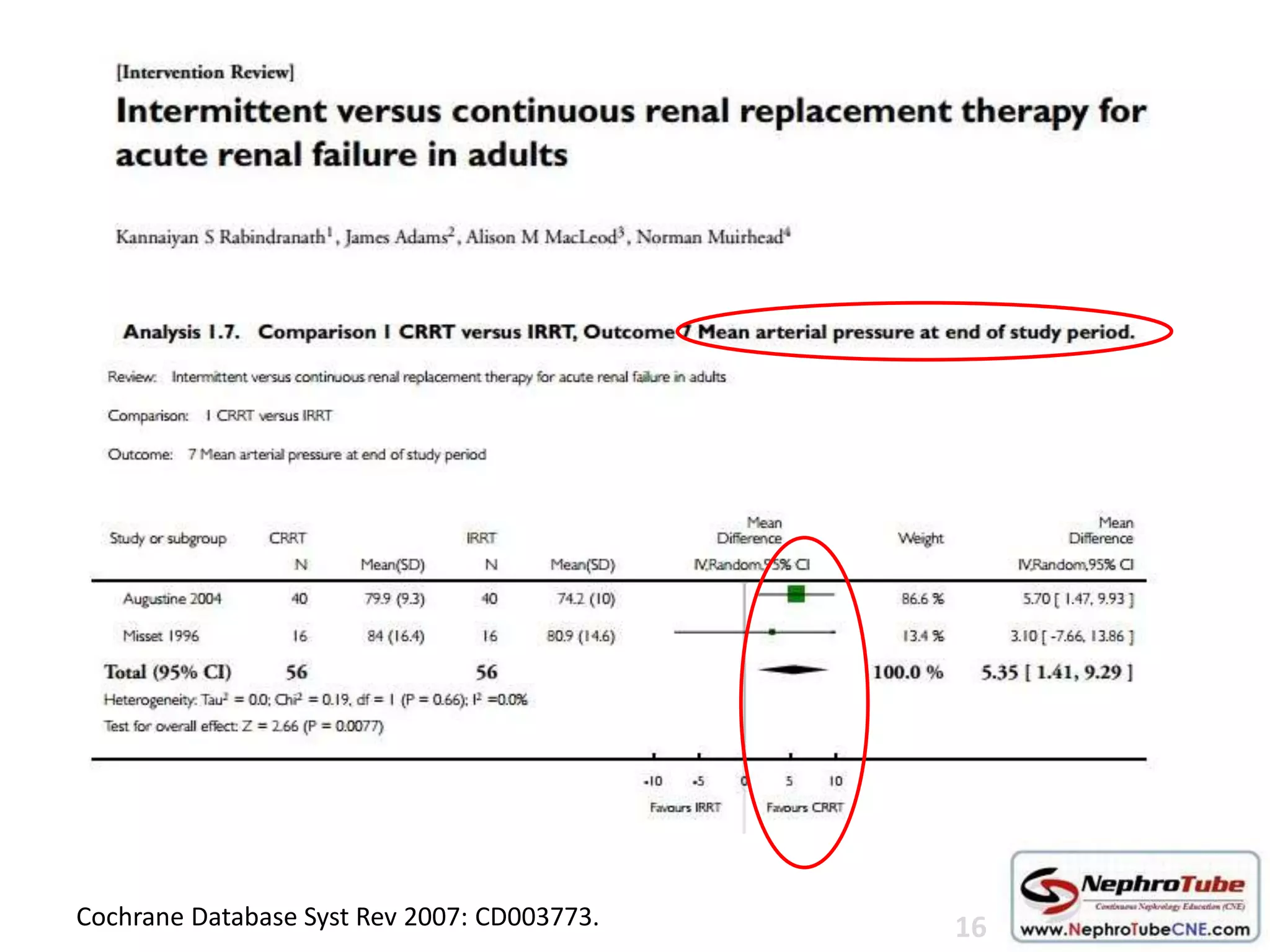
Cochrane Database Syst Rev 2007: CD003773.
19
Cochrane Database Syst Rev 2007: CD003773.
18
Cochrane Database Syst Rev 2007: CD003773.
18
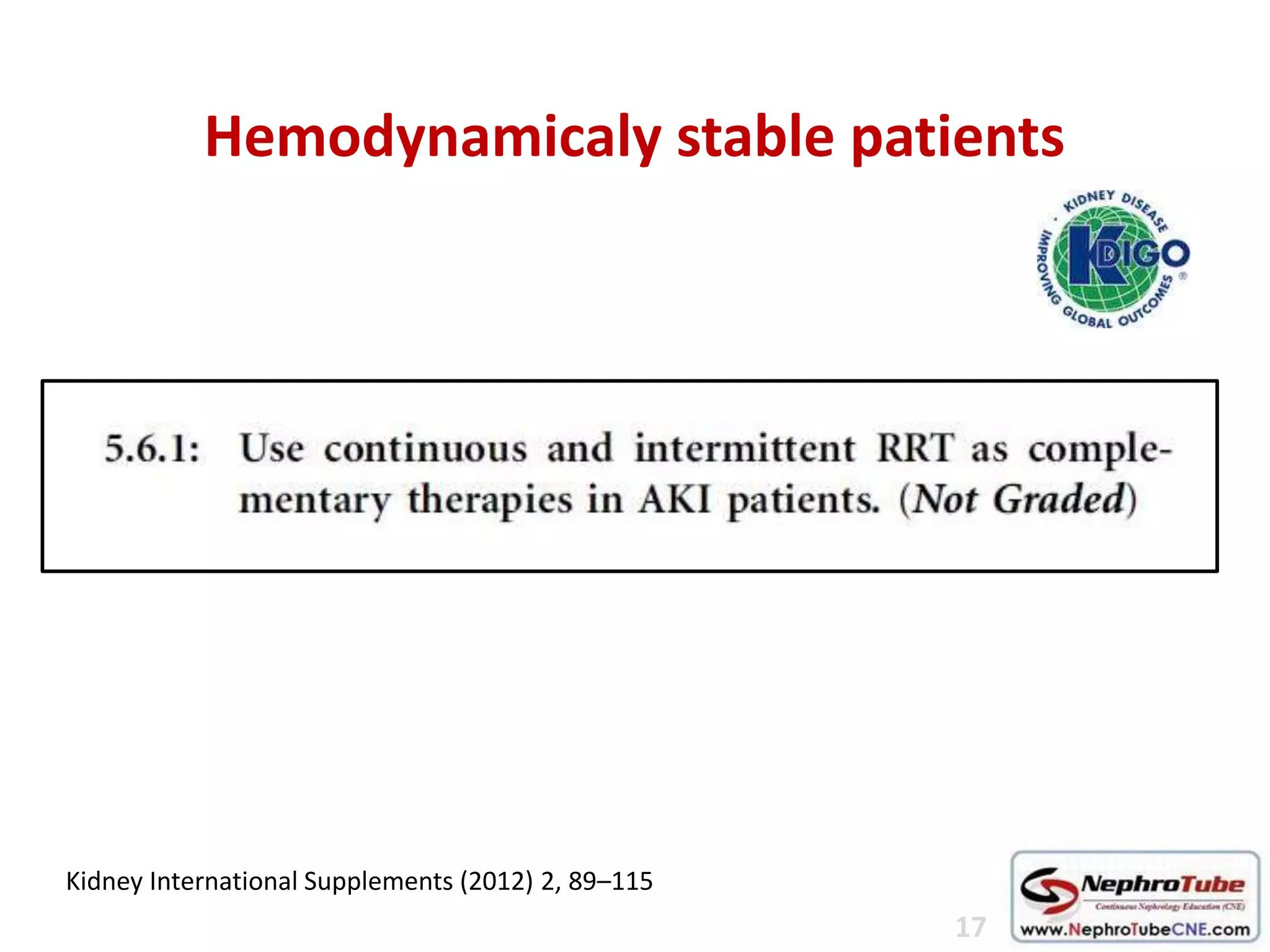
Kidney International Supplements (2012) 2, 89–115
Hemodynamicaly stable patients
17
Kidney International Supplements (2012) 2, 89–115
Hemodynamicaly unstable patients / ↑ ICP
17
Cochrane Database Syst Rev 2007: CD003773. 16
• In current clinical practice, the choice of the initial
modality for RRT is primarily based on:
– the availability
– experience
– patient’s hemodynamic status.
• SLED may also be tolerated in hemodynamically
unstable patients with AKI in settings where other
forms of CRRT are not available, (but data on
comparative efficacy and harm are limited).
Marshall MR et al. Nephrol Dial Transplant 2011; 26:2169–2175.
16
Talk Outline
• Is CRRT the best modality for ICU-AKI patients?
• When to initiate?
• When to stop?
• What is the dose – Effluent volume?
• Sepsis Considerations
• Filtration Fraction
16
Talk Outline
• Is CRRT the best modality for ICU-AKI patients?
• When to initiate?
• When to stop?
• What is the dose – Effluent volume?
• Sepsis Considerations
• Filtration Fraction
15
When to initiate? Early vs Late
What is meant by EARLY?
What is meant by LATE?
Studies aimed at determining the optimal time for starting
RRT have evaluated various arbitrary cut-offs for:
• serum creatinine
• serum urea
• urine output
• time from ICU admission or duration of AKI
15
When to initiate? Early vs Late
What is meant by EARLY?
What is meant by LATE?
Studies aimed at determining the optimal time for starting
RRT have evaluated various arbitrary cut-offs for:
• serum creatinine
• serum urea
• urine output
• time from ICU admission or duration of AKI
15
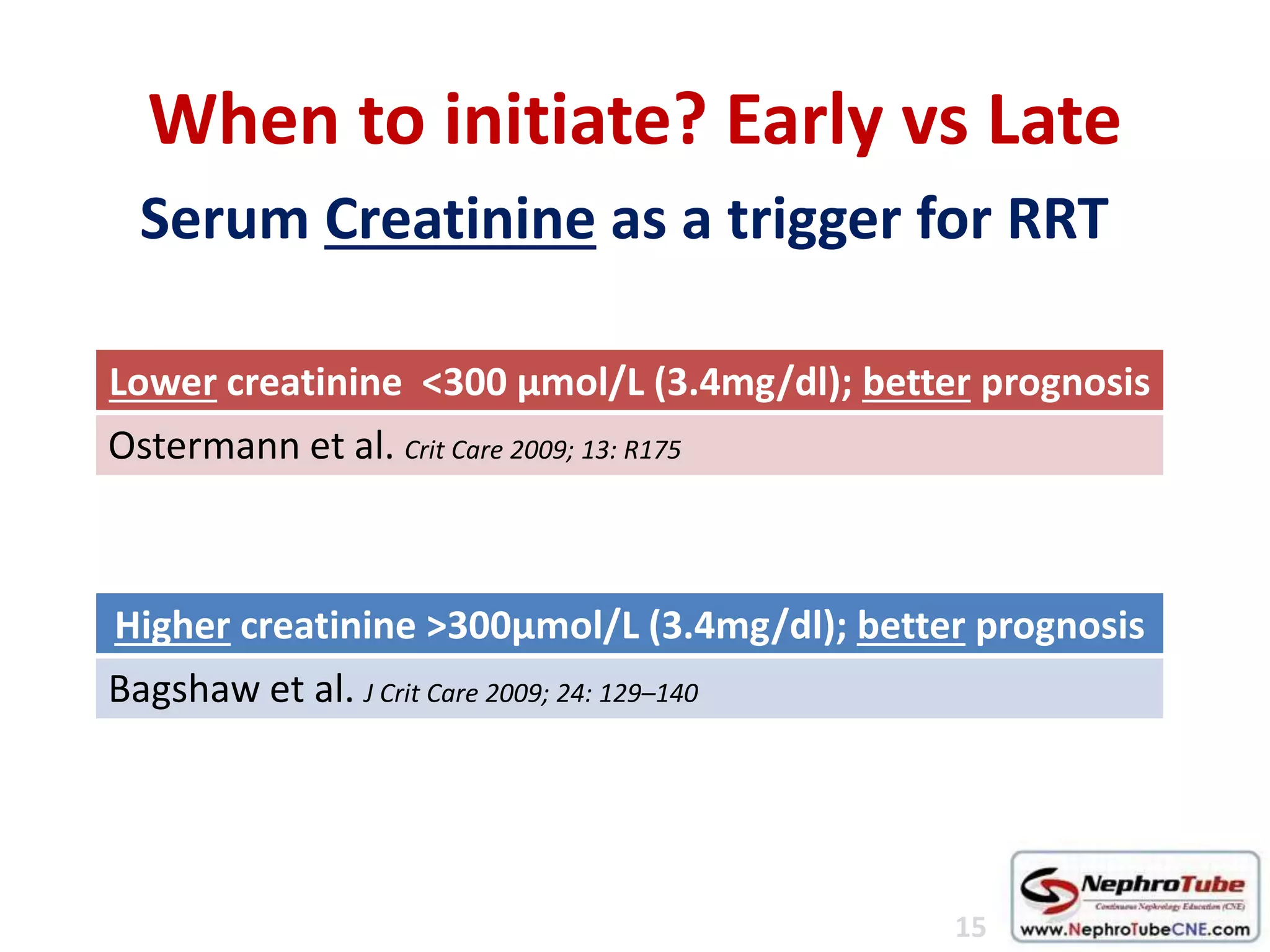
Serum Creatinine as a trigger for RRT
When to initiate? Early vs Late
Higher creatinine >300μmol/L (3.4mg/dl); better prognosis
Bagshaw et al. J Crit Care 2009; 24: 129–140
Lower creatinine <300 μmol/L (3.4mg/dl); better prognosis
Ostermann et al. Crit Care 2009; 13: R175
15
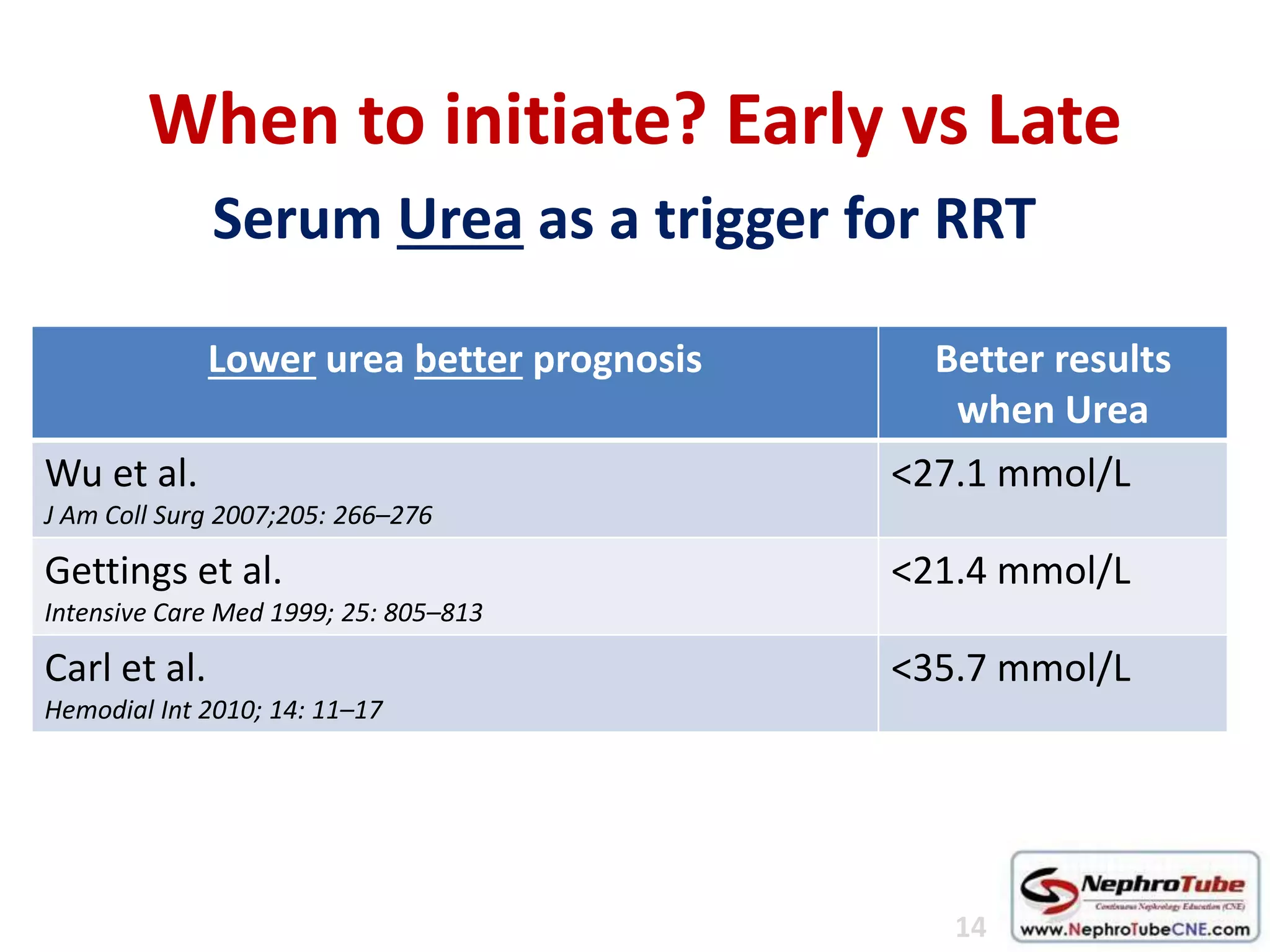
Serum Urea as a trigger for RRT
When to initiate? Early vs Late
Lower urea better prognosis Better results
when Urea
Wu et al.
J Am Coll Surg 2007;205: 266–276
<27.1 mmol/L
Gettings et al.
Intensive Care Med 1999; 25: 805–813
<21.4 mmol/L
Carl et al.
Hemodial Int 2010; 14: 11–17
<35.7 mmol/L
14
RIFLE as a trigger for RRT
When to initiate? Early vs Late
Lower RIFLE better prognosis
Shiao et al. Crit Care 2009; 13: R171
Similar prognosis across RIFLE categories
Chou et al. Crit Care 2011; 15: R134
14
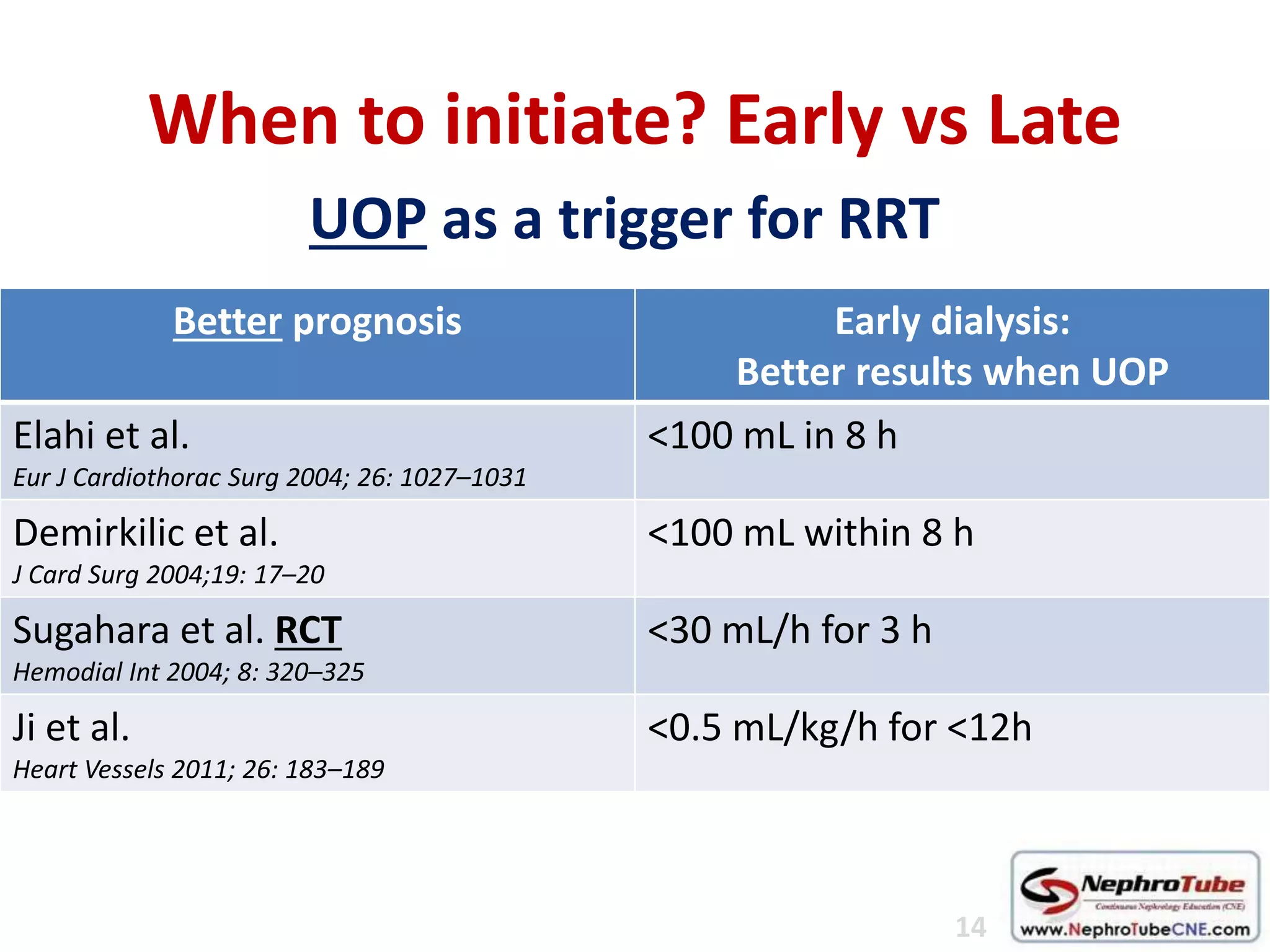
UOP as a trigger for RRT
When to initiate? Early vs Late
Better prognosis Early dialysis:
Better results when UOP
Elahi et al.
Eur J Cardiothorac Surg 2004; 26: 1027–1031
<100 mL in 8 h
Demirkilic et al.
J Card Surg 2004;19: 17–20
<100 mL within 8 h
Sugahara et al. RCT
Hemodial Int 2004; 8: 320–325
<30 mL/h for 3 h
Ji et al.
Heart Vessels 2011; 26: 183–189
<0.5 mL/kg/h for <12h
14
UOP as a trigger for RRT
When to initiate? Early vs Late
Similar prognosis across UOP
different volumes
Early dialysis defined when
UOP
Bouman et al. RCT
Crit Care Med 2002; 30:2205–2211
<30 mL/h for 6 h
and creatinine clearance <20 mL/min
Iyem et al.
Hemodial Int 2009; 13: 55–61
0.5 mL/kg/h
and a 50% increase in preoperative
urea and creatinine
13
The optimal timing of dialysis for
AKI is not defined
• Fluid overload (refractory to medical measures)
• Hyperkalemia (refractory to medical measures)
• Severe metabolic acidosis (refractory to medical measures)
• Signs of uremia (such as pericarditis, neuropathy, or an otherwise
unexplained decline in mental status)
• Certain alcohol and drug intoxications
Kidney International Supplements (2012) 2, 89–115 13
Kidney International Supplements (2012) 2, 19–36
13
• Considered RRT:
– Urea  21 mmol/L (60 mg/dl)
– Volume overload
– Persistent hyperkalemia (K+ > 6.2 mEq/L or ECG changes)
– Severe metabolic acidosis (pH < 7.20)
– Uremic signs or symptoms Palevsky PM et al. N Engl J Med. 2008;359:7-20
ATN
• Considered RRT:
– Oliguria: urine output <100 ml
in 6h
– Urea >70 mg/dl
– Creatinine >3.5 mg/dl
– Potassium > 6.5 mmol/L
– pH <7.2
– Clinically significant organ
edema
Bellomo R, Cass A, Cole L, et al. N Engl J Med 2009; 361:
1627–1638.
RENAL
12
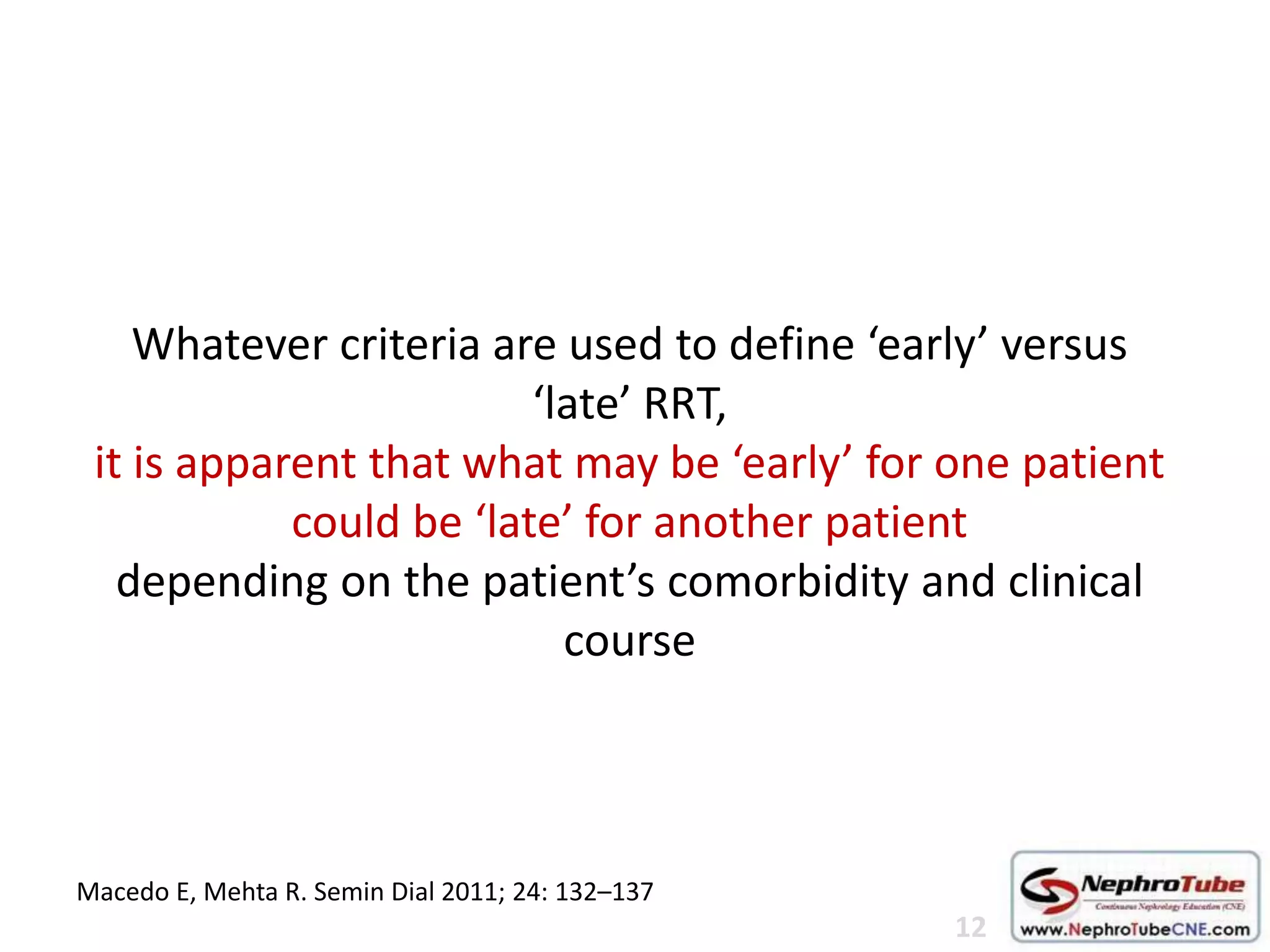
Whatever criteria are used to define ‘early’ versus
‘late’ RRT,
it is apparent that what may be ‘early’ for one patient
could be ‘late’ for another patient
depending on the patient’s comorbidity and clinical
course
Macedo E, Mehta R. Semin Dial 2011; 24: 132–137
12
Kidney International Supplements (2012) 2, 89–115
Other factors that might influence the decision of when to
start RRT are:
• the severity of the underlying disease (affecting the likelihood of
recovery of kidney function),
• the degree of dysfunction in other organs (affecting the tolerance
e.g., fluid overload),
• the prevalent or expected solute burden (e.g.,in tumor lysis
syndrome),
• the need for fluid input related to nutrition or drug therapy
11
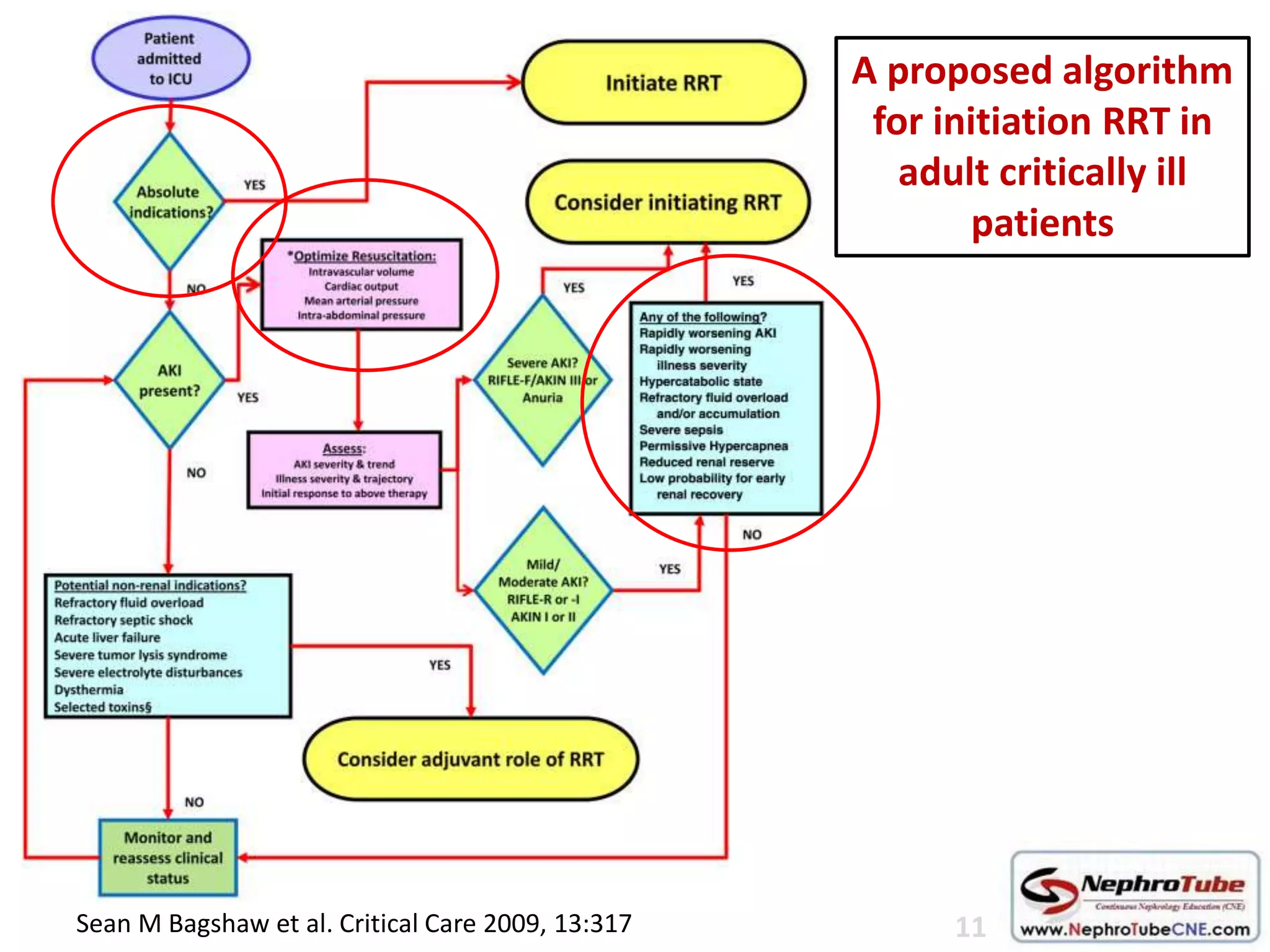
Sean M Bagshaw et al. Critical Care 2009, 13:317
A proposed algorithm
for initiation RRT in
adult critically ill
patients
11
What is the most important to be
early?
• AKI diagnosis?
• Initiation of RRT?
11
Talk Outline
• Is CRRT the best modality for ICU-AKI patients?
• When to initiate?
• When to stop?
• What is the dose – Effluent volume?
• Sepsis Considerations
• Filtration Fraction
11
Talk Outline
• Is CRRT the best modality for ICU-AKI patients?
• When to initiate?
• When to stop?
• What is the dose – Effluent volume?
• Sepsis Considerations
• Filtration Fraction
10
When to Stop?
Kidney International Supplements (2012) 2, 89–115
Creatinine Clearance
Urine Output
10
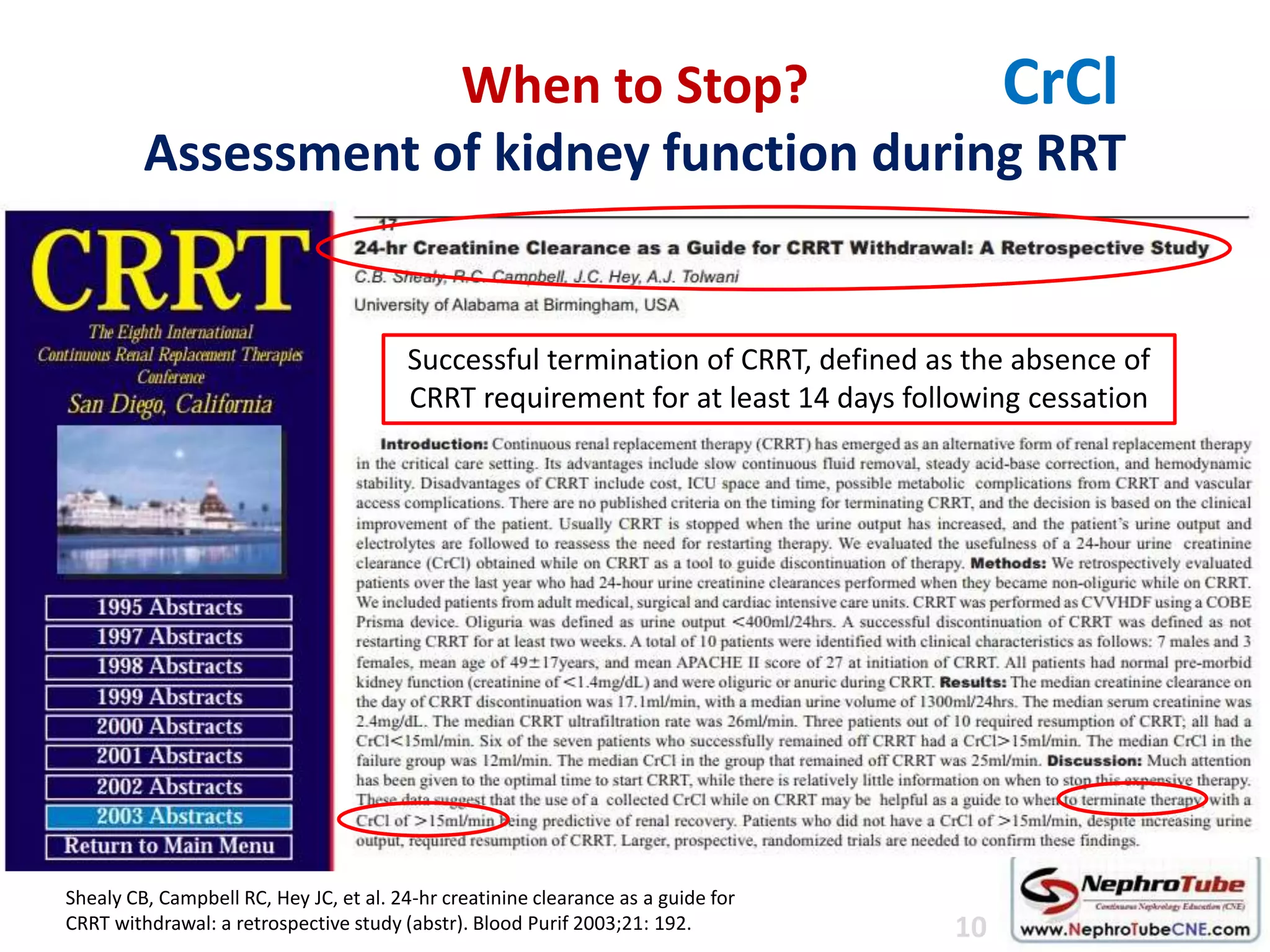
When to Stop?
Assessment of kidney function during RRT
Shealy CB, Campbell RC, Hey JC, et al. 24-hr creatinine clearance as a guide for
CRRT withdrawal: a retrospective study (abstr). Blood Purif 2003;21: 192.
Successful termination of CRRT, defined as the absence of
CRRT requirement for at least 14 days following cessation
10
CrCl
When to Stop?
Assessment of kidney function during RRT
CrCl RRT
<12 mL/min RRT was continued
12 to 20 mL/min Decision was left to the discretion of
providers
> 20 mL/min RRT was discontinued
Palevsky PM et al. N Engl J Med. 2008;359:7-20
10
ATN
CrCl
When to Stop?
Assessment of kidney function during RRT
Palevsky PM et al. N Engl J Med. 2008;359:7-20
When the UOP > 30 mL/hour
CrCl Assessment methodology
1 hr 3hr 6h
Urine
collection
9
CrCl
When to Stop?
Assessment of kidney function during RRT
Palevsky PM et al. N Engl J Med. 2008;359:7-20
When the UOP > 30 mL/hour
CrCl Assessment methodology
1 hr 3hr 6h
Urine
collection
Midpoint
serum Cr
9
CrCl
When to Stop?
Assessment of kidney function during RRT
Palevsky PM et al. N Engl J Med. 2008;359:7-20
When the UOP > 30 mL/hour
CrCl Assessment methodology
1 hr 3hr 6h
Urine
collection
serum Cr serum Cr
Average serum Cr
9
CrCl
When to Stop?
Assessment of kidney function during RRT
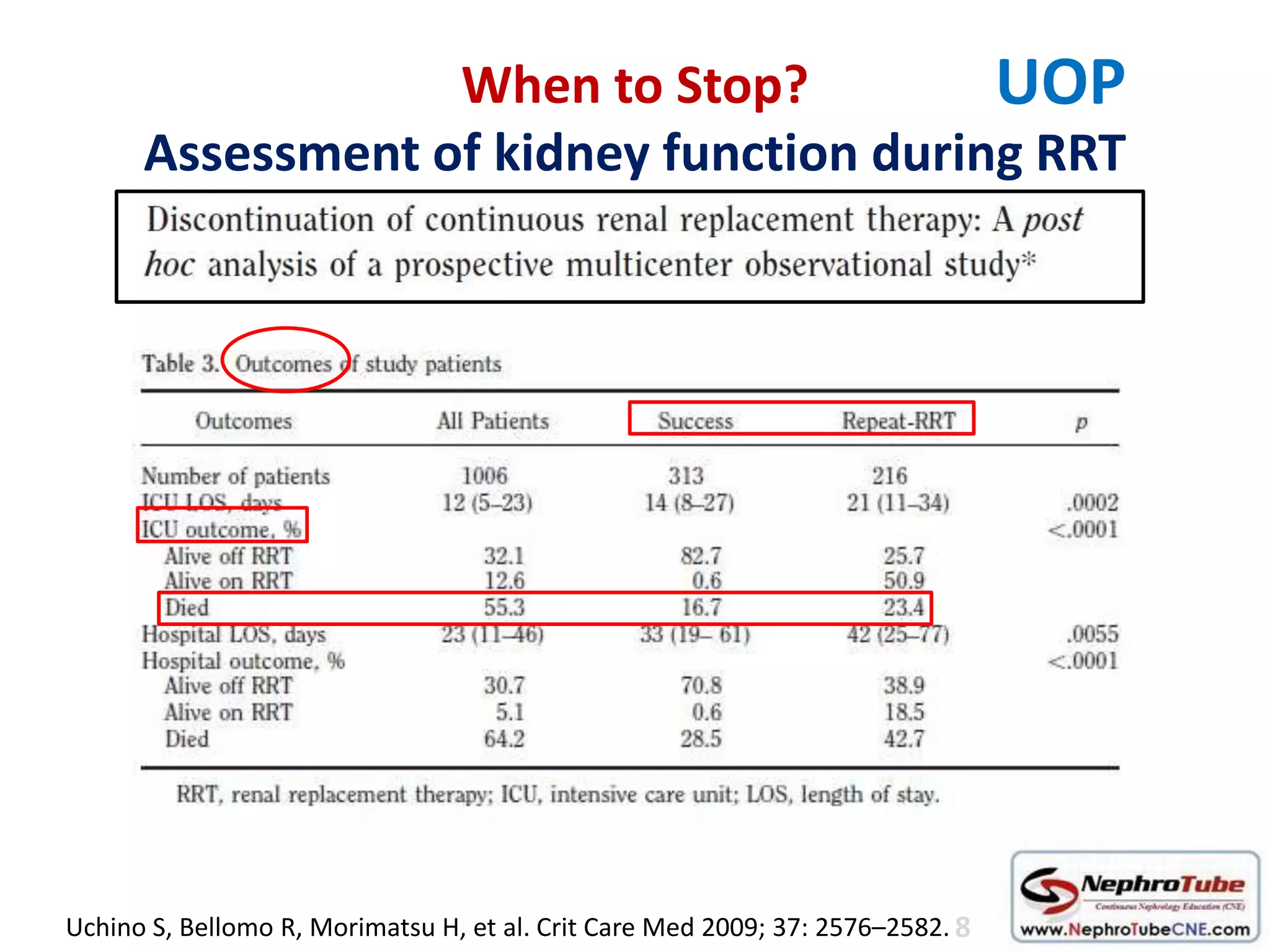
Uchino S, Bellomo R, Morimatsu H, et al. Crit Care Med 2009; 37: 2576–2582. 9
UOP
When to Stop?
Assessment of kidney function during RRT
Uchino S, Bellomo R, Morimatsu H, et al. Crit Care Med 2009; 37: 2576–2582. 9
UOP
When to Stop?
Assessment of kidney function during RRT
Uchino S, Bellomo R, Morimatsu H, et al. Crit Care Med 2009; 37: 2576–2582. 8
UOP
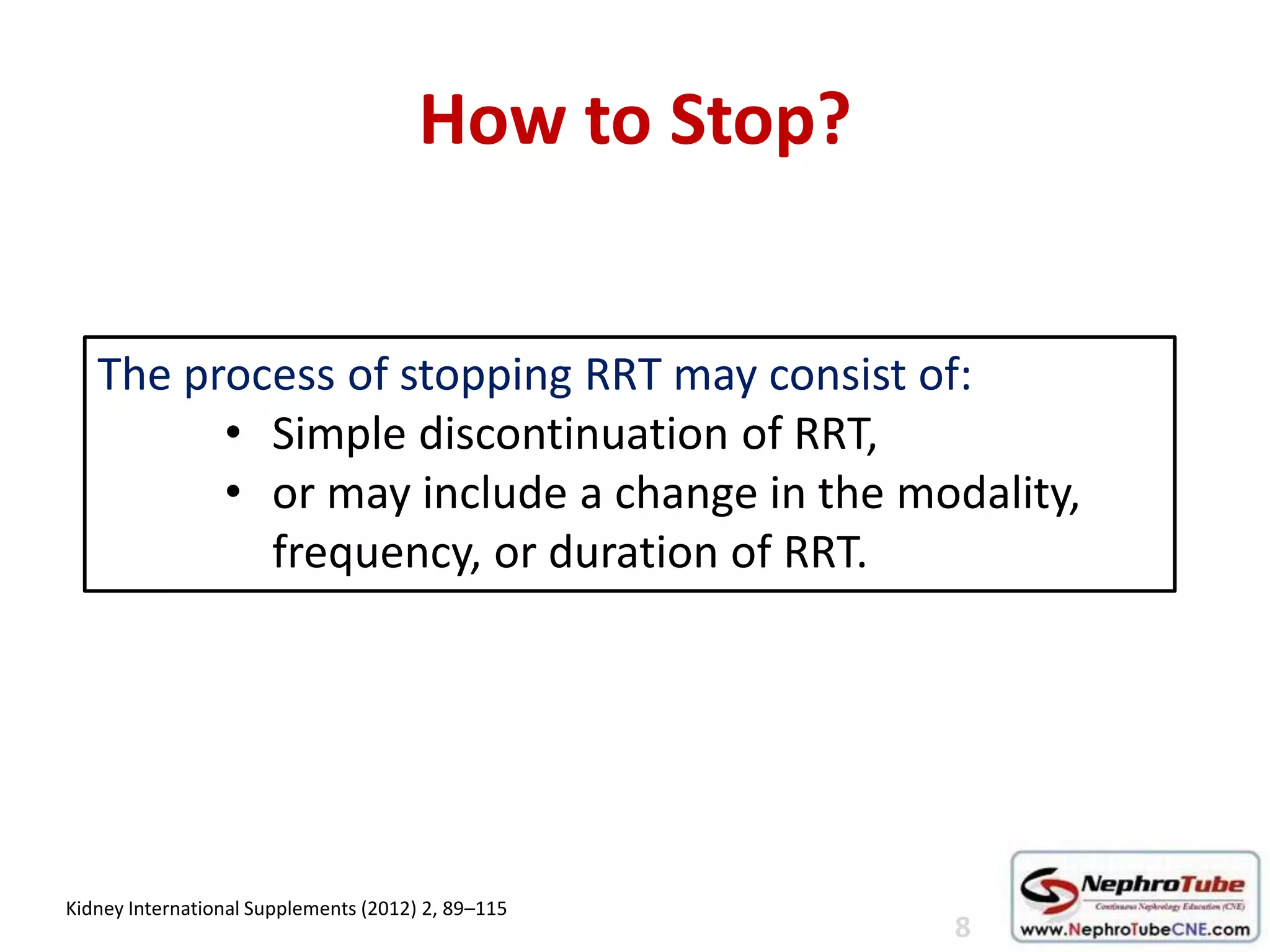
How to Stop?
The process of stopping RRT may consist of:
• Simple discontinuation of RRT,
• or may include a change in the modality,
frequency, or duration of RRT.
Kidney International Supplements (2012) 2, 89–115
8
When to Stop?
Kidney International Supplements (2012) 2, 89–115
It is also important to acknowledge that there may
be patients with a futile prognosis in whom RRT
would not be appropriate and where withholding
RRT constitutes good end-of-life care
Lassnigg A, Schmidlin D, Mouhieddine M et al. J Am Soc Nephrol 2004; 15:1597–1605
7
Talk Outline
• Is CRRT the best modality for ICU-AKI patients?
• When to initiate?
• When to stop?
• What is the dose – Effluent volume?
• Sepsis Considerations
• Filtration Fraction
7
Talk Outline
• Is CRRT the best modality for ICU-AKI patients?
• When to initiate?
• When to stop?
• What is the dose – Effluent volume?
• Sepsis Considerations
• Filtration Fraction
7
The Dose – Effluent Volume
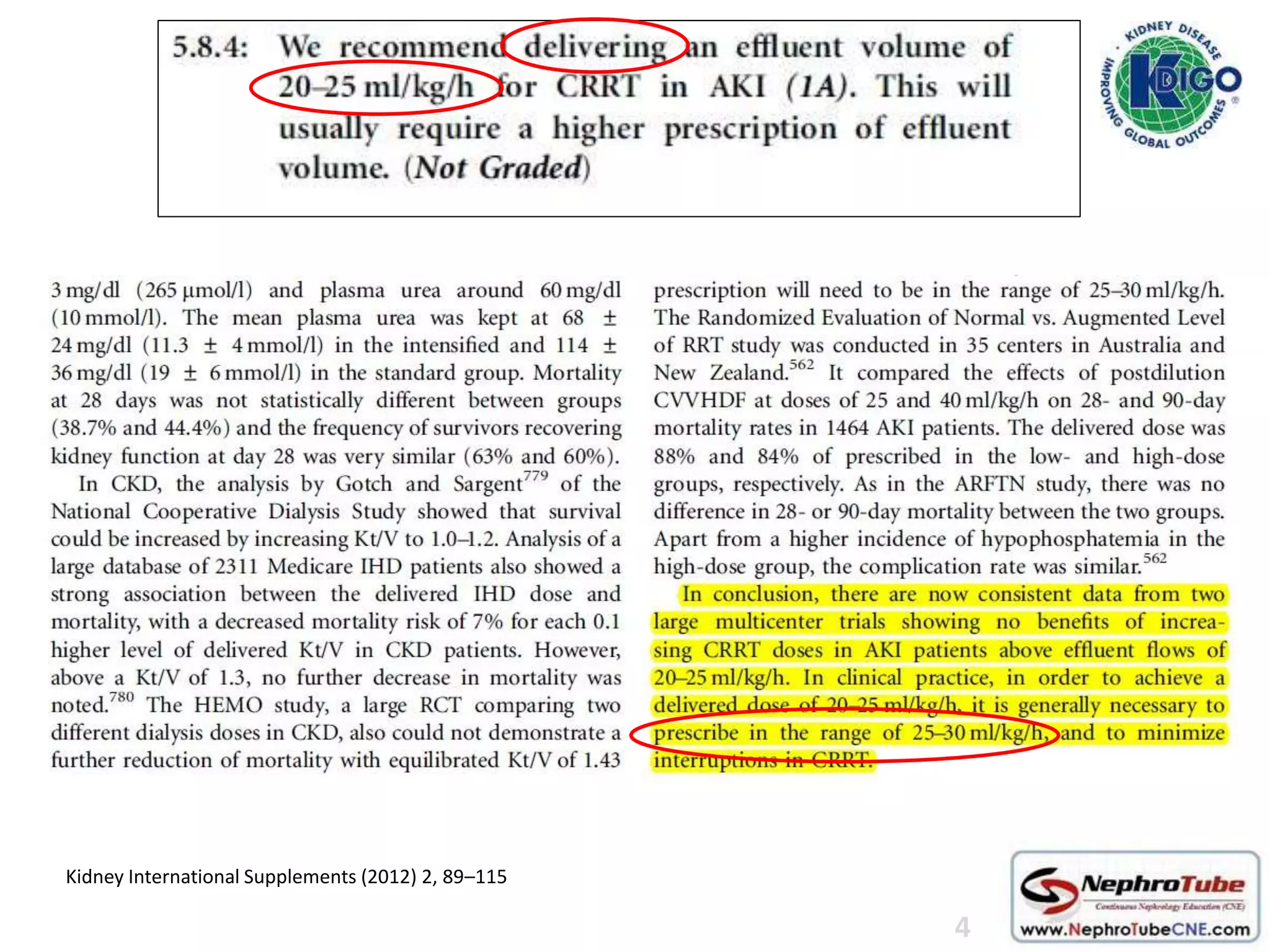
Kidney International Supplements (2012) 2, 89–115
6
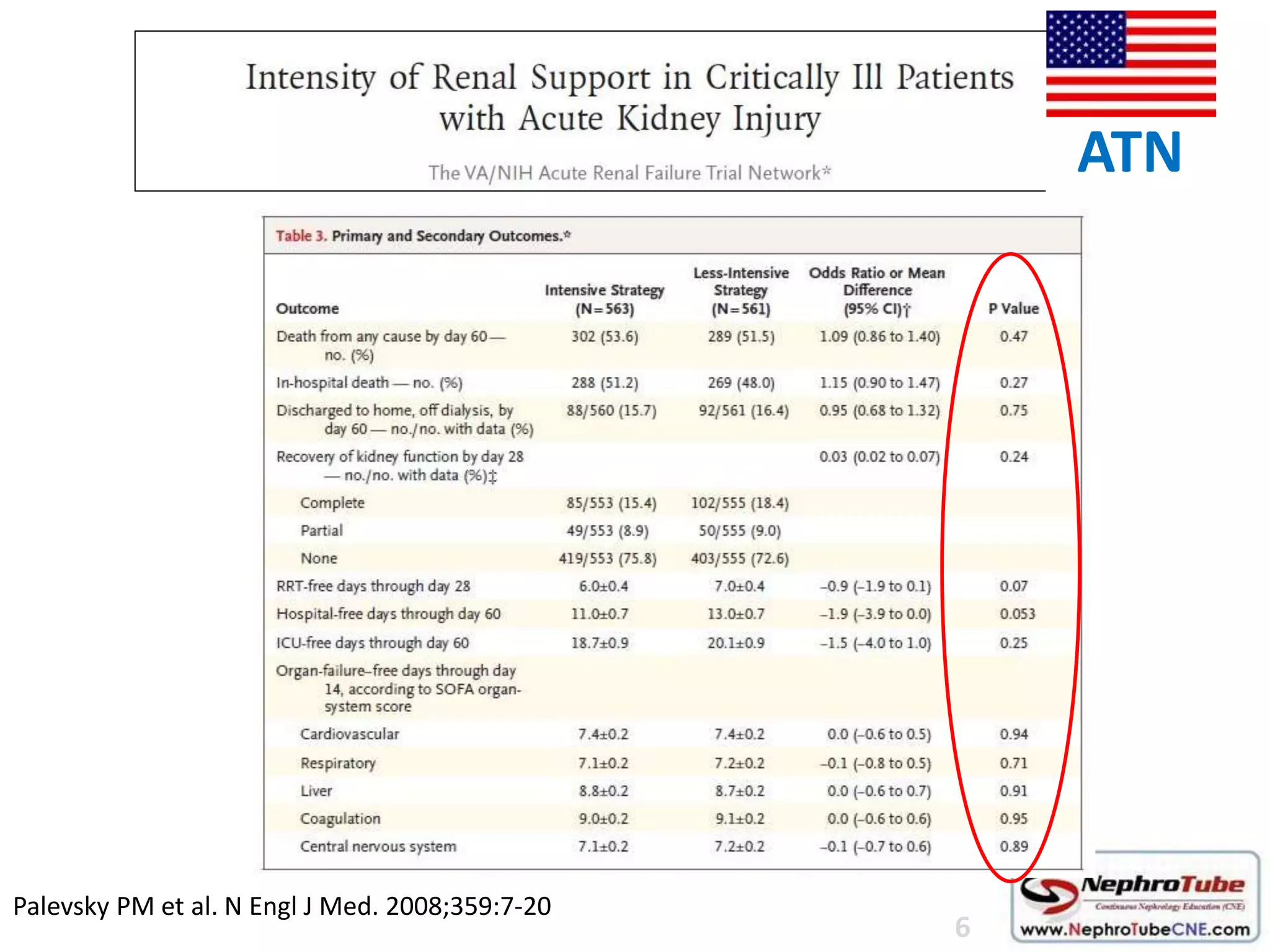
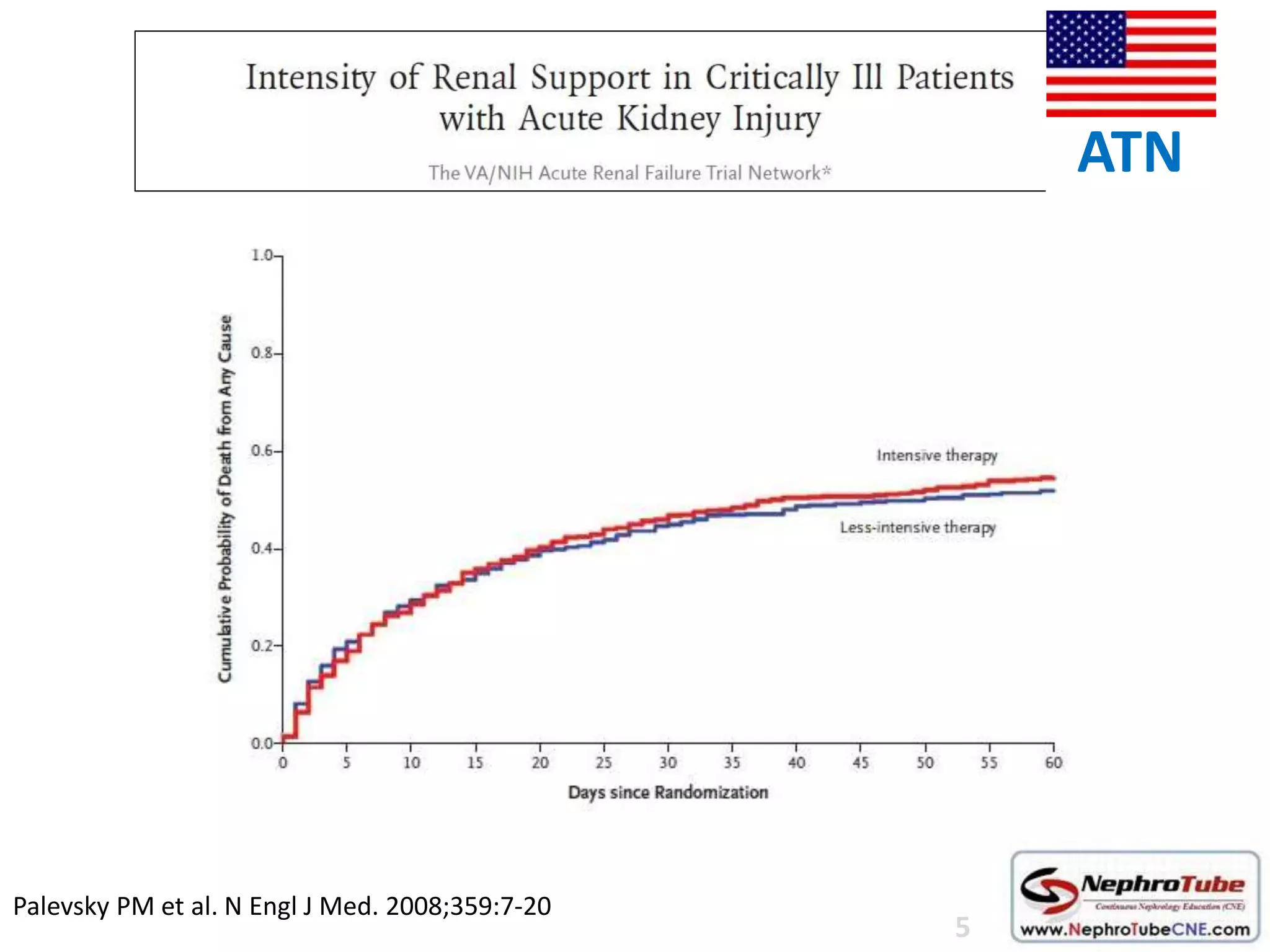
Palevsky PM et al. N Engl J Med. 2008;359:7-20
6
ATN
RENAL
Bellomo R, Cass A, Cole L, et al. N Engl J Med 2009; 361: 1627–1638.
Palevsky PM et al. N Engl J Med. 2008;359:7-20
6
ATN
VA/NIH Acute Renal Failure Trial Network, Palevsky PM et al. N Engl J Med. 2008;359:7-20Palevsky PM et al. N Engl J Med. 2008;359:7-20
5
ATN
Bellomo R, Cass A, Cole L, et al. N Engl J Med 2009; 361: 1627–1638.
5
RENAL
Kidney International Supplements (2012) 2, 89–115
4
Talk Outline
• Is CRRT the best modality for ICU-AKI patients?
• When to initiate?
• When to stop?
• What is the dose – Effluent volume?
• Sepsis Considerations
• Filtration Fraction
4
Talk Outline
• Is CRRT the best modality for ICU-AKI patients?
• When to initiate?
• When to stop?
• What is the dose – Effluent volume?
• Sepsis Considerations
• Filtration Fraction
4
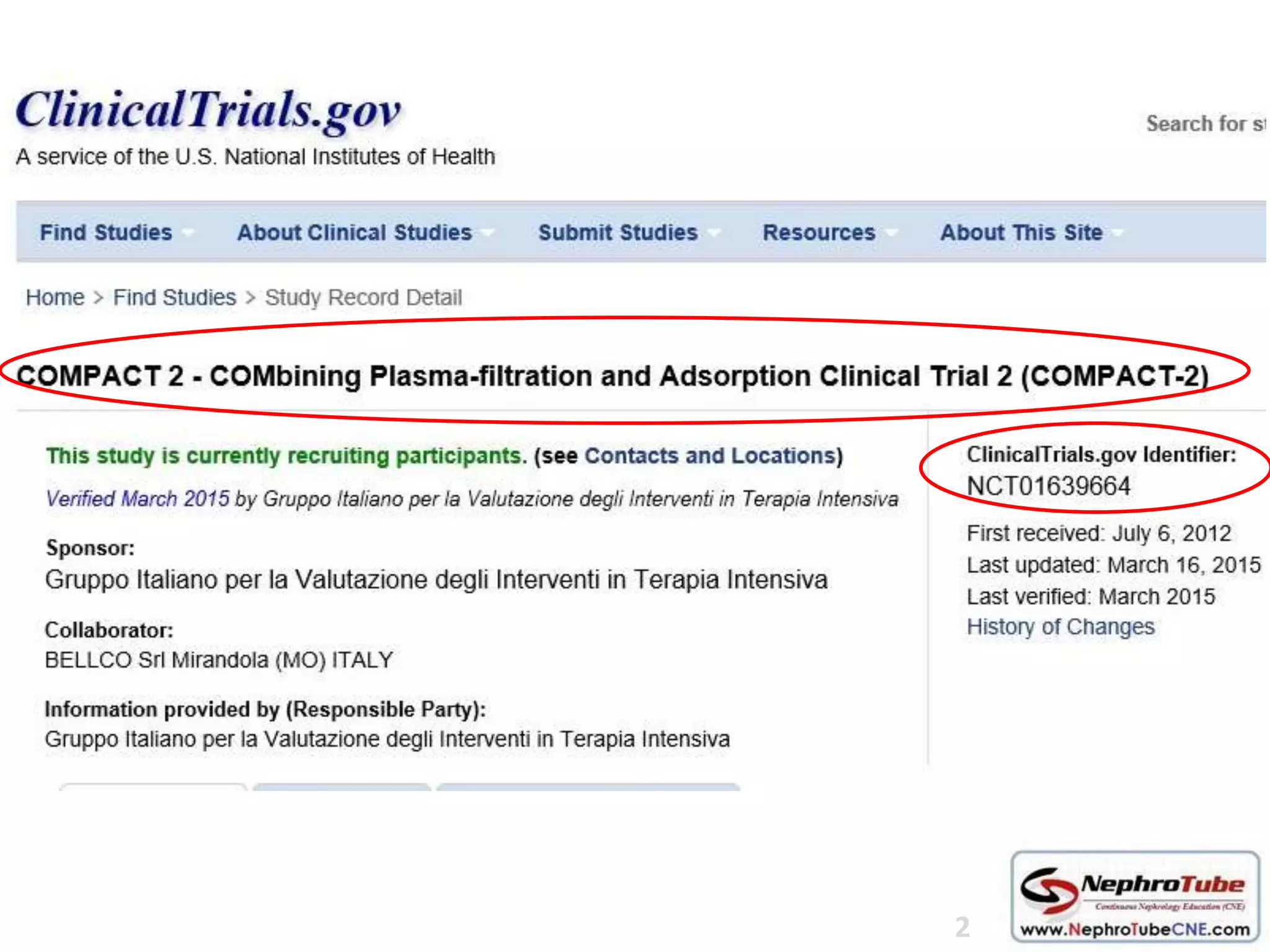
Joannes-Boyau O et al. Intensive Care Med. 2013 Sep;39(9):1535-46
3
Joannes-Boyau O et al. Intensive Care Med. 2013 Sep;39(9):1535-46
3
Coupled plasma filtration and
adsorption (CPFA)
+ CRRT
Plasma
filtration:
Plasma filter
separates
plasma from
blood
Plasma
Adsorption:
Plasma is then
passed through
a synthetic resin
cartridge
CRRT:
Plasma
returned to
blood to pass
through blood
filter
CPFA - Adsorption
Very effective in removing
large solutes 3
CRRT
Removes excess fluid
and small-MW toxins
Ronco et al. Critical Care (2015) 19:146
2
Talk Outline
• Is CRRT the best modality for ICU-AKI patients?
• When to initiate?
• When to stop?
• What is the dose – Effluent volume?
• Sepsis Considerations
• Filtration Fraction
2
Talk Outline
• Is CRRT the best modality for ICU-AKI patients?
• When to initiate?
• When to stop?
• What is the dose – Effluent volume?
• Sepsis Considerations
• Filtration Fraction
2
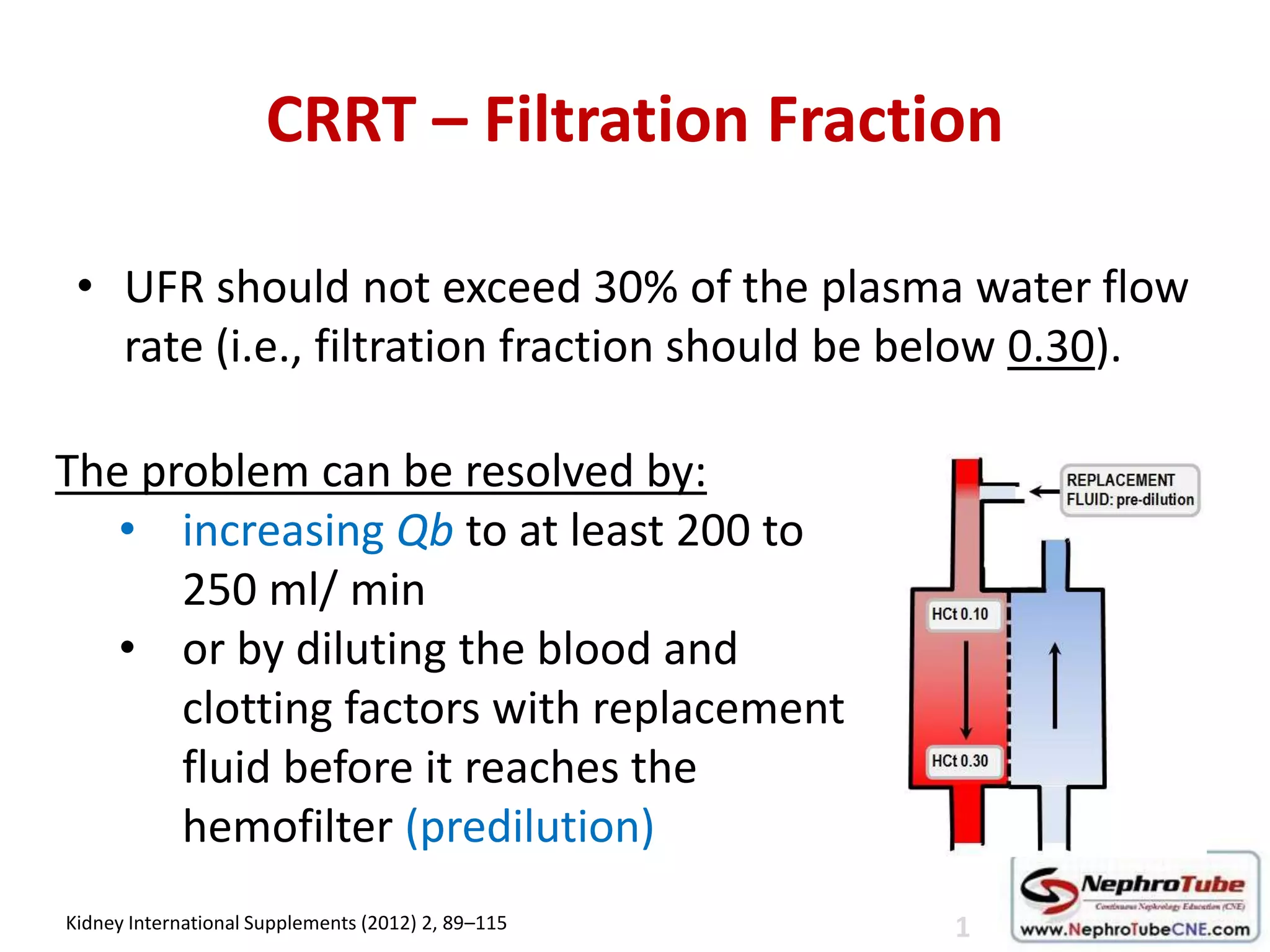
CRRT – Filtration Fraction
• UFR should not exceed 30% of the plasma water flow
rate (i.e., filtration fraction should be below 0.30).
• The problem can be resolved by:
– increasing Qb to at least 200 to 250 ml/ min
– or by diluting the blood and clotting factors with
replacement fluid before it reaches the hemofilter
(predilution)
1
Kidney International Supplements (2012) 2, 89–115
CRRT – Filtration Fraction
• UFR should not exceed 30% of the plasma water flow
rate (i.e., filtration fraction should be below 0.30).
1Kidney International Supplements (2012) 2, 89–115
The problem can be resolved by:
• increasing Qb to at least 200 to
250 ml/ min
• or by diluting the blood and
clotting factors with replacement
fluid before it reaches the
hemofilter (predilution)
Avoid extra-
corporeal
clotting
CRRT – Filtration Fraction
• UFR should not exceed 30% of the plasma water flow
rate (i.e., filtration fraction should be below 0.30).
1Kidney International Supplements (2012) 2, 89–115
The problem can be resolved by:
• increasing Qb to at least 200 to
250 ml/ min
• or by diluting the blood and
clotting factors with replacement
fluid before it reaches the
hemofilter (predilution)
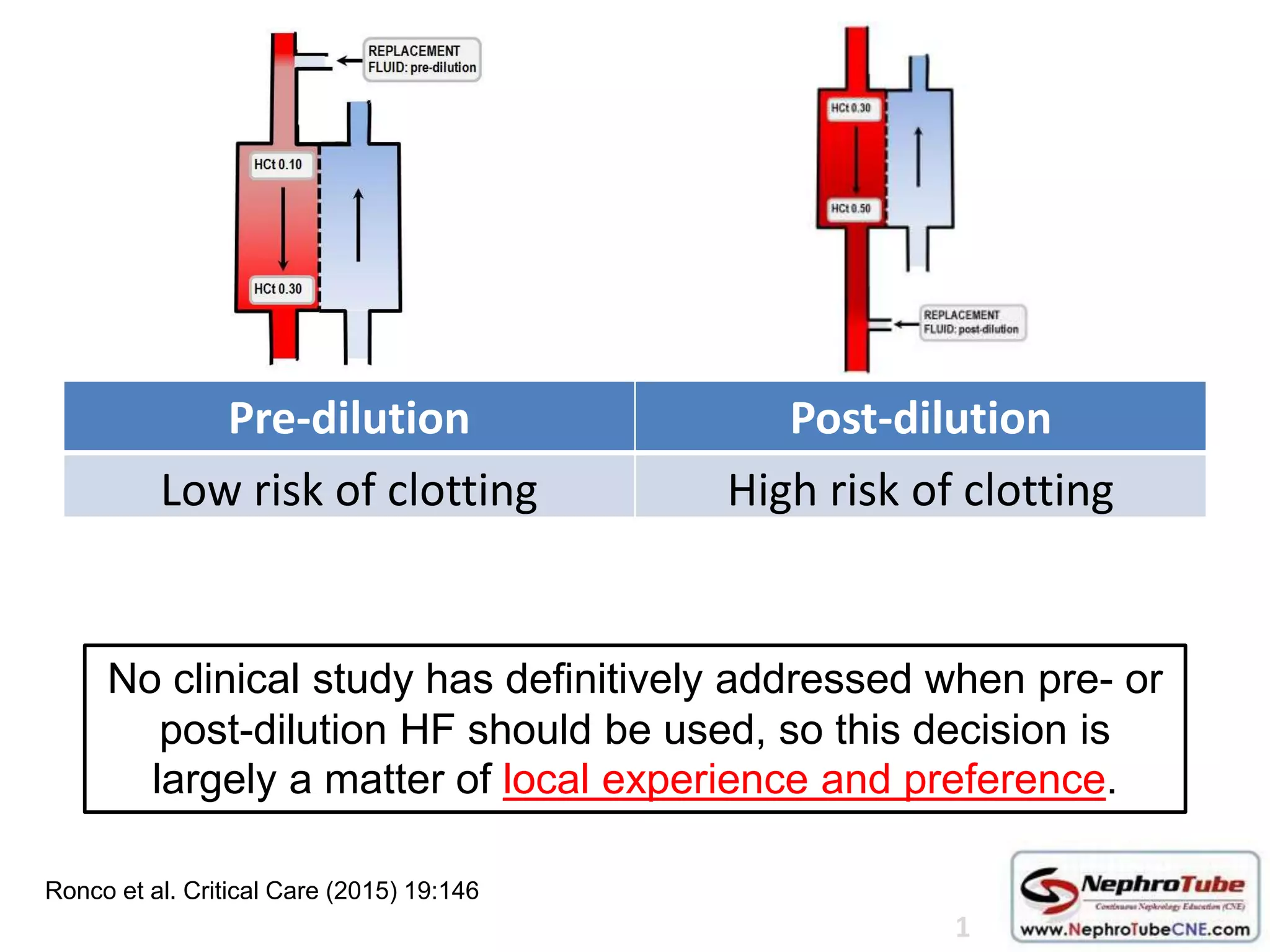
Pre-dilution Post-dilution
Low risk of clotting High risk of clotting
less efficient More efficient
No clinical study has definitively addressed when pre- or
post-dilution HF should be used, so this decision is
largely a matter of local experience and preference.
Ronco et al. Critical Care (2015) 19:146
1
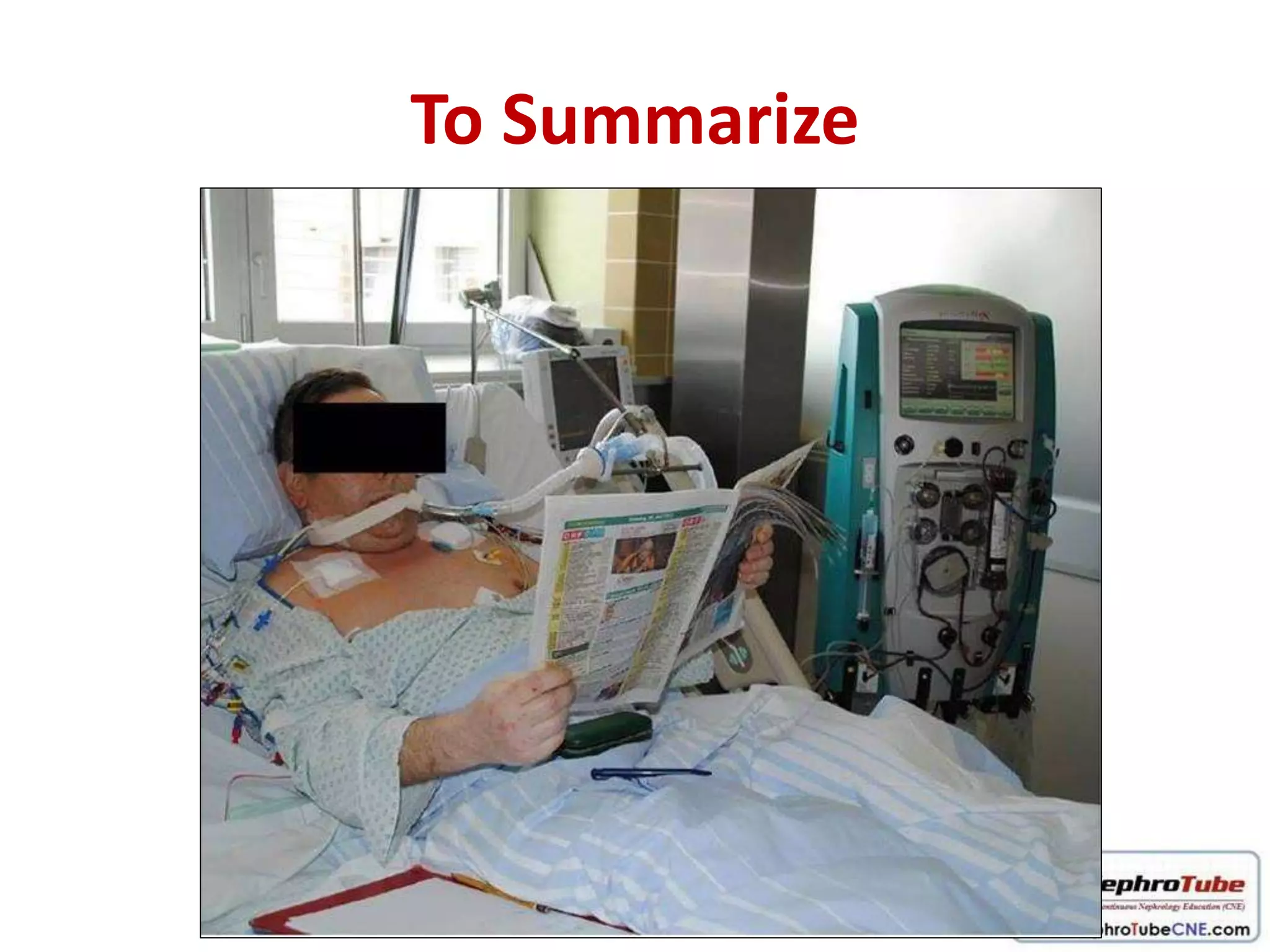
To Summarize
1
To Summarize
• Hemodynamic stable = IRRT & CRRT no
difference regarding outcomes
• Hemodynamic unstable/↑ICP = CRRT is
preferred
1
To Summarize
• Emergency indication = Start RRT immediately
• If No Emergency indication consider:
– broader clinical context
– laboratory trends rather than single values
0
To Summarize
• Early AKI diagnosis ensures early effective
management
• Late AKI diagnosis = Always late initiation of
RRT
0
To Summarize
• Stop CRRT when CrCl > 15-20ml/min (weak
evidence)
• UOP is an important parameter when
termination of CRRT is considered
0
To Summarize
• CRRT Dose
= Delivered effluent volume of 20-25ml/kg/hr
= Prescribed effluent volume of 25-30ml/kg/hr
• Filtration fraction during CRRT must be < 30%
0
To Summarize
• No evidence that septic shock patients will
benefit from higher effluent volumes
• Plasma Adsorption may have an important
role in management of septic AKI patients
0
To download the lecture please
contact me on drgawad@gmail.com
For more lectures please visit
www.NephroTubeCNE.com
Gawad
Thank You

CRRT in ICU - AKI - Dr. Gawad

  • 1.
    CRRT in ICU– AKI What is the Evidence? Mohammed Abdel Gawad Nephrology Specialist Kidney & Urology Center (KUC) Alexandria – EGY drgawad@gmail.com The Annual Egyptian Dialysis Conference 10-11, September, 2015
  • 2.
    To download thelecture please contact me on drgawad@gmail.com For more lectures please visit www.NephroTubeCNE.com
  • 3.
    Talk Outline • IsCRRT the best modality for ICU-AKI patients? • When to initiate? • When to stop? • What is the dose – Effluent volume? • Sepsis Considerations • Filtration Fraction 19
  • 4.
    Talk Outline • IsCRRT the best modality for ICU-AKI patients? • When to initiate? • When to stop? • What is the dose – Effluent volume? • Sepsis Considerations • Filtration Fraction 19 Marshall MR, Golper TA. Semin Dial. 2011;24:142-148.Marshall MR, Golper TA. Semin Dial. 2011;24:142-148.
  • 5.
    Talk Outline • IsCRRT the best modality for ICU-AKI patients? • When to initiate? • When to stop? • What is the dose – Effluent volume? • Sepsis Considerations • Filtration Fraction Haemodynamic Stability !!! ICP !!! 19
  • 6.
    Analyzing 15 RCTsin 1550 AKI patients CRRT vs IRRT Cochrane Database Syst Rev 2007: CD003773. 19
  • 7.
    Cochrane Database SystRev 2007: CD003773. 18
  • 8.
    Cochrane Database SystRev 2007: CD003773. 18
  • 9.
    Kidney International Supplements(2012) 2, 89–115 Hemodynamicaly stable patients 17
  • 10.
    Kidney International Supplements(2012) 2, 89–115 Hemodynamicaly unstable patients / ↑ ICP 17
  • 11.
    Cochrane Database SystRev 2007: CD003773. 16
  • 12.
    Cochrane Database SystRev 2007: CD003773. 16
  • 13.
    • In currentclinical practice, the choice of the initial modality for RRT is primarily based on: – the availability – experience – patient’s hemodynamic status. • SLED may also be tolerated in hemodynamically unstable patients with AKI in settings where other forms of CRRT are not available, (but data on comparative efficacy and harm are limited). Marshall MR et al. Nephrol Dial Transplant 2011; 26:2169–2175. 16
  • 14.
    Talk Outline • IsCRRT the best modality for ICU-AKI patients? • When to initiate? • When to stop? • What is the dose – Effluent volume? • Sepsis Considerations • Filtration Fraction 16
  • 15.
    Talk Outline • IsCRRT the best modality for ICU-AKI patients? • When to initiate? • When to stop? • What is the dose – Effluent volume? • Sepsis Considerations • Filtration Fraction 15
  • 16.
    When to initiate?Early vs Late What is meant by EARLY? What is meant by LATE? Studies aimed at determining the optimal time for starting RRT have evaluated various arbitrary cut-offs for: • serum creatinine • serum urea • urine output • time from ICU admission or duration of AKI 15
  • 17.
    When to initiate?Early vs Late What is meant by EARLY? What is meant by LATE? Studies aimed at determining the optimal time for starting RRT have evaluated various arbitrary cut-offs for: • serum creatinine • serum urea • urine output • time from ICU admission or duration of AKI 15
  • 18.
    Serum Creatinine asa trigger for RRT When to initiate? Early vs Late Higher creatinine >300μmol/L (3.4mg/dl); better prognosis Bagshaw et al. J Crit Care 2009; 24: 129–140 Lower creatinine <300 μmol/L (3.4mg/dl); better prognosis Ostermann et al. Crit Care 2009; 13: R175 15
  • 19.
    Serum Urea asa trigger for RRT When to initiate? Early vs Late Lower urea better prognosis Better results when Urea Wu et al. J Am Coll Surg 2007;205: 266–276 <27.1 mmol/L Gettings et al. Intensive Care Med 1999; 25: 805–813 <21.4 mmol/L Carl et al. Hemodial Int 2010; 14: 11–17 <35.7 mmol/L 14
  • 20.
    RIFLE as atrigger for RRT When to initiate? Early vs Late Lower RIFLE better prognosis Shiao et al. Crit Care 2009; 13: R171 Similar prognosis across RIFLE categories Chou et al. Crit Care 2011; 15: R134 14
  • 21.
    UOP as atrigger for RRT When to initiate? Early vs Late Better prognosis Early dialysis: Better results when UOP Elahi et al. Eur J Cardiothorac Surg 2004; 26: 1027–1031 <100 mL in 8 h Demirkilic et al. J Card Surg 2004;19: 17–20 <100 mL within 8 h Sugahara et al. RCT Hemodial Int 2004; 8: 320–325 <30 mL/h for 3 h Ji et al. Heart Vessels 2011; 26: 183–189 <0.5 mL/kg/h for <12h 14
  • 22.
    UOP as atrigger for RRT When to initiate? Early vs Late Similar prognosis across UOP different volumes Early dialysis defined when UOP Bouman et al. RCT Crit Care Med 2002; 30:2205–2211 <30 mL/h for 6 h and creatinine clearance <20 mL/min Iyem et al. Hemodial Int 2009; 13: 55–61 0.5 mL/kg/h and a 50% increase in preoperative urea and creatinine 13
  • 23.
    The optimal timingof dialysis for AKI is not defined • Fluid overload (refractory to medical measures) • Hyperkalemia (refractory to medical measures) • Severe metabolic acidosis (refractory to medical measures) • Signs of uremia (such as pericarditis, neuropathy, or an otherwise unexplained decline in mental status) • Certain alcohol and drug intoxications Kidney International Supplements (2012) 2, 89–115 13
  • 24.
  • 25.
    • Considered RRT: –Urea  21 mmol/L (60 mg/dl) – Volume overload – Persistent hyperkalemia (K+ > 6.2 mEq/L or ECG changes) – Severe metabolic acidosis (pH < 7.20) – Uremic signs or symptoms Palevsky PM et al. N Engl J Med. 2008;359:7-20 ATN • Considered RRT: – Oliguria: urine output <100 ml in 6h – Urea >70 mg/dl – Creatinine >3.5 mg/dl – Potassium > 6.5 mmol/L – pH <7.2 – Clinically significant organ edema Bellomo R, Cass A, Cole L, et al. N Engl J Med 2009; 361: 1627–1638. RENAL 12
  • 26.
    Whatever criteria areused to define ‘early’ versus ‘late’ RRT, it is apparent that what may be ‘early’ for one patient could be ‘late’ for another patient depending on the patient’s comorbidity and clinical course Macedo E, Mehta R. Semin Dial 2011; 24: 132–137 12
  • 27.
    Kidney International Supplements(2012) 2, 89–115 Other factors that might influence the decision of when to start RRT are: • the severity of the underlying disease (affecting the likelihood of recovery of kidney function), • the degree of dysfunction in other organs (affecting the tolerance e.g., fluid overload), • the prevalent or expected solute burden (e.g.,in tumor lysis syndrome), • the need for fluid input related to nutrition or drug therapy 11
  • 28.
    Sean M Bagshawet al. Critical Care 2009, 13:317 A proposed algorithm for initiation RRT in adult critically ill patients 11
  • 29.
    What is themost important to be early? • AKI diagnosis? • Initiation of RRT? 11
  • 30.
    Talk Outline • IsCRRT the best modality for ICU-AKI patients? • When to initiate? • When to stop? • What is the dose – Effluent volume? • Sepsis Considerations • Filtration Fraction 11
  • 31.
    Talk Outline • IsCRRT the best modality for ICU-AKI patients? • When to initiate? • When to stop? • What is the dose – Effluent volume? • Sepsis Considerations • Filtration Fraction 10
  • 32.
    When to Stop? KidneyInternational Supplements (2012) 2, 89–115 Creatinine Clearance Urine Output 10
  • 33.
    When to Stop? Assessmentof kidney function during RRT Shealy CB, Campbell RC, Hey JC, et al. 24-hr creatinine clearance as a guide for CRRT withdrawal: a retrospective study (abstr). Blood Purif 2003;21: 192. Successful termination of CRRT, defined as the absence of CRRT requirement for at least 14 days following cessation 10 CrCl
  • 34.
    When to Stop? Assessmentof kidney function during RRT CrCl RRT <12 mL/min RRT was continued 12 to 20 mL/min Decision was left to the discretion of providers > 20 mL/min RRT was discontinued Palevsky PM et al. N Engl J Med. 2008;359:7-20 10 ATN CrCl
  • 35.
    When to Stop? Assessmentof kidney function during RRT Palevsky PM et al. N Engl J Med. 2008;359:7-20 When the UOP > 30 mL/hour CrCl Assessment methodology 1 hr 3hr 6h Urine collection 9 CrCl
  • 36.
    When to Stop? Assessmentof kidney function during RRT Palevsky PM et al. N Engl J Med. 2008;359:7-20 When the UOP > 30 mL/hour CrCl Assessment methodology 1 hr 3hr 6h Urine collection Midpoint serum Cr 9 CrCl
  • 37.
    When to Stop? Assessmentof kidney function during RRT Palevsky PM et al. N Engl J Med. 2008;359:7-20 When the UOP > 30 mL/hour CrCl Assessment methodology 1 hr 3hr 6h Urine collection serum Cr serum Cr Average serum Cr 9 CrCl
  • 38.
    When to Stop? Assessmentof kidney function during RRT Uchino S, Bellomo R, Morimatsu H, et al. Crit Care Med 2009; 37: 2576–2582. 9 UOP
  • 39.
    When to Stop? Assessmentof kidney function during RRT Uchino S, Bellomo R, Morimatsu H, et al. Crit Care Med 2009; 37: 2576–2582. 9 UOP
  • 40.
    When to Stop? Assessmentof kidney function during RRT Uchino S, Bellomo R, Morimatsu H, et al. Crit Care Med 2009; 37: 2576–2582. 8 UOP
  • 41.
    How to Stop? Theprocess of stopping RRT may consist of: • Simple discontinuation of RRT, • or may include a change in the modality, frequency, or duration of RRT. Kidney International Supplements (2012) 2, 89–115 8
  • 42.
    When to Stop? KidneyInternational Supplements (2012) 2, 89–115 It is also important to acknowledge that there may be patients with a futile prognosis in whom RRT would not be appropriate and where withholding RRT constitutes good end-of-life care Lassnigg A, Schmidlin D, Mouhieddine M et al. J Am Soc Nephrol 2004; 15:1597–1605 7
  • 43.
    Talk Outline • IsCRRT the best modality for ICU-AKI patients? • When to initiate? • When to stop? • What is the dose – Effluent volume? • Sepsis Considerations • Filtration Fraction 7
  • 44.
    Talk Outline • IsCRRT the best modality for ICU-AKI patients? • When to initiate? • When to stop? • What is the dose – Effluent volume? • Sepsis Considerations • Filtration Fraction 7
  • 45.
    The Dose –Effluent Volume Kidney International Supplements (2012) 2, 89–115 6
  • 46.
    Palevsky PM etal. N Engl J Med. 2008;359:7-20 6 ATN RENAL Bellomo R, Cass A, Cole L, et al. N Engl J Med 2009; 361: 1627–1638.
  • 47.
    Palevsky PM etal. N Engl J Med. 2008;359:7-20 6 ATN
  • 48.
    VA/NIH Acute RenalFailure Trial Network, Palevsky PM et al. N Engl J Med. 2008;359:7-20Palevsky PM et al. N Engl J Med. 2008;359:7-20 5 ATN
  • 49.
    Bellomo R, CassA, Cole L, et al. N Engl J Med 2009; 361: 1627–1638. 5 RENAL
  • 50.
  • 51.
    Talk Outline • IsCRRT the best modality for ICU-AKI patients? • When to initiate? • When to stop? • What is the dose – Effluent volume? • Sepsis Considerations • Filtration Fraction 4
  • 52.
    Talk Outline • IsCRRT the best modality for ICU-AKI patients? • When to initiate? • When to stop? • What is the dose – Effluent volume? • Sepsis Considerations • Filtration Fraction 4
  • 53.
    Joannes-Boyau O etal. Intensive Care Med. 2013 Sep;39(9):1535-46 3
  • 54.
    Joannes-Boyau O etal. Intensive Care Med. 2013 Sep;39(9):1535-46 3
  • 55.
    Coupled plasma filtrationand adsorption (CPFA) + CRRT Plasma filtration: Plasma filter separates plasma from blood Plasma Adsorption: Plasma is then passed through a synthetic resin cartridge CRRT: Plasma returned to blood to pass through blood filter CPFA - Adsorption Very effective in removing large solutes 3 CRRT Removes excess fluid and small-MW toxins Ronco et al. Critical Care (2015) 19:146
  • 56.
  • 57.
    Talk Outline • IsCRRT the best modality for ICU-AKI patients? • When to initiate? • When to stop? • What is the dose – Effluent volume? • Sepsis Considerations • Filtration Fraction 2
  • 58.
    Talk Outline • IsCRRT the best modality for ICU-AKI patients? • When to initiate? • When to stop? • What is the dose – Effluent volume? • Sepsis Considerations • Filtration Fraction 2
  • 59.
    CRRT – FiltrationFraction • UFR should not exceed 30% of the plasma water flow rate (i.e., filtration fraction should be below 0.30). • The problem can be resolved by: – increasing Qb to at least 200 to 250 ml/ min – or by diluting the blood and clotting factors with replacement fluid before it reaches the hemofilter (predilution) 1 Kidney International Supplements (2012) 2, 89–115
  • 60.
    CRRT – FiltrationFraction • UFR should not exceed 30% of the plasma water flow rate (i.e., filtration fraction should be below 0.30). 1Kidney International Supplements (2012) 2, 89–115 The problem can be resolved by: • increasing Qb to at least 200 to 250 ml/ min • or by diluting the blood and clotting factors with replacement fluid before it reaches the hemofilter (predilution) Avoid extra- corporeal clotting
  • 61.
    CRRT – FiltrationFraction • UFR should not exceed 30% of the plasma water flow rate (i.e., filtration fraction should be below 0.30). 1Kidney International Supplements (2012) 2, 89–115 The problem can be resolved by: • increasing Qb to at least 200 to 250 ml/ min • or by diluting the blood and clotting factors with replacement fluid before it reaches the hemofilter (predilution)
  • 62.
    Pre-dilution Post-dilution Low riskof clotting High risk of clotting less efficient More efficient No clinical study has definitively addressed when pre- or post-dilution HF should be used, so this decision is largely a matter of local experience and preference. Ronco et al. Critical Care (2015) 19:146 1
  • 63.
  • 64.
    To Summarize • Hemodynamicstable = IRRT & CRRT no difference regarding outcomes • Hemodynamic unstable/↑ICP = CRRT is preferred 1
  • 65.
    To Summarize • Emergencyindication = Start RRT immediately • If No Emergency indication consider: – broader clinical context – laboratory trends rather than single values 0
  • 66.
    To Summarize • EarlyAKI diagnosis ensures early effective management • Late AKI diagnosis = Always late initiation of RRT 0
  • 67.
    To Summarize • StopCRRT when CrCl > 15-20ml/min (weak evidence) • UOP is an important parameter when termination of CRRT is considered 0
  • 68.
    To Summarize • CRRTDose = Delivered effluent volume of 20-25ml/kg/hr = Prescribed effluent volume of 25-30ml/kg/hr • Filtration fraction during CRRT must be < 30% 0
  • 69.
    To Summarize • Noevidence that septic shock patients will benefit from higher effluent volumes • Plasma Adsorption may have an important role in management of septic AKI patients 0
  • 70.
    To download thelecture please contact me on drgawad@gmail.com For more lectures please visit www.NephroTubeCNE.com
  • 71.