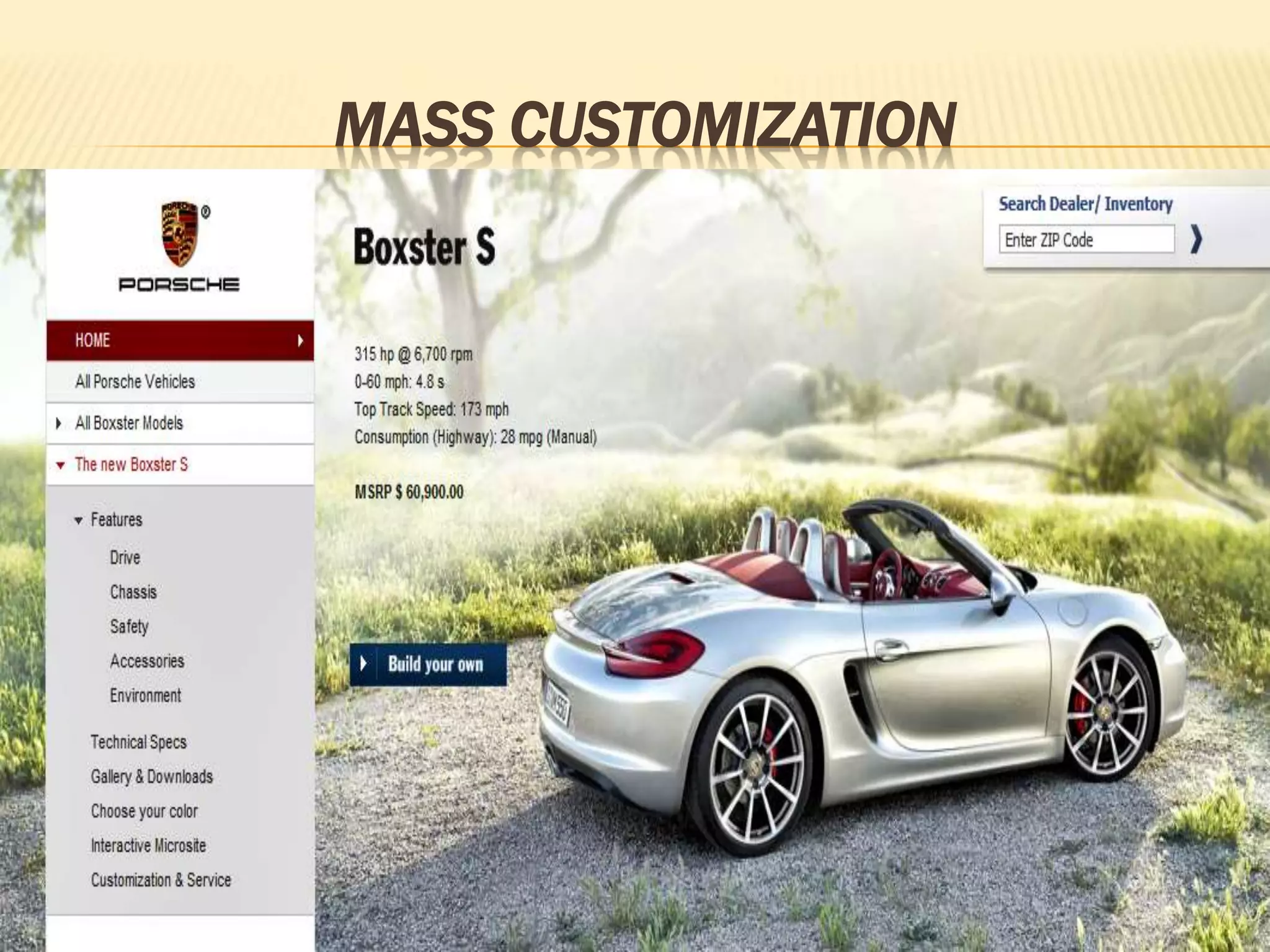

MASS CUSTOMIZATION
Mass Customization
Concept
 ‘Future Shock’ by Toffler, 1970 - “future
manufacturing enabled by information technology
would be able to provide customized products in a
large scale with little or no extra cost”
 Pine et al.’s Harvard Business Review article, 1993 –
the ability to provide individually designed products
and services to every customer through high process
agility, flexibility, and integration
 Hart 1995 et al. - Mass customization is a system that
uses information technology, flexible processes, and
organizational structures to deliver a wide range of
products and services that meet specific needs of
individual customers at a cost near that of mass-
produced items
MASS CUSTOMIZATIONIt aims to deliver product and services that best meet
customers’ needs with near mass production efficiency.
The paradigm shift to mass customization is made an
imperative for many companies to survive in an
increasingly diversified, fragmented and competitive
market place.
Currently, the focus of research in mass customization
is shifting from its strategic viability to operational
feasibility.
Definition
 The process of delivering wide-market goods and
services that are modified to satisfy a specific
customer need. Mass customization is a marketing
and manufacturing technique that combines the
flexibility and personalization of "custom-made"
with the low unit costs associated with mass
production. Many applications of mass
customization include software-based product
configurations that allow end-users to add and/or
change certain functionalities of a core product.
Sometimes called "made to order" or "built to
order."
 Mass customization is the method of "effectively
postponing the task of differentiating a product for a
specific customer until the latest possible point in
the supply network."
Cont…….
Joseph Pine II's 1992 book "Mass Customization: The New
Frontier in Business Competition" describes four types of mass
customization:
1. Collaborative Customization - where companies work in
partnership with individual customers to develop precise product
offerings to best suit each customer's needs.
2. Adaptive Customization - where companies produce
standardized products that are customizable by the end-user.
3. Transparent Customization - where companies provide unique
products to individual customers without overtly stating the
products are customized.
4. Cosmetic Customization - where companies produce
standardized products but market the products in different ways
to various customers.
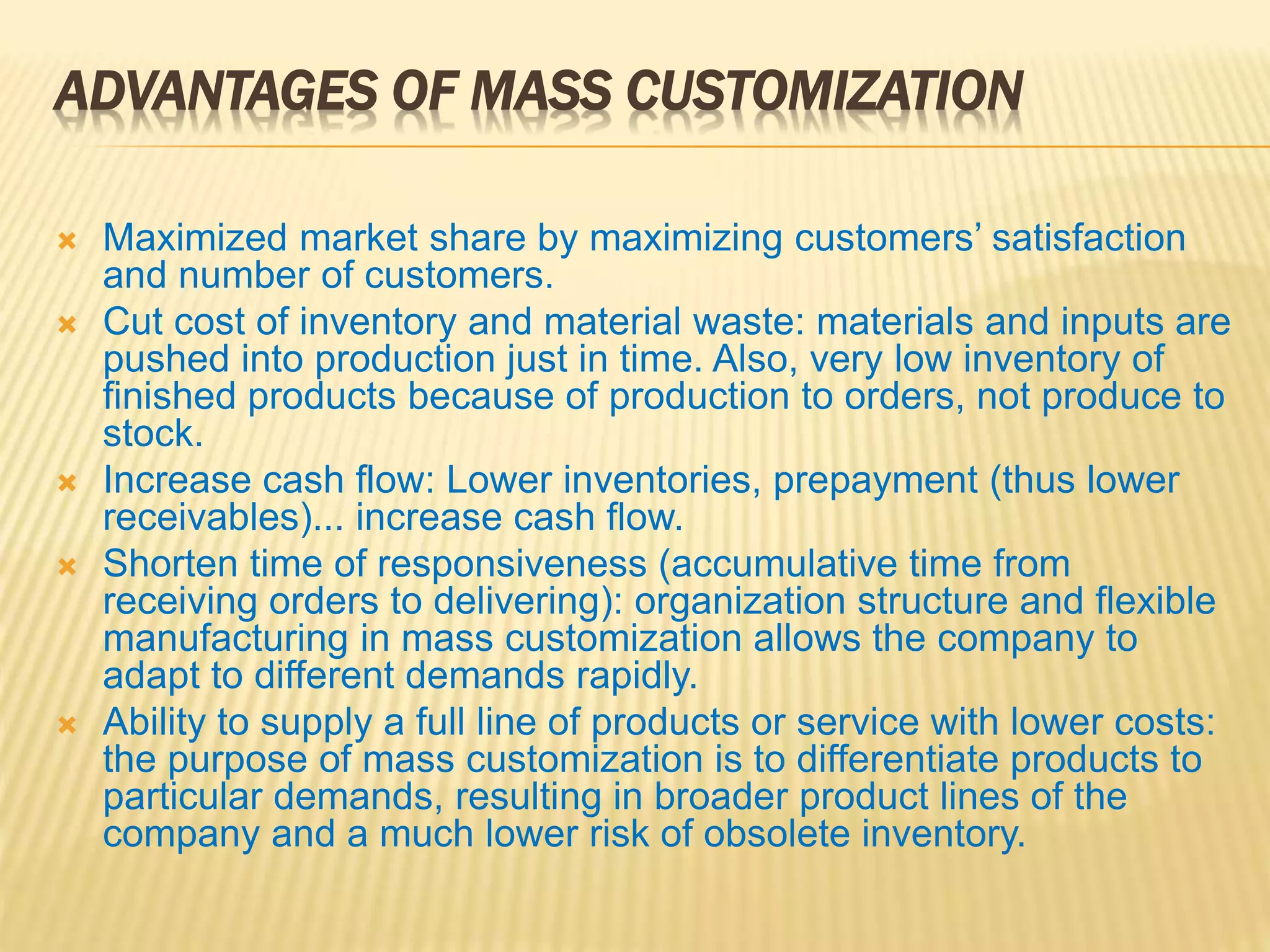
MASS CUSTOMIZATION
- THE GENERIC MODEL
Spring et al. (2000) proposed a generic model
of product customization :
ADVANTAGES OF MASS CUSTOMIZATION
 Maximized market share by maximizing customers’ satisfaction
and number of customers.
 Cut cost of inventory and material waste: materials and inputs are
pushed into production just in time. Also, very low inventory of
finished products because of production to orders, not produce to
stock.
 Increase cash flow: Lower inventories, prepayment (thus lower
receivables)... increase cash flow.
 Shorten time of responsiveness (accumulative time from
receiving orders to delivering): organization structure and flexible
manufacturing in mass customization allows the company to
adapt to different demands rapidly.
 Ability to supply a full line of products or service with lower costs:
the purpose of mass customization is to differentiate products to
particular demands, resulting in broader product lines of the
company and a much lower risk of obsolete inventory.
MASS CUSTOMIZATION STRATEGIES:
 Design- in this mass customization strategy, customers interact
with suppliers with the objective to design a particular product that
fulfills particular requirements (e.g. residential architecture). This
strategy allows for customer involvement.
 Fabrication- this mass customization strategy includes
customized product using basic predefined design, and allows
customer to modify the product building block (e.g. Motorola’s
Bandit pager).
 Assembly- this mass customization strategy refers to the use of
standard models that can be combined into different product
variants in order to meet particular customer requirements (e.g.
Hewlett-Packard products). This strategy allows for customer
involvement.
 Additional Custom Work- in this strategy, mass customization
is achieved by adding custom work (e.g. Ikea’s furniture) to
standard product, often at the point of delivery.
CONT…….
 Package and Distribution- this mass customization
strategy refers to delivery or packaging similar
products in different ways (e.g. Wal-Mart’s peanuts).
 Usage- in this mass customization strategy, usage
occurs only after delivery, through products that can
be adapted to different functions or situations (e.g.
Lutron’s lighting systems).
 Standardization- this mass customization strategy
relates to customizing products which self adapts to
specific customer needs.
Mass customization and  strategies

Mass customization and strategies

  • 1.
  • 2.
    Mass Customization Concept  ‘FutureShock’ by Toffler, 1970 - “future manufacturing enabled by information technology would be able to provide customized products in a large scale with little or no extra cost”  Pine et al.’s Harvard Business Review article, 1993 – the ability to provide individually designed products and services to every customer through high process agility, flexibility, and integration  Hart 1995 et al. - Mass customization is a system that uses information technology, flexible processes, and organizational structures to deliver a wide range of products and services that meet specific needs of individual customers at a cost near that of mass- produced items
  • 3.
    MASS CUSTOMIZATIONIt aimsto deliver product and services that best meet customers’ needs with near mass production efficiency. The paradigm shift to mass customization is made an imperative for many companies to survive in an increasingly diversified, fragmented and competitive market place. Currently, the focus of research in mass customization is shifting from its strategic viability to operational feasibility.
  • 4.
    Definition  The processof delivering wide-market goods and services that are modified to satisfy a specific customer need. Mass customization is a marketing and manufacturing technique that combines the flexibility and personalization of "custom-made" with the low unit costs associated with mass production. Many applications of mass customization include software-based product configurations that allow end-users to add and/or change certain functionalities of a core product. Sometimes called "made to order" or "built to order."  Mass customization is the method of "effectively postponing the task of differentiating a product for a specific customer until the latest possible point in the supply network."
  • 5.
    Cont……. Joseph Pine II's1992 book "Mass Customization: The New Frontier in Business Competition" describes four types of mass customization: 1. Collaborative Customization - where companies work in partnership with individual customers to develop precise product offerings to best suit each customer's needs. 2. Adaptive Customization - where companies produce standardized products that are customizable by the end-user. 3. Transparent Customization - where companies provide unique products to individual customers without overtly stating the products are customized. 4. Cosmetic Customization - where companies produce standardized products but market the products in different ways to various customers.
  • 6.
    MASS CUSTOMIZATION - THEGENERIC MODEL Spring et al. (2000) proposed a generic model of product customization :
  • 7.
    ADVANTAGES OF MASSCUSTOMIZATION  Maximized market share by maximizing customers’ satisfaction and number of customers.  Cut cost of inventory and material waste: materials and inputs are pushed into production just in time. Also, very low inventory of finished products because of production to orders, not produce to stock.  Increase cash flow: Lower inventories, prepayment (thus lower receivables)... increase cash flow.  Shorten time of responsiveness (accumulative time from receiving orders to delivering): organization structure and flexible manufacturing in mass customization allows the company to adapt to different demands rapidly.  Ability to supply a full line of products or service with lower costs: the purpose of mass customization is to differentiate products to particular demands, resulting in broader product lines of the company and a much lower risk of obsolete inventory.
  • 8.
    MASS CUSTOMIZATION STRATEGIES: Design- in this mass customization strategy, customers interact with suppliers with the objective to design a particular product that fulfills particular requirements (e.g. residential architecture). This strategy allows for customer involvement.  Fabrication- this mass customization strategy includes customized product using basic predefined design, and allows customer to modify the product building block (e.g. Motorola’s Bandit pager).  Assembly- this mass customization strategy refers to the use of standard models that can be combined into different product variants in order to meet particular customer requirements (e.g. Hewlett-Packard products). This strategy allows for customer involvement.  Additional Custom Work- in this strategy, mass customization is achieved by adding custom work (e.g. Ikea’s furniture) to standard product, often at the point of delivery.
  • 9.
    CONT…….  Package andDistribution- this mass customization strategy refers to delivery or packaging similar products in different ways (e.g. Wal-Mart’s peanuts).  Usage- in this mass customization strategy, usage occurs only after delivery, through products that can be adapted to different functions or situations (e.g. Lutron’s lighting systems).  Standardization- this mass customization strategy relates to customizing products which self adapts to specific customer needs.