Global supply chain management
Presented by :
A Raj Shravanthi
What is a Supply Chain?
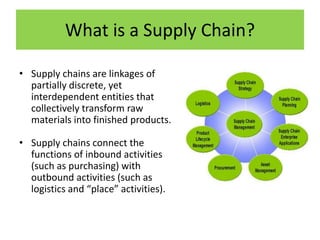
• Supply chains are linkages of
partially discrete, yet
interdependent entities that
collectively transform raw
materials into finished products.
• Supply chains connect the
functions of inbound activities
(such as purchasing) with
outbound activities (such as
logistics and “place” activities).
What is Global Supply Chain?
• A global supply chain is made up of the interrelated
organizations, resources, and processes that create and
deliver products and services to end customers. In the
instance of global supply chains, it is extended around
the world
• Any company that uses parts and services from another
factory overseas faces issues with global supply chain
management
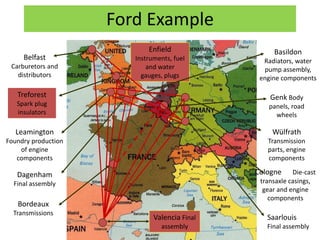
Belfast
Carburetors and
distributors
Treforest
Spark plug
insulators
Leamington
Foundry production
of engine
components
Dagenham
Final assembly
Bordeaux
Transmissions
Enfield
Instruments, fuel
and water
gauges, plugs
Basildon
Radiators, water
pump assembly,
engine components
Genk Body
panels, road
wheels
Wülfrath
Transmission
parts, engine
components
Saarlouis
Final assembly
Cologne Die-cast
transaxle casings,
gear and engine
components
Valencia Final
assembly
Ford Example
Forces Driving Globalization
• Global Market Forces
• Technological Forces
• Global Cost Forces
• Political and Economic Forces
Global Market Forces
• Foreign competition in local markets
• Growth in foreign demand
– Domestic consumption from 40% to <30% of world
consumption since 1970
– Foreign sales fuel growth
• Global presence as a defensive tool
– Nestle’s and Kellogg’s
• Presence in state-of-the-art markets
– Japan -- consumer electronics
– Germany -- machine tools
– US: Sport Utility Vehicle’s
Technological Forces
• Diffusion of knowledge
– Many high tech components developed overseas
– Need close relationships with foreign suppliers
– For example, Canon has 80% of laser engines
• Technology sharing/collaborations
– Access to technology/markets
• Global location of R&D facilities
– Close to production (as cycles get shorter)
– Close to expertise (Indian programmers?)
Global Cost Forces
• Low labor cost
– Diminishing importance (Costs underestimated, benefits
overestimated)
• Other cost priorities
– Integrated supplier infrastructure (as suppliers become
more involved in design)
– Skilled labor
• Capital intensive facilities
– tax breaks
– joint ventures
– price breaks
– cost sharing
Political and Economic Forces
• Exchange rate fluctuations and operating
flexibility
• Regional trade agreements (Europe, North
America, Pacific Rim)
– Value of being in a country in one of these regions
– Implications for supply network design
– Reevaluation of foreign facilities (Production
processes designed to avoid tariffs)
Political and Economic Forces
• Trade protection mechanisms
– Tariffs
– Quotas
– Voluntary export restrictions
• Japanese automakers in US
– Local content requirements
• TI/Intel factories in Europe
• Japanese automakers in the EU
– Health/environmental regulations
• Japanese refused to import US skis for many years (different snow)
– Government procurement policies
• Up to 50% advantage for American companies on US Defense contracts
11
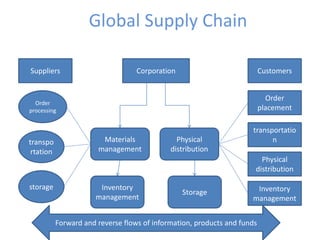
Global Supply Chain
Inventory
management
Physical
distribution
transportatio
n
Order
placement
CorporationSuppliers Customers
Order
processing
transpo
rtation
storage
Materials
management
Inventory
management
Physical
distribution
Storage
Forward and reverse flows of information, products and funds
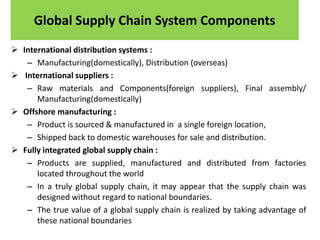
Global Supply Chain System Components
 International distribution systems :
– Manufacturing(domestically), Distribution (overseas)
 International suppliers :
– Raw materials and Components(foreign suppliers), Final assembly/
Manufacturing(domestically)
 Offshore manufacturing :
– Product is sourced & manufactured in a single foreign location,
– Shipped back to domestic warehouses for sale and distribution.
 Fully integrated global supply chain :
– Products are supplied, manufactured and distributed from factories
located throughout the world
– In a truly global supply chain, it may appear that the supply chain was
designed without regard to national boundaries.
– The true value of a global supply chain is realized by taking advantage of
these national boundaries
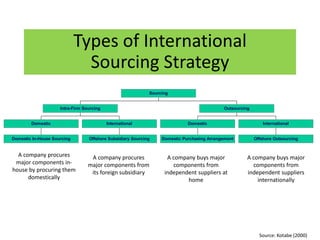
Types of International
Sourcing Strategy
Domestic In-House Sourcing
Domestic
Offshore Subsidiary Sourcing
International
Intra-Firm Sourcing
Domestic Purchasing Arrangement
Domestic
Offshore Outsourcing
International
Outsourcing
Sourcing
A company procures
major components in-
house by procuring them
domestically
A company procures
major components from
its foreign subsidiary
A company buys major
components from
independent suppliers at
home
A company buys major
components from
independent suppliers
internationally
Source: Kotabe (2000)
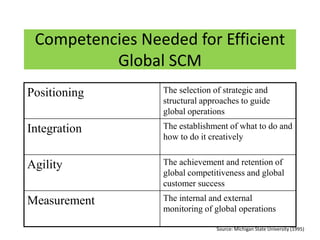
Competencies Needed for Efficient
Global SCM
Positioning The selection of strategic and
structural approaches to guide
global operations
Integration The establishment of what to do and
how to do it creatively
Agility The achievement and retention of
global competitiveness and global
customer success
Measurement The internal and external
monitoring of global operations
Source: Michigan State University (1995)
Global SCM Factors
• Costs
– Local labor rates
– International freight tariffs
– Currency exchange rates
• Customs Duty
– Duty rates differ by commodity and level of assembly
– Impact of GATT/WTO: Changes over time
Source: Global Supply Chain Associates (GSCA) 1999
Global SCM
Factors Continued
• Export Regulations
• Denied parties list
• Export licenses
• Time
• Lead time
• Cycle time
• Transit time
• Export license approval cycle
• Customs clearance
Global SCM
Factors Continued
• Taxes on Corporate Income
– Different markups by country
– Make vs. buy effect
• Offset Trade and Local Content
– Local content requirement for government purchases
– Content for preferential duty rates
1. Substantial geographical distances
2. Forecasting problems/difficulties in foreign markets
3. Fluctuations in exchange rates for different currencies
4. Demand for great variety of products
5. Inadequate infrastructures such as
 labor skills,
 availability of supply
 Supplier quality
 Lack of local process equipments and technologies
 Inadequate transportation facilities and
 Inadequate telecommunication facilities
Areas to be considered while moving from domestic to
International supply chain
Advantages
• The main reason for any business to exist is to increase sales and
profits.
• When you go global, then the likelihood of increasing sales goes up as
you open up your market to consumers all over the world.
• This allows businesses to reduce dependence on their local and
national economies.
• With the number of Internet users on the rise, global businesses are
able to do business at all hours of the day with consumers from every
point on the globe.
• The potential for expansion for businesses increase as they enter into
more markets.
• Lower supply chain costs , reduced cycle time & Enhance speed and
efficiency
• Competitive advantage
• Untapped markets
Disadvantages
• Heavy investment of time, money, and resources needed to implement and
overlook the supply chain.
• Inefficient and undersized transportation and distribution systems
• Market instability
• Integrating the supply chain and choosing the correct suppliers is much more
difficult than one can imagine.
• Not only do companies have to strongly consider price and quality, but they
also have to make sure that all the organizations are willing to cooperate to
benefit the group.
• Managerial styles, objectives, and goals must have a strategic fit between all
companies involved and power must be evenly distributed throughout the
supply chain.
• When entering the global market, businesses need to be aware that
the gains may not be seen in the short term.
• It may be many years before they start reaping the rewards of their
efforts.
• Hire additional staff to help launch their companies in the global
markets they expand into.
• Companies usually have to modify their products and packaging to
suit the local culture, preferences and language of the new market.
• Travel expenses are sure to increase for the administrative staff, as
(travel all over the world to oversee their business outlets)
Global SCM Example :
Large Computer Company
• Goals
– Reduce cost
– Improve ROA
– Simplify the worldwide supply chain
Source: Global Supply Chain Associates (GSCA) 1999
Objectives
• Redesign the entire worldwide supply chain
• Determine how many plants and where they should
be located
• Determine what process technologies should be in
each plant
• Specify the loading on each plant and the service
area
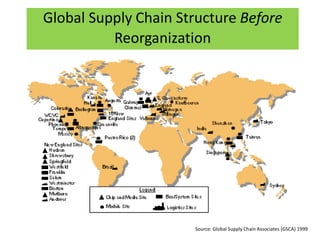
Global Supply Chain Structure Before
Reorganization
Source: Global Supply Chain Associates (GSCA) 1999
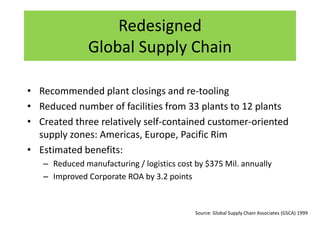
Redesigned
Global Supply Chain
• Recommended plant closings and re-tooling
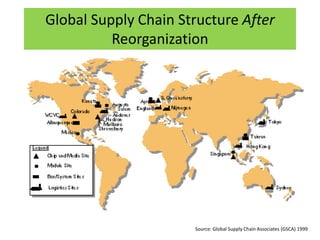
• Reduced number of facilities from 33 plants to 12 plants
• Created three relatively self-contained customer-oriented
supply zones: Americas, Europe, Pacific Rim
• Estimated benefits:
– Reduced manufacturing / logistics cost by $375 Mil. annually
– Improved Corporate ROA by 3.2 points
Source: Global Supply Chain Associates (GSCA) 1999
Global Supply Chain Structure After
Reorganization
Source: Global Supply Chain Associates (GSCA) 1999
28
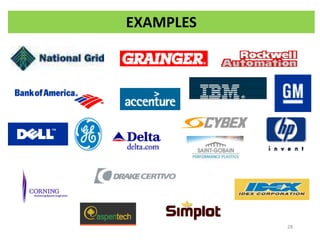
EXAMPLES
29
30
Global supply chain management

Global supply chain management

  • 1.
    Global supply chainmanagement Presented by : A Raj Shravanthi
  • 2.
    What is aSupply Chain? • Supply chains are linkages of partially discrete, yet interdependent entities that collectively transform raw materials into finished products. • Supply chains connect the functions of inbound activities (such as purchasing) with outbound activities (such as logistics and “place” activities).
  • 3.
    What is GlobalSupply Chain? • A global supply chain is made up of the interrelated organizations, resources, and processes that create and deliver products and services to end customers. In the instance of global supply chains, it is extended around the world • Any company that uses parts and services from another factory overseas faces issues with global supply chain management
  • 4.
    Belfast Carburetors and distributors Treforest Spark plug insulators Leamington Foundryproduction of engine components Dagenham Final assembly Bordeaux Transmissions Enfield Instruments, fuel and water gauges, plugs Basildon Radiators, water pump assembly, engine components Genk Body panels, road wheels Wülfrath Transmission parts, engine components Saarlouis Final assembly Cologne Die-cast transaxle casings, gear and engine components Valencia Final assembly Ford Example
  • 5.
    Forces Driving Globalization •Global Market Forces • Technological Forces • Global Cost Forces • Political and Economic Forces
  • 6.
    Global Market Forces •Foreign competition in local markets • Growth in foreign demand – Domestic consumption from 40% to <30% of world consumption since 1970 – Foreign sales fuel growth • Global presence as a defensive tool – Nestle’s and Kellogg’s • Presence in state-of-the-art markets – Japan -- consumer electronics – Germany -- machine tools – US: Sport Utility Vehicle’s
  • 7.
    Technological Forces • Diffusionof knowledge – Many high tech components developed overseas – Need close relationships with foreign suppliers – For example, Canon has 80% of laser engines • Technology sharing/collaborations – Access to technology/markets • Global location of R&D facilities – Close to production (as cycles get shorter) – Close to expertise (Indian programmers?)
  • 8.
    Global Cost Forces •Low labor cost – Diminishing importance (Costs underestimated, benefits overestimated) • Other cost priorities – Integrated supplier infrastructure (as suppliers become more involved in design) – Skilled labor • Capital intensive facilities – tax breaks – joint ventures – price breaks – cost sharing
  • 9.
    Political and EconomicForces • Exchange rate fluctuations and operating flexibility • Regional trade agreements (Europe, North America, Pacific Rim) – Value of being in a country in one of these regions – Implications for supply network design – Reevaluation of foreign facilities (Production processes designed to avoid tariffs)
  • 10.
    Political and EconomicForces • Trade protection mechanisms – Tariffs – Quotas – Voluntary export restrictions • Japanese automakers in US – Local content requirements • TI/Intel factories in Europe • Japanese automakers in the EU – Health/environmental regulations • Japanese refused to import US skis for many years (different snow) – Government procurement policies • Up to 50% advantage for American companies on US Defense contracts
  • 11.
  • 12.
    Global Supply Chain Inventory management Physical distribution transportatio n Order placement CorporationSuppliersCustomers Order processing transpo rtation storage Materials management Inventory management Physical distribution Storage Forward and reverse flows of information, products and funds
  • 13.
    Global Supply ChainSystem Components  International distribution systems : – Manufacturing(domestically), Distribution (overseas)  International suppliers : – Raw materials and Components(foreign suppliers), Final assembly/ Manufacturing(domestically)  Offshore manufacturing : – Product is sourced & manufactured in a single foreign location, – Shipped back to domestic warehouses for sale and distribution.  Fully integrated global supply chain : – Products are supplied, manufactured and distributed from factories located throughout the world – In a truly global supply chain, it may appear that the supply chain was designed without regard to national boundaries. – The true value of a global supply chain is realized by taking advantage of these national boundaries
  • 14.
    Types of International SourcingStrategy Domestic In-House Sourcing Domestic Offshore Subsidiary Sourcing International Intra-Firm Sourcing Domestic Purchasing Arrangement Domestic Offshore Outsourcing International Outsourcing Sourcing A company procures major components in- house by procuring them domestically A company procures major components from its foreign subsidiary A company buys major components from independent suppliers at home A company buys major components from independent suppliers internationally Source: Kotabe (2000)
  • 15.
    Competencies Needed forEfficient Global SCM Positioning The selection of strategic and structural approaches to guide global operations Integration The establishment of what to do and how to do it creatively Agility The achievement and retention of global competitiveness and global customer success Measurement The internal and external monitoring of global operations Source: Michigan State University (1995)
  • 16.
    Global SCM Factors •Costs – Local labor rates – International freight tariffs – Currency exchange rates • Customs Duty – Duty rates differ by commodity and level of assembly – Impact of GATT/WTO: Changes over time Source: Global Supply Chain Associates (GSCA) 1999
  • 17.
    Global SCM Factors Continued •Export Regulations • Denied parties list • Export licenses • Time • Lead time • Cycle time • Transit time • Export license approval cycle • Customs clearance
  • 18.
    Global SCM Factors Continued •Taxes on Corporate Income – Different markups by country – Make vs. buy effect • Offset Trade and Local Content – Local content requirement for government purchases – Content for preferential duty rates
  • 19.
    1. Substantial geographicaldistances 2. Forecasting problems/difficulties in foreign markets 3. Fluctuations in exchange rates for different currencies 4. Demand for great variety of products 5. Inadequate infrastructures such as  labor skills,  availability of supply  Supplier quality  Lack of local process equipments and technologies  Inadequate transportation facilities and  Inadequate telecommunication facilities Areas to be considered while moving from domestic to International supply chain
  • 20.
    Advantages • The mainreason for any business to exist is to increase sales and profits. • When you go global, then the likelihood of increasing sales goes up as you open up your market to consumers all over the world. • This allows businesses to reduce dependence on their local and national economies. • With the number of Internet users on the rise, global businesses are able to do business at all hours of the day with consumers from every point on the globe. • The potential for expansion for businesses increase as they enter into more markets. • Lower supply chain costs , reduced cycle time & Enhance speed and efficiency • Competitive advantage • Untapped markets
  • 21.
    Disadvantages • Heavy investmentof time, money, and resources needed to implement and overlook the supply chain. • Inefficient and undersized transportation and distribution systems • Market instability • Integrating the supply chain and choosing the correct suppliers is much more difficult than one can imagine. • Not only do companies have to strongly consider price and quality, but they also have to make sure that all the organizations are willing to cooperate to benefit the group. • Managerial styles, objectives, and goals must have a strategic fit between all companies involved and power must be evenly distributed throughout the supply chain.
  • 22.
    • When enteringthe global market, businesses need to be aware that the gains may not be seen in the short term. • It may be many years before they start reaping the rewards of their efforts. • Hire additional staff to help launch their companies in the global markets they expand into. • Companies usually have to modify their products and packaging to suit the local culture, preferences and language of the new market. • Travel expenses are sure to increase for the administrative staff, as (travel all over the world to oversee their business outlets)
  • 23.
    Global SCM Example: Large Computer Company • Goals – Reduce cost – Improve ROA – Simplify the worldwide supply chain Source: Global Supply Chain Associates (GSCA) 1999
  • 24.
    Objectives • Redesign theentire worldwide supply chain • Determine how many plants and where they should be located • Determine what process technologies should be in each plant • Specify the loading on each plant and the service area
  • 25.
    Global Supply ChainStructure Before Reorganization Source: Global Supply Chain Associates (GSCA) 1999
  • 26.
    Redesigned Global Supply Chain •Recommended plant closings and re-tooling • Reduced number of facilities from 33 plants to 12 plants • Created three relatively self-contained customer-oriented supply zones: Americas, Europe, Pacific Rim • Estimated benefits: – Reduced manufacturing / logistics cost by $375 Mil. annually – Improved Corporate ROA by 3.2 points Source: Global Supply Chain Associates (GSCA) 1999
  • 27.
    Global Supply ChainStructure After Reorganization Source: Global Supply Chain Associates (GSCA) 1999
  • 28.
  • 29.
  • 30.