



ECE CEREN DOĞAR
2016800449
Dokuz Eylül University
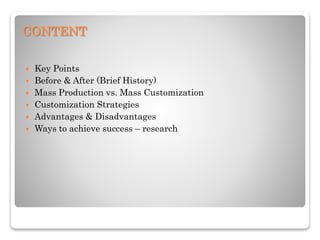
CONTENT
 Key Points
 Before & After (Brief History)
 Mass Production vs. Mass Customization
 Customization Strategies
 Advantages & Disadvantages
 Ways to achieve success – research
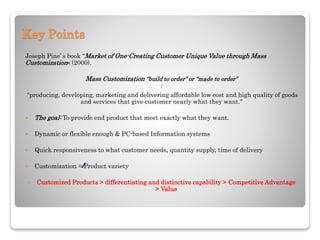
Key Points
Joseph Pine’ s book "Market of One-Creating Customer Unique Value through Mass
Customization« (2000).
Mass Customization “build to order” or “made to order”
:
"producing, developing, marketing and delivering affordable low cost and high quality of goods
and services that give customer nearly what they want."
 The goal: To provide end product that meet exactly what they want.
 Dynamic or flexible enough & PC-based Information systems
 Quick responsiveness to what customer needs, quantity supply, time of delivery
 Customization = Product variety
 Customized Products > differentiating and distinctive capability > Competitive Adventage
> Value
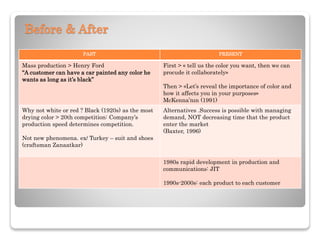
Before & After
PAST PRESENT
Mass production > Henry Ford
“A customer can have a car painted any color he
wants as long as it’s black”
First > « tell us the color you want, then we can
procude it collaborately»
Then > «Let’s reveal the importance of color and
how it affects you in your purposes»
McKenna’nın (1991)
Why not white or red ? Black (1920s) as the most
drying color > 20th competition: Company’s
production speed determines competition.
Not new phenomena. ex/ Turkey – suit and shoes
(craftsman Zanaatkar)
Alternatives .Success is possible with managing
demand, NOT decreasing time that the product
enter the market
(Baxter, 1996)
1980s rapid development in production and
communications: JIT
1990s-2000s: each product to each customer
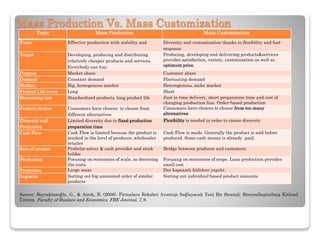
Mass Production Vs. Mass Customization
Topic Mass Production Mass Customization
Focus Effective production with stability and Diversity and customization thanks to flexibility and fast-
response
Target Developing, producing and distributing
relatively cheaper products and services.
Everybody can buy.
Producing, developing and delivering products&services
provides satisfaction, variety, customization as well as
optimum price.
Purpose Market share Customer share
Demand Constant demand Flactuating demand
Market Big, homogenous market Heterogenous, niche market
Product Life curve Long Short
Decreasing cost Standardized products, long product life Just in time delivery, short preparation time and cost of
changing production line. Order-based production
Product choices Consumers have choices to choose from
different alternatives
Consumers have choices to choose from too many
alternatives
Diversity and
Production
Limited diversity due to fixed production
preparation time
Flexibility is needed in order to create diversity
Cash Flow Cash Flow is limited because the product is
stocked in the level of producer, wholesaler
retailer
Cash Flow is made. Generally the product is sold before
produced. Some cash money is already paid.
Role of retailer Probelm-solver & cash provider and stock
holder
Bridge between producer and customers.
Production Focusing on economies of scale, so decresing
the costs.
Focusing on economies of scope. Lean production provides
small cost
Promotion Large mass Dar kapsamlı kitlelere yapılır.
Logistics Sorting out big amounted order of similar
products
Sorting out individual-based product amounts
.
Source: Bayraktaroğlu, G., & Atrek, B. (2006). Firmalara Rekabet Avantajı Sağlayacak Yeni Bir Strateji: Bireyselleştirilmiş Kitlesel
Üretim. Faculty of Busines and Economics, FBE Journal, 7, 8.
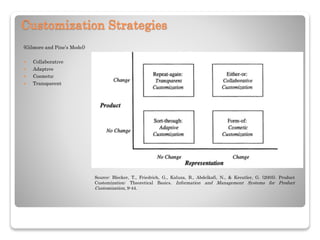
Customization Strategies
(Gilmore and Pine’s Model)
 Collaboratıve
 Adaptıve
 Cosmetıc
 Transparent
Source: Blecker, T., Friedrich, G., Kaluza, B., Abdelkafi, N., & Kreutler, G. (2005). Product
Customization: Theoretical Basics. Information and Management Systems for Product
Customization, 9-44.
Customization Strategies – Cont.
Name of the
Customizing
Strategy
What is it ? What is the aim? Example
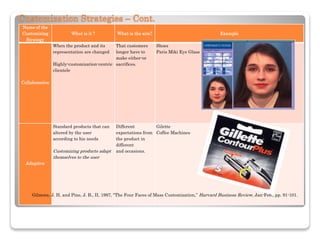
Collaborative
When the product and its
representation are changed
Highly-customization-centric
clientele
That customers
longer have to
make either-or
sacrifices.
Shoes
Paris Miki Eye Glass
Adaptive
Standard products that can
altered by the user
according to his needs
Customizing products adapt
themselves to the user
Different
expectations from
the product in
different
and occasions.
Gilette
Coffee Machines
Gilmore, J. H, and Pine, J. B., II, 1997, “The Four Faces of Mass Customization,” Harvard Business Review, Jan-Feb., pp. 91-101.
Customization Strategies – Cont.
Name of the
Customizing
Strategy
What is it ? What is the aim? Example
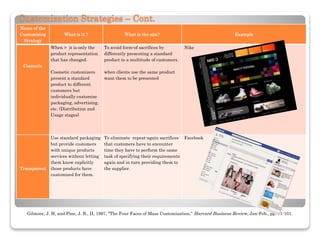
Cosmetic
When > it is only the
product representation
that has changed.
Cosmetic customizers
present a standard
product to different
customers but
individually customize
packaging, advertising,
etc. (Distribution and
Usage stages)
To avoid form-of sacrifices by
differently presenting a standard
product to a multitude of customers.
when clients use the same product
want them to be presented
Nike
Transparent
Use standard packaging
but provide customers
with unique products
services without letting
them know explicitly
those products have
customized for them.
To eliminate repeat-again sacrifices
that customers have to encounter
time they have to perform the same
task of specifying their requirements
again and in turn providing them to
the supplier.
Facebook
Gilmore, J. H, and Pine, J. B., II, 1997, “The Four Faces of Mass Customization,” Harvard Business Review, Jan-Feb., pp. 91-101.
Collaborative - ECD
MOÇEV Modüler
Çelik Evler
www.mocev.com
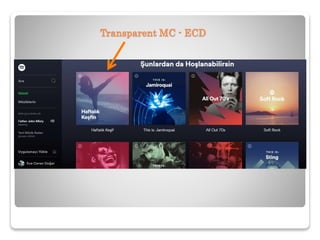
Transparent MC - ECD
Advantages & Disadvantages
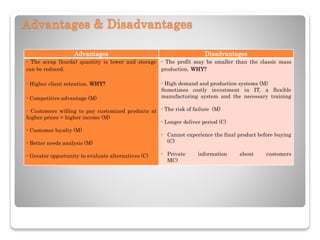
Advantages Disadvantages
- The scrap (hurda) quantity is lower and storage
can be reduced.
- Higher client retention. WHY?
- Competitive advantage (M)
- Customers willing to pay customized products at
higher prices > higher income (M)
- Customer loyalty (M)
- Better needs analysis (M)
- Greater opportunity to evaluate alternatives (C)
- The profit may be smaller than the classic mass
production. WHY?
- High demand and production systems (M)
Sometimes costly investment in IT, a flexible
manufacturing system and the necessary training
- The risk of failure (M)
- Longer deliver period (C)
- Cannot experience the final product before buying
(C)
- Private information about customers
MC)
Other Challanges
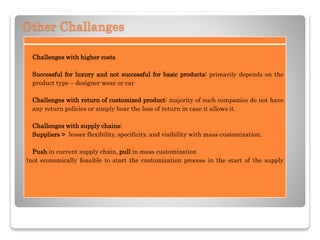
- Challenges with higher costs
- Successful for luxury and not successful for basic products: primarily depends on the
product type – designer wear or car
- Challenges with return of customized product: majority of such companies do not have
any return policies or simply bear the loss of return in case it allows it.
- Challenges with supply chains:
- Suppliers > lesser flexibility, specificity, and visibility with mass customization.
- Push in current supply chain, pull in mass customization
(not economically feasible to start the customization process in the start of the supply
How can success be achieved?
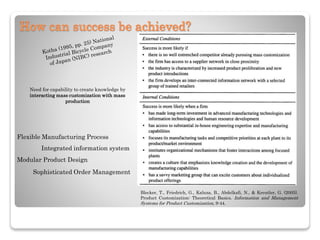
Need for capability to create knowledge by
interacting mass customization with mass
production
Blecker, T., Friedrich, G., Kaluza, B., Abdelkafi, N., & Kreutler, G. (2005).
Product Customization: Theoretical Basics. Information and Management
Systems for Product Customization, 9-44.
Modular Product Design
Flexible Manufacturing Process
Sophisticated Order Management
Integrated information system
Last but not least...
Dell
https://www.youtube.com/watch?v=xcDT3bNrQkY
Mass customization introduction

Mass customization introduction

  • 1.
  • 2.
    CONTENT  Key Points Before & After (Brief History)  Mass Production vs. Mass Customization  Customization Strategies  Advantages & Disadvantages  Ways to achieve success – research
  • 3.
    Key Points Joseph Pine’s book "Market of One-Creating Customer Unique Value through Mass Customization« (2000). Mass Customization “build to order” or “made to order” : "producing, developing, marketing and delivering affordable low cost and high quality of goods and services that give customer nearly what they want."  The goal: To provide end product that meet exactly what they want.  Dynamic or flexible enough & PC-based Information systems  Quick responsiveness to what customer needs, quantity supply, time of delivery  Customization = Product variety  Customized Products > differentiating and distinctive capability > Competitive Adventage > Value
  • 4.
    Before & After PASTPRESENT Mass production > Henry Ford “A customer can have a car painted any color he wants as long as it’s black” First > « tell us the color you want, then we can procude it collaborately» Then > «Let’s reveal the importance of color and how it affects you in your purposes» McKenna’nın (1991) Why not white or red ? Black (1920s) as the most drying color > 20th competition: Company’s production speed determines competition. Not new phenomena. ex/ Turkey – suit and shoes (craftsman Zanaatkar) Alternatives .Success is possible with managing demand, NOT decreasing time that the product enter the market (Baxter, 1996) 1980s rapid development in production and communications: JIT 1990s-2000s: each product to each customer
  • 5.
    Mass Production Vs.Mass Customization Topic Mass Production Mass Customization Focus Effective production with stability and Diversity and customization thanks to flexibility and fast- response Target Developing, producing and distributing relatively cheaper products and services. Everybody can buy. Producing, developing and delivering products&services provides satisfaction, variety, customization as well as optimum price. Purpose Market share Customer share Demand Constant demand Flactuating demand Market Big, homogenous market Heterogenous, niche market Product Life curve Long Short Decreasing cost Standardized products, long product life Just in time delivery, short preparation time and cost of changing production line. Order-based production Product choices Consumers have choices to choose from different alternatives Consumers have choices to choose from too many alternatives Diversity and Production Limited diversity due to fixed production preparation time Flexibility is needed in order to create diversity Cash Flow Cash Flow is limited because the product is stocked in the level of producer, wholesaler retailer Cash Flow is made. Generally the product is sold before produced. Some cash money is already paid. Role of retailer Probelm-solver & cash provider and stock holder Bridge between producer and customers. Production Focusing on economies of scale, so decresing the costs. Focusing on economies of scope. Lean production provides small cost Promotion Large mass Dar kapsamlı kitlelere yapılır. Logistics Sorting out big amounted order of similar products Sorting out individual-based product amounts . Source: Bayraktaroğlu, G., & Atrek, B. (2006). Firmalara Rekabet Avantajı Sağlayacak Yeni Bir Strateji: Bireyselleştirilmiş Kitlesel Üretim. Faculty of Busines and Economics, FBE Journal, 7, 8.
  • 6.
    Customization Strategies (Gilmore andPine’s Model)  Collaboratıve  Adaptıve  Cosmetıc  Transparent Source: Blecker, T., Friedrich, G., Kaluza, B., Abdelkafi, N., & Kreutler, G. (2005). Product Customization: Theoretical Basics. Information and Management Systems for Product Customization, 9-44.
  • 7.
    Customization Strategies –Cont. Name of the Customizing Strategy What is it ? What is the aim? Example Collaborative When the product and its representation are changed Highly-customization-centric clientele That customers longer have to make either-or sacrifices. Shoes Paris Miki Eye Glass Adaptive Standard products that can altered by the user according to his needs Customizing products adapt themselves to the user Different expectations from the product in different and occasions. Gilette Coffee Machines Gilmore, J. H, and Pine, J. B., II, 1997, “The Four Faces of Mass Customization,” Harvard Business Review, Jan-Feb., pp. 91-101.
  • 8.
    Customization Strategies –Cont. Name of the Customizing Strategy What is it ? What is the aim? Example Cosmetic When > it is only the product representation that has changed. Cosmetic customizers present a standard product to different customers but individually customize packaging, advertising, etc. (Distribution and Usage stages) To avoid form-of sacrifices by differently presenting a standard product to a multitude of customers. when clients use the same product want them to be presented Nike Transparent Use standard packaging but provide customers with unique products services without letting them know explicitly those products have customized for them. To eliminate repeat-again sacrifices that customers have to encounter time they have to perform the same task of specifying their requirements again and in turn providing them to the supplier. Facebook Gilmore, J. H, and Pine, J. B., II, 1997, “The Four Faces of Mass Customization,” Harvard Business Review, Jan-Feb., pp. 91-101.
  • 9.
    Collaborative - ECD MOÇEVModüler Çelik Evler www.mocev.com
  • 10.
  • 11.
    Advantages & Disadvantages AdvantagesDisadvantages - The scrap (hurda) quantity is lower and storage can be reduced. - Higher client retention. WHY? - Competitive advantage (M) - Customers willing to pay customized products at higher prices > higher income (M) - Customer loyalty (M) - Better needs analysis (M) - Greater opportunity to evaluate alternatives (C) - The profit may be smaller than the classic mass production. WHY? - High demand and production systems (M) Sometimes costly investment in IT, a flexible manufacturing system and the necessary training - The risk of failure (M) - Longer deliver period (C) - Cannot experience the final product before buying (C) - Private information about customers MC)
  • 12.
    Other Challanges - Challengeswith higher costs - Successful for luxury and not successful for basic products: primarily depends on the product type – designer wear or car - Challenges with return of customized product: majority of such companies do not have any return policies or simply bear the loss of return in case it allows it. - Challenges with supply chains: - Suppliers > lesser flexibility, specificity, and visibility with mass customization. - Push in current supply chain, pull in mass customization (not economically feasible to start the customization process in the start of the supply
  • 13.
    How can successbe achieved? Need for capability to create knowledge by interacting mass customization with mass production Blecker, T., Friedrich, G., Kaluza, B., Abdelkafi, N., & Kreutler, G. (2005). Product Customization: Theoretical Basics. Information and Management Systems for Product Customization, 9-44. Modular Product Design Flexible Manufacturing Process Sophisticated Order Management Integrated information system
  • 14.
    Last but notleast... Dell https://www.youtube.com/watch?v=xcDT3bNrQkY

Editor's Notes

  • #13 Higher client retention. WHY? because the purchaser himself engages a lot more intensively with the product and later on shares a personal reference with it. By analysing costumer requirements it is possible for the company to detect certain trends and thereby to gain competitive advantages.