As a Collaborative Engineering Effort
By Songlin Chen, Yue Wang, Mitchell M Tseng
Abstract
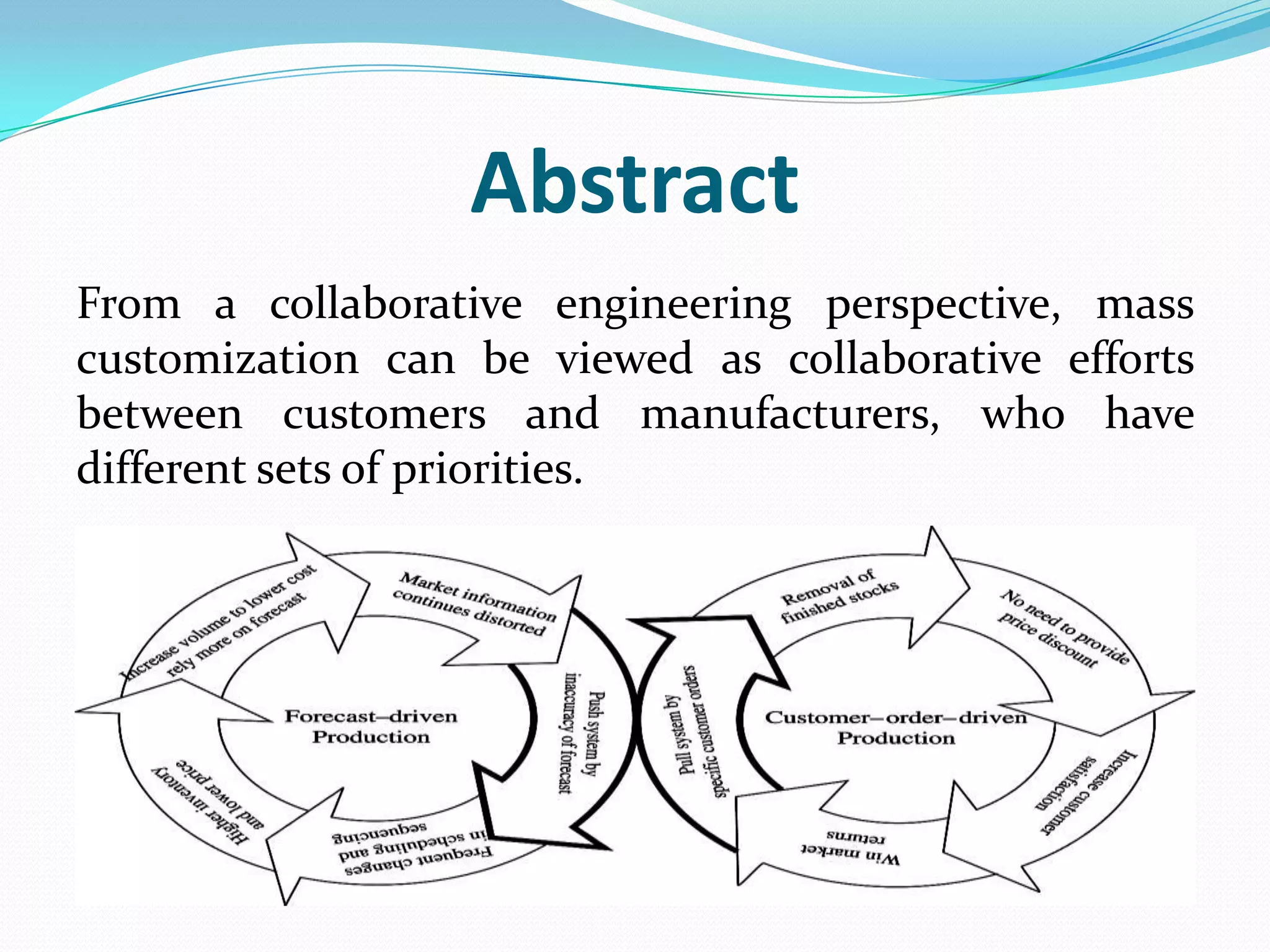
From a collaborative engineering perspective, mass
customization can be viewed as collaborative efforts
between customers and manufacturers, who have
different sets of priorities.
Mass Customization
- An Introduction
 It aims to deliver product and services that best meet
customers’ needs with near mass production efficiency
 The paradigm shift to mass customization is made an
imperative for many companies to survive in an
increasingly diversified, fragmented and competitive
market place
 Currently, the focus of research in mass customization
is shifting from its strategic viability to operational
feasibility
What?
Why?
How?
Mass Customization
- An Introduction (cont.)
 Despite its advances in academia and industry, mass
customization continues to be challenged by critics
 One of the arguments against mass customization is
that it has limited novelty and restricted applicability
 Engineering Collaboration via Negotiation (ECN)
paradigm (Lu 2003) promises great potential to tame
many of the challenges that are currently constraining
many mass customization programs
Mass Customization Concept
 ‘Future Shock’ by Toffler, 1970 - “future manufacturing
enabled by information technology would be able to
provide customized products in a large scale with little or
no extra cost”
 Pine et al.’s Harvard Business Review article, 1993 – the
ability to provide individually designed products and
services to every customer through high process agility,
flexibility, and integration
 Hart 1995 et al. - Mass customization is a system that uses
information technology, flexible processes, and
organizational structures to deliver a wide range of
products and services that meet specific needs of
individual customers at a cost near that of mass-produced
items
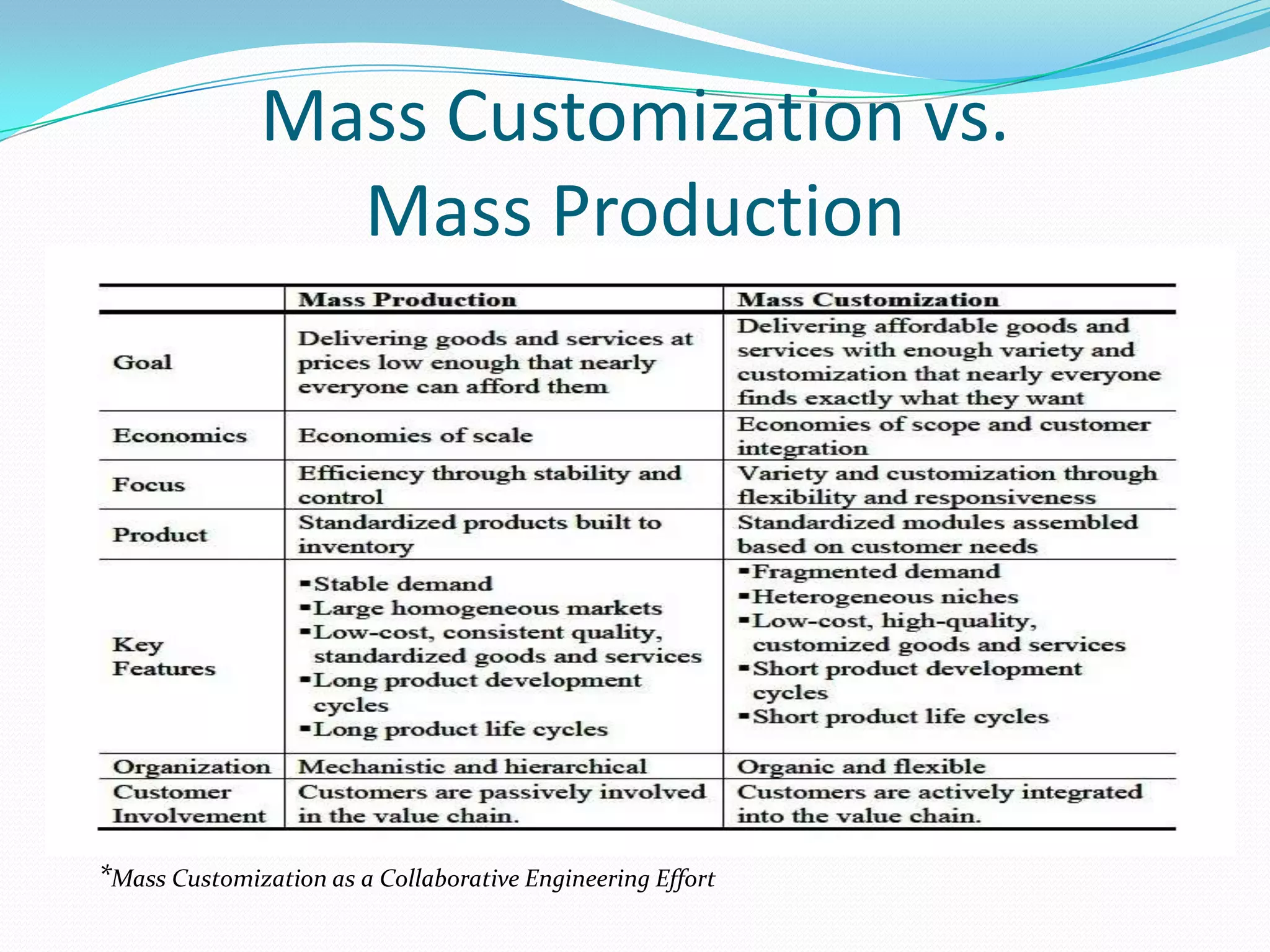
Mass Customization vs.
Mass Production
*Mass Customization as a Collaborative Engineering Effort
Development of Mass
Customization
 The paradigm shift to mass customization is mainly
propelled by three forces :
 Market demand - ‘the mass market is dead and
segmentation has progressed to the era of mass
customization’ – Kotler(1989)
 Market competition - Product variety is exploding while
product life cycle is shortening
 Technological revolutions - Flexible manufacturing
systems allow manufacturers to quickly adapt to changes
without incurring high penalty in terms of cost and lead
time
Mass Customization Economics
 Huffman (1998) – “there’s a thin line between mass
customization and mass confusion”
 Piller et al. (2004) – “with customers integrated into
the value creation process, companies gain access to
more accurate information about market demand and
can postpone some activities” which add to cost pools
 In general, the key issue in mass customization from
an economic perspective is how to leverage economies
of integration to compensate potential loss of
economies of scale
Conflicts in Mass Customization
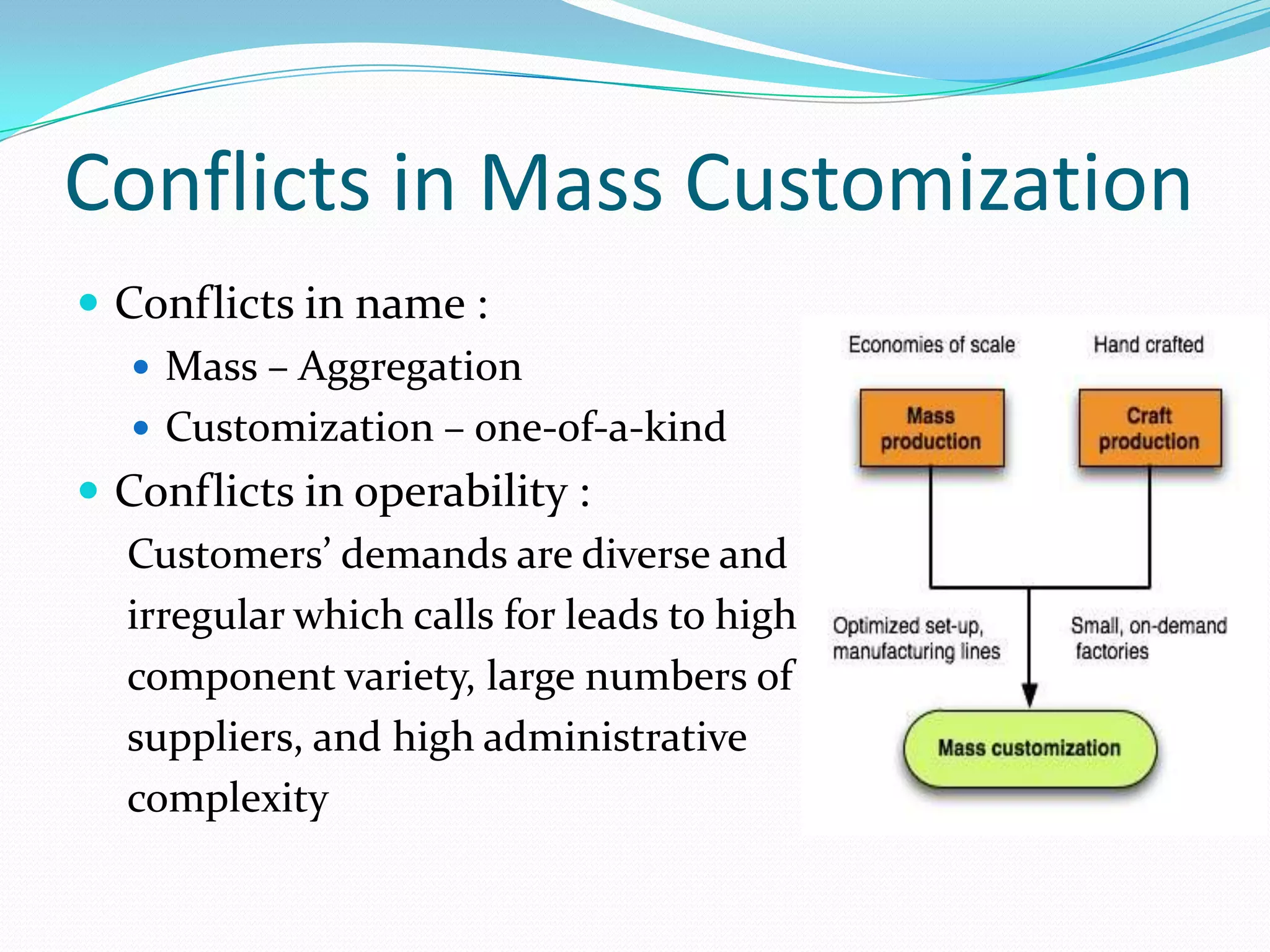
 Conflicts in name :
 Mass – Aggregation
 Customization – one-of-a-kind
 Conflicts in operability :
Customers’ demands are diverse and
irregular which calls for leads to high
component variety, large numbers of
suppliers, and high administrative
complexity
Collaborative Engineering
As a Tool for Conflict Resolution
 Monplaisir and Salhieh (2002) – “collaborative engineering
can be viewed as a process in which people working in teams
according to engineering methodologies and supported by
technical tools can share resources and knowledge to
achieve common goals”
 Lu (2003) proposes Engineering Collaboration via
Negotiation (ECN) as a new paradigm for collaborative
engineering. ECN is defined as “a socio-technical decision
making activity where a team of stakeholders with different
expertise and mixed motives engage in interactive and joint
conflict resolutions to co-construct consensual agreements
of some engineering matter”
Mass Customization
- In Collaborative Engineering Perspective
 Conceptually, mass customization can be taken as a
collaborative engineering activity, where customers
and manufacturers with asymmetric information and
different preferences engage in interactive and joint
conflict resolutions to co-create an artefact
 How such collaboration can be carried out effectively
and efficiently is an ideal research topic for
collaborative engineering
Mass Customization
- The Generic model*
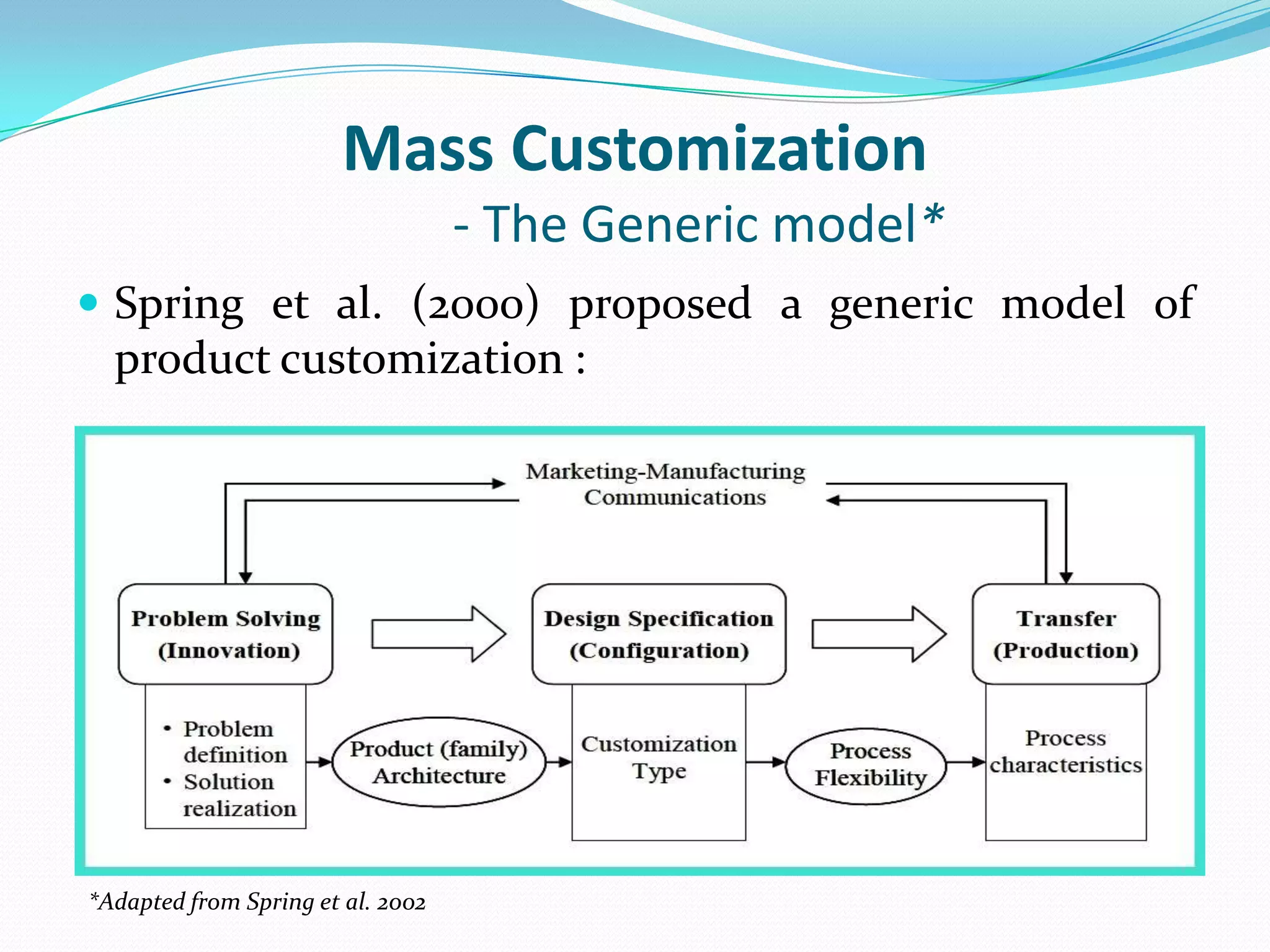
 Spring et al. (2000) proposed a generic model of
product customization :
*Adapted from Spring et al. 2002
Mass Customization
- The Generic model* (cont.)
 Problem Solving :
The product customization concept
and design scheme are determined
and agreed between customers and
manufacturers
 Design Specification :
This stage determines the firm’s
performance on some of the
operational objectives
Mass Customization
- The Generic model* (cont.)
 Transfer :
convert design specifications
into actual products
A limitation of this 3-stage
generic model is that
customer – manufacturer
interaction is confined to
the problem solving stage only
Application scenarios
 Scenario I : Co-Innovation
 The manufacturer-centric view holds that innovations result
from intentional research while the user-centric (or
customer-centric) view contents that many innovations
actually come from users
 Problem solving in mass customization is collaborative in
nature and designated as collaborative innovation (co-
innovation)*
 Family Architecture (PFA) - As a framework for co-innovation
PFA allows customers, product engineers, and process
engineers can work under a unified framework with their
interdependent relationships explicitly mapped out
* Songlin Chen, Yue Wang, Mitchell M. Tseng
Application scenarios (contd.)
 Scenario II : Co-Configuration
 The stage where customers and manufacturers come to
agree upon the specifications of a specific product
offering or customization type
 In a typical organization setting, co-configuration often
involves customers and sales engineers (sometimes
design engineers)
 Besides product configuration systems, personal
recommendation systems (Stolze and Strobel 2004) are
proposed to facilitate customers in product
configuration enabled by techniques like data mining,
recommendation system
Application scenarios (contd.)
 Scenario III : Co-Production
 Co-production corresponds to the transfer stage (Spring
et al. 2000) by including material conversion, material
transportation, shop floor control, procurement,
inventory management etc.
 By sharing demand and supply information, supply
chain partners can better utilize production resources in
response to volatile market demand
Conclusion
 Mass customization defies the contradiction between
mass and customization and aims to deliver products
and services that best meet individual customers’
needs with near mass production efficiency
 It is important that all parties concerned can engage in
collaboration with sufficient trust and only then
collaborative engineering can play a significant role
 The Economist: “Mass Customization a Result of the
Third Industrial Revolution”
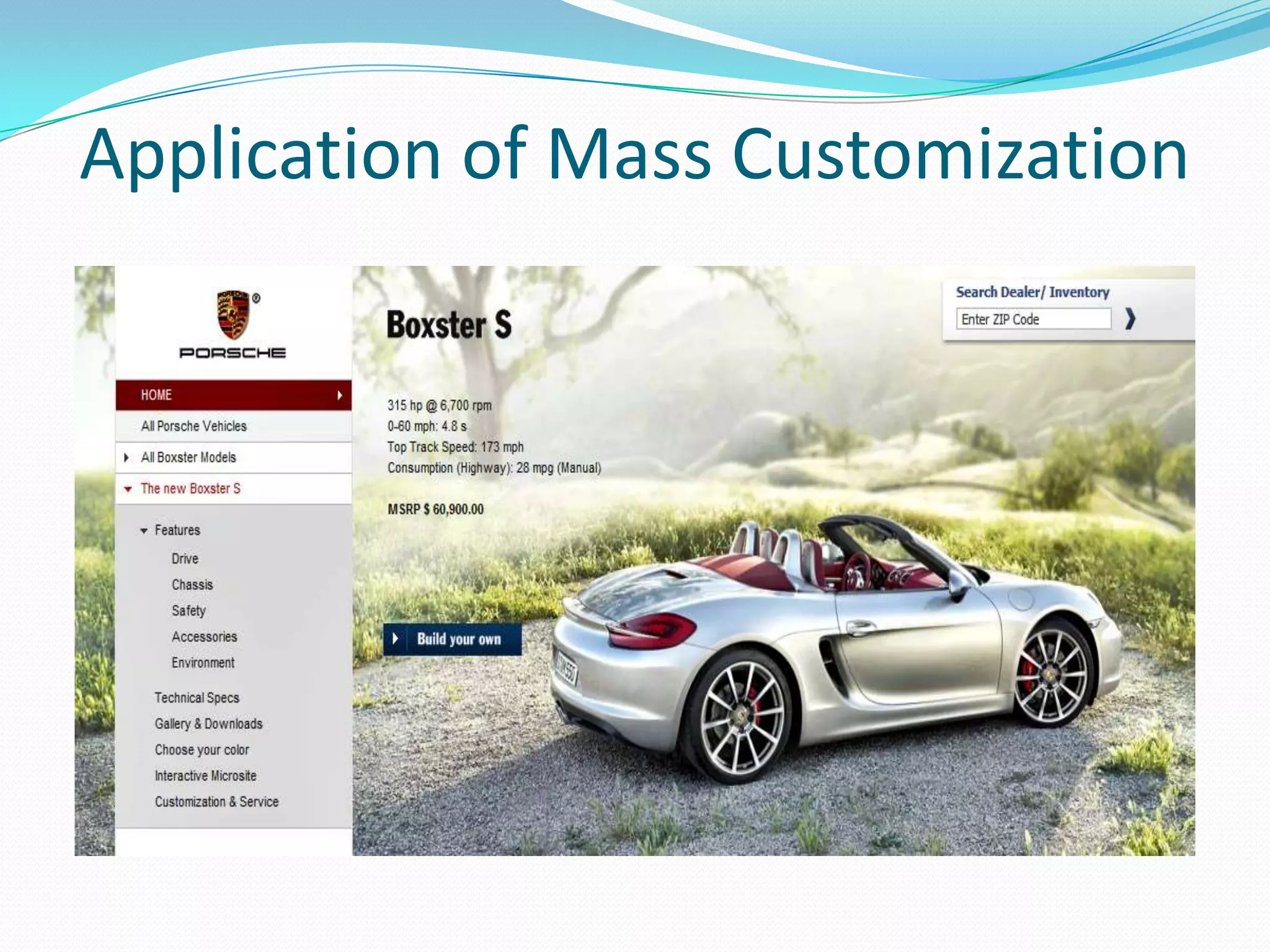
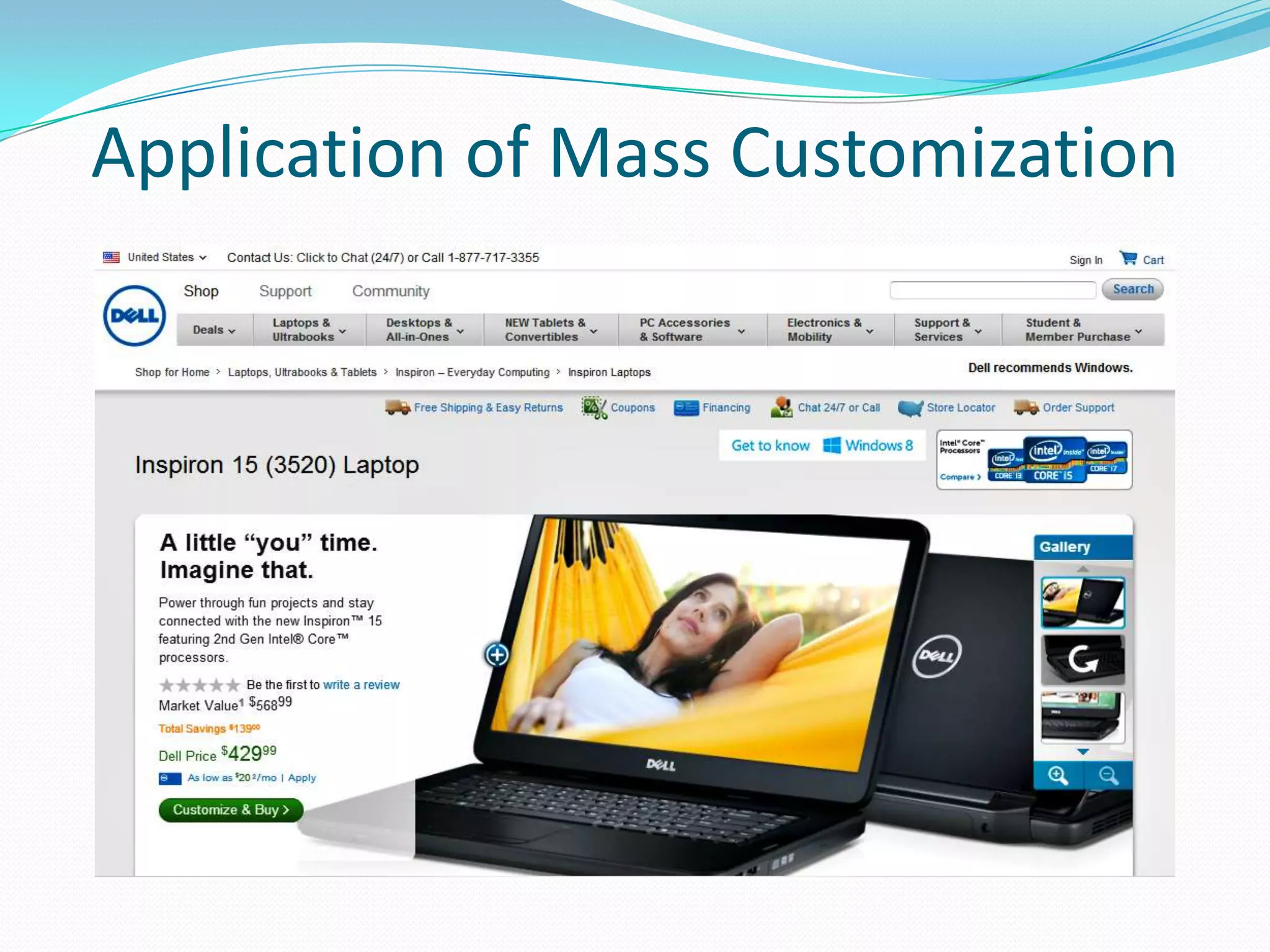
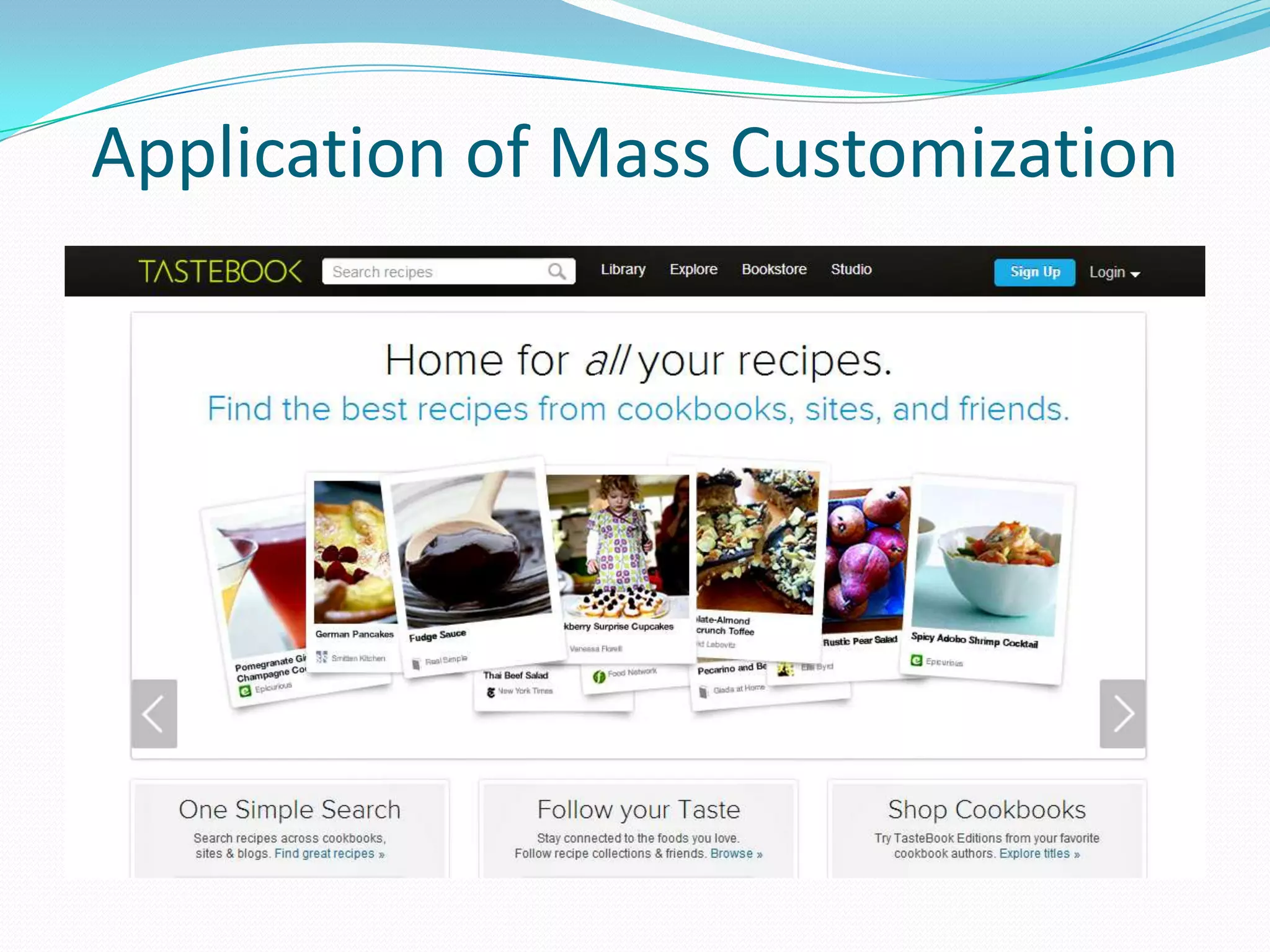
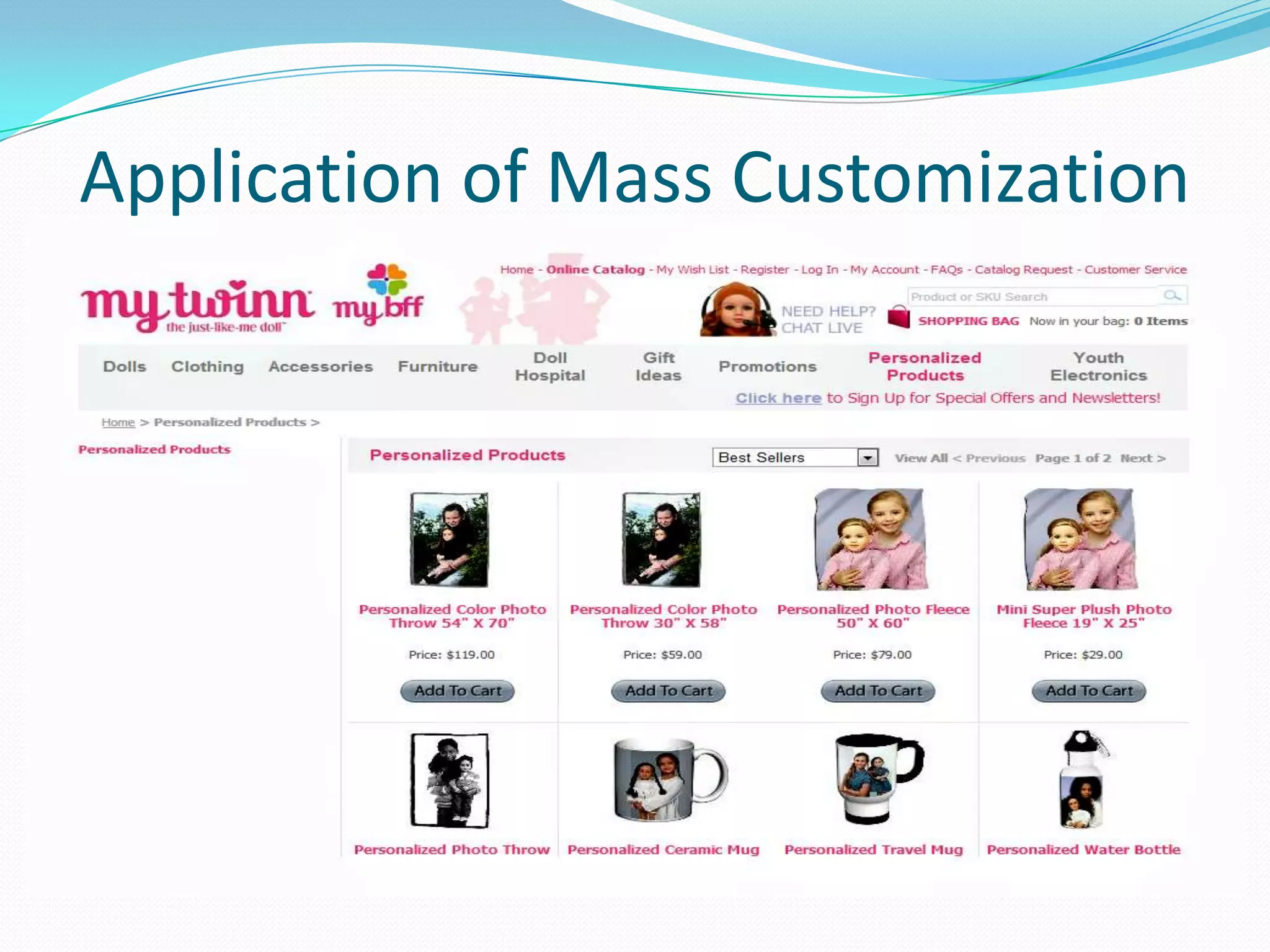
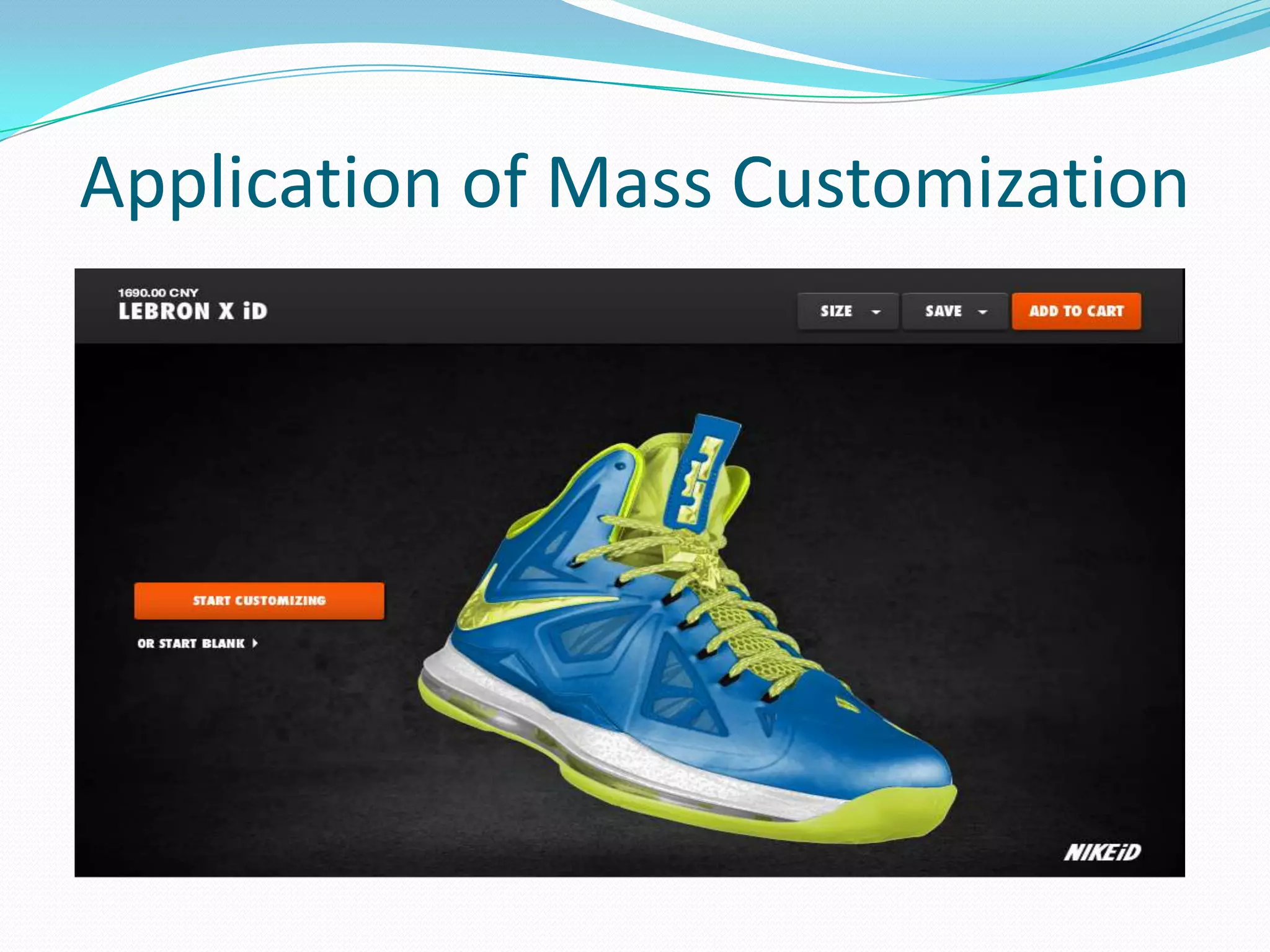
Application of Mass Customization

Mass customization

  • 1.
    As a CollaborativeEngineering Effort By Songlin Chen, Yue Wang, Mitchell M Tseng
  • 2.
    Abstract From a collaborativeengineering perspective, mass customization can be viewed as collaborative efforts between customers and manufacturers, who have different sets of priorities.
  • 3.
    Mass Customization - AnIntroduction  It aims to deliver product and services that best meet customers’ needs with near mass production efficiency  The paradigm shift to mass customization is made an imperative for many companies to survive in an increasingly diversified, fragmented and competitive market place  Currently, the focus of research in mass customization is shifting from its strategic viability to operational feasibility What? Why? How?
  • 4.
    Mass Customization - AnIntroduction (cont.)  Despite its advances in academia and industry, mass customization continues to be challenged by critics  One of the arguments against mass customization is that it has limited novelty and restricted applicability  Engineering Collaboration via Negotiation (ECN) paradigm (Lu 2003) promises great potential to tame many of the challenges that are currently constraining many mass customization programs
  • 5.
    Mass Customization Concept ‘Future Shock’ by Toffler, 1970 - “future manufacturing enabled by information technology would be able to provide customized products in a large scale with little or no extra cost”  Pine et al.’s Harvard Business Review article, 1993 – the ability to provide individually designed products and services to every customer through high process agility, flexibility, and integration  Hart 1995 et al. - Mass customization is a system that uses information technology, flexible processes, and organizational structures to deliver a wide range of products and services that meet specific needs of individual customers at a cost near that of mass-produced items
  • 6.
    Mass Customization vs. MassProduction *Mass Customization as a Collaborative Engineering Effort
  • 7.
    Development of Mass Customization The paradigm shift to mass customization is mainly propelled by three forces :  Market demand - ‘the mass market is dead and segmentation has progressed to the era of mass customization’ – Kotler(1989)  Market competition - Product variety is exploding while product life cycle is shortening  Technological revolutions - Flexible manufacturing systems allow manufacturers to quickly adapt to changes without incurring high penalty in terms of cost and lead time
  • 8.
    Mass Customization Economics Huffman (1998) – “there’s a thin line between mass customization and mass confusion”  Piller et al. (2004) – “with customers integrated into the value creation process, companies gain access to more accurate information about market demand and can postpone some activities” which add to cost pools  In general, the key issue in mass customization from an economic perspective is how to leverage economies of integration to compensate potential loss of economies of scale
  • 9.
    Conflicts in MassCustomization  Conflicts in name :  Mass – Aggregation  Customization – one-of-a-kind  Conflicts in operability : Customers’ demands are diverse and irregular which calls for leads to high component variety, large numbers of suppliers, and high administrative complexity
  • 10.
    Collaborative Engineering As aTool for Conflict Resolution  Monplaisir and Salhieh (2002) – “collaborative engineering can be viewed as a process in which people working in teams according to engineering methodologies and supported by technical tools can share resources and knowledge to achieve common goals”  Lu (2003) proposes Engineering Collaboration via Negotiation (ECN) as a new paradigm for collaborative engineering. ECN is defined as “a socio-technical decision making activity where a team of stakeholders with different expertise and mixed motives engage in interactive and joint conflict resolutions to co-construct consensual agreements of some engineering matter”
  • 11.
    Mass Customization - InCollaborative Engineering Perspective  Conceptually, mass customization can be taken as a collaborative engineering activity, where customers and manufacturers with asymmetric information and different preferences engage in interactive and joint conflict resolutions to co-create an artefact  How such collaboration can be carried out effectively and efficiently is an ideal research topic for collaborative engineering
  • 12.
    Mass Customization - TheGeneric model*  Spring et al. (2000) proposed a generic model of product customization : *Adapted from Spring et al. 2002
  • 13.
    Mass Customization - TheGeneric model* (cont.)  Problem Solving : The product customization concept and design scheme are determined and agreed between customers and manufacturers  Design Specification : This stage determines the firm’s performance on some of the operational objectives
  • 14.
    Mass Customization - TheGeneric model* (cont.)  Transfer : convert design specifications into actual products A limitation of this 3-stage generic model is that customer – manufacturer interaction is confined to the problem solving stage only
  • 15.
    Application scenarios  ScenarioI : Co-Innovation  The manufacturer-centric view holds that innovations result from intentional research while the user-centric (or customer-centric) view contents that many innovations actually come from users  Problem solving in mass customization is collaborative in nature and designated as collaborative innovation (co- innovation)*  Family Architecture (PFA) - As a framework for co-innovation PFA allows customers, product engineers, and process engineers can work under a unified framework with their interdependent relationships explicitly mapped out * Songlin Chen, Yue Wang, Mitchell M. Tseng
  • 16.
    Application scenarios (contd.) Scenario II : Co-Configuration  The stage where customers and manufacturers come to agree upon the specifications of a specific product offering or customization type  In a typical organization setting, co-configuration often involves customers and sales engineers (sometimes design engineers)  Besides product configuration systems, personal recommendation systems (Stolze and Strobel 2004) are proposed to facilitate customers in product configuration enabled by techniques like data mining, recommendation system
  • 17.
    Application scenarios (contd.) Scenario III : Co-Production  Co-production corresponds to the transfer stage (Spring et al. 2000) by including material conversion, material transportation, shop floor control, procurement, inventory management etc.  By sharing demand and supply information, supply chain partners can better utilize production resources in response to volatile market demand
  • 18.
    Conclusion  Mass customizationdefies the contradiction between mass and customization and aims to deliver products and services that best meet individual customers’ needs with near mass production efficiency  It is important that all parties concerned can engage in collaboration with sufficient trust and only then collaborative engineering can play a significant role  The Economist: “Mass Customization a Result of the Third Industrial Revolution”
  • 19.
    Application of MassCustomization
  • 20.
    Application of MassCustomization
  • 21.
    Application of MassCustomization
  • 22.
    Application of MassCustomization
  • 23.
    Application of MassCustomization