Louis Althusser
(ideology & the state)
IDEOLOGY DEFINITION


      IDEOLOGY
                      (WHAT IS IT?)
IDEOLOGY DEFINITION


                           An ideology is a set of ideas that
                           constitute      one's       goals,
                           expectations, and actions.


            An ideology is a comprehensive vision, a
            way of looking at things as in several
            philosophical tendencies, or a set of ideas
            proposed by the dominant class of a
            society to all members of this society.
IDEOLOGY DEFINITION


•   What does this word mean to you?
•   What is an ideology?
•   The term ideology was coined (by Claude
    Destutt in 1796) to mean "the science of
    ideas"
•   Since then, has taken on many other
    meanings
•   Here are some of the most common:
IDEOLOGY DEFINITION


    #1. Value-neutral
    conception
    What this implies
      an individual does not have an
    ideology
    but an individual may reflect the
    ideology of the group they are a member
    of
IDEOLOGY DEFINITION


    #2. Karl Marx's definition
    "False consciousness"
IDEOLOGY DEFINITION


    #3: Focus on "ideological
    forms”
IDEOLOGY DEFINITION


    #4: Ideology as "material
    practice”
    Examples of "material practice" that
    reflects ideology
    taking summer holidays, giving gifts at
    Christmas
IDEOLOGY DEFINITION


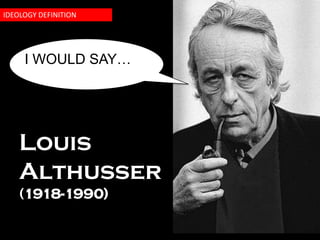
     I WOULD SAY…


    Louis
    Althusser
    (1918-1990)
IDEOLOGY DEFINITION


    These   things give us
    pleasure, release tensions


    But ultimately they return
    us to our place in the
    social order
        Because          they
        reproduce the social
        conditions necessary
        for    capitalism   to
        continue
IDEOLOGY

         What produces and maintains
       (dominant) ideology in society?
      Althusser talked about "ideological state
       apparatuses" (ISAs)
          Family
          Education system
          Church (religion)
          Mass media
      These ISAs "train" us to follow and perpetuate the
       values and rules of the dominant classes
IDEOLOGY & THE STATE


    ISAs vs. RSA
       Althusser: because of the power (and willingness) of
        the ISAs to do the work of the powerful...
       The Repressive State Apparatus (government,
        military, courts) need not use force
          The ISAs do their jobs
          And make us into good, law-abiding students,
           family members, citizens, church members,
           capitalists
          Who do not complain, do not try to overthrow
           the government, do not try to overthrow the
           bosses
IDEOLOGY & THE STATE


    CONSEQUENTLY…
       Ideology (world-view maintained and "taught" by
        the ISAs) comes to be seen as
           Natural
           Universal
           Complete
           Neutral
           Legitimate
           "common sense”
IDEOLOGY


In all of these definitions (except #1),
ideology is...
Meaning   in the service of power
   not just a value-neutral set or system of
   ideas
Rather, a system that underlies, supports, and
justifies a group's
   Exercise   of power
   Maintenance   of power
   Struggles   for power

Marxism (louis althusser)

  • 1.
  • 2.
    IDEOLOGY DEFINITION IDEOLOGY (WHAT IS IT?)
  • 3.
    IDEOLOGY DEFINITION An ideology is a set of ideas that constitute one's goals, expectations, and actions. An ideology is a comprehensive vision, a way of looking at things as in several philosophical tendencies, or a set of ideas proposed by the dominant class of a society to all members of this society.
  • 4.
    IDEOLOGY DEFINITION • What does this word mean to you? • What is an ideology? • The term ideology was coined (by Claude Destutt in 1796) to mean "the science of ideas" • Since then, has taken on many other meanings • Here are some of the most common:
  • 5.
    IDEOLOGY DEFINITION #1. Value-neutral conception What this implies  an individual does not have an ideology but an individual may reflect the ideology of the group they are a member of
  • 6.
    IDEOLOGY DEFINITION #2. Karl Marx's definition "False consciousness"
  • 7.
    IDEOLOGY DEFINITION #3: Focus on "ideological forms”
  • 8.
    IDEOLOGY DEFINITION #4: Ideology as "material practice” Examples of "material practice" that reflects ideology taking summer holidays, giving gifts at Christmas
  • 9.
    IDEOLOGY DEFINITION I WOULD SAY… Louis Althusser (1918-1990)
  • 10.
    IDEOLOGY DEFINITION These things give us pleasure, release tensions But ultimately they return us to our place in the social order Because they reproduce the social conditions necessary for capitalism to continue
  • 11.
    IDEOLOGY What produces and maintains (dominant) ideology in society?  Althusser talked about "ideological state apparatuses" (ISAs)  Family  Education system  Church (religion)  Mass media  These ISAs "train" us to follow and perpetuate the values and rules of the dominant classes
  • 12.
    IDEOLOGY & THESTATE ISAs vs. RSA  Althusser: because of the power (and willingness) of the ISAs to do the work of the powerful...  The Repressive State Apparatus (government, military, courts) need not use force  The ISAs do their jobs  And make us into good, law-abiding students, family members, citizens, church members, capitalists  Who do not complain, do not try to overthrow the government, do not try to overthrow the bosses
  • 13.
    IDEOLOGY & THESTATE CONSEQUENTLY…  Ideology (world-view maintained and "taught" by the ISAs) comes to be seen as  Natural  Universal  Complete  Neutral  Legitimate  "common sense”
  • 14.
    IDEOLOGY In all ofthese definitions (except #1), ideology is... Meaning in the service of power not just a value-neutral set or system of ideas Rather, a system that underlies, supports, and justifies a group's Exercise of power Maintenance of power Struggles for power

Editor's Notes

  • #6 #1. Value-neutral conceptionSystematic body of ideas, a world-view,articulated by a particular group of people"Pattern of ideas, belief systems, or interpretive schemes found in a society or among a specific social group" (Hall).
  • #7 #1. Value-neutral conceptionSystematic body of ideas, a world-view,articulated by a particular group of people"Pattern of ideas, belief systems, or interpretive schemes found in a society or among a specific social group" (Hall).#2. Karl Marx's definition"False consciousness": a masking, distortion, or concealmentThe way some cultural texts and practices present distorted images of realityIdeology works in interest of the powerfuland AGAINST interests of the powerlessResults of ideological distortion, in Marx's viewConceals reality of domination from those in power: dominant class do not see themselves as exploitersConceals reality of domination from the powerless: they do not see themselves as exploited
  • #8 #1. Value-neutral conceptionSystematic body of ideas, a world-view,articulated by a particular group of people"Pattern of ideas, belief systems, or interpretive schemes found in a society or among a specific social group" (Hall).#2. Karl Marx's definition"False consciousness": a masking, distortion, or concealmentThe way some cultural texts and practices present distorted images of realityIdeology works in interest of the powerfuland AGAINST interests of the powerlessResults of ideological distortion, in Marx's viewConceals reality of domination from those in power: dominant class do not see themselves as exploitersConceals reality of domination from the powerless: they do not see themselves as exploitedTexts (mediated) always present a particular picture of the world, always take sides, thus reflect producer's ideologyAll texts are ultimately political: they offer one view or another (but not a multiplicity of views!) of how the world isDiffering ideological significations of reality compete with one another#4: Ideology as "material practice"French Marxist philosopher Louis Althusser (1918-1990) saidIdeology is not simply a body of ideas, but rather "material practice"Ideology is encountered in practices of everyday life
  • #9 #1. Value-neutral conceptionSystematic body of ideas, a world-view,articulated by a particular group of people"Pattern of ideas, belief systems, or interpretive schemes found in a society or among a specific social group" (Hall).#2. Karl Marx's definition"False consciousness": a masking, distortion, or concealmentThe way some cultural texts and practices present distorted images of realityIdeology works in interest of the powerfuland AGAINST interests of the powerlessResults of ideological distortion, in Marx's viewConceals reality of domination from those in power: dominant class do not see themselves as exploitersConceals reality of domination from the powerless: they do not see themselves as exploitedTexts (mediated) always present a particular picture of the world, always take sides, thus reflect producer's ideologyAll texts are ultimately political: they offer one view or another (but not a multiplicity of views!) of how the world isDiffering ideological significations of reality compete with one another
  • #11 These things give us pleasure, release tensionsBut ultimately they return us to our place in the social orderBecause they reproduce the social conditions necessary for capitalism to continue
  • #14 natural (as opposed to constructed)universal (as opposed to particular)complete (as opposed to incomplete)neutral (as opposed to partial/biased)legitimate (as opposed to illegitimate)"common sense" (as opposed to a particular, chosen, preferred sense)