Lecture 3:
                  Marxism, ideology and the
                            media
                              Or
                “We are stupid to believe what
                         we believe”


MS 2900 Exploring Media Theory
University of Winchester
Dr Marcus Leaning
   In this lecture we are going to look at ideology
    from a Marxist perspective.
   Ideology is a key concept in the fields of cultural
    analysis, media studies and literary analysis.
   The idea of ideology explains:
    ◦ why people hold beliefs that seem antithetical to their
      material position –why do we believe we should continue
      with the current system when it is obvious we are not
      benefiting from the present state of affairs?
    ◦ how „culture‟ is structured in such a way that enables the
      group holding power to have the maximum control with the
      minimum of conflict.
   This is not a matter of groups deliberately
    planning to oppress people or alter their
    consciousness (although this can
    happen), but rather a matter of how the
    dominant institutions and groups in society
    work through:
    ◦ values,
    ◦ conceptions of the world,
    ◦ symbol systems,
   in order to legitimise the current order.
   Briefly, this legitimisation is managed
    through the widespread social adoption of
    ideas about the way things are, how the
    world works and should be.
   These ideas which are often embedded in
    cultural practices orient people's thinking in
    such a way that they accept the current way
    of doing things, the current sense of what is
    'natural,' and the current understanding of
    their roles in society.
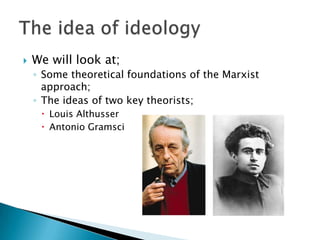
   We will look at;
    ◦ Some theoretical foundations of the Marxist
      approach;
    ◦ The ideas of two key theorists;
      Louis Althusser
      Antonio Gramsci
   Marxists are interested in “How dominant
    social groups are able to reproduce their
    social and economic power” Taylor and Willis
    (1999) P.29.
   This idea goes right back to Marx.
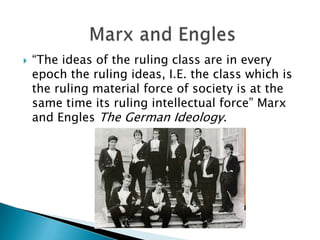
   “The ideas of the ruling class are in every
    epoch the ruling ideas, I.E. the class which is
    the ruling material force of society is at the
    same time its ruling intellectual force” Marx
    and Engles The German Ideology.
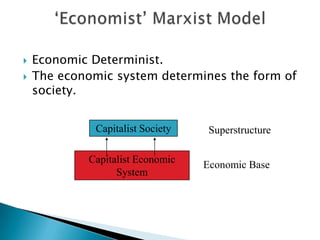
   Economic Determinist.
   The economic system determines the form of
    society.


              Capitalist Society    Superstructure

            Capitalist Economic    Economic Base
                  System
   All aspects of culture in a given society are
    dependent on and derived from the
    relations of production of the system of the
    particular mode of production.
   The particular mode of production of an era
    formed the base structure of society; all
    other aspects, including
    culture, religion, values are simple
    superstructure, a consequence of the
    economic structure.
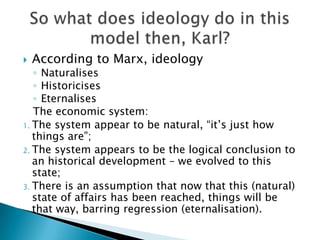
   According to Marx, ideology
   ◦ Naturalises
   ◦ Historicises
   ◦ Eternalises
   The economic system:
1. The system appear to be natural, “it‟s just how
   things are”;
2. The system appears to be the logical conclusion to
   an historical development – we evolved to this
   state;
3. There is an assumption that now that this (natural)
   state of affairs has been reached, things will be
   that way, barring regression (eternalisation).
   “The free market is the economic system most in
    keeping with the nature and needs of humans;
    history has been an evolution of economic forms
    towards our version of the free market; once states
    have all reached this, all they have to do is avoid
    reverting, there is no 'further' to go in terms of
    economic organization."
   We assume that the free market is the political
    system best suited to the nature and aspirations of
    humans, we see history as a movement towards
    this, we assume that once all nations have achieved
    it they will continue to be free markets
    forever, unless they erode.
   These assumptions are ideology.
   More recent theories have tended to look at
    how elements of society contribute to the
    maintenance of the system.
   Cultural life is not just a result of economic
    life, they help to maintain it, contribute to it
    and accelerate it.
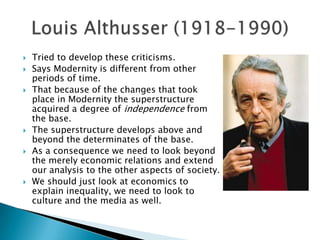
   Tried to develop these criticisms.
   Says Modernity is different from other
    periods of time.
   That because of the changes that took
    place in Modernity the superstructure
    acquired a degree of independence from
    the base.
   The superstructure develops above and
    beyond the determinates of the base.
   As a consequence we need to look beyond
    the merely economic relations and extend
    our analysis to the other aspects of society.
   We should just look at economics to
    explain inequality, we need to look to
    culture and the media as well.
   The Marxists economistic way of thinking of
    proposed that ideologies are false, they
    misrepresent reality to us.
   Ideologies are a veil that hide reality.
   For them, underneath ideology is a real
    hidden world (for example, the "real"
    economic relations of production).
   We can‟t see these real systems.
   Trad. Marxists contend they „pulled back
    the veil‟ on the falsity of Modern life and
    have seen the reality beneath.
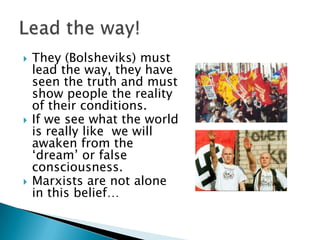
   They (Bolsheviks) must
    lead the way, they have
    seen the truth and must
    show people the reality
    of their conditions.
   If we see what the world
    is really like we will
    awaken from the
    „dream‟ or false
    consciousness.
   Marxists are not alone
    in this belief…
   Ideology is not “false consciousness.”
   Rather ideology structures what we do and
    makes our reality.
   Althusser is a structuralist We cannot exist
    outside of culture or ideology.
   It provides meaning to our lives, the systems
    that we live through.
   In short, we have no reality beyond our
    ideology – we „adopt‟ an identity from a
    shared set.
   For Althusser, it is impossible to access the “real conditions
    of existence" due to our reliance on language.
   Our language structures our experience of the world –
    (remember semiotics?) and our language is a consequence of
    the social world.
   We have no way of engaging with the world apart from
    language.
   Because of our being inside language we can‟t see external
    reality only the ideological interpretation of it - we can only
    see the representation of reality, not reality itself.
   However, through a vigorous study of economics, history and
    sociology, we can come close to perceiving ideological
    systems and how we are placed in specific sets of relations by
    those systems.
   1971 – Althusser‟s main and possibly most
    important contribution.
   Had some key (but tricky ideas).
   Process of an individual adopting a set of beliefs or
    ideology from a system of beliefs.
   We come to think that our beliefs are our own, that
    they originate from ourselves.
   My beliefs emerge from my conscious decisions, I
    have free will and can choose what to do.
   However what Althusser argues is that these beliefs
    are not really our own – they are social.
   We are taking part in shared societal ideas but
    think they are our own private ideas.
   We internalise social beliefs and see them as our
    own.
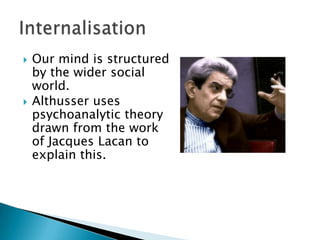
   Our mind is structured
    by the wider social
    world.
   Althusser uses
    psychoanalytic theory
    drawn from the work
    of Jacques Lacan to
    explain this.
   The beliefs/ideology come to us through
    the Ideological State Apparatus, the devices
    by which ideology is transmitted.
    ◦   Family
    ◦   Education
    ◦   Media
    ◦   Religion
    ◦   Culture
    ◦   Arts
   Our consciousness, what we are emerges
    from these.
   We exist is a system of beliefs, we internalise
    these beliefs and they become our own, and
    in turn we play a part in reproducing them.
   The people produced by this, the ideological
    „subjects‟ facilitate the economic systems.
   If for some reason the ISA fail to do
    their job, and the subjects created
    are not convivial to the economic
    system there is a range of systems to
    back them up;
    ◦   Police
    ◦   Judiciary
    ◦   Armed forces
    ◦   Occasionally medicine, particularly
        psychiatric medicine.
   „Faulty‟ non-compliant subjects /
    people are labelled:
    ◦ criminal,
    ◦ terrorist
    ◦ lunatic
   and dealt with.
   Are people simply duped into adopting such
    a set of beliefs?
   Is this really that much different from the
    main traditional Marxist ideas?
   Aren‟t we more free willed?
   Gramsci, an Italian Communist, developed his ideas during the
    late 1920‟s while he was on „holiday‟ at Mussolini‟s expense.
   During this time, he completed 32 notebooks containing almost
    3,000 pages.
   These notebooks were smuggled out from his prison and
    published in Italian after the war but did not find an English-
    language publisher until the 1970s.
   The central and guiding theme of the Notebooks was the
    development of a new Marxist theory applicable to the conditions
    of advanced capitalism.
   He became the first Marxist theorist to work with the problems of
    revolutionary change in 20th century Western European society -
    he sought to explain why revolution had not happened according
    to the [predictions of scientific Marxism.
   He identified the importance of the struggle against bourgeois
    values – that the struggle must occur at the symbolic as well as
    the physical level.
   Gramsci accepted the analysis of capitalism
    put forward by Marx.
   He accepted that the struggle between the
    ruling class and the subordinate working
    class was the driving force that moved
    society forward.
   But he had difficulty with the traditional
    Marxist view of how power was maintained.
   This was Gramsci‟s contribution his idea on
    the role played by ideology in maintaining
    power.
   Gramsci uses the idea of hegemony
   By this he meant the dissemination throughout society of a
    system of values, attitudes, beliefs and morality that has the
    effect of supporting the status quo in power relations.
   Hegemony in this sense might be defined as an overarching
    belief that is diffused by the process of socialisation into
    every area of daily life.
   Dominant relations of power become seen as 'common
    sense' so that the philosophy, culture and morality of the
    ruling elite comes to appear as the natural order of things.
   The values that maintain the power relations permeate all
    levels and aspects of culture.
   A hegemonic belief is something we all concur with, its
    normal and is spread throughout society.
   Because we all concur with these beliefs and
    share them we actively contribute to their
    maintenance.
   Rather than a passive public we give consent
    to power systems.
   EG - The ruling groups present themselves as
    the group best able to provide us with the
    means to pursue our needs.
   And to maintain power the dominant groups
    constantly realign themselves and adopt
    different critical concerns.
   Ideology is not fixed and constant but in
    flux
   “Hegemony… is not universal and “given” to
    the continuing rule of a particular class. It
    has to be won, reproduced, sustained.
    Hegemony is as Gramsci said, a “moving
    equilibrium containing relations of forces
    favourable and unfavourable to this and
    that tendency”” (Hall 1978).
   Hegemony is about getting us to actively
    agree to the system of oppression.
   Ideology is not imposed but a system of
    choices and ideas.
   These are grouped together into set which we
    choose to adhere to.
   The media play a part in justifying oppression
    by making it seem legitimate.
   The help in the “Manufacture of Consent” – a
    term taken up by Noam Chomsky but that is
    for another day…
   Ideological Marxism is different from pol ec
    marxism.
   It stresses the importance of culture and
    values.
   Althusser sees us as subjects.
   Gramsci sees us as willing if not complicit
    participants in our own subjectification.
   We‟ve only just scratched the surface…

Exploring Media Theory Lecture 3 Ideology and Marxism

  • 1.
    Lecture 3: Marxism, ideology and the media Or “We are stupid to believe what we believe” MS 2900 Exploring Media Theory University of Winchester Dr Marcus Leaning
  • 2.
    In this lecture we are going to look at ideology from a Marxist perspective.  Ideology is a key concept in the fields of cultural analysis, media studies and literary analysis.  The idea of ideology explains: ◦ why people hold beliefs that seem antithetical to their material position –why do we believe we should continue with the current system when it is obvious we are not benefiting from the present state of affairs? ◦ how „culture‟ is structured in such a way that enables the group holding power to have the maximum control with the minimum of conflict.
  • 3.
    This is not a matter of groups deliberately planning to oppress people or alter their consciousness (although this can happen), but rather a matter of how the dominant institutions and groups in society work through: ◦ values, ◦ conceptions of the world, ◦ symbol systems,  in order to legitimise the current order.
  • 4.
    Briefly, this legitimisation is managed through the widespread social adoption of ideas about the way things are, how the world works and should be.  These ideas which are often embedded in cultural practices orient people's thinking in such a way that they accept the current way of doing things, the current sense of what is 'natural,' and the current understanding of their roles in society.
  • 5.
    We will look at; ◦ Some theoretical foundations of the Marxist approach; ◦ The ideas of two key theorists;  Louis Althusser  Antonio Gramsci
  • 6.
    Marxists are interested in “How dominant social groups are able to reproduce their social and economic power” Taylor and Willis (1999) P.29.  This idea goes right back to Marx.
  • 7.
    “The ideas of the ruling class are in every epoch the ruling ideas, I.E. the class which is the ruling material force of society is at the same time its ruling intellectual force” Marx and Engles The German Ideology.
  • 8.
    Economic Determinist.  The economic system determines the form of society. Capitalist Society Superstructure Capitalist Economic Economic Base System
  • 9.
    All aspects of culture in a given society are dependent on and derived from the relations of production of the system of the particular mode of production.  The particular mode of production of an era formed the base structure of society; all other aspects, including culture, religion, values are simple superstructure, a consequence of the economic structure.
  • 10.
    According to Marx, ideology ◦ Naturalises ◦ Historicises ◦ Eternalises The economic system: 1. The system appear to be natural, “it‟s just how things are”; 2. The system appears to be the logical conclusion to an historical development – we evolved to this state; 3. There is an assumption that now that this (natural) state of affairs has been reached, things will be that way, barring regression (eternalisation).
  • 11.
    “The free market is the economic system most in keeping with the nature and needs of humans; history has been an evolution of economic forms towards our version of the free market; once states have all reached this, all they have to do is avoid reverting, there is no 'further' to go in terms of economic organization."  We assume that the free market is the political system best suited to the nature and aspirations of humans, we see history as a movement towards this, we assume that once all nations have achieved it they will continue to be free markets forever, unless they erode.  These assumptions are ideology.
  • 12.
    More recent theories have tended to look at how elements of society contribute to the maintenance of the system.  Cultural life is not just a result of economic life, they help to maintain it, contribute to it and accelerate it.
  • 13.
    Tried to develop these criticisms.  Says Modernity is different from other periods of time.  That because of the changes that took place in Modernity the superstructure acquired a degree of independence from the base.  The superstructure develops above and beyond the determinates of the base.  As a consequence we need to look beyond the merely economic relations and extend our analysis to the other aspects of society.  We should just look at economics to explain inequality, we need to look to culture and the media as well.
  • 14.
    The Marxists economistic way of thinking of proposed that ideologies are false, they misrepresent reality to us.  Ideologies are a veil that hide reality.  For them, underneath ideology is a real hidden world (for example, the "real" economic relations of production).  We can‟t see these real systems.  Trad. Marxists contend they „pulled back the veil‟ on the falsity of Modern life and have seen the reality beneath.
  • 15.
    They (Bolsheviks) must lead the way, they have seen the truth and must show people the reality of their conditions.  If we see what the world is really like we will awaken from the „dream‟ or false consciousness.  Marxists are not alone in this belief…
  • 16.
    Ideology is not “false consciousness.”  Rather ideology structures what we do and makes our reality.  Althusser is a structuralist We cannot exist outside of culture or ideology.  It provides meaning to our lives, the systems that we live through.  In short, we have no reality beyond our ideology – we „adopt‟ an identity from a shared set.
  • 17.
    For Althusser, it is impossible to access the “real conditions of existence" due to our reliance on language.  Our language structures our experience of the world – (remember semiotics?) and our language is a consequence of the social world.  We have no way of engaging with the world apart from language.  Because of our being inside language we can‟t see external reality only the ideological interpretation of it - we can only see the representation of reality, not reality itself.  However, through a vigorous study of economics, history and sociology, we can come close to perceiving ideological systems and how we are placed in specific sets of relations by those systems.
  • 18.
    1971 – Althusser‟s main and possibly most important contribution.  Had some key (but tricky ideas).
  • 19.
    Process of an individual adopting a set of beliefs or ideology from a system of beliefs.  We come to think that our beliefs are our own, that they originate from ourselves.  My beliefs emerge from my conscious decisions, I have free will and can choose what to do.  However what Althusser argues is that these beliefs are not really our own – they are social.  We are taking part in shared societal ideas but think they are our own private ideas.  We internalise social beliefs and see them as our own.
  • 20.
    Our mind is structured by the wider social world.  Althusser uses psychoanalytic theory drawn from the work of Jacques Lacan to explain this.
  • 21.
    The beliefs/ideology come to us through the Ideological State Apparatus, the devices by which ideology is transmitted. ◦ Family ◦ Education ◦ Media ◦ Religion ◦ Culture ◦ Arts
  • 22.
    Our consciousness, what we are emerges from these.  We exist is a system of beliefs, we internalise these beliefs and they become our own, and in turn we play a part in reproducing them.  The people produced by this, the ideological „subjects‟ facilitate the economic systems.
  • 23.
    If for some reason the ISA fail to do their job, and the subjects created are not convivial to the economic system there is a range of systems to back them up; ◦ Police ◦ Judiciary ◦ Armed forces ◦ Occasionally medicine, particularly psychiatric medicine.  „Faulty‟ non-compliant subjects / people are labelled: ◦ criminal, ◦ terrorist ◦ lunatic  and dealt with.
  • 24.
    Are people simply duped into adopting such a set of beliefs?  Is this really that much different from the main traditional Marxist ideas?  Aren‟t we more free willed?
  • 25.
    Gramsci, an Italian Communist, developed his ideas during the late 1920‟s while he was on „holiday‟ at Mussolini‟s expense.  During this time, he completed 32 notebooks containing almost 3,000 pages.  These notebooks were smuggled out from his prison and published in Italian after the war but did not find an English- language publisher until the 1970s.  The central and guiding theme of the Notebooks was the development of a new Marxist theory applicable to the conditions of advanced capitalism.  He became the first Marxist theorist to work with the problems of revolutionary change in 20th century Western European society - he sought to explain why revolution had not happened according to the [predictions of scientific Marxism.  He identified the importance of the struggle against bourgeois values – that the struggle must occur at the symbolic as well as the physical level.
  • 26.
    Gramsci accepted the analysis of capitalism put forward by Marx.  He accepted that the struggle between the ruling class and the subordinate working class was the driving force that moved society forward.  But he had difficulty with the traditional Marxist view of how power was maintained.  This was Gramsci‟s contribution his idea on the role played by ideology in maintaining power.
  • 27.
    Gramsci uses the idea of hegemony  By this he meant the dissemination throughout society of a system of values, attitudes, beliefs and morality that has the effect of supporting the status quo in power relations.  Hegemony in this sense might be defined as an overarching belief that is diffused by the process of socialisation into every area of daily life.  Dominant relations of power become seen as 'common sense' so that the philosophy, culture and morality of the ruling elite comes to appear as the natural order of things.  The values that maintain the power relations permeate all levels and aspects of culture.  A hegemonic belief is something we all concur with, its normal and is spread throughout society.
  • 28.
    Because we all concur with these beliefs and share them we actively contribute to their maintenance.  Rather than a passive public we give consent to power systems.  EG - The ruling groups present themselves as the group best able to provide us with the means to pursue our needs.  And to maintain power the dominant groups constantly realign themselves and adopt different critical concerns.
  • 29.
    Ideology is not fixed and constant but in flux  “Hegemony… is not universal and “given” to the continuing rule of a particular class. It has to be won, reproduced, sustained. Hegemony is as Gramsci said, a “moving equilibrium containing relations of forces favourable and unfavourable to this and that tendency”” (Hall 1978).
  • 30.
    Hegemony is about getting us to actively agree to the system of oppression.  Ideology is not imposed but a system of choices and ideas.  These are grouped together into set which we choose to adhere to.
  • 31.
    The media play a part in justifying oppression by making it seem legitimate.  The help in the “Manufacture of Consent” – a term taken up by Noam Chomsky but that is for another day…
  • 32.
    Ideological Marxism is different from pol ec marxism.  It stresses the importance of culture and values.  Althusser sees us as subjects.  Gramsci sees us as willing if not complicit participants in our own subjectification.  We‟ve only just scratched the surface…