CHAPTER I. Philosophy: An
Attempt at its Definition,
Nature, and Historical
Definition of Philosophy
Outline

•The word philosophy can be looked at from two aspects: its
etymological and its real definition.
•Etymologically, philosophy comes from the two greek
words, philo and sophia, which means lover of wisdom.
•Its real real definition can be stated briefly: philosophy is a
search for meaning.
•The word “search” means to look, to find, to seek.
•The difference lies in the three elements found in
philosophical search. These are:
1. The object of the search is of real value to subject
Object- refers to a thing/
Subject- to the person philosophizing
2. It “consumes” the whole person – his
attention, concentration, interest, effort.
3. The philosophers searches for the meaning of
life-its importance, significance, value, relevance.
The Nature of Philosophy
 It is in the very nature of philosophy that man
searches for the meaning of himself and his
world.
 It can truly be said that philosophy was born
the very first time man started wondering at
what he saw around him.
 To early Greeks, philosophy was a superstar of
a subject.
 Philosophy is considered to have four main
What is Philosophy?
 Philosophy has been
called many things
and it can have many
meanings
 Those single words
or statements on the
right side are only
some of them
 What words would
you add?

Wisdom
Reality
Theories
Meaning of Life
Nature of being
human
 Life perspectives





Universities with a major in philosophy usually
offer the following core subjects:
1. Logic – the science and art of correct thinking.
2. Ethics- the science of the morality of human
acts.
3. Epistemology- the theory of knowledge, the
goal of which is truth.
4. Metaphysics- the foundation subject of all
philosophy, it deals with human reality and
system of human thought that seeks to explain
the fundamental concepts of man.
5. Cosmology- the study of inanimate things such
as the universe, from the philosophical
viewpoint.
6. Aesthetics- the study of the beautiful
7. Rational or Philosophical Psychology- the study
9. Social Philosophy- the study of man in relation to the family,
the State, and the Church.
10. Philosophy of Man- is an inquiry into man as person and as
existent being in the world: his dignity, truth, freedom,
justice, love, death, his relations with others and with God.
 Approaches to Ethics is a study according to historical periods.
The outline that follows is based on these three sources.
A. Pre-Socratic Period
B. The Greeks
1. Socrates
2. Plato
3. Aristotle
C. The Romans
1. Seneca
2. Marcus Aurelius
3. Epictetus
D. The Middle Ages
1. Augustine
2. Bonaventure
3. Boethius
4. Albert the Great
5. Thomas Aquinas
6. Duns Scotus
7. Pico Della Miranda
E. Early Modern Period
1. Rene Decartes
2. Nicolo Machiavellie
3. Thomas Hobbes
4. Benedict Spinoza
5. John Locke
6. David Hume
7. Immanuel Kant
F. The Nineteenth Century
1. Jeremy Bentham
2. Georg Wilhelm Friedrich Hegel
3. Arthur Schopenhauer
4. John Stuart Mill
5. Soren Kierkegard
6. Frederich Nietzche
7. Karl Marx
G. The Contemporary Period
1. Jean Paul Sarte
2. Gabriel Marcel
3. Edmund Husserl
4. Martin Heidegger
5. Teilhard de Chardin
6. Karl Jaspers
7. Martin Buber
8. Robert Johann
9. Henri Bergson
10. Ludwig Wittgenstein
11. William Luijpen
12. Alfred North Whitehead
13. John Dewey
14. William James
15. Charles S. Peirce
16. Paul Ricoeur
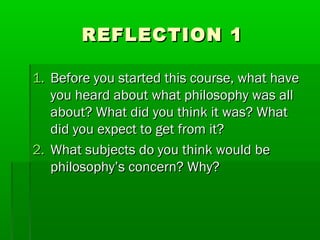
REFLECTION 1
1. Before you started this course, what have
you heard about what philosophy was all
about? What did you think it was? What
did you expect to get from it?
2. What subjects do you think would be
philosophy’s concern? Why?
Thank You!

Prepared by: Prof. Arnold T. Malayao

Chapter 1: Philosophy

  • 1.
    CHAPTER I. Philosophy:An Attempt at its Definition, Nature, and Historical Definition of Philosophy Outline •The word philosophy can be looked at from two aspects: its etymological and its real definition. •Etymologically, philosophy comes from the two greek words, philo and sophia, which means lover of wisdom. •Its real real definition can be stated briefly: philosophy is a search for meaning. •The word “search” means to look, to find, to seek. •The difference lies in the three elements found in philosophical search. These are: 1. The object of the search is of real value to subject Object- refers to a thing/ Subject- to the person philosophizing
  • 2.
    2. It “consumes”the whole person – his attention, concentration, interest, effort. 3. The philosophers searches for the meaning of life-its importance, significance, value, relevance. The Nature of Philosophy  It is in the very nature of philosophy that man searches for the meaning of himself and his world.  It can truly be said that philosophy was born the very first time man started wondering at what he saw around him.  To early Greeks, philosophy was a superstar of a subject.  Philosophy is considered to have four main
  • 3.
    What is Philosophy? Philosophy has been called many things and it can have many meanings  Those single words or statements on the right side are only some of them  What words would you add? Wisdom Reality Theories Meaning of Life Nature of being human  Life perspectives     
  • 4.
    Universities with amajor in philosophy usually offer the following core subjects: 1. Logic – the science and art of correct thinking. 2. Ethics- the science of the morality of human acts. 3. Epistemology- the theory of knowledge, the goal of which is truth. 4. Metaphysics- the foundation subject of all philosophy, it deals with human reality and system of human thought that seeks to explain the fundamental concepts of man. 5. Cosmology- the study of inanimate things such as the universe, from the philosophical viewpoint. 6. Aesthetics- the study of the beautiful 7. Rational or Philosophical Psychology- the study
  • 5.
    9. Social Philosophy-the study of man in relation to the family, the State, and the Church. 10. Philosophy of Man- is an inquiry into man as person and as existent being in the world: his dignity, truth, freedom, justice, love, death, his relations with others and with God.  Approaches to Ethics is a study according to historical periods. The outline that follows is based on these three sources. A. Pre-Socratic Period B. The Greeks 1. Socrates 2. Plato 3. Aristotle
  • 6.
    C. The Romans 1.Seneca 2. Marcus Aurelius 3. Epictetus D. The Middle Ages 1. Augustine 2. Bonaventure 3. Boethius 4. Albert the Great 5. Thomas Aquinas 6. Duns Scotus 7. Pico Della Miranda E. Early Modern Period 1. Rene Decartes 2. Nicolo Machiavellie 3. Thomas Hobbes
  • 7.
    4. Benedict Spinoza 5.John Locke 6. David Hume 7. Immanuel Kant F. The Nineteenth Century 1. Jeremy Bentham 2. Georg Wilhelm Friedrich Hegel 3. Arthur Schopenhauer 4. John Stuart Mill 5. Soren Kierkegard 6. Frederich Nietzche 7. Karl Marx G. The Contemporary Period 1. Jean Paul Sarte 2. Gabriel Marcel 3. Edmund Husserl 4. Martin Heidegger 5. Teilhard de Chardin
  • 8.
    6. Karl Jaspers 7.Martin Buber 8. Robert Johann 9. Henri Bergson 10. Ludwig Wittgenstein 11. William Luijpen 12. Alfred North Whitehead 13. John Dewey 14. William James 15. Charles S. Peirce 16. Paul Ricoeur
  • 9.
    REFLECTION 1 1. Beforeyou started this course, what have you heard about what philosophy was all about? What did you think it was? What did you expect to get from it? 2. What subjects do you think would be philosophy’s concern? Why?
  • 10.
    Thank You! Prepared by:Prof. Arnold T. Malayao