POLITICAL IDEOLOGIES
Learning Objectives:
•Define ideology and political ideologies
•Identify the different characteristics of ideology
Ideology
•It refers to a set of belief and ideas that shape an
individual’s or a group’s views, action, and
interactions with the world.
Ideology
•a systematic body of concepts especially
about human life or culture
• a manner or the content of thinking
characteristic of an individual, group, or
culture
Ideology
•the integrated assertions, theories and aims
that constitute a socio-political program
•is a more or less coherent set of ideas that
provides the basis for organized political
action, whether this is intended to preserve,
modify or overthrow the existing system of
power.
Political ideology
•is a set of related beliefs about political theory and policy held
by an individual, group of individuals or a particular social
class
•political ideologies form the basis of how they view the world
around them and the proper role of government in the world.
Political ideology
•(a)offer an account of the existing order, usually in the form
of a ‘world-view’, (b) advance a model of a desired future, a
vision of the ‘good society’, and (c) explain how political
change can and should be brought about- how to get from
A to B. (Heywood 2003, 12)
Political ideology
•Is a set of beliefs and ideas that define political activities,
policies, and events.
•It outlines the role of government and the economy in
society.
•It proposes the ideas regarding the most effective
government.
•Became the basis for the values, principles, and ideas to
which the state subscribes to define its laws, programs, and
political activities.
Political ideology
• According to the International Encyclopedia of the Social
and Behavioral Sciences (2001), a political ideology is a
set of ideas, beliefs, values, and opinions, exhibiting a
recurring pattern, that competes deliberately as well as
unintentionally over providing plans of action for public
policy making.
Political ideologies
•Political ideologies may more or less provide
basis for coherent ideas for organized political
action whether these ideas intend to preserve,
modify or overthrow an existing government or
power structure.
Characteristics of Ideologies
Ideologies provide an explanation for problems
that confronts modern societies by providing
futuristic visions.
Ideology is action-oriented.
Ideologies mobilize a large number of people.
“One-sentence summary”
Summarize the definition of ideology and
political ideologies by doing “one-sentence
summary.
RUBRIC:
APPLICATIONS
1. Compare the ideologies of yor mother and father.
2. Given such experience from your parents, who among them are you
in favor? Why?
Generalizations
Activity: DYAD
• “To be clear: ideology is a belief system with an
inadequate basis in reality; religion is a belief system
with no basis, in reality, whatever.” – Martin Amis.
•
POLITICAL IDEOLOGIES
Learning Objectives:
Identify the different political ideologies and
its functions.
Differentiate the political ideologies
REVIEW ACTIVITY
•ACROSTIC
Direction: Let the students give
characteristics of ideology based from
the letters of the word I-D-E-O-L-O-G-Y
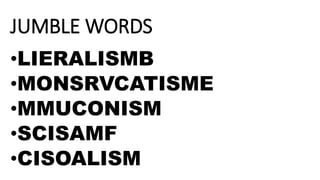
JUMBLE WORDS
•LIERALISMB
•MONSRVCATISME
•MMUCONISM
•SCISAMF
•CISOALISM
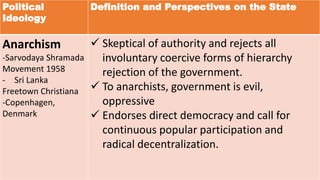
Political
Ideology
Definition and Perspectives on the State
Anarchism
-Sarvodaya Shramada
Movement 1958
- Sri Lanka
Freetown Christiana
-Copenhagen,
Denmark
 Skeptical of authority and rejects all
involuntary coercive forms of hierarchy
rejection of the government.
 To anarchists, government is evil,
oppressive
 Endorses direct democracy and call for
continuous popular participation and
radical decentralization.
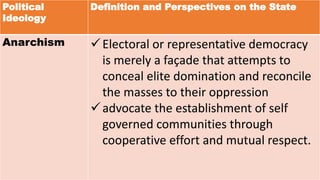
Political
Ideology
Definition and Perspectives on the State
Anarchism Electoral or representative democracy
is merely a façade that attempts to
conceal elite domination and reconcile
the masses to their oppression
advocate the establishment of self
governed communities through
cooperative effort and mutual respect.
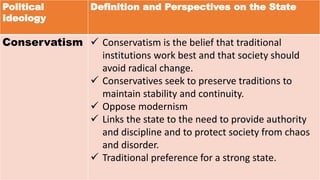
Political
Ideology
Definition and Perspectives on the State
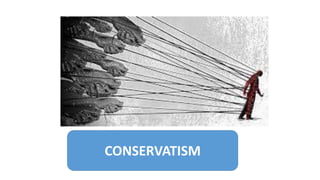
Conservatism  Conservatism is the belief that traditional
institutions work best and that society should
avoid radical change.
 Conservatives seek to preserve traditions to
maintain stability and continuity.
 Oppose modernism
 Links the state to the need to provide authority
and discipline and to protect society from chaos
and disorder.
 Traditional preference for a strong state.
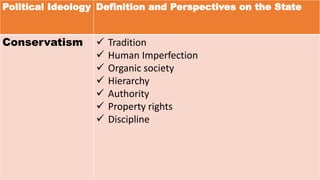
Political Ideology Definition and Perspectives on the State
Conservatism  Tradition
 Human Imperfection
 Organic society
 Hierarchy
 Authority
 Property rights
 Discipline
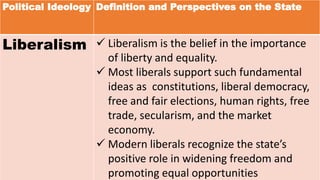
Political Ideology Definition and Perspectives on the State
Liberalism  Liberalism is the belief in the importance
of liberty and equality.
 Most liberals support such fundamental
ideas as constitutions, liberal democracy,
free and fair elections, human rights, free
trade, secularism, and the market
economy.
 Modern liberals recognize the state’s
positive role in widening freedom and
promoting equal opportunities
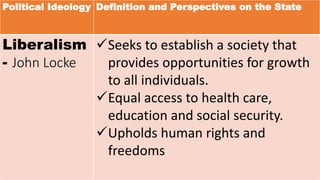
Political Ideology Definition and Perspectives on the State
Liberalism
- John Locke
Seeks to establish a society that
provides opportunities for growth
to all individuals.
Equal access to health care,
education and social security.
Upholds human rights and
freedoms
Political Ideology Definition and Perspectives on the State
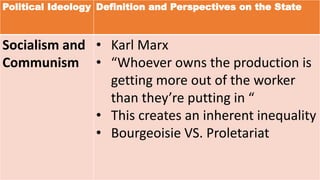
Socialism and
Communism
• Karl Marx
• “Whoever owns the production is
getting more out of the worker
than they’re putting in “
• This creates an inherent inequality
• Bourgeoisie VS. Proletariat
Political Ideology Definition and Perspectives on the State
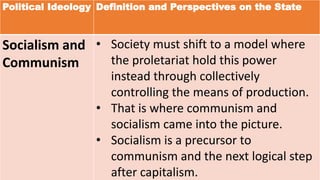
Socialism and
Communism
• Society must shift to a model where
the proletariat hold this power
instead through collectively
controlling the means of production.
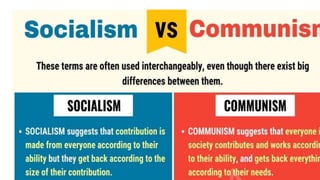
• That is where communism and
socialism came into the picture.
• Socialism is a precursor to
communism and the next logical step
after capitalism.
Political Ideology Definition and Perspectives on the State
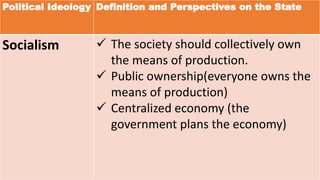
Socialism  The society should collectively own
the means of production.
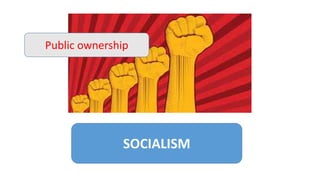
 Public ownership(everyone owns the
means of production)
 Centralized economy (the
government plans the economy)
Political Ideology Definition and Perspectives on the State
Socialism  Economic equality
 The government ensures that all
citizens have free access to goods
and services
 Doesn’t believe in social classes
and worker exploitation.
Political Ideology Definition and Perspectives on the State
Socialism
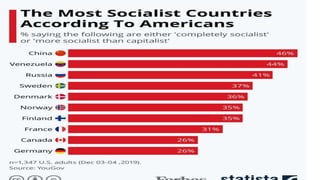
-Social Democracy
- Sweden, Denmark,
Norway ,Switzerland
 Improving quality of life through
equal rights and opportunities
provided by a state-run welfare
system and on top of a capitalist
economy.
Political Ideology Definition and Perspectives on the State
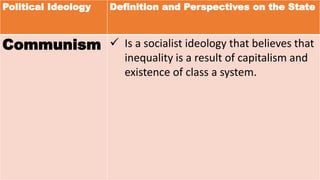
Communism  Is a socialist ideology that believes that
inequality is a result of capitalism and
existence of class a system.
Political Ideology Definition and Perspectives on the State
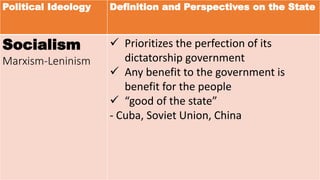
Socialism
Marxism-Leninism
 Prioritizes the perfection of its
dictatorship government
 Any benefit to the government is
benefit for the people
 “good of the state”
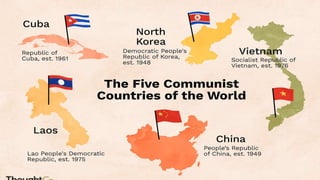
- Cuba, Soviet Union, China
Political Ideology Definition and Perspectives on the State
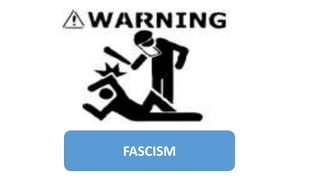
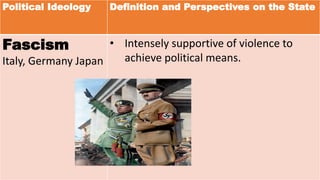
Fascism
Italy, Germany Japan
 Based on fierce nationalism and
authoritarianism.
 Advocates central government
 When the society is in danger from
various threats (invasion, war,
rebellion) a strong government with
unlimited power is needed to address
the threats.
 The interest of the state is more
important than individual liberties.
Political Ideology Definition and Perspectives on the State
Fascism
Italy, Germany Japan
 Born out of the idea that rational
democracies would lead to severe crisis
and weakness.
 It promise to create the rebirth of a
new stronger, and greater society,
stripped all weaknesses
 Totalitarianism
Political Ideology Definition and Perspectives on the State
Fascism
Italy, Germany Japan  Follow strict doctrine:
 It attempts to unify country under a
single genetic banner. Nationalism
includes the concept of “racial” or
cultural purity.
 Total control of society and people by
the state called Totalitarianism. People
must believe in a single party ruling
elite, a dictator.
Political Ideology Definition and Perspectives on the State
Fascism
Italy, Germany Japan
• Intensely supportive of violence to
achieve political means.
COLLABORATIVE ACTIVITY
•Pick-tell
•Jumbled pictures will be available at the teacher’s
table and each group will select a representative to
pick one and give them time to collaborate their
ideas in relation to ideologies and political
ideologies.
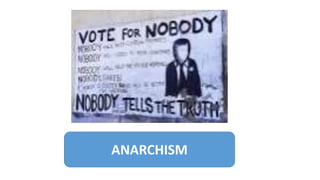
ANARCHISM
FASCISM
SOCIALISM
Public ownership
CONSERVATISM
ROLE PLAYING
Direction:
The class will divide into five groups. Each
group will present a role paly about the
different political ideologies.
WHICH TYPE OF IDEOLOGIES IS BEING
DESCRIBED?
Fascism
Communism
Socialism
Conservatism
Liberalism
APPLICATIONS
•Section 18. The President shall be the
Commander-in-Chief of all armed forces of
the Philippines and whenever it becomes
necessary, he may call out such armed
forces to prevent or suppress lawless
violence, invasion or rebellion.
Article III (Bill of Rights)
•No person shall be deprived of life, liberty, or
property without due process of law, nor shall
any person be denied the equal protection of
the laws. To be considered as "illegal", such
discrimination must however be in violation
of a specific law.
Article XIII (Social Justice and Human Rights)
•Everyone has the right to freedom of
thought, conscience and religion; this right
includes freedom to change his religion or
belief, and freedom, either alone or in
community with others and in public or
private, to manifest his religion or belief in
teaching, practice, worship and observance.
Article XV (The Family)
•The State recognizes the Filipino family
as the foundation of the nation.
Accordingly, it shall strengthen its
solidarity and actively promote its total
development.
GENERALIZATION
Complete the exit ticket:
1. Today I have learned that__________.
2. The topic that is NOT clear to me is /are?________________.
3-2-1 ACTIVITY
Writing activity where students write:
3 key terms from what they have learned__________
2 ideas they would like to learn more about__________
1 concept or skill they think they have
mastered_________
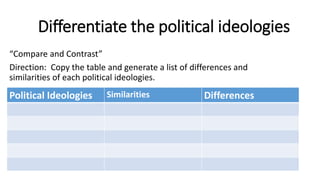
Differentiate the political ideologies
“Compare and Contrast”
Direction: Copy the table and generate a list of differences and
similarities of each political ideologies.
Political Ideologies Similarities Differences

POLITICS WEEK 2-3.pptx

  • 1.
    POLITICAL IDEOLOGIES Learning Objectives: •Defineideology and political ideologies •Identify the different characteristics of ideology
  • 2.
    Ideology •It refers toa set of belief and ideas that shape an individual’s or a group’s views, action, and interactions with the world.
  • 3.
    Ideology •a systematic bodyof concepts especially about human life or culture • a manner or the content of thinking characteristic of an individual, group, or culture
  • 4.
    Ideology •the integrated assertions,theories and aims that constitute a socio-political program •is a more or less coherent set of ideas that provides the basis for organized political action, whether this is intended to preserve, modify or overthrow the existing system of power.
  • 5.
    Political ideology •is aset of related beliefs about political theory and policy held by an individual, group of individuals or a particular social class •political ideologies form the basis of how they view the world around them and the proper role of government in the world.
  • 6.
    Political ideology •(a)offer anaccount of the existing order, usually in the form of a ‘world-view’, (b) advance a model of a desired future, a vision of the ‘good society’, and (c) explain how political change can and should be brought about- how to get from A to B. (Heywood 2003, 12)
  • 7.
    Political ideology •Is aset of beliefs and ideas that define political activities, policies, and events. •It outlines the role of government and the economy in society. •It proposes the ideas regarding the most effective government. •Became the basis for the values, principles, and ideas to which the state subscribes to define its laws, programs, and political activities.
  • 8.
    Political ideology • Accordingto the International Encyclopedia of the Social and Behavioral Sciences (2001), a political ideology is a set of ideas, beliefs, values, and opinions, exhibiting a recurring pattern, that competes deliberately as well as unintentionally over providing plans of action for public policy making.
  • 9.
    Political ideologies •Political ideologiesmay more or less provide basis for coherent ideas for organized political action whether these ideas intend to preserve, modify or overthrow an existing government or power structure.
  • 10.
    Characteristics of Ideologies Ideologiesprovide an explanation for problems that confronts modern societies by providing futuristic visions. Ideology is action-oriented. Ideologies mobilize a large number of people.
  • 11.
    “One-sentence summary” Summarize thedefinition of ideology and political ideologies by doing “one-sentence summary. RUBRIC:
  • 12.
    APPLICATIONS 1. Compare theideologies of yor mother and father. 2. Given such experience from your parents, who among them are you in favor? Why?
  • 13.
    Generalizations Activity: DYAD • “Tobe clear: ideology is a belief system with an inadequate basis in reality; religion is a belief system with no basis, in reality, whatever.” – Martin Amis. •
  • 14.
    POLITICAL IDEOLOGIES Learning Objectives: Identifythe different political ideologies and its functions. Differentiate the political ideologies
  • 15.
    REVIEW ACTIVITY •ACROSTIC Direction: Letthe students give characteristics of ideology based from the letters of the word I-D-E-O-L-O-G-Y
  • 16.
  • 17.
    Political Ideology Definition and Perspectiveson the State Anarchism -Sarvodaya Shramada Movement 1958 - Sri Lanka Freetown Christiana -Copenhagen, Denmark  Skeptical of authority and rejects all involuntary coercive forms of hierarchy rejection of the government.  To anarchists, government is evil, oppressive  Endorses direct democracy and call for continuous popular participation and radical decentralization.
  • 18.
    Political Ideology Definition and Perspectiveson the State Anarchism Electoral or representative democracy is merely a façade that attempts to conceal elite domination and reconcile the masses to their oppression advocate the establishment of self governed communities through cooperative effort and mutual respect.
  • 19.
    Political Ideology Definition and Perspectiveson the State Conservatism  Conservatism is the belief that traditional institutions work best and that society should avoid radical change.  Conservatives seek to preserve traditions to maintain stability and continuity.  Oppose modernism  Links the state to the need to provide authority and discipline and to protect society from chaos and disorder.  Traditional preference for a strong state.
  • 20.
    Political Ideology Definitionand Perspectives on the State Conservatism  Tradition  Human Imperfection  Organic society  Hierarchy  Authority  Property rights  Discipline
  • 21.
    Political Ideology Definitionand Perspectives on the State Liberalism  Liberalism is the belief in the importance of liberty and equality.  Most liberals support such fundamental ideas as constitutions, liberal democracy, free and fair elections, human rights, free trade, secularism, and the market economy.  Modern liberals recognize the state’s positive role in widening freedom and promoting equal opportunities
  • 22.
    Political Ideology Definitionand Perspectives on the State Liberalism - John Locke Seeks to establish a society that provides opportunities for growth to all individuals. Equal access to health care, education and social security. Upholds human rights and freedoms
  • 24.
    Political Ideology Definitionand Perspectives on the State Socialism and Communism • Karl Marx • “Whoever owns the production is getting more out of the worker than they’re putting in “ • This creates an inherent inequality • Bourgeoisie VS. Proletariat
  • 25.
    Political Ideology Definitionand Perspectives on the State Socialism and Communism • Society must shift to a model where the proletariat hold this power instead through collectively controlling the means of production. • That is where communism and socialism came into the picture. • Socialism is a precursor to communism and the next logical step after capitalism.
  • 26.
    Political Ideology Definitionand Perspectives on the State Socialism  The society should collectively own the means of production.  Public ownership(everyone owns the means of production)  Centralized economy (the government plans the economy)
  • 27.
    Political Ideology Definitionand Perspectives on the State Socialism  Economic equality  The government ensures that all citizens have free access to goods and services  Doesn’t believe in social classes and worker exploitation.
  • 28.
    Political Ideology Definitionand Perspectives on the State Socialism -Social Democracy - Sweden, Denmark, Norway ,Switzerland  Improving quality of life through equal rights and opportunities provided by a state-run welfare system and on top of a capitalist economy.
  • 29.
    Political Ideology Definitionand Perspectives on the State Communism  Is a socialist ideology that believes that inequality is a result of capitalism and existence of class a system.
  • 30.
    Political Ideology Definitionand Perspectives on the State Socialism Marxism-Leninism  Prioritizes the perfection of its dictatorship government  Any benefit to the government is benefit for the people  “good of the state” - Cuba, Soviet Union, China
  • 34.
    Political Ideology Definitionand Perspectives on the State Fascism Italy, Germany Japan  Based on fierce nationalism and authoritarianism.  Advocates central government  When the society is in danger from various threats (invasion, war, rebellion) a strong government with unlimited power is needed to address the threats.  The interest of the state is more important than individual liberties.
  • 35.
    Political Ideology Definitionand Perspectives on the State Fascism Italy, Germany Japan  Born out of the idea that rational democracies would lead to severe crisis and weakness.  It promise to create the rebirth of a new stronger, and greater society, stripped all weaknesses  Totalitarianism
  • 36.
    Political Ideology Definitionand Perspectives on the State Fascism Italy, Germany Japan  Follow strict doctrine:  It attempts to unify country under a single genetic banner. Nationalism includes the concept of “racial” or cultural purity.  Total control of society and people by the state called Totalitarianism. People must believe in a single party ruling elite, a dictator.
  • 37.
    Political Ideology Definitionand Perspectives on the State Fascism Italy, Germany Japan • Intensely supportive of violence to achieve political means.
  • 38.
    COLLABORATIVE ACTIVITY •Pick-tell •Jumbled pictureswill be available at the teacher’s table and each group will select a representative to pick one and give them time to collaborate their ideas in relation to ideologies and political ideologies.
  • 39.
  • 40.
  • 41.
  • 42.
  • 43.
    ROLE PLAYING Direction: The classwill divide into five groups. Each group will present a role paly about the different political ideologies.
  • 44.
    WHICH TYPE OFIDEOLOGIES IS BEING DESCRIBED? Fascism Communism Socialism Conservatism Liberalism
  • 45.
    APPLICATIONS •Section 18. ThePresident shall be the Commander-in-Chief of all armed forces of the Philippines and whenever it becomes necessary, he may call out such armed forces to prevent or suppress lawless violence, invasion or rebellion.
  • 46.
    Article III (Billof Rights) •No person shall be deprived of life, liberty, or property without due process of law, nor shall any person be denied the equal protection of the laws. To be considered as "illegal", such discrimination must however be in violation of a specific law.
  • 47.
    Article XIII (SocialJustice and Human Rights) •Everyone has the right to freedom of thought, conscience and religion; this right includes freedom to change his religion or belief, and freedom, either alone or in community with others and in public or private, to manifest his religion or belief in teaching, practice, worship and observance.
  • 48.
    Article XV (TheFamily) •The State recognizes the Filipino family as the foundation of the nation. Accordingly, it shall strengthen its solidarity and actively promote its total development.
  • 49.
    GENERALIZATION Complete the exitticket: 1. Today I have learned that__________. 2. The topic that is NOT clear to me is /are?________________.
  • 50.
    3-2-1 ACTIVITY Writing activitywhere students write: 3 key terms from what they have learned__________ 2 ideas they would like to learn more about__________ 1 concept or skill they think they have mastered_________
  • 51.
    Differentiate the politicalideologies “Compare and Contrast” Direction: Copy the table and generate a list of differences and similarities of each political ideologies. Political Ideologies Similarities Differences