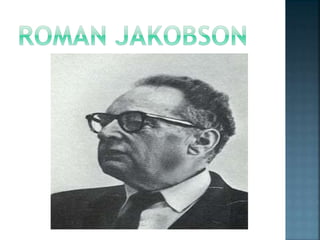
• Roman Jakobson (11 October1896-18
July1982) was one of the greatest linguists
of the 20th century. He was born in Russia
and was a member of the Russian Formalist
• school as early as 1915.
• In 1943 he became one of the founding
members of the Linguistic Circle of New York
and acted as its vice president until 1949. He
taught at numerous institutions from 1943
on, including Harvard University and MIT
 His famous model of the functions of language is
part of the intellectual heritage of semiotics.
Jakobson extended linguistics beyond syntax,
semantics, and morphology, with a careful
analysis of the sounds of language
 A pioneer of structural linguistics, Jakobson was
one of the most celebrated and
influential linguists of the twentieth century.
With Nikolai Trubetzkoy, he developed
revolutionary new techniques for the analysis of
linguistic sound systems
 In New York, he began teaching at The New
School, still closely associated with the
Czech émigré community during that period.
 After the war, he became a consultant to
the International Auxiliary Language
Association, which would
present Interlingua in 1951.
 In 1949 Jakobson moved to Harvard University,
where he remained until his retirement in 1967.
 In his last decade, Jakobson maintained an office
at the Massachusetts Institute of Technology, where
he was an honorary Professor Emeritus.
•Roman Jakobson defined six functions
of language (or communication
functions), according to which an
effective act of verbal communication
can be described.Each of the
functions has an associated factor.
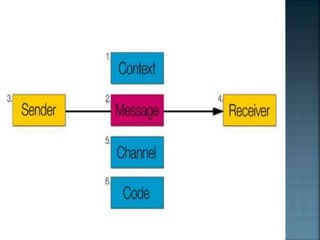
 the REFERENTIAL function is oriented toward the
CONTEXT
 the EMOTIVE (expressive) function is oriented
toward the ADDRESSER
 the CONATIVE (action-inducing, such as a
command) function is oriented toward the
ADDRESSEE
 the METALINGUAL (language speaking about
language) function is oriented toward the CODE
 the POETIC function is oriented toward the
MESSAGE for its own sake.
The referential function
corresponds to the factor of Context and
describes a situation, object or mental
state. The descriptive statements of the
referential function can consist of both
definite descriptions and deictic words
The poetic function
focuses on "the message for its own sake"[4] (the
code itself, and how it is used) and is the
operative function in poetry as well as slogans.
The emotive function
relates to the Addresser (sender) and is best
exemplified by interjections and other sound
changes that do not alter the denotative
meaning of an utterance but do add
information about the Addresser's (speaker's)
internal state, e.g. "Wow, what a view!"
The conative function
engages the Addressee (receiver) directly and is
best illustrated by vocatives and imperatives,
e.g. "Tom! Come inside and eat!“
The phonic function
is language for the sake of interaction and is
therefore associated with the Contact/Channel
factor. The Phatic Function can be observed in
greetings and casual discussions of the weather,
particularly with strangers. It also provides the
keys to open, maintain, verify or close the
communication channel: "Hello?", "Ok?",
"Hummm", "Bye"
The metalingual ("reflexive")
function
is the use of language (what Jakobson calls
"Code") to discuss or describe itself
Jakobson has been pigeon-holed as a linguist
unappreciative of the finer points of poetry
on the basis of a small and misunderstood
fragment of his total output, but even a brief
perusal of the volume under review should
persuade anyone that in terms of trenchancy,
precision, versatility and cultural range,
Jakobson's oeuvre is without rival in the
modern age. He has been the central, if as
yet unacknowledged, figure in the
development of modern poetics; it is time
for us to come to terms with his formidable
legacy.
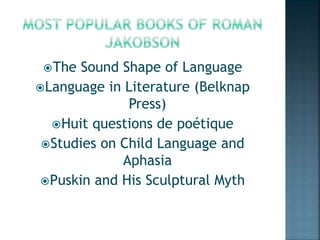
The Sound Shape of Language
Language in Literature (Belknap
Press)
Huit questions de poétique
Studies on Child Language and
Aphasia
Puskin and His Sculptural Myth

Roman jakobson linguistic

  • 2.
    • Roman Jakobson(11 October1896-18 July1982) was one of the greatest linguists of the 20th century. He was born in Russia and was a member of the Russian Formalist • school as early as 1915. • In 1943 he became one of the founding members of the Linguistic Circle of New York and acted as its vice president until 1949. He taught at numerous institutions from 1943 on, including Harvard University and MIT
  • 3.
     His famousmodel of the functions of language is part of the intellectual heritage of semiotics. Jakobson extended linguistics beyond syntax, semantics, and morphology, with a careful analysis of the sounds of language  A pioneer of structural linguistics, Jakobson was one of the most celebrated and influential linguists of the twentieth century. With Nikolai Trubetzkoy, he developed revolutionary new techniques for the analysis of linguistic sound systems
  • 4.
     In NewYork, he began teaching at The New School, still closely associated with the Czech émigré community during that period.  After the war, he became a consultant to the International Auxiliary Language Association, which would present Interlingua in 1951.
  • 5.
     In 1949Jakobson moved to Harvard University, where he remained until his retirement in 1967.  In his last decade, Jakobson maintained an office at the Massachusetts Institute of Technology, where he was an honorary Professor Emeritus.
  • 6.
    •Roman Jakobson definedsix functions of language (or communication functions), according to which an effective act of verbal communication can be described.Each of the functions has an associated factor.
  • 8.
     the REFERENTIALfunction is oriented toward the CONTEXT  the EMOTIVE (expressive) function is oriented toward the ADDRESSER  the CONATIVE (action-inducing, such as a command) function is oriented toward the ADDRESSEE  the METALINGUAL (language speaking about language) function is oriented toward the CODE  the POETIC function is oriented toward the MESSAGE for its own sake.
  • 9.
    The referential function correspondsto the factor of Context and describes a situation, object or mental state. The descriptive statements of the referential function can consist of both definite descriptions and deictic words
  • 10.
    The poetic function focuseson "the message for its own sake"[4] (the code itself, and how it is used) and is the operative function in poetry as well as slogans. The emotive function relates to the Addresser (sender) and is best exemplified by interjections and other sound changes that do not alter the denotative meaning of an utterance but do add information about the Addresser's (speaker's) internal state, e.g. "Wow, what a view!"
  • 11.
    The conative function engagesthe Addressee (receiver) directly and is best illustrated by vocatives and imperatives, e.g. "Tom! Come inside and eat!“ The phonic function is language for the sake of interaction and is therefore associated with the Contact/Channel factor. The Phatic Function can be observed in greetings and casual discussions of the weather, particularly with strangers. It also provides the keys to open, maintain, verify or close the communication channel: "Hello?", "Ok?", "Hummm", "Bye"
  • 12.
    The metalingual ("reflexive") function isthe use of language (what Jakobson calls "Code") to discuss or describe itself
  • 13.
    Jakobson has beenpigeon-holed as a linguist unappreciative of the finer points of poetry on the basis of a small and misunderstood fragment of his total output, but even a brief perusal of the volume under review should persuade anyone that in terms of trenchancy, precision, versatility and cultural range, Jakobson's oeuvre is without rival in the modern age. He has been the central, if as yet unacknowledged, figure in the development of modern poetics; it is time for us to come to terms with his formidable legacy.
  • 14.
    The Sound Shapeof Language Language in Literature (Belknap Press) Huit questions de poétique Studies on Child Language and Aphasia Puskin and His Sculptural Myth