A Presentation on
Markov Chain Model
Course Title: Development Planning and Management
Course Code: DS 3109
Presented to-
Asma Ul Husna
Assistant Professor
Development Studies Discipline
Khulna University
Presented by-
Md. Ayatullah Khan
Student ID: 152119
Development Studies Discipline
Khulna University
Date of Submission: 29 October, 2017
Table of Content
• Introduction
• Origin of Markov Chain Model
• What is Markov Chain Model?
• Markov assumptions
• Configuration of the Markov-Chain Model
• Markov Chain Application
• Example of Markov Chain Model
• Conclusion
Introduction
• Development planning contains a number of
theories and planning models. Markov model is
one of the best planning model of them.
• Markov model is a stochastic model used to
model randomly changing systems where it is
assumed that future states depend only on the
current state not on the events that occurred
before it (that is, it assumes the Markov
property).
• Markov chain model is one of the most
powerful tools for analyzing complex
stochastic system.
• Markov chain model have become popular
in manpower planning system. Several
researchers have adopted Markov chain
models to clarify manpower policy issues.
Origin of Markov Chain Model
• Markov chains were introduced in 1906 by Andrey Markov
(1856–1922)and were named in his honor.
• Andrey Markov studied Markov chains in the early 20th
century.
• Markov was interested in studying an extension of
independent random sequences, motivated by a
disagreement with Pavel Nekrasov .
• In his first paper on Markov chains, Markov showed that
under certain conditions the average outcomes of the
Markov chain would converge to a fixed vector of values.
• Markov later used Markov chains to study the distribution
of vowels in Eugene Onegin, written by Alexander Pushkin,
and proved a central limit theorem for such chains.
• Markov-Chain(Markov 1914) has been applied
to short term market forecasting and business
decision, on the future market the firms'
future market share, given a consumer
transition from one firm to the next.
What is Markov Chain Model?
• A stochastic model that describe the probabilities
of transition among the states of a system.
• It is a random process that undergoes transitions
from one state to another on a state space.
• Change of states depends probabilistically only on
the current state of the system.
• It is required to possess a property that is usually
characterized as "memoryless": the probability
distribution of the next state depends only on the
current state and not on the sequence of events
that preceded it.
• a Markov chain model is defined by a set of
states
some states emit symbols
other states (e.g. the begin state) are silent
• Changes of state depends probabilistically on
the current state of the system.
• Markov chain model makes calculation of
conditional probability easy.
Markov assumptions
• The probabilities of moving from a state to all
others sum to one.
• The probabilities apply to all system
participants.
• The probabilities are constant over time.
Configuration of the Markov-Chain
Model
• Markov systems deal with stochastic environments
in which possible "outcomes occur at the end of a
well-defined, usually first period“.
• This situation further involves a multi-period time
frame, during which the occurring consumer's
transient behavior, for example, affects the
stability of the firm's performance.
• This transient behavior, whose future outcome is
unknown but needs to be predicated, creates
inter-period transitional probabilities.
• Such a stochastic process, known as the
Markov process, contains a special case,
where the transitional probabilities from one
time period to another remains stationary, in
which case the process is referred to as the
Markov-Chain.
Markov Chain Application
Market research problems (Market share
predictions)
• Markov text generators
• Asset pricing and other financial predictions
• Customer journey predictions
• Population genetics
• Algorithmic music composition
• Page ranks (Google results)
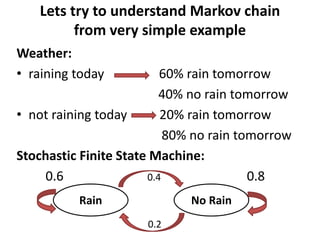
Lets try to understand Markov chain
from very simple example
Weather:
• raining today 60% rain tomorrow
40% no rain tomorrow
• not raining today 20% rain tomorrow
80% no rain tomorrow
Stochastic Finite State Machine:
0.6 0.4 0.8
0.2
Rain No Rain
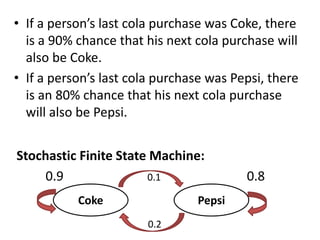
• If a person’s last cola purchase was Coke, there
is a 90% chance that his next cola purchase will
also be Coke.
• If a person’s last cola purchase was Pepsi, there
is an 80% chance that his next cola purchase
will also be Pepsi.
Stochastic Finite State Machine:
0.9 0.1 0.8
0.2
Coke Pepsi
Conclusion
• Markov chain is a simple concept which can
explain most complicated real time Many of
the Artificial intelligence tools use this simple
principle called Markov chain in some form.
• This presentation illustrates how easy it is to
understand this concept and some of it’s
applications.
Thank You

Markov chain-model

  • 1.
    A Presentation on MarkovChain Model Course Title: Development Planning and Management Course Code: DS 3109 Presented to- Asma Ul Husna Assistant Professor Development Studies Discipline Khulna University Presented by- Md. Ayatullah Khan Student ID: 152119 Development Studies Discipline Khulna University Date of Submission: 29 October, 2017
  • 2.
    Table of Content •Introduction • Origin of Markov Chain Model • What is Markov Chain Model? • Markov assumptions • Configuration of the Markov-Chain Model • Markov Chain Application • Example of Markov Chain Model • Conclusion
  • 3.
    Introduction • Development planningcontains a number of theories and planning models. Markov model is one of the best planning model of them. • Markov model is a stochastic model used to model randomly changing systems where it is assumed that future states depend only on the current state not on the events that occurred before it (that is, it assumes the Markov property).
  • 4.
    • Markov chainmodel is one of the most powerful tools for analyzing complex stochastic system. • Markov chain model have become popular in manpower planning system. Several researchers have adopted Markov chain models to clarify manpower policy issues.
  • 5.
    Origin of MarkovChain Model • Markov chains were introduced in 1906 by Andrey Markov (1856–1922)and were named in his honor. • Andrey Markov studied Markov chains in the early 20th century. • Markov was interested in studying an extension of independent random sequences, motivated by a disagreement with Pavel Nekrasov . • In his first paper on Markov chains, Markov showed that under certain conditions the average outcomes of the Markov chain would converge to a fixed vector of values. • Markov later used Markov chains to study the distribution of vowels in Eugene Onegin, written by Alexander Pushkin, and proved a central limit theorem for such chains.
  • 6.
    • Markov-Chain(Markov 1914)has been applied to short term market forecasting and business decision, on the future market the firms' future market share, given a consumer transition from one firm to the next.
  • 7.
    What is MarkovChain Model? • A stochastic model that describe the probabilities of transition among the states of a system. • It is a random process that undergoes transitions from one state to another on a state space. • Change of states depends probabilistically only on the current state of the system. • It is required to possess a property that is usually characterized as "memoryless": the probability distribution of the next state depends only on the current state and not on the sequence of events that preceded it.
  • 8.
    • a Markovchain model is defined by a set of states some states emit symbols other states (e.g. the begin state) are silent • Changes of state depends probabilistically on the current state of the system. • Markov chain model makes calculation of conditional probability easy.
  • 9.
    Markov assumptions • Theprobabilities of moving from a state to all others sum to one. • The probabilities apply to all system participants. • The probabilities are constant over time.
  • 10.
    Configuration of theMarkov-Chain Model • Markov systems deal with stochastic environments in which possible "outcomes occur at the end of a well-defined, usually first period“. • This situation further involves a multi-period time frame, during which the occurring consumer's transient behavior, for example, affects the stability of the firm's performance. • This transient behavior, whose future outcome is unknown but needs to be predicated, creates inter-period transitional probabilities.
  • 11.
    • Such astochastic process, known as the Markov process, contains a special case, where the transitional probabilities from one time period to another remains stationary, in which case the process is referred to as the Markov-Chain.
  • 12.
    Markov Chain Application Marketresearch problems (Market share predictions) • Markov text generators • Asset pricing and other financial predictions • Customer journey predictions • Population genetics • Algorithmic music composition • Page ranks (Google results)
  • 13.
    Lets try tounderstand Markov chain from very simple example Weather: • raining today 60% rain tomorrow 40% no rain tomorrow • not raining today 20% rain tomorrow 80% no rain tomorrow Stochastic Finite State Machine: 0.6 0.4 0.8 0.2 Rain No Rain
  • 14.
    • If aperson’s last cola purchase was Coke, there is a 90% chance that his next cola purchase will also be Coke. • If a person’s last cola purchase was Pepsi, there is an 80% chance that his next cola purchase will also be Pepsi. Stochastic Finite State Machine: 0.9 0.1 0.8 0.2 Coke Pepsi
  • 15.
    Conclusion • Markov chainis a simple concept which can explain most complicated real time Many of the Artificial intelligence tools use this simple principle called Markov chain in some form. • This presentation illustrates how easy it is to understand this concept and some of it’s applications.
  • 16.