Markov Chains
Presented By
Tilak Poudel
Presented By
Tilak Poudel
Today’s Discussion focuses on..
Google Page Rank….
Markov Chains
✔ If the future states of a process are independent of the
past and depend only on the present , the process is
called a Markov process.
✔ A Markov chain is "a stochastic model describing a
sequence of possible events in which the probability of
each event depends only on the state attained in the
previous event."
✔ A Markov Chain is a random process with the property that
the next state depends only on the current state.
Markov Chains, why?
✔ Markov chains are used to analyze trends and
predict the future. (Weather, stock market,
genetics, product success, etc.)
Applications of Markov Chain
✔ Physics
✔ Chemistry
✔ Speech Recognition
✔ Information and Communication System
✔ Queuing Theory
✔ Statistics
✔ Internet Applications
Internet Application
● Have you ever wandered(moving around)
visiting the web pages that you had never
expected to visit before reaching your goal web
page ????
Internet Application
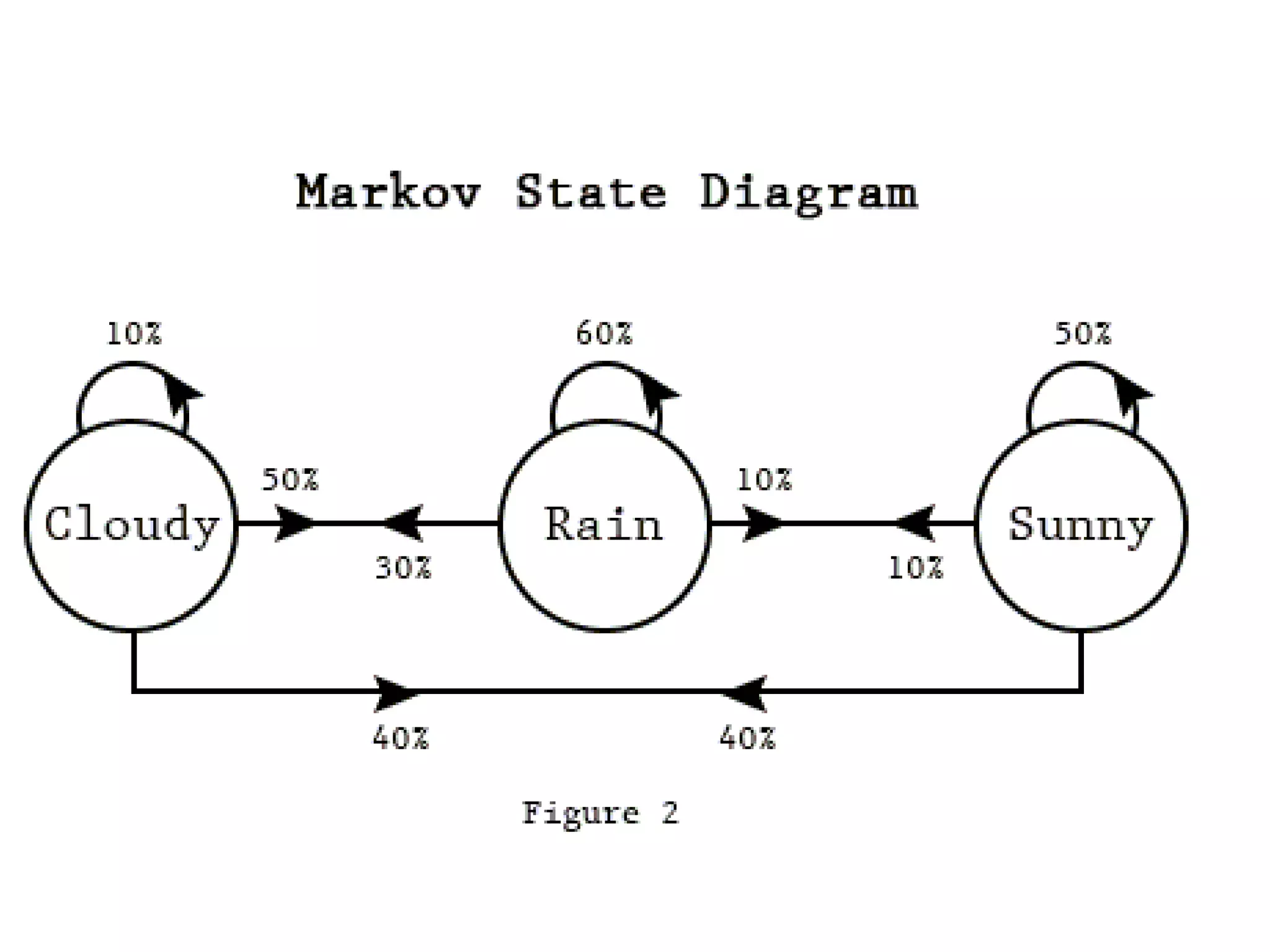
✔ The Markov chain has network structure much
like that of website, where each node in the
network is called a state and to each link in the
network a transition probability is attached, which
denotes the probability of moving from the
source state of the link to its destination state.
Internet Application
✔ The process attached to a Markov chain moves
through the states of the networks in steps,
where if any time the system is in state i, then
with probability equal to the transition probability
from state I to state j, it moves to state j.
✔ We will model the transitions from one page to
another in a web site as a Markov chain.
✔ The assumption we will make , called Markov
property, is that the probability of moving from
source page to a destination page doesn’t
depend on the route taken to reach the source.
Page Rank
● Any Ideas regarding the page ranking done by
google and other ???
Internet Application● The Page Rank of a web page as used by Google is defined
by a Markov chain.
● It is the probability to be at page i in the stationary distribution
on the following Markov chain on all (known) web pages.
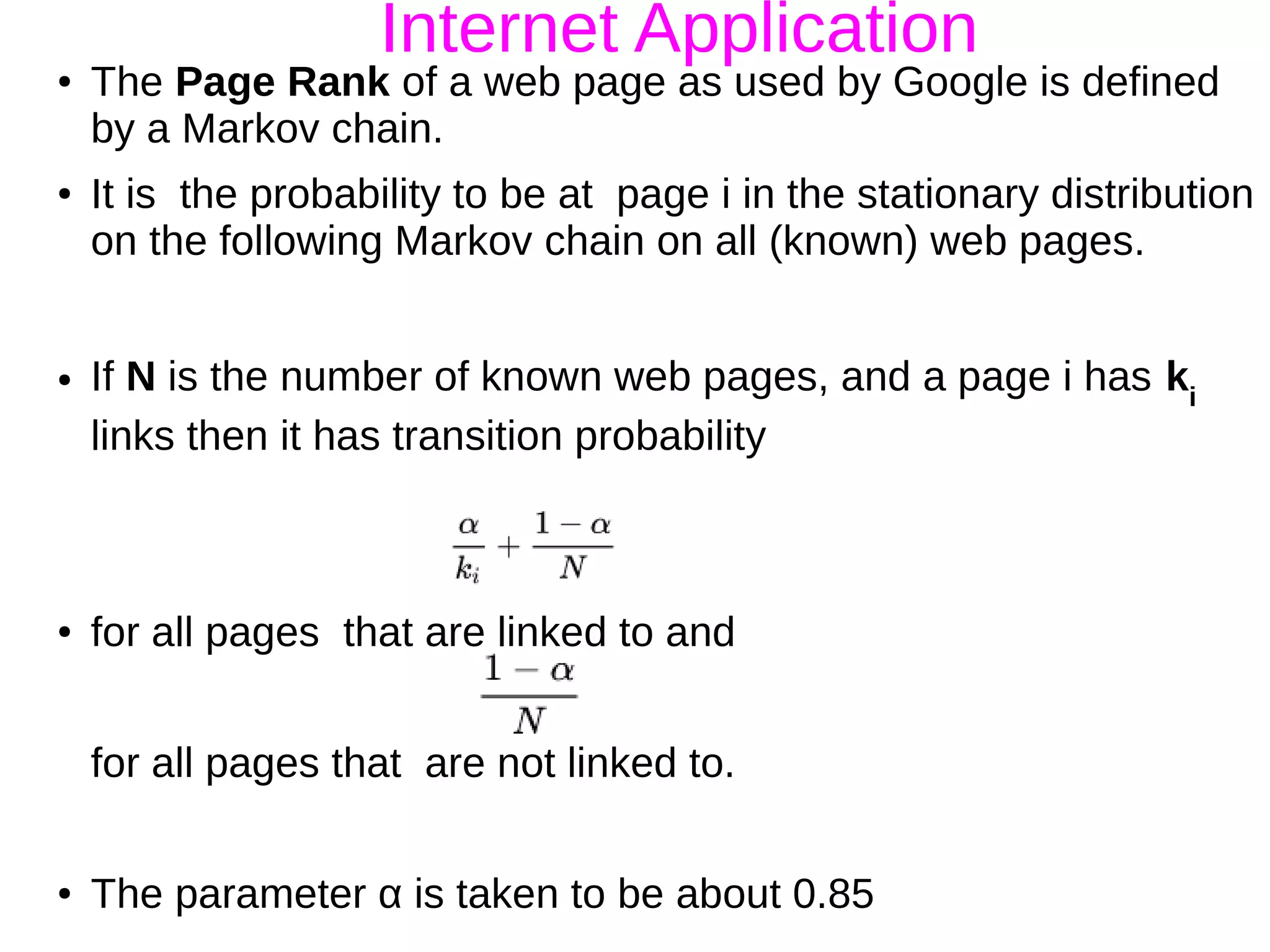
● If N is the number of known web pages, and a page i has ki
links then it has transition probability
● for all pages that are linked to and
for all pages that are not linked to.
● The parameter α is taken to be about 0.85
Page Rank
● Page Rank (PR) is an algorithm used by Google Search to
rank websites in their search engine results.
● Page Rank was named after Larry Page, one of the founders of
Google. Page Rank is a way of measuring the importance of
website pages. According to Google:
● Page Rank works by counting the number and quality of links
to a page to determine a rough estimate of how important the
website is. The underlying assumption is that more important
websites are likely to receive more links from other websites.
● Page Rank is a link analysis algorithm and it assigns a
numerical weighting to each element of a hyper linked set of
documents, such as the World Wide Web, with the purpose of
"measuring" its relative importance within the set.
Page Rank
● The rank value indicates an importance of a
particular page.
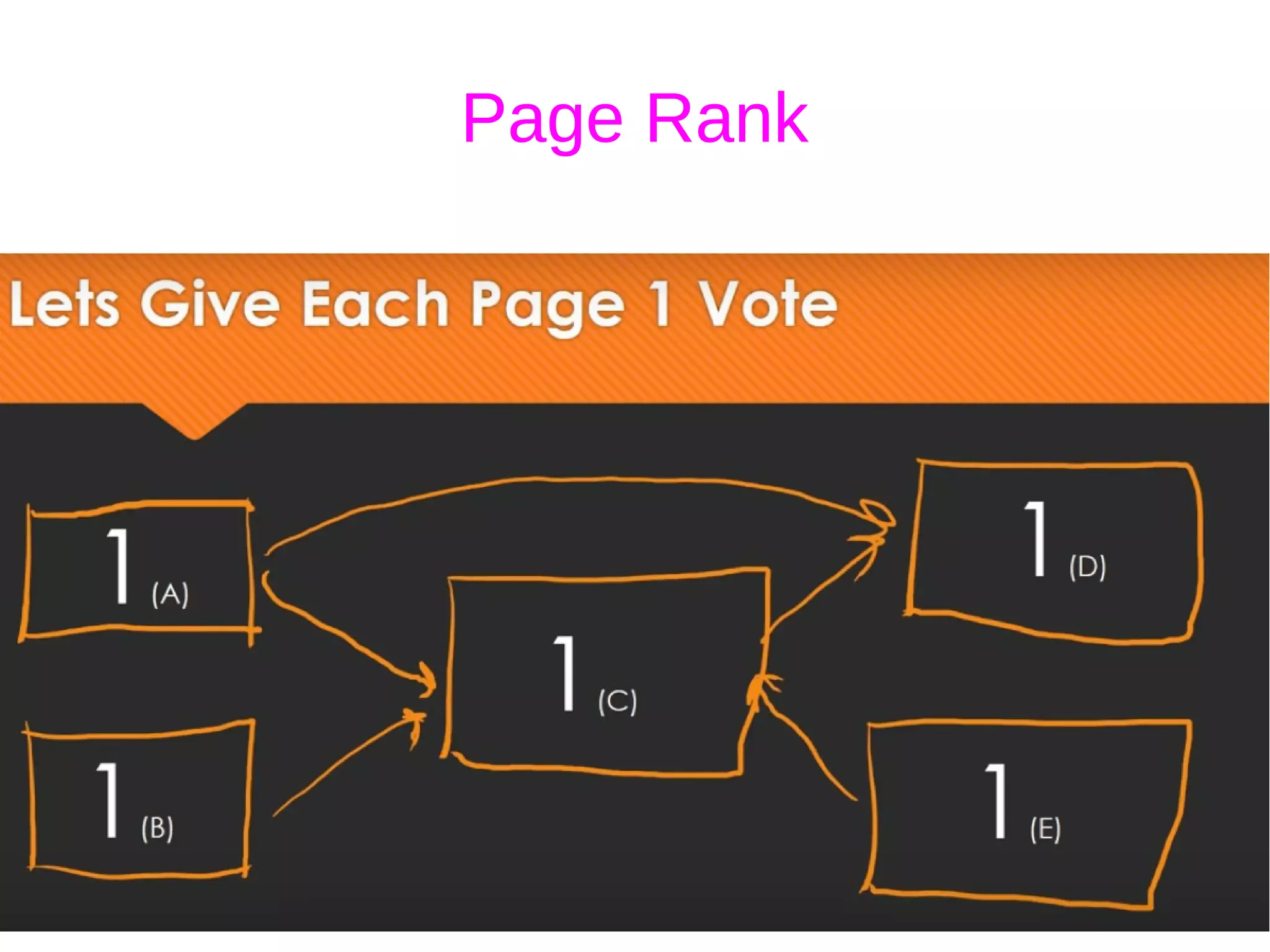
● A hyper link to a page counts as a vote of
support.
● A page that is linked to by many pages with
high Page Rank receives a high rank itself.
Page Rank
Page Rank
Page Rank
Page Rank
Page Rank
Page Rank
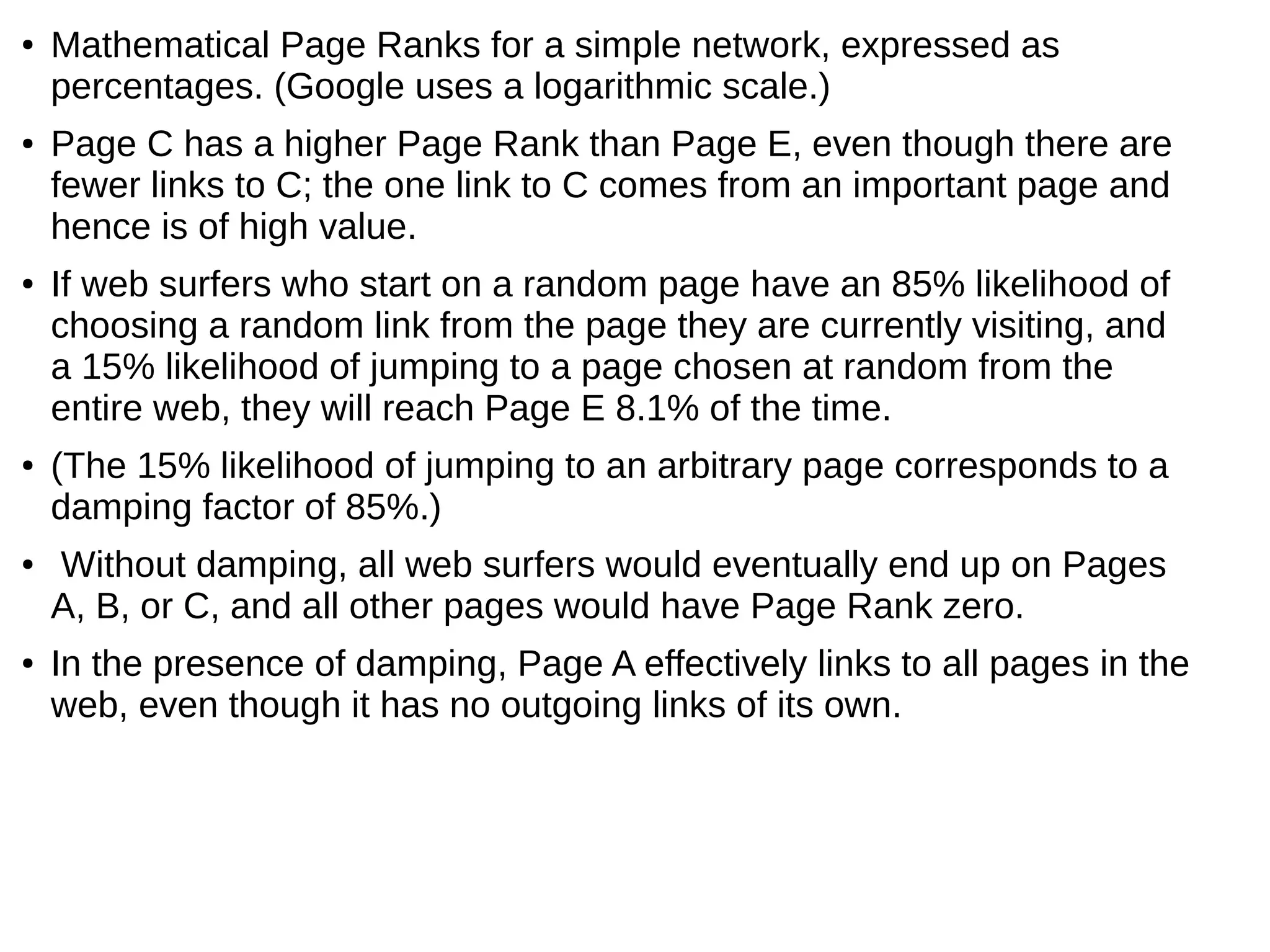
● Mathematical Page Ranks for a simple network, expressed as
percentages. (Google uses a logarithmic scale.)
● Page C has a higher Page Rank than Page E, even though there are
fewer links to C; the one link to C comes from an important page and
hence is of high value.
● If web surfers who start on a random page have an 85% likelihood of
choosing a random link from the page they are currently visiting, and
a 15% likelihood of jumping to a page chosen at random from the
entire web, they will reach Page E 8.1% of the time.
● (The 15% likelihood of jumping to an arbitrary page corresponds to a
damping factor of 85%.)
● Without damping, all web surfers would eventually end up on Pages
A, B, or C, and all other pages would have Page Rank zero.
● In the presence of damping, Page A effectively links to all pages in the
web, even though it has no outgoing links of its own.
Page Rank
● Cartoon illustrating the basic principle of Page
Rank.
● The size of each face is proportional to the
total size of the other faces which are pointing
to it.
Internet Application
✔ Markov models have also been used to analyze
web navigation behavior of users.
✔ A user's web link transition on a particular
website can be modeled using first- or second-
order
✔ Markov models and can be used to make
predictions regarding future navigation and to
personalize the web page for an individual user.
Q &A ???
● Any queries ??????
!!! THANK YOU !!!

Markov chain and its Application

  • 1.
    Markov Chains Presented By TilakPoudel Presented By Tilak Poudel
  • 2.
    Today’s Discussion focuseson.. Google Page Rank….
  • 3.
    Markov Chains ✔ Ifthe future states of a process are independent of the past and depend only on the present , the process is called a Markov process. ✔ A Markov chain is "a stochastic model describing a sequence of possible events in which the probability of each event depends only on the state attained in the previous event." ✔ A Markov Chain is a random process with the property that the next state depends only on the current state.
  • 6.
    Markov Chains, why? ✔Markov chains are used to analyze trends and predict the future. (Weather, stock market, genetics, product success, etc.)
  • 7.
    Applications of MarkovChain ✔ Physics ✔ Chemistry ✔ Speech Recognition ✔ Information and Communication System ✔ Queuing Theory ✔ Statistics ✔ Internet Applications
  • 8.
    Internet Application ● Haveyou ever wandered(moving around) visiting the web pages that you had never expected to visit before reaching your goal web page ????
  • 9.
    Internet Application ✔ TheMarkov chain has network structure much like that of website, where each node in the network is called a state and to each link in the network a transition probability is attached, which denotes the probability of moving from the source state of the link to its destination state.
  • 10.
    Internet Application ✔ Theprocess attached to a Markov chain moves through the states of the networks in steps, where if any time the system is in state i, then with probability equal to the transition probability from state I to state j, it moves to state j. ✔ We will model the transitions from one page to another in a web site as a Markov chain. ✔ The assumption we will make , called Markov property, is that the probability of moving from source page to a destination page doesn’t depend on the route taken to reach the source.
  • 11.
    Page Rank ● AnyIdeas regarding the page ranking done by google and other ???
  • 12.
    Internet Application● ThePage Rank of a web page as used by Google is defined by a Markov chain. ● It is the probability to be at page i in the stationary distribution on the following Markov chain on all (known) web pages. ● If N is the number of known web pages, and a page i has ki links then it has transition probability ● for all pages that are linked to and for all pages that are not linked to. ● The parameter α is taken to be about 0.85
  • 13.
    Page Rank ● PageRank (PR) is an algorithm used by Google Search to rank websites in their search engine results. ● Page Rank was named after Larry Page, one of the founders of Google. Page Rank is a way of measuring the importance of website pages. According to Google: ● Page Rank works by counting the number and quality of links to a page to determine a rough estimate of how important the website is. The underlying assumption is that more important websites are likely to receive more links from other websites. ● Page Rank is a link analysis algorithm and it assigns a numerical weighting to each element of a hyper linked set of documents, such as the World Wide Web, with the purpose of "measuring" its relative importance within the set.
  • 14.
    Page Rank ● Therank value indicates an importance of a particular page. ● A hyper link to a page counts as a vote of support. ● A page that is linked to by many pages with high Page Rank receives a high rank itself.
  • 15.
  • 16.
  • 17.
  • 18.
  • 19.
  • 20.
  • 21.
    ● Mathematical PageRanks for a simple network, expressed as percentages. (Google uses a logarithmic scale.) ● Page C has a higher Page Rank than Page E, even though there are fewer links to C; the one link to C comes from an important page and hence is of high value. ● If web surfers who start on a random page have an 85% likelihood of choosing a random link from the page they are currently visiting, and a 15% likelihood of jumping to a page chosen at random from the entire web, they will reach Page E 8.1% of the time. ● (The 15% likelihood of jumping to an arbitrary page corresponds to a damping factor of 85%.) ● Without damping, all web surfers would eventually end up on Pages A, B, or C, and all other pages would have Page Rank zero. ● In the presence of damping, Page A effectively links to all pages in the web, even though it has no outgoing links of its own.
  • 23.
    Page Rank ● Cartoonillustrating the basic principle of Page Rank. ● The size of each face is proportional to the total size of the other faces which are pointing to it.
  • 24.
    Internet Application ✔ Markovmodels have also been used to analyze web navigation behavior of users. ✔ A user's web link transition on a particular website can be modeled using first- or second- order ✔ Markov models and can be used to make predictions regarding future navigation and to personalize the web page for an individual user.
  • 25.
    Q &A ??? ●Any queries ??????
  • 26.