PATTERN RECOGNITION

                Markov models
                          Vu PHAM
                     phvu@fit.hcmus.edu.vn


                 Department of Computer Science

                        March 28th, 2011


28/03/2011                Markov models           1
Contents
• Introduction
   – Introduction

   – Motivation

• Markov Chain

• Hidden Markov Models

• Markov Random Field

 28/03/2011         Markov models   2
Introduction
• Markov processes are first proposed by
   Russian mathematician Andrei Markov
    – He used these processes to investigate
        Pushkin’s poem.
• Nowadays, Markov property and HMMs are
   widely used in many domains:
    – Natural Language Processing
    – Speech Recognition
    – Bioinformatics
    – Image/video processing
    – ...

  28/03/2011                        Markov models   3
Motivation [0]
• As shown in his paper in 1906, Markov’s original
  motivation is purely mathematical:
   – Application of The Weak Law of Large Number to dependent
       random variables.

• However, we shall not follow this motivation...


 28/03/2011                Markov models                    4
Motivation [1]
• From the viewpoint of classification:
   – Context-free classification: Bayes classifier
               p (ωi | x ) > p (ω j | x ) ∀j ≠ i


 28/03/2011                 Markov models            5
Motivation [1]
• From the viewpoint of classification:
   – Context-free classification: Bayes classifier
               p (ωi | x ) > p (ω j | x ) ∀j ≠ i

               • Classes are independent.
               • Feature vectors are independent.


 28/03/2011                  Markov models           6
Motivation [1]
• From the viewpoint of classification:
   – Context-free classification: Bayes classifier
                    p (ωi | x ) > p (ω j | x ) ∀j ≠ i

   – However, there are some applications where various
       classes are closely realated:
          • POS Tagging, Tracking, Gene boundary recover...

              s1      s2           s3            ...    sm    ...

 28/03/2011                      Markov models                      7
Motivation [1]
• Context-dependent classification:

              s1        s2             s3            ...          sm              ...
   – s1, s2, ..., sm: sequence of m feature vector

   – ω1, ω2,..., ωN: classes in which these vectors are classified: ωi = 1...k.


 28/03/2011                          Markov models                                      8
Motivation [1]
• Context-dependent classification:

               s1           s2             s3             ...          sm          ...
    – s1, s2, ..., sm: sequence of m feature vector

    – ω1, ω2,..., ωN: classes in which these vectors are classified: ωi = 1...k.

• To apply Bayes classifier:
    – X = s1s2...sm: extened feature vector

    – Ωi = ωi1, ωi2,..., ωiN : a classification      Nm possible classifications

                       p ( Ωi | X ) > p ( Ω j | X ) ∀j ≠ i
               p ( X | Ωi ) p ( Ωi ) > p ( X | Ω j ) p ( Ω j ) ∀j ≠ i
  28/03/2011                             Markov models                                   9
Motivation [1]
• Context-dependent classification:

               s1           s2             s3             ...          sm          ...
    – s1, s2, ..., sm: sequence of m feature vector

    – ω1, ω2,..., ωN: classes in which these vectors are classified: ωi = 1...k.

• To apply Bayes classifier:
    – X = s1s2...sm: extened feature vector

    – Ωi = ωi1, ωi2,..., ωiN : a classification      Nm possible classifications

                       p ( Ωi | X ) > p ( Ω j | X ) ∀j ≠ i
               p ( X | Ωi ) p ( Ωi ) > p ( X | Ω j ) p ( Ω j ) ∀j ≠ i
  28/03/2011                             Markov models                                   10
Motivation [2]
• From a general view, sometimes we want to evaluate the joint
  distribution of a sequence of dependent random variables


 28/03/2011                  Markov models                       11
Motivation [2]
• From a general view, sometimes we want to evaluate the joint
  distribution of a sequence of dependent random variables
                        Hôm nay mùng tám tháng ba
                         Chị em phụ nữ đi ra đi vào...

         Hôm      nay            mùng            ...     vào   ...
          q1      q2              q3                     qm


 28/03/2011                      Markov models                       12
Motivation [2]
• From a general view, sometimes we want to evaluate the joint
  distribution of a sequence of dependent random variables
                        Hôm nay mùng tám tháng ba
                         Chị em phụ nữ đi ra đi vào...

         Hôm      nay            mùng            ...     vào   ...
          q1      q2              q3                     qm

• What is p(Hôm nay.... vào) = p(q1=Hôm q2=nay ... qm=vào)?


 28/03/2011                      Markov models                       13
Motivation [2]
• From a general view, sometimes we want to evaluate the joint
  distribution of a sequence of dependent random variables
                           Hôm nay mùng tám tháng ba
                            Chị em phụ nữ đi ra đi vào...

         Hôm         nay            mùng            ...     vào   ...
          q1         q2              q3                     qm

• What is p(Hôm nay.... vào) = p(q1=Hôm q2=nay ... qm=vào)?
                                   p(s1s2... sm-1 sm)
               p(sm|s1s2...sm-1) =
                                    p(s1s2... sm-1)

 28/03/2011                         Markov models                       14
Contents
• Introduction

• Markov Chain

• Hidden Markov Models

• Markov Random Field


 28/03/2011         Markov models   15
Markov Chain
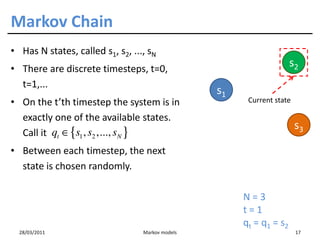
• Has N states, called s1, s2, ..., sN
• There are discrete timesteps, t=0,
                                                                        s2
  t=1,...
                                                  s1
• On the t’th timestep the system is in
  exactly one of the available states.
                                                                         s3
  Call it qt ∈ {s1 , s2 ,..., sN }

                                                          Current state


                                                       N=3
                                                       t=0
                                                       q t = q 0 = s3
  28/03/2011                      Markov models                          16
Markov Chain
• Has N states, called s1, s2, ..., sN
• There are discrete timesteps, t=0,
                                                                        s2
  t=1,...
                                                  s1
• On the t’th timestep the system is in                 Current state

  exactly one of the available states.
                                                                         s3
  Call it qt ∈ {s1 , s2 ,..., sN }
• Between each timestep, the next
  state is chosen randomly.

                                                       N=3
                                                       t=1
                                                       q t = q 1 = s2
  28/03/2011                      Markov models                          17
p ( s1 ˚ s2 ) = 1 2
Markov Chain                                                                 p ( s2 ˚ s2 ) = 1 2
                                                                             p ( s3 ˚ s2 ) = 0
• Has N states, called s1, s2, ..., sN
• There are discrete timesteps, t=0,
                                                                                         s2
  t=1,...
                                                                 s1
• On the t’th timestep the system is in
  exactly one of the available states.
                                        p ( qt +1 = s1 ˚ qt = s1 ) = 0                    s3
  Call it qt ∈ {s1 , s2 ,..., sN }
                                                    p ( s2 ˚ s1 ) = 0
• Between each timestep, the next                   p ( s3 ˚ s1 ) = 1         p ( s1 ˚ s3 ) = 1 3
  state is chosen randomly.                                                   p ( s2 ˚ s3 ) = 2 3
                                                                              p ( s3 ˚ s3 ) = 0
• The current state determines the
  probability for the next state.                                       N=3
                                                                        t=1
                                                                        q t = q 1 = s2
  28/03/2011                        Markov models                                         18
p ( s1 ˚ s2 ) = 1 2
Markov Chain                                                                    p ( s2 ˚ s2 ) = 1 2
                                                                                p ( s3 ˚ s2 ) = 0
• Has N states, called s1, s2, ..., sN                                      1/2
• There are discrete timesteps, t=0,
                                                                                           s2
                                                                          1/2
  t=1,...
                                                                  s1                           2/3
• On the t’th timestep the system is in                               1/3
                                                             1
  exactly one of the available states.
                                        p ( qt +1 = s1 ˚ qt = s1 ) = 0                       s3
  Call it qt ∈ {s1 , s2 ,..., sN }
                                                     p ( s2 ˚ s1 ) = 0
• Between each timestep, the next                    p ( s3 ˚ s1 ) = 1            p ( s1 ˚ s3 ) = 1 3
  state is chosen randomly.                                                       p ( s2 ˚ s3 ) = 2 3
                                                                                  p ( s3 ˚ s3 ) = 0
• The current state determines the
  probability for the next state.                                        N=3
    – Often notated with arcs between states
                                                                         t=1
                                                                         q t = q 1 = s2
  28/03/2011                         Markov models                                           19
p ( s1 ˚ s2 ) = 1 2
Markov Property                                                                         p ( s2 ˚ s2 ) = 1 2
                                                                                        p ( s3 ˚ s2 ) = 0
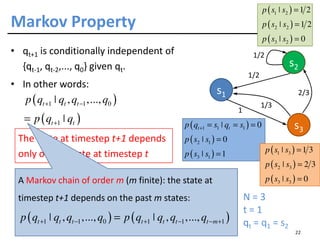
• qt+1 is conditionally independent of                                            1/2
  {qt-1, qt-2,..., q0} given qt.                                                                  s2
                                                                                1/2
• In other words:
                                                                    s1                                2/3
   p ( qt +1 ˚ qt , qt −1 ,..., q0 )                                                  1/3
                                                                           1
    = p ( qt +1 ˚ qt )                                 p ( qt +1 = s1 ˚ qt = s1 ) = 0               s3
                                                       p ( s2 ˚ s1 ) = 0
                                                       p ( s3 ˚ s1 ) = 1                 p ( s1 ˚ s3 ) = 1 3
                                                                                         p ( s2 ˚ s3 ) = 2 3
                                                                                         p ( s3 ˚ s3 ) = 0

                                                                               N=3
                                                                               t=1
                                                                               q t = q 1 = s2
  28/03/2011                           Markov models                                                 20
p ( s1 ˚ s2 ) = 1 2
Markov Property                                                                         p ( s2 ˚ s2 ) = 1 2
                                                                                        p ( s3 ˚ s2 ) = 0
• qt+1 is conditionally independent of                                            1/2
  {qt-1, qt-2,..., q0} given qt.                                                                  s2
                                                                                1/2
• In other words:
                                                                    s1                                2/3
   p ( qt +1 ˚ qt , qt −1 ,..., q0 )                                                  1/3
                                                                           1
    = p ( qt +1 ˚ qt )                                 p ( qt +1 = s1 ˚ qt = s1 ) = 0               s3
  The state at timestep t+1 depends                    p ( s2 ˚ s1 ) = 0
                                                       p ( s3 ˚ s1 ) = 1                 p ( s1 ˚ s3 ) = 1 3
  only on the state at timestep t
                                                                                         p ( s2 ˚ s3 ) = 2 3
                                                                                         p ( s3 ˚ s3 ) = 0

                                                                               N=3
                                                                               t=1
                                                                               q t = q 1 = s2
  28/03/2011                           Markov models                                                 21
p ( s1 ˚ s2 ) = 1 2
Markov Property                                                                                 p ( s2 ˚ s2 ) = 1 2
                                                                                                p ( s3 ˚ s2 ) = 0
• qt+1 is conditionally independent of                                                    1/2
  {qt-1, qt-2,..., q0} given qt.                                                                          s2
                                                                                        1/2
• In other words:
                                                                            s1                                2/3
   p ( qt +1 ˚ qt , qt −1 ,..., q0 )                                                          1/3
                                                                                   1
    = p ( qt +1 ˚ qt )                                         p ( qt +1 = s1 ˚ qt = s1 ) = 0               s3
  The state at timestep t+1 depends                            p ( s2 ˚ s1 ) = 0
                                                               p ( s3 ˚ s1 ) = 1                 p ( s1 ˚ s3 ) = 1 3
  only on the state at timestep t
                                                                                                 p ( s2 ˚ s3 ) = 2 3
  A Markov chain of order m (m finite): the state at                                             p ( s3 ˚ s3 ) = 0

  timestep t+1 depends on the past m states:                                           N=3
                                                                                       t=1
   p ( qt +1 ˚ qt , qt −1 ,..., q0 ) = p ( qt +1 ˚ qt , qt −1 ,..., qt − m +1 )        q t = q 1 = s2
  28/03/2011                                   Markov models                                                 22
p ( s1 ˚ s2 ) = 1 2
Markov Property                                                                         p ( s2 ˚ s2 ) = 1 2
                                                                                        p ( s3 ˚ s2 ) = 0
• qt+1 is conditionally independent of                                            1/2
  {qt-1, qt-2,..., q0} given qt.                                                                  s2
                                                                                1/2
• In other words:
                                                                    s1                                2/3
   p ( qt +1 ˚ qt , qt −1 ,..., q0 )                                                  1/3
                                                                           1
    = p ( qt +1 ˚ qt )                                 p ( qt +1 = s1 ˚ qt = s1 ) = 0               s3
  The state at timestep t+1 depends                    p ( s2 ˚ s1 ) = 0
                                                       p ( s3 ˚ s1 ) = 1                 p ( s1 ˚ s3 ) = 1 3
  only on the state at timestep t
                                                                                         p ( s2 ˚ s3 ) = 2 3
• How to represent the joint                                                             p ( s3 ˚ s3 ) = 0
  distribution of (q0, q1, q2...) using
                                                                               N=3
  graphical models?                                                            t=1
                                                                               q t = q 1 = s2
  28/03/2011                           Markov models                                                 23
p ( s1 ˚ s2 ) = 1 2
Markov Property                                                                       p ( s2 ˚ s2 ) = 1 2

                                                                                 q0p ( s    3   ˚ s2 ) = 0
• qt+1 is conditionally independent of                                            1/2
  {qt-1, qt-2,..., q0} given qt.                                                                      s2
                                                                                1/2
• In other words:                                                                q1
                                                                    s1                                   1/3
   p ( qt +1 ˚ qt , qt −1 ,..., q0 )                                                  1/3
                                                                           1
    = p ( qt +1 ˚ qt )                                 p ( qt +1 = s1 ˚ qt = s1 ) = 0
                                                                                  q2                    s3
  The state at timestep t+1 depends                    p ( s2 ˚ s1 ) = 0
                                                       p ( s3 ˚ s1 ) = 1                p ( s1 ˚ s3 ) = 1 3
  only on the state at timestep t
• How to represent the joint                                                     q3 p ( s       2   ˚ s3 ) = 2 3
                                                                                        p ( s3 ˚ s3 ) = 0
  distribution of (q0, q1, q2...) using
                                                                               N=3
  graphical models?                                                            t=1
                                                                               q t = q 1 = s2
  28/03/2011                           Markov models                                                    24
Markov chain
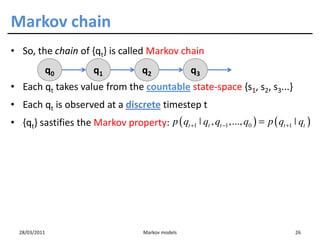
• So, the chain of {qt} is called Markov chain
           q0      q1          q2              q3


  28/03/2011                   Markov models        25
Markov chain
• So, the chain of {qt} is called Markov chain
           q0           q1             q2              q3
• Each qt takes value from the countable state-space {s1, s2, s3...}
• Each qt is observed at a discrete timestep t
• {qt} sastifies the Markov property: p ( qt +1 ˚ qt , qt −1 ,..., q0 ) = p ( qt +1 ˚ qt )


  28/03/2011                           Markov models                                 26
Markov chain
• So, the chain of {qt} is called Markov chain
           q0                  q1              q2              q3
• Each qt takes value from the countable state-space {s1, s2, s3...}
• Each qt is observed at a discrete timestep t
• {qt} sastifies the Markov property: p ( qt +1 ˚ qt , qt −1 ,..., q0 ) = p ( qt +1 ˚ qt )
• The transition from qt to qt+1 is calculated from the transition
  probability matrix
             1/2
                                                   s1     s2     s3
                                    s2                          s1        0       0        1
                   1/2
      s1                                                        s2        ½       ½        0
                                         2/3
               1
                         1/3                                    s3        1/3     2/3      0

  28/03/2011
                                     s3        Markov models
                                                                     Transition probabilities
                                                                                                27
Markov chain
• So, the chain of {qt} is called Markov chain
           q0                  q1              q2              q3
• Each qt takes value from the countable state-space {s1, s2, s3...}
• Each qt is observed at a discrete timestep t
• {qt} sastifies the Markov property: p ( qt +1 ˚ qt , qt −1 ,..., q0 ) = p ( qt +1 ˚ qt )
• The transition from qt to qt+1 is calculated from the transition
  probability matrix
             1/2
                                                   s1     s2     s3
                                    s2                          s1        0       0        1
                   1/2
      s1                                                        s2        ½       ½        0
                                         2/3
               1
                         1/3                                    s3        1/3     2/3      0

  28/03/2011
                                     s3        Markov models
                                                                     Transition probabilities
                                                                                                28
Markov Chain – Important property
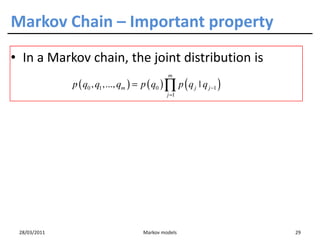
• In a Markov chain, the joint distribution is
                                                m
              p ( q0 , q1 ,..., qm ) = p ( q0 ) ∏ p ( q j | q j −1 )
                                                j =1


 28/03/2011                            Markov models                   29
Markov Chain – Important property
• In a Markov chain, the joint distribution is
                                                        m
                      p ( q0 , q1 ,..., qm ) = p ( q0 ) ∏ p ( q j | q j −1 )
                                                        j =1


• Why?                                         m
              p ( q0 , q1 ,..., qm ) = p ( q0 ) ∏ p ( q j | q j −1 , previous states )
                                               j =1
                                               m
                                  = p ( q0 ) ∏ p ( q j | q j −1 )
                                               j =1


                Due to the Markov property


 28/03/2011                                    Markov models                             30
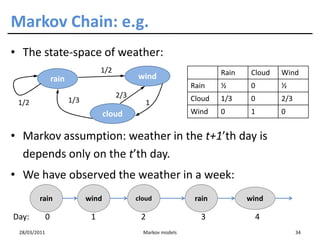
Markov Chain: e.g.
• The state-space of weather:

              rain           wind


                     cloud


 28/03/2011                   Markov models   31
Markov Chain: e.g.
• The state-space of weather:
                           1/2                                  Rain   Cloud   Wind
              rain                     wind
                                                        Rain    ½      0       ½
                                 2/3                    Cloud   1/3    0       2/3
 1/2                 1/3                1
                           cloud                        Wind    0      1       0


 28/03/2011                             Markov models                                32
Markov Chain: e.g.
• The state-space of weather:
                           1/2                                  Rain   Cloud   Wind
              rain                     wind
                                                        Rain    ½      0       ½
                                 2/3                    Cloud   1/3    0       2/3
 1/2                 1/3                1
                           cloud                        Wind    0      1       0


• Markov assumption: weather in the t+1’th day is
  depends only on the t’th day.


 28/03/2011                             Markov models                                33
Markov Chain: e.g.
• The state-space of weather:
                                    1/2                                   Rain    Cloud   Wind
                  rain                          wind
                                                                  Rain    ½       0       ½
                                          2/3                     Cloud   1/3     0       2/3
 1/2                     1/3                         1
                                      cloud                       Wind    0       1       0


• Markov assumption: weather in the t+1’th day is
  depends only on the t’th day.
• We have observed the weather in a week:
        rain                   wind             cloud              rain          wind

Day:          0                 1                2                  3              4
 28/03/2011                                       Markov models                                 34
Markov Chain: e.g.
• The state-space of weather:
                                    1/2                                   Rain    Cloud    Wind
                  rain                          wind
                                                                  Rain    ½       0        ½
                                          2/3                     Cloud   1/3     0        2/3
 1/2                     1/3                         1
                                      cloud                       Wind    0       1        0


• Markov assumption: weather in the t+1’th day is
  depends only on the t’th day.
• We have observed the weather in a week:                                              Markov Chain

        rain                   wind             cloud              rain          wind

Day:          0                 1                2                  3              4
 28/03/2011                                       Markov models                                  35
Contents
• Introduction
• Markov Chain
• Hidden Markov Models
   – Independent assumptions
   – Formal definition
   – Forward algorithm
   – Viterbi algorithm
   – Baum-Welch algorithm
• Markov Random Field

 28/03/2011                    Markov models   36
Modeling pairs of sequences
• In many applications, we have to model pair of sequences
• Examples:
    – POS tagging in Natural Language Processing (assign each word in a
        sentence to Noun, Adj, Verb...)
    – Speech recognition (map acoustic sequences to sequences of words)
    – Computational biology (recover gene boundaries in DNA sequences)
    – Video tracking (estimate the underlying model states from the observation
        sequences)
    – And many others...


  28/03/2011                         Markov models                          37
Probabilistic models for sequence pairs
• We have two sequences of random variables:
   X1, X2, ..., Xm and S1, S2, ..., Sm

• Intuitively, in a pratical system, each Xi corresponds to an observation
   and each Si corresponds to a state that generated the observation.

• Let each Si be in {1, 2, ..., k} and each Xi be in {1, 2, ..., o}

• How do we model the joint distribution:

               p ( X 1 = x1 ,..., X m = xm , S1 = s1 ,..., S m = sm )


  28/03/2011                             Markov models                   38
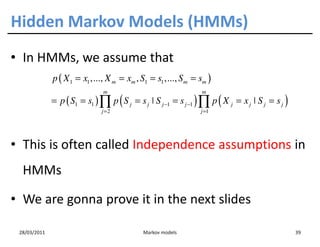
Hidden Markov Models (HMMs)
• In HMMs, we assume that
              p ( X 1 = x1 ,..., X m = xm , S1 = s1 ,..., Sm = sm )
                               m                                 m
              = p ( S1 = s1 ) ∏ p ( S j = s j ˚ S j −1 = s j −1 ) ∏ p ( X j = x j ˚ S j = s j )
                               j =2                              j =1


• This is often called Independence assumptions in
  HMMs

• We are gonna prove it in the next slides

 28/03/2011                                  Markov models                                        39
Independence Assumptions in HMMs [1]
                                 p ( ABC ) = p ( A | BC ) p ( BC ) = p ( A | BC ) p ( B ˚ C ) p ( C )
• By the chain rule, the following equality is exact:
          p ( X 1 = x1 ,..., X m = xm , S1 = s1 ,..., S m = sm )
         = p ( S1 = s1 ,..., S m = sm ) ×
          p ( X 1 = x1 ,..., X m = xm ˚ S1 = s1 ,..., S m = sm )

• Assumption 1: the state sequence forms a Markov chain
                                                          m
         p ( S1 = s1 ,..., S m = sm ) = p ( S1 = s1 ) ∏ p ( S j = s j ˚ S j −1 = s j −1 )
                                                          j =2


  28/03/2011                              Markov models                                      40
Independence Assumptions in HMMs [2]
• By the chain rule, the following equality is exact:
               p ( X 1 = x1 ,..., X m = xm ˚ S1 = s1 ,..., S m = sm )
                  m
               = ∏ p ( X j = x j ˚ S1 = s1 ,..., Sm = sm , X 1 = x1 ,..., X j −1 = x j −1 )
                  j =1

• Assumption 2: each observation depends only on the underlying
   state
                p ( X j = x j ˚ S1 = s1 ,..., Sm = sm , X 1 = x1 ,..., X j −1 = x j −1 )
                = p( X j = xj ˚ S j = sj )
• These two assumptions are often called independence
   assumptions in HMMs

  28/03/2011                                 Markov models                                    41
The Model form for HMMs
• The model takes the following form:
                                                            m                   m
              p ( x1 ,.., xm , s1 ,..., sm ;θ ) = π ( s1 ) ∏ t ( s j ˚ s j −1 ) ∏ e ( x j ˚ s j )
                                                           j =2                j =1


• Parameters in the model:
   – Initial probabilities π ( s ) for s ∈ {1, 2,..., k }

   – Transition probabilities t ( s ˚ s′ ) for s, s ' ∈ {1, 2,..., k }

   – Emission probabilities e ( x ˚ s ) for s ∈ {1, 2,..., k }
         and x ∈ {1, 2,.., o}
 28/03/2011                                     Markov models                                       42
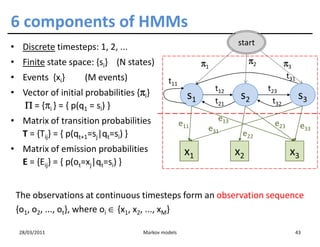
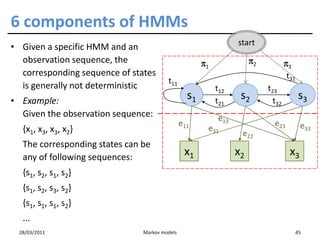
6 components of HMMs
                                                                      start
• Discrete timesteps: 1, 2, ...
• Finite state space: {si} (N states)                      π1              π2           π3
• Events {xi}       (M events)                                                           t31
                                             t11
                                                                t12             t23
                                   π
• Vector of initial probabilities {πi}                s1               s2                       s3
                                                                t21               t32
  Π = {πi } = { p(q1 = si) }
• Matrix of transition probabilities                            e13
                                                    e11                           e23           e33
                                                            e31
  T = {Tij} = { p(qt+1=sj|qt=si) }                                     e22
• Matrix of emission probabilities                   x1               x2                  x3
  E = {Eij} = { p(ot=xj|qt=si) }


 The observations at continuous timesteps form an observation sequence
 {o1, o2, ..., ot}, where oi ∈ {x1, x2, ..., xM}

  28/03/2011                        Markov models                                              43
6 components of HMMs
                                                                       start
• Discrete timesteps: 1, 2, ...
• Finite state space: {si} (N states)                       π1              π2           π3
• Events {xi}          (M events)                                                         t31
                                              t11
                                                                 t12             t23
                                   π
• Vector of initial probabilities {πi}                 s1               s2                       s3
                                                                 t21               t32
  Π = {πi } = { p(q1 = si) }
• Matrix of transition probabilities                             e13
                                                     e11                           e23           e33
                                                             e31
  T = {Tij} = { p(qt+1=sj|qt=si) }                                      e22
• Matrix of emission probabilities                    x1               x2                  x3
  E = {Eij} = { p(ot=xj|qt=si) }
                Constraints:
 The observations at continuous timesteps form an observation sequence
                   N           N               M

                ∑    πi = 1  ∑              ∑
 {o1, o2, ..., ot}, where oi ∈ {x1Tij 2=..., xM} Eij = 1
                i =1          j =1
                                  ,x , 1
                                             j =1

  28/03/2011                         Markov models                                              44
6 components of HMMs
                                                                 start
• Given a specific HMM and an
  observation sequence, the                           π1              π2           π3
  corresponding sequence of states                                                  t31
                                        t11
  is generally not deterministic                           t12             t23
• Example:                                       s1        t21
                                                                  s2         t32
                                                                                           s3
  Given the observation sequence:                          e13
                                               e11                           e23           e33
  {x1, x3, x3, x2}                                     e31
                                                                  e22
  The corresponding states can be
  any of following sequences:
                                                x1               x2                  x3
  {s1, s2, s1, s2}
  {s1, s2, s3, s2}
  {s1, s1, s1, s2}
  ...
 28/03/2011                    Markov models                                              45
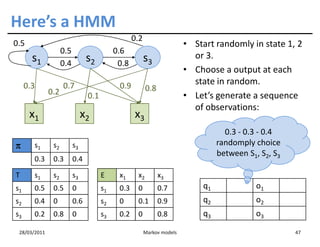
Here’s an HMM
                                                                               0.2
                       0.5
                                              0.5                       0.6
                                  s1          0.4
                                                          s2             0.8
                                                                                     s3

                         0.3                  0.7                        0.9         0.8
                                        0.2                0.1

                              x1                         x2                     x3


             T    s1         s2        s3           E         x1    x2         x3          π   s1    s2    s3
             s1   0.5        0.5       0            s1        0.3   0          0.7             0.3   0.3   0.4
             s2   0.4        0         0.6          s2        0     0.1        0.9
             s3   0.2        0.8       0            s3        0.2   0          0.8


28/03/2011                                              Markov models                                            46
Here’s a HMM
                                                  0.2
0.5                                                                     • Start randomly in state 1, 2
                    0.5                    0.6
       s1                       s2                      s3                or 3.
                    0.4                     0.8
                                                                        • Choose a output at each
     0.3            0.7                     0.9                           state in random.
              0.2                                       0.8
                                0.1                                     • Let’s generate a sequence
                                                                          of observations:
      x1                       x2                 x3
                                                                                    0.3 - 0.3 - 0.4
π      s1      s2         s3                                                      randomply choice
                                                                                  between S1, S2, S3
       0.3     0.3        0.4

T      s1      s2         s3          E     x1     x2         x3
s1     0.5     0.5        0           s1    0.3    0          0.7            q1              o1
s2     0.4     0          0.6         s2    0      0.1        0.9            q2              o2
s3     0.2     0.8        0           s3    0.2    0          0.8            q3              o3

 28/03/2011                                             Markov models                                  47
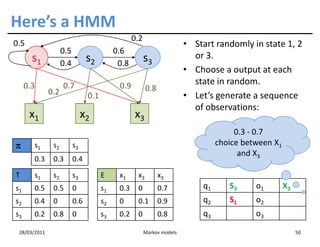
Here’s a HMM
                                                  0.2
0.5                                                                     • Start randomly in state 1, 2
                    0.5                    0.6
       s1                       s2                      s3                or 3.
                    0.4                     0.8
                                                                        • Choose a output at each
     0.3            0.7                     0.9                           state in random.
              0.2                                       0.8
                                0.1                                     • Let’s generate a sequence
                                                                          of observations:
      x1                       x2                 x3
                                                                                       0.2 - 0.8
π      s1      s2         s3                                                      choice between X1
                                                                                        and X3
       0.3     0.3        0.4

T      s1      s2         s3          E     x1     x2         x3
s1     0.5     0.5        0           s1    0.3    0          0.7            q1      S3     o1
s2     0.4     0          0.6         s2    0      0.1        0.9            q2             o2
s3     0.2     0.8        0           s3    0.2    0          0.8            q3             o3

 28/03/2011                                             Markov models                                 48
Here’s a HMM
                                                  0.2
0.5                                                                     • Start randomly in state 1, 2
                    0.5                    0.6
       s1                       s2                      s3                or 3.
                    0.4                     0.8
                                                                        • Choose a output at each
     0.3            0.7                     0.9                           state in random.
              0.2                                       0.8
                                0.1                                     • Let’s generate a sequence
                                                                          of observations:
      x1                       x2                 x3
                                                                                    Go to S2 with
π      s1      s2         s3                                                      probability 0.8 or
                                                                                  S1 with prob. 0.2
       0.3     0.3        0.4

T      s1      s2         s3          E     x1     x2         x3
s1     0.5     0.5        0           s1    0.3    0          0.7            q1      S3      o1        X3
s2     0.4     0          0.6         s2    0      0.1        0.9            q2              o2
s3     0.2     0.8        0           s3    0.2    0          0.8            q3              o3

 28/03/2011                                             Markov models                                       49
Here’s a HMM
                                                  0.2
0.5                                                                     • Start randomly in state 1, 2
                    0.5                    0.6
       s1                       s2                      s3                or 3.
                    0.4                     0.8
                                                                        • Choose a output at each
     0.3            0.7                     0.9                           state in random.
              0.2                                       0.8
                                0.1                                     • Let’s generate a sequence
                                                                          of observations:
      x1                       x2                 x3
                                                                                       0.3 - 0.7
π      s1      s2         s3                                                      choice between X1
                                                                                        and X3
       0.3     0.3        0.4

T      s1      s2         s3          E     x1     x2         x3
s1     0.5     0.5        0           s1    0.3    0          0.7            q1      S3     o1        X3
s2     0.4     0          0.6         s2    0      0.1        0.9            q2      S1     o2
s3     0.2     0.8        0           s3    0.2    0          0.8            q3             o3

 28/03/2011                                             Markov models                                      50
Here’s a HMM
                                                  0.2
0.5                                                                     • Start randomly in state 1, 2
                    0.5                    0.6
       s1                       s2                      s3                or 3.
                    0.4                     0.8
                                                                        • Choose a output at each
     0.3            0.7                     0.9                           state in random.
              0.2                                       0.8
                                0.1                                     • Let’s generate a sequence
                                                                          of observations:
      x1                       x2                 x3
                                                                                    Go to S2 with
π      s1      s2         s3                                                      probability 0.5 or
                                                                                  S1 with prob. 0.5
       0.3     0.3        0.4

T      s1      s2         s3          E     x1     x2         x3
s1     0.5     0.5        0           s1    0.3    0          0.7            q1      S3      o1        X3
s2     0.4     0          0.6         s2    0      0.1        0.9            q2      S1      o2        X1
s3     0.2     0.8        0           s3    0.2    0          0.8            q3              o3

 28/03/2011                                             Markov models                                       51
Here’s a HMM
                                                  0.2
0.5                                                                     • Start randomly in state 1, 2
                    0.5                    0.6
       s1                       s2                      s3                or 3.
                    0.4                     0.8
                                                                        • Choose a output at each
     0.3            0.7                     0.9                           state in random.
              0.2                                       0.8
                                0.1                                     • Let’s generate a sequence
                                                                          of observations:
      x1                       x2                 x3
                                                                                       0.3 - 0.7
π      s1      s2         s3                                                      choice between X1
                                                                                        and X3
       0.3     0.3        0.4

T      s1      s2         s3          E     x1     x2         x3
s1     0.5     0.5        0           s1    0.3    0          0.7            q1      S3     o1        X3
s2     0.4     0          0.6         s2    0      0.1        0.9            q2      S1     o2        X1
s3     0.2     0.8        0           s3    0.2    0          0.8            q3      S1     o3

 28/03/2011                                             Markov models                                      52
Here’s a HMM
                                                  0.2
0.5                                                                     • Start randomly in state 1, 2
                    0.5                    0.6
       s1                       s2                      s3                or 3.
                    0.4                     0.8
                                                                        • Choose a output at each
     0.3            0.7                     0.9                           state in random.
              0.2                                       0.8
                                0.1                                     • Let’s generate a sequence
                                                                          of observations:
      x1                       x2                 x3
                                                                                  We got a sequence
                                                                                    of states and
π      s1      s2         s3                                                       corresponding
       0.3     0.3        0.4                                                      observations!
T      s1      s2         s3          E     x1     x2         x3
s1     0.5     0.5        0           s1    0.3    0          0.7            q1      S3     o1    X3
s2     0.4     0          0.6         s2    0      0.1        0.9            q2      S1     o2    X1
s3     0.2     0.8        0           s3    0.2    0          0.8            q3      S1     o3    X3

 28/03/2011                                             Markov models                                  53
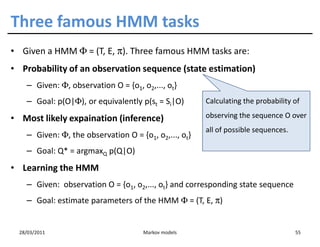
Three famous HMM tasks
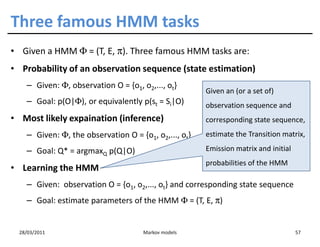
• Given a HMM Φ = (T, E, π). Three famous HMM tasks are:
• Probability of an observation sequence (state estimation)
    – Given: Φ, observation O = {o1, o2,..., ot}
    – Goal: p(O|Φ), or equivalently p(st = Si|O)
• Most likely expaination (inference)
    – Given: Φ, the observation O = {o1, o2,..., ot}
    – Goal: Q* = argmaxQ p(Q|O)
• Learning the HMM
    – Given: observation O = {o1, o2,..., ot} and corresponding state sequence
    – Goal: estimate parameters of the HMM Φ = (T, E, π)


  28/03/2011                          Markov models                              54
Three famous HMM tasks
• Given a HMM Φ = (T, E, π). Three famous HMM tasks are:
• Probability of an observation sequence (state estimation)
    – Given: Φ, observation O = {o1, o2,..., ot}
    – Goal: p(O|Φ), or equivalently p(st = Si|O)       Calculating the probability of

• Most likely expaination (inference)                  observing the sequence O over
                                                       all of possible sequences.
    – Given: Φ, the observation O = {o1, o2,..., ot}
    – Goal: Q* = argmaxQ p(Q|O)
• Learning the HMM
    – Given: observation O = {o1, o2,..., ot} and corresponding state sequence
    – Goal: estimate parameters of the HMM Φ = (T, E, π)


  28/03/2011                          Markov models                                 55
Three famous HMM tasks
• Given a HMM Φ = (T, E, π). Three famous HMM tasks are:
• Probability of an observation sequence (state estimation)
    – Given: Φ, observation O = {o1, o2,..., ot}
    – Goal: p(O|Φ), or equivalently p(st = Si|O)       Calculating the best

• Most likely expaination (inference)                  corresponding state sequence,
                                                       given an observation
    – Given: Φ, the observation O = {o1, o2,..., ot}
                                                       sequence.
    – Goal: Q* = argmaxQ p(Q|O)
• Learning the HMM
    – Given: observation O = {o1, o2,..., ot} and corresponding state sequence
    – Goal: estimate parameters of the HMM Φ = (T, E, π)


  28/03/2011                          Markov models                              56
Three famous HMM tasks
• Given a HMM Φ = (T, E, π). Three famous HMM tasks are:
• Probability of an observation sequence (state estimation)
    – Given: Φ, observation O = {o1, o2,..., ot}
                                                       Given an (or a set of)
    – Goal: p(O|Φ), or equivalently p(st = Si|O)       observation sequence and
• Most likely expaination (inference)                  corresponding state sequence,
    – Given: Φ, the observation O = {o1, o2,..., ot}   estimate the Transition matrix,

    – Goal: Q* = argmaxQ p(Q|O)                        Emission matrix and initial
                                                       probabilities of the HMM
• Learning the HMM
    – Given: observation O = {o1, o2,..., ot} and corresponding state sequence
    – Goal: estimate parameters of the HMM Φ = (T, E, π)


  28/03/2011                          Markov models                                  57
Three famous HMM tasks
  Problem                           Algorithm          Complexity

  State estimation                  Forward            O(TN2)
  Calculating: p(O|Φ)

  Inference                         Viterbi decoding   O(TN2)
  Calculating: Q*= argmaxQp(Q|O)

  Learning                          Baum-Welch (EM)    O(TN2)
  Calculating: Φ* = argmaxΦp(O|Φ)


   T: number of timesteps
   N: number of states

28/03/2011                          Markov models                   58
State estimation problem
• Given: Φ = (T, E, π), observation O = {o1, o2,..., ot}

• Goal: What is p(o1o2...ot) ?

• We can do this in a slow, stupid way
   – As shown in the next slide...


 28/03/2011               Markov models               59
Here’s a HMM
0.5                                     0.2
                    0.5          0.6                        • What is p(O) = p(o1o2o3)
       s1           0.4
                           s2     0.8
                                              s3              = p(o1=X3 ∧ o2=X1 ∧ o3=X3)?

  0.3               0.7           0.9                       • Slow, stupid way:
              0.2                             0.8
                           0.1
                                                                   p (O ) =          ∑              p ( OQ )
      x1                  x2            x3                                    Q∈paths of length 3

                                                                         =           ∑
                                                                              Q∈paths of length 3
                                                                              Q∈
                                                                                                    p (O | Q ) p (Q )


                                                            • How to compute p(Q) for an
                                                              arbitrary path Q?
                                                            • How to compute p(O|Q) for an
                                                              arbitrary path Q?


      28/03/2011                                   Markov models                                               60
Here’s a HMM
0.5                                         0.2
                    0.5              0.6                        • What is p(O) = p(o1o2o3)
       s1           0.4
                           s2         0.8
                                                  s3              = p(o1=X3 ∧ o2=X1 ∧ o3=X3)?

  0.3               0.7               0.9                       • Slow, stupid way:
              0.2                                 0.8
                               0.1
                                                                       p (O ) =          ∑              p ( OQ )
      x1                  x2                x3                                    Q∈paths of length 3


  π         s1      s2    s3                                                 =           ∑
                                                                                  Q∈paths of length 3
                                                                                  Q∈
                                                                                                        p (O | Q ) p (Q )
            0.3     0.3   0.4

 p(Q) = p(q1q2q3)                                               • How to compute p(Q) for an
 = p(q1)p(q2|q1)p(q3|q2,q1) (chain)                               arbitrary path Q?
 = p(q1)p(q2|q1)p(q3|q2) (why?)                                 • How to compute p(O|Q) for an
                                                                  arbitrary path Q?
 Example in the case Q=S3S1S1
 P(Q) = 0.4 * 0.2 * 0.5 = 0.04
      28/03/2011                                       Markov models                                               61
Here’s a HMM
0.5                                         0.2
                    0.5              0.6                        • What is p(O) = p(o1o2o3)
       s1           0.4
                           s2         0.8
                                                  s3              = p(o1=X3 ∧ o2=X1 ∧ o3=X3)?

  0.3               0.7               0.9                       • Slow, stupid way:
              0.2                                 0.8
                               0.1
                                                                       p (O ) =          ∑              p ( OQ )
      x1                  x2                x3                                    Q∈paths of length 3


  π         s1      s2    s3                                                 =           ∑
                                                                                  Q∈paths of length 3
                                                                                  Q∈
                                                                                                        p (O | Q ) p (Q )
            0.3     0.3   0.4

 p(O|Q) = p(o1o2o3|q1q2q3)                                      • How to compute p(Q) for an
 = p(o1|q1)p(o2|q1)p(o3|q3) (why?)                                arbitrary path Q?
                                                                • How to compute p(O|Q) for an
 Example in the case Q=S3S1S1                                     arbitrary path Q?
 P(O|Q) = p(X3|S3)p(X1|S1) p(X3|S1)
 =0.8 * 0.3 * 0.7 = 0.168
      28/03/2011                                       Markov models                                               62
Here’s a HMM
0.5                                         0.2
                    0.5              0.6                        • What is p(O) = p(o1o2o3)
       s1           0.4
                           s2         0.8
                                                  s3              = p(o1=X3 ∧ o2=X1 ∧ o3=X3)?

  0.3               0.7               0.9                       • Slow, stupid way:
              0.2                                 0.8
                               0.1
                                                                       p (O ) =          ∑              p ( OQ )
      x1                  x2                x3                                    Q∈paths of length 3


  π         s1      s2    s3                                                 =           ∑
                                                                                  Q∈paths of length 3
                                                                                  Q∈
                                                                                                        p (O | Q ) p (Q )
            0.3     0.3   0.4

 p(O|Q) = p(o1o2o3|q1q2q3)                                      • How to compute p(Q) for an
              p(O) needs 27 p(Q)                                  arbitrary path Q?
 = p(o1|q1)p(o2|q1)p(o3|q3) (why?)
                     computations and 27
                                                                • How to compute p(O|Q) for an
                     p(O|Q) computations.
 Example in the case Q=S3S1S1                                     arbitrary path Q?
 P(O|Q) = p(X3|S3)p(Xsequence3has )
           What if the
                       1|S1) p(X |S1
                20 observations?
 =0.8 * 0.3 * 0.7 = 0.168                                     So let’s be smarter...
      28/03/2011                                       Markov models                                               63
The Forward algorithm
• Given observation o1o2...oT

• Forward probabilities:

  αt(i) = p(o1o2...ot ∧ qt = si | Φ)           where 1 ≤ t ≤ T

  αt(i) = probability that, in a random trial:
   – We’d have seen the first t observations

   – We’d have ended up in si as the t’th state visited.

• In our example, what is α2(3) ?

 28/03/2011                    Markov models                     64
αt(i): easy to define recursively
  α t ( i ) = p ( o1o2 ...ot ∧ qt = si | Φ )
                                                                               Π = {π i } = { p ( q1 = si )}
  α1 ( i ) = p ( o1 ∧ q1 = si )
           = p ( q1 = si ) p ( o1 | q1 = si )
                                                                                         {
                                                                               T = {Tij } = p ( qt +1 = s j | qt = si ) }
           = π i Ei ( o1 )                                                     E = {E } = { p ( o = x
                                                                                       ij           t     j   | q = s )}
                                                                                                                t    i


α t +1 ( i ) = p ( o1o2 ...ot +1 ∧ qt +1 = si )
               N
          = ∑ p ( o1o2 ...ot ∧ qt = s j ∧ ot +1 ∧ qt +1 = si )
              j =1
               N
          = ∑ p ( ot +1 ∧ qt +1 = si | o1o2 ...ot ∧ qt = s j ) p ( o1o2 ...ot ∧ qt = s j )
              j =1
               N
          = ∑ p ( ot +1 ∧ qt +1 = si | qt = s j ) α t ( j )
              j =1
               N
          = ∑ p ( ot +1 | qt +1 = si ) p ( qt +1 = si | qt = s j ) α t ( j )
              j =1
               N
          = ∑T ji Ei ( ot +1 ) α t ( j )
              j =1
  28/03/2011                                             Markov models                                                   65
In our example
                                                                0.5                                             0.2
 αt ( i ) = p ( o1o2 ...ot ∧ qt = si | Φ )                               s1         0.5
                                                                                              s2         0.6
                                                                                                                      s3
                                                                                    0.4                   0.8
 α1 ( i ) = Ei ( o1 ) π i
                                                                       0.3          0.7                   0.9
αt +1 ( i ) = ∑Tji Ei ( ot +1 ) αt ( j ) = Ei ( ot +1 ) ∑Tjiαt ( j )          0.2             0.1
                                                                                                                      0.8
              j                                       j
                                                                        x1                x2                    x3
                                                                                          π        s1    s2     s3
                                                                                                   0.3   0.3    0.4
    We observed:                        x1x2
  α1(1) = 0.3 * 0.3 = 0.09                     α2(1) = 0 * (0.09*0 .5+ 0*0.4 + 0.08*0.2) = 0

  α1(2) = 0                                    α2(2) = 0.1 * (0.09*0.5 + 0*0 + 0.08*0.8) = 0.0109

  α1(3) = 0.2 * 0.4 = 0.08                     α2(3) = 0 * (0.09*0 + 0*0.6 + 0.08*0) = 0


      28/03/2011                                    Markov models                                               66
Forward probabilities - Trellis
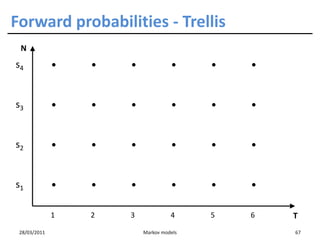
 N
s4


s3


s2


s1

              1   2   3             4     5   6   T
 28/03/2011               Markov models           67
Forward probabilities - Trellis
 N
       α1 (4)
s4

       α1 (3)         α2 (3)                                                 α6 (3)
s3

       α1 (2)                      α3 (2)                       α5 (2)
s2

       α1 (1)                                      α4 (1)
s1

              1   2            3               4            5            6            T
 28/03/2011                          Markov models                                    68
Forward probabilities - Trellis
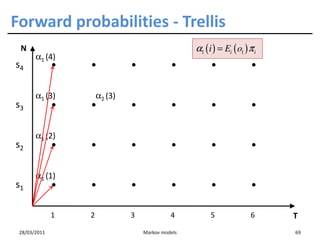
 N                                                 α1 ( i ) = Ei ( o1 ) π i
       α1 (4)
s4

       α1 (3)         α2 (3)
s3

       α1 (2)
s2

       α1 (1)
s1

              1   2            3             4           5              6     T
 28/03/2011                        Markov models                              69
Forward probabilities - Trellis
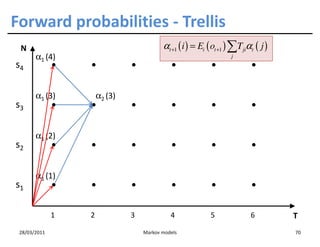
 N                                        αt +1 ( i ) = Ei ( ot +1 ) ∑Tjiαt ( j )
       α1 (4)                                                      j
s4

       α1 (3)         α2 (3)
s3

       α1 (2)
s2

       α1 (1)
s1

              1   2            3             4             5              6         T
 28/03/2011                        Markov models                                    70
Forward probabilities
• So, we can cheaply compute:
              αt ( i ) = p ( o1o2 ...ot ∧ qt = si )

• How can we cheaply compute:
                         p ( o1 o 2 ...o t )

• How can we cheaply compute:
                    p ( q t = s i | o1 o 2 ...o t )


 28/03/2011                           Markov models   71
Forward probabilities
• So, we can cheaply compute:
               αt ( i ) = p ( o1o2 ...ot ∧ qt = si )

• How can we cheaply compute:
                 p ( o1 o 2 ...o t ) =           ∑ α (i )
                                                     i
                                                         t


• How can we cheaply compute:
                                                        αt ( i )
                     p ( q t = s i | o1 o 2 ...o t ) =
                                                       ∑α t ( j )
                                                             j


    Look back the trellis...

  28/03/2011                         Markov models                  72
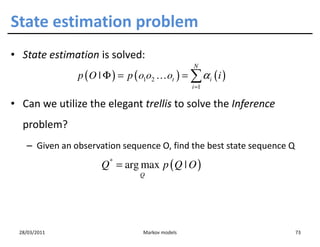
State estimation problem
• State estimation is solved:
                                                  N
               p ( O | Φ ) = p ( o1o2 … ot ) = ∑ α i ( i )
                                                  i =1

• Can we utilize the elegant trellis to solve the Inference
  problem?
   – Given an observation sequence O, find the best state sequence Q
                     Q = arg max p ( Q | O )
                        *

                                 Q


 28/03/2011                       Markov models                        73
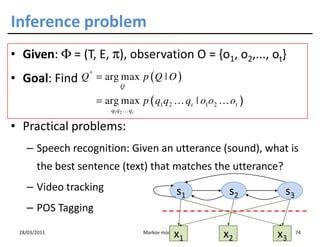
Inference problem
• Given: Φ = (T, E, π), observation O = {o1, o2,..., ot}
• Goal: Find    Q * = arg max p ( Q | O )
                          Q

                   = arg max p ( q1q2 … qt | o1o2 … ot )
                       q1q2 … qt

• Practical problems:
   – Speech recognition: Given an utterance (sound), what is
       the best sentence (text) that matches the utterance?
   – Video tracking                            s1    s2       s3
   – POS Tagging
 28/03/2011
                                              x1
                                   Markov models
                                                    x2     x3      74
Inference problem
• We can do this in a slow, stupid way:
            Q * = arg max p ( Q | O )
                      Q

                            p (O | Q ) p (Q )
                = arg max
                      Q             p (O )
                = arg max p ( O | Q ) p ( Q )
                      Q

                = arg max p ( o1o2 … ot | Q ) p ( Q )
                      Q


• But it’s better if we can find another way to
  compute the most probability path (MPP)...
 28/03/2011                 Markov models               75
Efficient MPP computation
• We are going to compute the following variables:
         δ t ( i ) = max p ( q1q2 … qt −1 ∧ qt = si ∧ o1o2 …ot )
                 q1q2 …qt −1


• δt(i) is the probability of the best path of length
  t-1 which ends up in si and emits o1...ot.

• Define: mppt(i) = that path
  so:             δt(i) = p(mppt(i))

 28/03/2011                         Markov models                  76
Viterbi algorithm
   δ t ( i ) = max p ( q1q2 … qt −1 ∧ qt = si ∧ o1o2 … ot )
               q1q2 …qt −1

mppt ( i ) = arg max p ( q1q2 … qt −1 ∧ qt = si ∧ o1o2 …ot )
                q1q2 …qt −1

   δ1 ( i ) = max p ( q1 = si ∧ o1 )
               one choice

          = π i Ei ( o1 ) = α1 ( i )
       N δ (4)
          1
    s4
               δ 1 (3)
    s3                              δ 2 (3)

               δ 1 (2)
    s2

    s1
                      δ 1 (1)
                     1          2             3        4          5   6   T
  28/03/2011                                      Markov models               77
Viterbi algorithm
         time t     time t + 1
                                 • The most prob path with last two states
          s1
                                   sisj is the most path to si, followed by
              ...


                                   transition si          sj.
              si         sj
                                 • The prob of that path will be:
              ...
              ...


                                   δt(i) × p(si         sj ∧ ot+1)

                                   = δt(i)TijEj(ot+1)

                                 • So, the previous state at time t is:
                                    i* = arg max δ t ( i ) Tij E j ( ot +1 )
                                                    i


 28/03/2011                         Markov models                              78
Viterbi algorithm
• Summary:                  δ t +1 ( j ) = δ t ( i* ) Tij E j ( ot +1 )   δ1 ( i ) = π i Ei ( o1 ) = α1 ( i )
                        mppt +1 ( j ) = mppt i* s j  ( )
                                      i* = arg max δ t ( i ) Tij E j ( ot +1 )
                                                 i

      N δ (4)
         1
   s4
              δ 1 (3)
   s3                           δ 2 (3)

              δ 1 (2)
   s2

   s1
                  δ 1 (1)
                  1         2             3          4             5        6            T
 28/03/2011                                     Markov models                                         79
What’s Viterbi used for?
 • Speech Recognition


Chong, Jike and Yi, Youngmin and Faria, Arlo and Satish, Nadathur Rajagopalan and Keutzer, Kurt, “Data-Parallel Large Vocabulary
Continuous Speech Recognition on Graphics Processors”, EECS Department, University of California, Berkeley, 2008.


     28/03/2011                                              Markov models                                                         80
Training HMMs
• Given: large sequence of observation o1o2...oT
  and number of states N.

• Goal: Estimation of parameters Φ = 〈T, E, π〉

• That is, how to design an HMM.

• We will infer the model from a large amount of
  data o1o2...oT with a big “T”.

 28/03/2011             Markov models              81
Training HMMs
• Remember, we have just computed
                                p(o1o2...oT | Φ)
• Now, we have some observations and we want to inference Φ
  from them.
• So, we could use:
   – MAX LIKELIHOOD:         Φ = arg max p ( o1 … oT | Φ )
                                     Φ
   – BAYES:
       Compute p ( Φ | o1 … oT )
        then take E [ Φ ] or max p ( Φ | o1 … oT )
                               Φ


 28/03/2011                         Markov models             82
Max likelihood for HMMs
• Forward probability: the probability of producing o1...ot while
  ending up in state si
                                                                  α1 ( i ) = Ei ( o1 ) π i
              αt ( i ) = p ( o1o2 ...ot ∧ qt = si )
                                                                α t +1 ( i ) = Ei ( ot +1 ) ∑ T jiα t ( j )
                                                                                             j


• Backward probability: the probability of producing ot+1...oT given
  that at time t, we are at state si

         βt ( i ) = p ( ot +1ot +2 ...oT | qt = si )


 28/03/2011                                     Markov models                                            83
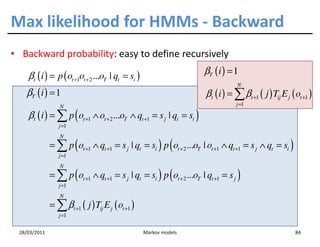
Max likelihood for HMMs - Backward
• Backward probability: easy to define recursively

    βt ( i ) = p ( ot +1ot +2 ...oT | qt = si )                         βT ( i ) = 1
                                                                                    N
   βT ( i ) = 1                                                         βt ( i ) = ∑ βt +1 ( j ) Tij E j ( ot +1 )
                 N                                                                  j =1

    βt ( i ) = ∑ p ( ot +1 ∧ ot +2 ...oT ∧ qt +1 = s j | qt = si )
                 j =1
                 N
              = ∑ p ( ot +1 ∧ qt +1 = s j | qt = si ) p ( ot + 2 ...oT | ot +1 ∧ qt +1 = s j ∧ qt = si )
                 j =1
                 N
              = ∑ p ( ot +1 ∧ qt +1 = s j | qt = si ) p ( ot + 2 ...oT | qt +1 = s j )
                 j =1
                 N
              = ∑ βt +1 ( j ) Tij E j ( ot +1 )
                 j =1

 28/03/2011                                       Markov models                                            84
Max likelihood for HMMs
• The probability of traversing a certain arc at time t given
  o1o2...oT:
  ε ij ( t ) = p ( qt = si ∧ qt +1 = s j | o1o2 …oT )
                  p ( qt = si ∧ qt +1 = s j ∧ o1o2 …oT )
              =
                                  p ( o1o2 …oT )
                  p ( o1o2 … ot ∧ qt = si ) p ( qt = si ∧ qt +1 = s j ) p ( ot +1ot + 2 …oT | qt = si )
              =                   N

                                 ∑ p ( o o …o ∧ q
                                 i =1
                                            1 2    t       t   = si ) p ( ot +1ot + 2 … oT | qt = si )

                  α t ( i ) Tij β t ( i )
  ε ij ( t ) =    N

                  ∑α (i ) β (i )
                  i =1
                         t         t


 28/03/2011                                            Markov models                                     85
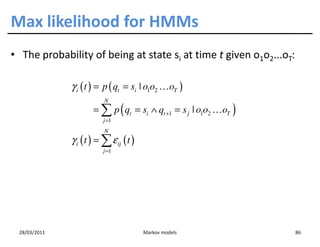
Max likelihood for HMMs
• The probability of being at state si at time t given o1o2...oT:

              γ i ( t ) = p ( qt = si | o1o2 …oT )
                          N
                      = ∑ p ( qt = si ∧ qt +1 = s j | o1o2 …oT )
                          j =1
                          N
              γ i ( t ) = ∑ ε ij ( t )
                          j =1


 28/03/2011                              Markov models              86
Max likelihood for HMMs
• Sum over the time index:
   – Expected # of transitions from state i to j in o1o2...oT:
                         T −1

                         ∑ ε (t )
                          t =1
                                 ij


   – Expected # of transitions from state i in o1o2...oT :
              T −1       T −1 N                       N T −1

              ∑ γ ( t ) = ∑∑ ε ( t ) = ∑ ∑ε ( t )
              t =1
                     i
                          t =1 j =1
                                         ij
                                                      j =1 t =1
                                                                  ij


 28/03/2011                           Markov models                    87
Π = {π i } = { p ( q1 = si )}
Update parameters                                                                  {
                                                                         T = {Tij } = p ( qt +1 = s j | qt = si )               }
                                                                         E = {E } = { p ( o = x
                                                                                   ij               t             j   | q = s )}
                                                                                                                        t        i


π i = expected frequency in state i at time t = 1 = γ i (1)
 ˆ
                                                                       T −1                  T −1

      expected # of transitions from state i to j                      ∑ ε (t )
                                                                       t =1
                                                                              ij             ∑ ε (t )
                                                                                             t =1
                                                                                                        ij
Tij =                                             =                    T −1
                                                                                        =   N T −1
        expected # of transitions from state i
                                                                       ∑ γ ( t ) ∑∑ ε ( t )
                                                                       t =1
                                                                              i
                                                                                            j =1 t =1
                                                                                                             ij


      expected # of transitions from state i with x k observed
Eik =
              expected # of transitions from state i
       T −1                           N T −1

       ∑ δ ( o , x ) γ ( t ) ∑∑ δ ( o , x ) ε ( t )
       t =1
                  t       k   i
                                      j =1 t =1
                                                     t        k   ij

   =           T −1
                                  =            N T −1

               ∑ γ (t )
               t =1
                      i                     ∑∑ ε ( t )
                                             j =1 t =1
                                                         ij


  28/03/2011                                         Markov models                                                          88
The inner loop of Forward-Backward
Given an input sequence.
1. Calculate forward probability:
    – Base case:                         α1 ( i ) = Ei ( o1 ) π i
    – Recursive case: α t +1 ( i ) = Ei ( ot +1 ) ∑ T jiα t ( j )
                                                                        j
2. Calculate backward probability:
    –      Base case:                     βT ( i ) = 1
                                                     N
    –      Recursive case: βt ( i ) = ∑ βt +1 ( j ) Tij E j ( ot +1 )
                                                     j =1
                                                                                                             α t ( i ) Tij βt ( i )
3. Calculate expected count:                                                                  ε ij ( t ) =   N

4. Update parameters:                                                                                        ∑α (i ) β (i )
                                                                                                             i =1
                                                                                                                    t        t
             T −1                                           N T −1

             ∑ ε ij ( t )                                ∑∑ δ ( o , x ) ε ( t )
                                                         j =1 t =1
                                                                            t        k   ij
                         t =1
                Tij =   N T −1
                                               Eik =              N T −1

                        ∑∑ ε ( t )
                        j =1 t =1
                                    ij                          ∑∑ ε ( t )
                                                                 j =1 t =1
                                                                                ij

  28/03/2011                                                   Markov models                                                          89
Forward-Backward: EM for HMM
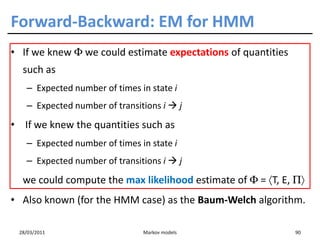
• If we knew Φ we could estimate expectations of quantities
  such as
   – Expected number of times in state i
   – Expected number of transitions i          j
• If we knew the quantities such as
   – Expected number of times in state i
   – Expected number of transitions i          j
  we could compute the max likelihood estimate of Φ = 〈T, E, Π〉
• Also known (for the HMM case) as the Baum-Welch algorithm.

 28/03/2011                    Markov models                  90
EM for HMM
• Each iteration provides values for all the parameters

• The new model always improve the likeliness of the
  training data:
               (           ˆ )
              p o1o2 …oT | Φ ≥ p ( o1o2 …oT | Φ )

• The algorithm does not guarantee to reach global
  maximum.


 28/03/2011                  Markov models                91
EM for HMM
• Bad News
   – There are lots of local minima
• Good News
   – The local minima are usually adequate models of the data.
• Notice
   – EM does not estimate the number of states. That must be given (tradeoffs)
   – Often, HMMs are forced to have some links with zero probability. This is done
       by setting Tij = 0 in initial estimate Φ(0)
   – Easy extension of everything seen today: HMMs with real valued outputs


 28/03/2011                              Markov models                           92
Contents
• Introduction

• Markov Chain

• Hidden Markov Models

• Markov Random Field (from the viewpoint of
  classification)


 28/03/2011          Markov models             93
Example: Image segmentation


• Observations: pixel values
• Hidden variable: class of each pixel
• It’s reasonable to think that there are some underlying relationships
   between neighbouring pixels... Can we use Markov models?
• Errr.... the relationships are in 2D!


  28/03/2011                       Markov models                          94
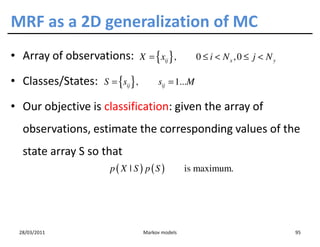
MRF as a 2D generalization of MC
• Array of observations:             X = { xij } ,       0 ≤ i < Nx , 0 ≤ j < N y

• Classes/States:     S = {sij } ,         sij = 1...M

• Our objective is classification: given the array of
  observations, estimate the corresponding values of the
  state array S so that
                     p( X | S ) p(S )                 is maximum.


 28/03/2011                           Markov models                                 95
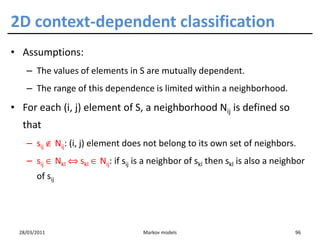
2D context-dependent classification
• Assumptions:
   – The values of elements in S are mutually dependent.
   – The range of this dependence is limited within a neighborhood.
• For each (i, j) element of S, a neighborhood Nij is defined so
  that
   – sij ∉ Nij: (i, j) element does not belong to its own set of neighbors.
   – sij ∈ Nkl ⇔ skl ∈ Nij: if sij is a neighbor of skl then skl is also a neighbor
       of sij


 28/03/2011                         Markov models                               96
2D context-dependent classification
• The Markov property for 2D case:
                         (        )
                       p sij | Sij = p ( sij | N ij )

   where Sij includes all the elements of S except the (i, j) one.

• The elegeant dynamic programing is not applicable: the problem is
   much harder now!


  28/03/2011                          Markov models                   97
2D context-dependent classification
• The Markov property for 2D case:
                           (        )
                         p sij | Sij = p ( sij | N ij )

     where Sij includes all the elements of S except the (i, j) one.
                         We are gonna see an
•    The elegeant dynamic programing is not applicable: the problem is
                        application of MRF for
     much harder now! Image Segmentation
                            and Restoration.


    28/03/2011                          Markov models                    98
MRF for Image Segmentation
• Cliques: a set of each pixel which are neighbors
  of each other (w.r.t the type of neighborhood)


 28/03/2011            Markov models                 99
MRF for Image Segmentation
• Dual Lattice number

• Line process:


 28/03/2011             Markov models   100
MRF for Image Segmentation
• Gibbs distribution:
                          1    −U ( s )
                 π ( s ) = exp
                          Z      T
   – Z: normalizing constant

   – T: parameter

• It turns out that Gibbs distribution implies MRF
  ([Gema 84])

 28/03/2011                Markov models         101
MRF for Image Segmentation
• A Gibbs conditional probability is of the form:
                                    1     1                      
                  p ( sij | N ij ) = exp  − ∑ Fk ( Ck ( i, j ) ) 
                                    Z     T k                    

   – Ck(i, j): clique of the pixel (i, j)

   – Fk: some functions, e.g.
               1
                       (
              − sij α1 + α 2 ( si −1, j + si +1, j ) + α 2 ( si , j −1 + si , j +1 )
               T
                                                                                       )


 28/03/2011                               Markov models                                    102
MRF for Image Segmentation
• Then, the joint probability for the Gibbs model is
                               ∑∑ Fk ( Ck ( i, j ) ) 
                               i, j k                
                p ( S ) = exp  −                     
                                      T              
                                                     
   – The sum is calculated over all possible cliques associated
       with the neighborhood.

• We also need to work out p(X|S)
• Then p(X|S)p(S) can be maximized... [Gema 84]

 28/03/2011                     Markov models                103
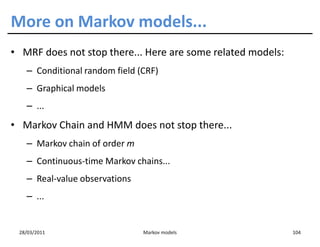
More on Markov models...
• MRF does not stop there... Here are some related models:
   – Conditional random field (CRF)
   – Graphical models
   – ...
• Markov Chain and HMM does not stop there...
   – Markov chain of order m
   – Continuous-time Markov chains...
   – Real-value observations
   – ...


 28/03/2011                    Markov models                 104
What you should know
• Markov property, Markov Chain

• HMM:
   – Defining and computing αt(i)

   – Viterbi algorithm

   – Outline of the EM algorithm for HMM

• Markov Random Field
   – And an application in Image Segmentation

   – [Geman 84] for more information.


 28/03/2011                         Markov models   105
Q&A


28/03/2011   Markov models   106
References
•    L. R. Rabiner, "A Tutorial on Hidden Markov Models and Selected Applications
     in Speech Recognition“, Proc. of the IEEE, Vol.77, No.2, pp.257--286, 1989.

•    Andrew W. Moore, “Hidden Markov Models”, http://www.autonlab.org/tutorials/

•    Geman S., Geman D. “Stochastic relaxation, Gibbs distributions and the
     Bayesian restoration of images,” IEEE Transactions on Pattern Analysis and
     Machine Intelligence, Vol. 6(6), pp. 721-741, 1984.


    28/03/2011                         Markov models                               107

Markov Models

  • 1.
    PATTERN RECOGNITION Markov models Vu PHAM phvu@fit.hcmus.edu.vn Department of Computer Science March 28th, 2011 28/03/2011 Markov models 1
  • 2.
    Contents • Introduction – Introduction – Motivation • Markov Chain • Hidden Markov Models • Markov Random Field 28/03/2011 Markov models 2
  • 3.
    Introduction • Markov processesare first proposed by Russian mathematician Andrei Markov – He used these processes to investigate Pushkin’s poem. • Nowadays, Markov property and HMMs are widely used in many domains: – Natural Language Processing – Speech Recognition – Bioinformatics – Image/video processing – ... 28/03/2011 Markov models 3
  • 4.
    Motivation [0] • Asshown in his paper in 1906, Markov’s original motivation is purely mathematical: – Application of The Weak Law of Large Number to dependent random variables. • However, we shall not follow this motivation... 28/03/2011 Markov models 4
  • 5.
    Motivation [1] • Fromthe viewpoint of classification: – Context-free classification: Bayes classifier p (ωi | x ) > p (ω j | x ) ∀j ≠ i 28/03/2011 Markov models 5
  • 6.
    Motivation [1] • Fromthe viewpoint of classification: – Context-free classification: Bayes classifier p (ωi | x ) > p (ω j | x ) ∀j ≠ i • Classes are independent. • Feature vectors are independent. 28/03/2011 Markov models 6
  • 7.
    Motivation [1] • Fromthe viewpoint of classification: – Context-free classification: Bayes classifier p (ωi | x ) > p (ω j | x ) ∀j ≠ i – However, there are some applications where various classes are closely realated: • POS Tagging, Tracking, Gene boundary recover... s1 s2 s3 ... sm ... 28/03/2011 Markov models 7
  • 8.
    Motivation [1] • Context-dependentclassification: s1 s2 s3 ... sm ... – s1, s2, ..., sm: sequence of m feature vector – ω1, ω2,..., ωN: classes in which these vectors are classified: ωi = 1...k. 28/03/2011 Markov models 8
  • 9.
    Motivation [1] • Context-dependentclassification: s1 s2 s3 ... sm ... – s1, s2, ..., sm: sequence of m feature vector – ω1, ω2,..., ωN: classes in which these vectors are classified: ωi = 1...k. • To apply Bayes classifier: – X = s1s2...sm: extened feature vector – Ωi = ωi1, ωi2,..., ωiN : a classification Nm possible classifications p ( Ωi | X ) > p ( Ω j | X ) ∀j ≠ i p ( X | Ωi ) p ( Ωi ) > p ( X | Ω j ) p ( Ω j ) ∀j ≠ i 28/03/2011 Markov models 9
  • 10.
    Motivation [1] • Context-dependentclassification: s1 s2 s3 ... sm ... – s1, s2, ..., sm: sequence of m feature vector – ω1, ω2,..., ωN: classes in which these vectors are classified: ωi = 1...k. • To apply Bayes classifier: – X = s1s2...sm: extened feature vector – Ωi = ωi1, ωi2,..., ωiN : a classification Nm possible classifications p ( Ωi | X ) > p ( Ω j | X ) ∀j ≠ i p ( X | Ωi ) p ( Ωi ) > p ( X | Ω j ) p ( Ω j ) ∀j ≠ i 28/03/2011 Markov models 10
  • 11.
    Motivation [2] • Froma general view, sometimes we want to evaluate the joint distribution of a sequence of dependent random variables 28/03/2011 Markov models 11
  • 12.
    Motivation [2] • Froma general view, sometimes we want to evaluate the joint distribution of a sequence of dependent random variables Hôm nay mùng tám tháng ba Chị em phụ nữ đi ra đi vào... Hôm nay mùng ... vào ... q1 q2 q3 qm 28/03/2011 Markov models 12
  • 13.
    Motivation [2] • Froma general view, sometimes we want to evaluate the joint distribution of a sequence of dependent random variables Hôm nay mùng tám tháng ba Chị em phụ nữ đi ra đi vào... Hôm nay mùng ... vào ... q1 q2 q3 qm • What is p(Hôm nay.... vào) = p(q1=Hôm q2=nay ... qm=vào)? 28/03/2011 Markov models 13
  • 14.
    Motivation [2] • Froma general view, sometimes we want to evaluate the joint distribution of a sequence of dependent random variables Hôm nay mùng tám tháng ba Chị em phụ nữ đi ra đi vào... Hôm nay mùng ... vào ... q1 q2 q3 qm • What is p(Hôm nay.... vào) = p(q1=Hôm q2=nay ... qm=vào)? p(s1s2... sm-1 sm) p(sm|s1s2...sm-1) = p(s1s2... sm-1) 28/03/2011 Markov models 14
  • 15.
    Contents • Introduction • MarkovChain • Hidden Markov Models • Markov Random Field 28/03/2011 Markov models 15
  • 16.
    Markov Chain • HasN states, called s1, s2, ..., sN • There are discrete timesteps, t=0, s2 t=1,... s1 • On the t’th timestep the system is in exactly one of the available states. s3 Call it qt ∈ {s1 , s2 ,..., sN } Current state N=3 t=0 q t = q 0 = s3 28/03/2011 Markov models 16
  • 17.
    Markov Chain • HasN states, called s1, s2, ..., sN • There are discrete timesteps, t=0, s2 t=1,... s1 • On the t’th timestep the system is in Current state exactly one of the available states. s3 Call it qt ∈ {s1 , s2 ,..., sN } • Between each timestep, the next state is chosen randomly. N=3 t=1 q t = q 1 = s2 28/03/2011 Markov models 17
  • 18.
    p ( s1˚ s2 ) = 1 2 Markov Chain p ( s2 ˚ s2 ) = 1 2 p ( s3 ˚ s2 ) = 0 • Has N states, called s1, s2, ..., sN • There are discrete timesteps, t=0, s2 t=1,... s1 • On the t’th timestep the system is in exactly one of the available states. p ( qt +1 = s1 ˚ qt = s1 ) = 0 s3 Call it qt ∈ {s1 , s2 ,..., sN } p ( s2 ˚ s1 ) = 0 • Between each timestep, the next p ( s3 ˚ s1 ) = 1 p ( s1 ˚ s3 ) = 1 3 state is chosen randomly. p ( s2 ˚ s3 ) = 2 3 p ( s3 ˚ s3 ) = 0 • The current state determines the probability for the next state. N=3 t=1 q t = q 1 = s2 28/03/2011 Markov models 18
  • 19.
    p ( s1˚ s2 ) = 1 2 Markov Chain p ( s2 ˚ s2 ) = 1 2 p ( s3 ˚ s2 ) = 0 • Has N states, called s1, s2, ..., sN 1/2 • There are discrete timesteps, t=0, s2 1/2 t=1,... s1 2/3 • On the t’th timestep the system is in 1/3 1 exactly one of the available states. p ( qt +1 = s1 ˚ qt = s1 ) = 0 s3 Call it qt ∈ {s1 , s2 ,..., sN } p ( s2 ˚ s1 ) = 0 • Between each timestep, the next p ( s3 ˚ s1 ) = 1 p ( s1 ˚ s3 ) = 1 3 state is chosen randomly. p ( s2 ˚ s3 ) = 2 3 p ( s3 ˚ s3 ) = 0 • The current state determines the probability for the next state. N=3 – Often notated with arcs between states t=1 q t = q 1 = s2 28/03/2011 Markov models 19
  • 20.
    p ( s1˚ s2 ) = 1 2 Markov Property p ( s2 ˚ s2 ) = 1 2 p ( s3 ˚ s2 ) = 0 • qt+1 is conditionally independent of 1/2 {qt-1, qt-2,..., q0} given qt. s2 1/2 • In other words: s1 2/3 p ( qt +1 ˚ qt , qt −1 ,..., q0 ) 1/3 1 = p ( qt +1 ˚ qt ) p ( qt +1 = s1 ˚ qt = s1 ) = 0 s3 p ( s2 ˚ s1 ) = 0 p ( s3 ˚ s1 ) = 1 p ( s1 ˚ s3 ) = 1 3 p ( s2 ˚ s3 ) = 2 3 p ( s3 ˚ s3 ) = 0 N=3 t=1 q t = q 1 = s2 28/03/2011 Markov models 20
  • 21.
    p ( s1˚ s2 ) = 1 2 Markov Property p ( s2 ˚ s2 ) = 1 2 p ( s3 ˚ s2 ) = 0 • qt+1 is conditionally independent of 1/2 {qt-1, qt-2,..., q0} given qt. s2 1/2 • In other words: s1 2/3 p ( qt +1 ˚ qt , qt −1 ,..., q0 ) 1/3 1 = p ( qt +1 ˚ qt ) p ( qt +1 = s1 ˚ qt = s1 ) = 0 s3 The state at timestep t+1 depends p ( s2 ˚ s1 ) = 0 p ( s3 ˚ s1 ) = 1 p ( s1 ˚ s3 ) = 1 3 only on the state at timestep t p ( s2 ˚ s3 ) = 2 3 p ( s3 ˚ s3 ) = 0 N=3 t=1 q t = q 1 = s2 28/03/2011 Markov models 21
  • 22.
    p ( s1˚ s2 ) = 1 2 Markov Property p ( s2 ˚ s2 ) = 1 2 p ( s3 ˚ s2 ) = 0 • qt+1 is conditionally independent of 1/2 {qt-1, qt-2,..., q0} given qt. s2 1/2 • In other words: s1 2/3 p ( qt +1 ˚ qt , qt −1 ,..., q0 ) 1/3 1 = p ( qt +1 ˚ qt ) p ( qt +1 = s1 ˚ qt = s1 ) = 0 s3 The state at timestep t+1 depends p ( s2 ˚ s1 ) = 0 p ( s3 ˚ s1 ) = 1 p ( s1 ˚ s3 ) = 1 3 only on the state at timestep t p ( s2 ˚ s3 ) = 2 3 A Markov chain of order m (m finite): the state at p ( s3 ˚ s3 ) = 0 timestep t+1 depends on the past m states: N=3 t=1 p ( qt +1 ˚ qt , qt −1 ,..., q0 ) = p ( qt +1 ˚ qt , qt −1 ,..., qt − m +1 ) q t = q 1 = s2 28/03/2011 Markov models 22
  • 23.
    p ( s1˚ s2 ) = 1 2 Markov Property p ( s2 ˚ s2 ) = 1 2 p ( s3 ˚ s2 ) = 0 • qt+1 is conditionally independent of 1/2 {qt-1, qt-2,..., q0} given qt. s2 1/2 • In other words: s1 2/3 p ( qt +1 ˚ qt , qt −1 ,..., q0 ) 1/3 1 = p ( qt +1 ˚ qt ) p ( qt +1 = s1 ˚ qt = s1 ) = 0 s3 The state at timestep t+1 depends p ( s2 ˚ s1 ) = 0 p ( s3 ˚ s1 ) = 1 p ( s1 ˚ s3 ) = 1 3 only on the state at timestep t p ( s2 ˚ s3 ) = 2 3 • How to represent the joint p ( s3 ˚ s3 ) = 0 distribution of (q0, q1, q2...) using N=3 graphical models? t=1 q t = q 1 = s2 28/03/2011 Markov models 23
  • 24.
    p ( s1˚ s2 ) = 1 2 Markov Property p ( s2 ˚ s2 ) = 1 2 q0p ( s 3 ˚ s2 ) = 0 • qt+1 is conditionally independent of 1/2 {qt-1, qt-2,..., q0} given qt. s2 1/2 • In other words: q1 s1 1/3 p ( qt +1 ˚ qt , qt −1 ,..., q0 ) 1/3 1 = p ( qt +1 ˚ qt ) p ( qt +1 = s1 ˚ qt = s1 ) = 0 q2 s3 The state at timestep t+1 depends p ( s2 ˚ s1 ) = 0 p ( s3 ˚ s1 ) = 1 p ( s1 ˚ s3 ) = 1 3 only on the state at timestep t • How to represent the joint q3 p ( s 2 ˚ s3 ) = 2 3 p ( s3 ˚ s3 ) = 0 distribution of (q0, q1, q2...) using N=3 graphical models? t=1 q t = q 1 = s2 28/03/2011 Markov models 24
  • 25.
    Markov chain • So,the chain of {qt} is called Markov chain q0 q1 q2 q3 28/03/2011 Markov models 25
  • 26.
    Markov chain • So,the chain of {qt} is called Markov chain q0 q1 q2 q3 • Each qt takes value from the countable state-space {s1, s2, s3...} • Each qt is observed at a discrete timestep t • {qt} sastifies the Markov property: p ( qt +1 ˚ qt , qt −1 ,..., q0 ) = p ( qt +1 ˚ qt ) 28/03/2011 Markov models 26
  • 27.
    Markov chain • So,the chain of {qt} is called Markov chain q0 q1 q2 q3 • Each qt takes value from the countable state-space {s1, s2, s3...} • Each qt is observed at a discrete timestep t • {qt} sastifies the Markov property: p ( qt +1 ˚ qt , qt −1 ,..., q0 ) = p ( qt +1 ˚ qt ) • The transition from qt to qt+1 is calculated from the transition probability matrix 1/2 s1 s2 s3 s2 s1 0 0 1 1/2 s1 s2 ½ ½ 0 2/3 1 1/3 s3 1/3 2/3 0 28/03/2011 s3 Markov models Transition probabilities 27
  • 28.
    Markov chain • So,the chain of {qt} is called Markov chain q0 q1 q2 q3 • Each qt takes value from the countable state-space {s1, s2, s3...} • Each qt is observed at a discrete timestep t • {qt} sastifies the Markov property: p ( qt +1 ˚ qt , qt −1 ,..., q0 ) = p ( qt +1 ˚ qt ) • The transition from qt to qt+1 is calculated from the transition probability matrix 1/2 s1 s2 s3 s2 s1 0 0 1 1/2 s1 s2 ½ ½ 0 2/3 1 1/3 s3 1/3 2/3 0 28/03/2011 s3 Markov models Transition probabilities 28
  • 29.
    Markov Chain –Important property • In a Markov chain, the joint distribution is m p ( q0 , q1 ,..., qm ) = p ( q0 ) ∏ p ( q j | q j −1 ) j =1 28/03/2011 Markov models 29
  • 30.
    Markov Chain –Important property • In a Markov chain, the joint distribution is m p ( q0 , q1 ,..., qm ) = p ( q0 ) ∏ p ( q j | q j −1 ) j =1 • Why? m p ( q0 , q1 ,..., qm ) = p ( q0 ) ∏ p ( q j | q j −1 , previous states ) j =1 m = p ( q0 ) ∏ p ( q j | q j −1 ) j =1 Due to the Markov property 28/03/2011 Markov models 30
  • 31.
    Markov Chain: e.g. •The state-space of weather: rain wind cloud 28/03/2011 Markov models 31
  • 32.
    Markov Chain: e.g. •The state-space of weather: 1/2 Rain Cloud Wind rain wind Rain ½ 0 ½ 2/3 Cloud 1/3 0 2/3 1/2 1/3 1 cloud Wind 0 1 0 28/03/2011 Markov models 32
  • 33.
    Markov Chain: e.g. •The state-space of weather: 1/2 Rain Cloud Wind rain wind Rain ½ 0 ½ 2/3 Cloud 1/3 0 2/3 1/2 1/3 1 cloud Wind 0 1 0 • Markov assumption: weather in the t+1’th day is depends only on the t’th day. 28/03/2011 Markov models 33
  • 34.
    Markov Chain: e.g. •The state-space of weather: 1/2 Rain Cloud Wind rain wind Rain ½ 0 ½ 2/3 Cloud 1/3 0 2/3 1/2 1/3 1 cloud Wind 0 1 0 • Markov assumption: weather in the t+1’th day is depends only on the t’th day. • We have observed the weather in a week: rain wind cloud rain wind Day: 0 1 2 3 4 28/03/2011 Markov models 34
  • 35.
    Markov Chain: e.g. •The state-space of weather: 1/2 Rain Cloud Wind rain wind Rain ½ 0 ½ 2/3 Cloud 1/3 0 2/3 1/2 1/3 1 cloud Wind 0 1 0 • Markov assumption: weather in the t+1’th day is depends only on the t’th day. • We have observed the weather in a week: Markov Chain rain wind cloud rain wind Day: 0 1 2 3 4 28/03/2011 Markov models 35
  • 36.
    Contents • Introduction • MarkovChain • Hidden Markov Models – Independent assumptions – Formal definition – Forward algorithm – Viterbi algorithm – Baum-Welch algorithm • Markov Random Field 28/03/2011 Markov models 36
  • 37.
    Modeling pairs ofsequences • In many applications, we have to model pair of sequences • Examples: – POS tagging in Natural Language Processing (assign each word in a sentence to Noun, Adj, Verb...) – Speech recognition (map acoustic sequences to sequences of words) – Computational biology (recover gene boundaries in DNA sequences) – Video tracking (estimate the underlying model states from the observation sequences) – And many others... 28/03/2011 Markov models 37
  • 38.
    Probabilistic models forsequence pairs • We have two sequences of random variables: X1, X2, ..., Xm and S1, S2, ..., Sm • Intuitively, in a pratical system, each Xi corresponds to an observation and each Si corresponds to a state that generated the observation. • Let each Si be in {1, 2, ..., k} and each Xi be in {1, 2, ..., o} • How do we model the joint distribution: p ( X 1 = x1 ,..., X m = xm , S1 = s1 ,..., S m = sm ) 28/03/2011 Markov models 38
  • 39.
    Hidden Markov Models(HMMs) • In HMMs, we assume that p ( X 1 = x1 ,..., X m = xm , S1 = s1 ,..., Sm = sm ) m m = p ( S1 = s1 ) ∏ p ( S j = s j ˚ S j −1 = s j −1 ) ∏ p ( X j = x j ˚ S j = s j ) j =2 j =1 • This is often called Independence assumptions in HMMs • We are gonna prove it in the next slides 28/03/2011 Markov models 39
  • 40.
    Independence Assumptions inHMMs [1] p ( ABC ) = p ( A | BC ) p ( BC ) = p ( A | BC ) p ( B ˚ C ) p ( C ) • By the chain rule, the following equality is exact: p ( X 1 = x1 ,..., X m = xm , S1 = s1 ,..., S m = sm ) = p ( S1 = s1 ,..., S m = sm ) × p ( X 1 = x1 ,..., X m = xm ˚ S1 = s1 ,..., S m = sm ) • Assumption 1: the state sequence forms a Markov chain m p ( S1 = s1 ,..., S m = sm ) = p ( S1 = s1 ) ∏ p ( S j = s j ˚ S j −1 = s j −1 ) j =2 28/03/2011 Markov models 40
  • 41.
    Independence Assumptions inHMMs [2] • By the chain rule, the following equality is exact: p ( X 1 = x1 ,..., X m = xm ˚ S1 = s1 ,..., S m = sm ) m = ∏ p ( X j = x j ˚ S1 = s1 ,..., Sm = sm , X 1 = x1 ,..., X j −1 = x j −1 ) j =1 • Assumption 2: each observation depends only on the underlying state p ( X j = x j ˚ S1 = s1 ,..., Sm = sm , X 1 = x1 ,..., X j −1 = x j −1 ) = p( X j = xj ˚ S j = sj ) • These two assumptions are often called independence assumptions in HMMs 28/03/2011 Markov models 41
  • 42.
    The Model formfor HMMs • The model takes the following form: m m p ( x1 ,.., xm , s1 ,..., sm ;θ ) = π ( s1 ) ∏ t ( s j ˚ s j −1 ) ∏ e ( x j ˚ s j ) j =2 j =1 • Parameters in the model: – Initial probabilities π ( s ) for s ∈ {1, 2,..., k } – Transition probabilities t ( s ˚ s′ ) for s, s ' ∈ {1, 2,..., k } – Emission probabilities e ( x ˚ s ) for s ∈ {1, 2,..., k } and x ∈ {1, 2,.., o} 28/03/2011 Markov models 42
  • 43.
    6 components ofHMMs start • Discrete timesteps: 1, 2, ... • Finite state space: {si} (N states) π1 π2 π3 • Events {xi} (M events) t31 t11 t12 t23 π • Vector of initial probabilities {πi} s1 s2 s3 t21 t32 Π = {πi } = { p(q1 = si) } • Matrix of transition probabilities e13 e11 e23 e33 e31 T = {Tij} = { p(qt+1=sj|qt=si) } e22 • Matrix of emission probabilities x1 x2 x3 E = {Eij} = { p(ot=xj|qt=si) } The observations at continuous timesteps form an observation sequence {o1, o2, ..., ot}, where oi ∈ {x1, x2, ..., xM} 28/03/2011 Markov models 43
  • 44.
    6 components ofHMMs start • Discrete timesteps: 1, 2, ... • Finite state space: {si} (N states) π1 π2 π3 • Events {xi} (M events) t31 t11 t12 t23 π • Vector of initial probabilities {πi} s1 s2 s3 t21 t32 Π = {πi } = { p(q1 = si) } • Matrix of transition probabilities e13 e11 e23 e33 e31 T = {Tij} = { p(qt+1=sj|qt=si) } e22 • Matrix of emission probabilities x1 x2 x3 E = {Eij} = { p(ot=xj|qt=si) } Constraints: The observations at continuous timesteps form an observation sequence N N M ∑ πi = 1 ∑ ∑ {o1, o2, ..., ot}, where oi ∈ {x1Tij 2=..., xM} Eij = 1 i =1 j =1 ,x , 1 j =1 28/03/2011 Markov models 44
  • 45.
    6 components ofHMMs start • Given a specific HMM and an observation sequence, the π1 π2 π3 corresponding sequence of states t31 t11 is generally not deterministic t12 t23 • Example: s1 t21 s2 t32 s3 Given the observation sequence: e13 e11 e23 e33 {x1, x3, x3, x2} e31 e22 The corresponding states can be any of following sequences: x1 x2 x3 {s1, s2, s1, s2} {s1, s2, s3, s2} {s1, s1, s1, s2} ... 28/03/2011 Markov models 45
  • 46.
    Here’s an HMM 0.2 0.5 0.5 0.6 s1 0.4 s2 0.8 s3 0.3 0.7 0.9 0.8 0.2 0.1 x1 x2 x3 T s1 s2 s3 E x1 x2 x3 π s1 s2 s3 s1 0.5 0.5 0 s1 0.3 0 0.7 0.3 0.3 0.4 s2 0.4 0 0.6 s2 0 0.1 0.9 s3 0.2 0.8 0 s3 0.2 0 0.8 28/03/2011 Markov models 46
  • 47.
    Here’s a HMM 0.2 0.5 • Start randomly in state 1, 2 0.5 0.6 s1 s2 s3 or 3. 0.4 0.8 • Choose a output at each 0.3 0.7 0.9 state in random. 0.2 0.8 0.1 • Let’s generate a sequence of observations: x1 x2 x3 0.3 - 0.3 - 0.4 π s1 s2 s3 randomply choice between S1, S2, S3 0.3 0.3 0.4 T s1 s2 s3 E x1 x2 x3 s1 0.5 0.5 0 s1 0.3 0 0.7 q1 o1 s2 0.4 0 0.6 s2 0 0.1 0.9 q2 o2 s3 0.2 0.8 0 s3 0.2 0 0.8 q3 o3 28/03/2011 Markov models 47
  • 48.
    Here’s a HMM 0.2 0.5 • Start randomly in state 1, 2 0.5 0.6 s1 s2 s3 or 3. 0.4 0.8 • Choose a output at each 0.3 0.7 0.9 state in random. 0.2 0.8 0.1 • Let’s generate a sequence of observations: x1 x2 x3 0.2 - 0.8 π s1 s2 s3 choice between X1 and X3 0.3 0.3 0.4 T s1 s2 s3 E x1 x2 x3 s1 0.5 0.5 0 s1 0.3 0 0.7 q1 S3 o1 s2 0.4 0 0.6 s2 0 0.1 0.9 q2 o2 s3 0.2 0.8 0 s3 0.2 0 0.8 q3 o3 28/03/2011 Markov models 48
  • 49.
    Here’s a HMM 0.2 0.5 • Start randomly in state 1, 2 0.5 0.6 s1 s2 s3 or 3. 0.4 0.8 • Choose a output at each 0.3 0.7 0.9 state in random. 0.2 0.8 0.1 • Let’s generate a sequence of observations: x1 x2 x3 Go to S2 with π s1 s2 s3 probability 0.8 or S1 with prob. 0.2 0.3 0.3 0.4 T s1 s2 s3 E x1 x2 x3 s1 0.5 0.5 0 s1 0.3 0 0.7 q1 S3 o1 X3 s2 0.4 0 0.6 s2 0 0.1 0.9 q2 o2 s3 0.2 0.8 0 s3 0.2 0 0.8 q3 o3 28/03/2011 Markov models 49
  • 50.
    Here’s a HMM 0.2 0.5 • Start randomly in state 1, 2 0.5 0.6 s1 s2 s3 or 3. 0.4 0.8 • Choose a output at each 0.3 0.7 0.9 state in random. 0.2 0.8 0.1 • Let’s generate a sequence of observations: x1 x2 x3 0.3 - 0.7 π s1 s2 s3 choice between X1 and X3 0.3 0.3 0.4 T s1 s2 s3 E x1 x2 x3 s1 0.5 0.5 0 s1 0.3 0 0.7 q1 S3 o1 X3 s2 0.4 0 0.6 s2 0 0.1 0.9 q2 S1 o2 s3 0.2 0.8 0 s3 0.2 0 0.8 q3 o3 28/03/2011 Markov models 50
  • 51.
    Here’s a HMM 0.2 0.5 • Start randomly in state 1, 2 0.5 0.6 s1 s2 s3 or 3. 0.4 0.8 • Choose a output at each 0.3 0.7 0.9 state in random. 0.2 0.8 0.1 • Let’s generate a sequence of observations: x1 x2 x3 Go to S2 with π s1 s2 s3 probability 0.5 or S1 with prob. 0.5 0.3 0.3 0.4 T s1 s2 s3 E x1 x2 x3 s1 0.5 0.5 0 s1 0.3 0 0.7 q1 S3 o1 X3 s2 0.4 0 0.6 s2 0 0.1 0.9 q2 S1 o2 X1 s3 0.2 0.8 0 s3 0.2 0 0.8 q3 o3 28/03/2011 Markov models 51
  • 52.
    Here’s a HMM 0.2 0.5 • Start randomly in state 1, 2 0.5 0.6 s1 s2 s3 or 3. 0.4 0.8 • Choose a output at each 0.3 0.7 0.9 state in random. 0.2 0.8 0.1 • Let’s generate a sequence of observations: x1 x2 x3 0.3 - 0.7 π s1 s2 s3 choice between X1 and X3 0.3 0.3 0.4 T s1 s2 s3 E x1 x2 x3 s1 0.5 0.5 0 s1 0.3 0 0.7 q1 S3 o1 X3 s2 0.4 0 0.6 s2 0 0.1 0.9 q2 S1 o2 X1 s3 0.2 0.8 0 s3 0.2 0 0.8 q3 S1 o3 28/03/2011 Markov models 52
  • 53.
    Here’s a HMM 0.2 0.5 • Start randomly in state 1, 2 0.5 0.6 s1 s2 s3 or 3. 0.4 0.8 • Choose a output at each 0.3 0.7 0.9 state in random. 0.2 0.8 0.1 • Let’s generate a sequence of observations: x1 x2 x3 We got a sequence of states and π s1 s2 s3 corresponding 0.3 0.3 0.4 observations! T s1 s2 s3 E x1 x2 x3 s1 0.5 0.5 0 s1 0.3 0 0.7 q1 S3 o1 X3 s2 0.4 0 0.6 s2 0 0.1 0.9 q2 S1 o2 X1 s3 0.2 0.8 0 s3 0.2 0 0.8 q3 S1 o3 X3 28/03/2011 Markov models 53
  • 54.
    Three famous HMMtasks • Given a HMM Φ = (T, E, π). Three famous HMM tasks are: • Probability of an observation sequence (state estimation) – Given: Φ, observation O = {o1, o2,..., ot} – Goal: p(O|Φ), or equivalently p(st = Si|O) • Most likely expaination (inference) – Given: Φ, the observation O = {o1, o2,..., ot} – Goal: Q* = argmaxQ p(Q|O) • Learning the HMM – Given: observation O = {o1, o2,..., ot} and corresponding state sequence – Goal: estimate parameters of the HMM Φ = (T, E, π) 28/03/2011 Markov models 54
  • 55.
    Three famous HMMtasks • Given a HMM Φ = (T, E, π). Three famous HMM tasks are: • Probability of an observation sequence (state estimation) – Given: Φ, observation O = {o1, o2,..., ot} – Goal: p(O|Φ), or equivalently p(st = Si|O) Calculating the probability of • Most likely expaination (inference) observing the sequence O over all of possible sequences. – Given: Φ, the observation O = {o1, o2,..., ot} – Goal: Q* = argmaxQ p(Q|O) • Learning the HMM – Given: observation O = {o1, o2,..., ot} and corresponding state sequence – Goal: estimate parameters of the HMM Φ = (T, E, π) 28/03/2011 Markov models 55
  • 56.
    Three famous HMMtasks • Given a HMM Φ = (T, E, π). Three famous HMM tasks are: • Probability of an observation sequence (state estimation) – Given: Φ, observation O = {o1, o2,..., ot} – Goal: p(O|Φ), or equivalently p(st = Si|O) Calculating the best • Most likely expaination (inference) corresponding state sequence, given an observation – Given: Φ, the observation O = {o1, o2,..., ot} sequence. – Goal: Q* = argmaxQ p(Q|O) • Learning the HMM – Given: observation O = {o1, o2,..., ot} and corresponding state sequence – Goal: estimate parameters of the HMM Φ = (T, E, π) 28/03/2011 Markov models 56
  • 57.
    Three famous HMMtasks • Given a HMM Φ = (T, E, π). Three famous HMM tasks are: • Probability of an observation sequence (state estimation) – Given: Φ, observation O = {o1, o2,..., ot} Given an (or a set of) – Goal: p(O|Φ), or equivalently p(st = Si|O) observation sequence and • Most likely expaination (inference) corresponding state sequence, – Given: Φ, the observation O = {o1, o2,..., ot} estimate the Transition matrix, – Goal: Q* = argmaxQ p(Q|O) Emission matrix and initial probabilities of the HMM • Learning the HMM – Given: observation O = {o1, o2,..., ot} and corresponding state sequence – Goal: estimate parameters of the HMM Φ = (T, E, π) 28/03/2011 Markov models 57
  • 58.
    Three famous HMMtasks Problem Algorithm Complexity State estimation Forward O(TN2) Calculating: p(O|Φ) Inference Viterbi decoding O(TN2) Calculating: Q*= argmaxQp(Q|O) Learning Baum-Welch (EM) O(TN2) Calculating: Φ* = argmaxΦp(O|Φ) T: number of timesteps N: number of states 28/03/2011 Markov models 58
  • 59.
    State estimation problem •Given: Φ = (T, E, π), observation O = {o1, o2,..., ot} • Goal: What is p(o1o2...ot) ? • We can do this in a slow, stupid way – As shown in the next slide... 28/03/2011 Markov models 59
  • 60.
    Here’s a HMM 0.5 0.2 0.5 0.6 • What is p(O) = p(o1o2o3) s1 0.4 s2 0.8 s3 = p(o1=X3 ∧ o2=X1 ∧ o3=X3)? 0.3 0.7 0.9 • Slow, stupid way: 0.2 0.8 0.1 p (O ) = ∑ p ( OQ ) x1 x2 x3 Q∈paths of length 3 = ∑ Q∈paths of length 3 Q∈ p (O | Q ) p (Q ) • How to compute p(Q) for an arbitrary path Q? • How to compute p(O|Q) for an arbitrary path Q? 28/03/2011 Markov models 60
  • 61.
    Here’s a HMM 0.5 0.2 0.5 0.6 • What is p(O) = p(o1o2o3) s1 0.4 s2 0.8 s3 = p(o1=X3 ∧ o2=X1 ∧ o3=X3)? 0.3 0.7 0.9 • Slow, stupid way: 0.2 0.8 0.1 p (O ) = ∑ p ( OQ ) x1 x2 x3 Q∈paths of length 3 π s1 s2 s3 = ∑ Q∈paths of length 3 Q∈ p (O | Q ) p (Q ) 0.3 0.3 0.4 p(Q) = p(q1q2q3) • How to compute p(Q) for an = p(q1)p(q2|q1)p(q3|q2,q1) (chain) arbitrary path Q? = p(q1)p(q2|q1)p(q3|q2) (why?) • How to compute p(O|Q) for an arbitrary path Q? Example in the case Q=S3S1S1 P(Q) = 0.4 * 0.2 * 0.5 = 0.04 28/03/2011 Markov models 61
  • 62.
    Here’s a HMM 0.5 0.2 0.5 0.6 • What is p(O) = p(o1o2o3) s1 0.4 s2 0.8 s3 = p(o1=X3 ∧ o2=X1 ∧ o3=X3)? 0.3 0.7 0.9 • Slow, stupid way: 0.2 0.8 0.1 p (O ) = ∑ p ( OQ ) x1 x2 x3 Q∈paths of length 3 π s1 s2 s3 = ∑ Q∈paths of length 3 Q∈ p (O | Q ) p (Q ) 0.3 0.3 0.4 p(O|Q) = p(o1o2o3|q1q2q3) • How to compute p(Q) for an = p(o1|q1)p(o2|q1)p(o3|q3) (why?) arbitrary path Q? • How to compute p(O|Q) for an Example in the case Q=S3S1S1 arbitrary path Q? P(O|Q) = p(X3|S3)p(X1|S1) p(X3|S1) =0.8 * 0.3 * 0.7 = 0.168 28/03/2011 Markov models 62
  • 63.
    Here’s a HMM 0.5 0.2 0.5 0.6 • What is p(O) = p(o1o2o3) s1 0.4 s2 0.8 s3 = p(o1=X3 ∧ o2=X1 ∧ o3=X3)? 0.3 0.7 0.9 • Slow, stupid way: 0.2 0.8 0.1 p (O ) = ∑ p ( OQ ) x1 x2 x3 Q∈paths of length 3 π s1 s2 s3 = ∑ Q∈paths of length 3 Q∈ p (O | Q ) p (Q ) 0.3 0.3 0.4 p(O|Q) = p(o1o2o3|q1q2q3) • How to compute p(Q) for an p(O) needs 27 p(Q) arbitrary path Q? = p(o1|q1)p(o2|q1)p(o3|q3) (why?) computations and 27 • How to compute p(O|Q) for an p(O|Q) computations. Example in the case Q=S3S1S1 arbitrary path Q? P(O|Q) = p(X3|S3)p(Xsequence3has ) What if the 1|S1) p(X |S1 20 observations? =0.8 * 0.3 * 0.7 = 0.168 So let’s be smarter... 28/03/2011 Markov models 63
  • 64.
    The Forward algorithm •Given observation o1o2...oT • Forward probabilities: αt(i) = p(o1o2...ot ∧ qt = si | Φ) where 1 ≤ t ≤ T αt(i) = probability that, in a random trial: – We’d have seen the first t observations – We’d have ended up in si as the t’th state visited. • In our example, what is α2(3) ? 28/03/2011 Markov models 64
  • 65.
    αt(i): easy todefine recursively α t ( i ) = p ( o1o2 ...ot ∧ qt = si | Φ ) Π = {π i } = { p ( q1 = si )} α1 ( i ) = p ( o1 ∧ q1 = si ) = p ( q1 = si ) p ( o1 | q1 = si ) { T = {Tij } = p ( qt +1 = s j | qt = si ) } = π i Ei ( o1 ) E = {E } = { p ( o = x ij t j | q = s )} t i α t +1 ( i ) = p ( o1o2 ...ot +1 ∧ qt +1 = si ) N = ∑ p ( o1o2 ...ot ∧ qt = s j ∧ ot +1 ∧ qt +1 = si ) j =1 N = ∑ p ( ot +1 ∧ qt +1 = si | o1o2 ...ot ∧ qt = s j ) p ( o1o2 ...ot ∧ qt = s j ) j =1 N = ∑ p ( ot +1 ∧ qt +1 = si | qt = s j ) α t ( j ) j =1 N = ∑ p ( ot +1 | qt +1 = si ) p ( qt +1 = si | qt = s j ) α t ( j ) j =1 N = ∑T ji Ei ( ot +1 ) α t ( j ) j =1 28/03/2011 Markov models 65
  • 66.
    In our example 0.5 0.2 αt ( i ) = p ( o1o2 ...ot ∧ qt = si | Φ ) s1 0.5 s2 0.6 s3 0.4 0.8 α1 ( i ) = Ei ( o1 ) π i 0.3 0.7 0.9 αt +1 ( i ) = ∑Tji Ei ( ot +1 ) αt ( j ) = Ei ( ot +1 ) ∑Tjiαt ( j ) 0.2 0.1 0.8 j j x1 x2 x3 π s1 s2 s3 0.3 0.3 0.4 We observed: x1x2 α1(1) = 0.3 * 0.3 = 0.09 α2(1) = 0 * (0.09*0 .5+ 0*0.4 + 0.08*0.2) = 0 α1(2) = 0 α2(2) = 0.1 * (0.09*0.5 + 0*0 + 0.08*0.8) = 0.0109 α1(3) = 0.2 * 0.4 = 0.08 α2(3) = 0 * (0.09*0 + 0*0.6 + 0.08*0) = 0 28/03/2011 Markov models 66
  • 67.
    Forward probabilities -Trellis N s4 s3 s2 s1 1 2 3 4 5 6 T 28/03/2011 Markov models 67
  • 68.
    Forward probabilities -Trellis N α1 (4) s4 α1 (3) α2 (3) α6 (3) s3 α1 (2) α3 (2) α5 (2) s2 α1 (1) α4 (1) s1 1 2 3 4 5 6 T 28/03/2011 Markov models 68
  • 69.
    Forward probabilities -Trellis N α1 ( i ) = Ei ( o1 ) π i α1 (4) s4 α1 (3) α2 (3) s3 α1 (2) s2 α1 (1) s1 1 2 3 4 5 6 T 28/03/2011 Markov models 69
  • 70.
    Forward probabilities -Trellis N αt +1 ( i ) = Ei ( ot +1 ) ∑Tjiαt ( j ) α1 (4) j s4 α1 (3) α2 (3) s3 α1 (2) s2 α1 (1) s1 1 2 3 4 5 6 T 28/03/2011 Markov models 70
  • 71.
    Forward probabilities • So,we can cheaply compute: αt ( i ) = p ( o1o2 ...ot ∧ qt = si ) • How can we cheaply compute: p ( o1 o 2 ...o t ) • How can we cheaply compute: p ( q t = s i | o1 o 2 ...o t ) 28/03/2011 Markov models 71
  • 72.
    Forward probabilities • So,we can cheaply compute: αt ( i ) = p ( o1o2 ...ot ∧ qt = si ) • How can we cheaply compute: p ( o1 o 2 ...o t ) = ∑ α (i ) i t • How can we cheaply compute: αt ( i ) p ( q t = s i | o1 o 2 ...o t ) = ∑α t ( j ) j Look back the trellis... 28/03/2011 Markov models 72
  • 73.
    State estimation problem •State estimation is solved: N p ( O | Φ ) = p ( o1o2 … ot ) = ∑ α i ( i ) i =1 • Can we utilize the elegant trellis to solve the Inference problem? – Given an observation sequence O, find the best state sequence Q Q = arg max p ( Q | O ) * Q 28/03/2011 Markov models 73
  • 74.
    Inference problem • Given:Φ = (T, E, π), observation O = {o1, o2,..., ot} • Goal: Find Q * = arg max p ( Q | O ) Q = arg max p ( q1q2 … qt | o1o2 … ot ) q1q2 … qt • Practical problems: – Speech recognition: Given an utterance (sound), what is the best sentence (text) that matches the utterance? – Video tracking s1 s2 s3 – POS Tagging 28/03/2011 x1 Markov models x2 x3 74
  • 75.
    Inference problem • Wecan do this in a slow, stupid way: Q * = arg max p ( Q | O ) Q p (O | Q ) p (Q ) = arg max Q p (O ) = arg max p ( O | Q ) p ( Q ) Q = arg max p ( o1o2 … ot | Q ) p ( Q ) Q • But it’s better if we can find another way to compute the most probability path (MPP)... 28/03/2011 Markov models 75
  • 76.
    Efficient MPP computation •We are going to compute the following variables: δ t ( i ) = max p ( q1q2 … qt −1 ∧ qt = si ∧ o1o2 …ot ) q1q2 …qt −1 • δt(i) is the probability of the best path of length t-1 which ends up in si and emits o1...ot. • Define: mppt(i) = that path so: δt(i) = p(mppt(i)) 28/03/2011 Markov models 76
  • 77.
    Viterbi algorithm δ t ( i ) = max p ( q1q2 … qt −1 ∧ qt = si ∧ o1o2 … ot ) q1q2 …qt −1 mppt ( i ) = arg max p ( q1q2 … qt −1 ∧ qt = si ∧ o1o2 …ot ) q1q2 …qt −1 δ1 ( i ) = max p ( q1 = si ∧ o1 ) one choice = π i Ei ( o1 ) = α1 ( i ) N δ (4) 1 s4 δ 1 (3) s3 δ 2 (3) δ 1 (2) s2 s1 δ 1 (1) 1 2 3 4 5 6 T 28/03/2011 Markov models 77
  • 78.
    Viterbi algorithm time t time t + 1 • The most prob path with last two states s1 sisj is the most path to si, followed by ... transition si sj. si sj • The prob of that path will be: ... ... δt(i) × p(si sj ∧ ot+1) = δt(i)TijEj(ot+1) • So, the previous state at time t is: i* = arg max δ t ( i ) Tij E j ( ot +1 ) i 28/03/2011 Markov models 78
  • 79.
    Viterbi algorithm • Summary: δ t +1 ( j ) = δ t ( i* ) Tij E j ( ot +1 ) δ1 ( i ) = π i Ei ( o1 ) = α1 ( i ) mppt +1 ( j ) = mppt i* s j ( ) i* = arg max δ t ( i ) Tij E j ( ot +1 ) i N δ (4) 1 s4 δ 1 (3) s3 δ 2 (3) δ 1 (2) s2 s1 δ 1 (1) 1 2 3 4 5 6 T 28/03/2011 Markov models 79
  • 80.
    What’s Viterbi usedfor? • Speech Recognition Chong, Jike and Yi, Youngmin and Faria, Arlo and Satish, Nadathur Rajagopalan and Keutzer, Kurt, “Data-Parallel Large Vocabulary Continuous Speech Recognition on Graphics Processors”, EECS Department, University of California, Berkeley, 2008. 28/03/2011 Markov models 80
  • 81.
    Training HMMs • Given:large sequence of observation o1o2...oT and number of states N. • Goal: Estimation of parameters Φ = 〈T, E, π〉 • That is, how to design an HMM. • We will infer the model from a large amount of data o1o2...oT with a big “T”. 28/03/2011 Markov models 81
  • 82.
    Training HMMs • Remember,we have just computed p(o1o2...oT | Φ) • Now, we have some observations and we want to inference Φ from them. • So, we could use: – MAX LIKELIHOOD: Φ = arg max p ( o1 … oT | Φ ) Φ – BAYES: Compute p ( Φ | o1 … oT ) then take E [ Φ ] or max p ( Φ | o1 … oT ) Φ 28/03/2011 Markov models 82
  • 83.
    Max likelihood forHMMs • Forward probability: the probability of producing o1...ot while ending up in state si α1 ( i ) = Ei ( o1 ) π i αt ( i ) = p ( o1o2 ...ot ∧ qt = si ) α t +1 ( i ) = Ei ( ot +1 ) ∑ T jiα t ( j ) j • Backward probability: the probability of producing ot+1...oT given that at time t, we are at state si βt ( i ) = p ( ot +1ot +2 ...oT | qt = si ) 28/03/2011 Markov models 83
  • 84.
    Max likelihood forHMMs - Backward • Backward probability: easy to define recursively βt ( i ) = p ( ot +1ot +2 ...oT | qt = si ) βT ( i ) = 1 N βT ( i ) = 1 βt ( i ) = ∑ βt +1 ( j ) Tij E j ( ot +1 ) N j =1 βt ( i ) = ∑ p ( ot +1 ∧ ot +2 ...oT ∧ qt +1 = s j | qt = si ) j =1 N = ∑ p ( ot +1 ∧ qt +1 = s j | qt = si ) p ( ot + 2 ...oT | ot +1 ∧ qt +1 = s j ∧ qt = si ) j =1 N = ∑ p ( ot +1 ∧ qt +1 = s j | qt = si ) p ( ot + 2 ...oT | qt +1 = s j ) j =1 N = ∑ βt +1 ( j ) Tij E j ( ot +1 ) j =1 28/03/2011 Markov models 84
  • 85.
    Max likelihood forHMMs • The probability of traversing a certain arc at time t given o1o2...oT: ε ij ( t ) = p ( qt = si ∧ qt +1 = s j | o1o2 …oT ) p ( qt = si ∧ qt +1 = s j ∧ o1o2 …oT ) = p ( o1o2 …oT ) p ( o1o2 … ot ∧ qt = si ) p ( qt = si ∧ qt +1 = s j ) p ( ot +1ot + 2 …oT | qt = si ) = N ∑ p ( o o …o ∧ q i =1 1 2 t t = si ) p ( ot +1ot + 2 … oT | qt = si ) α t ( i ) Tij β t ( i ) ε ij ( t ) = N ∑α (i ) β (i ) i =1 t t 28/03/2011 Markov models 85
  • 86.
    Max likelihood forHMMs • The probability of being at state si at time t given o1o2...oT: γ i ( t ) = p ( qt = si | o1o2 …oT ) N = ∑ p ( qt = si ∧ qt +1 = s j | o1o2 …oT ) j =1 N γ i ( t ) = ∑ ε ij ( t ) j =1 28/03/2011 Markov models 86
  • 87.
    Max likelihood forHMMs • Sum over the time index: – Expected # of transitions from state i to j in o1o2...oT: T −1 ∑ ε (t ) t =1 ij – Expected # of transitions from state i in o1o2...oT : T −1 T −1 N N T −1 ∑ γ ( t ) = ∑∑ ε ( t ) = ∑ ∑ε ( t ) t =1 i t =1 j =1 ij j =1 t =1 ij 28/03/2011 Markov models 87
  • 88.
    Π = {πi } = { p ( q1 = si )} Update parameters { T = {Tij } = p ( qt +1 = s j | qt = si ) } E = {E } = { p ( o = x ij t j | q = s )} t i π i = expected frequency in state i at time t = 1 = γ i (1) ˆ T −1 T −1 expected # of transitions from state i to j ∑ ε (t ) t =1 ij ∑ ε (t ) t =1 ij Tij = = T −1 = N T −1 expected # of transitions from state i ∑ γ ( t ) ∑∑ ε ( t ) t =1 i j =1 t =1 ij expected # of transitions from state i with x k observed Eik = expected # of transitions from state i T −1 N T −1 ∑ δ ( o , x ) γ ( t ) ∑∑ δ ( o , x ) ε ( t ) t =1 t k i j =1 t =1 t k ij = T −1 = N T −1 ∑ γ (t ) t =1 i ∑∑ ε ( t ) j =1 t =1 ij 28/03/2011 Markov models 88
  • 89.
    The inner loopof Forward-Backward Given an input sequence. 1. Calculate forward probability: – Base case: α1 ( i ) = Ei ( o1 ) π i – Recursive case: α t +1 ( i ) = Ei ( ot +1 ) ∑ T jiα t ( j ) j 2. Calculate backward probability: – Base case: βT ( i ) = 1 N – Recursive case: βt ( i ) = ∑ βt +1 ( j ) Tij E j ( ot +1 ) j =1 α t ( i ) Tij βt ( i ) 3. Calculate expected count: ε ij ( t ) = N 4. Update parameters: ∑α (i ) β (i ) i =1 t t T −1 N T −1 ∑ ε ij ( t ) ∑∑ δ ( o , x ) ε ( t ) j =1 t =1 t k ij t =1 Tij = N T −1 Eik = N T −1 ∑∑ ε ( t ) j =1 t =1 ij ∑∑ ε ( t ) j =1 t =1 ij 28/03/2011 Markov models 89
  • 90.
    Forward-Backward: EM forHMM • If we knew Φ we could estimate expectations of quantities such as – Expected number of times in state i – Expected number of transitions i j • If we knew the quantities such as – Expected number of times in state i – Expected number of transitions i j we could compute the max likelihood estimate of Φ = 〈T, E, Π〉 • Also known (for the HMM case) as the Baum-Welch algorithm. 28/03/2011 Markov models 90
  • 91.
    EM for HMM •Each iteration provides values for all the parameters • The new model always improve the likeliness of the training data: ( ˆ ) p o1o2 …oT | Φ ≥ p ( o1o2 …oT | Φ ) • The algorithm does not guarantee to reach global maximum. 28/03/2011 Markov models 91
  • 92.
    EM for HMM •Bad News – There are lots of local minima • Good News – The local minima are usually adequate models of the data. • Notice – EM does not estimate the number of states. That must be given (tradeoffs) – Often, HMMs are forced to have some links with zero probability. This is done by setting Tij = 0 in initial estimate Φ(0) – Easy extension of everything seen today: HMMs with real valued outputs 28/03/2011 Markov models 92
  • 93.
    Contents • Introduction • MarkovChain • Hidden Markov Models • Markov Random Field (from the viewpoint of classification) 28/03/2011 Markov models 93
  • 94.
    Example: Image segmentation •Observations: pixel values • Hidden variable: class of each pixel • It’s reasonable to think that there are some underlying relationships between neighbouring pixels... Can we use Markov models? • Errr.... the relationships are in 2D! 28/03/2011 Markov models 94
  • 95.
    MRF as a2D generalization of MC • Array of observations: X = { xij } , 0 ≤ i < Nx , 0 ≤ j < N y • Classes/States: S = {sij } , sij = 1...M • Our objective is classification: given the array of observations, estimate the corresponding values of the state array S so that p( X | S ) p(S ) is maximum. 28/03/2011 Markov models 95
  • 96.
    2D context-dependent classification •Assumptions: – The values of elements in S are mutually dependent. – The range of this dependence is limited within a neighborhood. • For each (i, j) element of S, a neighborhood Nij is defined so that – sij ∉ Nij: (i, j) element does not belong to its own set of neighbors. – sij ∈ Nkl ⇔ skl ∈ Nij: if sij is a neighbor of skl then skl is also a neighbor of sij 28/03/2011 Markov models 96
  • 97.
    2D context-dependent classification •The Markov property for 2D case: ( ) p sij | Sij = p ( sij | N ij ) where Sij includes all the elements of S except the (i, j) one. • The elegeant dynamic programing is not applicable: the problem is much harder now! 28/03/2011 Markov models 97
  • 98.
    2D context-dependent classification •The Markov property for 2D case: ( ) p sij | Sij = p ( sij | N ij ) where Sij includes all the elements of S except the (i, j) one. We are gonna see an • The elegeant dynamic programing is not applicable: the problem is application of MRF for much harder now! Image Segmentation and Restoration. 28/03/2011 Markov models 98
  • 99.
    MRF for ImageSegmentation • Cliques: a set of each pixel which are neighbors of each other (w.r.t the type of neighborhood) 28/03/2011 Markov models 99
  • 100.
    MRF for ImageSegmentation • Dual Lattice number • Line process: 28/03/2011 Markov models 100
  • 101.
    MRF for ImageSegmentation • Gibbs distribution: 1 −U ( s ) π ( s ) = exp Z T – Z: normalizing constant – T: parameter • It turns out that Gibbs distribution implies MRF ([Gema 84]) 28/03/2011 Markov models 101
  • 102.
    MRF for ImageSegmentation • A Gibbs conditional probability is of the form: 1  1  p ( sij | N ij ) = exp  − ∑ Fk ( Ck ( i, j ) )  Z  T k  – Ck(i, j): clique of the pixel (i, j) – Fk: some functions, e.g. 1 ( − sij α1 + α 2 ( si −1, j + si +1, j ) + α 2 ( si , j −1 + si , j +1 ) T ) 28/03/2011 Markov models 102
  • 103.
    MRF for ImageSegmentation • Then, the joint probability for the Gibbs model is  ∑∑ Fk ( Ck ( i, j ) )   i, j k  p ( S ) = exp  −   T    – The sum is calculated over all possible cliques associated with the neighborhood. • We also need to work out p(X|S) • Then p(X|S)p(S) can be maximized... [Gema 84] 28/03/2011 Markov models 103
  • 104.
    More on Markovmodels... • MRF does not stop there... Here are some related models: – Conditional random field (CRF) – Graphical models – ... • Markov Chain and HMM does not stop there... – Markov chain of order m – Continuous-time Markov chains... – Real-value observations – ... 28/03/2011 Markov models 104
  • 105.
    What you shouldknow • Markov property, Markov Chain • HMM: – Defining and computing αt(i) – Viterbi algorithm – Outline of the EM algorithm for HMM • Markov Random Field – And an application in Image Segmentation – [Geman 84] for more information. 28/03/2011 Markov models 105
  • 106.
    Q&A 28/03/2011 Markov models 106
  • 107.
    References • L. R. Rabiner, "A Tutorial on Hidden Markov Models and Selected Applications in Speech Recognition“, Proc. of the IEEE, Vol.77, No.2, pp.257--286, 1989. • Andrew W. Moore, “Hidden Markov Models”, http://www.autonlab.org/tutorials/ • Geman S., Geman D. “Stochastic relaxation, Gibbs distributions and the Bayesian restoration of images,” IEEE Transactions on Pattern Analysis and Machine Intelligence, Vol. 6(6), pp. 721-741, 1984. 28/03/2011 Markov models 107