Markov Model and 
Monte Carlo Model 
10/21/2014 By : Eng. Sajid Ali 1
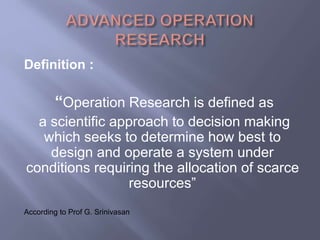
Definition : 
“Operation Research is defined as 
a scientific approach to decision making 
which seeks to determine how best to 
design and operate a system under 
conditions requiring the allocation of scarce 
resources” 
According to Prof G. Srinivasan
“Operation Research is a discipline that 
deals with the application of advanced 
analytical methods to help make better 
decisions” 
“Operations Research provides a set of 
algorithms that acts as tools for effective 
problem solving and decision making”
 Scheduling airlines, including both planes and crew. 
 Deciding the appropriate place to site new facilities 
such as a warehouse, factory or fire station. 
 Managing the flow of water from reservoirs. 
 Identifying possible future development paths for parts 
of the telecommunications industry. 
 Establishing the information needs and appropriate 
systems to supply them within the health service. 
 Identifying and understanding the strategies adopted 
by companies for their information systems.
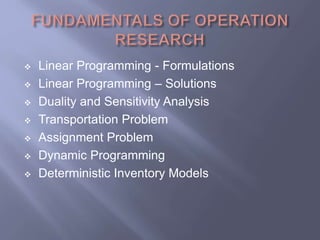
 Linear Programming - Formulations 
 Linear Programming – Solutions 
 Duality and Sensitivity Analysis 
 Transportation Problem 
 Assignment Problem 
 Dynamic Programming 
 Deterministic Inventory Models
 Simulation 
 Mathematical Optimization 
 Queuing Theory 
 Stochastic-Process Models 
 Markov Decision Processes 
 Decision Analysis 
 Linear Programming
A Markov process is a stochastic process 
(random process) in which the probability 
distribution of the current state is conditionally 
independent of the path of past states, a 
characteristic called the Markov property. 
Markov chain is a discrete-time stochastic 
process with the Markov property. 
Stochastic Process :- 
“ In probability theory a stochastic process is a 
collection of random variables representing the 
evolution of some system of random values over time.”
A stochastic process has the Markov property if 
the conditional property distribution of future 
states of the process (conditional on both past 
and present values) depends only upon the 
present state, and the future does not depend 
upon the past or not on the sequence of events 
that preceded it. A process with this property is 
called a Markov process.
 Andrey Markov produced the first results 
(1906) for these processes purely theoretically. 
 In 1917 practical application was made 
by Erlang to obtain formulas for call loss and 
waiting time in telephone networks.
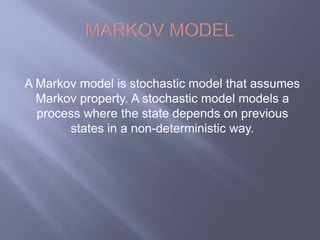
A Markov model is stochastic model that assumes 
Markov property. A stochastic model models a 
process where the state depends on previous 
states in a non-deterministic way.
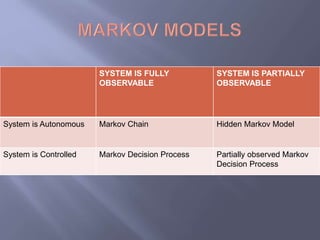
SYSTEM IS FULLY 
OBSERVABLE 
SYSTEM IS PARTIALLY 
OBSERVABLE 
System is Autonomous Markov Chain Hidden Markov Model 
System is Controlled Markov Decision Process Partially observed Markov 
Decision Process
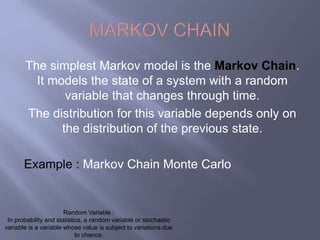
The simplest Markov model is the Markov Chain. 
It models the state of a system with a random 
variable that changes through time. 
The distribution for this variable depends only on 
the distribution of the previous state. 
Example : Markov Chain Monte Carlo 
Random Variable : 
In probability and statistics, a random variable or stochastic 
variable is a variable whose value is subject to variations due 
to chance.
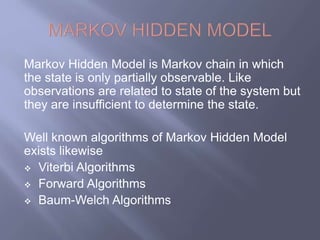
Markov Hidden Model is Markov chain in which 
the state is only partially observable. Like 
observations are related to state of the system but 
they are insufficient to determine the state. 
Well known algorithms of Markov Hidden Model 
exists likewise 
 Viterbi Algorithms 
 Forward Algorithms 
 Baum-Welch Algorithms
Monte Carlo started as a gambling place 
around 1950. The most famous casino known 
as Monte Carlo but it soon became a technical 
term for simulation of random processes. 
It’s a sample from distribution and to compute 
maximum mean. 
Markov Chain Monte Carlo soon inverted after 
ordinary Monte Carlo in 1953 at Los Alamos. 
Geyer in 1992 and Tierney in 1994 firstly 
started doing work on MCMC.
In Statistics , Markov Chain Monte Carlo ( 
MCMC) methods are a class of algorithms 
for sampling from a Probability distribution. 
Its also said to be sampling using the local 
information. 
The quality of the sample improves as a 
function of the number of steps. 
probability distribution is a probability to each measurable subset of the 
possible outcomes of a random experiment
MCMC methods are primarily used for 
calculating numerical approximation of multi-dimensional 
integrations , for example in 
Bayesian statistics,. 
 They are also used for generating samples that 
gradually populate the rare failure region 
in rare event sampling. 
 MCMC is generic problem solving technique. 
 Basically used for optimization and decision 
making. 
sampling is concerned with the selection of a subset of individuals 
from within a statistical population to estimate characteristics of the 
whole population

Advanced operation research

  • 1.
    Markov Model and Monte Carlo Model 10/21/2014 By : Eng. Sajid Ali 1
  • 2.
    Definition : “OperationResearch is defined as a scientific approach to decision making which seeks to determine how best to design and operate a system under conditions requiring the allocation of scarce resources” According to Prof G. Srinivasan
  • 3.
    “Operation Research isa discipline that deals with the application of advanced analytical methods to help make better decisions” “Operations Research provides a set of algorithms that acts as tools for effective problem solving and decision making”
  • 4.
     Scheduling airlines,including both planes and crew.  Deciding the appropriate place to site new facilities such as a warehouse, factory or fire station.  Managing the flow of water from reservoirs.  Identifying possible future development paths for parts of the telecommunications industry.  Establishing the information needs and appropriate systems to supply them within the health service.  Identifying and understanding the strategies adopted by companies for their information systems.
  • 5.
     Linear Programming- Formulations  Linear Programming – Solutions  Duality and Sensitivity Analysis  Transportation Problem  Assignment Problem  Dynamic Programming  Deterministic Inventory Models
  • 6.
     Simulation Mathematical Optimization  Queuing Theory  Stochastic-Process Models  Markov Decision Processes  Decision Analysis  Linear Programming
  • 7.
    A Markov processis a stochastic process (random process) in which the probability distribution of the current state is conditionally independent of the path of past states, a characteristic called the Markov property. Markov chain is a discrete-time stochastic process with the Markov property. Stochastic Process :- “ In probability theory a stochastic process is a collection of random variables representing the evolution of some system of random values over time.”
  • 8.
    A stochastic processhas the Markov property if the conditional property distribution of future states of the process (conditional on both past and present values) depends only upon the present state, and the future does not depend upon the past or not on the sequence of events that preceded it. A process with this property is called a Markov process.
  • 9.
     Andrey Markovproduced the first results (1906) for these processes purely theoretically.  In 1917 practical application was made by Erlang to obtain formulas for call loss and waiting time in telephone networks.
  • 10.
    A Markov modelis stochastic model that assumes Markov property. A stochastic model models a process where the state depends on previous states in a non-deterministic way.
  • 11.
    SYSTEM IS FULLY OBSERVABLE SYSTEM IS PARTIALLY OBSERVABLE System is Autonomous Markov Chain Hidden Markov Model System is Controlled Markov Decision Process Partially observed Markov Decision Process
  • 12.
    The simplest Markovmodel is the Markov Chain. It models the state of a system with a random variable that changes through time. The distribution for this variable depends only on the distribution of the previous state. Example : Markov Chain Monte Carlo Random Variable : In probability and statistics, a random variable or stochastic variable is a variable whose value is subject to variations due to chance.
  • 13.
    Markov Hidden Modelis Markov chain in which the state is only partially observable. Like observations are related to state of the system but they are insufficient to determine the state. Well known algorithms of Markov Hidden Model exists likewise  Viterbi Algorithms  Forward Algorithms  Baum-Welch Algorithms
  • 14.
    Monte Carlo startedas a gambling place around 1950. The most famous casino known as Monte Carlo but it soon became a technical term for simulation of random processes. It’s a sample from distribution and to compute maximum mean. Markov Chain Monte Carlo soon inverted after ordinary Monte Carlo in 1953 at Los Alamos. Geyer in 1992 and Tierney in 1994 firstly started doing work on MCMC.
  • 15.
    In Statistics ,Markov Chain Monte Carlo ( MCMC) methods are a class of algorithms for sampling from a Probability distribution. Its also said to be sampling using the local information. The quality of the sample improves as a function of the number of steps. probability distribution is a probability to each measurable subset of the possible outcomes of a random experiment
  • 16.
    MCMC methods areprimarily used for calculating numerical approximation of multi-dimensional integrations , for example in Bayesian statistics,.  They are also used for generating samples that gradually populate the rare failure region in rare event sampling.  MCMC is generic problem solving technique.  Basically used for optimization and decision making. sampling is concerned with the selection of a subset of individuals from within a statistical population to estimate characteristics of the whole population