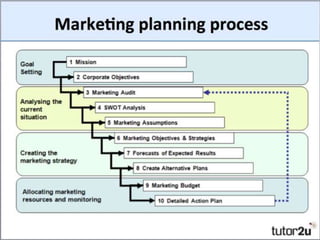
Marketing Management-UNIT 1
Recap
 Marketing is defined as an aggregate demand of
the potential buyers for a product or service –by
AMA
 Philip kotler defined market as an area of
potential exchange.
 AMA defined marketing as “the process of
planning and executing the conception, pricing,
promotion and distribution of ideas, goods and
services to create exchange that satisfy
individual and organizational goals.”
Philosophies/Concepts of Marketing
1. Product oriented marketing
2. Production oriented marketing
3. Sales oriented marketing
4. Customer oriented marketing
5. Social marketing
6. Green marketing
Functions of Marketing
I. Information research on customer’s needs and
wants
II. Merchandising product that satisfy customer’s
needs
III. Product planning and development
IV. Pricing
V. Promotion/Communication
VI. Physical Distribution/Selling
Types of Modern Marketing
 Viral Marketing: It is a marketing phenomenon
that facilitates and encourages people to pass
along a marketing message.
 Off the Internet viral marketing has been referred
to as “word-of-mouth,””creating a buzz,”
“leveraging the media,” network marketing.” But
on the Internet, for better or worse, it is called
‘viral marketing.”
 Example : Hotmail.com, Reliance Jio
Types of Modern Marketing
 Green /Environmental/ Ecological Marketing:
According to the American Marketing Association
(AMA), green marketing is the marketing of
products that are presumed to be
environmentally safe.
 Green marketing can appeal to a wide variety of
these issues: an item can save water, reduce
greenhouse gas emissions, cut toxic pollution,
clean indoor air, and/or be easily recyclable.
Types of Modern Marketing
 Social media marketing: It refers to the
process of gaining website traffic or attention
through social media sites.
 Consumer’s Online Brand Related Activities
(COBRAs) is another method used by
advertisers to promote their products. Activities
such as uploading a picture of your new
(anything) to Facebook are an example of
COBRA.
 Another technique of SMM is electronic Word of
Mouth (eWOM).
Types of Modern Marketing
 Internet/web/ online/ webvertising/ e-
Marketing:
It is referred to as the marketing (generally
promotion) of product or services over the
Internet. It also includes marketing via e-mail,
wireless media, Digital customer data and
electronic customer relationship management
(ECRM).
 It uses tools & techniques such as social media
marketing (SMM), local directory listing, and
targeted online sales promotions. Examples are
EBay, OLX etc.
Types of Modern Marketing
 Industrial Marketing (or Business to
Business marketing): It is the marketing of
goods & services by one business to another.
Industrial goods are those an industry uses to
produce an end product from one or more raw
materials.
Types of Modern Marketing
 Ecommerce (e-commerce) or electronic
Commerce: A subset of ebusiness, is the
purchasing, selling, and exchanging of goods
and services over computer networks (such as
the Internet) through which transactions or terms
of sales are performed electronically. Contrary to
popular belief, ecommerce is not just on the web.
 Ecommerce can be broken into four main
categories: B2B, B2C, C2B, and C2C.
4P’s or 5P’s of Marketing mix by
McCarthy
1. Product: refers to the item actually being sold.
2. Price: refers to the value that is put for a
product.
3. Place: refers to the point of sale.
4. Promotion: this refers to all the activities
undertaken to make the product or service
known to the user and trade.
5. Packaging: refers to all those activities related
to designing, evaluating and producing the
container for a product.
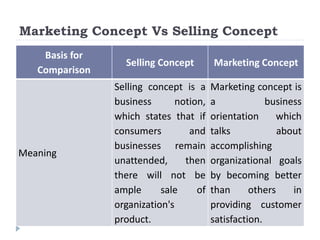
Marketing Concept Vs Selling Concept
Basis for
Comparison
Selling Concept Marketing Concept
Meaning
Selling concept is a
business notion,
which states that if
consumers and
businesses remain
unattended, then
there will not be
ample sale of
organization's
product.
Marketing concept is
a business
orientation which
talks about
accomplishing
organizational goals
by becoming better
than others in
providing customer
satisfaction.
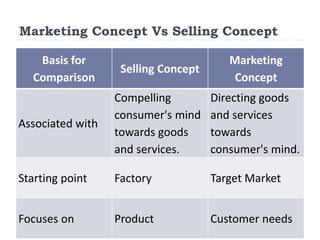
Marketing Concept Vs Selling Concept
Basis for
Comparison
Selling Concept
Marketing
Concept
Associated with
Compelling
consumer's mind
towards goods
and services.
Directing goods
and services
towards
consumer's mind.
Starting point Factory Target Market
Focuses on Product Customer needs
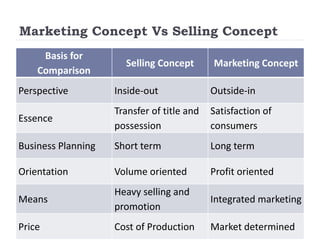
Marketing Concept Vs Selling Concept
Basis for
Comparison
Selling Concept Marketing Concept
Perspective Inside-out Outside-in
Essence
Transfer of title and
possession
Satisfaction of
consumers
Business Planning Short term Long term
Orientation Volume oriented Profit oriented
Means
Heavy selling and
promotion
Integrated marketing
Price Cost of Production Market determined
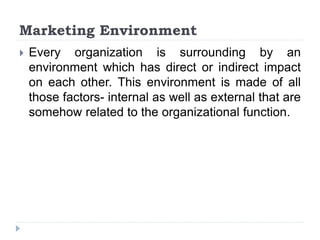
Marketing Environment
 Every organization is surrounding by an
environment which has direct or indirect impact
on each other. This environment is made of all
those factors- internal as well as external that are
somehow related to the organizational function.
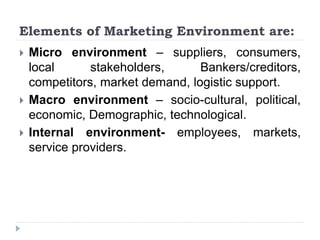
Elements of Marketing Environment are:
 Micro environment – suppliers, consumers,
local stakeholders, Bankers/creditors,
competitors, market demand, logistic support.
 Macro environment – socio-cultural, political,
economic, Demographic, technological.
 Internal environment- employees, markets,
service providers.
Marketing strategy
 It is a long-term, forward-looking approach and
an overall game plan of any organization or any
business with the fundamental goal of achieving
a sustainable competitive advantage by
understanding the needs and want of customers.
Strategic planning seeks to address
three deceptively simple questions,
specifically:
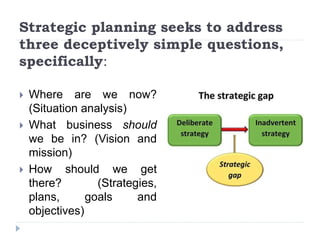
 Where are we now?
(Situation analysis)
 What business should
we be in? (Vision and
mission)
 How should we get
there? (Strategies,
plans, goals and
objectives)
Strategic analysis
tools and
techniques
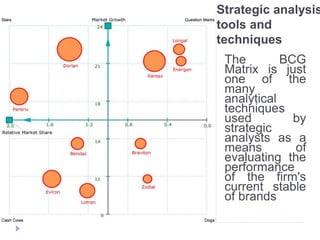
The BCG
Matrix is just
one of the
many
analytical
techniques
used by
strategic
analysts as a
means of
evaluating the
performance
of the firm's
current stable
of brands
Strategic analysis
tools and
techniques
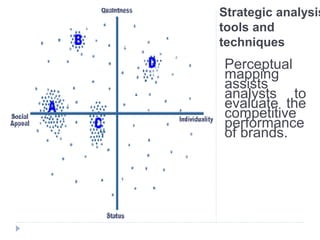
Perceptual
mapping
assists
analysts to
evaluate the
competitive
performance
of brands.
Strategic analysis
tools and
techniques
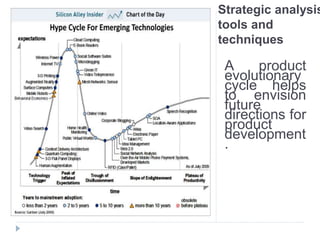
A product
evolutionary
cycle helps
to envision
future
directions for
product
development
.
Strategic analysis
tools and
techniques
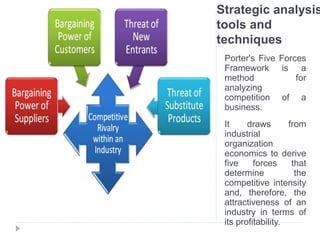
Porter's Five Forces
Framework is a
method for
analyzing
competition of a
business.
It draws from
industrial
organization
economics to derive
five forces that
determine the
competitive intensity
and, therefore, the
attractiveness of an
industry in terms of
its profitability.
Strategic analysis
tools and
techniques
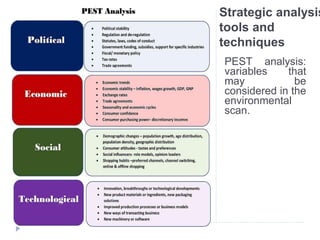
PEST analysis:
variables that
may be
considered in the
environmental
scan.
Strategic analysis
tools and
techniques
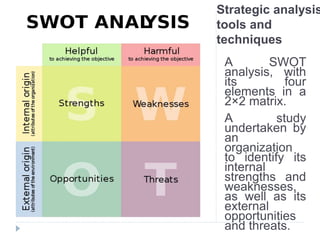
A SWOT
analysis, with
its four
elements in a
2×2 matrix.
A study
undertaken by
an
organization
to identify its
internal
strengths and
weaknesses,
as well as its
external
opportunities
and threats.
Marketing Information System (MIS)
 The marketing excellence achieved by a firm
bears a direct relationship to the way it manages
marketing information.
 Firms have develop MIS that provide
management with database related to the buyers
wants, preferences, demographic features,
vendors details, the price list of different
competitors so that this aid in taking accurate
and correct marketing decisions.
Advantage of MIS
1. Make available information related to external
as well as internal environment of the company
in order to enhance opportunities and build
defenses against threats.
2. Helps to sense the changing trends of the
market.
3. Provide valuable market intelligence.
4. Makes customers –oriented marketing mix
which is more relevant to the current needs of
the customer.
Advantage of MIS
5. Helps product innovations which are the results
of the firm’s knowledge of un-served market
needs.
6. Helps reduce product failures.
7. Helps in building customer relations.
8. Impart quality to all marketable decisions, the
quality of these decisions depends greatly on
the quality marketing information available to
decision maker.
Marketing Intelligence
 Marketing intelligence is different from MIS in
sense that it gives strategic “happening
information” quite often related to competitors’
activities.
 It furnishes information on change in market
conditions, changes in customer tastes and
consumption patterns, emerging marketing
strategies of competitors and emerging threat
and opportunities in the business.
 In many cases MIS is used to gather marketing
intelligence.
Marketing Intelligence
 Marketing managers collect marketing intelligence
by reading books, newspapers, and trade journal;
talking to customers, suppliers and distributers;
monitoring social media via online discussion
groups; blogs and chats.
 A company can motivate sales executives,
distributers, retailers and other intermediaries to
pass important intelligence and new market
developments.
Data Mining & Data warehousing
 Companies warehouse information into customer
databases, product databases, salesperson
databases and make them easily accessible to
decision makers.
 By hiring analysts skilled in statistical methods, they
can ‘mine’ the data and spot the un- served
customer needs and other useful information.
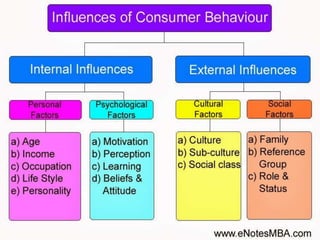
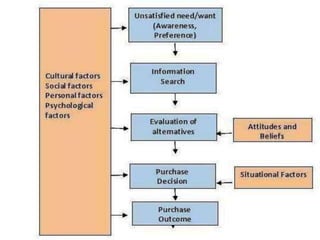
Understanding Consumer Markets/
Consumer’s Behaviour
 Analyzing consumer markets implies
understanding the consumer behaviour.
 It is the study of how customers select,
buy, use, and dispose off goods to satisfy
their needs and wants.
Market Research
 It is research into a market’s size and type of
customers who constitutes it.
Marketing Research
 It is a systematic gathering, recording and
analyzing the data about marketing problems to
facilitate marketing decision making.
Objectives/Marketing Research tells
about
 Who are customers?
 What they need and want?
 What are their buying motives?
 What to produce?
 What will be the price?
 What will be the promotional tool used?
 What will be the features, quality of the product?
 How can be the new markets for existing
product?
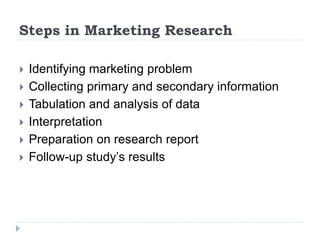
Steps in Marketing Research
 Identifying marketing problem
 Collecting primary and secondary information
 Tabulation and analysis of data
 Interpretation
 Preparation on research report
 Follow-up study’s results
Marketing Research is not used when the
1. Required information is already available
2. Decisions need to be made now
3. Organization can’t afford the research
4. Costs outweigh the value of the research

Marketing management recap unit 1

  • 1.
  • 2.
     Marketing isdefined as an aggregate demand of the potential buyers for a product or service –by AMA  Philip kotler defined market as an area of potential exchange.  AMA defined marketing as “the process of planning and executing the conception, pricing, promotion and distribution of ideas, goods and services to create exchange that satisfy individual and organizational goals.”
  • 3.
    Philosophies/Concepts of Marketing 1.Product oriented marketing 2. Production oriented marketing 3. Sales oriented marketing 4. Customer oriented marketing 5. Social marketing 6. Green marketing
  • 4.
    Functions of Marketing I.Information research on customer’s needs and wants II. Merchandising product that satisfy customer’s needs III. Product planning and development IV. Pricing V. Promotion/Communication VI. Physical Distribution/Selling
  • 5.
    Types of ModernMarketing  Viral Marketing: It is a marketing phenomenon that facilitates and encourages people to pass along a marketing message.  Off the Internet viral marketing has been referred to as “word-of-mouth,””creating a buzz,” “leveraging the media,” network marketing.” But on the Internet, for better or worse, it is called ‘viral marketing.”  Example : Hotmail.com, Reliance Jio
  • 6.
    Types of ModernMarketing  Green /Environmental/ Ecological Marketing: According to the American Marketing Association (AMA), green marketing is the marketing of products that are presumed to be environmentally safe.  Green marketing can appeal to a wide variety of these issues: an item can save water, reduce greenhouse gas emissions, cut toxic pollution, clean indoor air, and/or be easily recyclable.
  • 7.
    Types of ModernMarketing  Social media marketing: It refers to the process of gaining website traffic or attention through social media sites.  Consumer’s Online Brand Related Activities (COBRAs) is another method used by advertisers to promote their products. Activities such as uploading a picture of your new (anything) to Facebook are an example of COBRA.  Another technique of SMM is electronic Word of Mouth (eWOM).
  • 8.
    Types of ModernMarketing  Internet/web/ online/ webvertising/ e- Marketing: It is referred to as the marketing (generally promotion) of product or services over the Internet. It also includes marketing via e-mail, wireless media, Digital customer data and electronic customer relationship management (ECRM).  It uses tools & techniques such as social media marketing (SMM), local directory listing, and targeted online sales promotions. Examples are EBay, OLX etc.
  • 9.
    Types of ModernMarketing  Industrial Marketing (or Business to Business marketing): It is the marketing of goods & services by one business to another. Industrial goods are those an industry uses to produce an end product from one or more raw materials.
  • 10.
    Types of ModernMarketing  Ecommerce (e-commerce) or electronic Commerce: A subset of ebusiness, is the purchasing, selling, and exchanging of goods and services over computer networks (such as the Internet) through which transactions or terms of sales are performed electronically. Contrary to popular belief, ecommerce is not just on the web.  Ecommerce can be broken into four main categories: B2B, B2C, C2B, and C2C.
  • 11.
    4P’s or 5P’sof Marketing mix by McCarthy 1. Product: refers to the item actually being sold. 2. Price: refers to the value that is put for a product. 3. Place: refers to the point of sale. 4. Promotion: this refers to all the activities undertaken to make the product or service known to the user and trade. 5. Packaging: refers to all those activities related to designing, evaluating and producing the container for a product.
  • 12.
    Marketing Concept VsSelling Concept Basis for Comparison Selling Concept Marketing Concept Meaning Selling concept is a business notion, which states that if consumers and businesses remain unattended, then there will not be ample sale of organization's product. Marketing concept is a business orientation which talks about accomplishing organizational goals by becoming better than others in providing customer satisfaction.
  • 13.
    Marketing Concept VsSelling Concept Basis for Comparison Selling Concept Marketing Concept Associated with Compelling consumer's mind towards goods and services. Directing goods and services towards consumer's mind. Starting point Factory Target Market Focuses on Product Customer needs
  • 14.
    Marketing Concept VsSelling Concept Basis for Comparison Selling Concept Marketing Concept Perspective Inside-out Outside-in Essence Transfer of title and possession Satisfaction of consumers Business Planning Short term Long term Orientation Volume oriented Profit oriented Means Heavy selling and promotion Integrated marketing Price Cost of Production Market determined
  • 15.
    Marketing Environment  Everyorganization is surrounding by an environment which has direct or indirect impact on each other. This environment is made of all those factors- internal as well as external that are somehow related to the organizational function.
  • 16.
    Elements of MarketingEnvironment are:  Micro environment – suppliers, consumers, local stakeholders, Bankers/creditors, competitors, market demand, logistic support.  Macro environment – socio-cultural, political, economic, Demographic, technological.  Internal environment- employees, markets, service providers.
  • 17.
    Marketing strategy  Itis a long-term, forward-looking approach and an overall game plan of any organization or any business with the fundamental goal of achieving a sustainable competitive advantage by understanding the needs and want of customers.
  • 18.
    Strategic planning seeksto address three deceptively simple questions, specifically:  Where are we now? (Situation analysis)  What business should we be in? (Vision and mission)  How should we get there? (Strategies, plans, goals and objectives)
  • 19.
    Strategic analysis tools and techniques TheBCG Matrix is just one of the many analytical techniques used by strategic analysts as a means of evaluating the performance of the firm's current stable of brands
  • 20.
    Strategic analysis tools and techniques Perceptual mapping assists analyststo evaluate the competitive performance of brands.
  • 21.
    Strategic analysis tools and techniques Aproduct evolutionary cycle helps to envision future directions for product development .
  • 22.
    Strategic analysis tools and techniques Porter'sFive Forces Framework is a method for analyzing competition of a business. It draws from industrial organization economics to derive five forces that determine the competitive intensity and, therefore, the attractiveness of an industry in terms of its profitability.
  • 23.
    Strategic analysis tools and techniques PESTanalysis: variables that may be considered in the environmental scan.
  • 24.
    Strategic analysis tools and techniques ASWOT analysis, with its four elements in a 2×2 matrix. A study undertaken by an organization to identify its internal strengths and weaknesses, as well as its external opportunities and threats.
  • 26.
    Marketing Information System(MIS)  The marketing excellence achieved by a firm bears a direct relationship to the way it manages marketing information.  Firms have develop MIS that provide management with database related to the buyers wants, preferences, demographic features, vendors details, the price list of different competitors so that this aid in taking accurate and correct marketing decisions.
  • 27.
    Advantage of MIS 1.Make available information related to external as well as internal environment of the company in order to enhance opportunities and build defenses against threats. 2. Helps to sense the changing trends of the market. 3. Provide valuable market intelligence. 4. Makes customers –oriented marketing mix which is more relevant to the current needs of the customer.
  • 28.
    Advantage of MIS 5.Helps product innovations which are the results of the firm’s knowledge of un-served market needs. 6. Helps reduce product failures. 7. Helps in building customer relations. 8. Impart quality to all marketable decisions, the quality of these decisions depends greatly on the quality marketing information available to decision maker.
  • 29.
    Marketing Intelligence  Marketingintelligence is different from MIS in sense that it gives strategic “happening information” quite often related to competitors’ activities.  It furnishes information on change in market conditions, changes in customer tastes and consumption patterns, emerging marketing strategies of competitors and emerging threat and opportunities in the business.  In many cases MIS is used to gather marketing intelligence.
  • 30.
    Marketing Intelligence  Marketingmanagers collect marketing intelligence by reading books, newspapers, and trade journal; talking to customers, suppliers and distributers; monitoring social media via online discussion groups; blogs and chats.  A company can motivate sales executives, distributers, retailers and other intermediaries to pass important intelligence and new market developments.
  • 31.
    Data Mining &Data warehousing  Companies warehouse information into customer databases, product databases, salesperson databases and make them easily accessible to decision makers.  By hiring analysts skilled in statistical methods, they can ‘mine’ the data and spot the un- served customer needs and other useful information.
  • 32.
    Understanding Consumer Markets/ Consumer’sBehaviour  Analyzing consumer markets implies understanding the consumer behaviour.  It is the study of how customers select, buy, use, and dispose off goods to satisfy their needs and wants.
  • 36.
    Market Research  Itis research into a market’s size and type of customers who constitutes it.
  • 37.
    Marketing Research  Itis a systematic gathering, recording and analyzing the data about marketing problems to facilitate marketing decision making.
  • 38.
    Objectives/Marketing Research tells about Who are customers?  What they need and want?  What are their buying motives?  What to produce?  What will be the price?  What will be the promotional tool used?  What will be the features, quality of the product?  How can be the new markets for existing product?
  • 39.
    Steps in MarketingResearch  Identifying marketing problem  Collecting primary and secondary information  Tabulation and analysis of data  Interpretation  Preparation on research report  Follow-up study’s results
  • 40.
    Marketing Research isnot used when the 1. Required information is already available 2. Decisions need to be made now 3. Organization can’t afford the research 4. Costs outweigh the value of the research