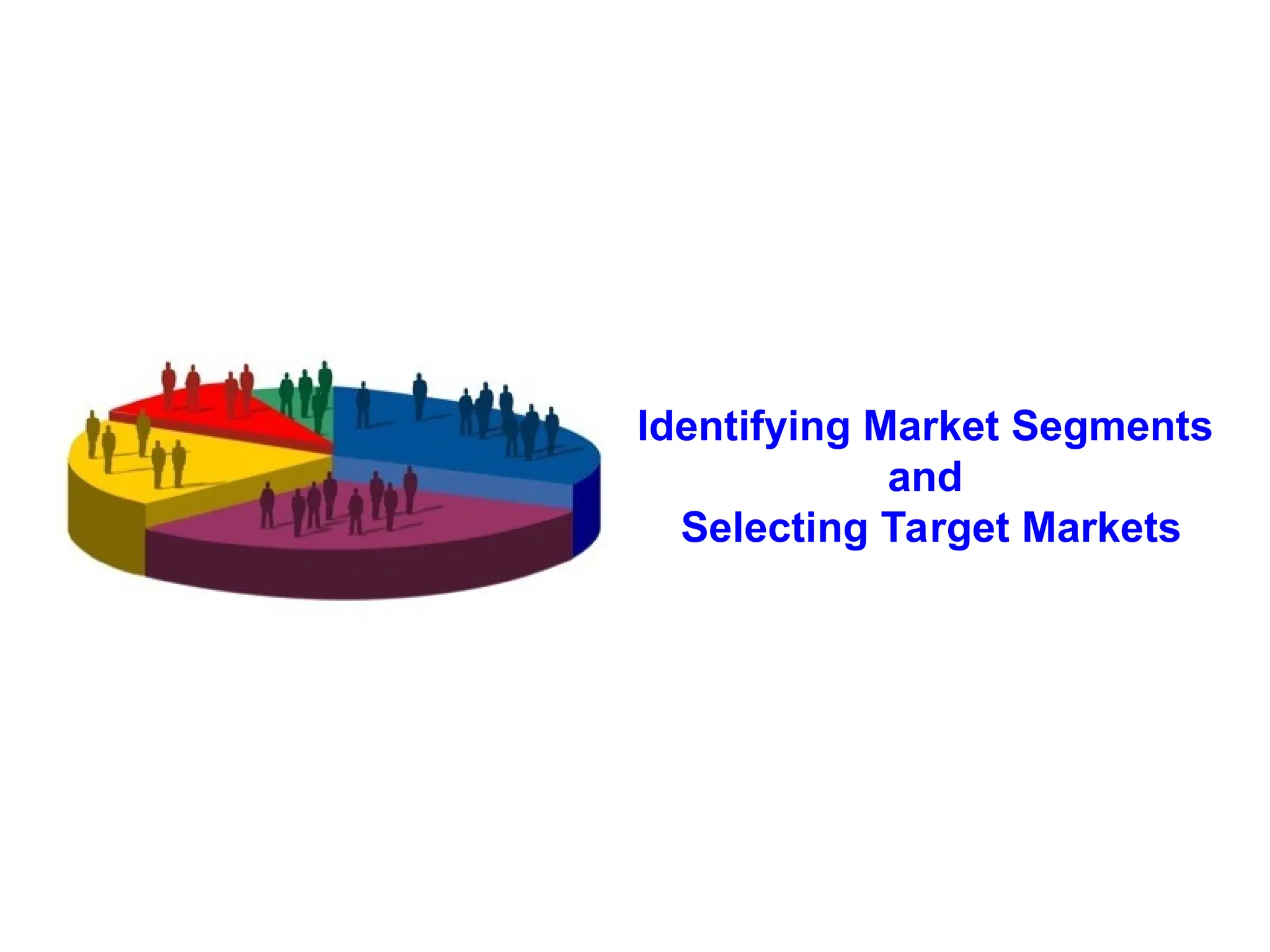
Identifying Market Segments
and
Selecting Target Markets
“
“Don’t buy
Don’t buy
market share.
market share.
Figure out
Figure out
how to earn it.”
how to earn it.”
Kotler
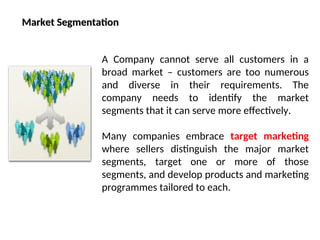
Market Segmentation
Market Segmentation
A Company cannot serve all customers in a
broad market – customers are too numerous
and diverse in their requirements. The
company needs to identify the market
segments that it can serve more effectively.
Many companies embrace target marketing
where sellers distinguish the major market
segments, target one or more of those
segments, and develop products and marketing
programmes tailored to each.
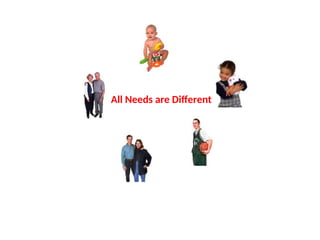
All Needs are Different
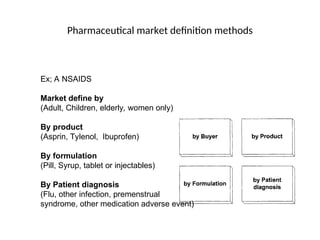
Pharmaceutical market definition methods
Ex; A NSAIDS
Market define by
(Adult, Children, elderly, women only)
By product
(Asprin, Tylenol, Ibuprofen)
By formulation
(Pill, Syrup, tablet or injectables)
By Patient diagnosis
(Flu, other infection, premenstrual
syndrome, other medication adverse event)
Market Segmentation
Target marketing requires three steps:
1.Identify and profile distinct group of buyers
who might require separate products or
marketing mixes – market segmentation.
2. Select one or more market segments to
enter – market targeting.
3. Establish and communicate the products’ key
distinctive benefits to the target
market – market positioning
The marketer does not create the segments; the marketer’s task is
to identify the segments and decide which one to target.
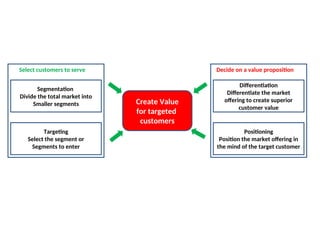
Select customers to serve Decide on a value proposition
Segmentation
Divide the total market into
Smaller segments
Targeting
Select the segment or
Segments to enter
Differentiation
Differentiate the market
offering to create superior
customer value
Positioning
Position the market offering in
the mind of the target customer
Create Value
for targeted
customers
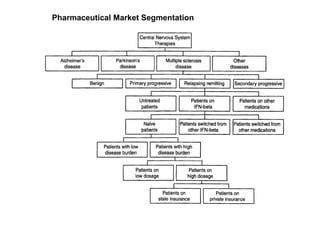
Pharmaceutical Market Segmentation
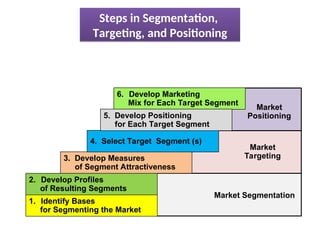
1. Identify Bases
for Segmenting the Market
2. Develop Profiles
of Resulting Segments
3. Develop Measures
of Segment Attractiveness
4. Select Target Segment (s)
6. Develop Marketing
Mix for Each Target Segment
5. Develop Positioning
for Each Target Segment
Market Segmentation
Market
Targeting
Market
Positioning
Steps in Segmentation,
Targeting, and Positioning
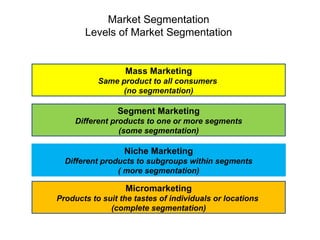
Mass Marketing
Same product to all consumers
(no segmentation)
Micromarketing
Products to suit the tastes of individuals or locations
(complete segmentation)
Segment Marketing
Different products to one or more segments
(some segmentation)
Niche Marketing
Different products to subgroups within segments
( more segmentation)
Market Segmentation
Levels of Market Segmentation
Market Segmentation
Market Segmentation
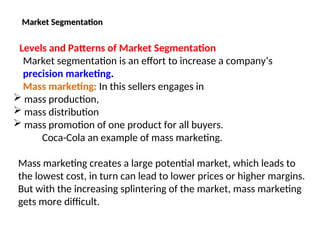
Levels and Patterns of Market Segmentation
Market segmentation is an effort to increase a company’s
precision marketing.
Mass marketing: In this sellers engages in
 mass production,
 mass distribution
 mass promotion of one product for all buyers.
Coca-Cola an example of mass marketing.
Mass marketing creates a large potential market, which leads to
the lowest cost, in turn can lead to lower prices or higher margins.
But with the increasing splintering of the market, mass marketing
gets more difficult.
Market Segmentation Four levels of marketing:
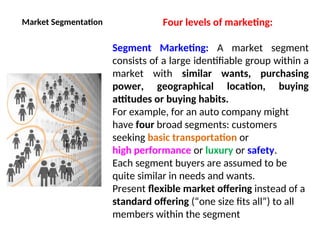
Segment Marketing: A market segment
consists of a large identifiable group within a
market with similar wants, purchasing
power, geographical location, buying
attitudes or buying habits.
For example, for an auto company might
have four broad segments: customers
seeking basic transportation or
high performance or luxury or safety.
Each segment buyers are assumed to be
quite similar in needs and wants.
Present flexible market offering instead of a
standard offering (“one size fits all”) to all
members within the segment
Market Segmentation
Four levels of marketing:
Benefits of Segment Marketing are:
 The company can create more fine tuned product or services
offering and price it appropriately for target audience
 Choice of distribution channel and communication channel
becomes much easier
The company also may face fewer competitions in a
particular segment.
Market Segmentation
Market Segmentation
Four levels of marketing:
Niche Marketing: A niche is more narrowly defined group,
typically a small market whose needs are not well served.
Marketers usually identify niches by dividing a segment into sub
segments or defining a group seeking a distinctive mix of
benefits. Niches are fairly small and attract very few
competitors. Large companies loose pieces of their market to
nichers. Niche marketers understand their customers so well
that customer’s willingly pay a premium.
Market Segmentation
Market Segmentation
Attractive niches are characterized as:
Customers in the niche have a distinct set of needs
They will pay a premium to the firm that best satisfies their
needs
Niche is not likely to attract other competitors
The nichers gain certain economies trough specialization
The niche has size, profit and growth potential
The low cost of setting up shop on the Internet is a key factor on
making it more profitable to serve even more seemingly
miniscule niches.
Market Segmentation
Four levels of marketing:
Local Marketing: Marketing programmes being
tailored to the needs and wants of local customer
groups – trading areas, neighborhood, individual
stores. E.g. Many banks have NRI branches in Kerala
Disadvantages of local marketing are – it drives up
the manufacturing and marketing cost by reducing
the economies of scale, logistical problems become
magnified and a brands overall image may be diluted
if the product and message differ in different
localities.
Market Segmentation
Individual Marketing:
Ultimate level of marketing “segment of one”, “customized
marketing”, “one-to-one marketing”. Tailors, cobblers etc. B2B
marketing today is customized. Mass customization is the ability
to prepare on a mass basis individually designed products and
communication to meet each customer’s requirements. New
technologies such as computers, Internet, databases, robotic
production, email, fax etc. permit companies to adopt mass
customization.
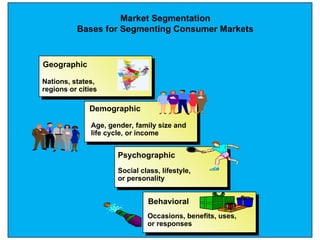
Nations, states,
regions or cities
Geographic
Demographic
Age, gender, family size and
life cycle, or income
Psychographic
Social class, lifestyle,
or personality
Behavioral
Occasions, benefits, uses,
or responses
Market Segmentation
Bases for Segmenting Consumer Markets
SEGEMENTING CONSUMER AND BUSINESS MARKETS
Basis for segmenting consumer markets:
Two broad groups of variables are used to segment consumer markets.
Some segments by looking at consumer characteristics:
demographic, geographic, and psychographic. Then they examine whether
These customer segments exhibit different needs or product responses.
Methods of Segmentation
A. Geographic segmentation: The company can operate in one or few
geographic areas or operate in all but pay attention to local variations
Geographic
Region Mountain, North East West South
City or metro size Class1,Class2, Class3, Class4, Metros
Density Urban /rural
Climate Northern, southern
SEGEMENTING CONSUMER AND BUSINESS MARKETS
Methods of Segmentation
B. Demographic segmentation: in this the market is divided into groups on the
basis of variables such as age, family, size, life cycle, gender, income, occupation,
education, religion, race, generation, nationality, social class. These variables are
the most popular basis for distinguishing customer groups. One reason is that
Consumer wants, preferences, usage rates are often associated with demographic
variables.
Another reason is that demographic variables are easier to measure even when the
target market is defined in non-demographic terms. The link back to demographic
characteristics is needed in order to estimate the size of the target market and the
media that should be used to reach it efficiently.
Age and life cycle stage: consumer wants and abilities change with age.
Nevertheless age and life cycle can be tricky variables.
Gender: gender segmentation has been applied to clothing hairstyling
cosmetics and magazines. Other marketers also noticed opportunity for
gender segmentation for e.g. the cigarette market where brands like Virginia
slims was launched to reinforce female image.
Income: it is a long standing practice in such product and service categories
e.g. Automobile, clothing and cosmetic and travel.
Generation:
Cohort segmentation: cohorts are groups of people who share experiences of
major external events that have deeply affected their attitudes and
preferences. Members of cohort groups feel the bonding with each other for
having shared the same major experiences. Advertising to a cohort group
should be done using icons and images prominent in their experiences.
Social Class: has a strong influence on preference in cars clothing home
furnishing, leisure activities reading habits and retailers. The taste of social
class can change with years.
C. Psychographic segmentation:
Buyers are divided into different groups based on personality and values.
People within the same demographic group can exhibit very different
psychographic profiles.
Lifestyle: people generally exhibit more lifestyle than are suggested by
social classes generally the goods they consume express their lifestyle such
as cosmetics, alcoholic beverages, furniture etc.
Personality: Marketers can use personality variables to segment markets.
They endow their products with brand personalities that correspond to
consumer personalities.
Values: some marketers segment by core values, the belief systems that
underlie consumer attitudes and behaviors. Core values go much deeper
than behavior or attitude and determine at a basic level people’s choices
and desires over long term. Marketers who segment by values believe that
by appealing to people’s inner selves it is possible to influence their outer
selves- their purchase behavior.
D. Behavioral Segmentation
Divides the market by observable purchase behaviors:
Occasions: Regulars , Special
Benefits: Quality, service, economy, speed
User Status: Nonuser, Ex-User, potential user, First time
Usage rate: Light , Medium, heavy
Loyalty Status: None, Medium, Strong, Absolute
Readiness stage: Unaware, Aware, Informed, Interested
Attitude towards product: Enthusiastic, Positive,
Indifferent, Negative, Hostile
Loyal status: 4 groups
1.Hard-core loyals – one brand all the time
2.Split loyals – loyal to 2 or 3 brands
3.Shifting loyals – consumers who shift from one brand to another
4.Switchers – no loyalty to any brand
Markets
•Brand loyal markets – high % of hard-core brand loyal buyers
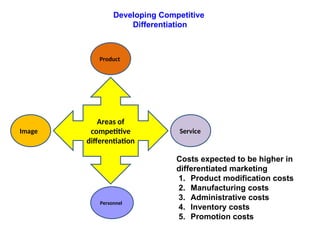
Areas of
competitive
differentiation
Developing Competitive
Differentiation
Product
Image Service
Personnel
Costs expected to be higher in
differentiated marketing
1. Product modification costs
2. Manufacturing costs
3. Administrative costs
4. Inventory costs
5. Promotion costs
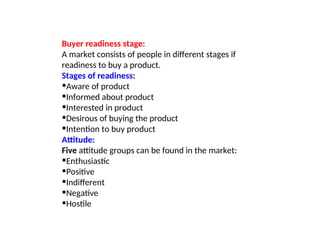
Buyer readiness stage:
A market consists of people in different stages if
readiness to buy a product.
Stages of readiness:
•Aware of product
•Informed about product
•Interested in product
•Desirous of buying the product
•Intention to buy product
Attitude:
Five attitude groups can be found in the market:
•Enthusiastic
•Positive
•Indifferent
•Negative
•Hostile
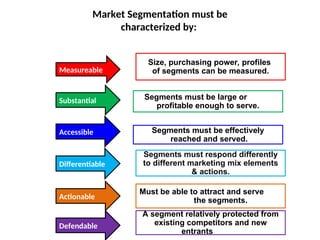
Market Segmentation must be
characterized by:
Measureable
Substantial
Accessible
Differentiable
Actionable
Size, purchasing power, profiles
of segments can be measured.
Segments must be large or
profitable enough to serve.
Segments must respond differently
to different marketing mix elements
& actions.
Must be able to attract and serve
the segments.
Segments must be effectively
reached and served.
Defendable
A segment relatively protected from
existing competitors and new
entrants
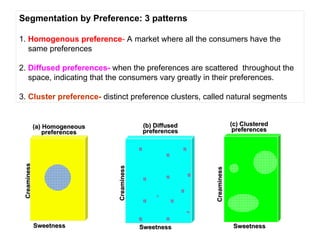
Segmentation by Preference: 3 patterns
1. Homogenous preference- A market where all the consumers have the
same preferences
2. Diffused preferences- when the preferences are scattered throughout the
space, indicating that the consumers vary greatly in their preferences.
3. Cluster preference- distinct preference clusters, called natural segments
(a) Homogeneous
(a) Homogeneous
preferences
preferences
Sweetness
Sweetness
Creaminess
Creaminess
(b) Diffused
(b) Diffused
preferences
preferences
Creaminess
Creaminess
Sweetness
Sweetness
(c) Clustered
(c) Clustered
preferences
preferences
Creaminess
Creaminess
Sweetness
Sweetness
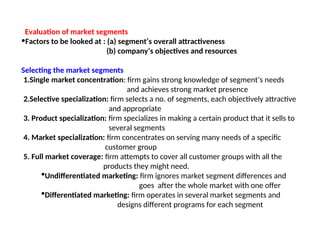
Evaluation of market segments
•Factors to be looked at : (a) segment’s overall attractiveness
(b) company’s objectives and resources
Selecting the market segments
1.Single market concentration: firm gains strong knowledge of segment’s needs
and achieves strong market presence
2.Selective specialization: firm selects a no. of segments, each objectively attractive
and appropriate
3. Product specialization: firm specializes in making a certain product that it sells to
several segments
4. Market specialization: firm concentrates on serving many needs of a specific
customer group
5. Full market coverage: firm attempts to cover all customer groups with all the
products they might need.
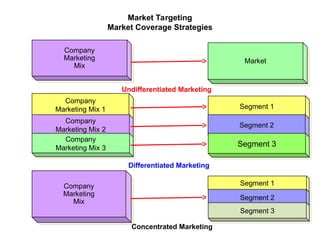
Undifferentiated marketing: firm ignores market segment differences and
goes after the whole market with one offer
Differentiated marketing: firm operates in several market segments and
designs different programs for each segment
Market Targeting
Market Coverage Strategies
Company
Marketing
Mix
Market
Company
Marketing Mix 1
Company
Marketing Mix 2
Company
Marketing Mix 3
Segment 1
Segment 2
Segment 3
Company
Marketing
Mix
Segment 1
Segment 2
Segment 3
Undifferentiated Marketing
Differentiated Marketing
Concentrated Marketing
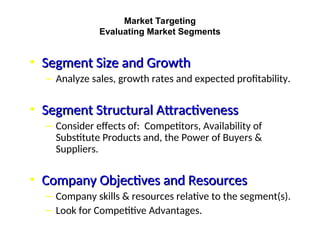
• Segment Size and Growth
Segment Size and Growth
– Analyze sales, growth rates and expected profitability.
• Segment Structural Attractiveness
Segment Structural Attractiveness
– Consider effects of: Competitors, Availability of
Substitute Products and, the Power of Buyers &
Suppliers.
• Company Objectives and Resources
Company Objectives and Resources
– Company skills & resources relative to the segment(s).
– Look for Competitive Advantages.
Market Targeting
Evaluating Market Segments
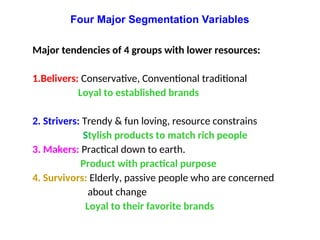
Major tendencies of 4 groups with lower resources:
1.Belivers: Conservative, Conventional traditional
Loyal to established brands
2. Strivers: Trendy & fun loving, resource constrains
Stylish products to match rich people
3. Makers: Practical down to earth.
Product with practical purpose
4. Survivors: Elderly, passive people who are concerned
about change
Loyal to their favorite brands
Four Major Segmentation Variables
Four major segmentation variables
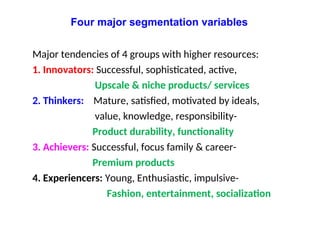
Major tendencies of 4 groups with higher resources:
1. Innovators: Successful, sophisticated, active,
Upscale & niche products/ services
2. Thinkers: Mature, satisfied, motivated by ideals,
value, knowledge, responsibility-
Product durability, functionality
3. Achievers: Successful, focus family & career-
Premium products
4. Experiencers: Young, Enthusiastic, impulsive-
Fashion, entertainment, socialization
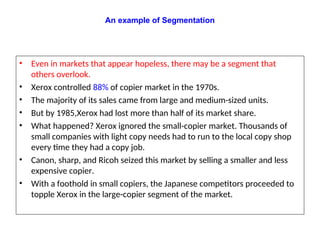
• Even in markets that appear hopeless, there may be a segment that
others overlook.
• Xerox controlled 88% of copier market in the 1970s.
• The majority of its sales came from large and medium-sized units.
• But by 1985,Xerox had lost more than half of its market share.
• What happened? Xerox ignored the small-copier market. Thousands of
small companies with light copy needs had to run to the local copy shop
every time they had a copy job.
• Canon, sharp, and Ricoh seized this market by selling a smaller and less
expensive copier.
• With a foothold in small copiers, the Japanese competitors proceeded to
topple Xerox in the large-copier segment of the market.
An example of Segmentation
1. According to Age / Sex / Environment
Pediatric diseases
Geriatric diseases
Gynecological disorders
Tropical diseases
Occupational diseases
2. According to System / Organs
Cardiovascular diseases
Digestive disorders
Musculo-skeletal disorders
Hepatic diseases
Renal diseases
3. According to cause
Due to micro-organisms
Communicable diseases
Nutritional deficiency diseases
Allergic disorders
Auto-immune diseases
Hereditary disease
Diseases caused by accidents / trauma
Iatrogenic diseases
Nosocomial diseases
4.According to Symptom Picture
Acute diseases
Chronic diseases
Degenerative diseases
Psychosomatic diseases
Pseudo-diseases e.g. malingering.
WHAT IS A MARKET SEGMENT
A market segment is a group of actual or potential
customers who can be expected to respond in
approximately the same way to a given offer.
e.g. GP
Pediatrician
Ob/Gyn
(also asthmatics, arthritics etc.)
An attractive market segment must be
 MEASURABLE
 ACCESSIBLE
 PROFITABLE
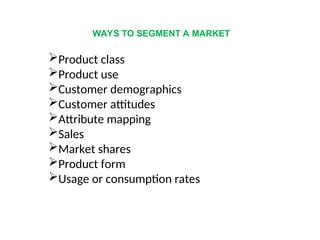
WAYS TO SEGMENT A MARKET
Product class
Product use
Customer demographics
Customer attitudes
Attribute mapping
Sales
Market shares
Product form
Usage or consumption rates
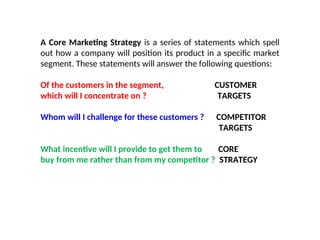
A Core Marketing Strategy is a series of statements which spell
out how a company will position its product in a specific market
segment. These statements will answer the following questions:
Of the customers in the segment, CUSTOMER
which will I concentrate on ? TARGETS
Whom will I challenge for these customers ? COMPETITOR
TARGETS
What incentive will I provide to get them to CORE
buy from me rather than from my competitor ? STRATEGY

Market segmentation in pharmaceuticals I

  • 1.
  • 2.
    “ “Don’t buy Don’t buy marketshare. market share. Figure out Figure out how to earn it.” how to earn it.” Kotler
  • 3.
    Market Segmentation Market Segmentation ACompany cannot serve all customers in a broad market – customers are too numerous and diverse in their requirements. The company needs to identify the market segments that it can serve more effectively. Many companies embrace target marketing where sellers distinguish the major market segments, target one or more of those segments, and develop products and marketing programmes tailored to each.
  • 4.
    All Needs areDifferent
  • 5.
    Pharmaceutical market definitionmethods Ex; A NSAIDS Market define by (Adult, Children, elderly, women only) By product (Asprin, Tylenol, Ibuprofen) By formulation (Pill, Syrup, tablet or injectables) By Patient diagnosis (Flu, other infection, premenstrual syndrome, other medication adverse event)
  • 6.
    Market Segmentation Target marketingrequires three steps: 1.Identify and profile distinct group of buyers who might require separate products or marketing mixes – market segmentation. 2. Select one or more market segments to enter – market targeting. 3. Establish and communicate the products’ key distinctive benefits to the target market – market positioning The marketer does not create the segments; the marketer’s task is to identify the segments and decide which one to target.
  • 7.
    Select customers toserve Decide on a value proposition Segmentation Divide the total market into Smaller segments Targeting Select the segment or Segments to enter Differentiation Differentiate the market offering to create superior customer value Positioning Position the market offering in the mind of the target customer Create Value for targeted customers
  • 8.
  • 9.
    1. Identify Bases forSegmenting the Market 2. Develop Profiles of Resulting Segments 3. Develop Measures of Segment Attractiveness 4. Select Target Segment (s) 6. Develop Marketing Mix for Each Target Segment 5. Develop Positioning for Each Target Segment Market Segmentation Market Targeting Market Positioning Steps in Segmentation, Targeting, and Positioning
  • 10.
    Mass Marketing Same productto all consumers (no segmentation) Micromarketing Products to suit the tastes of individuals or locations (complete segmentation) Segment Marketing Different products to one or more segments (some segmentation) Niche Marketing Different products to subgroups within segments ( more segmentation) Market Segmentation Levels of Market Segmentation
  • 11.
    Market Segmentation Market Segmentation Levelsand Patterns of Market Segmentation Market segmentation is an effort to increase a company’s precision marketing. Mass marketing: In this sellers engages in  mass production,  mass distribution  mass promotion of one product for all buyers. Coca-Cola an example of mass marketing. Mass marketing creates a large potential market, which leads to the lowest cost, in turn can lead to lower prices or higher margins. But with the increasing splintering of the market, mass marketing gets more difficult.
  • 12.
    Market Segmentation Fourlevels of marketing: Segment Marketing: A market segment consists of a large identifiable group within a market with similar wants, purchasing power, geographical location, buying attitudes or buying habits. For example, for an auto company might have four broad segments: customers seeking basic transportation or high performance or luxury or safety. Each segment buyers are assumed to be quite similar in needs and wants. Present flexible market offering instead of a standard offering (“one size fits all”) to all members within the segment
  • 13.
    Market Segmentation Four levelsof marketing: Benefits of Segment Marketing are:  The company can create more fine tuned product or services offering and price it appropriately for target audience  Choice of distribution channel and communication channel becomes much easier The company also may face fewer competitions in a particular segment.
  • 14.
    Market Segmentation Market Segmentation Fourlevels of marketing: Niche Marketing: A niche is more narrowly defined group, typically a small market whose needs are not well served. Marketers usually identify niches by dividing a segment into sub segments or defining a group seeking a distinctive mix of benefits. Niches are fairly small and attract very few competitors. Large companies loose pieces of their market to nichers. Niche marketers understand their customers so well that customer’s willingly pay a premium.
  • 15.
    Market Segmentation Market Segmentation Attractiveniches are characterized as: Customers in the niche have a distinct set of needs They will pay a premium to the firm that best satisfies their needs Niche is not likely to attract other competitors The nichers gain certain economies trough specialization The niche has size, profit and growth potential The low cost of setting up shop on the Internet is a key factor on making it more profitable to serve even more seemingly miniscule niches.
  • 16.
    Market Segmentation Four levelsof marketing: Local Marketing: Marketing programmes being tailored to the needs and wants of local customer groups – trading areas, neighborhood, individual stores. E.g. Many banks have NRI branches in Kerala Disadvantages of local marketing are – it drives up the manufacturing and marketing cost by reducing the economies of scale, logistical problems become magnified and a brands overall image may be diluted if the product and message differ in different localities.
  • 17.
    Market Segmentation Individual Marketing: Ultimatelevel of marketing “segment of one”, “customized marketing”, “one-to-one marketing”. Tailors, cobblers etc. B2B marketing today is customized. Mass customization is the ability to prepare on a mass basis individually designed products and communication to meet each customer’s requirements. New technologies such as computers, Internet, databases, robotic production, email, fax etc. permit companies to adopt mass customization.
  • 18.
    Nations, states, regions orcities Geographic Demographic Age, gender, family size and life cycle, or income Psychographic Social class, lifestyle, or personality Behavioral Occasions, benefits, uses, or responses Market Segmentation Bases for Segmenting Consumer Markets
  • 19.
    SEGEMENTING CONSUMER ANDBUSINESS MARKETS Basis for segmenting consumer markets: Two broad groups of variables are used to segment consumer markets. Some segments by looking at consumer characteristics: demographic, geographic, and psychographic. Then they examine whether These customer segments exhibit different needs or product responses. Methods of Segmentation A. Geographic segmentation: The company can operate in one or few geographic areas or operate in all but pay attention to local variations Geographic Region Mountain, North East West South City or metro size Class1,Class2, Class3, Class4, Metros Density Urban /rural Climate Northern, southern
  • 20.
    SEGEMENTING CONSUMER ANDBUSINESS MARKETS Methods of Segmentation B. Demographic segmentation: in this the market is divided into groups on the basis of variables such as age, family, size, life cycle, gender, income, occupation, education, religion, race, generation, nationality, social class. These variables are the most popular basis for distinguishing customer groups. One reason is that Consumer wants, preferences, usage rates are often associated with demographic variables. Another reason is that demographic variables are easier to measure even when the target market is defined in non-demographic terms. The link back to demographic characteristics is needed in order to estimate the size of the target market and the media that should be used to reach it efficiently.
  • 21.
    Age and lifecycle stage: consumer wants and abilities change with age. Nevertheless age and life cycle can be tricky variables. Gender: gender segmentation has been applied to clothing hairstyling cosmetics and magazines. Other marketers also noticed opportunity for gender segmentation for e.g. the cigarette market where brands like Virginia slims was launched to reinforce female image. Income: it is a long standing practice in such product and service categories e.g. Automobile, clothing and cosmetic and travel. Generation: Cohort segmentation: cohorts are groups of people who share experiences of major external events that have deeply affected their attitudes and preferences. Members of cohort groups feel the bonding with each other for having shared the same major experiences. Advertising to a cohort group should be done using icons and images prominent in their experiences. Social Class: has a strong influence on preference in cars clothing home furnishing, leisure activities reading habits and retailers. The taste of social class can change with years.
  • 22.
    C. Psychographic segmentation: Buyersare divided into different groups based on personality and values. People within the same demographic group can exhibit very different psychographic profiles. Lifestyle: people generally exhibit more lifestyle than are suggested by social classes generally the goods they consume express their lifestyle such as cosmetics, alcoholic beverages, furniture etc. Personality: Marketers can use personality variables to segment markets. They endow their products with brand personalities that correspond to consumer personalities. Values: some marketers segment by core values, the belief systems that underlie consumer attitudes and behaviors. Core values go much deeper than behavior or attitude and determine at a basic level people’s choices and desires over long term. Marketers who segment by values believe that by appealing to people’s inner selves it is possible to influence their outer selves- their purchase behavior.
  • 23.
    D. Behavioral Segmentation Dividesthe market by observable purchase behaviors: Occasions: Regulars , Special Benefits: Quality, service, economy, speed User Status: Nonuser, Ex-User, potential user, First time Usage rate: Light , Medium, heavy Loyalty Status: None, Medium, Strong, Absolute Readiness stage: Unaware, Aware, Informed, Interested Attitude towards product: Enthusiastic, Positive, Indifferent, Negative, Hostile
  • 24.
    Loyal status: 4groups 1.Hard-core loyals – one brand all the time 2.Split loyals – loyal to 2 or 3 brands 3.Shifting loyals – consumers who shift from one brand to another 4.Switchers – no loyalty to any brand Markets •Brand loyal markets – high % of hard-core brand loyal buyers
  • 25.
    Areas of competitive differentiation Developing Competitive Differentiation Product ImageService Personnel Costs expected to be higher in differentiated marketing 1. Product modification costs 2. Manufacturing costs 3. Administrative costs 4. Inventory costs 5. Promotion costs
  • 26.
    Buyer readiness stage: Amarket consists of people in different stages if readiness to buy a product. Stages of readiness: •Aware of product •Informed about product •Interested in product •Desirous of buying the product •Intention to buy product Attitude: Five attitude groups can be found in the market: •Enthusiastic •Positive •Indifferent •Negative •Hostile
  • 27.
    Market Segmentation mustbe characterized by: Measureable Substantial Accessible Differentiable Actionable Size, purchasing power, profiles of segments can be measured. Segments must be large or profitable enough to serve. Segments must respond differently to different marketing mix elements & actions. Must be able to attract and serve the segments. Segments must be effectively reached and served. Defendable A segment relatively protected from existing competitors and new entrants
  • 28.
    Segmentation by Preference:3 patterns 1. Homogenous preference- A market where all the consumers have the same preferences 2. Diffused preferences- when the preferences are scattered throughout the space, indicating that the consumers vary greatly in their preferences. 3. Cluster preference- distinct preference clusters, called natural segments (a) Homogeneous (a) Homogeneous preferences preferences Sweetness Sweetness Creaminess Creaminess (b) Diffused (b) Diffused preferences preferences Creaminess Creaminess Sweetness Sweetness (c) Clustered (c) Clustered preferences preferences Creaminess Creaminess Sweetness Sweetness
  • 29.
    Evaluation of marketsegments •Factors to be looked at : (a) segment’s overall attractiveness (b) company’s objectives and resources Selecting the market segments 1.Single market concentration: firm gains strong knowledge of segment’s needs and achieves strong market presence 2.Selective specialization: firm selects a no. of segments, each objectively attractive and appropriate 3. Product specialization: firm specializes in making a certain product that it sells to several segments 4. Market specialization: firm concentrates on serving many needs of a specific customer group 5. Full market coverage: firm attempts to cover all customer groups with all the products they might need. Undifferentiated marketing: firm ignores market segment differences and goes after the whole market with one offer Differentiated marketing: firm operates in several market segments and designs different programs for each segment
  • 30.
    Market Targeting Market CoverageStrategies Company Marketing Mix Market Company Marketing Mix 1 Company Marketing Mix 2 Company Marketing Mix 3 Segment 1 Segment 2 Segment 3 Company Marketing Mix Segment 1 Segment 2 Segment 3 Undifferentiated Marketing Differentiated Marketing Concentrated Marketing
  • 31.
    • Segment Sizeand Growth Segment Size and Growth – Analyze sales, growth rates and expected profitability. • Segment Structural Attractiveness Segment Structural Attractiveness – Consider effects of: Competitors, Availability of Substitute Products and, the Power of Buyers & Suppliers. • Company Objectives and Resources Company Objectives and Resources – Company skills & resources relative to the segment(s). – Look for Competitive Advantages. Market Targeting Evaluating Market Segments
  • 32.
    Major tendencies of4 groups with lower resources: 1.Belivers: Conservative, Conventional traditional Loyal to established brands 2. Strivers: Trendy & fun loving, resource constrains Stylish products to match rich people 3. Makers: Practical down to earth. Product with practical purpose 4. Survivors: Elderly, passive people who are concerned about change Loyal to their favorite brands Four Major Segmentation Variables
  • 33.
    Four major segmentationvariables Major tendencies of 4 groups with higher resources: 1. Innovators: Successful, sophisticated, active, Upscale & niche products/ services 2. Thinkers: Mature, satisfied, motivated by ideals, value, knowledge, responsibility- Product durability, functionality 3. Achievers: Successful, focus family & career- Premium products 4. Experiencers: Young, Enthusiastic, impulsive- Fashion, entertainment, socialization
  • 34.
    • Even inmarkets that appear hopeless, there may be a segment that others overlook. • Xerox controlled 88% of copier market in the 1970s. • The majority of its sales came from large and medium-sized units. • But by 1985,Xerox had lost more than half of its market share. • What happened? Xerox ignored the small-copier market. Thousands of small companies with light copy needs had to run to the local copy shop every time they had a copy job. • Canon, sharp, and Ricoh seized this market by selling a smaller and less expensive copier. • With a foothold in small copiers, the Japanese competitors proceeded to topple Xerox in the large-copier segment of the market. An example of Segmentation
  • 36.
    1. According toAge / Sex / Environment Pediatric diseases Geriatric diseases Gynecological disorders Tropical diseases Occupational diseases 2. According to System / Organs Cardiovascular diseases Digestive disorders Musculo-skeletal disorders Hepatic diseases Renal diseases
  • 37.
    3. According tocause Due to micro-organisms Communicable diseases Nutritional deficiency diseases Allergic disorders Auto-immune diseases Hereditary disease Diseases caused by accidents / trauma Iatrogenic diseases Nosocomial diseases 4.According to Symptom Picture Acute diseases Chronic diseases Degenerative diseases Psychosomatic diseases Pseudo-diseases e.g. malingering.
  • 38.
    WHAT IS AMARKET SEGMENT A market segment is a group of actual or potential customers who can be expected to respond in approximately the same way to a given offer. e.g. GP Pediatrician Ob/Gyn (also asthmatics, arthritics etc.) An attractive market segment must be  MEASURABLE  ACCESSIBLE  PROFITABLE
  • 39.
    WAYS TO SEGMENTA MARKET Product class Product use Customer demographics Customer attitudes Attribute mapping Sales Market shares Product form Usage or consumption rates
  • 40.
    A Core MarketingStrategy is a series of statements which spell out how a company will position its product in a specific market segment. These statements will answer the following questions: Of the customers in the segment, CUSTOMER which will I concentrate on ? TARGETS Whom will I challenge for these customers ? COMPETITOR TARGETS What incentive will I provide to get them to CORE buy from me rather than from my competitor ? STRATEGY