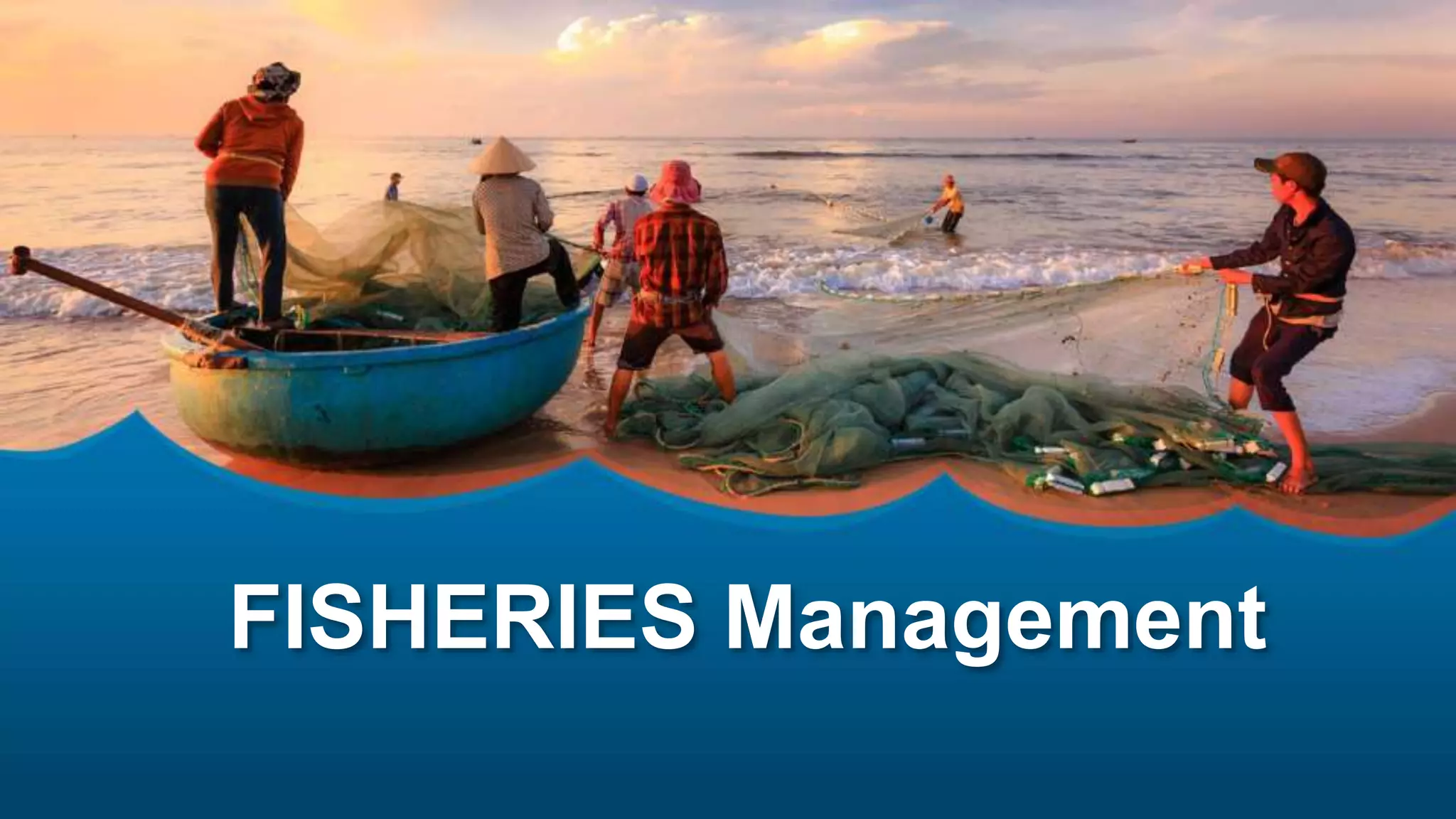
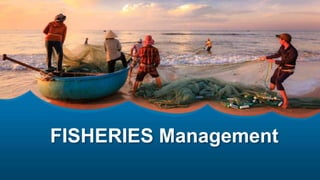
FISHERIES Management
Fishing - Maldives
"Fishing is the lifeblood of our nation, it is
inborn. From the soil on which we live, to the
sea around us, it remains an integral part of
our existence.”
Objectives
–Discuss good fisheries management
practices for sustainable fisheries.
–Demonstrate knowledge of the practices
and extent of the fishing industry in the
Maldives
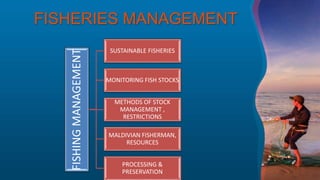
FISHERIES MANAGEMENT
FISHINGMANAGEMENT
SUSTAINABLE FISHERIES
MONITORING FISH STOCKS
METHODS OF STOCK
MANAGEMENT ,
RESTRICTIONS
MALDIVIAN FISHERMAN,
RESOURCES
PROCESSING &
PRESERVATION
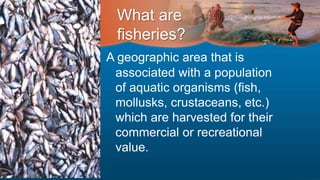
What are fisheries?
Fishery
• A fishery can defined as; human harvest of wild
marine resources for food or industry.
• Its not just fish: also crustaceans, mollusks, marine
mammals, turtles, algae, etc.
Fisheries Management – definition
• Controlling the quantity of a stock caught
through the human objective of fishing
(to obtain the largest sustainable catch)
through recreation, commercial or
traditional activities.
What is STOCK?
• A supply accumulated for future use; a
store.
• All the animals kept or raised on a farm;
live stocks
What do you think of when you hear
the word “FISHING”?
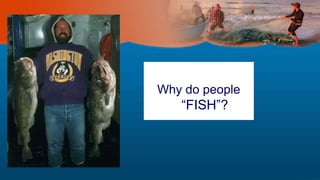
Why do people
“FISH”?
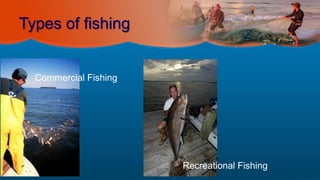
Types of fishing
Commercial Fishing
Recreational Fishing
What are
fisheries?
A geographic area that is
associated with a population
of aquatic organisms (fish,
mollusks, crustaceans, etc.)
which are harvested for their
commercial or recreational
value.
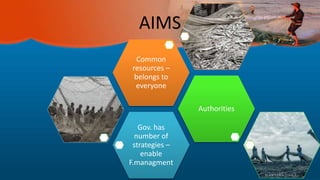
AIMS
Gov. has
number of
strategies –
enable
F.managment
Authorities
Common
resources –
belongs to
everyone
AIMS
Continued employment
Increased earnings
Protection of fisheries resources
THE NEED FOR FISHERIES MANAGEMENT
• FISH stocks are complex and precious resources. Extensive
knowledge and experience of such stocks and the influence
upon them is required in order for fisheries to be managed in
sustainable manner.
• Wealth experience
• Integrated management solutions
• Stocks assessment and monitoring
• Ecosystems effects of fishing
• THE NEED FOR FISHERIES MANAGEMENT
• Farmed fish and fish health
• Fishery management –sustainable utilization
• Monitoring control and surveillance
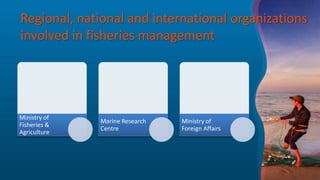
Regional, national and international organizations
involved in fisheries management
Ministry of
Fisheries &
Agriculture
Marine Research
Centre
Ministry of
Foreign Affairs
WORLD FISHERIES INTERNATIONAL ORGANIZATIONS
Conservation of Arctic Flora and Fauna
Convention on the Conservation of Antarctic Marine Living
Resources
Commission for the Conservation of Southern Bluefin Tuna
Food and Agriculture Organization of the United Nations
Inter-American Tropical Tuna Commission
International Commission for the Conservation of Atlantic Tunas
International Council for the Exploration of the Seas
Indian Ocean Tuna Commission
• Increased from 80 million tonnes to 100 million
tonnes by 2010. Reasons:
• Marine resources are good source of proteins.
• Provide food for millions of people.
• Provide employment.
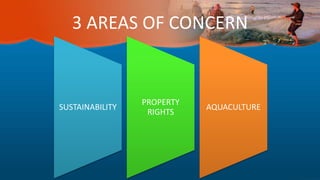
3 AREAS OF CONCERN
SUSTAINABILITY
PROPERTY
RIGHTS
AQUACULTURE
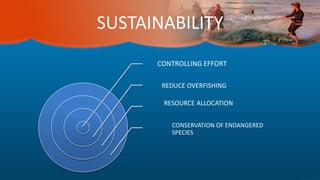
SUSTAINABILITY
CONTROLLING EFFORT
REDUCE OVERFISHING
RESOURCE ALLOCATION
CONSERVATION OF ENDANGERED
SPECIES
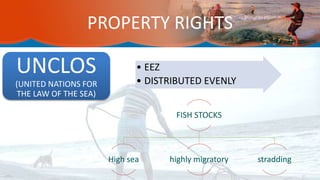
PROPERTY RIGHTS
• EEZ
• DISTRIBUTED EVENLY
UNCLOS
(UNITED NATIONS FOR
THE LAW OF THE SEA)
FISH STOCKS
High sea highly migratory stradding
AQUACULTURE
Monitoring Fish Stocks
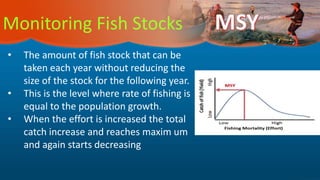
• The amount of fish stock that can be
taken each year without reducing the
size of the stock for the following year.
• This is the level where rate of fishing is
equal to the population growth.
• When the effort is increased the total
catch increase and reaches maxim um
and again starts decreasing
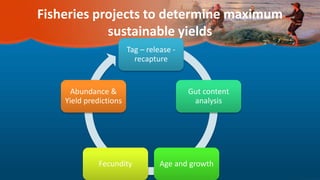
Fisheries projects to determine maximum
sustainable yields
Tag – release -
recapture
Gut content
analysis
Age and growthFecundity
Abundance &
Yield predictions
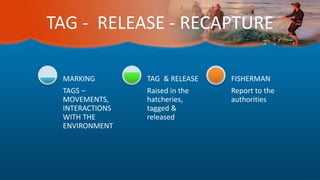
TAG - RELEASE - RECAPTURE
TAGS –
MOVEMENTS,
INTERACTIONS
WITH THE
ENVIRONMENT
MARKING
Raised in the
hatcheries,
tagged &
released
TAG & RELEASE
Report to the
authorities
FISHERMAN
TAG - RELEASE - RECAPTURE
Yellow fin Tuna -
high seas
TUNA TAGGING
PROGRAMME
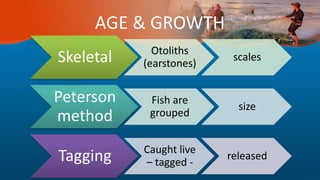
AGE & GROWTH
Skeletal Otoliths
(earstones)
scales
Peterson
method
Fish are
grouped
size
Tagging Caught live
– tagged -
released
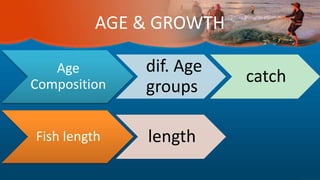
AGE & GROWTH
Age
Composition
dif. Age
groups
catch
Fish length length
GUT CONTENT ANALYSIS
FECUNDITY
Fecundity is a measure of the reproduction rate of a
species or the number of eggs produced by an
individual. It is used to calculate the reproductive
potential of a stock.
Bony fish - count the no.of eggs in the ovary
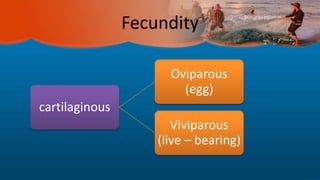
Fecundity
cartilaginous
Oviparous
(egg)
Viviparous
(live – bearing)
FECUNDITY
(dissect and) remove ovaries ;
find (total) volume of ovaries / find mass of ovaries ;
credit reference to displacement method ;
take (small) sample and find volume / find mass ;
shake with water and strain / eq ;
count number of eggs ;
calculate total number ;
Data
Fishery – independent data
• Trawl survey
• Dive survey
Fishery – dependent data
• Market survey
• Port monitoring
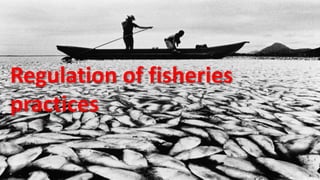
Regulation of fisheries
practices
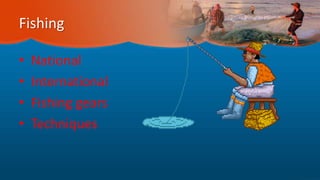
Fishing
• National
• International
• Fishing gears
• Techniques
LIMIT ON THE NUMBER OF
IMPORTS ALLOWED INTO A
COUNTRY PER YEAR.
Quota
LICENSES
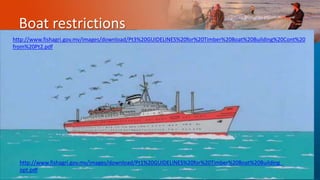
Boat restrictions
http://www.fishagri.gov.mv/images/download/Pt1%20GUIDELINES%20for%20Timber%20Boat%20Building_
opt.pdf
http://www.fishagri.gov.mv/images/download/Pt3%20GUIDELINES%20for%20Timber%20Boat%20Building%20Cont%20
from%20Pt2.pdf
Gear restrictions
• Restricted gears are:
• demersal trawls and seines
• beam trawls
• fixed nets – gill, entangling and trammel
• long lines
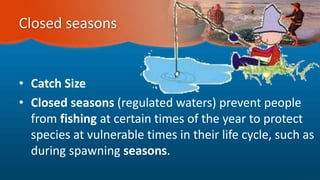
Closed seasons
• Catch Size
• Closed seasons (regulated waters) prevent people
from fishing at certain times of the year to protect
species at vulnerable times in their life cycle, such as
during spawning seasons.
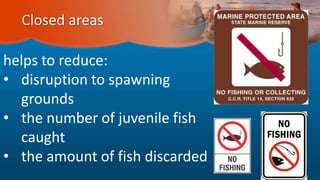
Closed areas
helps to reduce:
• disruption to spawning
grounds
• the number of juvenile fish
caught
• the amount of fish discarded
FAD Implementation of Maldives
• 1. Conduct a countrywide program to design,
develop, construct, install and monitor FAD
systems as a means of enhancing the country's fish
production.
2. Designed , developed construct installation and
monitor of bait Aggregation device
3. To conduct hydro graphic survey for installation
of bait aggregating devise and fish aggregation
devices in Maldives
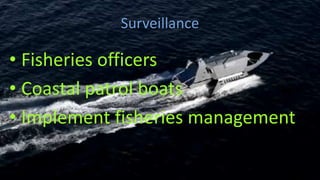
Surveillance
• Fisheries officers
• Coastal patrol boats
• Implement fisheries management
Save
FISHERIES Management
Objectives
–Discuss good fisheries management
practices for sustainable fisheries.
–Demonstrate knowledge of the practices
and extent of the fishing industry in the
Maldives
Fisheries Management
• The need for sustainable fisheries.
Monitoring of fish stocks.
Methods of stock management and the enforcement
of restrictions. Methods of rehabilitating depleted
stocks.
sustainable fish stock
• North Sea – productive source sp. – includes – cod,
herring, haddock and plaice.
• Maldives – Yellow fin Tuna
• Most stocks – overexploited
• Spawning stock
• 157,000 tones in 1963
• 38,000 tones in 2001 (76%)
• UNABLE TO RECOVER
MODERN FISHING TECHNOLOGY
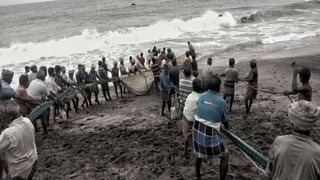
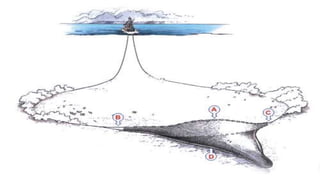
• METHODS – Seine, lampera, trawl
• INCREASED NET SIZE AND MECHANIZATION – CATCH
• UNSUSTAINABLE FISHING
• SONAR – SOUND AND RANGING – LOACATE –
DEPTHS and Underwater objects – wrecks & shoal of
fish
• FISH FINDER
Technology
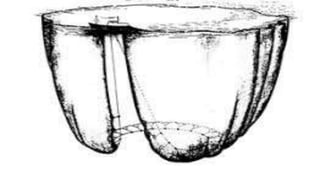
• Purse seine – catching school of fish – Methodology
• Fish caught – tuna, mackerel, sardines and Non
target species, including dolphins
• Benthic Trawl – near the sea bed – 200m – 1000m
• Benthic – cod, flat fish, plaice and halibut.
• Damage – habitat – leads the fish stocks
• Food chains and food webs
Long-term and short-term sociological impacts of
restrictions on fishing, and of unrestricted fishing.
• Human communities experience – income low –
depletion stocks
• Impacts on Fishing Industry – marketing, distribution and
transport.
• Longer term – Displacement of fishing industry.
• Ex – 1960 (north sea – Herring catch decreased)
• As a result – work as service vessels for the increasing
numbers of oil in the north sea.
• Maldives – Fisherman - Resorts
INFORMATION -
• FISHERIES DATA:
• Provides – information on the growth of fish stocks and
the impacts of fishing.
• The term recruitment refers to the rate of addition of
new fish to the population, which depends on the rate of
reproduction.
• As long as fish grow – available for the fishing gear.
• Data - Tagging
Mortality
• 2 components – fishing mortality – natural mortality
• Fishing mortality – proportional to fishing effort and
be estimated using tagging experiments.
• Or calculation of mortality rates from the data
obtained from the history of a fishery.
Age of reproductive maturity:
• variable in fish and may depend upon population density.
In sardines, for example, the age at which spawning
occurs decreases as the population density decreases.
• In general, larger and older fish produce more eggs than
younger fish. The eggs produced by older fish also tend
to be larger, which increases the chances of survival of
the larvae. This has important implications for the
exploitation of fish stocks; catching fish below their age
of maturity will inevitably result in a population decrease.
Fecundity
• Number of eggs produced by a fish or other
organisms. In a given species of fish, fecundity is
proportional to the length of the fish. Fecundity and
subsequent survival to recruitment age are important
factors in determining the size of fish stocks.
Habitat
• Understanding the habitat of fish stocks is also
important. Broadly, commercial fisheries consist of two
groups, demersel and pelagic. Demersel fisheries target
species such as cod, haddock and flat-fish which live on,
or near the sea bed. Pelagic fisheries exploit those
species which form shoals near the surface, such as
herring, mackerel and tuna. As outlined in (b), damage to
the habitat can result in a decrease in the availability of a
target species.
Sustainable
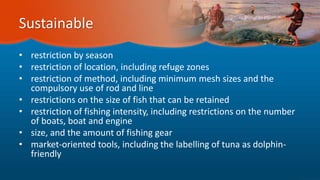
• restriction by season
• restriction of location, including refuge zones
• restriction of method, including minimum mesh sizes and the
compulsory use of rod and line
• restrictions on the size of fish that can be retained
• restriction of fishing intensity, including restrictions on the number
of boats, boat and engine
• size, and the amount of fishing gear
• market-oriented tools, including the labelling of tuna as dolphin-
friendly
Prevention – overexploitation
• technical, which aim to reduce the number of young
fish caught before they mature, for example, by
minimum mesh size.
• direct methods, which aim to limit the quantity of
catch, for example, by limiting the fishing effort.
Monitoring
• CPUE – determine the stock size for the management
purpose.
• example, the time spent fishing, or the amount of
fuel used. Fishermen are required to keep records of
these factors, to provide data relating to fish stock
abundance.
Fines
• Imposed for exceeding legal quotes can be
considerable
• Fisherman may be given a limited time to pay the
fine or face a prison sentence.
Discuss the advantages and disadvantages of the
tools and methods in (monitoring) and
(sustainable), including their
effectiveness and their impact on non-target
species.
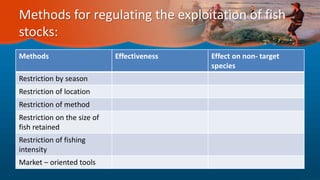
Methods for regulating the exploitation of fish
stocks:
Methods Effectiveness Effect on non- target
species
Restriction by season
Restriction of location
Restriction of method
Restriction on the size of
fish retained
Restriction of fishing
intensity
Market – oriented tools
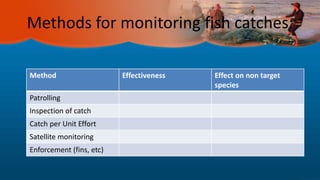
Methods for monitoring fish catches:
Method Effectiveness Effect on non target
species
Patrolling
Inspection of catch
Catch per Unit Effort
Satellite monitoring
Enforcement (fins, etc)
Rehabilitation
• Mangroves – providing nursery – fish and crustaceans. South – Asia
mangroves have been lost de to shrimp farming.
• Replantation – mangroves – provide habitats both fish and crustaceans
• Provides protection – coastal areas from storm damage.
• Artificial Reefs: materials – old tyres, concrete blocks filled with ash..
• Provides habitats – increasing – abundance.
• (It has also been suggested that redundant oil-drilling rigs could be sunk in deep
water to act as artificial reefs. This, however, remains controversial as there is
concern about their possible adverse impact on deep sea ecosystems)
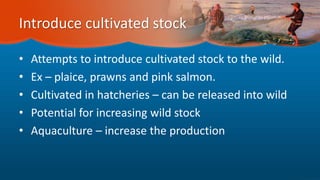
Introduce cultivated stock
• Attempts to introduce cultivated stock to the wild.
• Ex – plaice, prawns and pink salmon.
• Cultivated in hatcheries – can be released into wild
• Potential for increasing wild stock
• Aquaculture – increase the production
FISHERIES RESOURCES
• HANDLING
• PROCESSING
• PRESERVATION
• SALTING
• BOAT CONSTRUCTION
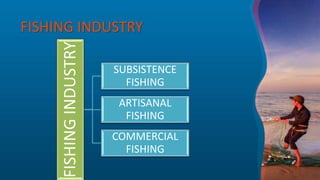
FISHING INDUSTRY
FISHINGINDUSTRY SUBSISTENCE
FISHING
ARTISANAL
FISHING
COMMERCIAL
FISHING
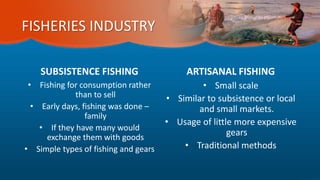
FISHERIES INDUSTRY
SUBSISTENCE FISHING
• Fishing for consumption rather
than to sell
• Early days, fishing was done –
family
• If they have many would
exchange them with goods
• Simple types of fishing and gears
ARTISANAL FISHING
• Small scale
• Similar to subsistence or local
and small markets.
• Usage of little more expensive
gears
• Traditional methods
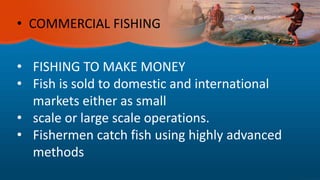
• COMMERCIAL FISHING
• FISHING TO MAKE MONEY
• Fish is sold to domestic and international
markets either as small
• scale or large scale operations.
• Fishermen catch fish using highly advanced
methods
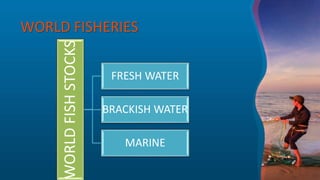
WORLD FISHERIES
WORLDFISHSTOCKS FRESH WATER
BRACKISH WATER
MARINE
WORLD FISHERIES
FRESH WATER
• Production from inland waters, rivers and
lakes.
• Has been growing slowly and now exceeds
15 million tons per year. Fisheries affected by:
• Building of dams for electricity generation.
Removal of water for irrigation.
• Counterbalanced by increases in food
production from reservoirs & other man-
made lakes & through the development of
aquaculture.
• Eg: Tilapia & Salmon
BRACKISH WATER
• Most of the brackish water fish
production comes from the
shrimp culture.
• This is very large industry
particularly in developing
countries and makes large
• contribution to the total world
fish production.
• In brackish water crabs,
prawns and lobsters are also
cultured.
Marine
• Almost 90% of the world’s fish production
comes from the sea
• Most of the catch comes from North Pacific &
North Atlantic.
Economically Important fish stocks
• These species have very good demand in the market.
• Fishermen catch large amount of fish to earn money.
Example: grouper , snapper, barracuda, sea
cucumber , some tuna species, reef fish
Untapped stocks
• Untapped stocks are stocks that are potentially good
sources of protein that have not been tapped.
• There are some reasons for not exploiting this fish
production. 1. The cost to catch the fish is greater.
2. They do not fetch a high market price.
Example:
– Angler fish
– Spider fish
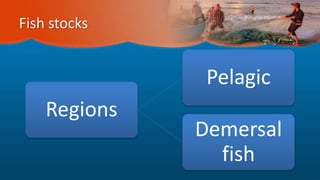
Fish stocks
Regions
Pelagic
Demersal
fish
High sea resources:
• High seas resources exist beyond the 200 miles zone.
• 200 miles from the coastline of the nation is EXCLUSIVE ECONOMIC
ZONE (EEZ).
• Beyond EEZ international water are found which is called high seas
area.
• They are mostly pelagic.
• Some demersal resources exist on sea mounts.
• There are about 400 high seas species.
• 50 species of cephalopods,
270 species of fish,
60 species of marine mammals.
International Fisheries Resources
• The major fishing areas include:
• Indian Ocean
• Atlantic Ocean
• Pacific Ocean
• Mediterranean Sea
Status of major fish stocks
• Major fish stocks decline in many areas of the world ocean.
• North West pacific region is the largest producing area in the world.
• Alaskan Pollack, Japanese pilchard population greatly decrease in
pacific and Atlantic Ocean.
• Reasons:
• Over exploitation, since develop countries use advanced technology
to collect the fish in large numbers.
• Changes in climate conditions like El Nino effect pilchard population
in Atlantic ocean.
Main factors affecting international fisheries
resources:
• 1. Production
2. Demand
3. Exploitation ( Use of resources by organisms)
• Human population increases continuously.
• So we have to increase the production of fisheries
resources to meet the increasing demand.
What can be done to maintain the future
demands:
• Finding new fishing grounds.
• Making agriculture farms for the decreasing fish
stocks.
• Maintain the aquaculture fisheries in the land water.
• Better management to avoid over fishing.
The national fishing industry;
• Fishing grounds
• Seasons
Fishing grounds
Inshore water;
• Water close to land and up to about 30m in depth.
• Almost all the fish found are demersal with the
exceptions of few pelagics.
• Fish found here include: Bait fish, aquarium fish, reef fish
and sharks.
• Other organisms include: Lobsters, crabs, sea cucumbers,
shrimp, and octopus.
Near shore water
• deep lagoons, near reefs and water within and around
the atolls
• Fish found in near-shore water are mixture of pelagic and
demersal.
• Example:
• ▫ Frigate tuna (raagondi)
• ▫ Kawakawa (latti)
• ▫ Marlin (mas hibaru)
Off – shore
• Off-shore water is open seas and oceans.
• These waters provide most of the Maldivian fish
stock.
• Fish caught are nearly all pelagics.
• Example:
– ▫ skip jack tuna (Kalhubila mas)
– ▫ Yellowfin tuna. (Reendhoo uraha kanneli)
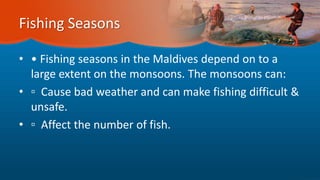
Fishing Seasons
• • Fishing seasons in the Maldives depend on to a
large extent on the monsoons. The monsoons can:
• ▫ Cause bad weather and can make fishing difficult &
unsafe.
• ▫ Affect the number of fish.
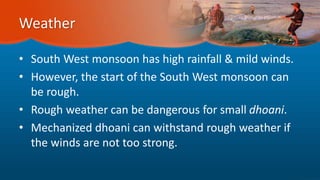
Weather
• South West monsoon has high rainfall & mild winds.
• However, the start of the South West monsoon can
be rough.
• Rough weather can be dangerous for small dhoani.
• Mechanized dhoani can withstand rough weather if
the winds are not too strong.
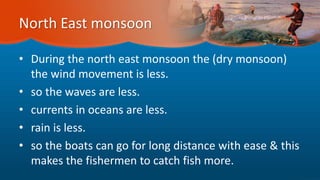
North East monsoon
• During the north east monsoon the (dry monsoon)
the wind movement is less.
• so the waves are less.
• currents in oceans are less.
• rain is less.
• so the boats can go for long distance with ease & this
makes the fishermen to catch fish more.
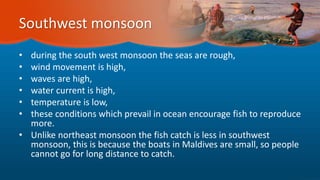
Southwest monsoon
• during the south west monsoon the seas are rough,
• wind movement is high,
• waves are high,
• water current is high,
• temperature is low,
• these conditions which prevail in ocean encourage fish to reproduce
more.
• Unlike northeast monsoon the fish catch is less in southwest
monsoon, this is because the boats in Maldives are small, so people
cannot go for long distance to catch.
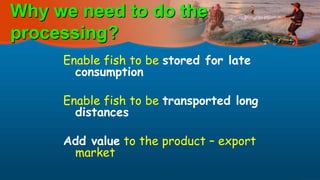
PROCESSING
Why we need to do the
processing?
Enable fish to be stored for late
consumption
Enable fish to be transported long
distances
Add value to the product – export
market
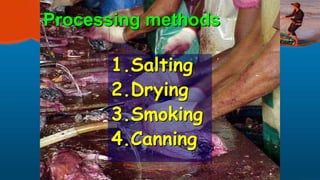
Processing methods
1.Salting
2.Drying
3.Smoking
4.Canning
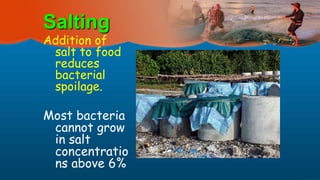
Salting
Addition of
salt to food
reduces
bacterial
spoilage.
Most bacteria
cannot grow
in salt
concentratio
ns above 6%
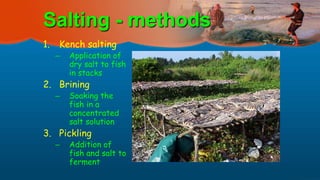
Salting - methods
1. Kench salting
– Application of
dry salt to fish
in stacks
2. Brining
– Soaking the
fish in a
concentrated
salt solution
3. Pickling
– Addition of
fish and salt to
ferment
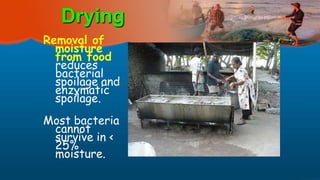
Drying
Removal of
moisture
from food
reduces
bacterial
spoilage and
enzymatic
spoilage.
Most bacteria
cannot
survive in <
25%
moisture.
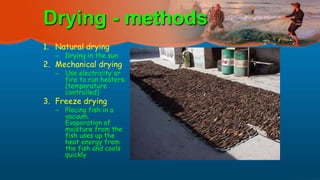
Drying - methods
1. Natural drying
– Drying in the sun
2. Mechanical drying
– Use electricity or
fire to run heaters.
(temperature
controlled)
3. Freeze drying
– Placing fish in a
vacuum.
Evaporation of
moisture from the
fish uses up the
heat energy from
the fish and cools
quickly
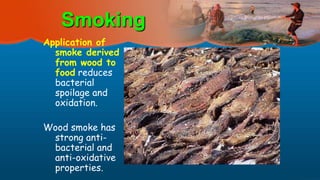
Smoking
Application of
smoke derived
from wood to
food reduces
bacterial
spoilage and
oxidation.
Wood smoke has
strong anti-
bacterial and
anti-oxidative
properties.
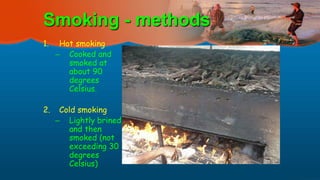
1. Hot smoking
– Cooked and
smoked at
about 90
degrees
Celsius.
2. Cold smoking
– Lightly brined
and then
smoked (not
exceeding 30
degrees
Celsius)
Smoking - methods
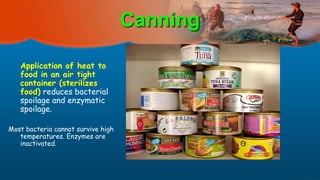
Canning
Application of heat to
food in an air tight
container (sterilizes
food) reduces bacterial
spoilage and enzymatic
spoilage.
Most bacteria cannot survive high
temperatures. Enzymes are
inactivated.
Fisheries management (Intermediate Marine Science)

Fisheries management (Intermediate Marine Science)

  • 1.
  • 2.
    Fishing - Maldives "Fishingis the lifeblood of our nation, it is inborn. From the soil on which we live, to the sea around us, it remains an integral part of our existence.”
  • 3.
    Objectives –Discuss good fisheriesmanagement practices for sustainable fisheries. –Demonstrate knowledge of the practices and extent of the fishing industry in the Maldives
  • 4.
    FISHERIES MANAGEMENT FISHINGMANAGEMENT SUSTAINABLE FISHERIES MONITORINGFISH STOCKS METHODS OF STOCK MANAGEMENT , RESTRICTIONS MALDIVIAN FISHERMAN, RESOURCES PROCESSING & PRESERVATION
  • 5.
  • 6.
    Fishery • A fisherycan defined as; human harvest of wild marine resources for food or industry. • Its not just fish: also crustaceans, mollusks, marine mammals, turtles, algae, etc.
  • 7.
    Fisheries Management –definition • Controlling the quantity of a stock caught through the human objective of fishing (to obtain the largest sustainable catch) through recreation, commercial or traditional activities.
  • 8.
    What is STOCK? •A supply accumulated for future use; a store. • All the animals kept or raised on a farm; live stocks
  • 9.
    What do youthink of when you hear the word “FISHING”?
  • 10.
  • 11.
    Types of fishing CommercialFishing Recreational Fishing
  • 12.
    What are fisheries? A geographicarea that is associated with a population of aquatic organisms (fish, mollusks, crustaceans, etc.) which are harvested for their commercial or recreational value.
  • 13.
    AIMS Gov. has number of strategies– enable F.managment Authorities Common resources – belongs to everyone
  • 14.
  • 15.
    THE NEED FORFISHERIES MANAGEMENT • FISH stocks are complex and precious resources. Extensive knowledge and experience of such stocks and the influence upon them is required in order for fisheries to be managed in sustainable manner. • Wealth experience • Integrated management solutions • Stocks assessment and monitoring • Ecosystems effects of fishing
  • 16.
    • THE NEEDFOR FISHERIES MANAGEMENT • Farmed fish and fish health • Fishery management –sustainable utilization • Monitoring control and surveillance
  • 17.
    Regional, national andinternational organizations involved in fisheries management Ministry of Fisheries & Agriculture Marine Research Centre Ministry of Foreign Affairs
  • 18.
    WORLD FISHERIES INTERNATIONALORGANIZATIONS Conservation of Arctic Flora and Fauna Convention on the Conservation of Antarctic Marine Living Resources Commission for the Conservation of Southern Bluefin Tuna Food and Agriculture Organization of the United Nations Inter-American Tropical Tuna Commission International Commission for the Conservation of Atlantic Tunas International Council for the Exploration of the Seas Indian Ocean Tuna Commission
  • 20.
    • Increased from80 million tonnes to 100 million tonnes by 2010. Reasons: • Marine resources are good source of proteins. • Provide food for millions of people. • Provide employment.
  • 21.
    3 AREAS OFCONCERN SUSTAINABILITY PROPERTY RIGHTS AQUACULTURE
  • 22.
    SUSTAINABILITY CONTROLLING EFFORT REDUCE OVERFISHING RESOURCEALLOCATION CONSERVATION OF ENDANGERED SPECIES
  • 23.
    PROPERTY RIGHTS • EEZ •DISTRIBUTED EVENLY UNCLOS (UNITED NATIONS FOR THE LAW OF THE SEA) FISH STOCKS High sea highly migratory stradding
  • 24.
  • 25.
    Monitoring Fish Stocks •The amount of fish stock that can be taken each year without reducing the size of the stock for the following year. • This is the level where rate of fishing is equal to the population growth. • When the effort is increased the total catch increase and reaches maxim um and again starts decreasing
  • 26.
    Fisheries projects todetermine maximum sustainable yields Tag – release - recapture Gut content analysis Age and growthFecundity Abundance & Yield predictions
  • 27.
    TAG - RELEASE- RECAPTURE TAGS – MOVEMENTS, INTERACTIONS WITH THE ENVIRONMENT MARKING Raised in the hatcheries, tagged & released TAG & RELEASE Report to the authorities FISHERMAN
  • 28.
    TAG - RELEASE- RECAPTURE Yellow fin Tuna - high seas TUNA TAGGING PROGRAMME
  • 29.
    AGE & GROWTH SkeletalOtoliths (earstones) scales Peterson method Fish are grouped size Tagging Caught live – tagged - released
  • 30.
    AGE & GROWTH Age Composition dif.Age groups catch Fish length length
  • 31.
  • 32.
    FECUNDITY Fecundity is ameasure of the reproduction rate of a species or the number of eggs produced by an individual. It is used to calculate the reproductive potential of a stock. Bony fish - count the no.of eggs in the ovary
  • 33.
  • 34.
    FECUNDITY (dissect and) removeovaries ; find (total) volume of ovaries / find mass of ovaries ; credit reference to displacement method ; take (small) sample and find volume / find mass ; shake with water and strain / eq ; count number of eggs ; calculate total number ;
  • 35.
    Data Fishery – independentdata • Trawl survey • Dive survey Fishery – dependent data • Market survey • Port monitoring
  • 36.
  • 37.
    Fishing • National • International •Fishing gears • Techniques
  • 38.
    LIMIT ON THENUMBER OF IMPORTS ALLOWED INTO A COUNTRY PER YEAR. Quota
  • 39.
  • 40.
  • 41.
    Gear restrictions • Restrictedgears are: • demersal trawls and seines • beam trawls • fixed nets – gill, entangling and trammel • long lines
  • 42.
    Closed seasons • CatchSize • Closed seasons (regulated waters) prevent people from fishing at certain times of the year to protect species at vulnerable times in their life cycle, such as during spawning seasons.
  • 43.
    Closed areas helps toreduce: • disruption to spawning grounds • the number of juvenile fish caught • the amount of fish discarded
  • 44.
    FAD Implementation ofMaldives • 1. Conduct a countrywide program to design, develop, construct, install and monitor FAD systems as a means of enhancing the country's fish production. 2. Designed , developed construct installation and monitor of bait Aggregation device 3. To conduct hydro graphic survey for installation of bait aggregating devise and fish aggregation devices in Maldives
  • 45.
    Surveillance • Fisheries officers •Coastal patrol boats • Implement fisheries management
  • 46.
  • 47.
  • 48.
    Objectives –Discuss good fisheriesmanagement practices for sustainable fisheries. –Demonstrate knowledge of the practices and extent of the fishing industry in the Maldives
  • 49.
    Fisheries Management • Theneed for sustainable fisheries. Monitoring of fish stocks. Methods of stock management and the enforcement of restrictions. Methods of rehabilitating depleted stocks.
  • 50.
    sustainable fish stock •North Sea – productive source sp. – includes – cod, herring, haddock and plaice. • Maldives – Yellow fin Tuna • Most stocks – overexploited • Spawning stock • 157,000 tones in 1963 • 38,000 tones in 2001 (76%) • UNABLE TO RECOVER
  • 51.
    MODERN FISHING TECHNOLOGY •METHODS – Seine, lampera, trawl • INCREASED NET SIZE AND MECHANIZATION – CATCH • UNSUSTAINABLE FISHING • SONAR – SOUND AND RANGING – LOACATE – DEPTHS and Underwater objects – wrecks & shoal of fish • FISH FINDER
  • 56.
    Technology • Purse seine– catching school of fish – Methodology • Fish caught – tuna, mackerel, sardines and Non target species, including dolphins • Benthic Trawl – near the sea bed – 200m – 1000m • Benthic – cod, flat fish, plaice and halibut. • Damage – habitat – leads the fish stocks • Food chains and food webs
  • 57.
    Long-term and short-termsociological impacts of restrictions on fishing, and of unrestricted fishing. • Human communities experience – income low – depletion stocks • Impacts on Fishing Industry – marketing, distribution and transport. • Longer term – Displacement of fishing industry. • Ex – 1960 (north sea – Herring catch decreased) • As a result – work as service vessels for the increasing numbers of oil in the north sea. • Maldives – Fisherman - Resorts
  • 58.
    INFORMATION - • FISHERIESDATA: • Provides – information on the growth of fish stocks and the impacts of fishing. • The term recruitment refers to the rate of addition of new fish to the population, which depends on the rate of reproduction. • As long as fish grow – available for the fishing gear. • Data - Tagging
  • 59.
    Mortality • 2 components– fishing mortality – natural mortality • Fishing mortality – proportional to fishing effort and be estimated using tagging experiments. • Or calculation of mortality rates from the data obtained from the history of a fishery.
  • 60.
    Age of reproductivematurity: • variable in fish and may depend upon population density. In sardines, for example, the age at which spawning occurs decreases as the population density decreases. • In general, larger and older fish produce more eggs than younger fish. The eggs produced by older fish also tend to be larger, which increases the chances of survival of the larvae. This has important implications for the exploitation of fish stocks; catching fish below their age of maturity will inevitably result in a population decrease.
  • 61.
    Fecundity • Number ofeggs produced by a fish or other organisms. In a given species of fish, fecundity is proportional to the length of the fish. Fecundity and subsequent survival to recruitment age are important factors in determining the size of fish stocks.
  • 62.
    Habitat • Understanding thehabitat of fish stocks is also important. Broadly, commercial fisheries consist of two groups, demersel and pelagic. Demersel fisheries target species such as cod, haddock and flat-fish which live on, or near the sea bed. Pelagic fisheries exploit those species which form shoals near the surface, such as herring, mackerel and tuna. As outlined in (b), damage to the habitat can result in a decrease in the availability of a target species.
  • 63.
    Sustainable • restriction byseason • restriction of location, including refuge zones • restriction of method, including minimum mesh sizes and the compulsory use of rod and line • restrictions on the size of fish that can be retained • restriction of fishing intensity, including restrictions on the number of boats, boat and engine • size, and the amount of fishing gear • market-oriented tools, including the labelling of tuna as dolphin- friendly
  • 64.
    Prevention – overexploitation •technical, which aim to reduce the number of young fish caught before they mature, for example, by minimum mesh size. • direct methods, which aim to limit the quantity of catch, for example, by limiting the fishing effort.
  • 65.
    Monitoring • CPUE –determine the stock size for the management purpose. • example, the time spent fishing, or the amount of fuel used. Fishermen are required to keep records of these factors, to provide data relating to fish stock abundance.
  • 66.
    Fines • Imposed forexceeding legal quotes can be considerable • Fisherman may be given a limited time to pay the fine or face a prison sentence.
  • 67.
    Discuss the advantagesand disadvantages of the tools and methods in (monitoring) and (sustainable), including their effectiveness and their impact on non-target species.
  • 68.
    Methods for regulatingthe exploitation of fish stocks: Methods Effectiveness Effect on non- target species Restriction by season Restriction of location Restriction of method Restriction on the size of fish retained Restriction of fishing intensity Market – oriented tools
  • 69.
    Methods for monitoringfish catches: Method Effectiveness Effect on non target species Patrolling Inspection of catch Catch per Unit Effort Satellite monitoring Enforcement (fins, etc)
  • 70.
    Rehabilitation • Mangroves –providing nursery – fish and crustaceans. South – Asia mangroves have been lost de to shrimp farming. • Replantation – mangroves – provide habitats both fish and crustaceans • Provides protection – coastal areas from storm damage. • Artificial Reefs: materials – old tyres, concrete blocks filled with ash.. • Provides habitats – increasing – abundance. • (It has also been suggested that redundant oil-drilling rigs could be sunk in deep water to act as artificial reefs. This, however, remains controversial as there is concern about their possible adverse impact on deep sea ecosystems)
  • 71.
    Introduce cultivated stock •Attempts to introduce cultivated stock to the wild. • Ex – plaice, prawns and pink salmon. • Cultivated in hatcheries – can be released into wild • Potential for increasing wild stock • Aquaculture – increase the production
  • 72.
    FISHERIES RESOURCES • HANDLING •PROCESSING • PRESERVATION • SALTING • BOAT CONSTRUCTION
  • 73.
  • 74.
    FISHERIES INDUSTRY SUBSISTENCE FISHING •Fishing for consumption rather than to sell • Early days, fishing was done – family • If they have many would exchange them with goods • Simple types of fishing and gears ARTISANAL FISHING • Small scale • Similar to subsistence or local and small markets. • Usage of little more expensive gears • Traditional methods
  • 75.
    • COMMERCIAL FISHING •FISHING TO MAKE MONEY • Fish is sold to domestic and international markets either as small • scale or large scale operations. • Fishermen catch fish using highly advanced methods
  • 76.
    WORLD FISHERIES WORLDFISHSTOCKS FRESHWATER BRACKISH WATER MARINE
  • 77.
    WORLD FISHERIES FRESH WATER •Production from inland waters, rivers and lakes. • Has been growing slowly and now exceeds 15 million tons per year. Fisheries affected by: • Building of dams for electricity generation. Removal of water for irrigation. • Counterbalanced by increases in food production from reservoirs & other man- made lakes & through the development of aquaculture. • Eg: Tilapia & Salmon BRACKISH WATER • Most of the brackish water fish production comes from the shrimp culture. • This is very large industry particularly in developing countries and makes large • contribution to the total world fish production. • In brackish water crabs, prawns and lobsters are also cultured.
  • 78.
    Marine • Almost 90%of the world’s fish production comes from the sea • Most of the catch comes from North Pacific & North Atlantic.
  • 79.
    Economically Important fishstocks • These species have very good demand in the market. • Fishermen catch large amount of fish to earn money. Example: grouper , snapper, barracuda, sea cucumber , some tuna species, reef fish
  • 80.
    Untapped stocks • Untappedstocks are stocks that are potentially good sources of protein that have not been tapped. • There are some reasons for not exploiting this fish production. 1. The cost to catch the fish is greater. 2. They do not fetch a high market price. Example: – Angler fish – Spider fish
  • 81.
  • 82.
    High sea resources: •High seas resources exist beyond the 200 miles zone. • 200 miles from the coastline of the nation is EXCLUSIVE ECONOMIC ZONE (EEZ). • Beyond EEZ international water are found which is called high seas area. • They are mostly pelagic. • Some demersal resources exist on sea mounts. • There are about 400 high seas species. • 50 species of cephalopods, 270 species of fish, 60 species of marine mammals.
  • 83.
    International Fisheries Resources •The major fishing areas include: • Indian Ocean • Atlantic Ocean • Pacific Ocean • Mediterranean Sea
  • 84.
    Status of majorfish stocks • Major fish stocks decline in many areas of the world ocean. • North West pacific region is the largest producing area in the world. • Alaskan Pollack, Japanese pilchard population greatly decrease in pacific and Atlantic Ocean. • Reasons: • Over exploitation, since develop countries use advanced technology to collect the fish in large numbers. • Changes in climate conditions like El Nino effect pilchard population in Atlantic ocean.
  • 85.
    Main factors affectinginternational fisheries resources: • 1. Production 2. Demand 3. Exploitation ( Use of resources by organisms) • Human population increases continuously. • So we have to increase the production of fisheries resources to meet the increasing demand.
  • 86.
    What can bedone to maintain the future demands: • Finding new fishing grounds. • Making agriculture farms for the decreasing fish stocks. • Maintain the aquaculture fisheries in the land water. • Better management to avoid over fishing.
  • 87.
    The national fishingindustry; • Fishing grounds • Seasons
  • 88.
    Fishing grounds Inshore water; •Water close to land and up to about 30m in depth. • Almost all the fish found are demersal with the exceptions of few pelagics. • Fish found here include: Bait fish, aquarium fish, reef fish and sharks. • Other organisms include: Lobsters, crabs, sea cucumbers, shrimp, and octopus.
  • 89.
    Near shore water •deep lagoons, near reefs and water within and around the atolls • Fish found in near-shore water are mixture of pelagic and demersal. • Example: • ▫ Frigate tuna (raagondi) • ▫ Kawakawa (latti) • ▫ Marlin (mas hibaru)
  • 90.
    Off – shore •Off-shore water is open seas and oceans. • These waters provide most of the Maldivian fish stock. • Fish caught are nearly all pelagics. • Example: – ▫ skip jack tuna (Kalhubila mas) – ▫ Yellowfin tuna. (Reendhoo uraha kanneli)
  • 91.
    Fishing Seasons • •Fishing seasons in the Maldives depend on to a large extent on the monsoons. The monsoons can: • ▫ Cause bad weather and can make fishing difficult & unsafe. • ▫ Affect the number of fish.
  • 92.
    Weather • South Westmonsoon has high rainfall & mild winds. • However, the start of the South West monsoon can be rough. • Rough weather can be dangerous for small dhoani. • Mechanized dhoani can withstand rough weather if the winds are not too strong.
  • 93.
    North East monsoon •During the north east monsoon the (dry monsoon) the wind movement is less. • so the waves are less. • currents in oceans are less. • rain is less. • so the boats can go for long distance with ease & this makes the fishermen to catch fish more.
  • 94.
    Southwest monsoon • duringthe south west monsoon the seas are rough, • wind movement is high, • waves are high, • water current is high, • temperature is low, • these conditions which prevail in ocean encourage fish to reproduce more. • Unlike northeast monsoon the fish catch is less in southwest monsoon, this is because the boats in Maldives are small, so people cannot go for long distance to catch.
  • 95.
  • 96.
    Why we needto do the processing? Enable fish to be stored for late consumption Enable fish to be transported long distances Add value to the product – export market
  • 97.
  • 98.
    Salting Addition of salt tofood reduces bacterial spoilage. Most bacteria cannot grow in salt concentratio ns above 6%
  • 99.
    Salting - methods 1.Kench salting – Application of dry salt to fish in stacks 2. Brining – Soaking the fish in a concentrated salt solution 3. Pickling – Addition of fish and salt to ferment
  • 100.
    Drying Removal of moisture from food reduces bacterial spoilageand enzymatic spoilage. Most bacteria cannot survive in < 25% moisture.
  • 101.
    Drying - methods 1.Natural drying – Drying in the sun 2. Mechanical drying – Use electricity or fire to run heaters. (temperature controlled) 3. Freeze drying – Placing fish in a vacuum. Evaporation of moisture from the fish uses up the heat energy from the fish and cools quickly
  • 102.
    Smoking Application of smoke derived fromwood to food reduces bacterial spoilage and oxidation. Wood smoke has strong anti- bacterial and anti-oxidative properties.
  • 103.
    1. Hot smoking –Cooked and smoked at about 90 degrees Celsius. 2. Cold smoking – Lightly brined and then smoked (not exceeding 30 degrees Celsius) Smoking - methods
  • 104.
    Canning Application of heatto food in an air tight container (sterilizes food) reduces bacterial spoilage and enzymatic spoilage. Most bacteria cannot survive high temperatures. Enzymes are inactivated.

Editor's Notes

  • #10 Multiple answers can be accepted here.
  • #11 Accept multiple responses here. -For fun (recreation) -To eat -To make a living (job)
  • #12 There are two types or classifications of fishing: commercial and recreational Commercial fishing is capturing fish and other seafood to sell for profit. (grocery stores and restaurants) Recreational fishing is capturing fish and other seafood for fun or relaxation. (personal use)
  • #13 Fisheries can occur in either freshwater or seawater, and rely on either wild or captive (farmed) stocks of organisms. Another way to define a fishery is the combination of fish and fisherman in a region. These fisherman are fishing for similar or the same species with similar or the same gear types.