GEN. ECOLOGY
Name: _____________________________________ Date: __________
Year & Section: ___________________
Quiz No. _____
I. Multiple Choice. Strike through the letter of the correct answer.
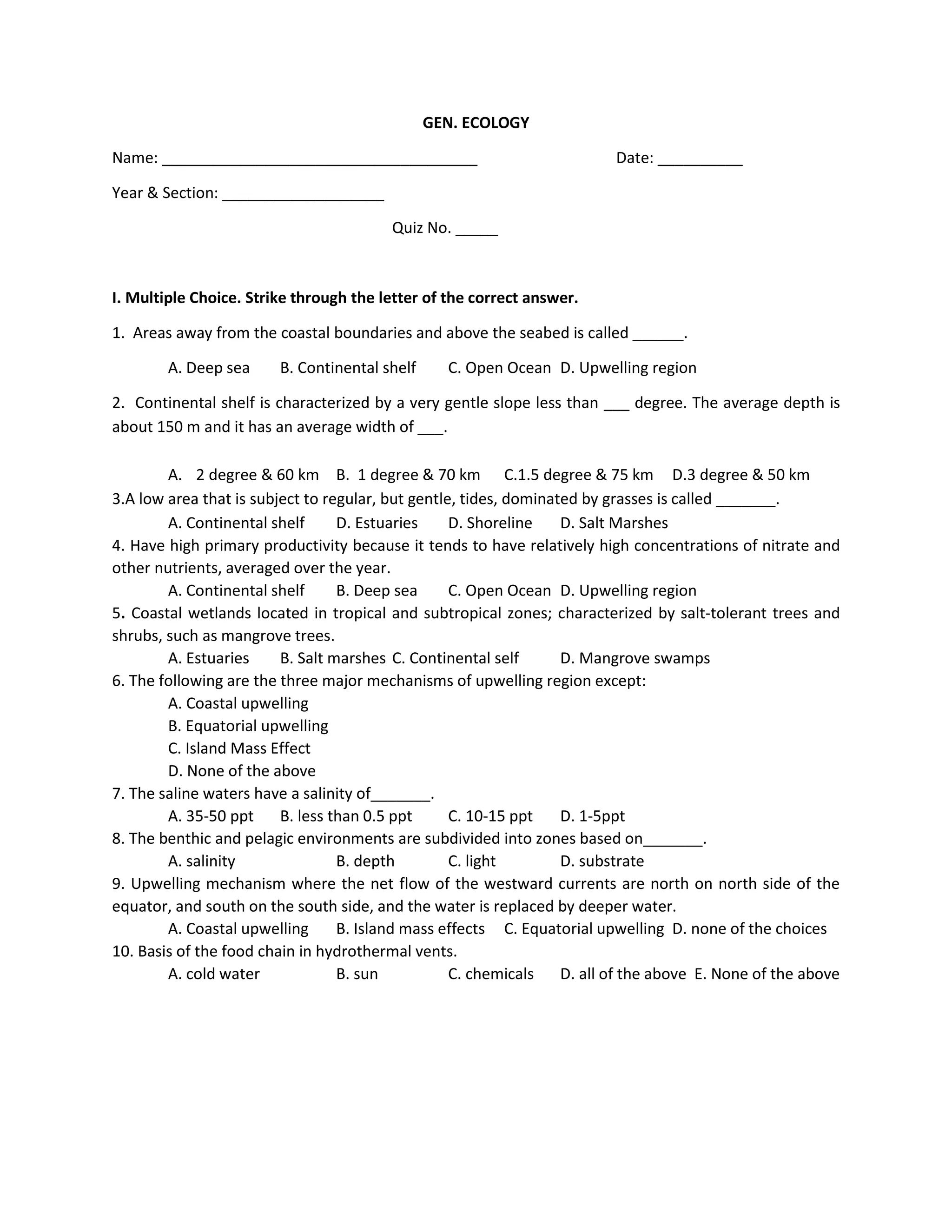
1. Areas away from the coastal boundaries and above the seabed is called ______.
A. Deep sea B. Continental shelf C. Open Ocean D. Upwelling region
2. Continental shelf is characterized by a very gentle slope less than ___ degree. The average depth is
about 150 m and it has an average width of ___.
A. 2 degree & 60 km B. 1 degree & 70 km C.1.5 degree & 75 km D.3 degree & 50 km
3.A low area that is subject to regular, but gentle, tides, dominated by grasses is called _______.
A. Continental shelf D. Estuaries D. Shoreline D. Salt Marshes
4. Have high primary productivity because it tends to have relatively high concentrations of nitrate and
other nutrients, averaged over the year.
A. Continental shelf B. Deep sea C. Open Ocean D. Upwelling region
5. Coastal wetlands located in tropical and subtropical zones; characterized by salt-tolerant trees and
shrubs, such as mangrove trees.
A. Estuaries B. Salt marshes C. Continental self D. Mangrove swamps
6. The following are the three major mechanisms of upwelling region except:
A. Coastal upwelling
B. Equatorial upwelling
C. Island Mass Effect
D. None of the above
7. The saline waters have a salinity of_______.
A. 35-50 ppt B. less than 0.5 ppt C. 10-15 ppt D. 1-5ppt
8. The benthic and pelagic environments are subdivided into zones based on_______.
A. salinity B. depth C. light D. substrate
9. Upwelling mechanism where the net flow of the westward currents are north on north side of the
equator, and south on the south side, and the water is replaced by deeper water.
A. Coastal upwelling B. Island mass effects C. Equatorial upwelling D. none of the choices
10. Basis of the food chain in hydrothermal vents.
A. cold water B. sun C. chemicals D. all of the above E. None of the above
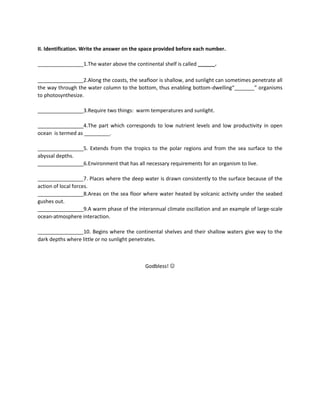
II. Identification. Write the answer on the space provided before each number.
________________1.The water above the continental shelf is called ______.
________________2.Along the coasts, the seafloor is shallow, and sunlight can sometimes penetrate all
the way through the water column to the bottom, thus enabling bottom-dwelling“_______” organisms
to photosynthesize.
________________3.Require two things: warm temperatures and sunlight.
________________4.The part which corresponds to low nutrient levels and low productivity in open
ocean is termed as _________.
________________5. Extends from the tropics to the polar regions and from the sea surface to the
abyssal depths.
________________6.Environment that has all necessary requirements for an organism to live.
________________7. Places where the deep water is drawn consistently to the surface because of the
action of local forces.
________________8.Areas on the sea floor where water heated by volcanic activity under the seabed
gushes out.
________________9.A warm phase of the interannual climate oscillation and an example of large-scale
ocean-atmosphere interaction.
________________10. Begins where the continental shelves and their shallow waters give way to the
dark depths where little or no sunlight penetrates.
Godbless! 

Marine habitats

  • 1.
    GEN. ECOLOGY Name: _____________________________________Date: __________ Year & Section: ___________________ Quiz No. _____ I. Multiple Choice. Strike through the letter of the correct answer. 1. Areas away from the coastal boundaries and above the seabed is called ______. A. Deep sea B. Continental shelf C. Open Ocean D. Upwelling region 2. Continental shelf is characterized by a very gentle slope less than ___ degree. The average depth is about 150 m and it has an average width of ___. A. 2 degree & 60 km B. 1 degree & 70 km C.1.5 degree & 75 km D.3 degree & 50 km 3.A low area that is subject to regular, but gentle, tides, dominated by grasses is called _______. A. Continental shelf D. Estuaries D. Shoreline D. Salt Marshes 4. Have high primary productivity because it tends to have relatively high concentrations of nitrate and other nutrients, averaged over the year. A. Continental shelf B. Deep sea C. Open Ocean D. Upwelling region 5. Coastal wetlands located in tropical and subtropical zones; characterized by salt-tolerant trees and shrubs, such as mangrove trees. A. Estuaries B. Salt marshes C. Continental self D. Mangrove swamps 6. The following are the three major mechanisms of upwelling region except: A. Coastal upwelling B. Equatorial upwelling C. Island Mass Effect D. None of the above 7. The saline waters have a salinity of_______. A. 35-50 ppt B. less than 0.5 ppt C. 10-15 ppt D. 1-5ppt 8. The benthic and pelagic environments are subdivided into zones based on_______. A. salinity B. depth C. light D. substrate 9. Upwelling mechanism where the net flow of the westward currents are north on north side of the equator, and south on the south side, and the water is replaced by deeper water. A. Coastal upwelling B. Island mass effects C. Equatorial upwelling D. none of the choices 10. Basis of the food chain in hydrothermal vents. A. cold water B. sun C. chemicals D. all of the above E. None of the above
  • 2.
    II. Identification. Writethe answer on the space provided before each number. ________________1.The water above the continental shelf is called ______. ________________2.Along the coasts, the seafloor is shallow, and sunlight can sometimes penetrate all the way through the water column to the bottom, thus enabling bottom-dwelling“_______” organisms to photosynthesize. ________________3.Require two things: warm temperatures and sunlight. ________________4.The part which corresponds to low nutrient levels and low productivity in open ocean is termed as _________. ________________5. Extends from the tropics to the polar regions and from the sea surface to the abyssal depths. ________________6.Environment that has all necessary requirements for an organism to live. ________________7. Places where the deep water is drawn consistently to the surface because of the action of local forces. ________________8.Areas on the sea floor where water heated by volcanic activity under the seabed gushes out. ________________9.A warm phase of the interannual climate oscillation and an example of large-scale ocean-atmosphere interaction. ________________10. Begins where the continental shelves and their shallow waters give way to the dark depths where little or no sunlight penetrates. Godbless! 