Prepared by: Jessy Chong
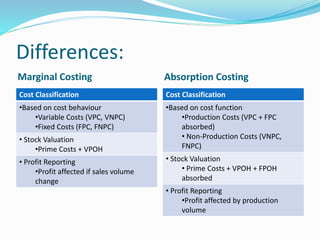
Differences:
Marginal Costing Absorption Costing
Cost Classification
•Based on cost behaviour
•Variable Costs (VPC, VNPC)
•Fixed Costs (FPC, FNPC)
• Stock Valuation
•Prime Costs + VPOH
• Profit Reporting
•Profit affected if sales volume
change
Cost Classification
•Based on cost function
•Production Costs (VPC + FPC
absorbed)
• Non-Production Costs (VNPC,
FNPC)
• Stock Valuation
• Prime Costs + VPOH + FPOH
absorbed
• Profit Reporting
•Profit affected by production
volume
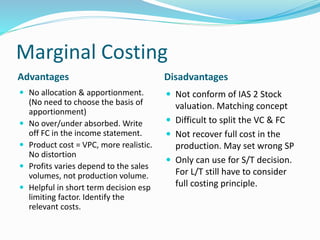
Marginal Costing
Advantages Disadvantages
 No allocation & apportionment.
(No need to choose the basis of
apportionment)
 No over/under absorbed. Write
off FC in the income statement.
 Product cost = VPC, more realistic.
No distortion
 Profits varies depend to the sales
volumes, not production volume.
 Helpful in short term decision esp
limiting factor. Identify the
relevant costs.
 Not conform of IAS 2 Stock
valuation. Matching concept
 Difficult to split the VC & FC
 Not recover full cost in the
production. May set wrong SP
 Only can use for S/T decision.
For L/T still have to consider
full costing principle.
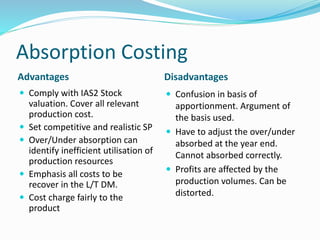
Absorption Costing
Advantages Disadvantages
 Comply with IAS2 Stock
valuation. Cover all relevant
production cost.
 Set competitive and realistic SP
 Over/Under absorption can
identify inefficient utilisation of
production resources
 Emphasis all costs to be
recover in the L/T DM.
 Cost charge fairly to the
product
 Confusion in basis of
apportionment. Argument of
the basis used.
 Have to adjust the over/under
absorbed at the year end.
Cannot absorbed correctly.
 Profits are affected by the
production volumes. Can be
distorted.
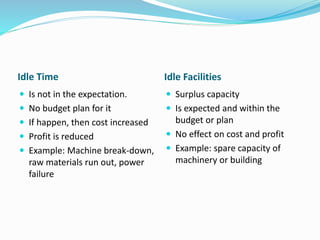
Idle Time Idle Facilities
 Is not in the expectation.
 No budget plan for it
 If happen, then cost increased
 Profit is reduced
 Example: Machine break-down,
raw materials run out, power
failure
 Surplus capacity
 Is expected and within the
budget or plan
 No effect on cost and profit
 Example: spare capacity of
machinery or building
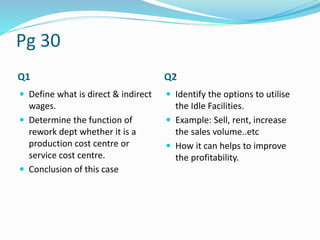
Pg 30
Q1 Q2
 Define what is direct & indirect
wages.
 Determine the function of
rework dept whether it is a
production cost centre or
service cost centre.
 Conclusion of this case
 Identify the options to utilise
the Idle Facilities.
 Example: Sell, rent, increase
the sales volume..etc
 How it can helps to improve
the profitability.
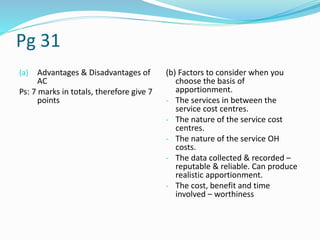
Pg 31
(a) Advantages & Disadvantages of
AC
Ps: 7 marks in totals, therefore give 7
points
(b) Factors to consider when you
choose the basis of
apportionment.
- The services in between the
service cost centres.
- The nature of the service cost
centres.
- The nature of the service OH
costs.
- The data collected & recorded –
reputable & reliable. Can produce
realistic apportionment.
- The cost, benefit and time
involved – worthiness

Marginal Costing vs Absorption Costing - ACCA - F5

  • 1.
  • 2.
    Differences: Marginal Costing AbsorptionCosting Cost Classification •Based on cost behaviour •Variable Costs (VPC, VNPC) •Fixed Costs (FPC, FNPC) • Stock Valuation •Prime Costs + VPOH • Profit Reporting •Profit affected if sales volume change Cost Classification •Based on cost function •Production Costs (VPC + FPC absorbed) • Non-Production Costs (VNPC, FNPC) • Stock Valuation • Prime Costs + VPOH + FPOH absorbed • Profit Reporting •Profit affected by production volume
  • 3.
    Marginal Costing Advantages Disadvantages No allocation & apportionment. (No need to choose the basis of apportionment)  No over/under absorbed. Write off FC in the income statement.  Product cost = VPC, more realistic. No distortion  Profits varies depend to the sales volumes, not production volume.  Helpful in short term decision esp limiting factor. Identify the relevant costs.  Not conform of IAS 2 Stock valuation. Matching concept  Difficult to split the VC & FC  Not recover full cost in the production. May set wrong SP  Only can use for S/T decision. For L/T still have to consider full costing principle.
  • 4.
    Absorption Costing Advantages Disadvantages Comply with IAS2 Stock valuation. Cover all relevant production cost.  Set competitive and realistic SP  Over/Under absorption can identify inefficient utilisation of production resources  Emphasis all costs to be recover in the L/T DM.  Cost charge fairly to the product  Confusion in basis of apportionment. Argument of the basis used.  Have to adjust the over/under absorbed at the year end. Cannot absorbed correctly.  Profits are affected by the production volumes. Can be distorted.
  • 5.
    Idle Time IdleFacilities  Is not in the expectation.  No budget plan for it  If happen, then cost increased  Profit is reduced  Example: Machine break-down, raw materials run out, power failure  Surplus capacity  Is expected and within the budget or plan  No effect on cost and profit  Example: spare capacity of machinery or building
  • 6.
    Pg 30 Q1 Q2 Define what is direct & indirect wages.  Determine the function of rework dept whether it is a production cost centre or service cost centre.  Conclusion of this case  Identify the options to utilise the Idle Facilities.  Example: Sell, rent, increase the sales volume..etc  How it can helps to improve the profitability.
  • 7.
    Pg 31 (a) Advantages& Disadvantages of AC Ps: 7 marks in totals, therefore give 7 points (b) Factors to consider when you choose the basis of apportionment. - The services in between the service cost centres. - The nature of the service cost centres. - The nature of the service OH costs. - The data collected & recorded – reputable & reliable. Can produce realistic apportionment. - The cost, benefit and time involved – worthiness