Unit 9 Management Accounting

COST MEASUREMENT
LEARNING OUTCOME

Calculate costs using
appropriate techniques
TOPICS
Review

of Last session
Group Reporting
Different Costing
Methods
REVIEW OF LAST SESSION

Costing methods
Group Works
COST TERMS










Cost object is anything for which a separate
measurement of costs is desired.
Direct costs of a cost object are costs that are
related to the particular cost object and can be
traced to it in an economically feasible way.
Indirect costs of a cost object are costs that are
related to the particular cost object but cannot be
traced to it in an economically feasible way.
Cost pool is a grouping of individual cost items.
Cost allocation base is a factor that is the
common denominator for systematically linking an
indirect cost or group of indirect costs to a cost
ABSORPTION COSTING
ABSORPTION COSTING
A managerial accounting cost method of
expensing all costs associated with
manufacturing a particular product.
 Absorption costing uses the total direct costs
and overhead costs associated with
manufacturing a product as the cost base.

INVENTORY COSTS IN ABSORPTION


inventory costs are made up of the following
under Absorption Costing:

• Direct Labor;
 • Direct Materials; and
 • Manufacturing Overhead (regardless of
whether it is fixed or variable)



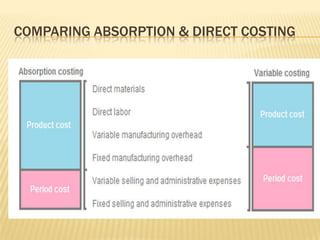
Under absorption costing system, the
product cost consists of all variable as well
as all fixed manufacturing costs i.e., direct
materials, direct labor and factory overhead
(FOH).
VARIABLE/ DIRECT COSTING
VARIABLE/DIRECT COSTING
Method in which the cost of a product or
operation is determined by allocating to it an
appropriate portion of the variable (direct)
costs.
 Direct costing treats fixed costs (overheads
such as administrative and selling costs) as
period costs (associated with time and
not output).



When variable costing system is used, the
fixed cost (both manufacturing and nonmanufacturing) is treated as a period or
capacity cost and therefore is not included in
the product cost.
COMPARING ABSORPTION & DIRECT COSTING
SAMPLE


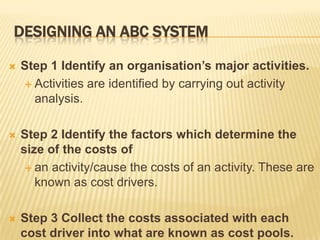

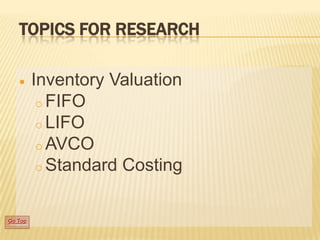





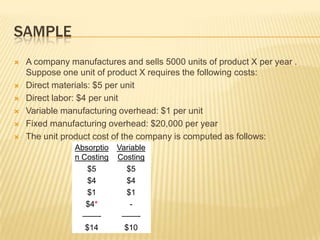
A company manufactures and sells 5000 units of product X per year .
Suppose one unit of product X requires the following costs:
Direct materials: $5 per unit
Direct labor: $4 per unit
Variable manufacturing overhead: $1 per unit
Fixed manufacturing overhead: $20,000 per year
The unit product cost of the company is computed as follows:
Absorptio
n Costing
$5
$4
$1
$4*
——$14

Variable
Costing
$5
$4
$1
——$10


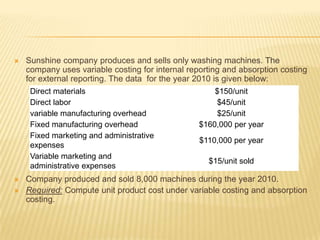
Sunshine company produces and sells only washing machines. The
company uses variable costing for internal reporting and absorption costing
for external reporting. The data for the year 2010 is given below:
Direct materials
Direct labor
variable manufacturing overhead
Fixed manufacturing overhead
Fixed marketing and administrative
expenses
Variable marketing and
administrative expenses




$150/unit
$45/unit
$25/unit
$160,000 per year
$110,000 per year
$15/unit sold

Company produced and sold 8,000 machines during the year 2010.
Required: Compute unit product cost under variable costing and absorption
costing.
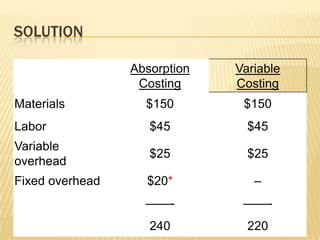
SOLUTION
Absorption
Costing

Variable
Costing

Materials

$150

$150

Labor

$45

$45

Variable
overhead

$25

$25

Fixed overhead

$20*

–

——-

——-

240

220
DIFFERENCE BETWEEN ABSORPTION
AND MARGINAL COSTING

18
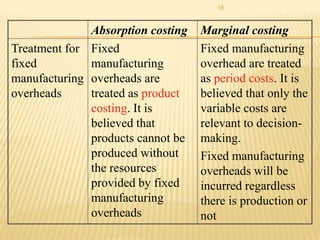
19

Absorption costing
Treatment for Fixed
fixed
manufacturing
manufacturing overheads are
overheads
treated as product
costing. It is
believed that
products cannot be
produced without
the resources
provided by fixed
manufacturing
overheads

Marginal costing
Fixed manufacturing
overhead are treated
as period costs. It is
believed that only the
variable costs are
relevant to decisionmaking.
Fixed manufacturing
overheads will be
incurred regardless
there is production or
not
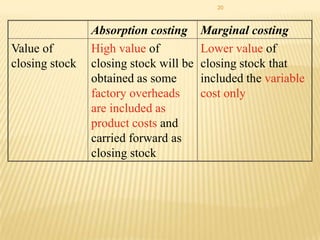
20

Value of
closing stock

Absorption costing
High value of
closing stock will be
obtained as some
factory overheads
are included as
product costs and
carried forward as
closing stock

Marginal costing
Lower value of
closing stock that
included the variable
cost only
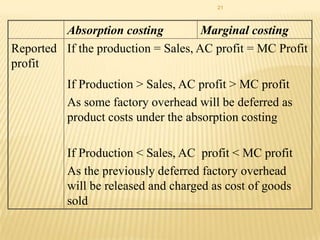
21

Absorption costing
Marginal costing
Reported If the production = Sales, AC profit = MC Profit
profit
If Production > Sales, AC profit > MC profit
As some factory overhead will be deferred as
product costs under the absorption costing
If Production < Sales, AC profit < MC profit
As the previously deferred factory overhead
will be released and charged as cost of goods
sold
ARGUMENT FOR ABSORPTION
COSTING

22
23





Compliance with the generally accepted accounting
principles
Importance of fixed overheads for production
Avoidance of fictitious profit or loss




During the period of high sales, the production is small
than the sales, a smaller number of fixed manufacturing
overheads are charged and a higher net profit will be
obtained under marginal costing
Absorption costing is better in avoiding the fluctuation of
profit being reported in marginal costing
ARGUMENTS FOR MARGINAL COSTING

24
25




More relevance to decision-making
Avoidance of profit manipulation




Marginal costing can avoid profit manipulation by
adjusting the stock level

Consideration given to fixed cost


In fact, marginal costing does not ignore fixed costs in
setting the selling price. On the contrary, it provides
useful information for break-even analysis that indicates
whether fixed costs can be converted with the change in
sales volume
TRADITIONAL COSTING
TRADITIONAL COSTING
The allocation of manufacturing overhead
(indirect manufacturing costs) to products on the
basis of a volume metric such as direct labor
hours or production machine hours.
 As manufacturing becomes more sophisticated
the manufacturing overhead costs usually
increase while the direct labor hours or
production machine hours decrease. Hence, the
direct labor or machine hours are unlikely to be
the root cause of the manufacturing overhead

EXPENSE ALLOCATIONS


Traditional cost accounting systems
assign operating expenses to products
with a two-stage procedure:
1. Expenses are assigned to production

departments
2. Production department expenses are
assigned to the products


Departmental structure influences the
first-stage allocation process
EFFECT OF DEPARTMENTAL STRUCTURE
Departments that have direct responsibility
for converting raw materials into finished
products are called production
departments
 Service departments perform activities
that support production, such as:


• Machine maintenance

• Production engineering

• Machine setup

• Production scheduling

– All service department costs are indirect support
activity costs because they do not arise from direct
production activities
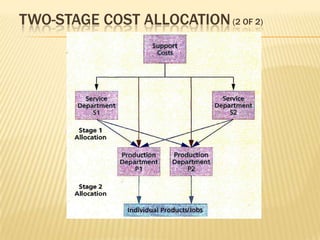
TWO-STAGE COST ALLOCATION
Conventional product costing systems assign
indirect costs to jobs or products in two stages
1.
In the first stage:




2.

System identifies indirect costs with various
production and service departments
Service department costs are then allocated to
production departments

The system assigns the accumulated indirect
costs for the production departments to
individual jobs or products based on
predetermined departmental cost driver rates
TWO-STAGE COST ALLOCATION (2 OF 2)
ALLOCATING SERVICE DEPARTMENT
COSTS TO PRODUCTION DEPARTMENTS


There are three ways that companies
allocate service department costs to
production departments:
 Direct

allocation
 Sequential allocation
 Reciprocal allocation


The last two are used when service
departments consume services provided by
other departments
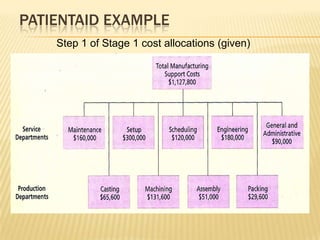
PATIENTAID EXAMPLE
Step 1 of Stage 1 cost allocations (given)
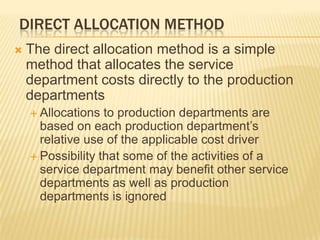
DIRECT ALLOCATION METHOD


The direct allocation method is a simple
method that allocates the service
department costs directly to the production
departments
 Allocations

to production departments are
based on each production department’s
relative use of the applicable cost driver
 Possibility that some of the activities of a
service department may benefit other service
departments as well as production
departments is ignored
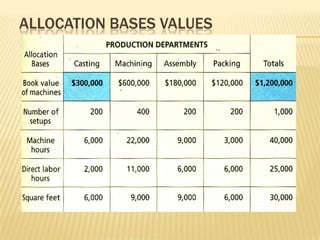
ALLOCATION BASES VALUES
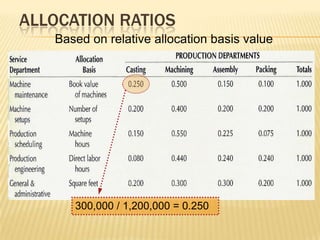
ALLOCATION RATIOS
Based on relative allocation basis value

300,000 / 1,200,000 = 0.250
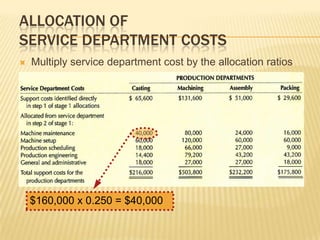
ALLOCATION OF
SERVICE DEPARTMENT COSTS


Multiply service department cost by the allocation ratios

$160,000 x 0.250 = $40,000
STAGE 2 COST ALLOCATIONS


Stage 2 allocations








Require the identification of appropriate cost drivers
for each production department
Assign production department costs to jobs and
products while they are worked on in the departments

Conventional cost accounting systems use unitrelated cost drivers
Dividing the indirect costs accumulated in each
production department by the total number of
units of the corresponding cost driver results in
cost driver rates for each department
PATIENTAID STAGE 2






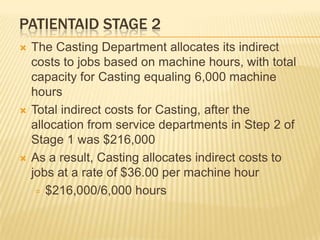
The Casting Department allocates its indirect
costs to jobs based on machine hours, with total
capacity for Casting equaling 6,000 machine
hours
Total indirect costs for Casting, after the
allocation from service departments in Step 2 of
Stage 1 was $216,000
As a result, Casting allocates indirect costs to
jobs at a rate of $36.00 per machine hour
= $216,000/6,000 hours
PATIENTAID STAGE 2


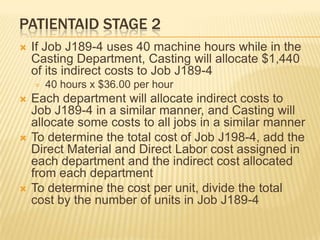
If Job J189-4 uses 40 machine hours while in the
Casting Department, Casting will allocate $1,440
of its indirect costs to Job J189-4
=







40 hours x $36.00 per hour

Each department will allocate indirect costs to
Job J189-4 in a similar manner, and Casting will
allocate some costs to all jobs in a similar manner
To determine the total cost of Job J198-4, add the
Direct Material and Direct Labor cost assigned in
each department and the indirect cost allocated
from each department
To determine the cost per unit, divide the total
cost by the number of units in Job J189-4
ACTIVITY BASED COSTING
ACTIVITY-BASED COSTING (OVERHEAD)
An accounting method that identifies the
activities that a firm performs, and then
assigns indirect costs to products.
 An activity based costing (ABC) system
recognizes the relationship between costs,
activities and products, and through this
relationship assigns indirect costs to
products less arbitrarily than traditional
methods.

assigns manufacturing overhead costs to
products in a more logical manner than the
traditional approach of simply allocating costs
on the basis of machine hours.
 Activity based costing first assigns costs to the
activities that are the real cause of the
overhead.
 It then assigns the cost of those activities only
to the products that are actually demanding the
activities.

WHAT IS ACTIVITY BASED COSTING?
Activity

Based Costing (ABC)
involves the identification of the
factors which cause the costs of
an organisation’s major
activities.
INTRODUCTION
The direct costs are easy to ascertain as one
knows the labour and material, etc. that went
into the product.
 The indirect cost of overheads are quite
different.
 This unit will introduce Absorption Costing
(traditional costing) and then compare it to
Activity Based Costing.
 The unit then looks at Activity Based Costing in
more detail by recognising the types of cost
drivers, designing an ABC system, and, finally,
considering the Resource Consumption Model.

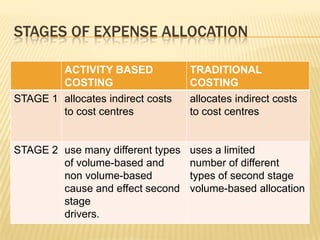
STAGES OF EXPENSE ALLOCATION
ACTIVITY BASED
COSTING
STAGE 1 allocates indirect costs
to cost centres

TRADITIONAL
COSTING
allocates indirect costs
to cost centres

STAGE 2 use many different types
of volume-based and
non volume-based
cause and effect second
stage
drivers.

uses a limited
number of different
types of second stage
volume-based allocation
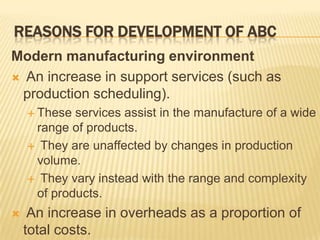
REASONS FOR DEVELOPMENT OF ABC
Modern manufacturing environment
 An increase in support services (such as
production scheduling).
 These

services assist in the manufacture of a wide
range of products.
 They are unaffected by changes in production
volume.
 They vary instead with the range and complexity
of products.


An increase in overheads as a proportion of
total costs.
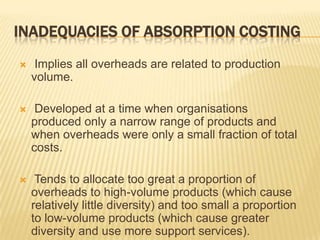
INADEQUACIES OF ABSORPTION COSTING


Implies all overheads are related to production
volume.



Developed at a time when organisations
produced only a narrow range of products and
when overheads were only a small fraction of total
costs.



Tends to allocate too great a proportion of
overheads to high-volume products (which cause
relatively little diversity) and too small a proportion
to low-volume products (which cause greater
diversity and use more support services).
A COMPARISON
ABSORPTION
COSTING VS.
ACTIVITY BASED
COSTING
ABSORPTION COSTING [TRADITIONAL METHOD]
 Absorption

costing is an old method of
product costing which aims to include
in the total cost of a product (unit, job
and so on) an appropriate share of an
organisation’s total overhead.
 Product costs are built up using
absorption costing by a process of
allocation,
apportionment
and
overhead absorption.
STAGES TO APPORTIONING OVERHEADS
(1) The first stage of overhead apportionment
involves sharing out (or apportioning) the
overheads within general overhead cost centres
between the other cost centres using a fair basis
of apportionment.
(2) The second stage of overhead apportionment is
to apportion the costs of service cost centres (both
directly allocated and apportioned costs) to
product cost centres.
The final stages (stage 3 and 4) in absorption
costing is the absorption into product costs (using
overhead absorption rates) of the overheads
which have been allocated and apportioned to the
product cost centres.
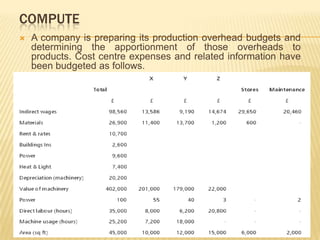
COMPUTE


A company is preparing its production overhead budgets and
determining the apportionment of those overheads to
products. Cost centre expenses and related information have
been budgeted as follows.
REQUIRED


Calculate overhead totals for all departments
by using direct apportionment as an
appropriate basis for apportionment.



Note: Service overheads of stores and
maintenance are allocated on the basis of
direct
labour
and
machine
usage
respectively.
STAGE 1
1.

The Indirect Expense of Materials and indirect
wages can be directly allocated to the
production cost centres XYZ and to the service
department’s stores and maintenance (as
these actually occurred in the departments).

2. The overheads of Rent and Rates, Building
Insurance, Power, light and heat, and
depreciation need to be apportioned (i.e. shared
out) using a fair and suitable basis.
CONT...
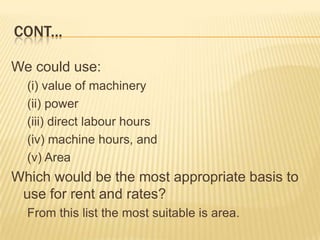
We could use:
(i) value of machinery
(ii) power
(iii) direct labour hours
(iv) machine hours, and
(v) Area

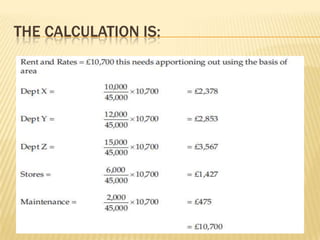
Which would be the most appropriate basis to
use for rent and rates?
From this list the most suitable is area.
THE CALCULATION IS:
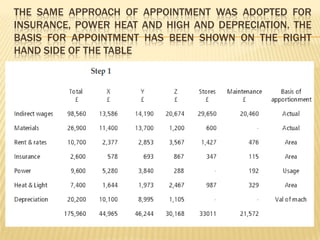
THE SAME APPROACH OF APPOINTMENT WAS ADOPTED FOR
INSURANCE, POWER HEAT AND HIGH AND DEPRECIATION. THE
BASIS FOR APPOINTMENT HAS BEEN SHOWN ON THE RIGHT
HAND SIDE OF THE TABLE
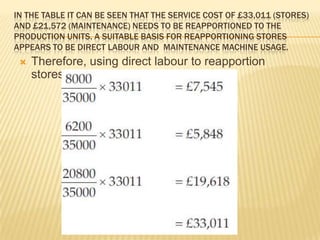
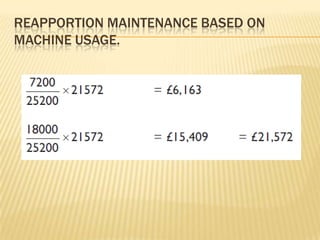
IN THE TABLE IT CAN BE SEEN THAT THE SERVICE COST OF £33,011 (STORES)
AND £21,572 (MAINTENANCE) NEEDS TO BE REAPPORTIONED TO THE
PRODUCTION UNITS. A SUITABLE BASIS FOR REAPPORTIONING STORES
APPEARS TO BE DIRECT LABOUR AND MAINTENANCE MACHINE USAGE.


Therefore, using direct labour to reapportion
stores
REAPPORTION MAINTENANCE BASED ON
MACHINE USAGE.
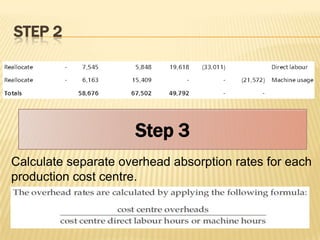
STEP 2

Step 3
Calculate separate overhead absorption rates for each
production cost centre.
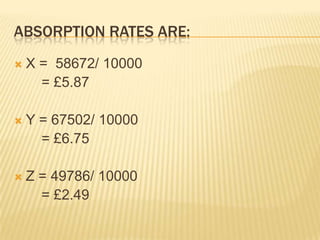
ABSORPTION RATES ARE:


X = 58672/ 10000
= £5.87



Y = 67502/ 10000
= £6.75



Z = 49786/ 10000
= £2.49
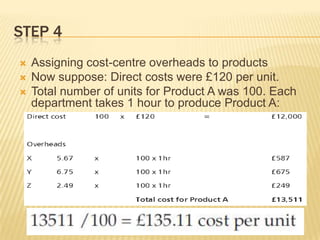
STEP 4




Assigning cost-centre overheads to products
Now suppose: Direct costs were £120 per unit.
Total number of units for Product A was 100. Each
department takes 1 hour to produce Product A:
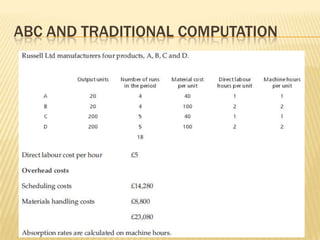
ABC AND TRADITIONAL COMPUTATION
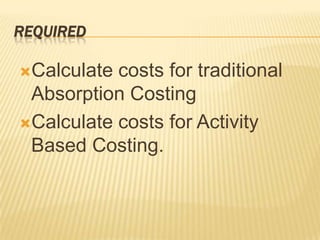
REQUIRED
Calculate

costs for traditional
Absorption Costing
Calculate costs for Activity
Based Costing.
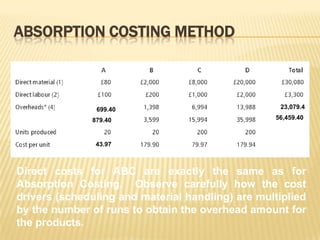
ABSORPTION COSTING METHOD

699.40
879.40

23,079.4
0
56,459.40

43.97

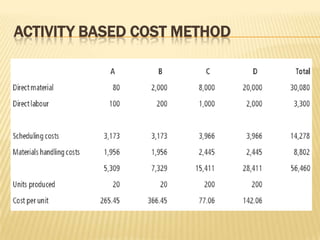
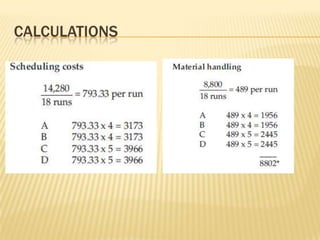
Direct costs for ABC are exactly the same as for
Absorption Costing. Observe carefully how the cost
drivers (scheduling and material handling) are multiplied
by the number of runs to obtain the overhead amount for
the products.
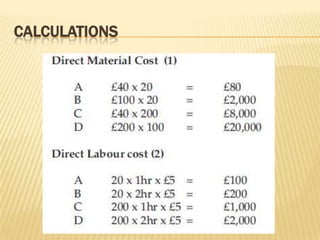
CALCULATIONS
OVERHEAD CALCULATIONS







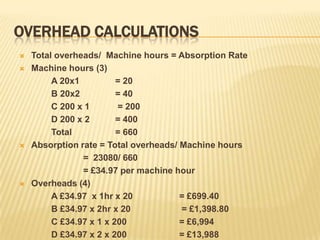
Total overheads/ Machine hours = Absorption Rate
Machine hours (3)
A 20x1
= 20
B 20x2
= 40
C 200 x 1
= 200
D 200 x 2
= 400
Total
= 660
Absorption rate = Total overheads/ Machine hours
= 23080/ 660
= £34.97 per machine hour
Overheads (4)
A £34.97 x 1hr x 20
= £699.40
B £34.97 x 2hr x 20
= £1,398.80
C £34.97 x 1 x 200
= £6,994
D £34.97 x 2 x 200
= £13,988
ACTIVITY BASED COST METHOD
CALCULATIONS
SUMMARY

43.97

221.4
8
CONCLUSION
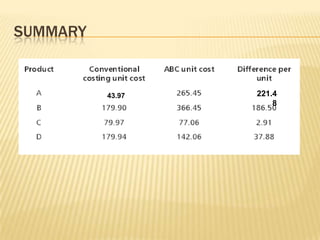
The figures suggest that the traditional volume-based
absorption costing system is flawed.
(a) It under allocates overhead costs to low-volume
products (here A and B) and over-allocates
overheads to higher-volume products (here Z in
particular)
(b) It under allocates overhead costs to smaller-sized
products (here A and C with just one hour of work
needed per unit) and over allocates overheads to
larger products (here B and D)
COST DRIVERS


A cost driver is a factor which causes a
change in the cost of an activity.
VOLUME-BASED AND NON-VOLUME-BASED COST
DRIVERS


ABC systems rely on a greater number and
variety of second stage cost drivers. The term
‘variety of cost drivers’ refers to the fact that
ABC systems use both volume-based and non
volume-based cost drivers.



Volume-based drivers are appropriate where
the activities are performed each time a unit of
the product or service is produced. In contrast,
non-volume related activities are not performed
each time aunit of the product or service is
produced.
ACTIVITY COST DRIVERS


Activity cost drivers consist of transaction
and duration drivers.



Transaction drivers, such as the number of
purchase orders processed, number of
customer orders processed, number of
inspections performed and the number of
set-ups undertaken, all count the number
of times an activity is performed.
DESIGNING AN ABC SYSTEM


Step 1 Identify an organisation’s major activities.
 Activities are identified by carrying out activity
analysis.



Step 2 Identify the factors which determine the
size of the costs of
 an activity/cause the costs of an activity. These are
known as cost drivers.



Step 3 Collect the costs associated with each
cost driver into what are known as cost pools.
TOPICS FOR RESEARCH
Inventory Valuation
o FIFO
o LIFO
o AVCO
o Standard Costing

Go Top
REQUIRED
Calculate costs using
appropriate techniques

Go Top
END OF SESSION

Unit 9 cost measurement

  • 1.
    Unit 9 ManagementAccounting COST MEASUREMENT
  • 2.
    LEARNING OUTCOME Calculate costsusing appropriate techniques
  • 3.
    TOPICS Review of Last session GroupReporting Different Costing Methods
  • 4.
    REVIEW OF LASTSESSION Costing methods Group Works
  • 5.
  • 6.
         Cost object isanything for which a separate measurement of costs is desired. Direct costs of a cost object are costs that are related to the particular cost object and can be traced to it in an economically feasible way. Indirect costs of a cost object are costs that are related to the particular cost object but cannot be traced to it in an economically feasible way. Cost pool is a grouping of individual cost items. Cost allocation base is a factor that is the common denominator for systematically linking an indirect cost or group of indirect costs to a cost
  • 7.
  • 8.
    ABSORPTION COSTING A managerialaccounting cost method of expensing all costs associated with manufacturing a particular product.  Absorption costing uses the total direct costs and overhead costs associated with manufacturing a product as the cost base. 
  • 9.
    INVENTORY COSTS INABSORPTION  inventory costs are made up of the following under Absorption Costing: • Direct Labor;  • Direct Materials; and  • Manufacturing Overhead (regardless of whether it is fixed or variable) 
  • 10.
     Under absorption costingsystem, the product cost consists of all variable as well as all fixed manufacturing costs i.e., direct materials, direct labor and factory overhead (FOH).
  • 11.
  • 12.
    VARIABLE/DIRECT COSTING Method inwhich the cost of a product or operation is determined by allocating to it an appropriate portion of the variable (direct) costs.  Direct costing treats fixed costs (overheads such as administrative and selling costs) as period costs (associated with time and not output). 
  • 13.
     When variable costingsystem is used, the fixed cost (both manufacturing and nonmanufacturing) is treated as a period or capacity cost and therefore is not included in the product cost.
  • 14.
    COMPARING ABSORPTION &DIRECT COSTING
  • 15.
    SAMPLE       A company manufacturesand sells 5000 units of product X per year . Suppose one unit of product X requires the following costs: Direct materials: $5 per unit Direct labor: $4 per unit Variable manufacturing overhead: $1 per unit Fixed manufacturing overhead: $20,000 per year The unit product cost of the company is computed as follows: Absorptio n Costing $5 $4 $1 $4* ——$14 Variable Costing $5 $4 $1 ——$10
  • 16.
     Sunshine company producesand sells only washing machines. The company uses variable costing for internal reporting and absorption costing for external reporting. The data for the year 2010 is given below: Direct materials Direct labor variable manufacturing overhead Fixed manufacturing overhead Fixed marketing and administrative expenses Variable marketing and administrative expenses   $150/unit $45/unit $25/unit $160,000 per year $110,000 per year $15/unit sold Company produced and sold 8,000 machines during the year 2010. Required: Compute unit product cost under variable costing and absorption costing.
  • 17.
  • 18.
  • 19.
    19 Absorption costing Treatment forFixed fixed manufacturing manufacturing overheads are overheads treated as product costing. It is believed that products cannot be produced without the resources provided by fixed manufacturing overheads Marginal costing Fixed manufacturing overhead are treated as period costs. It is believed that only the variable costs are relevant to decisionmaking. Fixed manufacturing overheads will be incurred regardless there is production or not
  • 20.
    20 Value of closing stock Absorptioncosting High value of closing stock will be obtained as some factory overheads are included as product costs and carried forward as closing stock Marginal costing Lower value of closing stock that included the variable cost only
  • 21.
    21 Absorption costing Marginal costing ReportedIf the production = Sales, AC profit = MC Profit profit If Production > Sales, AC profit > MC profit As some factory overhead will be deferred as product costs under the absorption costing If Production < Sales, AC profit < MC profit As the previously deferred factory overhead will be released and charged as cost of goods sold
  • 22.
  • 23.
    23    Compliance with thegenerally accepted accounting principles Importance of fixed overheads for production Avoidance of fictitious profit or loss   During the period of high sales, the production is small than the sales, a smaller number of fixed manufacturing overheads are charged and a higher net profit will be obtained under marginal costing Absorption costing is better in avoiding the fluctuation of profit being reported in marginal costing
  • 24.
  • 25.
    25   More relevance todecision-making Avoidance of profit manipulation   Marginal costing can avoid profit manipulation by adjusting the stock level Consideration given to fixed cost  In fact, marginal costing does not ignore fixed costs in setting the selling price. On the contrary, it provides useful information for break-even analysis that indicates whether fixed costs can be converted with the change in sales volume
  • 26.
  • 27.
    TRADITIONAL COSTING The allocationof manufacturing overhead (indirect manufacturing costs) to products on the basis of a volume metric such as direct labor hours or production machine hours.  As manufacturing becomes more sophisticated the manufacturing overhead costs usually increase while the direct labor hours or production machine hours decrease. Hence, the direct labor or machine hours are unlikely to be the root cause of the manufacturing overhead 
  • 28.
    EXPENSE ALLOCATIONS  Traditional costaccounting systems assign operating expenses to products with a two-stage procedure: 1. Expenses are assigned to production departments 2. Production department expenses are assigned to the products  Departmental structure influences the first-stage allocation process
  • 29.
    EFFECT OF DEPARTMENTALSTRUCTURE Departments that have direct responsibility for converting raw materials into finished products are called production departments  Service departments perform activities that support production, such as:  • Machine maintenance • Production engineering • Machine setup • Production scheduling – All service department costs are indirect support activity costs because they do not arise from direct production activities
  • 30.
    TWO-STAGE COST ALLOCATION Conventionalproduct costing systems assign indirect costs to jobs or products in two stages 1. In the first stage:   2. System identifies indirect costs with various production and service departments Service department costs are then allocated to production departments The system assigns the accumulated indirect costs for the production departments to individual jobs or products based on predetermined departmental cost driver rates
  • 31.
  • 32.
    ALLOCATING SERVICE DEPARTMENT COSTSTO PRODUCTION DEPARTMENTS  There are three ways that companies allocate service department costs to production departments:  Direct allocation  Sequential allocation  Reciprocal allocation  The last two are used when service departments consume services provided by other departments
  • 33.
    PATIENTAID EXAMPLE Step 1of Stage 1 cost allocations (given)
  • 34.
    DIRECT ALLOCATION METHOD  Thedirect allocation method is a simple method that allocates the service department costs directly to the production departments  Allocations to production departments are based on each production department’s relative use of the applicable cost driver  Possibility that some of the activities of a service department may benefit other service departments as well as production departments is ignored
  • 35.
  • 36.
    ALLOCATION RATIOS Based onrelative allocation basis value 300,000 / 1,200,000 = 0.250
  • 37.
    ALLOCATION OF SERVICE DEPARTMENTCOSTS  Multiply service department cost by the allocation ratios $160,000 x 0.250 = $40,000
  • 38.
    STAGE 2 COSTALLOCATIONS  Stage 2 allocations     Require the identification of appropriate cost drivers for each production department Assign production department costs to jobs and products while they are worked on in the departments Conventional cost accounting systems use unitrelated cost drivers Dividing the indirect costs accumulated in each production department by the total number of units of the corresponding cost driver results in cost driver rates for each department
  • 39.
    PATIENTAID STAGE 2    TheCasting Department allocates its indirect costs to jobs based on machine hours, with total capacity for Casting equaling 6,000 machine hours Total indirect costs for Casting, after the allocation from service departments in Step 2 of Stage 1 was $216,000 As a result, Casting allocates indirect costs to jobs at a rate of $36.00 per machine hour = $216,000/6,000 hours
  • 40.
    PATIENTAID STAGE 2  IfJob J189-4 uses 40 machine hours while in the Casting Department, Casting will allocate $1,440 of its indirect costs to Job J189-4 =    40 hours x $36.00 per hour Each department will allocate indirect costs to Job J189-4 in a similar manner, and Casting will allocate some costs to all jobs in a similar manner To determine the total cost of Job J198-4, add the Direct Material and Direct Labor cost assigned in each department and the indirect cost allocated from each department To determine the cost per unit, divide the total cost by the number of units in Job J189-4
  • 41.
  • 42.
    ACTIVITY-BASED COSTING (OVERHEAD) Anaccounting method that identifies the activities that a firm performs, and then assigns indirect costs to products.  An activity based costing (ABC) system recognizes the relationship between costs, activities and products, and through this relationship assigns indirect costs to products less arbitrarily than traditional methods. 
  • 43.
    assigns manufacturing overheadcosts to products in a more logical manner than the traditional approach of simply allocating costs on the basis of machine hours.  Activity based costing first assigns costs to the activities that are the real cause of the overhead.  It then assigns the cost of those activities only to the products that are actually demanding the activities. 
  • 44.
    WHAT IS ACTIVITYBASED COSTING? Activity Based Costing (ABC) involves the identification of the factors which cause the costs of an organisation’s major activities.
  • 45.
    INTRODUCTION The direct costsare easy to ascertain as one knows the labour and material, etc. that went into the product.  The indirect cost of overheads are quite different.  This unit will introduce Absorption Costing (traditional costing) and then compare it to Activity Based Costing.  The unit then looks at Activity Based Costing in more detail by recognising the types of cost drivers, designing an ABC system, and, finally, considering the Resource Consumption Model. 
  • 46.
    STAGES OF EXPENSEALLOCATION ACTIVITY BASED COSTING STAGE 1 allocates indirect costs to cost centres TRADITIONAL COSTING allocates indirect costs to cost centres STAGE 2 use many different types of volume-based and non volume-based cause and effect second stage drivers. uses a limited number of different types of second stage volume-based allocation
  • 47.
    REASONS FOR DEVELOPMENTOF ABC Modern manufacturing environment  An increase in support services (such as production scheduling).  These services assist in the manufacture of a wide range of products.  They are unaffected by changes in production volume.  They vary instead with the range and complexity of products.  An increase in overheads as a proportion of total costs.
  • 48.
    INADEQUACIES OF ABSORPTIONCOSTING  Implies all overheads are related to production volume.  Developed at a time when organisations produced only a narrow range of products and when overheads were only a small fraction of total costs.  Tends to allocate too great a proportion of overheads to high-volume products (which cause relatively little diversity) and too small a proportion to low-volume products (which cause greater diversity and use more support services).
  • 49.
  • 50.
    ABSORPTION COSTING [TRADITIONALMETHOD]  Absorption costing is an old method of product costing which aims to include in the total cost of a product (unit, job and so on) an appropriate share of an organisation’s total overhead.  Product costs are built up using absorption costing by a process of allocation, apportionment and overhead absorption.
  • 51.
    STAGES TO APPORTIONINGOVERHEADS (1) The first stage of overhead apportionment involves sharing out (or apportioning) the overheads within general overhead cost centres between the other cost centres using a fair basis of apportionment. (2) The second stage of overhead apportionment is to apportion the costs of service cost centres (both directly allocated and apportioned costs) to product cost centres. The final stages (stage 3 and 4) in absorption costing is the absorption into product costs (using overhead absorption rates) of the overheads which have been allocated and apportioned to the product cost centres.
  • 52.
    COMPUTE  A company ispreparing its production overhead budgets and determining the apportionment of those overheads to products. Cost centre expenses and related information have been budgeted as follows.
  • 53.
    REQUIRED  Calculate overhead totalsfor all departments by using direct apportionment as an appropriate basis for apportionment.  Note: Service overheads of stores and maintenance are allocated on the basis of direct labour and machine usage respectively.
  • 54.
    STAGE 1 1. The IndirectExpense of Materials and indirect wages can be directly allocated to the production cost centres XYZ and to the service department’s stores and maintenance (as these actually occurred in the departments). 2. The overheads of Rent and Rates, Building Insurance, Power, light and heat, and depreciation need to be apportioned (i.e. shared out) using a fair and suitable basis.
  • 55.
    CONT... We could use: (i)value of machinery (ii) power (iii) direct labour hours (iv) machine hours, and (v) Area Which would be the most appropriate basis to use for rent and rates? From this list the most suitable is area.
  • 56.
  • 57.
    THE SAME APPROACHOF APPOINTMENT WAS ADOPTED FOR INSURANCE, POWER HEAT AND HIGH AND DEPRECIATION. THE BASIS FOR APPOINTMENT HAS BEEN SHOWN ON THE RIGHT HAND SIDE OF THE TABLE
  • 58.
    IN THE TABLEIT CAN BE SEEN THAT THE SERVICE COST OF £33,011 (STORES) AND £21,572 (MAINTENANCE) NEEDS TO BE REAPPORTIONED TO THE PRODUCTION UNITS. A SUITABLE BASIS FOR REAPPORTIONING STORES APPEARS TO BE DIRECT LABOUR AND MAINTENANCE MACHINE USAGE.  Therefore, using direct labour to reapportion stores
  • 59.
  • 60.
    STEP 2 Step 3 Calculateseparate overhead absorption rates for each production cost centre.
  • 61.
    ABSORPTION RATES ARE:  X= 58672/ 10000 = £5.87  Y = 67502/ 10000 = £6.75  Z = 49786/ 10000 = £2.49
  • 62.
    STEP 4    Assigning cost-centreoverheads to products Now suppose: Direct costs were £120 per unit. Total number of units for Product A was 100. Each department takes 1 hour to produce Product A:
  • 63.
  • 64.
    REQUIRED Calculate costs for traditional AbsorptionCosting Calculate costs for Activity Based Costing.
  • 65.
    ABSORPTION COSTING METHOD 699.40 879.40 23,079.4 0 56,459.40 43.97 Directcosts for ABC are exactly the same as for Absorption Costing. Observe carefully how the cost drivers (scheduling and material handling) are multiplied by the number of runs to obtain the overhead amount for the products.
  • 66.
  • 67.
    OVERHEAD CALCULATIONS     Total overheads/Machine hours = Absorption Rate Machine hours (3) A 20x1 = 20 B 20x2 = 40 C 200 x 1 = 200 D 200 x 2 = 400 Total = 660 Absorption rate = Total overheads/ Machine hours = 23080/ 660 = £34.97 per machine hour Overheads (4) A £34.97 x 1hr x 20 = £699.40 B £34.97 x 2hr x 20 = £1,398.80 C £34.97 x 1 x 200 = £6,994 D £34.97 x 2 x 200 = £13,988
  • 68.
  • 69.
  • 70.
  • 71.
    CONCLUSION The figures suggestthat the traditional volume-based absorption costing system is flawed. (a) It under allocates overhead costs to low-volume products (here A and B) and over-allocates overheads to higher-volume products (here Z in particular) (b) It under allocates overhead costs to smaller-sized products (here A and C with just one hour of work needed per unit) and over allocates overheads to larger products (here B and D)
  • 72.
    COST DRIVERS  A costdriver is a factor which causes a change in the cost of an activity.
  • 73.
    VOLUME-BASED AND NON-VOLUME-BASEDCOST DRIVERS  ABC systems rely on a greater number and variety of second stage cost drivers. The term ‘variety of cost drivers’ refers to the fact that ABC systems use both volume-based and non volume-based cost drivers.  Volume-based drivers are appropriate where the activities are performed each time a unit of the product or service is produced. In contrast, non-volume related activities are not performed each time aunit of the product or service is produced.
  • 74.
    ACTIVITY COST DRIVERS  Activitycost drivers consist of transaction and duration drivers.  Transaction drivers, such as the number of purchase orders processed, number of customer orders processed, number of inspections performed and the number of set-ups undertaken, all count the number of times an activity is performed.
  • 75.
    DESIGNING AN ABCSYSTEM  Step 1 Identify an organisation’s major activities.  Activities are identified by carrying out activity analysis.  Step 2 Identify the factors which determine the size of the costs of  an activity/cause the costs of an activity. These are known as cost drivers.  Step 3 Collect the costs associated with each cost driver into what are known as cost pools.
  • 76.
    TOPICS FOR RESEARCH InventoryValuation o FIFO o LIFO o AVCO o Standard Costing Go Top
  • 77.
  • 78.