MANAGEMENT ACCOUNTING
Prepared and Presented By: Ramkumar Shah
Friday, April 18, 2014
Basic Learning Notes on
Introduction To Management Accounting
 Management accounting can be defined as
the process of identifying, analyzing &
communicating the managerial-cum-financial
records to the concerned authorities of
business organization for the purpose of
planning, decision making and controlling.
 It is quite different form the financial
accounting.
Management Accounting vs. Financial Accounting
Management and cost Accounting Financial Accounting
It focuses on the small part of the
organization. E.g. Individual product or
Activities.
Financial accounting reports refer to the
whole of the organization.
Cost and Management Accounting is
concerned with the provision of
information to managers that require for
planning, decision making and
controlling.
These reports are useful for the external
users outside the organization like
stakeholder, creditors, governmental
authorities etc.
It looks over the future as well as the past
of organization and has based on
estimation or forecasting.
It reports what has happened in the past.
These reports are made for internal
evaluation and control.
These reports are compulsorily needed
to the governmental authorities.
reports has lack of accuracy. The reports must be accurate.
This type of reports are made daily,
weekly, monthly or as per managerial
These reports are generally prepared at
the last of an accounting period
Objectives Of Management. Accounting
Changing role of management accountants:
 Information for planning, decision making
and controlling
 Directing and controlling the daily business
and administrative activities
 Motivating to labor and staffs
 Measuring the managerial performances
 Accumulating costs for stock valuation to
meet the requirements of external reporting
Cost Management: Allocation & Determination
 Cost is the price or the expenses which is
sacrificed to the acquiring of any particular
objects. We pay money or exchange the
things to get something; is called the cost.
For example, buying books, travelling
through bus, purchase of machinery or
shares etc. So, in general sense, cost is
expenses made on business activities.
Terminological Meanings
 Cost object: for which the cost is incurred.
 Cost unit: a unit of the basis of measurement cost.
 Cost centers: a department, a unit of concerned
authorities or a branch of the org.
 Cost accumulation: a process of collecting cost
and managerial info. from different cost centers.
 Cost allocation: assessing and apportioning units
to a cost object for the purpose of determining total
cost of the product.
Cost Classification On Different Basis
 On the basis of product costing:
1) Direct cost (Prime cost):
The cost which can’t be easily identifiable to a
particular cost object. It includes:
a) direct materials/ raw materials: e.g. sugarcane for
sugar manufacturing company
b) direct labor: e.g. salary and wages paid to workers
and production manager
c) other direct expenses: e.g. cost of product
designing, installation cost, royalties, cost of patient rights
etc.
Cost Classification On Different Basis
2) Indirect costs or overhead costs:
The cost which can’t be easily traceable to a
particular cost object. These costs do not take part
in production process but help on. It includes:
a) Indirect materials: e.g. oil and grease used in
machinery, stick and paints used in furniture etc.
b) Indirect labor: e.g. factory supervisor or managers.
c) Other overheads cost: e.g. rent, electricity cost,
stationary cost used for manufacturing purpose.
On The Basis Of Profit Maximizing Decisions
1) Relevant costs (Avoidable costs): the cost
which is emerged due to the managerial decisions
and it vary from one alternative to another one.
These are future and differential costs.
2) Irrelevant costs (unavoidable costs): the cost
which are emerged even the decision does not
influence to happen. Such as, the pre-committed
costs, fixed costs or the current portion of past or
long term debts etc.
On The Basis Of Function
1) Manufacturing cost (Factory costs):the cost
which emerged during the production process in
the factory. E.g. purchase of raw materials,
carrying and installation cost etc.
2) General administrative and legal expenses:
the cost related to daily administration. E.g.
stationary cost, salary to staffs, rent of office etc.
3) Selling and distribution costs: the cost related
to selling the products to market, R&D, marketing
strategies cost like advertisement costs etc.
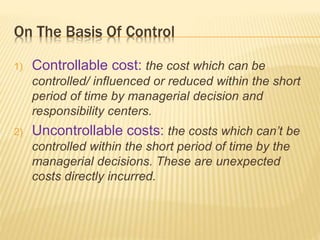
On The Basis Of Control
1) Controllable cost: the cost which can be
controlled/ influenced or reduced within the short
period of time by managerial decision and
responsibility centers.
2) Uncontrollable costs: the costs which can’t be
controlled within the short period of time by the
managerial decisions. These are unexpected
costs directly incurred.
On The Basis Of Absorption
1) Absorbed costs: the cost which is charged to
the given period of time or to the production cost
of that period. E.g. paying salary, rent of current
month to this month period.
2) Unabsorbed costs: the cost related to this year
is being transferred to another period or to another
year or remaining unchanged to this year; such
costs are called unabsorbed costs. E.g.
Outstanding salary
On The Basis Of Expiry Of Cost
1) Expired cost: the cost which has been expensed
during the given time period and has not remain
the potentiality to produce benefit in future.
2) Unexpired cost: the cost which has not
expensed during its time period and still has the
utility of producing potential benefit in future.
Behavioral Classification
1) Fixed costs: the cost remaining constant at each
activity level of production. For example, rent of
office building, depreciation on machinery etc.
features of fixed cost:
a) same in cost
b) variance in cost per unit that decreases
as per the increment in activity level.
Behavioral Classification
2) Variable costs: the cost which vary according to
the increment or decrement of production units.
These are caused to use the capacity. E.g.
manufacturing costs, selling and administrative
costs etc.
features of variable cost:
1) Change in production amount
2) Same in cost per unit
Behavioral Classification
3) Semi-variable or mixed costs: that cost which
has neither the features of variable nor of the fixed
cost. At the beginning, it is characterized by fixed
cost and later changes to variable cost. E.g.
payment of landline phone, postpaid phone,
electricity charge etc.
Identification Of Cost Behavior
Activity Level (in
units}
10,000 units 20,000 units 30,000 units
Total costs: (in Rs.)
Direct materials Rs. 20,000 Rs. 40,000 Variable cost
Cost per unit= Rs. 2 Rs. 2
Direct labor Rs.30,000 Rs. 60,000 Variable cost
Cost per unit= Rs.3 Rs. 3
depreciation Rs. 30,000 Rs. 30,000 Fixed cost
Cost per unit= Rs. 3 Rs. 1.5
Supervision Rs. 25,000 Rs. 45,000 Variable cost
Cost per unit= Rs. 2.5 Rs.
2.25
Rent of factory
building
Rs. 20,000 Rs. 20,000 Fixed cost
Cost per unit= Rs. 2 Rs. 1
Repairing costs Rs. 20,000 Rs. 30,000 semi-variable cost
Cost per unit= Rs. 2 Rs. 1.5
Heat, light & power Rs. 20,000 Rs. 25000 semi-variable cost
COST EQUATION
Total costs= total fixed costs + total variable cost
Or,
Y=a + b*X
Where,
a= fixed costs
y= total costs
b= variable cost per unit (VCPU)
X= activity level or production level or machine
hours
Cost Estimation Technique: segregation of cost
 High-low point method:
Variable cost per unit(VCPU)
b= high cost─ low cost
high unit ─ low unit
Total cost= fixed cost+ VCPU* activity volume
or, Y=a + b*X,
This method only consider and apply two points
of production process i.e. high and low point. On
the absence of any one of these points of cost
or unit, the total cost can’t be segregated to
apportionment- the fixed cost and variable cost.
Cost Estimation Technique: segregation of cost
 least-square regression method:
VCPU (b)= n*∑ x y ─ ∑ x. ∑ y
n. ∑x2— (∑x)2
Total cost function: Y=a + b * x
Fixed cost(a)=∑y/n─ ∑b/n*x
This method considers various activity level of
production. We prepare a table and find out VCPU
and the fixed cost accordingly.
Illustration: High-low Point Method
VCPU(b)= difference in cost/ difference in unit
or, (1000000—800000)/(100000—50000)
=Rs. 4 per unit.
Now, total fixed cost(a)= Y—b*x
At high activity level,
a= Rs.1000000—Rs. 4*100000 =Rs. 600000
Production in units 50,000 1,00,000
Total cost at Rs. 8,00,000 10,00,000
Illustration: Least-square Regression Method
Machine hour (x)
‘000
Maintenance cost
(Y) ‘000
X*y x2
110 235 25850 12100
100 215 21500 10000
140 260 36400 19600
130 255 33150 16900
120 235 28200 14400
∑x= 600 ∑y= 1200 ∑ x.y = 145100 ∑x2= 73000
Illustration: Least-square Regression Method
Now, VCPU (b)= 5*145100– 600*1200
5*73000– (600)2
= Rs. 1.1 per machine hour
And, a= ∑Y/n-- b. ∑x/n
=1200/5—1.1*600/5 = Rs. 108000
Preparation Of Income Statement
 Absorption costing method:
 Variable costing method:
Absorption costing method includes both
type of variable and fixed costs to its product
cost.
but, the variable costing method only
considers the variable cost item.
there is difference in answer of these two
distinct methods.
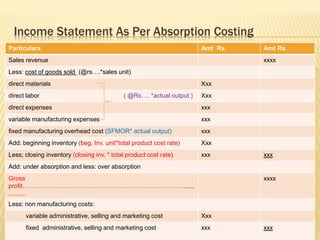
Income Statement As Per Absorption Costing
Particulars Amt Rs. Amt Rs.
Sales revenue xxxx
Less: cost of goods sold (@rs….*sales unit)
direct materials Xxx
direct labor ( @Rs…. *actual output ) Xxx
direct expenses xxx
variable manufacturing expenses xxx
fixed manufacturing overhead cost (SFMOR* actual output) xxx
Add: beginning inventory (beg. Inv. unit*total product cost rate) Xxx
Less; closing inventory (closing inv. * total product cost rate) xxx xxx
Add: under absorption and less: over absorption
Gross
profit……………………………………………………………………......
..........
xxxx
Less: non manufacturing costs:
variable administrative, selling and marketing cost Xxx
fixed administrative, selling and marketing cost xxx xxx
Income Statement As Per Variable Costing
Particulars Amt. Rs. Amt. Rs.
Sales revenue Xxxx
Less: variable cost of goods sold
opening inventory Xxx
Add: direct materials Xxx
direct labor Xxx
direct expenses Xxx
variable manufacturing costs Xxx
Less: closing inventory Xxx Xxxx
Gross contribution
margin……………………………………………………..
xxxx
Less: variable administrative and selling costs Xxx
net contribution
margin…………………………………………………………….
Xxxx
Less: fixed costs
Fixed manufacturing cost Xxx
Fixed administrative, selling and marketing cost xxx xxxx
Things To Remember (TTR)
Standard fixed manufacturing overhead(SFMOR)
is always calculated under average or normal
production level. And,
SFMOR= fixed manufacturing cost/normal output
Product or inventory cost include only the
manufacturing or factory fixed and variable
costs. In variable costing, other fixed and
variable administrative and selling costs are
deducted under the headings of fixed cost from
net contribution margin.
Preparation Of Reconciled Statements
Reconciliation statement from absorption
costingParticulars Amount Rs.
Net income from absorption costing xxxx
Add: fixed manufacturing cost on opening inventory
(opening inv. Units * SFMOR)
xxxx
Less: fixed manufacturing cost on closing inventory
(closing inv. Units * SFMOR)
xxxx
xxxx
Net income from variable
costing……………………………………………
xxxxxx
Note: while preparing from the variable costing, the fixed
manufacturing cost on opening inv. Must be less and the
another one should have added.
Reconciliation Statement
particulars Amt. Rs.
Net income from absorption costing 110000
Net income from variable costing 90000
# Difference in net
income
20000
Closing inventory 6000
Opening inventory 2000
Change in inventory/
stock (a)
4000
Standard fixed manufacturing overhead rate (SFMOR)
(b)
Rs. 5 per unit
Change in stock valuation (a*b) # 20000
Cost, Volume And Profit Analysis
To maximize the profit,
the company either
should have increased
the TR or decrease the
VC as much as possible
(but it does not decrease
even after the FC line).
Two distinct method has
different technique of
recording product costs.
Due to effect on product
cost, that also effects on
contribution margin and
accordingly on net
profit.
Things To Remember (TTR)
1) VCPU= VC/ sales unit
2) Required sales in units to earn desire profit
in % of SPPU= FC/ (SPPU—VCPU---
PPU+LPU)
3) PV ratio (CM ratio)=difference in profit
difference in sales revenue
4) CV ratio= 1– PV ratio= 1—(VCPU/SPPU)
5) Margin of safety (MOS)= Actual sales– BEP
sales and,
Things To Remember (TTR)
6) PV ratio (CM ratio)=CMPU/SPPU
7) CMPU=(TCM/total sales unit) = SPPU—VCPU
8) While applying equation,
sales= FC+ VC+ profit
9) Cash BEP in Rs. = cash FC only/ PV ratio
10) MOS in Rs.= MOS in units* SPPU
11) Incremental Profit= Incremental sales* PV
ratio, or,
Profit=(new sales revenue after increment * PV
ratio)--FC and, incremental sales= New—old.
Things To Remember (TTR)
12) BEP in units= FC/(SPPU—VCPU)
=FC/CMPU
13) Net profit= sales revenue(TR)– VC—FC
and,
CM= sales revenue– VC
14) CMPU= SPPU—VCPU
15) CM ratio(PV ratio)= CM/sales =
CMPU/SPPU=(SPPU-VCPU)/SPPU
16) profit= (sales revenue* PV ratio)– FC
17) profit= (sales units*CMPU)– FC
Things To Remember (TTR)
19) Required sales in units to earn desired
profit(before tax)=(FC + desire profit)/CMPU
20) Required sales in Rs. to earn desired
profit(before tax)=(FC + desire profit)/PV
ratio
21) Required sales in units to earn desired
profit after tax=(FC + (desire profit/(1-
taxrate))/CMPU
22) Required sales in Rs. to earn desired profit
after tax=(FC + (desire profit/(1-tax rate))/PV
Things To Remember (TTR)
23) Overall (composite, weighted average)
BEP:
Composite CMPU= CMPU* sales mix, For individual BEP:
composite PV ratio= PV ratio*sales mix, A’s BEP= Overall BEP*sales mix
sales ratio A:B= 2:3, TFC= Rs. 180000. =36000*2/5=14400 units
Overall BEP in units= TFC/ Composite CMPU and, for B’s
BEP=36000*3/5
=Rs. 180000/Rs. 5= 36000 units =21600 units
Product SPP
U
VCPU CMPU PV
ratio
Sales
mix
Composi
te CMPU
Composi
te PV
ratio
A 15 10 5 0.3 2/5 2 0.12
B 20 15 5 0.25 3/5 3 0.15
Total 5 0.27
Flexible Budget
 Budget is a specimen of costs that is
systematically prepared for future use. In every
decision making the budget should have
prepared. We need to classify and segregate
cost into fixed and variable cost before drafting
the budget sheet. Flexible Budget is the total of
fixed and variable costs. To segregate cost we
generally use high-low point method as
simplicity.
 Types:
1) Static Budget (Not Changeable)
2) Flexible Budget (Changeable)
Preparation Of Flexible Budget
Particulars 70000 units 80000 units
Variable costs: In Rs. In Rs.
Maintenance cost @ Rs. 0.7 49000 56000
Various costs @ Rs. 0.15 10500 12000
Total Variable
costs:…………………………………………………..
59500 68000
Fixed costs:
Salary 300000 300000
depreciation 60000 60000
Total Fixed
costs:……………………………………………………
…
360000 360000

Management accounting Presentation

  • 1.
    MANAGEMENT ACCOUNTING Prepared andPresented By: Ramkumar Shah Friday, April 18, 2014 Basic Learning Notes on
  • 2.
    Introduction To ManagementAccounting  Management accounting can be defined as the process of identifying, analyzing & communicating the managerial-cum-financial records to the concerned authorities of business organization for the purpose of planning, decision making and controlling.  It is quite different form the financial accounting.
  • 3.
    Management Accounting vs.Financial Accounting Management and cost Accounting Financial Accounting It focuses on the small part of the organization. E.g. Individual product or Activities. Financial accounting reports refer to the whole of the organization. Cost and Management Accounting is concerned with the provision of information to managers that require for planning, decision making and controlling. These reports are useful for the external users outside the organization like stakeholder, creditors, governmental authorities etc. It looks over the future as well as the past of organization and has based on estimation or forecasting. It reports what has happened in the past. These reports are made for internal evaluation and control. These reports are compulsorily needed to the governmental authorities. reports has lack of accuracy. The reports must be accurate. This type of reports are made daily, weekly, monthly or as per managerial These reports are generally prepared at the last of an accounting period
  • 4.
    Objectives Of Management.Accounting Changing role of management accountants:  Information for planning, decision making and controlling  Directing and controlling the daily business and administrative activities  Motivating to labor and staffs  Measuring the managerial performances  Accumulating costs for stock valuation to meet the requirements of external reporting
  • 5.
    Cost Management: Allocation& Determination  Cost is the price or the expenses which is sacrificed to the acquiring of any particular objects. We pay money or exchange the things to get something; is called the cost. For example, buying books, travelling through bus, purchase of machinery or shares etc. So, in general sense, cost is expenses made on business activities.
  • 6.
    Terminological Meanings  Costobject: for which the cost is incurred.  Cost unit: a unit of the basis of measurement cost.  Cost centers: a department, a unit of concerned authorities or a branch of the org.  Cost accumulation: a process of collecting cost and managerial info. from different cost centers.  Cost allocation: assessing and apportioning units to a cost object for the purpose of determining total cost of the product.
  • 7.
    Cost Classification OnDifferent Basis  On the basis of product costing: 1) Direct cost (Prime cost): The cost which can’t be easily identifiable to a particular cost object. It includes: a) direct materials/ raw materials: e.g. sugarcane for sugar manufacturing company b) direct labor: e.g. salary and wages paid to workers and production manager c) other direct expenses: e.g. cost of product designing, installation cost, royalties, cost of patient rights etc.
  • 8.
    Cost Classification OnDifferent Basis 2) Indirect costs or overhead costs: The cost which can’t be easily traceable to a particular cost object. These costs do not take part in production process but help on. It includes: a) Indirect materials: e.g. oil and grease used in machinery, stick and paints used in furniture etc. b) Indirect labor: e.g. factory supervisor or managers. c) Other overheads cost: e.g. rent, electricity cost, stationary cost used for manufacturing purpose.
  • 9.
    On The BasisOf Profit Maximizing Decisions 1) Relevant costs (Avoidable costs): the cost which is emerged due to the managerial decisions and it vary from one alternative to another one. These are future and differential costs. 2) Irrelevant costs (unavoidable costs): the cost which are emerged even the decision does not influence to happen. Such as, the pre-committed costs, fixed costs or the current portion of past or long term debts etc.
  • 10.
    On The BasisOf Function 1) Manufacturing cost (Factory costs):the cost which emerged during the production process in the factory. E.g. purchase of raw materials, carrying and installation cost etc. 2) General administrative and legal expenses: the cost related to daily administration. E.g. stationary cost, salary to staffs, rent of office etc. 3) Selling and distribution costs: the cost related to selling the products to market, R&D, marketing strategies cost like advertisement costs etc.
  • 11.
    On The BasisOf Control 1) Controllable cost: the cost which can be controlled/ influenced or reduced within the short period of time by managerial decision and responsibility centers. 2) Uncontrollable costs: the costs which can’t be controlled within the short period of time by the managerial decisions. These are unexpected costs directly incurred.
  • 12.
    On The BasisOf Absorption 1) Absorbed costs: the cost which is charged to the given period of time or to the production cost of that period. E.g. paying salary, rent of current month to this month period. 2) Unabsorbed costs: the cost related to this year is being transferred to another period or to another year or remaining unchanged to this year; such costs are called unabsorbed costs. E.g. Outstanding salary
  • 13.
    On The BasisOf Expiry Of Cost 1) Expired cost: the cost which has been expensed during the given time period and has not remain the potentiality to produce benefit in future. 2) Unexpired cost: the cost which has not expensed during its time period and still has the utility of producing potential benefit in future.
  • 14.
    Behavioral Classification 1) Fixedcosts: the cost remaining constant at each activity level of production. For example, rent of office building, depreciation on machinery etc. features of fixed cost: a) same in cost b) variance in cost per unit that decreases as per the increment in activity level.
  • 15.
    Behavioral Classification 2) Variablecosts: the cost which vary according to the increment or decrement of production units. These are caused to use the capacity. E.g. manufacturing costs, selling and administrative costs etc. features of variable cost: 1) Change in production amount 2) Same in cost per unit
  • 16.
    Behavioral Classification 3) Semi-variableor mixed costs: that cost which has neither the features of variable nor of the fixed cost. At the beginning, it is characterized by fixed cost and later changes to variable cost. E.g. payment of landline phone, postpaid phone, electricity charge etc.
  • 17.
    Identification Of CostBehavior Activity Level (in units} 10,000 units 20,000 units 30,000 units Total costs: (in Rs.) Direct materials Rs. 20,000 Rs. 40,000 Variable cost Cost per unit= Rs. 2 Rs. 2 Direct labor Rs.30,000 Rs. 60,000 Variable cost Cost per unit= Rs.3 Rs. 3 depreciation Rs. 30,000 Rs. 30,000 Fixed cost Cost per unit= Rs. 3 Rs. 1.5 Supervision Rs. 25,000 Rs. 45,000 Variable cost Cost per unit= Rs. 2.5 Rs. 2.25 Rent of factory building Rs. 20,000 Rs. 20,000 Fixed cost Cost per unit= Rs. 2 Rs. 1 Repairing costs Rs. 20,000 Rs. 30,000 semi-variable cost Cost per unit= Rs. 2 Rs. 1.5 Heat, light & power Rs. 20,000 Rs. 25000 semi-variable cost
  • 18.
    COST EQUATION Total costs=total fixed costs + total variable cost Or, Y=a + b*X Where, a= fixed costs y= total costs b= variable cost per unit (VCPU) X= activity level or production level or machine hours
  • 19.
    Cost Estimation Technique:segregation of cost  High-low point method: Variable cost per unit(VCPU) b= high cost─ low cost high unit ─ low unit Total cost= fixed cost+ VCPU* activity volume or, Y=a + b*X, This method only consider and apply two points of production process i.e. high and low point. On the absence of any one of these points of cost or unit, the total cost can’t be segregated to apportionment- the fixed cost and variable cost.
  • 20.
    Cost Estimation Technique:segregation of cost  least-square regression method: VCPU (b)= n*∑ x y ─ ∑ x. ∑ y n. ∑x2— (∑x)2 Total cost function: Y=a + b * x Fixed cost(a)=∑y/n─ ∑b/n*x This method considers various activity level of production. We prepare a table and find out VCPU and the fixed cost accordingly.
  • 21.
    Illustration: High-low PointMethod VCPU(b)= difference in cost/ difference in unit or, (1000000—800000)/(100000—50000) =Rs. 4 per unit. Now, total fixed cost(a)= Y—b*x At high activity level, a= Rs.1000000—Rs. 4*100000 =Rs. 600000 Production in units 50,000 1,00,000 Total cost at Rs. 8,00,000 10,00,000
  • 22.
    Illustration: Least-square RegressionMethod Machine hour (x) ‘000 Maintenance cost (Y) ‘000 X*y x2 110 235 25850 12100 100 215 21500 10000 140 260 36400 19600 130 255 33150 16900 120 235 28200 14400 ∑x= 600 ∑y= 1200 ∑ x.y = 145100 ∑x2= 73000
  • 23.
    Illustration: Least-square RegressionMethod Now, VCPU (b)= 5*145100– 600*1200 5*73000– (600)2 = Rs. 1.1 per machine hour And, a= ∑Y/n-- b. ∑x/n =1200/5—1.1*600/5 = Rs. 108000
  • 24.
    Preparation Of IncomeStatement  Absorption costing method:  Variable costing method: Absorption costing method includes both type of variable and fixed costs to its product cost. but, the variable costing method only considers the variable cost item. there is difference in answer of these two distinct methods.
  • 25.
    Income Statement AsPer Absorption Costing Particulars Amt Rs. Amt Rs. Sales revenue xxxx Less: cost of goods sold (@rs….*sales unit) direct materials Xxx direct labor ( @Rs…. *actual output ) Xxx direct expenses xxx variable manufacturing expenses xxx fixed manufacturing overhead cost (SFMOR* actual output) xxx Add: beginning inventory (beg. Inv. unit*total product cost rate) Xxx Less; closing inventory (closing inv. * total product cost rate) xxx xxx Add: under absorption and less: over absorption Gross profit……………………………………………………………………...... .......... xxxx Less: non manufacturing costs: variable administrative, selling and marketing cost Xxx fixed administrative, selling and marketing cost xxx xxx
  • 26.
    Income Statement AsPer Variable Costing Particulars Amt. Rs. Amt. Rs. Sales revenue Xxxx Less: variable cost of goods sold opening inventory Xxx Add: direct materials Xxx direct labor Xxx direct expenses Xxx variable manufacturing costs Xxx Less: closing inventory Xxx Xxxx Gross contribution margin…………………………………………………….. xxxx Less: variable administrative and selling costs Xxx net contribution margin……………………………………………………………. Xxxx Less: fixed costs Fixed manufacturing cost Xxx Fixed administrative, selling and marketing cost xxx xxxx
  • 27.
    Things To Remember(TTR) Standard fixed manufacturing overhead(SFMOR) is always calculated under average or normal production level. And, SFMOR= fixed manufacturing cost/normal output Product or inventory cost include only the manufacturing or factory fixed and variable costs. In variable costing, other fixed and variable administrative and selling costs are deducted under the headings of fixed cost from net contribution margin.
  • 28.
    Preparation Of ReconciledStatements Reconciliation statement from absorption costingParticulars Amount Rs. Net income from absorption costing xxxx Add: fixed manufacturing cost on opening inventory (opening inv. Units * SFMOR) xxxx Less: fixed manufacturing cost on closing inventory (closing inv. Units * SFMOR) xxxx xxxx Net income from variable costing…………………………………………… xxxxxx Note: while preparing from the variable costing, the fixed manufacturing cost on opening inv. Must be less and the another one should have added.
  • 29.
    Reconciliation Statement particulars Amt.Rs. Net income from absorption costing 110000 Net income from variable costing 90000 # Difference in net income 20000 Closing inventory 6000 Opening inventory 2000 Change in inventory/ stock (a) 4000 Standard fixed manufacturing overhead rate (SFMOR) (b) Rs. 5 per unit Change in stock valuation (a*b) # 20000
  • 30.
    Cost, Volume AndProfit Analysis To maximize the profit, the company either should have increased the TR or decrease the VC as much as possible (but it does not decrease even after the FC line). Two distinct method has different technique of recording product costs. Due to effect on product cost, that also effects on contribution margin and accordingly on net profit.
  • 31.
    Things To Remember(TTR) 1) VCPU= VC/ sales unit 2) Required sales in units to earn desire profit in % of SPPU= FC/ (SPPU—VCPU--- PPU+LPU) 3) PV ratio (CM ratio)=difference in profit difference in sales revenue 4) CV ratio= 1– PV ratio= 1—(VCPU/SPPU) 5) Margin of safety (MOS)= Actual sales– BEP sales and,
  • 32.
    Things To Remember(TTR) 6) PV ratio (CM ratio)=CMPU/SPPU 7) CMPU=(TCM/total sales unit) = SPPU—VCPU 8) While applying equation, sales= FC+ VC+ profit 9) Cash BEP in Rs. = cash FC only/ PV ratio 10) MOS in Rs.= MOS in units* SPPU 11) Incremental Profit= Incremental sales* PV ratio, or, Profit=(new sales revenue after increment * PV ratio)--FC and, incremental sales= New—old.
  • 33.
    Things To Remember(TTR) 12) BEP in units= FC/(SPPU—VCPU) =FC/CMPU 13) Net profit= sales revenue(TR)– VC—FC and, CM= sales revenue– VC 14) CMPU= SPPU—VCPU 15) CM ratio(PV ratio)= CM/sales = CMPU/SPPU=(SPPU-VCPU)/SPPU 16) profit= (sales revenue* PV ratio)– FC 17) profit= (sales units*CMPU)– FC
  • 34.
    Things To Remember(TTR) 19) Required sales in units to earn desired profit(before tax)=(FC + desire profit)/CMPU 20) Required sales in Rs. to earn desired profit(before tax)=(FC + desire profit)/PV ratio 21) Required sales in units to earn desired profit after tax=(FC + (desire profit/(1- taxrate))/CMPU 22) Required sales in Rs. to earn desired profit after tax=(FC + (desire profit/(1-tax rate))/PV
  • 35.
    Things To Remember(TTR) 23) Overall (composite, weighted average) BEP: Composite CMPU= CMPU* sales mix, For individual BEP: composite PV ratio= PV ratio*sales mix, A’s BEP= Overall BEP*sales mix sales ratio A:B= 2:3, TFC= Rs. 180000. =36000*2/5=14400 units Overall BEP in units= TFC/ Composite CMPU and, for B’s BEP=36000*3/5 =Rs. 180000/Rs. 5= 36000 units =21600 units Product SPP U VCPU CMPU PV ratio Sales mix Composi te CMPU Composi te PV ratio A 15 10 5 0.3 2/5 2 0.12 B 20 15 5 0.25 3/5 3 0.15 Total 5 0.27
  • 36.
    Flexible Budget  Budgetis a specimen of costs that is systematically prepared for future use. In every decision making the budget should have prepared. We need to classify and segregate cost into fixed and variable cost before drafting the budget sheet. Flexible Budget is the total of fixed and variable costs. To segregate cost we generally use high-low point method as simplicity.  Types: 1) Static Budget (Not Changeable) 2) Flexible Budget (Changeable)
  • 37.
    Preparation Of FlexibleBudget Particulars 70000 units 80000 units Variable costs: In Rs. In Rs. Maintenance cost @ Rs. 0.7 49000 56000 Various costs @ Rs. 0.15 10500 12000 Total Variable costs:………………………………………………….. 59500 68000 Fixed costs: Salary 300000 300000 depreciation 60000 60000 Total Fixed costs:…………………………………………………… … 360000 360000