Prepared by: Jessy Chong
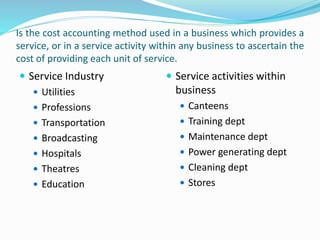
Is the cost accounting method used in a business which provides a
service, or in a service activity within any business to ascertain the
cost of providing each unit of service.
 Service Industry
 Utilities
 Professions
 Transportation
 Broadcasting
 Hospitals
 Theatres
 Education
 Service activities within
business
 Canteens
 Training dept
 Maintenance dept
 Power generating dept
 Cleaning dept
 Stores
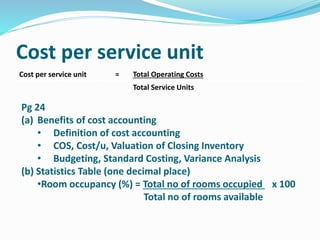
Cost per service unit
Cost per service unit = Total Operating Costs
Total Service Units
Pg 24
(a) Benefits of cost accounting
• Definition of cost accounting
• COS, Cost/u, Valuation of Closing Inventory
• Budgeting, Standard Costing, Variance Analysis
(b) Statistics Table (one decimal place)
•Room occupancy (%) = Total no of rooms occupied x 100
Total no of rooms available
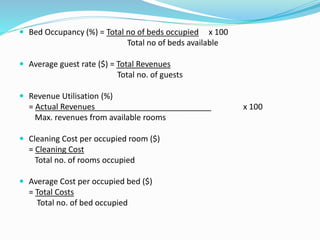
 Bed Occupancy (%) = Total no of beds occupied x 100
Total no of beds available
 Average guest rate ($) = Total Revenues
Total no. of guests
 Revenue Utilisation (%)
= Actual Revenues x 100
Max. revenues from available rooms
 Cleaning Cost per occupied room ($)
= Cleaning Cost
Total no. of rooms occupied
 Average Cost per occupied bed ($)
= Total Costs
Total no. of bed occupied
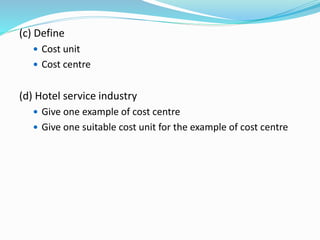
(c) Define
 Cost unit
 Cost centre
(d) Hotel service industry
 Give one example of cost centre
 Give one suitable cost unit for the example of cost centre

Service Costing - ACCA - F5

  • 1.
  • 2.
    Is the costaccounting method used in a business which provides a service, or in a service activity within any business to ascertain the cost of providing each unit of service.  Service Industry  Utilities  Professions  Transportation  Broadcasting  Hospitals  Theatres  Education  Service activities within business  Canteens  Training dept  Maintenance dept  Power generating dept  Cleaning dept  Stores
  • 3.
    Cost per serviceunit Cost per service unit = Total Operating Costs Total Service Units Pg 24 (a) Benefits of cost accounting • Definition of cost accounting • COS, Cost/u, Valuation of Closing Inventory • Budgeting, Standard Costing, Variance Analysis (b) Statistics Table (one decimal place) •Room occupancy (%) = Total no of rooms occupied x 100 Total no of rooms available
  • 4.
     Bed Occupancy(%) = Total no of beds occupied x 100 Total no of beds available  Average guest rate ($) = Total Revenues Total no. of guests  Revenue Utilisation (%) = Actual Revenues x 100 Max. revenues from available rooms  Cleaning Cost per occupied room ($) = Cleaning Cost Total no. of rooms occupied  Average Cost per occupied bed ($) = Total Costs Total no. of bed occupied
  • 5.
    (c) Define  Costunit  Cost centre (d) Hotel service industry  Give one example of cost centre  Give one suitable cost unit for the example of cost centre