TRADITIONAL/CONVENTIONAL/
FULL COSTING
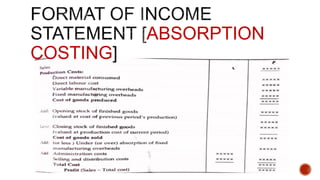
 This is a total cost technique under which total cost [i.e. fixed cost as well as variable cost] is
charged as production cost.
 In other words the absorption costing ,all manufacturing cost are absorbed in the cost of the
products produced .
 In this system the factory overhead are absorbed on the basis of a predetermined overhead
rates , based on normal capacity.
 Absorption costing approach is same as used in cost sheet
Advantages of
absorption costing
 simple and most commonly used
technique to ascertaining cost
 Ensures that all costs including fixed
and variable related production are
charged to products processes or
operations.
 Ensures correct fixation of selling
prices in long run as fixed costs
Disadvantages of
absorption costing
 Preparing flexible budgets under
absorption costing is not possible
 Comparison and cost control becomes
difficult when output level change with
cost per unit
 Not helpful in taking some managerial
decisions like accept or reject
decisions ,make or buy decisions
close or shut down decisions etc
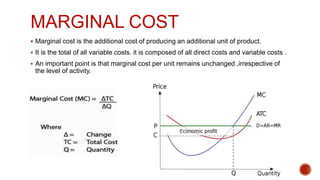
MARGINAL COST
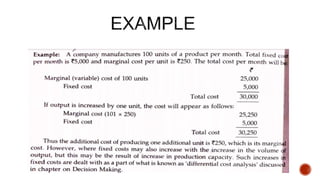
 Marginal cost is the additional cost of producing an additional unit of product.
 It is the total of all variable costs. it is composed of all direct costs and variable costs .
 An important point is that marginal cost per unit remains unchanged ,irrespective of
the level of activity.
VARIABLE COSTING
/DIRECT COSTING
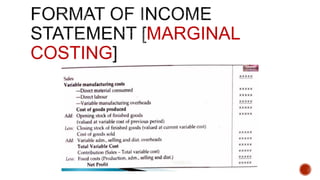
 An alternative to absorption costing is marginal costing .
 Under this technique only variable costs are changed as product costs and included in
inventory valuation.
 Fixed manufacturing costs are not allowed to products but are considered as sand
thus charged directly to profit and loss account of the year.
 Fixed cost also do not enter in stock valuation.
 Both absorption costing an marginal costing treat on manufacturing costs [i.e.
administration, selling and distribution overheads ]as periods costs.
Advantages of
marginal costing
 Helps in cost control
 Helps management in production
planning
 Facilitates study of relative profitability
 Profit planning
 Management reporting
Disadvantages of
marginal costing
 All cost are not divisible into fixed and
variable
 Based upon the assumptions which
may not hold good under all
circumstances
 Selling prices do not remain constant
for ever
 Marginal costing completely ignores
time factor
DIFFERENCE B/W ABSORPTION
COSTING AND MARGINAL
COSTING
 Total cost [ fixed and variable ] is
charged to the cost of products
 Fixed cost is included in the cost of
products
 Opening and closing stocks are valued
at total cost which includes fixed as
well as variable cost
 Profitability is measured by profit
earned by various products or
departments
 Only variable cost is charged to
products
 Fixed cost is not included in the cost of
products
 Stocks are valued only at variable
costs
 Profitability is judged by the
contribution made by the various
products and departments
ABSORPTION
COSTING
MARGINAL
COSTING
 Differential costing is the increase or decrease in total cost or the change in specific
elements of cost that result from any variation in operations.
 It’s the difference between the cost of two alternatives decision.
 Change in cost due to ;-
 a. change in activity.
 b. change in level of activity.
DIFFERENCE B/W
DIFFERENTIAL COSTING AND
MARGINAL COSTING
 Differential costing is the difference
between the cost of two alternatives
decisions or of a change in output
levels
 The purpose of differential costing is to
evaluate the most suitable option
between alternatives
 Cost of two scenarios are compared
and the less costly alternative is
selected
 Marginal costing considers the change
in the costs in order to produce an
additional unit of output
 The purpose of marginal costing is to
evaluate whether it is beneficial to
produce an additional unit /small
number of additional units
 Marginal cost is with marginal revenue
to calculate the impact of a decision
marginal costing.pptx

marginal costing.pptx

  • 2.
    TRADITIONAL/CONVENTIONAL/ FULL COSTING  Thisis a total cost technique under which total cost [i.e. fixed cost as well as variable cost] is charged as production cost.  In other words the absorption costing ,all manufacturing cost are absorbed in the cost of the products produced .  In this system the factory overhead are absorbed on the basis of a predetermined overhead rates , based on normal capacity.  Absorption costing approach is same as used in cost sheet
  • 3.
    Advantages of absorption costing simple and most commonly used technique to ascertaining cost  Ensures that all costs including fixed and variable related production are charged to products processes or operations.  Ensures correct fixation of selling prices in long run as fixed costs Disadvantages of absorption costing  Preparing flexible budgets under absorption costing is not possible  Comparison and cost control becomes difficult when output level change with cost per unit  Not helpful in taking some managerial decisions like accept or reject decisions ,make or buy decisions close or shut down decisions etc
  • 4.
    MARGINAL COST  Marginalcost is the additional cost of producing an additional unit of product.  It is the total of all variable costs. it is composed of all direct costs and variable costs .  An important point is that marginal cost per unit remains unchanged ,irrespective of the level of activity.
  • 6.
    VARIABLE COSTING /DIRECT COSTING An alternative to absorption costing is marginal costing .  Under this technique only variable costs are changed as product costs and included in inventory valuation.  Fixed manufacturing costs are not allowed to products but are considered as sand thus charged directly to profit and loss account of the year.  Fixed cost also do not enter in stock valuation.  Both absorption costing an marginal costing treat on manufacturing costs [i.e. administration, selling and distribution overheads ]as periods costs.
  • 7.
    Advantages of marginal costing Helps in cost control  Helps management in production planning  Facilitates study of relative profitability  Profit planning  Management reporting Disadvantages of marginal costing  All cost are not divisible into fixed and variable  Based upon the assumptions which may not hold good under all circumstances  Selling prices do not remain constant for ever  Marginal costing completely ignores time factor
  • 8.
    DIFFERENCE B/W ABSORPTION COSTINGAND MARGINAL COSTING  Total cost [ fixed and variable ] is charged to the cost of products  Fixed cost is included in the cost of products  Opening and closing stocks are valued at total cost which includes fixed as well as variable cost  Profitability is measured by profit earned by various products or departments  Only variable cost is charged to products  Fixed cost is not included in the cost of products  Stocks are valued only at variable costs  Profitability is judged by the contribution made by the various products and departments
  • 9.
  • 10.
  • 11.
     Differential costingis the increase or decrease in total cost or the change in specific elements of cost that result from any variation in operations.  It’s the difference between the cost of two alternatives decision.  Change in cost due to ;-  a. change in activity.  b. change in level of activity.
  • 12.
    DIFFERENCE B/W DIFFERENTIAL COSTINGAND MARGINAL COSTING  Differential costing is the difference between the cost of two alternatives decisions or of a change in output levels  The purpose of differential costing is to evaluate the most suitable option between alternatives  Cost of two scenarios are compared and the less costly alternative is selected  Marginal costing considers the change in the costs in order to produce an additional unit of output  The purpose of marginal costing is to evaluate whether it is beneficial to produce an additional unit /small number of additional units  Marginal cost is with marginal revenue to calculate the impact of a decision