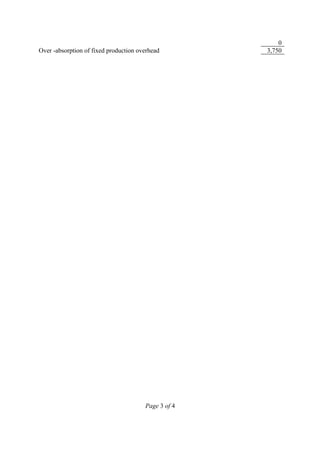
Marginal costing includes only variable costs when determining the cost per unit of a product, while absorption costing includes both variable and fixed costs. Marginal costing is useful for short-term decision making as it treats fixed costs as period costs, while absorption costing allocates fixed costs to each unit produced. Profits reported under the two methods may differ as absorption costing absorbs and adjusts for over- or under-absorbed fixed overhead costs, while marginal costing deducts fixed costs separately as period costs. A case example demonstrates the different profit calculations under each method.
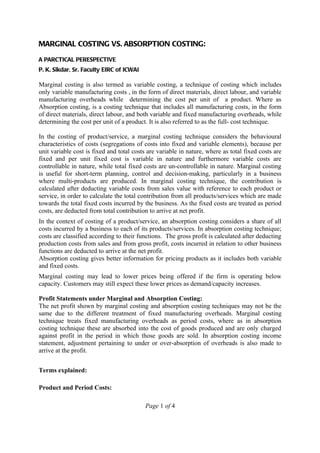
![1 Product costs: the costs of manufacturing the products;
2 Period costs: these are the costs other than product costs that are charged to, debited to, or
written off to the income statement each period.
A Case Example on Marginal and Absorption Costing:
Data for a Quarter for a manufacturing company:—
Level of Activity 60% 100%
Sales and Production(Units) 36,000 60,000
Rs. (’000) Rs. (’000)
Sales 432 720
Production costs :
(Variable and fixed) 366 510
Sales, distribution and administration costs
(Variable and fixed) 126 150
The normal level of activity for the current year is 60,000 units, and fixed costs are incurred
evenly throughout the year.
There were no stocks of the product at the start of the quarter, in which 16,500 units were
made and 13,500 units were sold. Actual fixed costs were the same as budgeted.
Then, various calculations regarding Absorption vs. Marginal costing can be worked out as
under:—
Production Sales etc
Costs (Rs.) costs (Rs.)
Total costs of 60,000 units 5,10,000 1,50,000
(fixed plus variable)
Total costs of 36,000 units 3,66,000 1,26,000
(fixed plus variable)
Difference = variable costs of 24,000 units 1,44,000 24,000
Variable costs per unit Rs.6 Re.1
Production Sales etc.
Costs (Rs.) Costs (Rs.)
Total costs of 60,000 units 5,10,000 1,50,000
Variable costs of 60,000 units 3,60,000 60,000
Fixed costs 1,50,000 90,000
The rate of absorption of fixed production overheads will therefore be:
Rs.1,50,000 ÷ 60,000 = Rs. 2.50 per unit.
(i) The fixed production overhead absorbed by the products would be 16,500 units
produced × Rs. 2.50 = Rs. 41,250
(ii) Budgeted annual fixed production overhead = Rs.1,50,000
Rs.
Actual quarterly fixed production overhead = budgeted quarterly fixed 37,50
production overhead (1,50,000 ÷ 4) 0
Production overhead absorbed into production [see (i) above] 41,25
Page 2 of 4](https://image.slidesharecdn.com/absorptioncostingvs-marginalcosting-110222095535-phpapp01/85/Absorption-costing-vs-marginal-costing-2-320.jpg)