MapReduce: Simplified Data
Processing on Large Clusters
Jeffrey Dean and Sanjay Ghemawat
Presented By
Ashraf Uddin
South Asian University
(http://ashrafsau.blogspot.in/)
11 February 2014
MapReduce
●

A programming model & associated implementaion
–

Processing & generating large datasets

●

Programs written are automatically parallelized

●

Takes care of
–

Partitioning the input data

–

Scheduling the program's execution

–

Handling machine failures

–

Managing inter-machine communication
MapReduce: Programming Model
●

MapReduce expresses the computation as two
functions: Map and Reduce

●

Map: an input pair --> key/value pairs

●

Reduce: Intermediate key/values --> output
MapReduce: Examples
●

Word Frequency in a large collection of documents

●

Distributed grep

●

Count of URL access Frequency

●

Reverse Web-Link graph

●

Inverted Index

●

Distributed Sort

●

Term-Vector per Host
Implementation
●

Many different implementaions interfaces

●

Depends on the environment
–

A small memory shared memory

–

A large NUMA multi-processor

–

A large collection of networked machine
Implementaion: Execution Overview
●

●

●

Map invocations are distributed across multiple
machines by automatically partitioning the input
data in a set of M splits.
Reduce
invocations
are
distributed
by
partitioning the intermediate key space into R
pieces.
There are M map tasks and R reduce tasks to
assign. The master picks idle workers and
assigns each one a map task or a reduce task.
Implementaion: Execution Overview

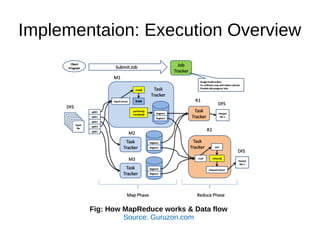
Fig: How MapReduce works & Data flow
Source: Guruzon.com
Implementaion: Execution Overview

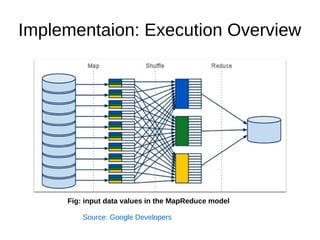
Fig: input data values in the MapReduce model
Source: Google Developers
Master Data Structure
●

●

●

For each map task and reduce task, it stores
the state (idle, in-progress, or completed), and
the identity of the worker machine
For each completed map task, the master
stores the locations and sizes of R intermediate
file regions produced by the map task.
The information is pushed incrementally to
workers that have in progress task.
Fault Tolerance: Worker Failure
●

The master pings every worker periodically

●

No respose means the worker is failed

●

●

All map tasks completed or in-progressby the
worker are reset to idle state and reexecuted on
other machines.
For a failed machine, in-progress reduce tasks
are rescheduled but completed reduce tasks do
not need to be re-executed.
Fault Tolerance: Worker Failure
●

●

When a map task is executed first by worker A
and later executed by worker B (because A
failed), all workers executing reduce tasks are
notified of the re-execution.
Any reduce task that has not already read data
from worker A will read data from B.
Fault Tolerance: Semantics in the
Presence of Failures

●

When the Map and Reduce operators are
deterministic functions, this implementation
produces the same output as would have been
produced by a non-faulting sequential
execution.
Implementaion: Locality
●

●

●

Network bandwith is relatively scarce resource
in the computing environment.
The input data managed by GFS is stored on
the local disk of the machines
GFS divides each file into 64 MB blocks, and
stores several copies of each block
Implementaion: Locality
●

●

●

The MapReduce master takes the location
information of input files into acount and attempts to
schedule a map task on a machine that contains a
replica of the corresponding input data.
Failing that, it attempts to schedule a map task near
a replica of that task's input data.
A significant fraction of the workers in a cluster,
most input is read locally and consumes no network
bandwidth.
Implementaion: Task Granularity
●

●

●

M and R should be much larger than the
number of worker machines.
Having each worker perform many different
tasks improves dynamic load balancing and
also speeds up recovery.
The master makes O(M+R) scheduling
decisions and keeps O(M*R) state in memory.
Implementaion: Task Granularity
●

●

R is often constrained by users because the
outout of each reduce task ends up in a
separate output file.
Choose M such that individual task is roughly
16 MB to 64 MB input data for locality
optimization.
Implementaion: Backup Tasks
●

●

●

A “straggler”: a machine that takes an unusually
long time to complete one of the last few map or
reduce tasks.
For example, a machine with a bad disk may
experiance frequent correctable errors that slow its
read performance.
When a MapReduce is close to completion, the
master schedules backup executions of the
remaining in-progress tasks.
Refinement: Partitioning Function
●

●

Data gets partitioned across R reduce tasks
using a partitioning function on the intermediate
key. (eg. “hash(key) mod R)
This tends to result in fairly well-balanced
partitions.
Refinement: Ordering Guarantees
●

●

Within a given partition, the intermediate
key/value pairs are processed in increasing key
order.
This ordering guarantee makes it easy to
generate a sorted output file per partition.
Refinement: Combiner Function
●

●

●

●

Each map task may produce hundreds or
thousands of records with same key.
The combiner function that does partial merging
of this data before it is sent over the network.
The combiner function is executed on each
machine that performs a map task
It significantly speeds up certain class of
MapReduce operations. (eg. Word Frequency)
Refinement: Skipping Bad Records
●

●

●

●

Sometimes there are bugs in user code that cause
the Map or Reduce functions to crash
deterministically on certain records.
If the bugs in third-party library for which source
code is not available then the bugs can not be fixed.
Also, sometimes it is acceptable to ignore a few
records (eg. Statistical analysis on larage dataset)
MapReduce library detects which records cause
deterministic crashes.
Refinement: Status Information
●

●

The master runs at HTTP server and exports a
set of status pages for human consumption.
It shows the progress of the computation such
as how many tasks have been completed, how
many are in progress, bytes of input data, bytes
of intermediate data, processing rate etc.
Refinement: Counters
●

●

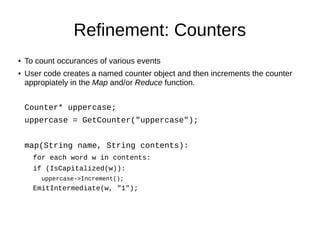
To count occurances of various events
User code creates a named counter object and then increments the counter
appropiately in the Map and/or Reduce function.
Counter* uppercase;
uppercase = GetCounter("uppercase");
map(String name, String contents):
for each word w in contents:
if (IsCapitalized(w)):
uppercase->Increment();

EmitIntermediate(w, "1");
Performance: Cluster Configuration
●

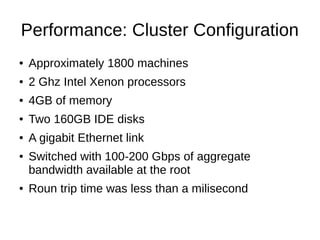
Approximately 1800 machines

●

2 Ghz Intel Xenon processors

●

4GB of memory

●

Two 160GB IDE disks

●

A gigabit Ethernet link

●

●

Switched with 100-200 Gbps of aggregate
bandwidth available at the root
Roun trip time was less than a milisecond
Performance: Grep
●

●
●

Scans through 10^10 100-byte records,
searching for a relatively rare three-character
patterns (92,337 records)
64MB pieces (M=15000)
The entire output is placed in one file (R=1)
Performance: Grep
Performance: Grep
●

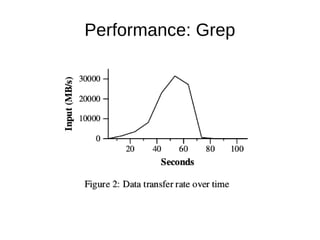
150 seconds from start to finish

●

The overhead is due to
–

the propogation of the program to all worker
machines

–

delays interacting with GFS to open the set of 1000
input files

–

get the information
optimization

needed

for

the

locality
Performance: Sort
●

●

●

●

●

Scans through 10^10 100-byte records (approximately 1
terabyte of data)
The sorting program consists of less than 50 lines of
code
A three line Map function extracts a 10-byte sorting key
from text line and emits the key and theoriginal text line.
M=15000, R= 4000
The final sorted output is written to a set of 2-way
replicated GFS files (i.e., 2 terabytes of data)
Performance: Sort
Performance: Sort
●

●

●
●

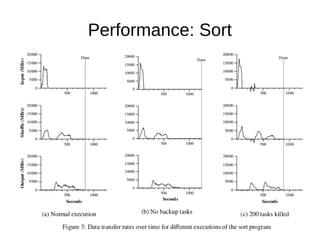
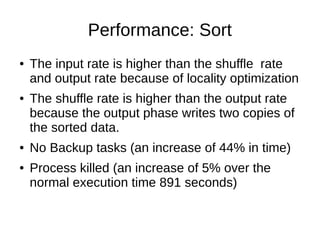
The input rate is higher than the shuffle rate
and output rate because of locality optimization
The shuffle rate is higher than the output rate
because the output phase writes two copies of
the sorted data.
No Backup tasks (an increase of 44% in time)
Process killed (an increase of 5% over the
normal execution time 891 seconds)
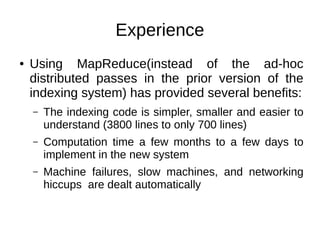
Experience
●

Using MapReduce(instead of the ad-hoc
distributed passes in the prior version of the
indexing system) has provided several benefits:
–

The indexing code is simpler, smaller and easier to
understand (3800 lines to only 700 lines)

–

Computation time a few months to a few days to
implement in the new system

–

Machine failures, slow machines, and networking
hiccups are dealt automatically
THANK YOU

MapReduce: Simplified Data Processing on Large Clusters

  • 1.
    MapReduce: Simplified Data Processingon Large Clusters Jeffrey Dean and Sanjay Ghemawat Presented By Ashraf Uddin South Asian University (http://ashrafsau.blogspot.in/) 11 February 2014
  • 2.
    MapReduce ● A programming model& associated implementaion – Processing & generating large datasets ● Programs written are automatically parallelized ● Takes care of – Partitioning the input data – Scheduling the program's execution – Handling machine failures – Managing inter-machine communication
  • 3.
    MapReduce: Programming Model ● MapReduceexpresses the computation as two functions: Map and Reduce ● Map: an input pair --> key/value pairs ● Reduce: Intermediate key/values --> output
  • 4.
    MapReduce: Examples ● Word Frequencyin a large collection of documents ● Distributed grep ● Count of URL access Frequency ● Reverse Web-Link graph ● Inverted Index ● Distributed Sort ● Term-Vector per Host
  • 5.
    Implementation ● Many different implementaionsinterfaces ● Depends on the environment – A small memory shared memory – A large NUMA multi-processor – A large collection of networked machine
  • 6.
    Implementaion: Execution Overview ● ● ● Mapinvocations are distributed across multiple machines by automatically partitioning the input data in a set of M splits. Reduce invocations are distributed by partitioning the intermediate key space into R pieces. There are M map tasks and R reduce tasks to assign. The master picks idle workers and assigns each one a map task or a reduce task.
  • 7.
    Implementaion: Execution Overview Fig:How MapReduce works & Data flow Source: Guruzon.com
  • 8.
    Implementaion: Execution Overview Fig:input data values in the MapReduce model Source: Google Developers
  • 9.
    Master Data Structure ● ● ● Foreach map task and reduce task, it stores the state (idle, in-progress, or completed), and the identity of the worker machine For each completed map task, the master stores the locations and sizes of R intermediate file regions produced by the map task. The information is pushed incrementally to workers that have in progress task.
  • 10.
    Fault Tolerance: WorkerFailure ● The master pings every worker periodically ● No respose means the worker is failed ● ● All map tasks completed or in-progressby the worker are reset to idle state and reexecuted on other machines. For a failed machine, in-progress reduce tasks are rescheduled but completed reduce tasks do not need to be re-executed.
  • 11.
    Fault Tolerance: WorkerFailure ● ● When a map task is executed first by worker A and later executed by worker B (because A failed), all workers executing reduce tasks are notified of the re-execution. Any reduce task that has not already read data from worker A will read data from B.
  • 12.
    Fault Tolerance: Semanticsin the Presence of Failures ● When the Map and Reduce operators are deterministic functions, this implementation produces the same output as would have been produced by a non-faulting sequential execution.
  • 13.
    Implementaion: Locality ● ● ● Network bandwithis relatively scarce resource in the computing environment. The input data managed by GFS is stored on the local disk of the machines GFS divides each file into 64 MB blocks, and stores several copies of each block
  • 14.
    Implementaion: Locality ● ● ● The MapReducemaster takes the location information of input files into acount and attempts to schedule a map task on a machine that contains a replica of the corresponding input data. Failing that, it attempts to schedule a map task near a replica of that task's input data. A significant fraction of the workers in a cluster, most input is read locally and consumes no network bandwidth.
  • 15.
    Implementaion: Task Granularity ● ● ● Mand R should be much larger than the number of worker machines. Having each worker perform many different tasks improves dynamic load balancing and also speeds up recovery. The master makes O(M+R) scheduling decisions and keeps O(M*R) state in memory.
  • 16.
    Implementaion: Task Granularity ● ● Ris often constrained by users because the outout of each reduce task ends up in a separate output file. Choose M such that individual task is roughly 16 MB to 64 MB input data for locality optimization.
  • 17.
    Implementaion: Backup Tasks ● ● ● A“straggler”: a machine that takes an unusually long time to complete one of the last few map or reduce tasks. For example, a machine with a bad disk may experiance frequent correctable errors that slow its read performance. When a MapReduce is close to completion, the master schedules backup executions of the remaining in-progress tasks.
  • 18.
    Refinement: Partitioning Function ● ● Datagets partitioned across R reduce tasks using a partitioning function on the intermediate key. (eg. “hash(key) mod R) This tends to result in fairly well-balanced partitions.
  • 19.
    Refinement: Ordering Guarantees ● ● Withina given partition, the intermediate key/value pairs are processed in increasing key order. This ordering guarantee makes it easy to generate a sorted output file per partition.
  • 20.
    Refinement: Combiner Function ● ● ● ● Eachmap task may produce hundreds or thousands of records with same key. The combiner function that does partial merging of this data before it is sent over the network. The combiner function is executed on each machine that performs a map task It significantly speeds up certain class of MapReduce operations. (eg. Word Frequency)
  • 21.
    Refinement: Skipping BadRecords ● ● ● ● Sometimes there are bugs in user code that cause the Map or Reduce functions to crash deterministically on certain records. If the bugs in third-party library for which source code is not available then the bugs can not be fixed. Also, sometimes it is acceptable to ignore a few records (eg. Statistical analysis on larage dataset) MapReduce library detects which records cause deterministic crashes.
  • 22.
    Refinement: Status Information ● ● Themaster runs at HTTP server and exports a set of status pages for human consumption. It shows the progress of the computation such as how many tasks have been completed, how many are in progress, bytes of input data, bytes of intermediate data, processing rate etc.
  • 23.
    Refinement: Counters ● ● To countoccurances of various events User code creates a named counter object and then increments the counter appropiately in the Map and/or Reduce function. Counter* uppercase; uppercase = GetCounter("uppercase"); map(String name, String contents): for each word w in contents: if (IsCapitalized(w)): uppercase->Increment(); EmitIntermediate(w, "1");
  • 24.
    Performance: Cluster Configuration ● Approximately1800 machines ● 2 Ghz Intel Xenon processors ● 4GB of memory ● Two 160GB IDE disks ● A gigabit Ethernet link ● ● Switched with 100-200 Gbps of aggregate bandwidth available at the root Roun trip time was less than a milisecond
  • 25.
    Performance: Grep ● ● ● Scans through10^10 100-byte records, searching for a relatively rare three-character patterns (92,337 records) 64MB pieces (M=15000) The entire output is placed in one file (R=1)
  • 26.
  • 27.
    Performance: Grep ● 150 secondsfrom start to finish ● The overhead is due to – the propogation of the program to all worker machines – delays interacting with GFS to open the set of 1000 input files – get the information optimization needed for the locality
  • 28.
    Performance: Sort ● ● ● ● ● Scans through10^10 100-byte records (approximately 1 terabyte of data) The sorting program consists of less than 50 lines of code A three line Map function extracts a 10-byte sorting key from text line and emits the key and theoriginal text line. M=15000, R= 4000 The final sorted output is written to a set of 2-way replicated GFS files (i.e., 2 terabytes of data)
  • 29.
  • 30.
    Performance: Sort ● ● ● ● The inputrate is higher than the shuffle rate and output rate because of locality optimization The shuffle rate is higher than the output rate because the output phase writes two copies of the sorted data. No Backup tasks (an increase of 44% in time) Process killed (an increase of 5% over the normal execution time 891 seconds)
  • 31.
    Experience ● Using MapReduce(instead ofthe ad-hoc distributed passes in the prior version of the indexing system) has provided several benefits: – The indexing code is simpler, smaller and easier to understand (3800 lines to only 700 lines) – Computation time a few months to a few days to implement in the new system – Machine failures, slow machines, and networking hiccups are dealt automatically
  • 32.