gooqwerty777@gmail.com
Introduction
● Motivation: lots of special-purpose programs
should process large amounts of raw data
– crawl(analyze) documents, web request logs, etc.
– should use lots of machine to reduce processing
time
– implementation is time-consuming and complex
● Solution: Design a programming model–
MapReduce
– Hides the details of parallelization, fault-tolerance,
locality optimization, and load balancing.
Map and Reduce
● Divide, Conquer, and Combine
-> Divide, Maps, and Reduces
● User only need to implement Map() and
Reduce() functions!(and some arguments)
Programming Model
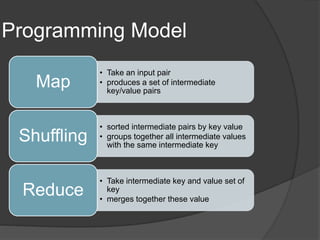
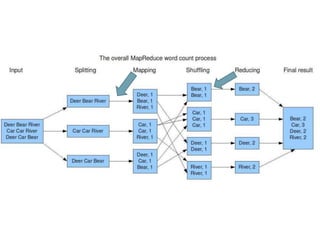
• Take an input pair
• produces a set of intermediate
key/value pairs
Map
• sorted intermediate pairs by key value
• groups together all intermediate values
with the same intermediate key
Shuffling
• Take intermediate key and value set of
key
• merges together these value
Reduce
More Example
● Inverted Index
– Find specified word in set of files
– Input: <files(splited), docID>
– Intermediate: <word, docID>
– Final: <word, list<docID>>
● Distributed Grep
● Distributed Sort
● Count of URL Access Frequency
● Term-Vector per Host
More Example
 Distributed Grep
 Distributed Sort
 Inverted Index
 Intermediate: <word, docID> → Final: <word,
list<docID>>
 Count of URL Access Frequency
 <URL, 1> → <URL, TotalCount>
 Term-Vector per Host
 summarize the most important words in docs
 <term, freq> → vector<term, freq>
Implementation
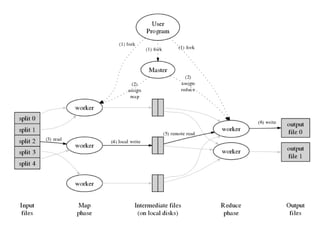
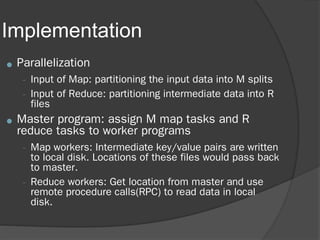
● Parallelization
– Input of Map: partitioning the input data into M splits
– Input of Reduce: partitioning intermediate data into R
files
● Master program: assign M map tasks and R
reduce tasks to worker programs
– Map workers: Intermediate key/value pairs are written
to local disk. Locations of these files would pass back
to master.
– Reduce workers: Get location from master and use
remote procedure calls(RPC) to read data in local
disk.
Fault Tolerance
● Worker Failure
– ping every worker periodically
– tasks in failed machine :
● rescheduling now assigning task
● reset completed map tasks and rescheduling
● but completed reduce tasks don't need to reset (files
are stored in global file system)
● Master Failure
– failure of master is unlikely
– aborts the MapReduce, clients should check and
retry it
Backup Tasks
● Straggler : machine that takes an unusually long
time to complete tasks
– bad disk
– other tasks
● Solution: when MapReduce is close to
completion, master schedules backup
executions of the remaining in-progress tasks
– Only wait one of they to complete
– Takes 30% less time to complete, with computational
resources increase by no more than a few percent
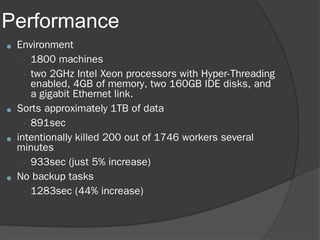
Performance
● Environment
– 1800 machines
– two 2GHz Intel Xeon processors with Hyper-Threading
enabled, 4GB of memory, two 160GB IDE disks, and
a gigabit Ethernet link.
● Sorts approximately 1TB of data
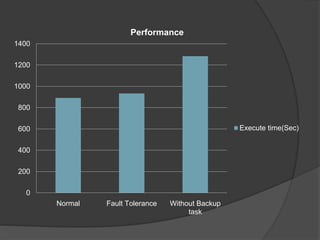
– 891sec
● intentionally killed 200 out of 1746 workers several
minutes
– 933sec (just 5% increase)
● No backup tasks
– 1283sec (44% increase)
0
200
400
600
800
1000
1200
1400
Normal Fault Tolerance Without Backup
task
Performance
Execute time(Sec)
Advantage
● Large variety of problems are easily expressible
as MapReduce
– Every work which can be divided!
● Easy to use for programmers who have no
experience with distributed or parallel systems
– What you think is how to deal with splited data, and
how to compose result
● Code is simpler, easier to understand and modify
Application
● large-scale machine learning
● extraction of data used to produce reports of
popular queries
● extraction of properties of web pages
– PageRank
● Open Source implementation
– Hadoop
Refinements
● Locality optimization
–Input file copies in local disks
● Skipping Bad Records
– ignore a few bad records, when doing statistical
analysis on a large data set.
– signal handler (When error, send information to
master)
● Counter object
– Piggybacked on the ping response
Refinements
● Locality optimization
– Input file copies in local disks
● Intermediate key/value pairs is in order
– Utilized sort and random access
● Input and Output Types
– the key is the offset in the file and the value is the contents of the line.
– reader interface
● Skipping Bad Records
– ignore a few bad records, when doing statistical analysis on a large data set.
– signal handler (When error, send information to master)
● Counter object
– Piggybacked on the ping response
● Combiner function
– partial merging at local disk before sending record
Reference
 Jeffrey Dean and Sanjay Ghemawat,
2004, MapReduce: Simplified Data
Processing on Large Clusters
Introduction of MapReduce

Introduction of MapReduce

  • 1.
  • 2.
    Introduction ● Motivation: lotsof special-purpose programs should process large amounts of raw data – crawl(analyze) documents, web request logs, etc. – should use lots of machine to reduce processing time – implementation is time-consuming and complex ● Solution: Design a programming model– MapReduce – Hides the details of parallelization, fault-tolerance, locality optimization, and load balancing.
  • 3.
    Map and Reduce ●Divide, Conquer, and Combine -> Divide, Maps, and Reduces ● User only need to implement Map() and Reduce() functions!(and some arguments)
  • 4.
    Programming Model • Takean input pair • produces a set of intermediate key/value pairs Map • sorted intermediate pairs by key value • groups together all intermediate values with the same intermediate key Shuffling • Take intermediate key and value set of key • merges together these value Reduce
  • 6.
    More Example ● InvertedIndex – Find specified word in set of files – Input: <files(splited), docID> – Intermediate: <word, docID> – Final: <word, list<docID>> ● Distributed Grep ● Distributed Sort ● Count of URL Access Frequency ● Term-Vector per Host
  • 7.
    More Example  DistributedGrep  Distributed Sort  Inverted Index  Intermediate: <word, docID> → Final: <word, list<docID>>  Count of URL Access Frequency  <URL, 1> → <URL, TotalCount>  Term-Vector per Host  summarize the most important words in docs  <term, freq> → vector<term, freq>
  • 9.
    Implementation ● Parallelization – Inputof Map: partitioning the input data into M splits – Input of Reduce: partitioning intermediate data into R files ● Master program: assign M map tasks and R reduce tasks to worker programs – Map workers: Intermediate key/value pairs are written to local disk. Locations of these files would pass back to master. – Reduce workers: Get location from master and use remote procedure calls(RPC) to read data in local disk.
  • 10.
    Fault Tolerance ● WorkerFailure – ping every worker periodically – tasks in failed machine : ● rescheduling now assigning task ● reset completed map tasks and rescheduling ● but completed reduce tasks don't need to reset (files are stored in global file system) ● Master Failure – failure of master is unlikely – aborts the MapReduce, clients should check and retry it
  • 11.
    Backup Tasks ● Straggler: machine that takes an unusually long time to complete tasks – bad disk – other tasks ● Solution: when MapReduce is close to completion, master schedules backup executions of the remaining in-progress tasks – Only wait one of they to complete – Takes 30% less time to complete, with computational resources increase by no more than a few percent
  • 12.
    Performance ● Environment – 1800machines – two 2GHz Intel Xeon processors with Hyper-Threading enabled, 4GB of memory, two 160GB IDE disks, and a gigabit Ethernet link. ● Sorts approximately 1TB of data – 891sec ● intentionally killed 200 out of 1746 workers several minutes – 933sec (just 5% increase) ● No backup tasks – 1283sec (44% increase)
  • 13.
    0 200 400 600 800 1000 1200 1400 Normal Fault ToleranceWithout Backup task Performance Execute time(Sec)
  • 14.
    Advantage ● Large varietyof problems are easily expressible as MapReduce – Every work which can be divided! ● Easy to use for programmers who have no experience with distributed or parallel systems – What you think is how to deal with splited data, and how to compose result ● Code is simpler, easier to understand and modify
  • 15.
    Application ● large-scale machinelearning ● extraction of data used to produce reports of popular queries ● extraction of properties of web pages – PageRank ● Open Source implementation – Hadoop
  • 16.
    Refinements ● Locality optimization –Inputfile copies in local disks ● Skipping Bad Records – ignore a few bad records, when doing statistical analysis on a large data set. – signal handler (When error, send information to master) ● Counter object – Piggybacked on the ping response
  • 17.
    Refinements ● Locality optimization –Input file copies in local disks ● Intermediate key/value pairs is in order – Utilized sort and random access ● Input and Output Types – the key is the offset in the file and the value is the contents of the line. – reader interface ● Skipping Bad Records – ignore a few bad records, when doing statistical analysis on a large data set. – signal handler (When error, send information to master) ● Counter object – Piggybacked on the ping response ● Combiner function – partial merging at local disk before sending record
  • 18.
    Reference  Jeffrey Deanand Sanjay Ghemawat, 2004, MapReduce: Simplified Data Processing on Large Clusters