
Samirsinh P. Parmar
Dept. of Civil Engineering
Dharmsinh Desai University, Nadiad
Mail: spp.cl@ddu.ac.in, samirddu@gmail.com
2
Map Projections in GIS, Samirsinh Parmar, DoCL, DDU, Nadiad.
Projection
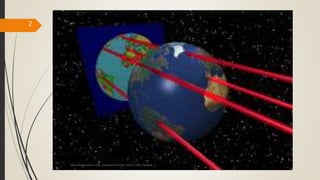
Transformation of Three Dimensional Space onto a
two dimensional map
A systematic arrangement of intersecting lines on a
plane that represent and have a one to one
correspondence to the meridians and parallels on
the datum surface
3
Map Projections in GIS, Samirsinh Parmar, DoCL, DDU, Nadiad.
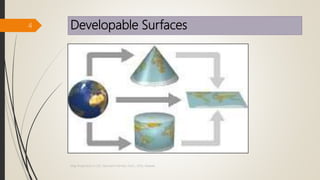
Developable Surfaces
4
Map Projections in GIS, Samirsinh Parmar, DoCL, DDU, Nadiad.
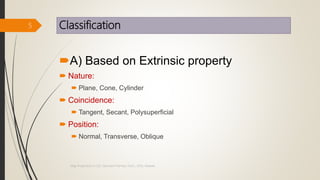
Classification
A) Based on Extrinsic property
 Nature:
 Plane, Cone, Cylinder
 Coincidence:
 Tangent, Secant, Polysuperficial
 Position:
 Normal, Transverse, Oblique
5
Map Projections in GIS, Samirsinh Parmar, DoCL, DDU, Nadiad.
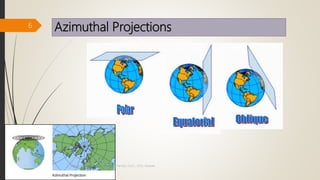
Azimuthal Projections
6
Map Projections in GIS, Samirsinh Parmar, DoCL, DDU, Nadiad.
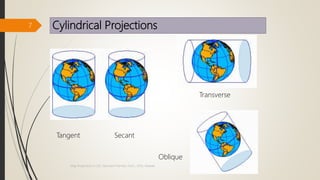
Cylindrical Projections
7
Tangent
Oblique
Transverse
Secant
Map Projections in GIS, Samirsinh Parmar, DoCL, DDU, Nadiad.
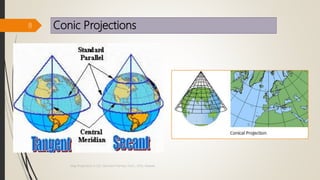
Conic Projections
8
Map Projections in GIS, Samirsinh Parmar, DoCL, DDU, Nadiad.
Classification contd.
B) Based on Intrinsic Property
 Property of Projection:
 Equidistant
 Conformal or Orthomorphic
 Equivalent or Equal area
 Generation:
 Geometric, Semi Geometric, Mathematical
9
Map Projections in GIS, Samirsinh Parmar, DoCL, DDU, Nadiad.
Cylindrical Map Projections
 Cylindrical map projections are made by projecting from the globe onto the
surface of an enclosing cylinder, and then unwrapping the cylinder to make a
flat surface
 Mercator
 Transverse Mercator
 Cassini-Soldner
10
Map Projections in GIS, Samirsinh Parmar, DoCL, DDU, Nadiad.
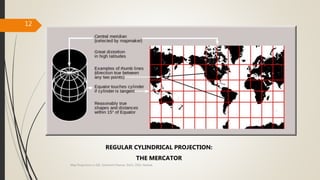
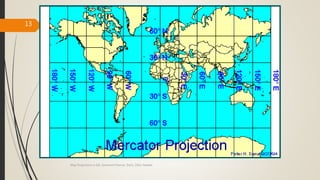
Mercator Projection
 Cylindrical, Conformal
 Meridians are equally spaced straight lines
 Parallels are unequally spaced straight lines
 Scale is true along the equator
 Great distortion of area in polar region
 Used for navigation
 Limitations
11
Map Projections in GIS, Samirsinh Parmar, DoCL, DDU, Nadiad.
12
REGULAR CYLINDRICAL PROJECTION:
THE MERCATOR
Map Projections in GIS, Samirsinh Parmar, DoCL, DDU, Nadiad.
13
Map Projections in GIS, Samirsinh Parmar, DoCL, DDU, Nadiad.
Transverse Mercator Projection
 Cylindrical (Transverse)
 Conformal
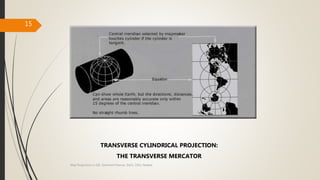
 Central meridian and equator are straight lines
 Other meridians and parallels are complex curves
 For areas with larger north-south extent than east-west extent
14
Map Projections in GIS, Samirsinh Parmar, DoCL, DDU, Nadiad.
15
TRANSVERSE CYLINDRICAL PROJECTION:
THE TRANSVERSE MERCATOR
Map Projections in GIS, Samirsinh Parmar, DoCL, DDU, Nadiad.
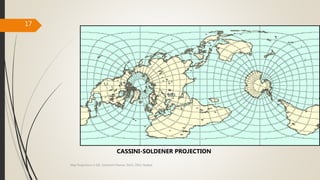
Cassini- Soldener Projection
Cylindrical, Tangent, Transverse
Equidistant
Cylinder is tangent along the meridian centrally located
Scale deteriorates away from central meridian
Normally used in 70 km belt from the central meridian,
as linear distortion factor at 70 km is 1.00006
Used for old cadastral surveys in India.
16
Map Projections in GIS, Samirsinh Parmar, DoCL, DDU, Nadiad.
17
CASSINI-SOLDENER PROJECTION
Map Projections in GIS, Samirsinh Parmar, DoCL, DDU, Nadiad.
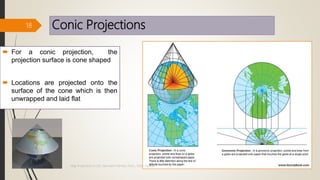
Conic Projections
18
 For a conic projection, the
projection surface is cone shaped
 Locations are projected onto the
surface of the cone which is then
unwrapped and laid flat
Map Projections in GIS, Samirsinh Parmar, DoCL, DDU, Nadiad.
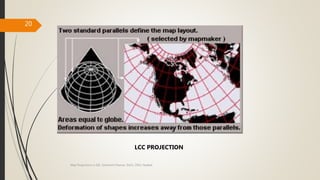
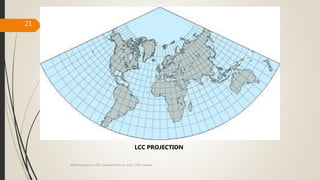
Lambert Conformal Conic Projection
 Conical, Conformal
 Parallels are concentric arcs
 Meridians are straight lines cutting parallels at right angles.
 Scale is true along two standard parallels, normally, or along
just one.
 It projects a great circle as a straight line – much better than
Mercator
 Used for maps of countries and regions with predominant
east west expanse
 Used for plane coordinate system (SPCS) in USA
19
Map Projections in GIS, Samirsinh Parmar, DoCL, DDU, Nadiad.
20
LCC PROJECTION
Map Projections in GIS, Samirsinh Parmar, DoCL, DDU, Nadiad.
21
LCC PROJECTION
Map Projections in GIS, Samirsinh Parmar, DoCL, DDU, Nadiad.
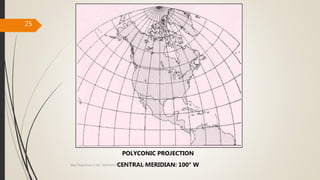
Polyconic Projection
In this projection all parallels are projected without
any distortion
Scale is exact along each parallel and central
meridian.
Parallels are arcs of circles but are not concentric.
It is neither conformal nor equal area.
22
Map Projections in GIS, Samirsinh Parmar, DoCL, DDU, Nadiad.
Polyconic Projection contd.
Central meridian and equator are straight lines;
all other meridians are curves.
Central Meridian cuts all parallels at 90 degrees
Free of distortion only along the central
meridian.
It has rolling fit with adjacent sheets in EW
direction.
Used in India for all topographical mapping on
1:250,000 and larger scales.
23
Map Projections in GIS, Samirsinh Parmar, DoCL, DDU, Nadiad.
24
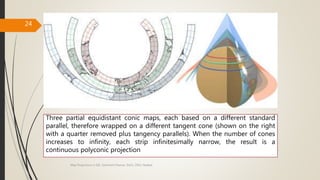
Three partial equidistant conic maps, each based on a different standard
parallel, therefore wrapped on a different tangent cone (shown on the right
with a quarter removed plus tangency parallels). When the number of cones
increases to infinity, each strip infinitesimally narrow, the result is a
continuous polyconic projection
Map Projections in GIS, Samirsinh Parmar, DoCL, DDU, Nadiad.
25
POLYCONIC PROJECTION
CENTRAL MERIDIAN: 100° W
Map Projections in GIS, Samirsinh Parmar, DoCL, DDU, Nadiad.
Azimuthal Projections
 For an azimuthal, or planar projection, projected forward onto
a flat plane.
 The normal aspect for these projections is the North or South
Pole. locations are
26
Map Projections in GIS, Samirsinh Parmar, DoCL, DDU, Nadiad.
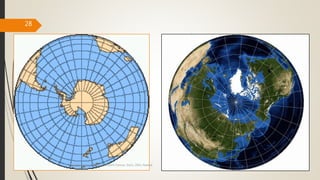
Universal Polar Stereographic (UPS)
 Defined above 84 degrees north latitude and 80 degree south
 Conformal
 Meridians are straight lines
 Parallels are circles
 Scale increases from center point
 Used in conformal mapping of polar regions
27
Map Projections in GIS, Samirsinh Parmar, DoCL, DDU, Nadiad.
28
Map Projections in GIS, Samirsinh Parmar, DoCL, DDU, Nadiad.
Grids
 Rectangular grids have been developed for the use of Surveyors.
 Each point can be designated merely by its ( x , y ) co-ordinates.
 Grid systems are normally divided into zones so that distortion and
variation of scale within any one zone are kept small.
 The UTM grid
 State Plane Coordinate System (SPCS)
29
Map Projections in GIS, Samirsinh Parmar, DoCL, DDU, Nadiad.
False Northing and False Easting
 Calculating coordinates is easier if negative number aren’t involved.
 Indian Grid and Universal transverse Mercator coordinates
 Expressed in coordinate units, not degrees.
30
Map Projections in GIS, Samirsinh Parmar, DoCL, DDU, Nadiad.
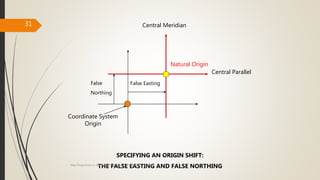
31
SPECIFYING AN ORIGIN SHIFT:
THE FALSE EASTING AND FALSE NORTHING
Central Meridian
Natural Origin
Central Parallel
Coordinate System
Origin
False Easting
False
Northing
Map Projections in GIS, Samirsinh Parmar, DoCL, DDU, Nadiad.
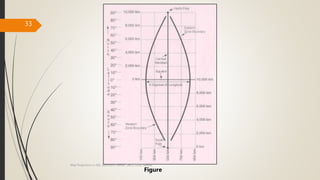
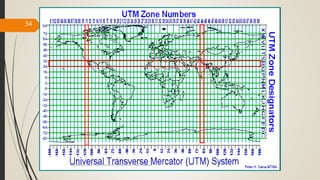
Universal Transverse Mercator (UTM)
 Particular case of Transverse Mercator Projection.
The earth between latitudes 84 N and 80 S, is divided
into 60, 6 wide strips;
Latitude origin – the Equator
Assumed (false) northing (y) at Equator
0 m for northern hemisphere
10,000,000 m for southern hemisphere
Assumed (false) easting (x) at Central Meridian
500,000 m
Scale factor at the central meridian : 0.9996
32
Map Projections in GIS, Samirsinh Parmar, DoCL, DDU, Nadiad.
33
Figure
Map Projections in GIS, Samirsinh Parmar, DoCL, DDU, Nadiad.
34
Map Projections in GIS, Samirsinh Parmar, DoCL, DDU, Nadiad.
Projection Parameters
To define the coordinate system completely, it is not
sufficient simply to name the kind of projection used,
it is also necessary to specify the projection
parameters.
The set of parameters required depends on the kind of
projection.
The central meridian of the projection for cylindrical,
where it touches the ellipsoid surface.
35
Map Projections in GIS, Samirsinh Parmar, DoCL, DDU, Nadiad.
Projection Parameterscontd.
 The standard parallel(s) for conic projections.
 The false easting and false northing
 The units
 Reference ellipsoid
36
Map Projections in GIS, Samirsinh Parmar, DoCL, DDU, Nadiad.
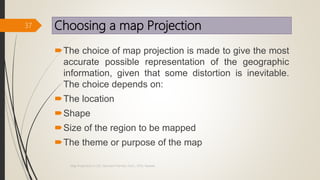
Choosing a map Projection
The choice of map projection is made to give the most
accurate possible representation of the geographic
information, given that some distortion is inevitable.
The choice depends on:
The location
Shape
Size of the region to be mapped
The theme or purpose of the map
37
Map Projections in GIS, Samirsinh Parmar, DoCL, DDU, Nadiad.
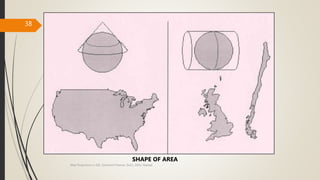
38
SHAPE OF AREA
Map Projections in GIS, Samirsinh Parmar, DoCL, DDU, Nadiad.
Some Related Terms
 Coordinate System
 Reference Ellipsoids
 Everest Ellipsoid
 GRS 80
 WGS 84
39
Map Projections in GIS, Samirsinh Parmar, DoCL, DDU, Nadiad.
Implications for GIS
Knowing the datum and reference ellipsoid
information is very important.
For converting the maps of one system to another
system.
When incorporating maps or GPS field data into a
GIS
40
Map Projections in GIS, Samirsinh Parmar, DoCL, DDU, Nadiad.
Coordinate System
Need to describe the location, i.e. referencing
network by which positions are measured and
computed.
Relative location (with respect to some other place).
E.g. Street address.
• Absolute location (with respect to the Earth as a
whole).
E.g. Geographic coordinates
41
Map Projections in GIS, Samirsinh Parmar, DoCL, DDU, Nadiad.
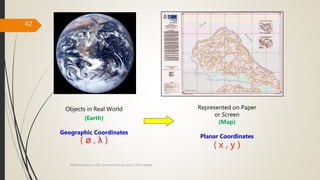
Objects in Real World
(Earth)
Geographic Coordinates
( ø , λ )
Represented on Paper
or Screen
(Map)
Planar Coordinates
( x , y )
Map Projections in GIS, Samirsinh Parmar, DoCL, DDU, Nadiad.
42
REFERENCE ELLIPSOID
 All the measurements are done on the surface of the Earth.
Various computations are required to determine the
coordinates, distances, area etc.
 The surface of the earth is irregular and therefore unsuitable
for such computations. We need a smooth mathematical
surface for these computations.
 The best mathematical figure that can represent the earth is
an ellipsoid. Ellipsoid is used as reference surface.
43
Map Projections in GIS, Samirsinh Parmar, DoCL, DDU, Nadiad.
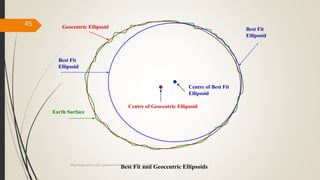
TYPES OF ELLIPSOIDS
1. Best-Fit Ellipsoid/Local Ellipsoid: based on the measurements
within a region, so it best fits that region only. The centre of
such reference ellipsoid does not coincide with the centre of
gravity of the Earth.
Example : Everest Ellipsoid
2. Geocentric Ellipsoid: The centre of geocentric ellipsoid
coincides with the centre of the Earth. This type of the
ellipsoid can be used worldwide.
Example : WGS 84 ellipsoid
44
Map Projections in GIS, Samirsinh Parmar, DoCL, DDU, Nadiad.
45
Best Fit and Geocentric Ellipsoids
Centre of Best Fit
Ellipsoid
Centre of Geocentric Ellipsoid
Best Fit
Ellipsoid
Geocentric Ellipsoid
Earth Surface
Best Fit
Ellipsoid
Map Projections in GIS, Samirsinh Parmar, DoCL, DDU, Nadiad.
DATUM
Datum is a model that describes the position,
direction, and scale relationships of a reference
surface to positions on the surface of Earth
Indian Datum
WGS 84
ITRF
46
Map Projections in GIS, Samirsinh Parmar, DoCL, DDU, Nadiad.
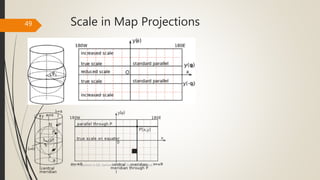
Scale
Only on a globe is a scale constant. It is impossible
to have a constant scale in different areas of a map
(but we can get close)
Map has fixed scale but GIS is scale-less, i.e. data
may be enlarged or reduced to any size.
However, if we go too far from the scale at which
map was made before it was captured into the GIS,
problems of scale appear.
47
Map Projections in GIS, Samirsinh Parmar, DoCL, DDU, Nadiad.
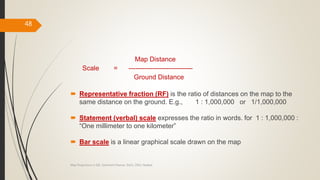
Map Distance
Scale = -----------------------------
Ground Distance
 Representative fraction (RF) is the ratio of distances on the map to the
same distance on the ground. E.g., 1 : 1,000,000 or 1/1,000,000
 Statement (verbal) scale expresses the ratio in words. for 1 : 1,000,000 :
“One millimeter to one kilometer”
 Bar scale is a linear graphical scale drawn on the map
48
Map Projections in GIS, Samirsinh Parmar, DoCL, DDU, Nadiad.
Scale in Map Projections
49
Map Projections in GIS, Samirsinh Parmar, DoCL, DDU, Nadiad.
Conclusions
 We need to project geospatial data for any analysis
 Makes it possible to use data from different sources
 Several Projections to choose from
 Projections inevitably distorts at least one property
 Can choose suitable Map Projection
 Can control scale error
50
Map Projections in GIS, Samirsinh Parmar, DoCL, DDU, Nadiad.
51
Map Projections in GIS, Samirsinh Parmar, DoCL, DDU, Nadiad.

MAP PROJECTION IN GIS.pptx

  • 1.
    Samirsinh P. Parmar Dept.of Civil Engineering Dharmsinh Desai University, Nadiad Mail: spp.cl@ddu.ac.in, samirddu@gmail.com
  • 2.
    2 Map Projections inGIS, Samirsinh Parmar, DoCL, DDU, Nadiad.
  • 3.
    Projection Transformation of ThreeDimensional Space onto a two dimensional map A systematic arrangement of intersecting lines on a plane that represent and have a one to one correspondence to the meridians and parallels on the datum surface 3 Map Projections in GIS, Samirsinh Parmar, DoCL, DDU, Nadiad.
  • 4.
    Developable Surfaces 4 Map Projectionsin GIS, Samirsinh Parmar, DoCL, DDU, Nadiad.
  • 5.
    Classification A) Based onExtrinsic property  Nature:  Plane, Cone, Cylinder  Coincidence:  Tangent, Secant, Polysuperficial  Position:  Normal, Transverse, Oblique 5 Map Projections in GIS, Samirsinh Parmar, DoCL, DDU, Nadiad.
  • 6.
    Azimuthal Projections 6 Map Projectionsin GIS, Samirsinh Parmar, DoCL, DDU, Nadiad.
  • 7.
  • 8.
    Conic Projections 8 Map Projectionsin GIS, Samirsinh Parmar, DoCL, DDU, Nadiad.
  • 9.
    Classification contd. B) Basedon Intrinsic Property  Property of Projection:  Equidistant  Conformal or Orthomorphic  Equivalent or Equal area  Generation:  Geometric, Semi Geometric, Mathematical 9 Map Projections in GIS, Samirsinh Parmar, DoCL, DDU, Nadiad.
  • 10.
    Cylindrical Map Projections Cylindrical map projections are made by projecting from the globe onto the surface of an enclosing cylinder, and then unwrapping the cylinder to make a flat surface  Mercator  Transverse Mercator  Cassini-Soldner 10 Map Projections in GIS, Samirsinh Parmar, DoCL, DDU, Nadiad.
  • 11.
    Mercator Projection  Cylindrical,Conformal  Meridians are equally spaced straight lines  Parallels are unequally spaced straight lines  Scale is true along the equator  Great distortion of area in polar region  Used for navigation  Limitations 11 Map Projections in GIS, Samirsinh Parmar, DoCL, DDU, Nadiad.
  • 12.
    12 REGULAR CYLINDRICAL PROJECTION: THEMERCATOR Map Projections in GIS, Samirsinh Parmar, DoCL, DDU, Nadiad.
  • 13.
    13 Map Projections inGIS, Samirsinh Parmar, DoCL, DDU, Nadiad.
  • 14.
    Transverse Mercator Projection Cylindrical (Transverse)  Conformal  Central meridian and equator are straight lines  Other meridians and parallels are complex curves  For areas with larger north-south extent than east-west extent 14 Map Projections in GIS, Samirsinh Parmar, DoCL, DDU, Nadiad.
  • 15.
    15 TRANSVERSE CYLINDRICAL PROJECTION: THETRANSVERSE MERCATOR Map Projections in GIS, Samirsinh Parmar, DoCL, DDU, Nadiad.
  • 16.
    Cassini- Soldener Projection Cylindrical,Tangent, Transverse Equidistant Cylinder is tangent along the meridian centrally located Scale deteriorates away from central meridian Normally used in 70 km belt from the central meridian, as linear distortion factor at 70 km is 1.00006 Used for old cadastral surveys in India. 16 Map Projections in GIS, Samirsinh Parmar, DoCL, DDU, Nadiad.
  • 17.
    17 CASSINI-SOLDENER PROJECTION Map Projectionsin GIS, Samirsinh Parmar, DoCL, DDU, Nadiad.
  • 18.
    Conic Projections 18  Fora conic projection, the projection surface is cone shaped  Locations are projected onto the surface of the cone which is then unwrapped and laid flat Map Projections in GIS, Samirsinh Parmar, DoCL, DDU, Nadiad.
  • 19.
    Lambert Conformal ConicProjection  Conical, Conformal  Parallels are concentric arcs  Meridians are straight lines cutting parallels at right angles.  Scale is true along two standard parallels, normally, or along just one.  It projects a great circle as a straight line – much better than Mercator  Used for maps of countries and regions with predominant east west expanse  Used for plane coordinate system (SPCS) in USA 19 Map Projections in GIS, Samirsinh Parmar, DoCL, DDU, Nadiad.
  • 20.
    20 LCC PROJECTION Map Projectionsin GIS, Samirsinh Parmar, DoCL, DDU, Nadiad.
  • 21.
    21 LCC PROJECTION Map Projectionsin GIS, Samirsinh Parmar, DoCL, DDU, Nadiad.
  • 22.
    Polyconic Projection In thisprojection all parallels are projected without any distortion Scale is exact along each parallel and central meridian. Parallels are arcs of circles but are not concentric. It is neither conformal nor equal area. 22 Map Projections in GIS, Samirsinh Parmar, DoCL, DDU, Nadiad.
  • 23.
    Polyconic Projection contd. Centralmeridian and equator are straight lines; all other meridians are curves. Central Meridian cuts all parallels at 90 degrees Free of distortion only along the central meridian. It has rolling fit with adjacent sheets in EW direction. Used in India for all topographical mapping on 1:250,000 and larger scales. 23 Map Projections in GIS, Samirsinh Parmar, DoCL, DDU, Nadiad.
  • 24.
    24 Three partial equidistantconic maps, each based on a different standard parallel, therefore wrapped on a different tangent cone (shown on the right with a quarter removed plus tangency parallels). When the number of cones increases to infinity, each strip infinitesimally narrow, the result is a continuous polyconic projection Map Projections in GIS, Samirsinh Parmar, DoCL, DDU, Nadiad.
  • 25.
    25 POLYCONIC PROJECTION CENTRAL MERIDIAN:100° W Map Projections in GIS, Samirsinh Parmar, DoCL, DDU, Nadiad.
  • 26.
    Azimuthal Projections  Foran azimuthal, or planar projection, projected forward onto a flat plane.  The normal aspect for these projections is the North or South Pole. locations are 26 Map Projections in GIS, Samirsinh Parmar, DoCL, DDU, Nadiad.
  • 27.
    Universal Polar Stereographic(UPS)  Defined above 84 degrees north latitude and 80 degree south  Conformal  Meridians are straight lines  Parallels are circles  Scale increases from center point  Used in conformal mapping of polar regions 27 Map Projections in GIS, Samirsinh Parmar, DoCL, DDU, Nadiad.
  • 28.
    28 Map Projections inGIS, Samirsinh Parmar, DoCL, DDU, Nadiad.
  • 29.
    Grids  Rectangular gridshave been developed for the use of Surveyors.  Each point can be designated merely by its ( x , y ) co-ordinates.  Grid systems are normally divided into zones so that distortion and variation of scale within any one zone are kept small.  The UTM grid  State Plane Coordinate System (SPCS) 29 Map Projections in GIS, Samirsinh Parmar, DoCL, DDU, Nadiad.
  • 30.
    False Northing andFalse Easting  Calculating coordinates is easier if negative number aren’t involved.  Indian Grid and Universal transverse Mercator coordinates  Expressed in coordinate units, not degrees. 30 Map Projections in GIS, Samirsinh Parmar, DoCL, DDU, Nadiad.
  • 31.
    31 SPECIFYING AN ORIGINSHIFT: THE FALSE EASTING AND FALSE NORTHING Central Meridian Natural Origin Central Parallel Coordinate System Origin False Easting False Northing Map Projections in GIS, Samirsinh Parmar, DoCL, DDU, Nadiad.
  • 32.
    Universal Transverse Mercator(UTM)  Particular case of Transverse Mercator Projection. The earth between latitudes 84 N and 80 S, is divided into 60, 6 wide strips; Latitude origin – the Equator Assumed (false) northing (y) at Equator 0 m for northern hemisphere 10,000,000 m for southern hemisphere Assumed (false) easting (x) at Central Meridian 500,000 m Scale factor at the central meridian : 0.9996 32 Map Projections in GIS, Samirsinh Parmar, DoCL, DDU, Nadiad.
  • 33.
    33 Figure Map Projections inGIS, Samirsinh Parmar, DoCL, DDU, Nadiad.
  • 34.
    34 Map Projections inGIS, Samirsinh Parmar, DoCL, DDU, Nadiad.
  • 35.
    Projection Parameters To definethe coordinate system completely, it is not sufficient simply to name the kind of projection used, it is also necessary to specify the projection parameters. The set of parameters required depends on the kind of projection. The central meridian of the projection for cylindrical, where it touches the ellipsoid surface. 35 Map Projections in GIS, Samirsinh Parmar, DoCL, DDU, Nadiad.
  • 36.
    Projection Parameterscontd.  Thestandard parallel(s) for conic projections.  The false easting and false northing  The units  Reference ellipsoid 36 Map Projections in GIS, Samirsinh Parmar, DoCL, DDU, Nadiad.
  • 37.
    Choosing a mapProjection The choice of map projection is made to give the most accurate possible representation of the geographic information, given that some distortion is inevitable. The choice depends on: The location Shape Size of the region to be mapped The theme or purpose of the map 37 Map Projections in GIS, Samirsinh Parmar, DoCL, DDU, Nadiad.
  • 38.
    38 SHAPE OF AREA MapProjections in GIS, Samirsinh Parmar, DoCL, DDU, Nadiad.
  • 39.
    Some Related Terms Coordinate System  Reference Ellipsoids  Everest Ellipsoid  GRS 80  WGS 84 39 Map Projections in GIS, Samirsinh Parmar, DoCL, DDU, Nadiad.
  • 40.
    Implications for GIS Knowingthe datum and reference ellipsoid information is very important. For converting the maps of one system to another system. When incorporating maps or GPS field data into a GIS 40 Map Projections in GIS, Samirsinh Parmar, DoCL, DDU, Nadiad.
  • 41.
    Coordinate System Need todescribe the location, i.e. referencing network by which positions are measured and computed. Relative location (with respect to some other place). E.g. Street address. • Absolute location (with respect to the Earth as a whole). E.g. Geographic coordinates 41 Map Projections in GIS, Samirsinh Parmar, DoCL, DDU, Nadiad.
  • 42.
    Objects in RealWorld (Earth) Geographic Coordinates ( ø , λ ) Represented on Paper or Screen (Map) Planar Coordinates ( x , y ) Map Projections in GIS, Samirsinh Parmar, DoCL, DDU, Nadiad. 42
  • 43.
    REFERENCE ELLIPSOID  Allthe measurements are done on the surface of the Earth. Various computations are required to determine the coordinates, distances, area etc.  The surface of the earth is irregular and therefore unsuitable for such computations. We need a smooth mathematical surface for these computations.  The best mathematical figure that can represent the earth is an ellipsoid. Ellipsoid is used as reference surface. 43 Map Projections in GIS, Samirsinh Parmar, DoCL, DDU, Nadiad.
  • 44.
    TYPES OF ELLIPSOIDS 1.Best-Fit Ellipsoid/Local Ellipsoid: based on the measurements within a region, so it best fits that region only. The centre of such reference ellipsoid does not coincide with the centre of gravity of the Earth. Example : Everest Ellipsoid 2. Geocentric Ellipsoid: The centre of geocentric ellipsoid coincides with the centre of the Earth. This type of the ellipsoid can be used worldwide. Example : WGS 84 ellipsoid 44 Map Projections in GIS, Samirsinh Parmar, DoCL, DDU, Nadiad.
  • 45.
    45 Best Fit andGeocentric Ellipsoids Centre of Best Fit Ellipsoid Centre of Geocentric Ellipsoid Best Fit Ellipsoid Geocentric Ellipsoid Earth Surface Best Fit Ellipsoid Map Projections in GIS, Samirsinh Parmar, DoCL, DDU, Nadiad.
  • 46.
    DATUM Datum is amodel that describes the position, direction, and scale relationships of a reference surface to positions on the surface of Earth Indian Datum WGS 84 ITRF 46 Map Projections in GIS, Samirsinh Parmar, DoCL, DDU, Nadiad.
  • 47.
    Scale Only on aglobe is a scale constant. It is impossible to have a constant scale in different areas of a map (but we can get close) Map has fixed scale but GIS is scale-less, i.e. data may be enlarged or reduced to any size. However, if we go too far from the scale at which map was made before it was captured into the GIS, problems of scale appear. 47 Map Projections in GIS, Samirsinh Parmar, DoCL, DDU, Nadiad.
  • 48.
    Map Distance Scale =----------------------------- Ground Distance  Representative fraction (RF) is the ratio of distances on the map to the same distance on the ground. E.g., 1 : 1,000,000 or 1/1,000,000  Statement (verbal) scale expresses the ratio in words. for 1 : 1,000,000 : “One millimeter to one kilometer”  Bar scale is a linear graphical scale drawn on the map 48 Map Projections in GIS, Samirsinh Parmar, DoCL, DDU, Nadiad.
  • 49.
    Scale in MapProjections 49 Map Projections in GIS, Samirsinh Parmar, DoCL, DDU, Nadiad.
  • 50.
    Conclusions  We needto project geospatial data for any analysis  Makes it possible to use data from different sources  Several Projections to choose from  Projections inevitably distorts at least one property  Can choose suitable Map Projection  Can control scale error 50 Map Projections in GIS, Samirsinh Parmar, DoCL, DDU, Nadiad.
  • 51.
    51 Map Projections inGIS, Samirsinh Parmar, DoCL, DDU, Nadiad.