Introduction to Materials Management Producción I IITI MC. Ma. del Pilar C. León Franco
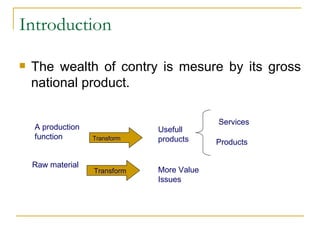
Introduction The wealth of contry is mesure by its gross national product. A  production function Usefull products Transform Services Products Raw material Transform More Value Issues
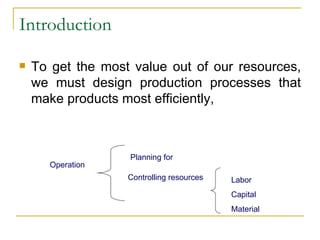
Introduction To get the most value out of our resources, we must design production processes that make products most efficiently, Operation Planning for Controlling resources Labor Capital Material
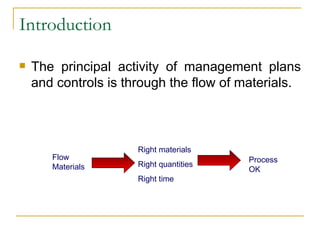
Introduction The principal activity of management plans and controls is through the flow of materials . Flow Materials Right materials Right quantities Right time Process OK
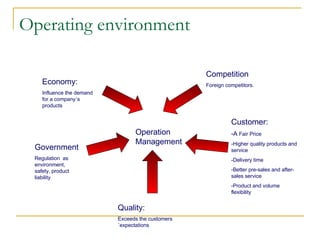
Operating environment Operation Management Government Regulation  as environment, safety, product liability Economy: Influence the demand for a company´s products Competition Foreign competitors. Customer: -A  Fair Price -Higher quality products and service -Delivery time -Better pre-sales and after-sales service -Product and volume flexibility Quality: Exceeds the customers´expectations
Operating environment Order Qualifiers:  Customer requirement (price, quality, delivery and so forth ) Order Winners:  Competitive characteristics or combination of characteristics, that persuade a company´s customer to choose its products or services .
Manufacturing strategy A highly market-oriented company will focus on meeting or exceeding customer expectations and on order winnings strategy. Delivery lead time:  Is the time from receipt of an order to the delivery of the product.
Manufacturing strategy Engineer to order: Customer´s specifications require unique engineering design or significant customization.  Delivery lead time is long because it includes not only purchase lead time, but design lead time as well.
Manufacturing strategy Make to order: Manufacturer does not start to make the product until a customer´s order is received. Assemble to order: Product es made from standard components that the manufacturer can inventory and assemble according to a customer order. (not design time and inventory is ready for ensambly)
Manufacturing strategy Make to stock: Supplier manufactures the foods and sells from finished goods inventory. Delivery lead time is shortest.
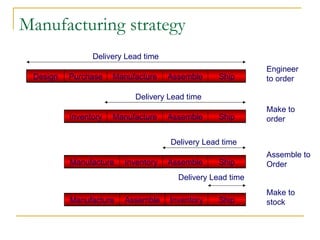
Manufacturing strategy Delivery Lead time Engineer to order Make to order Ship Assemble Manufacture Inventory Delivery Lead time Make to stock Design Ship Assemble Manufacture Purchase Ship Assemble Manufacture Inventory Delivery Lead time Ship Assemble Manufacture Inventory Delivery Lead time Assemble to Order
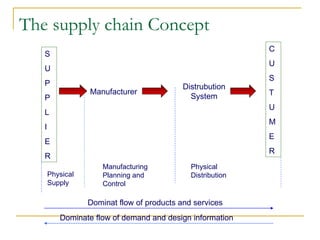
The supply chain Concept S U P P L I E R Manufacturer Distrubution System C U S T U M E R Dominate flow of demand and design information Dominat flow of products and services Physical Supply Manufacturing Planning and Control Physical Distribution
The supply chain Concept Factors: Includes activities and processes to supply a product or service to final customer. Any number of companies can be linked in the supply chain A customer can ve a supplier to another customer so the total chain can have a number of supplier/customer relationship
The supply chain Concept Factors: While the distribution system can be direct from supplier to customer, depending on the products and markets, it can contain a number of intermediaries (distribution) such as wholesalers, warehouses, and retailers. Product or services usually flow from supplier to customer and design and demand information usually flows from customer to supplier. Rarely is not so.
Supply Chain Concepts Historical perspective Attention on the issues that were internal to the companies. 1970 JIT  (Mutual analysis for cost reduction, Mutual product design and reduced inventory in process) 1980 Supply chain Concepts Explosive forth in computer capability Large growth in global competition Technological capabilities for products and process
Supply Chain Concepts Historical perspective 1980 Supply chain Concepts Explosive growth in computer capability Large growth in global competition Technological capabilities for products and process More companies are subcontracting their work to suppliers,
Supply Chain Concepts Entire set of activities from raw material production to final customer purchase as linked chain of activity. Flow materials Flow of information , mostly electronically Fund transfers.
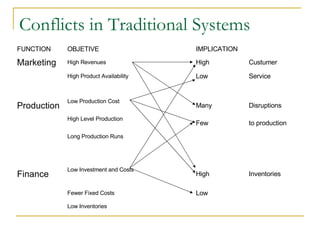
Conflicts in Traditional Systems Maximized departmental objectives without considering the effect they would have on other parts of the system. The principal objectives: Provide best costumer service Provide lowest production cost Provide lowest inventory investment Provide lowest distribution cost Conflicted with marketing, production and finance departments because each has different responsible.
Conflicts in Traditional Systems Actions: Marketing High inventories Interrupt production Extensive and costly distribution system Finance Reduce inventory Decrease the number of plants and warehouse Produce large quantities using long production runs Manufacture only to customer order
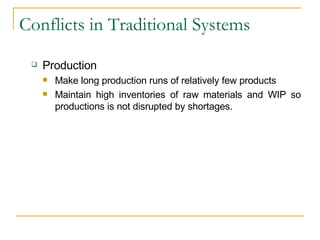
Conflicts in Traditional Systems Production Make long production runs of relatively few products Maintain high inventories of raw materials and WIP so productions is not disrupted by shortages .
Conflicts in Traditional Systems Low High Few Many Low High IMPLICATION Low Inventories Fewer Fixed Costs Inventories Low Investment and Costs Finance Long Production Runs to production High Level Production Disruptions Low Production Cost Production Service High Product Availability Custumer  High Revenues Marketing OBJETIVE FUNCTION
Materials Management Department responsible for the flow of material, from supplier through production to costumer. (some times include distribution planning and control and logistic management). Objectives: Maximize the use of the firm´s resources. Provide the required level of customer service
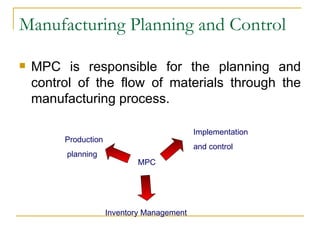
Manufacturing Planning and Control MPC is responsible for the planning and control of the flow of materials through the manufacturing process. MPC Implementation  and control Inventory Management Production planning
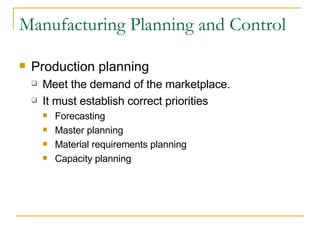
Manufacturing Planning and Control Production planning Meet the demand of the marketplace. It must establish correct priorities Forecasting Master planning Material requirements planning Capacity planning
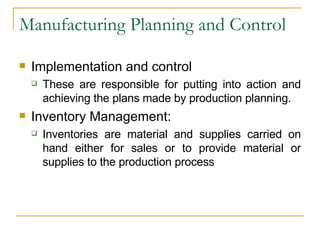
Manufacturing Planning and Control Implementation and control These are responsible for putting into action and achieving the plans made by production planning. Inventory Management: Inventories are material and supplies carried on hand either for sales or to provide material or supplies to the production process
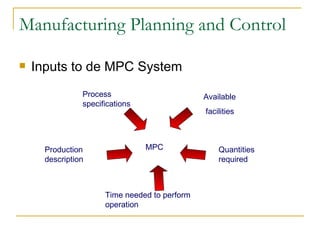
Manufacturing Planning and Control Inputs to de MPC System MPC Process specifications Time needed to perform operation Production description Quantities required Available facilities
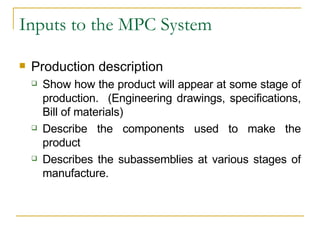
Inputs to the MPC System Production description Show how the product will appear at some stage of production.  (Engineering drawings, specifications, Bill of materials) Describe the components used to make the product Describes the subassemblies at various stages of manufacture.
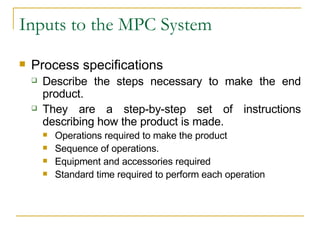
Inputs to the MPC System Process specifications Describe the steps necessary to make the end product. They are a step-by-step set of instructions describing how the product is made. Operations required to make the product Sequence of operations. Equipment and accessories required Standard time required to perform each operation
Inputs to the MPC System Time needed to perform operation Expressed in standard time which is the time taken by an average operator, working at a normal pace, to perform a task .
Inputs to the MPC System Available facilities Manufacturing planning and control must know what plant, equipment, and labor will be available to process work.  This information is usually found in the work center file.
Inputs to the MPC System Quantities required: This information will come from forecasts, customer orders, orders to  replace finished-goods inventory and the material requirements plan .
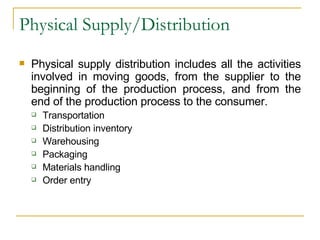
Physical Supply/Distribution Physical supply distribution includes all the activities involved in moving goods, from the supplier to the beginning of the production process, and from the end of the production process to the consumer. Transportation Distribution inventory Warehousing Packaging Materials handling Order entry
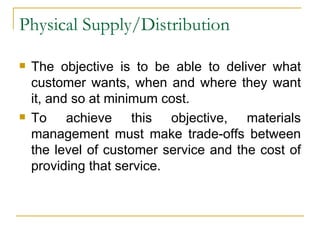
Physical Supply/Distribution The objective is to be able to deliver what customer wants, when and where they want it, and so at minimum cost. To achieve this objective, materials management must make trade-offs between the level of customer service and the cost of providing that service.
Physical Supply/Distribution The overall concern of materials management is the balance between priority and capacity Priority and capacity must be planned and controlled to meet customer demand at minimum cost.
Supply Chain Metrics A metric is a verifiable measure stated in either quantitative or qualitative terms defined with respect to a reference point. Metrics give us: Control by superiors Reporting of data to superiors and external groups Communication Learning Improvement
Supply Chain Metrics Metrics communicate expectations, identify problems, direct a course of action and motivate people.
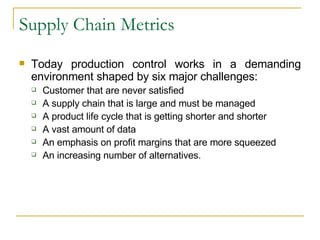
Supply Chain Metrics Today production control works in a demanding environment shaped by six major challenges: Customer that are never satisfied A supply chain that is large and must be managed A product life cycle that is getting shorter and shorter A vast amount of data An emphasis on profit margins that are more squeezed An increasing number of alternatives.
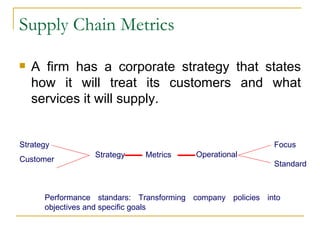
Supply Chain Metrics A firm has a corporate strategy that states how it will treat its customers and what services it will supply. Strategy Customer Strategy Focus Standard Operational Metrics Performance standars: Transforming company policies into objectives and specific goals
Supply Chain Metrics The necessary steps in implementing such a program are: Establish company goals and objectives Define performance State the measurement to be used Set performance standards Educate the user Make sure the program is consistently applied.
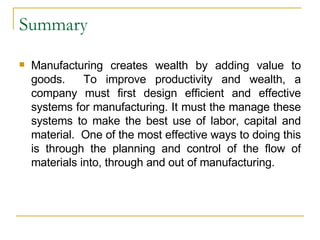
Summary Manufacturing creates wealth by adding value to goods.  To improve productivity and wealth, a company must first design efficient and effective systems for manufacturing. It must the manage these systems to make the best use of labor, capital and material.  One of the most effective ways to doing this is through the planning and control of the flow of materials into, through and out of manufacturing.
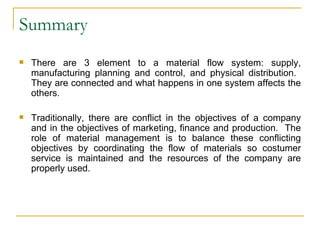
Summary There are 3 element to a material flow system: supply, manufacturing planning and control, and physical distribution.  They are connected and what happens in one system affects the others. Traditionally, there are conflict in the objectives of a company and in the objectives of marketing, finance and production.  The role of material management is to balance these conflicting objectives by coordinating the flow of materials so costumer service is maintained and the resources of the company are properly used.
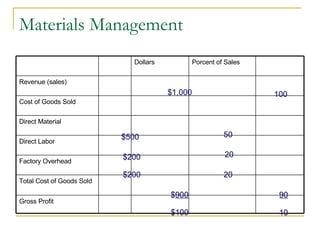
Materials Management $1,000 $500 $ 900 $200 $200 $100 90 100 20 20 50 10 Gross Profit Total Cost of Goods Sold Factory Overhead Direct Labor Direct Material Cost of Goods Sold Revenue (sales) Porcent of Sales Dollars
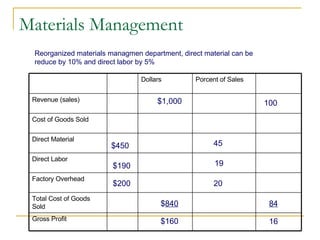
Materials Management $1,000 $450 $ 840 $200 $190 $160 84 100 20 19 45 16 Reorganized materials managmen department, direct material can be reduce by 10% and direct labor by 5% Gross Profit Total Cost of Goods Sold Factory Overhead Direct Labor Direct Material Cost of Goods Sold Revenue (sales) Porcent of Sales Dollars
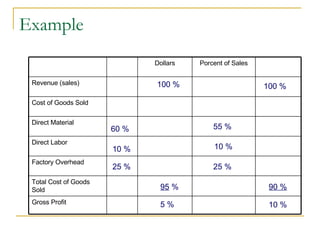
Example 100 % 60 % 95  % 25 % 10 % 5 % 90 % 100 % 25 % 10 % 55 % 10 % Gross Profit Total Cost of Goods Sold Factory Overhead Direct Labor Direct Material Cost of Goods Sold Revenue (sales) Porcent of Sales Dollars
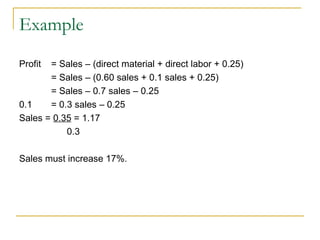
Example Profit = Sales – (direct material + direct labor + 0.25) = Sales – (0.60 sales + 0.1 sales + 0.25) = Sales – 0.7 sales – 0.25 0.1  = 0.3 sales – 0.25 Sales =  0.35  = 1.17   0.3 Sales must increase 17%.
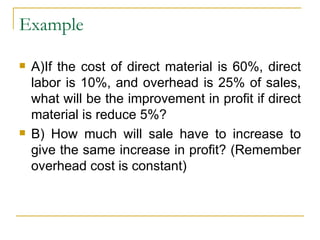
Example A)If the cost of direct material is 60%, direct labor is 10%, and overhead is 25% of sales, what will be the improvement in profit if direct material is reduce 5%? B) How much will sale have to increase to give the same increase in profit? (Remember overhead cost is constant)

Introductionto Materials Management

  • 1.
    Introduction to MaterialsManagement Producción I IITI MC. Ma. del Pilar C. León Franco
  • 2.
    Introduction The wealthof contry is mesure by its gross national product. A production function Usefull products Transform Services Products Raw material Transform More Value Issues
  • 3.
    Introduction To getthe most value out of our resources, we must design production processes that make products most efficiently, Operation Planning for Controlling resources Labor Capital Material
  • 4.
    Introduction The principalactivity of management plans and controls is through the flow of materials . Flow Materials Right materials Right quantities Right time Process OK
  • 5.
    Operating environment OperationManagement Government Regulation as environment, safety, product liability Economy: Influence the demand for a company´s products Competition Foreign competitors. Customer: -A Fair Price -Higher quality products and service -Delivery time -Better pre-sales and after-sales service -Product and volume flexibility Quality: Exceeds the customers´expectations
  • 6.
    Operating environment OrderQualifiers: Customer requirement (price, quality, delivery and so forth ) Order Winners: Competitive characteristics or combination of characteristics, that persuade a company´s customer to choose its products or services .
  • 7.
    Manufacturing strategy Ahighly market-oriented company will focus on meeting or exceeding customer expectations and on order winnings strategy. Delivery lead time: Is the time from receipt of an order to the delivery of the product.
  • 8.
    Manufacturing strategy Engineerto order: Customer´s specifications require unique engineering design or significant customization. Delivery lead time is long because it includes not only purchase lead time, but design lead time as well.
  • 9.
    Manufacturing strategy Maketo order: Manufacturer does not start to make the product until a customer´s order is received. Assemble to order: Product es made from standard components that the manufacturer can inventory and assemble according to a customer order. (not design time and inventory is ready for ensambly)
  • 10.
    Manufacturing strategy Maketo stock: Supplier manufactures the foods and sells from finished goods inventory. Delivery lead time is shortest.
  • 11.
    Manufacturing strategy DeliveryLead time Engineer to order Make to order Ship Assemble Manufacture Inventory Delivery Lead time Make to stock Design Ship Assemble Manufacture Purchase Ship Assemble Manufacture Inventory Delivery Lead time Ship Assemble Manufacture Inventory Delivery Lead time Assemble to Order
  • 12.
    The supply chainConcept S U P P L I E R Manufacturer Distrubution System C U S T U M E R Dominate flow of demand and design information Dominat flow of products and services Physical Supply Manufacturing Planning and Control Physical Distribution
  • 13.
    The supply chainConcept Factors: Includes activities and processes to supply a product or service to final customer. Any number of companies can be linked in the supply chain A customer can ve a supplier to another customer so the total chain can have a number of supplier/customer relationship
  • 14.
    The supply chainConcept Factors: While the distribution system can be direct from supplier to customer, depending on the products and markets, it can contain a number of intermediaries (distribution) such as wholesalers, warehouses, and retailers. Product or services usually flow from supplier to customer and design and demand information usually flows from customer to supplier. Rarely is not so.
  • 15.
    Supply Chain ConceptsHistorical perspective Attention on the issues that were internal to the companies. 1970 JIT (Mutual analysis for cost reduction, Mutual product design and reduced inventory in process) 1980 Supply chain Concepts Explosive forth in computer capability Large growth in global competition Technological capabilities for products and process
  • 16.
    Supply Chain ConceptsHistorical perspective 1980 Supply chain Concepts Explosive growth in computer capability Large growth in global competition Technological capabilities for products and process More companies are subcontracting their work to suppliers,
  • 17.
    Supply Chain ConceptsEntire set of activities from raw material production to final customer purchase as linked chain of activity. Flow materials Flow of information , mostly electronically Fund transfers.
  • 18.
    Conflicts in TraditionalSystems Maximized departmental objectives without considering the effect they would have on other parts of the system. The principal objectives: Provide best costumer service Provide lowest production cost Provide lowest inventory investment Provide lowest distribution cost Conflicted with marketing, production and finance departments because each has different responsible.
  • 19.
    Conflicts in TraditionalSystems Actions: Marketing High inventories Interrupt production Extensive and costly distribution system Finance Reduce inventory Decrease the number of plants and warehouse Produce large quantities using long production runs Manufacture only to customer order
  • 20.
    Conflicts in TraditionalSystems Production Make long production runs of relatively few products Maintain high inventories of raw materials and WIP so productions is not disrupted by shortages .
  • 21.
    Conflicts in TraditionalSystems Low High Few Many Low High IMPLICATION Low Inventories Fewer Fixed Costs Inventories Low Investment and Costs Finance Long Production Runs to production High Level Production Disruptions Low Production Cost Production Service High Product Availability Custumer High Revenues Marketing OBJETIVE FUNCTION
  • 22.
    Materials Management Departmentresponsible for the flow of material, from supplier through production to costumer. (some times include distribution planning and control and logistic management). Objectives: Maximize the use of the firm´s resources. Provide the required level of customer service
  • 23.
    Manufacturing Planning andControl MPC is responsible for the planning and control of the flow of materials through the manufacturing process. MPC Implementation and control Inventory Management Production planning
  • 24.
    Manufacturing Planning andControl Production planning Meet the demand of the marketplace. It must establish correct priorities Forecasting Master planning Material requirements planning Capacity planning
  • 25.
    Manufacturing Planning andControl Implementation and control These are responsible for putting into action and achieving the plans made by production planning. Inventory Management: Inventories are material and supplies carried on hand either for sales or to provide material or supplies to the production process
  • 26.
    Manufacturing Planning andControl Inputs to de MPC System MPC Process specifications Time needed to perform operation Production description Quantities required Available facilities
  • 27.
    Inputs to theMPC System Production description Show how the product will appear at some stage of production. (Engineering drawings, specifications, Bill of materials) Describe the components used to make the product Describes the subassemblies at various stages of manufacture.
  • 28.
    Inputs to theMPC System Process specifications Describe the steps necessary to make the end product. They are a step-by-step set of instructions describing how the product is made. Operations required to make the product Sequence of operations. Equipment and accessories required Standard time required to perform each operation
  • 29.
    Inputs to theMPC System Time needed to perform operation Expressed in standard time which is the time taken by an average operator, working at a normal pace, to perform a task .
  • 30.
    Inputs to theMPC System Available facilities Manufacturing planning and control must know what plant, equipment, and labor will be available to process work. This information is usually found in the work center file.
  • 31.
    Inputs to theMPC System Quantities required: This information will come from forecasts, customer orders, orders to replace finished-goods inventory and the material requirements plan .
  • 32.
    Physical Supply/Distribution Physicalsupply distribution includes all the activities involved in moving goods, from the supplier to the beginning of the production process, and from the end of the production process to the consumer. Transportation Distribution inventory Warehousing Packaging Materials handling Order entry
  • 33.
    Physical Supply/Distribution Theobjective is to be able to deliver what customer wants, when and where they want it, and so at minimum cost. To achieve this objective, materials management must make trade-offs between the level of customer service and the cost of providing that service.
  • 34.
    Physical Supply/Distribution Theoverall concern of materials management is the balance between priority and capacity Priority and capacity must be planned and controlled to meet customer demand at minimum cost.
  • 35.
    Supply Chain MetricsA metric is a verifiable measure stated in either quantitative or qualitative terms defined with respect to a reference point. Metrics give us: Control by superiors Reporting of data to superiors and external groups Communication Learning Improvement
  • 36.
    Supply Chain MetricsMetrics communicate expectations, identify problems, direct a course of action and motivate people.
  • 37.
    Supply Chain MetricsToday production control works in a demanding environment shaped by six major challenges: Customer that are never satisfied A supply chain that is large and must be managed A product life cycle that is getting shorter and shorter A vast amount of data An emphasis on profit margins that are more squeezed An increasing number of alternatives.
  • 38.
    Supply Chain MetricsA firm has a corporate strategy that states how it will treat its customers and what services it will supply. Strategy Customer Strategy Focus Standard Operational Metrics Performance standars: Transforming company policies into objectives and specific goals
  • 39.
    Supply Chain MetricsThe necessary steps in implementing such a program are: Establish company goals and objectives Define performance State the measurement to be used Set performance standards Educate the user Make sure the program is consistently applied.
  • 40.
    Summary Manufacturing createswealth by adding value to goods. To improve productivity and wealth, a company must first design efficient and effective systems for manufacturing. It must the manage these systems to make the best use of labor, capital and material. One of the most effective ways to doing this is through the planning and control of the flow of materials into, through and out of manufacturing.
  • 41.
    Summary There are3 element to a material flow system: supply, manufacturing planning and control, and physical distribution. They are connected and what happens in one system affects the others. Traditionally, there are conflict in the objectives of a company and in the objectives of marketing, finance and production. The role of material management is to balance these conflicting objectives by coordinating the flow of materials so costumer service is maintained and the resources of the company are properly used.
  • 42.
    Materials Management $1,000$500 $ 900 $200 $200 $100 90 100 20 20 50 10 Gross Profit Total Cost of Goods Sold Factory Overhead Direct Labor Direct Material Cost of Goods Sold Revenue (sales) Porcent of Sales Dollars
  • 43.
    Materials Management $1,000$450 $ 840 $200 $190 $160 84 100 20 19 45 16 Reorganized materials managmen department, direct material can be reduce by 10% and direct labor by 5% Gross Profit Total Cost of Goods Sold Factory Overhead Direct Labor Direct Material Cost of Goods Sold Revenue (sales) Porcent of Sales Dollars
  • 44.
    Example 100 %60 % 95 % 25 % 10 % 5 % 90 % 100 % 25 % 10 % 55 % 10 % Gross Profit Total Cost of Goods Sold Factory Overhead Direct Labor Direct Material Cost of Goods Sold Revenue (sales) Porcent of Sales Dollars
  • 45.
    Example Profit =Sales – (direct material + direct labor + 0.25) = Sales – (0.60 sales + 0.1 sales + 0.25) = Sales – 0.7 sales – 0.25 0.1 = 0.3 sales – 0.25 Sales = 0.35 = 1.17 0.3 Sales must increase 17%.
  • 46.
    Example A)If thecost of direct material is 60%, direct labor is 10%, and overhead is 25% of sales, what will be the improvement in profit if direct material is reduce 5%? B) How much will sale have to increase to give the same increase in profit? (Remember overhead cost is constant)