INDUSTRIAL SAFETY
OBJECTIVE OF PRESENTATION
IMPROVE SAFETY -
AWARENESS.
ACCIDENT PREVENTION.
REDUCE THE ACCIDENTS AND
ACHIEVE 100% ACCIDENT FREE
WORKING.
SAVE PRODUCTIVITY.
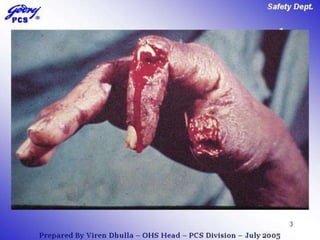
CONSEQUENCES OF ACCIDENTS
Medical expenses.
INDIRECT LOSSES:
No peace of mind in family.
Frustration in life.
Future plans upset.
Loss to the family if death or
disablement occurs.
CONSEQUENCES OF ACCIDENTS
SOCIAL LOSSES:
Children become orphans.
Burden to society.
CAUSES OF ACCIDENTS:
1. UNSAFE ACTS: Not following:
Safety norms applicable to them.
Standing orders of the company.
Plant safety rules.
Safety instructions.
Safety tips.
Accident prevention instructions.
CAUSES OF ACCIDENTS:
Not using:
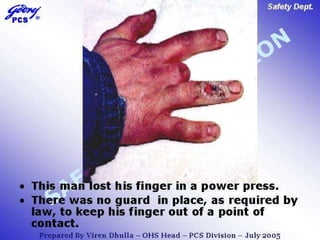
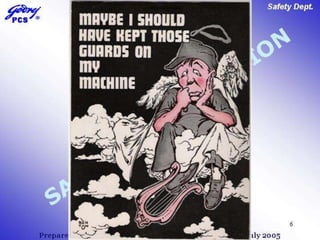
Safety guards.
Safety gadgets (PPEs)
Recommended speeds & feeds.
Not using right tool for right job/
use of worn-out/ non-standard
tools.
CAUSES OF ACCIDENTS:
Other misc. causes:
Horse play at the Shop floor.
Disturbing the concentration of
others by throwing items, talking.
Operating dangerous machines
without training, without knowing,
without orders etc.
Short-cuts methods.
CAUSES OF ACCIDENTS:
 Not reporting in-time and.
defects noticed
Bad house keeping.
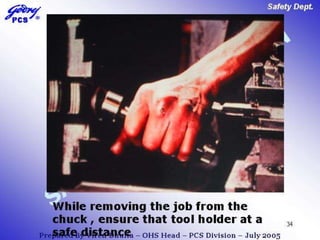
Improper cleaning of tool/ job/
m/c.
Not using proper and suitable
PPE.
CAUSES OF ACCIDENTS:
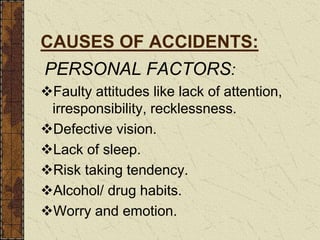
PERSONAL FACTORS:
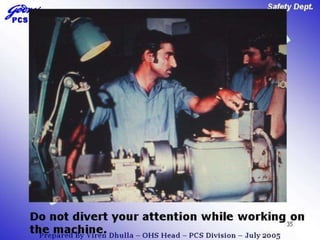
Faulty attitudes like lack of attention,
irresponsibility, recklessness.
Defective vision.
Lack of sleep.
Risk taking tendency.
Alcohol/ drug habits.
Worry and emotion.
CAUSES OF ACCIDENTS:
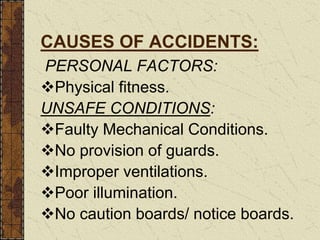
PERSONAL FACTORS:
Physical fitness.
UNSAFE CONDITIONS:
Faulty Mechanical Conditions.
No provision of guards.
Improper ventilations.
Poor illumination.
No caution boards/ notice boards.
CAUSES OF ACCIDENTS:
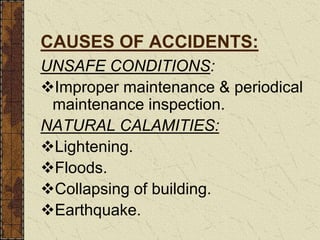
UNSAFE CONDITIONS:
Improper maintenance & periodical
maintenance inspection.
NATURAL CALAMITIES:
Lightening.
Floods.
Collapsing of building.
Earthquake.
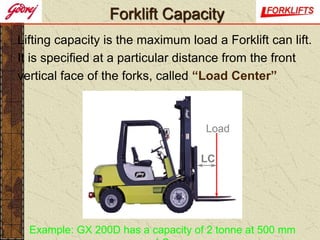
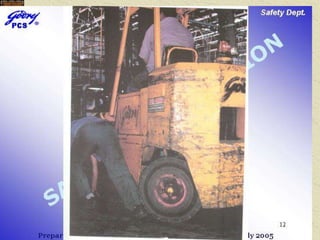
Forklift Capacity
Lifting capacity is the maximum load a Forklift can lift.
It is specified at a particular distance from the front
vertical face of the forks, called “Load Center”
LC
Load
Example: GX 200D has a capacity of 2 tonne at 500 mm
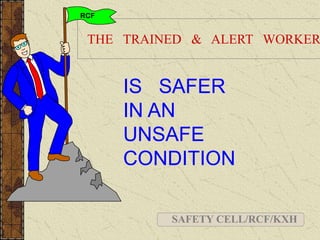
THE TRAINED & ALERT WORKER
IS SAFER
IN AN
UNSAFE
CONDITION
RCF
SAFETY CELL/RCF/KXH
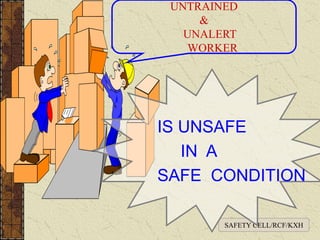
UNTRAINED
&
UNALERT
WORKER
SAFETY CELL/RCF/KXH
IS UNSAFE
IN A
SAFE CONDITION
ACCIDENT ASSESSMENT
METHOD IN YOUR SHOP
(Example):
Activity: Scrap lifting from shop floor
Hazard : Falling of heavy scrap from
low height
Risk : Injury to men
Controlled by: PPE (safety shoe, hand
gloves) and Safety
Work Instruction
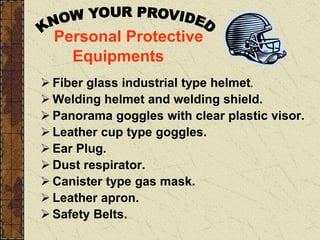
Personal Protective
Equipments
 Fiber glass industrial type helmet.
 Welding helmet and welding shield.
 Panorama goggles with clear plastic visor.
 Leather cup type goggles.
 Ear Plug.
 Dust respirator.
 Canister type gas mask.
 Leather apron.
 Safety Belts.
Personal Protective
Equipments
 Leather-cum-canvas hand gloves.
 Leather hand gloves.
 Cotton gloves.
 Rubber hand gloves.
 Electric shock resistant gloves.
 Protective barrier cream.
 Leg guard and leather legging.
 Leather safety boot.
 Gum boot.
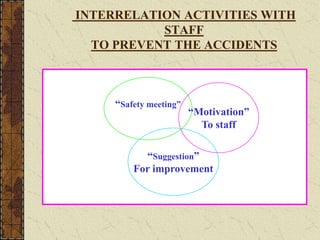
INTERRELATION ACTIVITIES WITH
STAFF
TO PREVENT THE ACCIDENTS
“Safety meeting”
“Motivation”
To staff
“Suggestion”
For improvement
(Invitation to FIRE )
We should not ignore the
following in the daily
working practice:
 SAFE USE OF Electricity.
 PROPER DISPOSAL OF
WASTES/ HAZARDOUS
WASTES
 GOOD HOUSE KEEPING.
 PROPER USAGE/
MAINTENANCE OF FIRE
FIGHTING EQUIPMENTS
HAZARD
IDENTIFICATION
IS POSSIBLE
THROUGH
• SAFETY INSPECTION
• YOURS VALUABLE SUGGESTIONS
•REPORTING OF ACTUAL CAUSE OF
ACCIDENTS
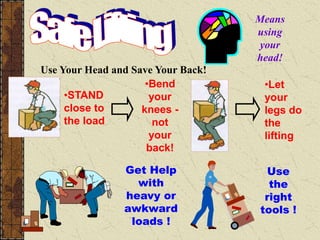
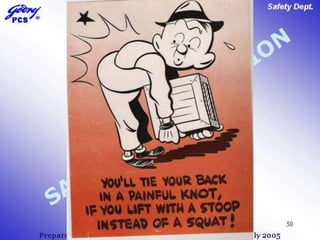
Use Your Head and Save Your Back!
•STAND
close to
the load
•Bend
your
knees -
not
your
back!
•Let
your
legs do
the
lifting
Get Help
with
heavy or
awkward
loads !
Use
the
right
tools !
Means
using
your
head!
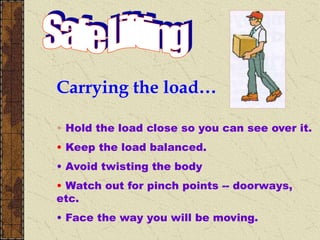
Carrying the load…
• Hold the load close so you can see over it.
• Keep the load balanced.
• Avoid twisting the body
• Watch out for pinch points -- doorways,
etc.
• Face the way you will be moving.
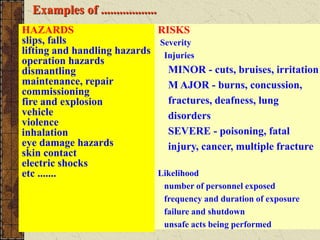
HAZARDS
slips, falls
lifting and handling hazards
operation hazards
dismantling
maintenance, repair
commissioning
fire and explosion
vehicle
violence
inhalation
eye damage hazards
skin contact
electric shocks
etc .......
RISKS
Severity
Injuries
MINOR - cuts, bruises, irritation
M AJOR - burns, concussion,
fractures, deafness, lung
disorders
SEVERE - poisoning, fatal
injury, cancer, multiple fracture
Likelihood
number of personnel exposed
frequency and duration of exposure
failure and shutdown
unsafe acts being performed
Examples of ..................
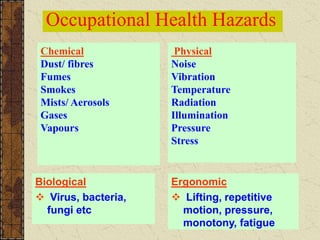
Chemical
Dust/ fibres
Fumes
Smokes
Mists/ Aerosols
Gases
Vapours
Physical
Noise
Vibration
Temperature
Radiation
Illumination
Pressure
Stress
Biological
 Virus, bacteria,
fungi etc
Ergonomic
 Lifting, repetitive
motion, pressure,
monotony, fatigue
Occupational Health Hazards
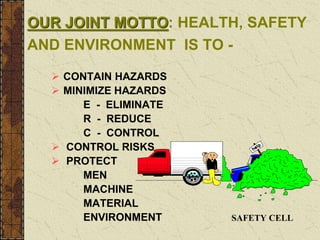
OUR JOINT MOTTO: HEALTH, SAFETY
AND ENVIRONMENT IS TO -
 CONTAIN HAZARDS
 MINIMIZE HAZARDS
E - ELIMINATE
R - REDUCE
C - CONTROL
 CONTROL RISKS
 PROTECT
MEN
MACHINE
MATERIAL
ENVIRONMENT SAFETY CELL
10 Commandments for safety
1. Use proper plugs.
2. No hand tool which is not double insulated in use.
3. No joint of welding lead un-insulated.
4. No direct connections from switch board.
5. No welding set improperly earthed.
6. No man working without wearing PPEs.
7. No fire extinguisher is over due testing & no empty fire
bucket.
8. No welding work in Fur./Finishing Shop without proper
supervision & without taking precautions.
9. No grinding m/c., circular saw working etc.; without
proper guards.
10. No wire ropes, chains over due testing, in use.
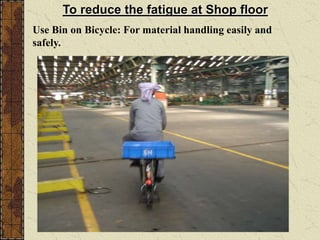
To reduce the fatigue at Shop floor
Use Bin on Bicycle: For material handling easily and
safely.
SUPERVISOR’S ROLE IN SAFETY
 Knowledge of Safety Policy
 Ensure Safety in daily work culture
 Waste disposal/Good Housekeeping
 Reporting of actual cause of injury
 Safe material handling
 Motivation to staff
 Support/help in work to staff
 Training to untrained staff
 Ensure the use of PPEs by staff
 Valuable suggestions
 Sets the example in safety/corrective-
actions
Industrial Safety mech.PPT

Industrial Safety mech.PPT

  • 1.
  • 2.
    OBJECTIVE OF PRESENTATION IMPROVESAFETY - AWARENESS. ACCIDENT PREVENTION. REDUCE THE ACCIDENTS AND ACHIEVE 100% ACCIDENT FREE WORKING. SAVE PRODUCTIVITY.
  • 3.
    CONSEQUENCES OF ACCIDENTS Medicalexpenses. INDIRECT LOSSES: No peace of mind in family. Frustration in life. Future plans upset. Loss to the family if death or disablement occurs.
  • 4.
    CONSEQUENCES OF ACCIDENTS SOCIALLOSSES: Children become orphans. Burden to society.
  • 5.
    CAUSES OF ACCIDENTS: 1.UNSAFE ACTS: Not following: Safety norms applicable to them. Standing orders of the company. Plant safety rules. Safety instructions. Safety tips. Accident prevention instructions.
  • 6.
    CAUSES OF ACCIDENTS: Notusing: Safety guards. Safety gadgets (PPEs) Recommended speeds & feeds. Not using right tool for right job/ use of worn-out/ non-standard tools.
  • 7.
    CAUSES OF ACCIDENTS: Othermisc. causes: Horse play at the Shop floor. Disturbing the concentration of others by throwing items, talking. Operating dangerous machines without training, without knowing, without orders etc. Short-cuts methods.
  • 8.
    CAUSES OF ACCIDENTS: Not reporting in-time and. defects noticed Bad house keeping. Improper cleaning of tool/ job/ m/c. Not using proper and suitable PPE.
  • 9.
    CAUSES OF ACCIDENTS: PERSONALFACTORS: Faulty attitudes like lack of attention, irresponsibility, recklessness. Defective vision. Lack of sleep. Risk taking tendency. Alcohol/ drug habits. Worry and emotion.
  • 10.
    CAUSES OF ACCIDENTS: PERSONALFACTORS: Physical fitness. UNSAFE CONDITIONS: Faulty Mechanical Conditions. No provision of guards. Improper ventilations. Poor illumination. No caution boards/ notice boards.
  • 11.
    CAUSES OF ACCIDENTS: UNSAFECONDITIONS: Improper maintenance & periodical maintenance inspection. NATURAL CALAMITIES: Lightening. Floods. Collapsing of building. Earthquake.
  • 20.
    Forklift Capacity Lifting capacityis the maximum load a Forklift can lift. It is specified at a particular distance from the front vertical face of the forks, called “Load Center” LC Load Example: GX 200D has a capacity of 2 tonne at 500 mm
  • 22.
    THE TRAINED &ALERT WORKER IS SAFER IN AN UNSAFE CONDITION RCF SAFETY CELL/RCF/KXH
  • 23.
  • 24.
    ACCIDENT ASSESSMENT METHOD INYOUR SHOP (Example): Activity: Scrap lifting from shop floor Hazard : Falling of heavy scrap from low height Risk : Injury to men Controlled by: PPE (safety shoe, hand gloves) and Safety Work Instruction
  • 25.
    Personal Protective Equipments  Fiberglass industrial type helmet.  Welding helmet and welding shield.  Panorama goggles with clear plastic visor.  Leather cup type goggles.  Ear Plug.  Dust respirator.  Canister type gas mask.  Leather apron.  Safety Belts.
  • 26.
    Personal Protective Equipments  Leather-cum-canvashand gloves.  Leather hand gloves.  Cotton gloves.  Rubber hand gloves.  Electric shock resistant gloves.  Protective barrier cream.  Leg guard and leather legging.  Leather safety boot.  Gum boot.
  • 27.
    INTERRELATION ACTIVITIES WITH STAFF TOPREVENT THE ACCIDENTS “Safety meeting” “Motivation” To staff “Suggestion” For improvement
  • 28.
    (Invitation to FIRE) We should not ignore the following in the daily working practice:  SAFE USE OF Electricity.  PROPER DISPOSAL OF WASTES/ HAZARDOUS WASTES  GOOD HOUSE KEEPING.  PROPER USAGE/ MAINTENANCE OF FIRE FIGHTING EQUIPMENTS
  • 29.
    HAZARD IDENTIFICATION IS POSSIBLE THROUGH • SAFETYINSPECTION • YOURS VALUABLE SUGGESTIONS •REPORTING OF ACTUAL CAUSE OF ACCIDENTS
  • 30.
    Use Your Headand Save Your Back! •STAND close to the load •Bend your knees - not your back! •Let your legs do the lifting Get Help with heavy or awkward loads ! Use the right tools ! Means using your head!
  • 31.
    Carrying the load… •Hold the load close so you can see over it. • Keep the load balanced. • Avoid twisting the body • Watch out for pinch points -- doorways, etc. • Face the way you will be moving.
  • 34.
    HAZARDS slips, falls lifting andhandling hazards operation hazards dismantling maintenance, repair commissioning fire and explosion vehicle violence inhalation eye damage hazards skin contact electric shocks etc ....... RISKS Severity Injuries MINOR - cuts, bruises, irritation M AJOR - burns, concussion, fractures, deafness, lung disorders SEVERE - poisoning, fatal injury, cancer, multiple fracture Likelihood number of personnel exposed frequency and duration of exposure failure and shutdown unsafe acts being performed Examples of ..................
  • 35.
    Chemical Dust/ fibres Fumes Smokes Mists/ Aerosols Gases Vapours Physical Noise Vibration Temperature Radiation Illumination Pressure Stress Biological Virus, bacteria, fungi etc Ergonomic  Lifting, repetitive motion, pressure, monotony, fatigue Occupational Health Hazards
  • 36.
    OUR JOINT MOTTO:HEALTH, SAFETY AND ENVIRONMENT IS TO -  CONTAIN HAZARDS  MINIMIZE HAZARDS E - ELIMINATE R - REDUCE C - CONTROL  CONTROL RISKS  PROTECT MEN MACHINE MATERIAL ENVIRONMENT SAFETY CELL
  • 37.
    10 Commandments forsafety 1. Use proper plugs. 2. No hand tool which is not double insulated in use. 3. No joint of welding lead un-insulated. 4. No direct connections from switch board. 5. No welding set improperly earthed. 6. No man working without wearing PPEs. 7. No fire extinguisher is over due testing & no empty fire bucket. 8. No welding work in Fur./Finishing Shop without proper supervision & without taking precautions. 9. No grinding m/c., circular saw working etc.; without proper guards. 10. No wire ropes, chains over due testing, in use.
  • 38.
    To reduce thefatigue at Shop floor Use Bin on Bicycle: For material handling easily and safely.
  • 39.
    SUPERVISOR’S ROLE INSAFETY  Knowledge of Safety Policy  Ensure Safety in daily work culture  Waste disposal/Good Housekeeping  Reporting of actual cause of injury  Safe material handling  Motivation to staff  Support/help in work to staff  Training to untrained staff  Ensure the use of PPEs by staff  Valuable suggestions  Sets the example in safety/corrective- actions