PRESENTATION ON
DISASTER MANAGEMENT
DISTURBING TRENDS OF
DISASTERS
AND
THEIR IMPACT ON INDIA
INDIA
ALASKA
USA
CHINA
AREA-WISE EVENTS (1975-2001)
DISTRIBUTION OF NATURAL DISASTERS
INDONESIA
JAPAN
DISTRIBUTION OF PEOPLE AFFECTED BY DISASTER (1975-2001)
INDIA
ALASKA
USA
CHINA
INDONESIA
JAPAN
IMPACT OF MITIGATION & PREPAREDNESS MEASURES
LOSSES DUE TO MAJOR EARTHQUAKES
(>6 ON RICHTER SCALE) IN JAPAN & USA
(2003 - 2005)
No of
Earthquakes
Killed Injured Houses
Destroyed Damaged
JAPAN
Ten 34 1048 > 496 >3553
USA
Seven 02 59 >55 >235
MAJOR DISASTERS IN INDIA : 1990 - 2005
YEAR PLACES & DISASTER LOSS OF LIVES
(APPROX)
LOSS OF PROPERTY
( Rs Crore) (APPROX)
1991 Uttarkashi Earthquake 2000 2000
1993 Latur Earthquake 9500 6000
1997 Jabalpur Earthquake 200 5000
1999 Chamoli Earthquake 2000 2000
1999 Orissa S Cyclone 9887 10000
2001 Bhuj Earthquake 14000 13400
2004 SE India Tsunami 15000 10000
2004 Assam & Bihar Floods 700 5000
2005 J&K Avalanche 350 100
2005 Mah, Guj, HP,
Karnataka, T’Nadu
Floods 1569 10300
2005 J&K Earthquakes 1336 1000
Total Losses of Major Disasters only 56542 64800
1. If Average Annual Lives Lost are Added, Figure Will go to More than
2. Adding Average Annual Losses, the Figure Will be More than
FACTORS RESPONSIBLE FOR
INCREASING NUMBER OF
DISASTERS
 Population Growth and Urban
Development
 Development Practices
 Climatic changes
 Effect of Environmental degradation
DISASTER MANAGEMENT CYCLE
Emergency Response
Post-disaster: recovery
Preparedness
Prevention/
Mitigation
Reconstruction
Rehabilitation
Response/Relief
Pre-disaster: risk reduction
Disaster
Emergency Response
Post-disaster: recovery
Preparedness
Prevention/
Mitigation
Reconstruction
Rehabilitation
Response/Relief
Pre-disaster: risk reduction
Disaster
DISASTER is an event which is –
-generally unpredictable,
-happens instantly or without giving enough time to react
-affecting a large number of people,
-disrupting normal life and leading to a large scale
devastation in terms of loss of life and property
-always finding the administration and affected people
struggling to respond in the desired manner and
-leaving deep socio-psychological, political and economic
after effects which persist for a long time to come.
WHAT IS A DISASTER?
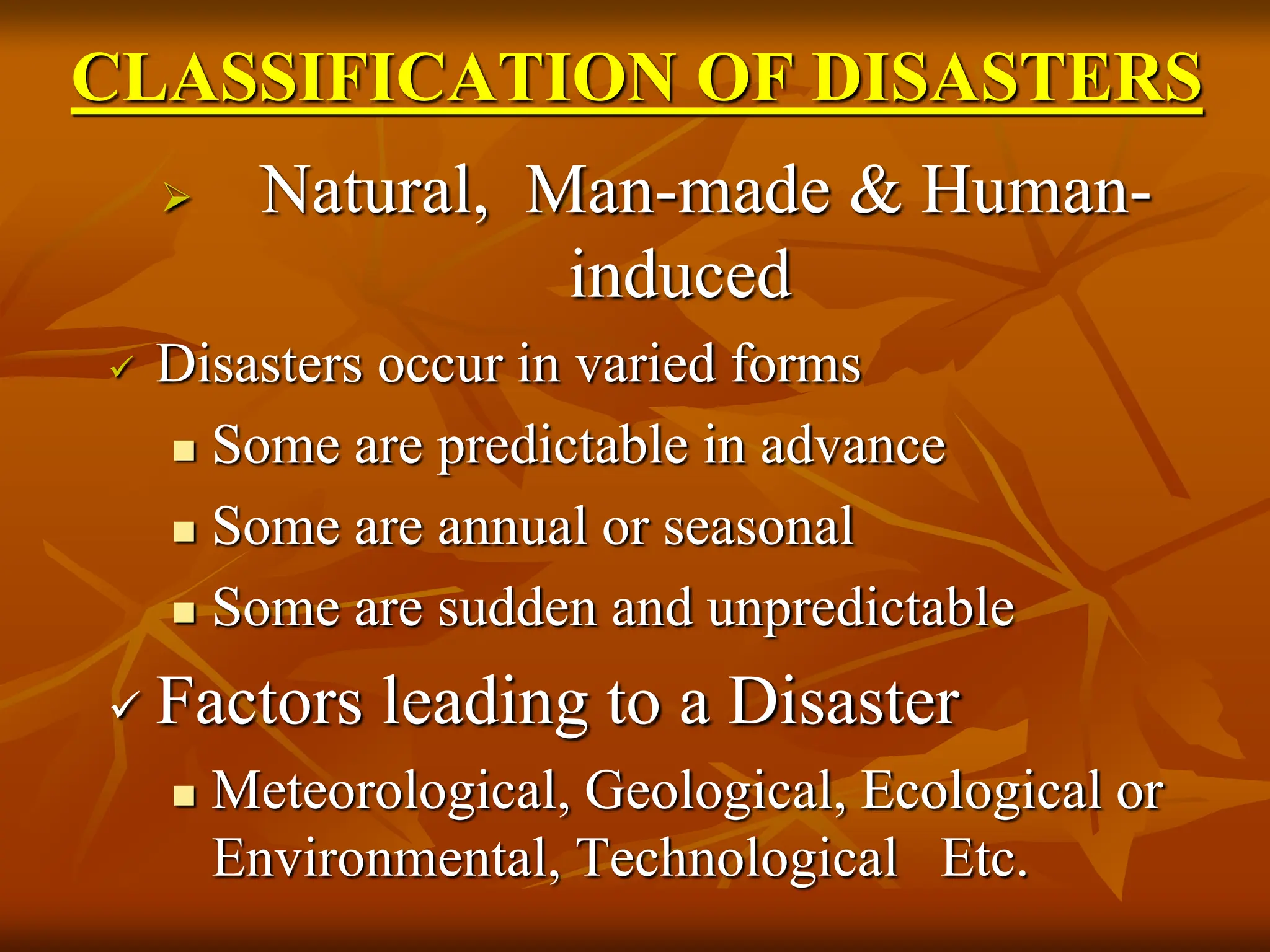
CLASSIFICATION OF DISASTERS
 Natural, Man-made & Human-
induced
 Disasters occur in varied forms
 Some are predictable in advance
 Some are annual or seasonal
 Some are sudden and unpredictable
 Factors leading to a Disaster
 Meteorological, Geological, Ecological or
Environmental, Technological Etc.
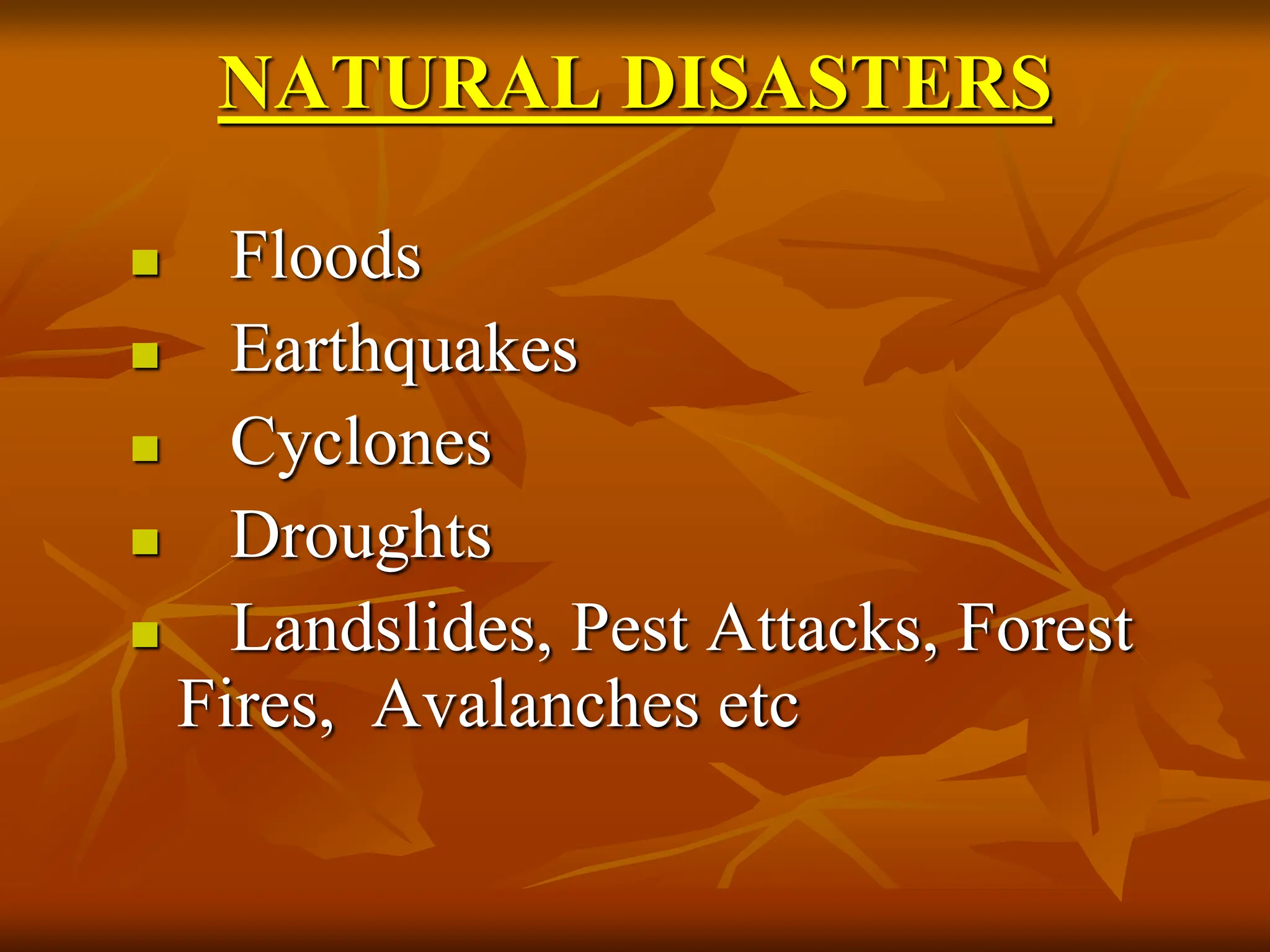
NATURAL DISASTERS
 Floods
 Earthquakes
 Cyclones
 Droughts
 Landslides, Pest Attacks, Forest
Fires, Avalanches etc
TIME DURATION OF NATURAL
DISASTERS
Earthquakes -> Seconds/minutes
Cyclones -> Days
Floods -> Days
Droughts -> Months
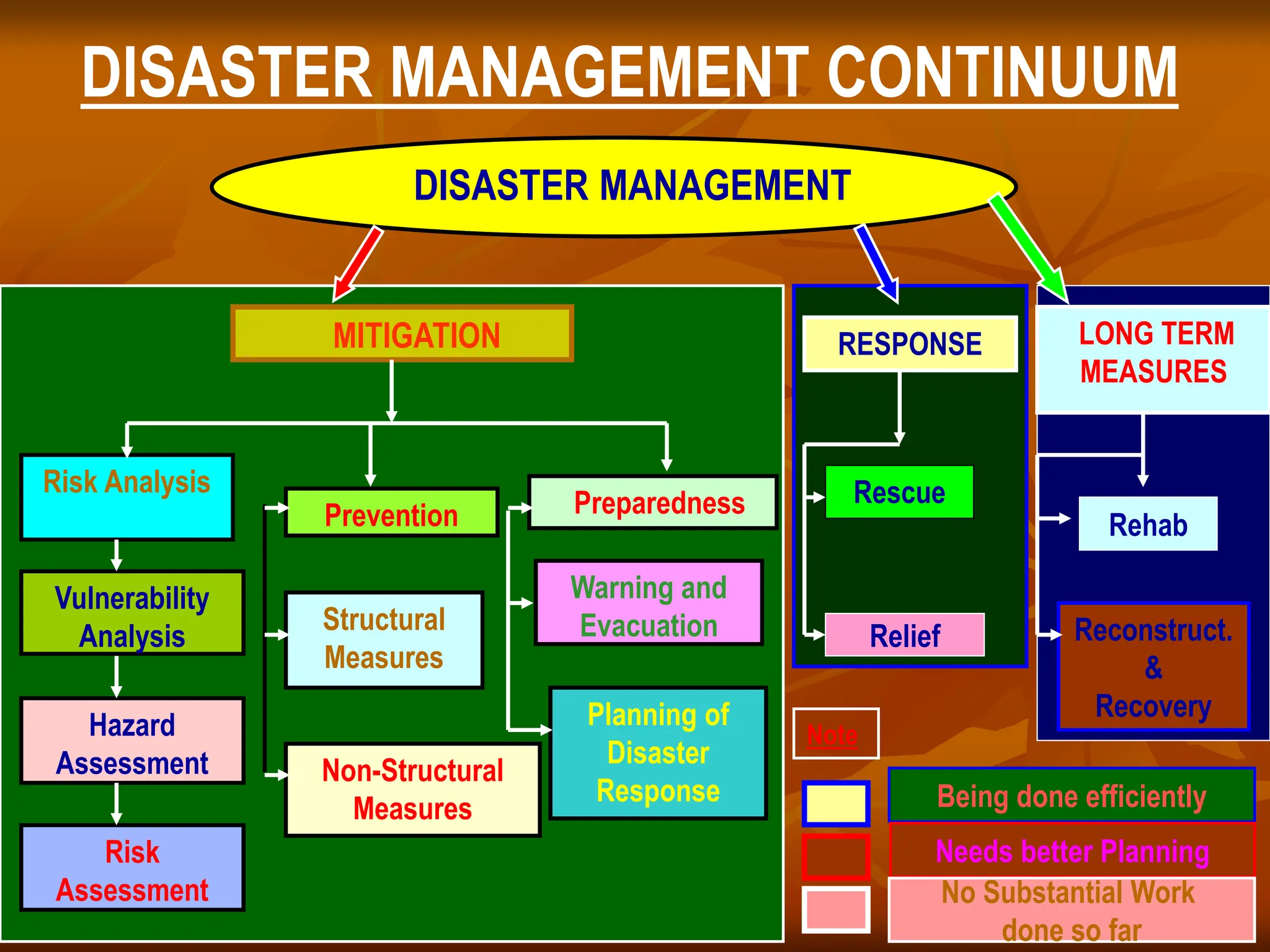
Prevention
Rescue
Structural
Measures
Warning and
Evacuation
Non-Structural
Measures
Planning of
Disaster
Response
Reconstruct.
&
Recovery
Risk Analysis
DISASTER MANAGEMENT
MITIGATION RESPONSE
Risk
Assessment
Preparedness
Hazard
Assessment
Vulnerability
Analysis Relief
Rehab
LONG TERM
MEASURES
Being done efficiently
Needs better Planning
No Substantial Work
done so far
Note
DISASTER MANAGEMENT CONTINUUM
HAZARD
VULNERABILITY
OF INDIA
EARTHQUAKE HAZARD ZONES 2002
Zone V MM IX or more
“ IV MM VIII
“ III MM VII
Zone II MM VI
“ I MM V or less
together now make
Zone II MM VI or less
Area under the zones
V 12%
IV 18%
III ~27%
Total damageable
~ 57%
V
V
III
V
III
IV
V
IV
WIND &
CYCLONE
HAZARD
ZONES IN
INDIA
FLOOD
HAZARD
PRONE
AREAS
OF
INDIA
LANDSLIDES
ZONATION
MAP
OF
INDIA
Severe Risk Area
High Risk Area
Moderate Risk Area
Unlikely Occurrence
*Types: Earthquake, Cyclone, Tsunami, Flood, Drought & Landslide.
1
4
10
17
*Even though affected only by Drought but suffers heavy
Financial Losses averaging Rs. 3 to 8 Thousand Crores, Annually.
3
“In order to Coordinate Central Govt efforts in
Preparedness, Prevention, Response, Mitigation, Relief
and Rehabilitation and for adoption of a Holistic
Pro-active Approach to Disaster Management, a
NATIONAL DISASTER MANAGEMENT AUTHORITY has
come into being by an Act of Parliament in December
2005 under the Chairmanship of Prime Minister as the
NODAL AGENCY for Disaster Management in the
Country.”
DISASTER MANAGEMENT ACT, 2005
CABINET COMMITTEE ON
MANAGEMENT OF NATURAL
CALAMITIES
HIGH LEVEL COMMITTEE
CABINET COMMITTEE ON
SECURITY
NATIONAL CRISIS MANAGEMENT
COMMITTEE
NATIONAL INSTITUTE OF DISASTER
MANAGEMENT
NATIONAL DISASTER RESPONSE FORCE
NDMA
/ NEC
PLANNING
COMMISSION
OTHER MINISTRIES/
DEPARTMENTS
ARMED FORCES
MHA
NATIONAL DISASTER MANAGEMENT STRUCTURE
GOVT OF INDIA
NATIONAL DISASTER MITIGATION RESOURCE
CENTRE
STATES/ UTs GOVTs
SDMAs
STATE DISASTER
RESPONSE FORCE
MINISTRIES/
DEPARTMENTS
DEPARTMENT
OF HOME
HOME GUARD
CIVIL DEFENCE
POLICE
DISTRICTS
DEPARTMENTS HOME GUARD CIVIL DEFENCE POLICE & FIRE SERVICES
DDMAs
LOCAL BODIES/ AUTHORITIES COMMUNITY
COMMUNITY
FIRE SERVICES
CHARTER – NDMA
AND
VISION
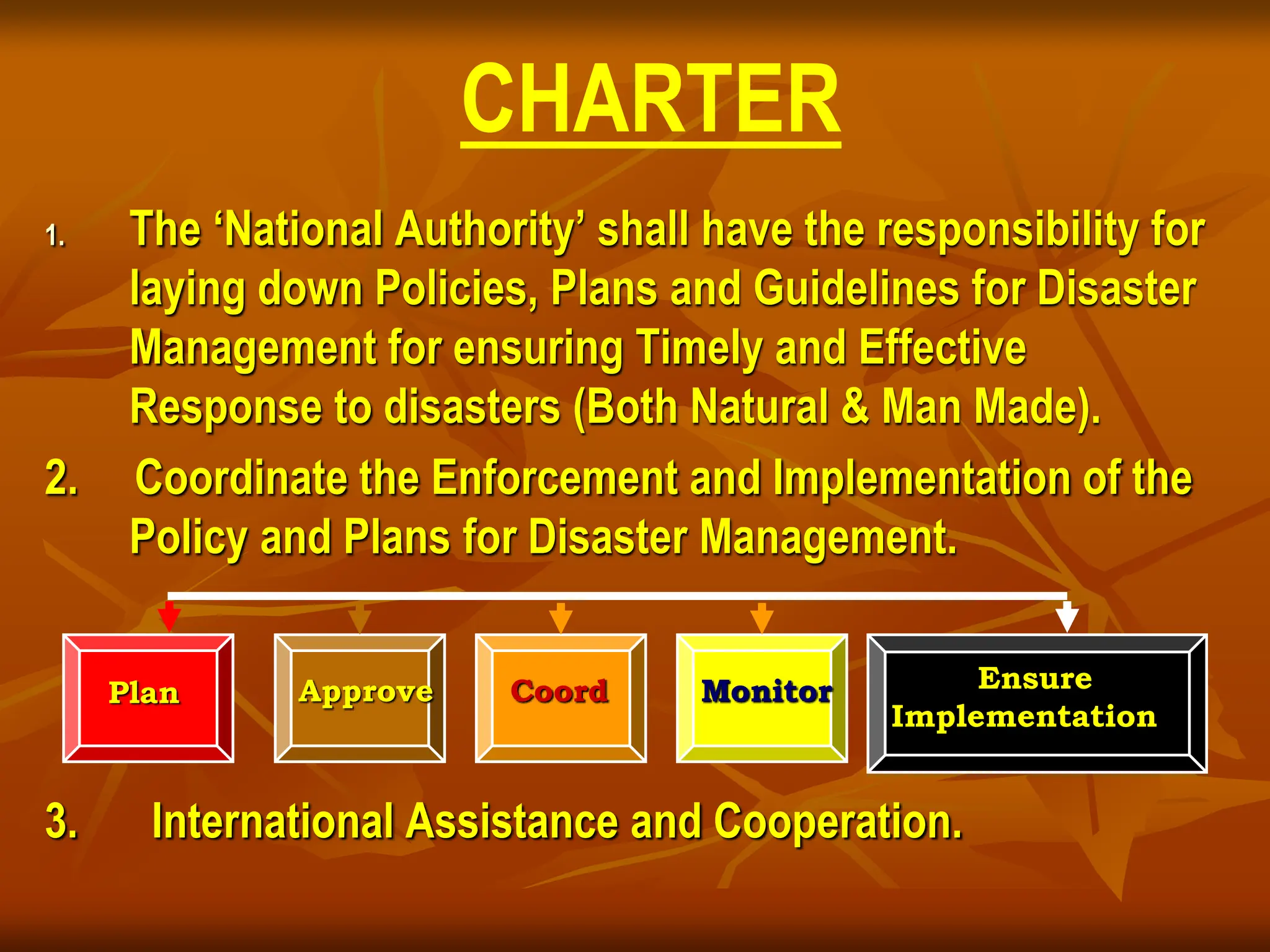
1. The ‘National Authority’ shall have the responsibility for
laying down Policies, Plans and Guidelines for Disaster
Management for ensuring Timely and Effective
Response to disasters (Both Natural & Man Made).
2. Coordinate the Enforcement and Implementation of the
Policy and Plans for Disaster Management.
3. International Assistance and Cooperation.
Plan Approve Coord Monitor Ensure
Implementation
CHARTER
“The National Vision is, to build a Safer and Disaster
Resilient India, by developing a Holistic, Proactive,
Multi-hazard and Technology-Driven Strategy for DM.
This will be achieved through a Culture of Prevention,
Mitigation and Preparedness to generate, a prompt and
efficient Response at the time of Disasters. The entire
process will Centre-Stage the Community and will be
provided Momentum and Sustenance through Collective
efforts of all Government Agencies and Non-
Governmental Organisations.
VISION
NATIONAL DISASTER MANAGEMENT AUTHORITY
CHAIRMAN
(PRIME MINISTER)
VICE CHAIRMAN
CABINET COMMITTEE
ON SECURITY
CABINET COMMITTEE ON MANAGEMENT OF
NATURAL CALAMITIES
POLICIES, PREVENTION, MITIGATION & PREPAREDNESS
MR. K.M.
SINGH
MEMBER
Mr B
BHATTACHARJEE
MEMBER
LT. GEN.
JRB
MEMBER
MR. M.K.
MEMBER
MR. M. S. REDDY
MEMBER
MR. NVC MENON
MEMBER
SECRETARY NDMA
CAPACITY BUILDING, COMMUNICATIONS & NEOC WING DISASTER MANAGEMENT WING
NATIONAL DISASTER MITIGATION RESOURCE CENTRES
NATIONAL EXECUTIVE
COMMITTEE
NATIONAL DISASTER RESPONSE FORCE
NATIONAL
INSTITUTE OF
DISASTER
MANAGEMENT
Mrs. P.J RAO
MEMBER
DISASTER MANAGEMENT WING
Financial
Advisor
International
Cooperation
Mitigation &
Preparedness
Policies &
Plans
Media & Public
Preparedness
Plans
Policies
Accounts
& Audits
Finance
Project
Formulation &
Preparedness
Project
Monitoring
Media &
Information
Community
Preparedness
CAPACITY BUILDING, COMMUNICATIONS & NEOC
NEOC & CAPACITY BUILDING COMMUNICATIONS,SYS & KM
Operations & Logistics Systems & KM
Communications
Capacity Building
Control
Room
Logistics
Coordina
tion
Strategic
Planning
& Policy
Scenario
Building
Operational
Commns
Logistics
Network
IT &
Systems
Knowledge
Management
& IDRN
Network
NATIONAL DISASTER
RESPONSE FORCE
NATIONAL DISASTER RESPONSE FORCE
• NDRF consists of 8 battalions, with 144 self sustaining teams for rendering
effective response to any threatening disaster situation or disaster.
• Four battalions are for natural disasters and four for NBC.
• NBC battalions will also be trained in combating natural disasters.
• The force will be equipped with State of the Art equipment and will be
deployed in anticipatory manner to provide instantaneous response.
• It will work under NDMA and will be located at nine vulnerable locations.
• They will maintain close liaison with the State Governments and will be
available to them automatically, thus, avoiding long procedural delays.
• Four Training Centres have been set up by PMF to train their respective NDRF
Battalions.
• They will also meet the requirement of States/ UTs.
• NDRF Battalions will impart basic training to State Disaster Response Force in
their respective locations.
NDRF BNS – REGIONAL MITIGATION RESOURCE CENTRES
(RMRCS) & TRAINING CENTRES
NDRF BNs/ RMRCs
TRAINING CENTRES
APEX TRAINING CENTRE
LEGEND
CHANDIGARH
GR. NOIDA
½
Bn
Each
GANDHINAGAR
PUNE
BHUBANESHWAR
KOLKATA
GUWAHATI
PATNA (SSB)
½ Bn
NAGPUR
LATUR
CHENNAI
HYDERABAD
CONSTITUTION OF SPECIALISED SEARCH
AND RESCUE TEAM
Team Commander
(Inspector)
Tech.
Support
(6)
Adm. Support Team
(7)
2 IC/ Ops Officer
(Sub Inspector)
Team B
(6)
Team C
(6)
Team D
(6)
Dog Squad
(3)
Medical
Support
Team
(3)
Team A
(6)
Total – 45 Personnel
CONSTITUTION OF SEARCH AND RESCUE TEAM FOR
NBC EMERGENCIES
Team Commander
(Inspector)
Information
Officer
(Sub Inspector)
Safety
Officer
(Sub Inspector)
Dy Team
Leader
(Sub Inspector)
Tech.
Support
(4)
Detection &
Assessment
Cum
Evacuation
Team (6)
Rescue
And
Evacuation
Team (6)
Rescue
and
Evacuation
Team (6)
Deconta-
mination
Team
(6)
Medical Unit
(6)
Adm. Support Team (7)
Total – 45 Personnel
HAZARD
A dangerous condition or events that threaten or have the potential for
causing injury to life or damage to property or the environment.
Hazards are basically grouped in two broad headings:
• Natural Hazards (hazards with meteorological, geological or biological
origin)
• Unnatural Hazards (hazards with human-caused or technological
origin)
Natural phenomena are extreme climatological, hydrological, or
geological, processes. A massive earthquake in an unpopulated area, is
a natural phenomenon, not a hazard. But when these natural
phenomena interact with the man made habitat, they may cause wide
spread damage. Then, they become hazard
VULNERABILITY
Vulnerability is defined as "The extent to which a
community, structure, service, or geographic area is
likely to be damaged or disrupted by the impact of
particular hazard, on account of their nature,
construction and proximity to hazardous terrain or a
disaster prone area.“
• Physical vulnerability – weak buildings, bridges, service
lines, lifeline structures, production units etc.
• Social & Economic vulnerability
Human losses in disasters in developing countries are
seen to be higher when compared to developed countries.
RISK
Risk is a measure of the expected losses (deaths, injuries,
property, economic activity etc) due to a hazard of a
particular magnitude or Intensity occurring in a given area
over a specific time period.
• Exposure: the value and importance of the various types of
structures and lifeline systems (such as water-supply,
communication network, transportation network etc in the
community serving the population)
HAZARD –
VULNERABILITY-
RISK –
DISASTER
LESSONS LEARNT – HURRICANE KATRINA
“ And any time you break that cycle of Preparing, Responding, Recovering and
Mitigating, you are doomed to failure. And the policies and decision that were
implemented by DHS put FEMA on a path to failure.”
-Michael Brown,Director,FEMA
General
1. The Foremost Lesson - all Facets of Disaster Cycle should be under one Agency
and not split among Multi-facet Authorities.
Mitigation & Preparedness
2. State’s Sovereignty be maintained in all Phases of Disaster Cycle.
3. Creating Culture of Preparedness at Community level.
4. Integrated Approach (of the Civil and Military efforts) for Preparedness. Coopt
Armed Forces in Disaster Response Plan.
5. Removal of Red Tapism and Bureaucratic Approach. US National Response Plan
is elaborate but Failed to Deliver. Need to Rewrite Rationale Response Plan to
include, conduct of mock drills periodically, state-of-the-art system in supply
chain management of relief supplies and inventory tracking.
6. Training and Equipping of Central Response Force duly backed by trained teams
from Armed Forces
7. Safe Houses . Identify shelters, for accommodating evacuees, both in Govt and
Private Sector, during Emergencies.
8. Establishment of a Homeland Security University. On the lines of National
Defence University, for General Awareness, Training and Research.
9. Use of Experts to find solutions to disaster related issues.
Communications
10. Failure within the DHS and in Communicating Relevant Information to Public, for
Early Warning, resulting in all available Federal Assets not being utilised. Need
to develop a more Comprehensive Emergency Communication System, to
ensure Survivability, Operability, Inter-Operability and Redundancy.
Response
11. Disaster Response Group at Central level to resolve disagreements
on Employment of Resources. This Group should also act as Single
Window Assistance Access for public.
12. Security of Assets by employing Local Law Enforcing Force for Law and Order.
13. Coordination, between:
(a) Search & Rescue and Medical Teams.
(b) State and Central Response Teams
(c) Local (Distt), State and Central Response Teams, to have inter-operable
Communication Network.
(d) At State level, Volunteer Coordinators in` State Emergency Operation
Centre, for coordinating Volunteer Efforts, like Debris Clearance, etc.
(e) Integrated Command at field level – local Response Units (National
Guards) and Active Duty Forces (ex Armed Forces) to work in tandem.
Mobile Command Field Centre near disaster site (not 80 km away
in Baton Rouge like during Katrina).
14. Need for National Emergency Operation Centre at DHS. DHS to have
a National Emergency Operations Centre, in addition to White House
Situation Room, regardless of whether President & the Secretary DHS are
in same place, to maintain flow of information from one agency.
15. Integrated Response. Civil and military assets to be combined and
employed as one resource and NOT in a graduated manner.
STRATEGIES FOR DISASTER MANAGEMENT
1. Change of Focus from Relief Centric to Holistic Approach.
2. Mainstreaming Disaster Management into all National
Developmental Programmes.
3. Empowerment of the Community to face the Disaster.
4. Emphasis on Training, Development of Human Capital and
Capacity Building.
5. Key Role of Educational and Professional Institutions for
Mass Education and Awareness.
6. Upgradation of the Key Responders.
STRATEGIES FOR DISASTER MANAGEMENT
7. Supporting and Enabling Mechanisms for the Districts
and States.
8. Failsafe Early Warning & Communication Systems.
9. Coordinated, Timely and Effective Response.
10. Involvement of NGOs & Corporate Sectors.
11. Time Bound Action Plan for Earthquakes, Floods &
Cyclones.
12. Pro-active Participation at the Regional and
International Level.
1. Concerned Member of Authority.
2. Concerned Ministry – Representative.
3. Lead/Nodal Organisations/Departments -
Representatives.
4. Project Team (When Study ordered on the
Subject).
5. Advisors/Experts.
6. Leading National (Academic – IITs) Institutions.
Secretarial Support
7. Additional Secretary.
8. Joint Secretary Planning.
9. DDG Strategic Planning.
POLICY FORMULATION
TEAM COMPOSTION

Disaster Management

  • 1.
  • 2.
  • 3.
  • 4.
    DISTRIBUTION OF PEOPLEAFFECTED BY DISASTER (1975-2001) INDIA ALASKA USA CHINA INDONESIA JAPAN IMPACT OF MITIGATION & PREPAREDNESS MEASURES
  • 5.
    LOSSES DUE TOMAJOR EARTHQUAKES (>6 ON RICHTER SCALE) IN JAPAN & USA (2003 - 2005) No of Earthquakes Killed Injured Houses Destroyed Damaged JAPAN Ten 34 1048 > 496 >3553 USA Seven 02 59 >55 >235
  • 6.
    MAJOR DISASTERS ININDIA : 1990 - 2005 YEAR PLACES & DISASTER LOSS OF LIVES (APPROX) LOSS OF PROPERTY ( Rs Crore) (APPROX) 1991 Uttarkashi Earthquake 2000 2000 1993 Latur Earthquake 9500 6000 1997 Jabalpur Earthquake 200 5000 1999 Chamoli Earthquake 2000 2000 1999 Orissa S Cyclone 9887 10000 2001 Bhuj Earthquake 14000 13400 2004 SE India Tsunami 15000 10000 2004 Assam & Bihar Floods 700 5000 2005 J&K Avalanche 350 100 2005 Mah, Guj, HP, Karnataka, T’Nadu Floods 1569 10300 2005 J&K Earthquakes 1336 1000 Total Losses of Major Disasters only 56542 64800 1. If Average Annual Lives Lost are Added, Figure Will go to More than 2. Adding Average Annual Losses, the Figure Will be More than
  • 7.
    FACTORS RESPONSIBLE FOR INCREASINGNUMBER OF DISASTERS  Population Growth and Urban Development  Development Practices  Climatic changes  Effect of Environmental degradation
  • 8.
    DISASTER MANAGEMENT CYCLE EmergencyResponse Post-disaster: recovery Preparedness Prevention/ Mitigation Reconstruction Rehabilitation Response/Relief Pre-disaster: risk reduction Disaster Emergency Response Post-disaster: recovery Preparedness Prevention/ Mitigation Reconstruction Rehabilitation Response/Relief Pre-disaster: risk reduction Disaster
  • 9.
    DISASTER is anevent which is – -generally unpredictable, -happens instantly or without giving enough time to react -affecting a large number of people, -disrupting normal life and leading to a large scale devastation in terms of loss of life and property -always finding the administration and affected people struggling to respond in the desired manner and -leaving deep socio-psychological, political and economic after effects which persist for a long time to come. WHAT IS A DISASTER?
  • 10.
    CLASSIFICATION OF DISASTERS Natural, Man-made & Human- induced  Disasters occur in varied forms  Some are predictable in advance  Some are annual or seasonal  Some are sudden and unpredictable  Factors leading to a Disaster  Meteorological, Geological, Ecological or Environmental, Technological Etc.
  • 11.
    NATURAL DISASTERS  Floods Earthquakes  Cyclones  Droughts  Landslides, Pest Attacks, Forest Fires, Avalanches etc
  • 12.
    TIME DURATION OFNATURAL DISASTERS Earthquakes -> Seconds/minutes Cyclones -> Days Floods -> Days Droughts -> Months
  • 13.
    Prevention Rescue Structural Measures Warning and Evacuation Non-Structural Measures Planning of Disaster Response Reconstruct. & Recovery RiskAnalysis DISASTER MANAGEMENT MITIGATION RESPONSE Risk Assessment Preparedness Hazard Assessment Vulnerability Analysis Relief Rehab LONG TERM MEASURES Being done efficiently Needs better Planning No Substantial Work done so far Note DISASTER MANAGEMENT CONTINUUM
  • 14.
  • 15.
    EARTHQUAKE HAZARD ZONES2002 Zone V MM IX or more “ IV MM VIII “ III MM VII Zone II MM VI “ I MM V or less together now make Zone II MM VI or less Area under the zones V 12% IV 18% III ~27% Total damageable ~ 57% V V III V III IV V IV
  • 16.
  • 17.
  • 18.
    LANDSLIDES ZONATION MAP OF INDIA Severe Risk Area HighRisk Area Moderate Risk Area Unlikely Occurrence
  • 19.
    *Types: Earthquake, Cyclone,Tsunami, Flood, Drought & Landslide. 1 4 10 17 *Even though affected only by Drought but suffers heavy Financial Losses averaging Rs. 3 to 8 Thousand Crores, Annually. 3
  • 20.
    “In order toCoordinate Central Govt efforts in Preparedness, Prevention, Response, Mitigation, Relief and Rehabilitation and for adoption of a Holistic Pro-active Approach to Disaster Management, a NATIONAL DISASTER MANAGEMENT AUTHORITY has come into being by an Act of Parliament in December 2005 under the Chairmanship of Prime Minister as the NODAL AGENCY for Disaster Management in the Country.” DISASTER MANAGEMENT ACT, 2005
  • 21.
    CABINET COMMITTEE ON MANAGEMENTOF NATURAL CALAMITIES HIGH LEVEL COMMITTEE CABINET COMMITTEE ON SECURITY NATIONAL CRISIS MANAGEMENT COMMITTEE NATIONAL INSTITUTE OF DISASTER MANAGEMENT NATIONAL DISASTER RESPONSE FORCE NDMA / NEC PLANNING COMMISSION OTHER MINISTRIES/ DEPARTMENTS ARMED FORCES MHA NATIONAL DISASTER MANAGEMENT STRUCTURE GOVT OF INDIA NATIONAL DISASTER MITIGATION RESOURCE CENTRE STATES/ UTs GOVTs SDMAs STATE DISASTER RESPONSE FORCE MINISTRIES/ DEPARTMENTS DEPARTMENT OF HOME HOME GUARD CIVIL DEFENCE POLICE DISTRICTS DEPARTMENTS HOME GUARD CIVIL DEFENCE POLICE & FIRE SERVICES DDMAs LOCAL BODIES/ AUTHORITIES COMMUNITY COMMUNITY FIRE SERVICES
  • 22.
  • 23.
    1. The ‘NationalAuthority’ shall have the responsibility for laying down Policies, Plans and Guidelines for Disaster Management for ensuring Timely and Effective Response to disasters (Both Natural & Man Made). 2. Coordinate the Enforcement and Implementation of the Policy and Plans for Disaster Management. 3. International Assistance and Cooperation. Plan Approve Coord Monitor Ensure Implementation CHARTER
  • 24.
    “The National Visionis, to build a Safer and Disaster Resilient India, by developing a Holistic, Proactive, Multi-hazard and Technology-Driven Strategy for DM. This will be achieved through a Culture of Prevention, Mitigation and Preparedness to generate, a prompt and efficient Response at the time of Disasters. The entire process will Centre-Stage the Community and will be provided Momentum and Sustenance through Collective efforts of all Government Agencies and Non- Governmental Organisations. VISION
  • 25.
    NATIONAL DISASTER MANAGEMENTAUTHORITY CHAIRMAN (PRIME MINISTER) VICE CHAIRMAN CABINET COMMITTEE ON SECURITY CABINET COMMITTEE ON MANAGEMENT OF NATURAL CALAMITIES POLICIES, PREVENTION, MITIGATION & PREPAREDNESS MR. K.M. SINGH MEMBER Mr B BHATTACHARJEE MEMBER LT. GEN. JRB MEMBER MR. M.K. MEMBER MR. M. S. REDDY MEMBER MR. NVC MENON MEMBER SECRETARY NDMA CAPACITY BUILDING, COMMUNICATIONS & NEOC WING DISASTER MANAGEMENT WING NATIONAL DISASTER MITIGATION RESOURCE CENTRES NATIONAL EXECUTIVE COMMITTEE NATIONAL DISASTER RESPONSE FORCE NATIONAL INSTITUTE OF DISASTER MANAGEMENT Mrs. P.J RAO MEMBER
  • 26.
    DISASTER MANAGEMENT WING Financial Advisor International Cooperation Mitigation& Preparedness Policies & Plans Media & Public Preparedness Plans Policies Accounts & Audits Finance Project Formulation & Preparedness Project Monitoring Media & Information Community Preparedness
  • 27.
    CAPACITY BUILDING, COMMUNICATIONS& NEOC NEOC & CAPACITY BUILDING COMMUNICATIONS,SYS & KM Operations & Logistics Systems & KM Communications Capacity Building Control Room Logistics Coordina tion Strategic Planning & Policy Scenario Building Operational Commns Logistics Network IT & Systems Knowledge Management & IDRN Network
  • 28.
  • 29.
    NATIONAL DISASTER RESPONSEFORCE • NDRF consists of 8 battalions, with 144 self sustaining teams for rendering effective response to any threatening disaster situation or disaster. • Four battalions are for natural disasters and four for NBC. • NBC battalions will also be trained in combating natural disasters. • The force will be equipped with State of the Art equipment and will be deployed in anticipatory manner to provide instantaneous response. • It will work under NDMA and will be located at nine vulnerable locations. • They will maintain close liaison with the State Governments and will be available to them automatically, thus, avoiding long procedural delays. • Four Training Centres have been set up by PMF to train their respective NDRF Battalions. • They will also meet the requirement of States/ UTs. • NDRF Battalions will impart basic training to State Disaster Response Force in their respective locations.
  • 30.
    NDRF BNS –REGIONAL MITIGATION RESOURCE CENTRES (RMRCS) & TRAINING CENTRES NDRF BNs/ RMRCs TRAINING CENTRES APEX TRAINING CENTRE LEGEND CHANDIGARH GR. NOIDA ½ Bn Each GANDHINAGAR PUNE BHUBANESHWAR KOLKATA GUWAHATI PATNA (SSB) ½ Bn NAGPUR LATUR CHENNAI HYDERABAD
  • 31.
    CONSTITUTION OF SPECIALISEDSEARCH AND RESCUE TEAM Team Commander (Inspector) Tech. Support (6) Adm. Support Team (7) 2 IC/ Ops Officer (Sub Inspector) Team B (6) Team C (6) Team D (6) Dog Squad (3) Medical Support Team (3) Team A (6) Total – 45 Personnel
  • 32.
    CONSTITUTION OF SEARCHAND RESCUE TEAM FOR NBC EMERGENCIES Team Commander (Inspector) Information Officer (Sub Inspector) Safety Officer (Sub Inspector) Dy Team Leader (Sub Inspector) Tech. Support (4) Detection & Assessment Cum Evacuation Team (6) Rescue And Evacuation Team (6) Rescue and Evacuation Team (6) Deconta- mination Team (6) Medical Unit (6) Adm. Support Team (7) Total – 45 Personnel
  • 33.
    HAZARD A dangerous conditionor events that threaten or have the potential for causing injury to life or damage to property or the environment. Hazards are basically grouped in two broad headings: • Natural Hazards (hazards with meteorological, geological or biological origin) • Unnatural Hazards (hazards with human-caused or technological origin) Natural phenomena are extreme climatological, hydrological, or geological, processes. A massive earthquake in an unpopulated area, is a natural phenomenon, not a hazard. But when these natural phenomena interact with the man made habitat, they may cause wide spread damage. Then, they become hazard
  • 34.
    VULNERABILITY Vulnerability is definedas "The extent to which a community, structure, service, or geographic area is likely to be damaged or disrupted by the impact of particular hazard, on account of their nature, construction and proximity to hazardous terrain or a disaster prone area.“ • Physical vulnerability – weak buildings, bridges, service lines, lifeline structures, production units etc. • Social & Economic vulnerability Human losses in disasters in developing countries are seen to be higher when compared to developed countries.
  • 35.
    RISK Risk is ameasure of the expected losses (deaths, injuries, property, economic activity etc) due to a hazard of a particular magnitude or Intensity occurring in a given area over a specific time period. • Exposure: the value and importance of the various types of structures and lifeline systems (such as water-supply, communication network, transportation network etc in the community serving the population)
  • 36.
  • 37.
    LESSONS LEARNT –HURRICANE KATRINA “ And any time you break that cycle of Preparing, Responding, Recovering and Mitigating, you are doomed to failure. And the policies and decision that were implemented by DHS put FEMA on a path to failure.” -Michael Brown,Director,FEMA General 1. The Foremost Lesson - all Facets of Disaster Cycle should be under one Agency and not split among Multi-facet Authorities. Mitigation & Preparedness 2. State’s Sovereignty be maintained in all Phases of Disaster Cycle. 3. Creating Culture of Preparedness at Community level. 4. Integrated Approach (of the Civil and Military efforts) for Preparedness. Coopt Armed Forces in Disaster Response Plan. 5. Removal of Red Tapism and Bureaucratic Approach. US National Response Plan is elaborate but Failed to Deliver. Need to Rewrite Rationale Response Plan to include, conduct of mock drills periodically, state-of-the-art system in supply chain management of relief supplies and inventory tracking.
  • 38.
    6. Training andEquipping of Central Response Force duly backed by trained teams from Armed Forces 7. Safe Houses . Identify shelters, for accommodating evacuees, both in Govt and Private Sector, during Emergencies. 8. Establishment of a Homeland Security University. On the lines of National Defence University, for General Awareness, Training and Research. 9. Use of Experts to find solutions to disaster related issues. Communications 10. Failure within the DHS and in Communicating Relevant Information to Public, for Early Warning, resulting in all available Federal Assets not being utilised. Need to develop a more Comprehensive Emergency Communication System, to ensure Survivability, Operability, Inter-Operability and Redundancy. Response 11. Disaster Response Group at Central level to resolve disagreements on Employment of Resources. This Group should also act as Single Window Assistance Access for public. 12. Security of Assets by employing Local Law Enforcing Force for Law and Order.
  • 39.
    13. Coordination, between: (a)Search & Rescue and Medical Teams. (b) State and Central Response Teams (c) Local (Distt), State and Central Response Teams, to have inter-operable Communication Network. (d) At State level, Volunteer Coordinators in` State Emergency Operation Centre, for coordinating Volunteer Efforts, like Debris Clearance, etc. (e) Integrated Command at field level – local Response Units (National Guards) and Active Duty Forces (ex Armed Forces) to work in tandem. Mobile Command Field Centre near disaster site (not 80 km away in Baton Rouge like during Katrina). 14. Need for National Emergency Operation Centre at DHS. DHS to have a National Emergency Operations Centre, in addition to White House Situation Room, regardless of whether President & the Secretary DHS are in same place, to maintain flow of information from one agency. 15. Integrated Response. Civil and military assets to be combined and employed as one resource and NOT in a graduated manner.
  • 41.
    STRATEGIES FOR DISASTERMANAGEMENT 1. Change of Focus from Relief Centric to Holistic Approach. 2. Mainstreaming Disaster Management into all National Developmental Programmes. 3. Empowerment of the Community to face the Disaster. 4. Emphasis on Training, Development of Human Capital and Capacity Building. 5. Key Role of Educational and Professional Institutions for Mass Education and Awareness. 6. Upgradation of the Key Responders.
  • 42.
    STRATEGIES FOR DISASTERMANAGEMENT 7. Supporting and Enabling Mechanisms for the Districts and States. 8. Failsafe Early Warning & Communication Systems. 9. Coordinated, Timely and Effective Response. 10. Involvement of NGOs & Corporate Sectors. 11. Time Bound Action Plan for Earthquakes, Floods & Cyclones. 12. Pro-active Participation at the Regional and International Level.
  • 43.
    1. Concerned Memberof Authority. 2. Concerned Ministry – Representative. 3. Lead/Nodal Organisations/Departments - Representatives. 4. Project Team (When Study ordered on the Subject). 5. Advisors/Experts. 6. Leading National (Academic – IITs) Institutions. Secretarial Support 7. Additional Secretary. 8. Joint Secretary Planning. 9. DDG Strategic Planning. POLICY FORMULATION TEAM COMPOSTION