

Picturesque
1.Introduction To Material Handling
2.Objectives of Material Handling
3.Types of Material Handling
4.Automation
5.Use Of Automation
6.Introduction To Automated Guided Vehicles
7.Applications of AGV
8. Components of AGV
9.Types of AGV
10.Vehicle Guidance Technology
11.AGV Control System
 Material handling is defined as "the movement,
storage, protection and control of materials
throughout the manufacturing and distribution
process including their consumption and disposal".
 The purpose of material handling in a factory is to
move raw materials, work piece-in process, finished
parts, tools, and supplies from one location to another
to facilitate the overall operations of manufacturing.
 The handling of materials must be performed safely,
efficiently, at low cost, in a timely manner, accurately
(the right materials in the right quantities to the right
locations), and without damage to the materials.
 To lower unit materials handling cost.
 To reduce manufacturing cycle time.
 To provide better control of the flow of materials.
 To provide better working conditions.
 To provide better quality by avoiding damages to products.
 To increase storage capacity through better utilization of
storage areas.
 To provide higher productivity at lower manufacturing
costs.
Manual handling
Manual handling refers to the use of a worker’s hands
to move individual containers by lifting, lowering,
filling, emptying, or carrying them.
Automated handling
Whenever technically and economically feasible,
equipment can be used to reduce and sometimes
replace the need to manually handle material.
 The term automation or automatic control is the use
of various control systems for operating equipment
such as machinery, processes in factories, and other
applications with minimal or reduced human
intervention or efforts.
 The biggest benefit of automation is that it saves
labor; however, it is also used to save energy and
materials and to improve quality, accuracy and
precision.
 In material handling process most work is done
through by Automated Guided Vehicles, Rail Guided
Vehicles, Robots, Automated storage and retrieval
system.
o To increase labor productivity.
o To reduce labor cost.
o To mitigate the effects of labor shortages.
o To reduce or remove routine manual and
clerical tasks.
o To improve worker safety.
o To improve product quality.
o To reduce manufacturing lead time.
o To accomplish what cannot be done manually.
INTRODUCTION
To
Automated Guided Vehicles
 It is a material handling system that uses
independently operated, self-propelled vehicles
guided along defined pathways. The vehicles are
powered by on-board batteries that allow many
hours of operation (8-16 hr. is typical) between
recharging.
 The Automated Guided Vehicle belongs to a class of
highly flexible, intelligent, and versatile material-
handling systems used to transfer materials from
various loading locations to various unloading
locations throughout the facility.
Some of the applications areas of Automated
Guided Vehicles include:
• Driverless train operations
• Assembly line operation
• Flexible manufacturing system
• Raw material handling
• Pallet handling
• Finished product handling
• Trailer loading
There are four main components of an automated guided
vehicle system. They are summarized as follows:
 The Vehicle: It is used to move the material within the
system without a human operator.
 The Guide Path: It guides the vehicle to move along the
path.
 The Control Unit: It monitors and directs system
operations, including feedback on moves, inventory, and
vehicles.
 The Computer Interface: It is connected with other
computers and systems such as mainframe host computer.
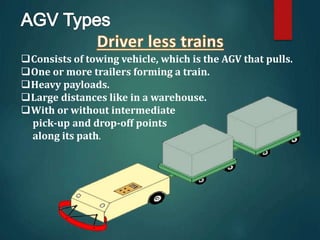
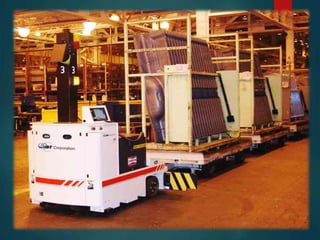
Consists of towing vehicle, which is the AGV that pulls.
One or more trailers forming a train.
Heavy payloads.
Large distances like in a warehouse.
With or without intermediate
pick-up and drop-off points
along its path.
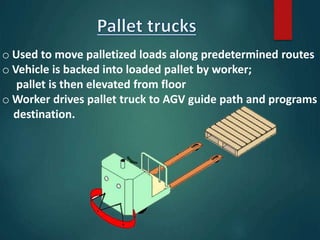
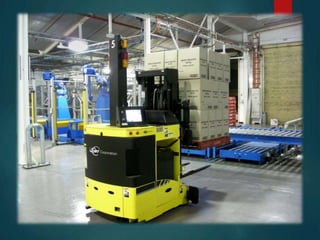
o Used to move palletized loads along predetermined routes
o Vehicle is backed into loaded pallet by worker;
pallet is then elevated from floor
o Worker drives pallet truck to AGV guide path and programs
destination.
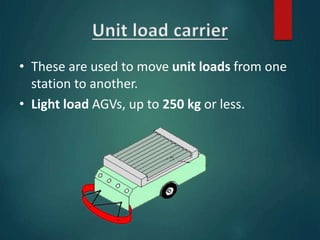
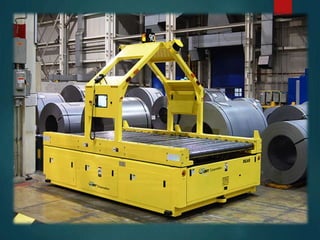
• These are used to move unit loads from one
station to another.
• Light load AGVs, up to 250 kg or less.
The widely used methods to set the path for AGV are :
• Imbedded guide wires
• Paint strips (Optical navigation system)
• Self guided vehicles (Laser triangulation navigation
system)
 The guidance system is the method by which AGVS
pathways are defined and vehicles are controlled to follow
the pathways.
 The primary objective of a guidance system is to keep the
vehicle in the pre-designated path.
•Faster and safer
•More accurate
•Less costly
•Simpler and less
programming
required.
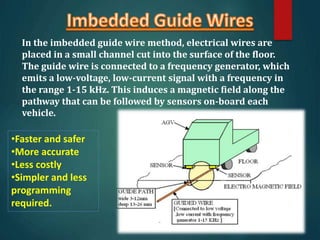
In the imbedded guide wire method, electrical wires are
placed in a small channel cut into the surface of the floor.
The guide wire is connected to a frequency generator, which
emits a low-voltage, low-current signal with a frequency in
the range 1-15 kHz. This induces a magnetic field along the
pathway that can be followed by sensors on-board each
vehicle.
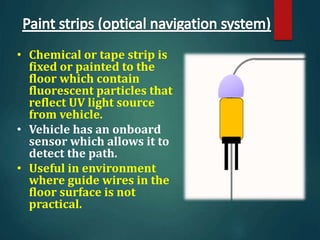
• Chemical or tape strip is
fixed or painted to the
floor which contain
fluorescent particles that
reflect UV light source
from vehicle.
• Vehicle has an onboard
sensor which allows it to
detect the path.
• Useful in environment
where guide wires in the
floor surface is not
practical.
(Laser triangulation navigation system)
• Most popular method of AGV navigation.
• Operate without continuously defined pathways.
• Use combination of dead reckoning (capability of a
vehicle to follow a given route in the absence of a
defined pathway) and beacons located throughout
the plant, which can be identified by on board
sensors.
• Continuously verify position by comparing the
calculated position with one or more known
position.
 Computer Control Systems
Most efficient but most expensive and complex controller
 Remote dispatch control system
• Human interactions take place using remote controls.
• Human factor is not directly involved in performing the
task.
• Only destination and material information are sent.
 Manual control systems
• Operator loads the vehicle.
• Inputs the location and path information on the board.
• Vehicle is routed by itself.
• Unloading is being done by humans as well.
Wikipedia.com
Quizlet.com
Introduction To Material Handling
By-Siddhartha Roy
Automated Material Handling

Automated Material Handling

  • 1.
  • 2.
    1.Introduction To MaterialHandling 2.Objectives of Material Handling 3.Types of Material Handling 4.Automation 5.Use Of Automation 6.Introduction To Automated Guided Vehicles 7.Applications of AGV 8. Components of AGV 9.Types of AGV 10.Vehicle Guidance Technology 11.AGV Control System
  • 3.
     Material handlingis defined as "the movement, storage, protection and control of materials throughout the manufacturing and distribution process including their consumption and disposal".  The purpose of material handling in a factory is to move raw materials, work piece-in process, finished parts, tools, and supplies from one location to another to facilitate the overall operations of manufacturing.  The handling of materials must be performed safely, efficiently, at low cost, in a timely manner, accurately (the right materials in the right quantities to the right locations), and without damage to the materials.
  • 4.
     To lowerunit materials handling cost.  To reduce manufacturing cycle time.  To provide better control of the flow of materials.  To provide better working conditions.  To provide better quality by avoiding damages to products.  To increase storage capacity through better utilization of storage areas.  To provide higher productivity at lower manufacturing costs.
  • 5.
    Manual handling Manual handlingrefers to the use of a worker’s hands to move individual containers by lifting, lowering, filling, emptying, or carrying them. Automated handling Whenever technically and economically feasible, equipment can be used to reduce and sometimes replace the need to manually handle material.
  • 7.
     The termautomation or automatic control is the use of various control systems for operating equipment such as machinery, processes in factories, and other applications with minimal or reduced human intervention or efforts.  The biggest benefit of automation is that it saves labor; however, it is also used to save energy and materials and to improve quality, accuracy and precision.  In material handling process most work is done through by Automated Guided Vehicles, Rail Guided Vehicles, Robots, Automated storage and retrieval system.
  • 8.
    o To increaselabor productivity. o To reduce labor cost. o To mitigate the effects of labor shortages. o To reduce or remove routine manual and clerical tasks. o To improve worker safety. o To improve product quality. o To reduce manufacturing lead time. o To accomplish what cannot be done manually.
  • 9.
  • 10.
     It isa material handling system that uses independently operated, self-propelled vehicles guided along defined pathways. The vehicles are powered by on-board batteries that allow many hours of operation (8-16 hr. is typical) between recharging.  The Automated Guided Vehicle belongs to a class of highly flexible, intelligent, and versatile material- handling systems used to transfer materials from various loading locations to various unloading locations throughout the facility.
  • 11.
    Some of theapplications areas of Automated Guided Vehicles include: • Driverless train operations • Assembly line operation • Flexible manufacturing system • Raw material handling • Pallet handling • Finished product handling • Trailer loading
  • 12.
    There are fourmain components of an automated guided vehicle system. They are summarized as follows:  The Vehicle: It is used to move the material within the system without a human operator.  The Guide Path: It guides the vehicle to move along the path.  The Control Unit: It monitors and directs system operations, including feedback on moves, inventory, and vehicles.  The Computer Interface: It is connected with other computers and systems such as mainframe host computer.
  • 13.
    Consists of towingvehicle, which is the AGV that pulls. One or more trailers forming a train. Heavy payloads. Large distances like in a warehouse. With or without intermediate pick-up and drop-off points along its path.
  • 15.
    o Used tomove palletized loads along predetermined routes o Vehicle is backed into loaded pallet by worker; pallet is then elevated from floor o Worker drives pallet truck to AGV guide path and programs destination.
  • 17.
    • These areused to move unit loads from one station to another. • Light load AGVs, up to 250 kg or less.
  • 19.
    The widely usedmethods to set the path for AGV are : • Imbedded guide wires • Paint strips (Optical navigation system) • Self guided vehicles (Laser triangulation navigation system)  The guidance system is the method by which AGVS pathways are defined and vehicles are controlled to follow the pathways.  The primary objective of a guidance system is to keep the vehicle in the pre-designated path.
  • 20.
    •Faster and safer •Moreaccurate •Less costly •Simpler and less programming required. In the imbedded guide wire method, electrical wires are placed in a small channel cut into the surface of the floor. The guide wire is connected to a frequency generator, which emits a low-voltage, low-current signal with a frequency in the range 1-15 kHz. This induces a magnetic field along the pathway that can be followed by sensors on-board each vehicle.
  • 21.
    • Chemical ortape strip is fixed or painted to the floor which contain fluorescent particles that reflect UV light source from vehicle. • Vehicle has an onboard sensor which allows it to detect the path. • Useful in environment where guide wires in the floor surface is not practical.
  • 22.
    (Laser triangulation navigationsystem) • Most popular method of AGV navigation. • Operate without continuously defined pathways. • Use combination of dead reckoning (capability of a vehicle to follow a given route in the absence of a defined pathway) and beacons located throughout the plant, which can be identified by on board sensors. • Continuously verify position by comparing the calculated position with one or more known position.
  • 23.
     Computer ControlSystems Most efficient but most expensive and complex controller  Remote dispatch control system • Human interactions take place using remote controls. • Human factor is not directly involved in performing the task. • Only destination and material information are sent.  Manual control systems • Operator loads the vehicle. • Inputs the location and path information on the board. • Vehicle is routed by itself. • Unloading is being done by humans as well.
  • 24.