Pressure Measurement
Diaphargm
9AEI306.29 2
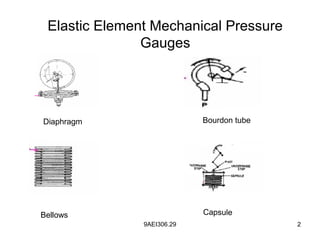
Elastic Element Mechanical Pressure
Gauges
Diaphragm Bourdon tube
Bellows Capsule
9AEI306.29 3
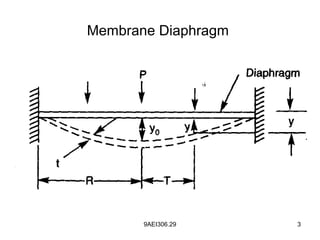
Membrane Diaphragm
9AEI306.29 4
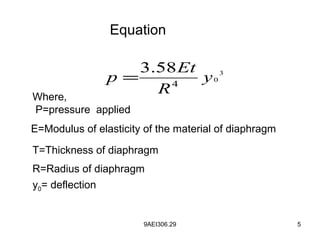
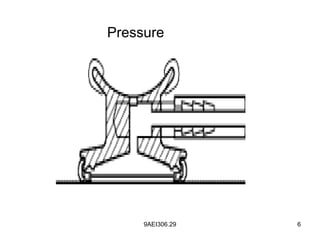
• Diaphragm is a thin circular plate stretched and
fastened.
• When pressure is applied bending stress causes

deflection in membrane diaphragm.
• The deflection at any point will be proportional to the
pressure applied
Description
9AEI306.29 5
3
0
4
58.3
y
R
Et
p =
Where,
P=pressure applied
E=Modulus of elasticity of the material of diaphragm
T=Thickness of diaphragm
R=Radius of diaphragm
y0= deflection
Equation
9AEI306.29 6
Pressure
9AEI306.29 7
• High accuracy
• Good dynamic response
• Excellent stability
• Good reliability
Advantages
9AEI306.29 8
• Low range
• Effect of environment
Disadvantages
9AEI306.29 9
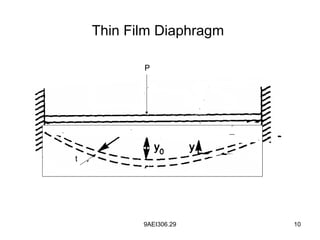
• Diaphragm is a thin circular plate stretched and
fastened.
• When pressure is applied bending stress causes
deflection in membrane diaphragm.
• The deflection at any point will be proportional to the
pressure applied
Thin Film Diaphragm
9AEI306.29 10
P
t
Thin Film Diaphragm
9AEI306.29 11
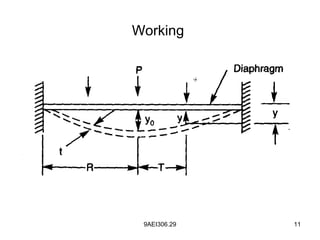
Working
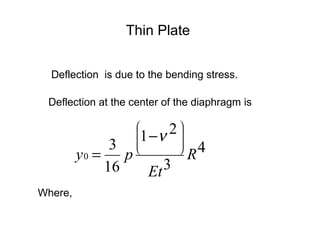
Thin Plate
Deflection is due to the bending stress.
Deflection at the center of the diaphragm is
4
3
21
16
3
0 R
Et
py








−
=
ν
Where,
9AEI306.29 13
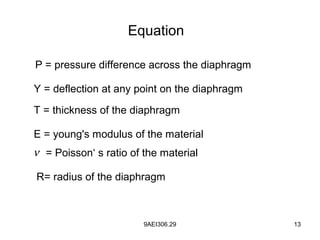
Equation
P = pressure difference across the diaphragm
Y = deflection at any point on the diaphragm
T = thickness of the diaphragm
E = young's modulus of the material
ν = Poisson‘ s ratio of the material
R= radius of the diaphragm
9AEI306.29 14
• High accuracy
• Good dynamic response
• Excellent stability
• Good reliability
Advantages
9AEI306.29 15
• Low range
• Effect of environment
Disadvantages
9AEI306.29 16
Construction
• Metal alloys are used for diaphragm Construction
Materials.
• Fabricated by pressing and stamping the sheet
materials.
• Phosphor Bronze, Nickel – span – c are used for
Diaphragms Fabrications
9AEI306.29 17
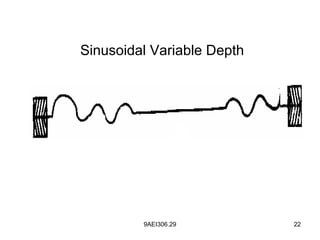
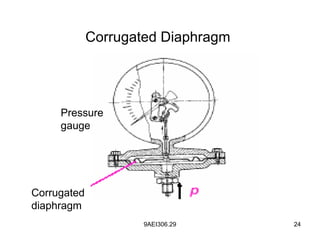
Corrugated Diaphragm
• Used where large deflections are required.
• Formed by connecting two identical diaphragms along
their flange.
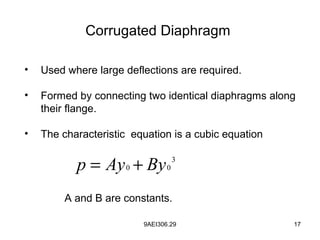
• The characteristic equation is a cubic equation
3
00 ByAyp +=
A and B are constants.
9AEI306.29 18
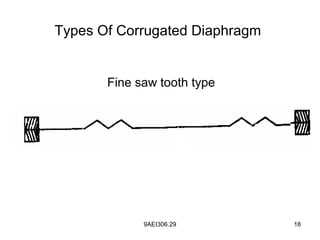
Types Of Corrugated Diaphragm
Fine saw tooth type
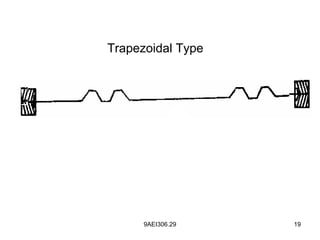
9AEI306.29 19
Trapezoidal Type
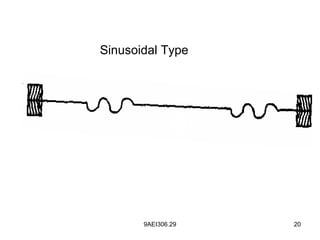
9AEI306.29 20
Sinusoidal Type
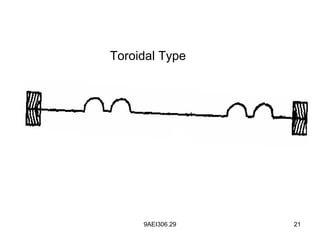
9AEI306.29 21
Toroidal Type
9AEI306.29 22
Sinusoidal Variable Depth
9AEI306.29 23
Characteristics
• Deflection is as twice as that of the single
diaphragm for same process.
• Used for static Measurement
• Susceptible to vibrations.
9AEI306.29 24
Corrugated Diaphragm
Corrugated
diaphragm
Pressure
gauge
9AEI306.29 25
Advantages
• These are used to where larger deflections are required
• Fine saw tooth type are
• Stable at small overloads
• Simple to manufacture
• Sinusoidal types are used
• Where stress concentration is more
9AEI306.45 26
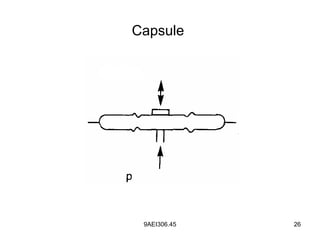
Capsule
9AEI306.45 27
Capsule
• It is also called as aneroid.
• Two identical diaphragms are sealed at their
periphery.
• One diaphragm consists of pressure inlet.
• Another one is linked to the mechanical
member.
9AEI306.45 28
Capsule
• Displacement of this member is proportional to the
difference of the inner and outer pressure.
• Two or more diaphragms are joined to form a capsule.
• All diaphragms in a capsule act in unison.
• The travel arm for a given pressure is greater than that
of single diaphragm.
9AEI306.45 29
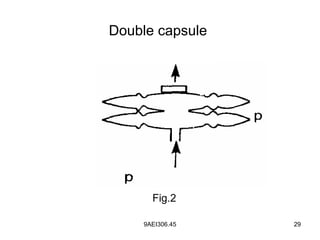
Double capsule
Fig.2
9AEI306.45 30
Double Capsule
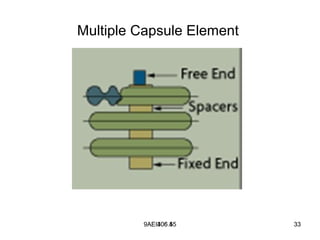
• Large displacements are achieved by stacking
multiple capsule elements coupled in tandem.
• This is called double capsule and is shown in Fig.2.
• Material usually used is bronze or stain steel for
capsules
9AEI306.45 31
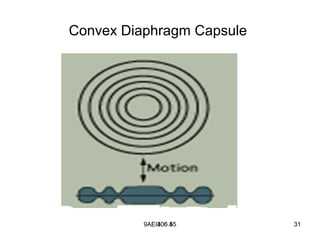
Convex Diaphragm Capsule
AEI405.5 31
9AEI306.45 32
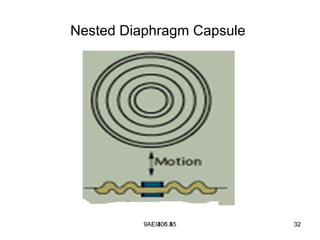
Nested Diaphragm Capsule
AEI405.5 32
9AEI306.45 33
Multiple Capsule Element
AEI405.5 33
9AEI306.45 34
Applications
• Used in pneumatic control system
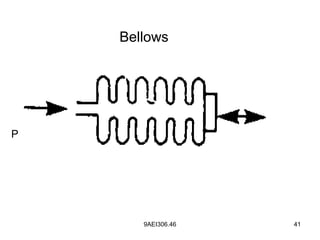
Bellows
9AEI306.46 36
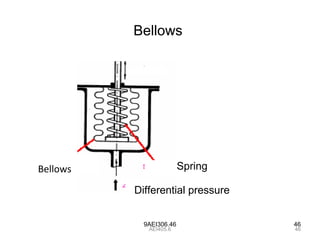
Principle of operation of bellows
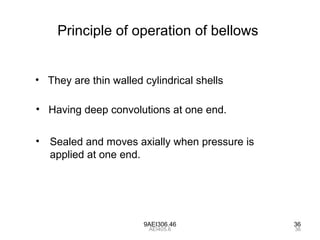
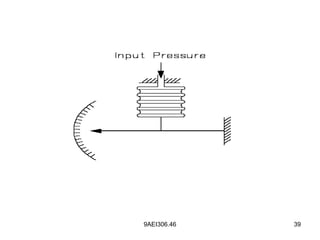
• They are thin walled cylindrical shells
• Having deep convolutions at one end.
• Sealed and moves axially when pressure is
applied at one end.
36AEI405.6
9AEI306.46 37
9AEI306.46 38
9AEI306.46 39
9AEI306.46 40
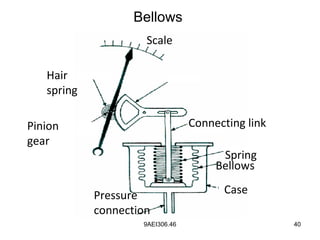
Bellows
Scale
Connecting link
Spring
Bellows
CasePressure
connection
Pinion
gear
Hair
spring
9AEI306.46 41
Bellows
P
9AEI306.46 42
• Pressure range
• Displacement required
• Operating temperature
9AEI306.46 43
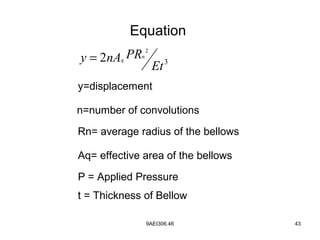
Equation
3
2
2
Et
PRnAy n
q=
y=displacement
n=number of convolutions
Rn= average radius of the bellows
Aq= effective area of the bellows
P = Applied Pressure
t = Thickness of Bellow
9AEI306.46 44
Applications And Materials Used
• Used for low pressure measurement
• It is sensitive to vibrations
9AEI306.46 45
• Phosphor bronze and stainless steel
are the materials used for construction of Bellow.
• Application materials used in Bellows
• Phosphar Bronge
• Stainless Steel
9AEI306.46 46
Bellows
Spring
Differential pressure
Bellows
46AEI405.6
9AEI306.46 47
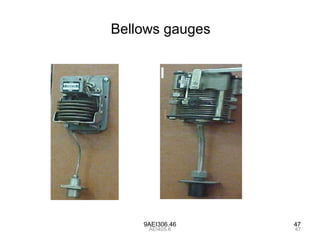
Bellows gauges
47AEI405.6
Pressure Measurement
Bourdon Tubes
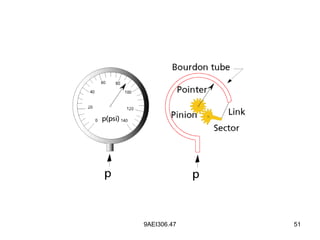
9AEI306.47 49
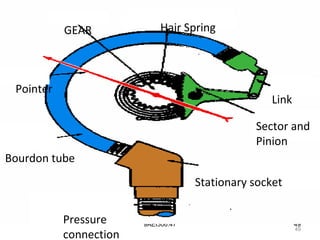
GEAR Hair Spring
Pointer
Bourdon tube
Pressure
connection
Stationary socket
Sector and
Pinion
Link
49
9AEI306.47 50
• It is a curved or twisted metallic tube
• Sealed at one end
• It will have elliptical cross section.
• Tube tends to straighten as the pressure is
applied
• Angular deflection at the free end is a measure
of pressure.
Construction And Operation
9AEI306.47 51
9AEI306.47 52
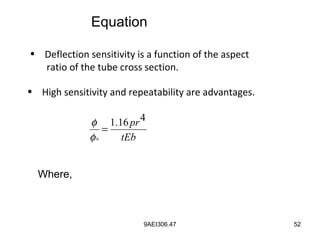
• Deflection sensitivity is a function of the aspect
ratio of the tube cross section.
• High sensitivity and repeatability are advantages.
tEb
pr416.1
0
=
φ
φ
Equation
Where,
9AEI306.47 53
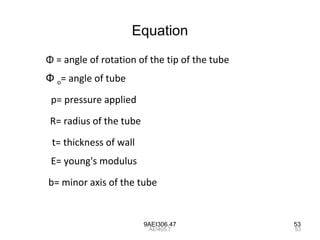
Equation
Φ = angle of rotation of the tip of the tube
Φ o= angle of tube
p= pressure applied
R= radius of the tube
t= thickness of wall
E= young's modulus
b= minor axis of the tube
53AEI405.7
9AEI306.47 54
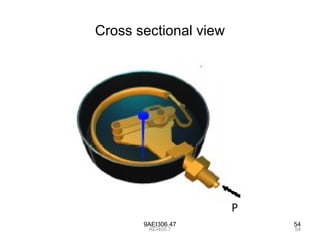
Cross sectional view
AEI405.7 54
P
9AEI306.47 55
Types Of Bourdon Tube
• There are four types of bourdon tubes
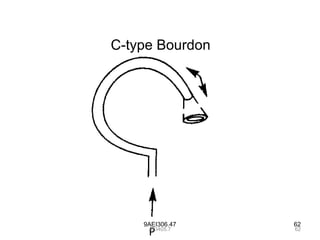
1. C-type bourdon
2. Helical type bourdon
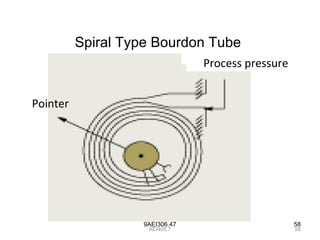
3. Spiral type bourdon
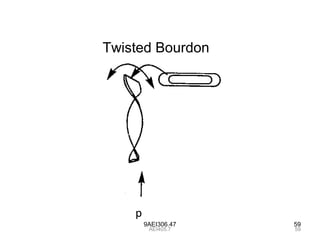
4. Twisted type bourdon
55AEI405.7
9AEI306.47 56
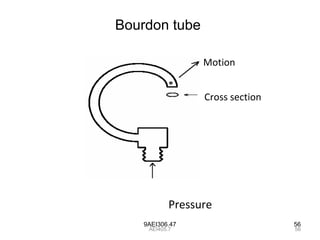
Bourdon tube
Pressure
Motion
Cross section
56AEI405.7
9AEI306.47 57
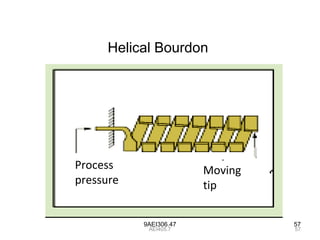
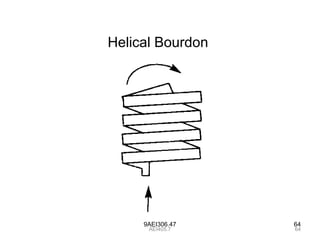
Helical Bourdon
Process
pressure
Moving
tip
57AEI405.7
9AEI306.47 58
Spiral Type Bourdon Tube
Process pressure
Pointer
58AEI405.7
9AEI306.47 59
Twisted Bourdon
p
59AEI405.7
9AEI306.47 60
Industrial Bourdon Tubes
60AEI405.7
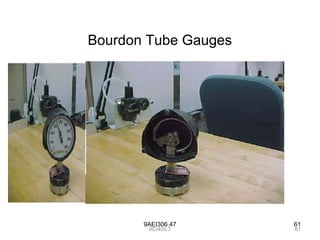
9AEI306.47 61
Bourdon Tube Gauges
AEI405.7 61
9AEI306.47 62
C-type Bourdon
P 62AEI405.7
9AEI306.47 63
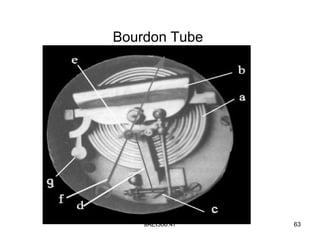
Bourdon Tube
9AEI306.47 64
Helical Bourdon
64AEI405.7
9AEI306.47 65
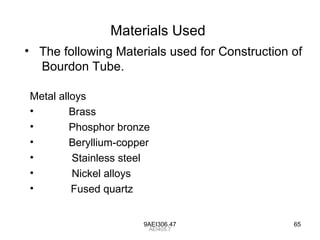
Materials Used
Metal alloys
• Brass
• Phosphor bronze
• Beryllium-copper
• Stainless steel
• Nickel alloys
• Fused quartz
AEI405.7
• The following Materials used for Construction of
Bourdon Tube.
9AEI306.47 66
• High accuracy
• Good dynamic response
• Excellent stability
• Good reliability
Advantages
9AEI306.47 67
• Low range
• Effect of environment
Disadvantages
Pressure Measurement
Electrical Pressure Transducers-
Potentiometric Pressure
Transducer
9AEI306.48 69
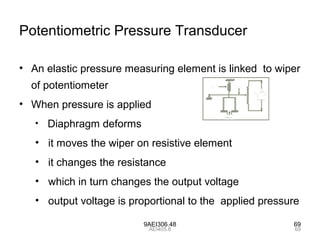
Potentiometric Pressure Transducer
• An elastic pressure measuring element is linked to wiper
of potentiometer
• When pressure is applied
• Diaphragm deforms
• it moves the wiper on resistive element
• it changes the resistance
• which in turn changes the output voltage
• output voltage is proportional to the applied pressure
69AEI405.8
9AEI306.48 70
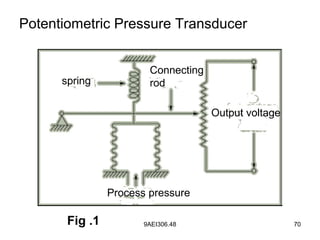
spring
Connecting
rod
Process pressure
Output voltage
Potentiometric Pressure Transducer
Fig .1
9AEI306.48 71
Advantages
• High resolution
• Ruggedness
• Simple instrumentation
• Strong output
• No need of amplification of output
9AEI306.48 72
Disadvantages
• Finite resolution
• Limited life
• Large size
• Poor frequency response
• Noise
• Susceptibility to vibration
9AEI306.48 73
Limitations
• Temperature effects cause additional errors,
• Because of the differences in thermal expansion
coefficients of the metallic components of the system
• Errors develop due to mechanical wear of the
components and of the contacts
73AEI405.8
9AEI306.48 74
Applications
• Low power applications
• 5 and 10,000 psi (35 KPa to 70 MPa)
74AEI405.8
Pressure Measurement
Strain Gauge Transducer
9AEI306.49 76
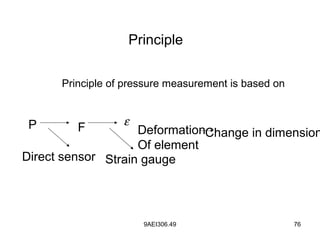
P F
ε
Direct sensor Strain gauge
Deformation
Of element
Change in dimension
Principle
Principle of pressure measurement is based on
9AEI306.49 77
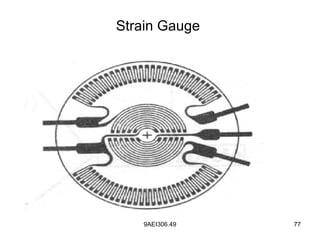
Strain Gauge
9AEI306.49 78
What It Means
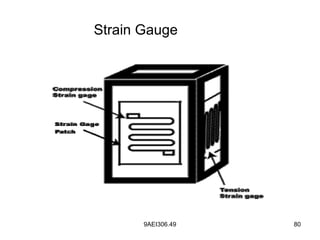
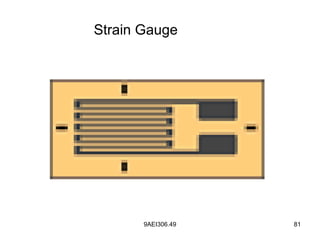
• Strain gauge is an example of passive transducer
• When an external force is applied to a stationary object
Stress and Strain will result
• Stress is defined as the object’s internal resisting force
• Strain is defined as the displacement and deformation
that occurs due to the stress
9AEI306.49 79
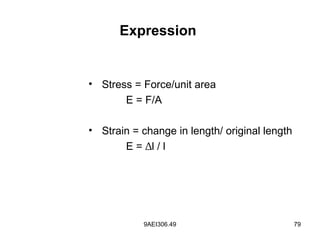
Expression
• Stress = Force/unit area
E = F/A
• Strain = change in length/ original length
E = Δl / l
9AEI306.49 80
Strain Gauge
9AEI306.49 81
Strain Gauge
9AEI306.49 82
Strain Gauge Transducer
• Strain gauge transducer is the most common type
pressure transducer
• It converts mechanical motion into electrical output
9AEI306.49 83
Diaphragm
Strain
gauges
Flange
Fig.1
Strain Gauge Pressure Transducer
9AEI306.49 84
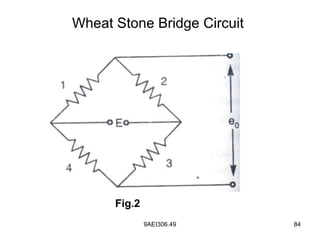
Wheat Stone Bridge Circuit
Fig.2
9AEI306.49 85
Operation
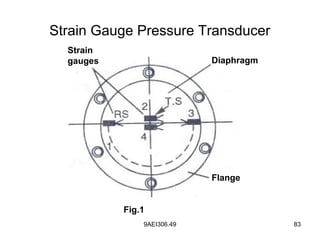
• Conversion of pressure into electrical is achieved by
physical deformation of SG (strain gauge)
• They are bonded on a diaphragm
• They are wired into a Wheatstone bridge configuration
• Pressure is applied to the pressure transducer
9AEI306.49 86
Operation
• It produces a deflection in the diaphragm
• It produces strain to the gauges
• The strain will produce change in electrical resistance
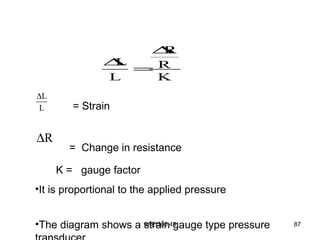
• The relationship between change in electrical resistance
and strain is given by
9AEI306.49 87
= Strain
= Change in resistance
K = gauge factor
•It is proportional to the applied pressure
•The diagram shows a strain gauge type pressure
R
L R
L K
∆
∆
=
L
L
∆
R∆
9AEI306.49 88
Operation
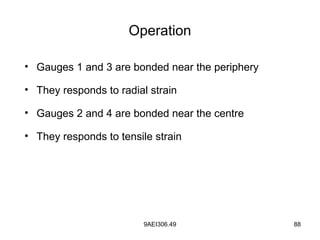
• Gauges 1 and 3 are bonded near the periphery
• They responds to radial strain
• Gauges 2 and 4 are bonded near the centre
• They responds to tensile strain
9AEI306.49 89
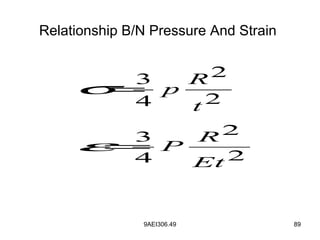
Relationship B/N Pressure And Strain
2
2
4
3
t
R
p=σ
2
2
4
3
Et
R
P=ε
9AEI306.49 90
Equation
Where,
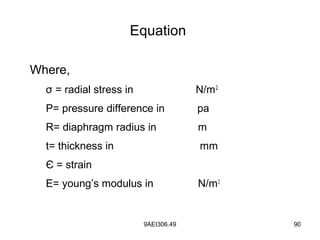
σ = radial stress in N/m2
P= pressure difference in pa
R= diaphragm radius in m
t= thickness in mm
Є = strain
E= young’s modulus in N/m2
9AEI306.49 91
Types
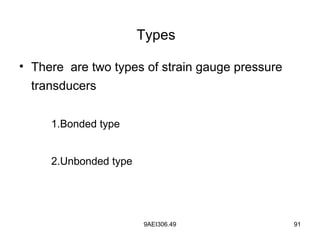
• There are two types of strain gauge pressure
transducers
1.Bonded type
2.Unbonded type
9AEI306.49 92
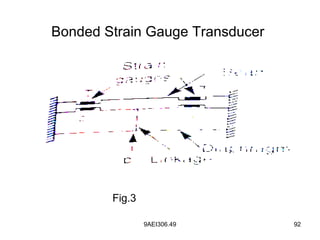
Fig.3
Bonded Strain Gauge Transducer
9AEI306.49 93
Bonded Strain Gauge Transducer
• It is a strain gauge pressure transducer
• Double cantilever beam symmetrically coupled to
diaphragm mechanically
• Strain gauges are bonded near the roots of cantilever
beam
• They are used to measure the compressive and tensile
strains
9AEI306.49 94
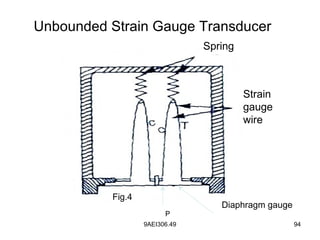
Spring
Strain
gauge
wire
Diaphragm gauge
P
Fig.4
Unbounded Strain Gauge Transducer
9AEI306.49 95
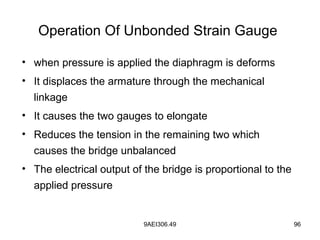
Operation Of Unbounded Strain Gauge
• Four bare strain gauge wires are stretched to known
initial tension
• They are mounted by linking on pressure sensing
diaphragm
• They form active arms of Wheatstone bridge
9AEI306.49 96
Operation Of Unbonded Strain Gauge
• when pressure is applied the diaphragm is deforms
• It displaces the armature through the mechanical
linkage
• It causes the two gauges to elongate
• Reduces the tension in the remaining two which
causes the bridge unbalanced
• The electrical output of the bridge is proportional to the
applied pressure
9AEI306.49 97
Advantages
• Excellent linearity
• Ruggedness
• Good linearity
• wide range
9AEI306.49 98
Disadvantages
• Temperature dependent
• Non linearity
• Mounting problem
• Sensitive to vibrations
Variable Relcutance type
pressure transducer
9AEI306.50 100
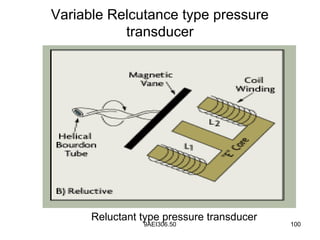
Variable Relcutance type pressure
transducer
Reluctant type pressure transducer
9AEI306.50 101
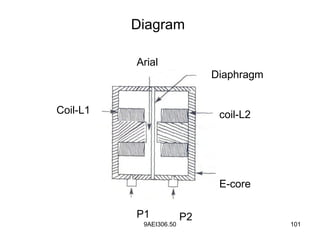
Diagram
Arial
E-core
P1 P2
coil-L2
Diaphragm
Coil-L1
9AEI306.50 102
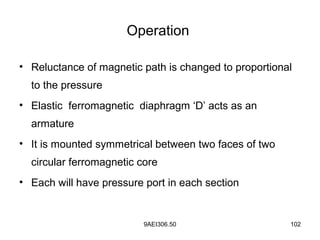
Operation
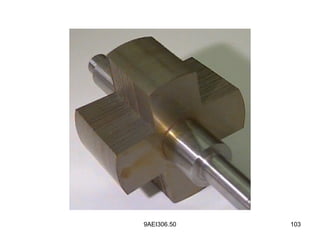
• Reluctance of magnetic path is changed to proportional
to the pressure
• Elastic ferromagnetic diaphragm ‘D’ acts as an
armature
• It is mounted symmetrical between two faces of two
circular ferromagnetic core
• Each will have pressure port in each section
9AEI306.50 103
9AEI306.50 104
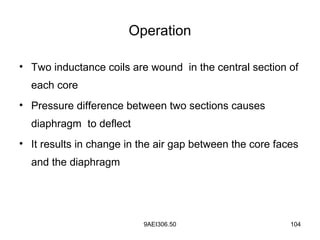
Operation
• Two inductance coils are wound in the central section of
each core
• Pressure difference between two sections causes
diaphragm to deflect
• It results in change in the air gap between the core faces
and the diaphragm
9AEI306.50 105
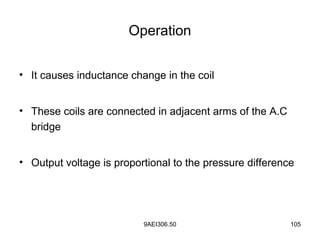
Operation
• It causes inductance change in the coil
• These coils are connected in adjacent arms of the A.C
bridge
• Output voltage is proportional to the pressure difference
9AEI306.50 106
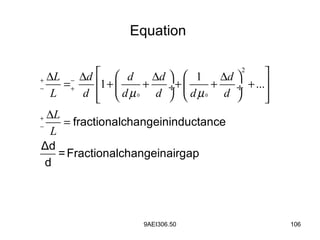
Equation
0 0
2
1
1 ...
L d d d d
L d d d d d
L
L
µ µ
+ −
− +
+
−
    ∆ ∆ ∆ ∆
= + + + + +  ÷  ÷
     
∆
= fractionalchangeininductance
Δd
=Fractionalchangeinairgap
d
9AEI306.50 107
Equation
Where
d= initial air gap
L= effective length of the magnetic flux path in the
ferromagnetic material
μ = initial permeability
9AEI306.50 108
Advantages
• Improved dynamic response
• High sensitivity
• Ruggedness
• Insensitive to vibrations
• Suitable for low pressure applications
LVDT Pressure Transducer
9AEI306.51 110
Operation
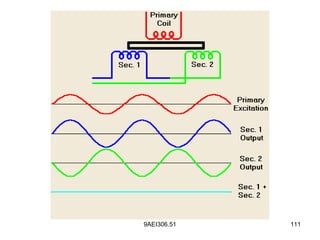
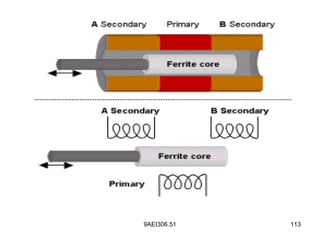
• Linear variable differential transformer (LVDT) type
pressure is the most popular one
• The elastic element is coupled to the core through a
suitable mechanical linkage
• Diaphragm, bourdon tube or bellows is used as the elastic
element
9AEI306.51 111
9AEI306.51 112
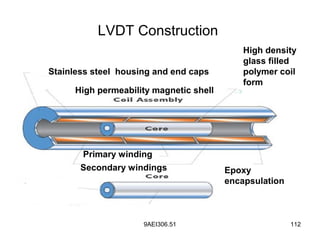
LVDT Construction
Stainless steel housing and end caps
High permeability magnetic shell
High density
glass filled
polymer coil
form
Primary winding
Secondary windings Epoxy
encapsulation
9AEI306.51 113
9AEI306.51 114
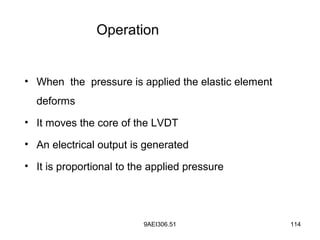
• When the pressure is applied the elastic element
deforms
• It moves the core of the LVDT
• An electrical output is generated
• It is proportional to the applied pressure
Operation
9AEI306.51 115
Advantages
• High stability
• Infinity resolution
• Suitable for low pressure application
• High accuracy
Variable Capacitance sensor
9AEI306.52 117
Principle
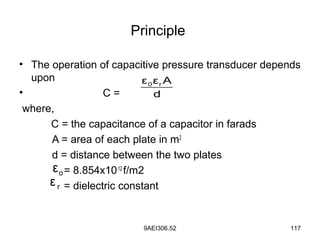
• The operation of capacitive pressure transducer depends
upon
• C =
where,
C = the capacitance of a capacitor in farads
A = area of each plate in m2
d = distance between the two plates
= 8.854x10⁻¹²
f/m2
= dielectric constant
0 rε ε A
d
oε
rε
9AEI306.52 118
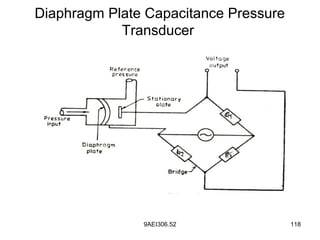
Diaphragm Plate Capacitance Pressure
Transducer
9AEI306.52 119
Basic Principle Of Capacitance Pressure
Transducer
9AEI306.52 120
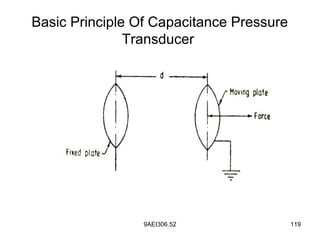
• The capacitance of a capacitor changes when
• The area ‘A’ of the plate changes
• The distance ‘d’ between two plate changes
• The dielectric constant changes
• C α 1/d
• This is the basic of capacitor pressure transducer
rε
Basic Principle
9AEI306.52 121
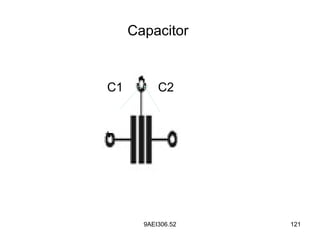
Capacitor
C1 C2
9AEI306.52 122
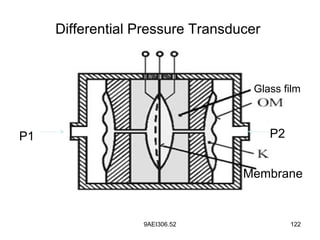
Differential Pressure Transducer
Glass film
Membrane
P1 P2
9AEI306.52 123
Construction
• It consists of fixed plates and movable plates
• Diaphragm is used as movable plate
• The capacitor is placed in one of the arms of the
capacitive bridge
• The output voltmeter is calibrated in terms of the input
applied pressure
9AEI306.52 124
Working
• The pressure under measurement is applied at the inlet
• Diaphragm expands
• The distance between the plates changes and
capacitance changes accordingly
• Some output voltage will be developed
• It is proportional to the applied pressure
9AEI306.52 125
Applications And Types
• Capacitance pressure transducers were originally
developed for use in low vacuum research
• Depending on the type of pressure the capacitive
transducer can be
1. An absolute gauge
2. Differential pressure transducer.
9AEI306.52 126
Materials
• Stainless steel is the most common diaphragm material
used
• For corrosive, high-nickel steel alloys, such as Inconel
or Hastelloy, give better performance.
• The diaphragm is usually metal or metal-coated quartz
9AEI306.52 127
• Tantalum is also used for highly corrosive, high
temperature applications.
• silver diaphragms can be used to measure the
pressure of chlorine, fluorine, and other halogens in
their elemental state.
9AEI306.52 128
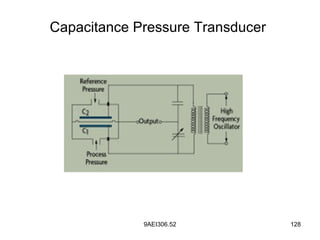
Capacitance Pressure Transducer
9AEI306.52 129
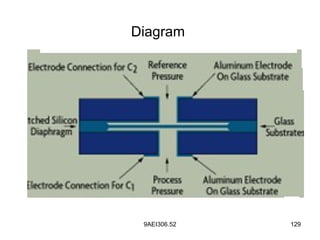
Diagram
9AEI306.52 130
Operation
• The deflection of the diaphragm causes a change in
capacitance
• That is detected by a bridge circuit
• This circuit can be operated in a
1. Balanced
2. Unbalanced mode
9AEI306.52 131
Operation
• In balanced mode the output voltage is fed to a null
detector
• The capacitor arms are varied to maintain the bridge at
null
• The null setting itself is a measure of process pressure
9AEI306.52 132
Operation
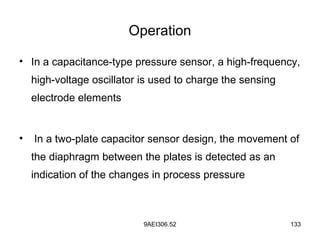
• In unbalanced mode
• The process pressure measurement is related to the
ratio between the output voltage and the excitation
voltage
9AEI306.52 133
Operation
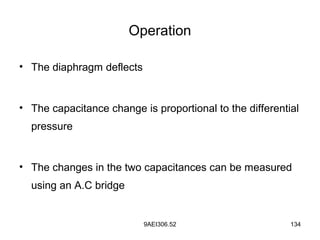
• In a capacitance-type pressure sensor, a high-frequency,
high-voltage oscillator is used to charge the sensing
electrode elements
• In a two-plate capacitor sensor design, the movement of
the diaphragm between the plates is detected as an
indication of the changes in process pressure
9AEI306.52 134
Operation
• The diaphragm deflects
• The capacitance change is proportional to the differential
pressure
• The changes in the two capacitances can be measured
using an A.C bridge
9AEI306.52 135
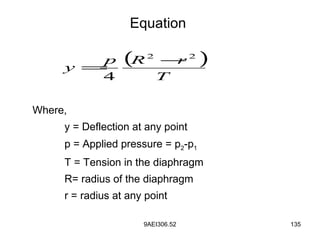
Equation
( )
T
rRp
y
22
4
−
=
Where,
y = Deflection at any point
p = Applied pressure = p2-p1
T = Tension in the diaphragm
R= radius of the diaphragm
r = radius at any point
9AEI306.52 136
Advantages
• Small size
• Good high frequency response
• Adaptability for higher temp. operation
• Good linearity
• High resolution
9AEI306.52 137
• Fast response
• Can withstand shock and vibration
• Extremely sensitive
Advantages
9AEI306.52 138
Disadvantages
• Inherent temp. sensitivity
• Susceptibility to vibration and shock
• Performance is affected by dirt and other contaminations
• Errors can be caused by erratic and distorted signals
9AEI306.52 139
Applications And Range
• Suitable for
• Very low pressure
• Fluctuating pressures
• Range
• ∆p = 1 m bar – 10 m bar
• Total pressure up to 400 bar
• For both static and dynamic changes
Thin Film Pressure
Transducer
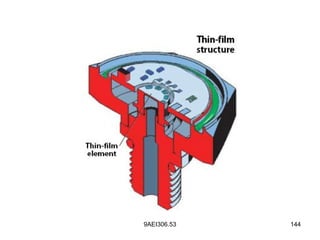
9AEI306.53 141
Description
• This can be considered as the modified version of
capacitive pressure transducer
• A Thin film of dielectric having constant modulus of
elasticity over wide temperature range is used
• Metal film is coated on both faces
9AEI306.53 142
Description
• They serve as electrodes
• One electrode is bonded near to the profile base
• Other electrode is free to move
• The free end is subjected to the pressure under
measurement
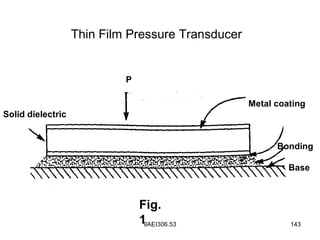
9AEI306.53 143
Thin Film Pressure Transducer
P
Solid dielectric
Bonding
Metal coating
Base
Fig.
1
9AEI306.53 144
9AEI306.53 145
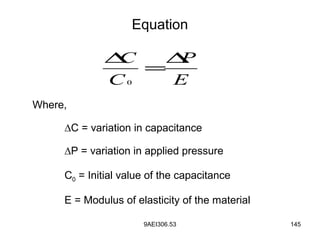
Equation
E
P
C
C ∆
=
∆
0
Where,
∆C = variation in capacitance
∆P = variation in applied pressure
C0 = Initial value of the capacitance
E = Modulus of elasticity of the material
9AEI306.53 146
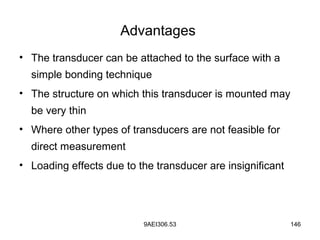
Advantages
• The transducer can be attached to the surface with a
simple bonding technique
• The structure on which this transducer is mounted may
be very thin
• Where other types of transducers are not feasible for
direct measurement
• Loading effects due to the transducer are insignificant
9AEI306.53 147
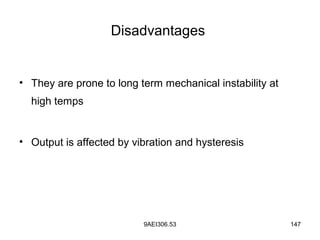
Disadvantages
• They are prone to long term mechanical instability at
high temps
• Output is affected by vibration and hysteresis
9AEI306.53 148
Applications
• Applicable for measurement of pressure on aerofoil's
Ex :- Fan or compressor blades
• Supersonic flow studies
Force Balance Pressure
Transducer
9AEI306.54 150
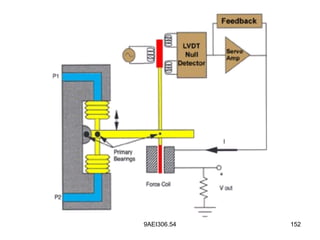
Force-balance Transducer
fL
DL
LVDT
Bellows
assembly
Beam
Force coil
Magnet
R
Out
putServo
amplifier
i
A
B
DK
AK
SS N
fK
ML
P
9AEI306.54 151
Introduction
• Performance of Pressure transducers is based on the
measurement of deflection of elastic element
• The material characteristics of hysteresis and creep can
degrade the accuracy
• For higher sensitivity these elements must have low
stiffness and /or large area
9AEI306.54 152
9AEI306.54 153
Introduction
• It makes the transducer bulky which is affected by
vibration
• Feedback principle employing balance of forces have
been applied to overcome the problem
• They employ electro dynamic devices or electric static
force generators to balance the forces produced by the
elastic elements which is subjected to the pressure
9AEI306.54 154
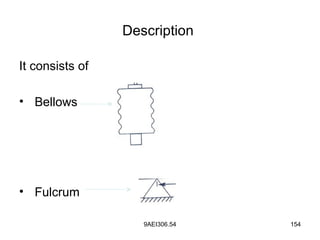
Description
It consists of
• Bellows
• Fulcrum
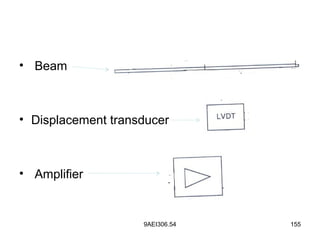
9AEI306.54 155
• Beam
• Displacement transducer
• Amplifier
9AEI306.54 156
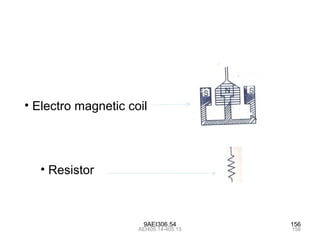
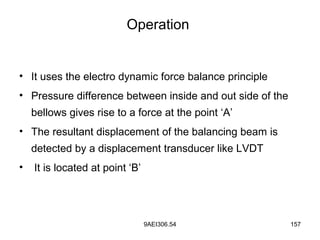
• Electro magnetic coil
• Resistor
156AEI405.14-405.15
9AEI306.54 157
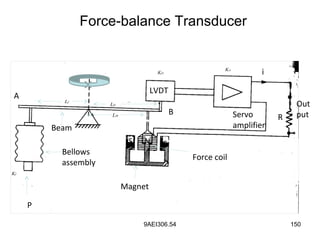
Operation
• It uses the electro dynamic force balance principle
• Pressure difference between inside and out side of the
bellows gives rise to a force at the point ‘A’
• The resultant displacement of the balancing beam is
detected by a displacement transducer like LVDT
• It is located at point ‘B’
9AEI306.54 158
Operation
• The electrical output of transducer is amplified
• It causes a current ‘I’ to flow through the balancing coil
• Which is attached to the beam
9AEI306.54 159
Operation
• At balancing position
• The electro dynamic force exerted by the coil
opposes the force exerted by the bellows
• The current required to get such a balance is taken as
a measure of the unknown pressure ‘P’ acting on the
bellows
9AEI306.54 160
Advantages
• High loop gain
• Small deflections can be measured
• Good linearity
• High accuracy
• Good sensitivity
9AEI306.54 161
Disadvantages
• It is heavy because of magnet and coil assembly
• Low frequency response limited to 100 Hz
Piezoelectric pressure
transducer
9AEI306.55 163
Introduction
• When pressure, force or acceleration is applied to a
quartz crystal, a charge is developed across the crystal
• The fundamental difference between these crystal
sensors and static-force devices such as strain gages is
that the electric signal generated by the crystal decays
rapidly
9AEI306.55 164
• Some types of materials generates an electrostatic
charge or voltage when mechanical stress is applied
across them
• An opposite effect is also observed when an electrostatic
charge or voltage is applied to the crystal
• It results mechanical deformation of the device
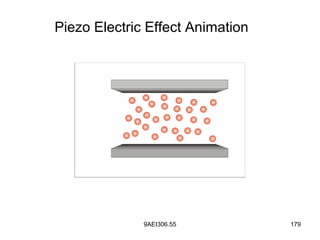
• This is called piezo electric effect
Piezo Electric Effect
9AEI306.55 165
• It is used for the design of pressure transducer
• In this mechanical stress is generated by the diaphragm
subjected to pressure
• The stress distribution in the crystal will depend not only
on the load applied but also manner in which it is
applied, size and shape of the sensing element
Piezo Electric Effect
9AEI306.55 166
Principle
• When pressure is applied to a crystal It is elastically
deformed
• This deformation results in a flow of electric charge
(which lasts for a period of a few seconds).
• The resulting electric signal can be measured as an
indication of the pressure which was applied to the
crystal
9AEI306.55 167
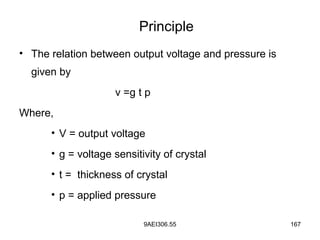
• The relation between output voltage and pressure is
given by
v =g t p
Where,
• V = output voltage
• g = voltage sensitivity of crystal
• t = thickness of crystal
• p = applied pressure
Principle
9AEI306.55 168
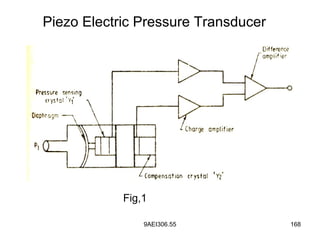
Piezo Electric Pressure Transducer
Fig,1
9AEI306.55 169
Construction And Working
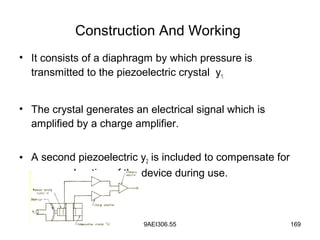
• It consists of a diaphragm by which pressure is
transmitted to the piezoelectric crystal y1.
• The crystal generates an electrical signal which is
amplified by a charge amplifier.
• A second piezoelectric y2 is included to compensate for
any acceleration of the device during use.
9AEI306.55 170
Construction And Working
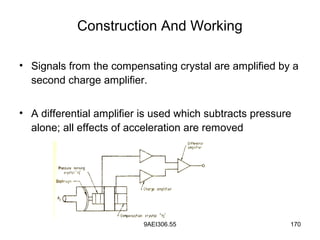
• Signals from the compensating crystal are amplified by a
second charge amplifier.
• A differential amplifier is used which subtracts pressure
alone; all effects of acceleration are removed
9AEI306.55 171
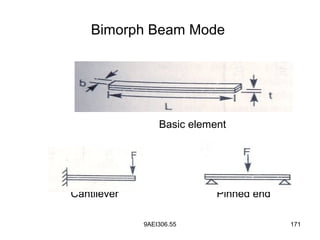
Bimorph Beam Mode
Basic element
Cantilever Pinned end
9AEI306.55 172
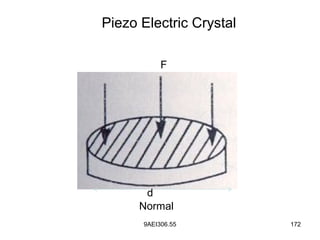
F
Normal
d
Piezo Electric Crystal
9AEI306.55 173
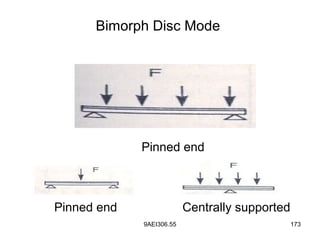
Bimorph Disc Mode
Pinned end
Pinned end Centrally supported
9AEI306.55 174
Piezoelectric Materials
• Materials used are
• Quartz
• Rochelle salt
• Synthetic ceramic material like
a. Barium – Titanate
b. Lead – Ziconatelianum
9AEI306.55 175
Advantages And Disadvantages
• Advantages
– Need no external power (Self generating)
– Very good high frequency response.
• Disadvantages
– Cannot measure static pressures
– Affected by changes in temperature
9AEI306.55 176
Applications
• Used to measure very high pressures that change very
rapidly.
• Used to measure the pressure inside the gasoline
engine.
• Used to measure the pressure in compressors, rocket
motors etc.
9AEI306.55 177
Applications
• Rapidly varying pressure
• Shock pressure
• Frequency response
• In aeronautics
• Turbines
• Pumps
• Hydraulics
• Acoustics
9AEI306.55 178
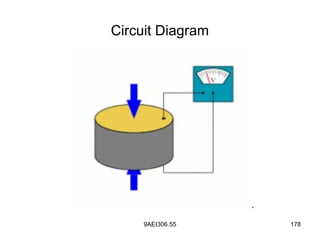
Circuit Diagram
9AEI306.55 179
Piezo Electric Effect Animation
9AEI306.55 180
Limitations
• Piezoelectric transducers are not capable of measuring
static pressures
• These sensors cannot detect static pressures
• Temperature range -200 Deg.C To +300 Deg.C
• 1 Hz -20 kHz
Need for Pneumatic
Transmitter
9AEI306.56 182
Necessity of Transmitter
• It is necessary to transmit a variable to a certain distance
for further processing, such as from site to control room
• Process variables measured not available locally
• Then the variables are converted to pressure signal for
easy transmission via differential pressure
9AEI306.56 183
Classification of transmitter
• Pneumatic transmitter
• Torque balance type transmitter
• Force balance type transmitter
• Pneumatic –electrical transmitter
9AEI306.56 184
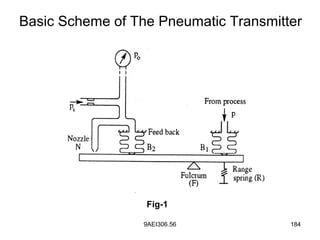
Basic Scheme of The Pneumatic Transmitter
Fig-1
9AEI306.56 185
Pneumatic Tansmitter
• The pneumatic transmitter as shows in the fig 1.
• When the process pressure increases, it causes the
beam about ‘F’ to move against ‘R’ through ‘B1’
• Thereby causing the beam to move closer nozzle N
• The pressure Po increases, which again is fed back
though ‘B2’
9AEI306.56 186
• A torque balance will be arrived at finally and it will be to
a large extent decided by the spring,
• Which in many cases is replaced by another bellows
element fed from a regulated supply pressure for range
adjustment
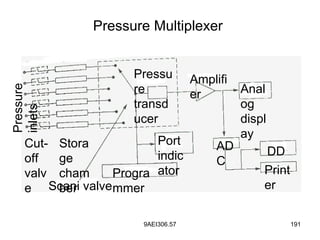
Pressure Multiplexer
9AEI306.57 188
Need For Pressure Multiplexer
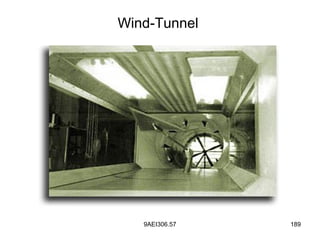
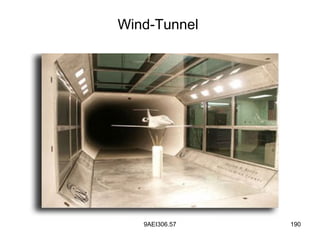
• Simultaneous measurement of pressure at various
locations is required for detailed investigation such as
wind tunnel testing
• If a pressure transducer is individually used at each point
the entire equipment tends to be
• Large
• Expensive
• Cumbersome
• To avoid this problem we require a Pressure multiplexer
9AEI306.57 189
Wind-Tunnel
9AEI306.57 190
Wind-Tunnel
9AEI306.57 191
Pressure Multiplexer
Amplifi
er
Stora
ge
cham
ber
Progra
mmer
Cut-
off
valv
e
Pressu
re
transd
ucer
Scani valve
Anal
og
displ
ay
Port
indic
ator
Pressure
inlets
AD
C
DD
Print
er
9AEI306.57 192
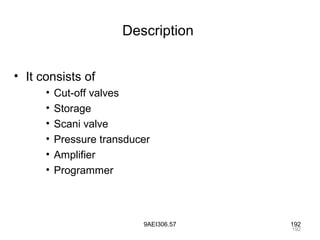
Description
• It consists of
• Cut-off valves
• Storage
• Scani valve
• Pressure transducer
• Amplifier
• Programmer
192
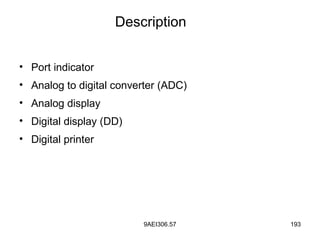
9AEI306.57 193
• Port indicator
• Analog to digital converter (ADC)
• Analog display
• Digital display (DD)
• Digital printer
Description
9AEI306.57 194
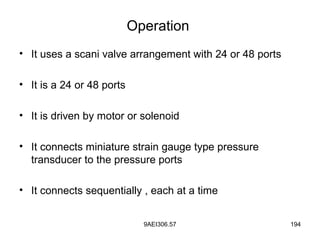
Operation
• It uses a scani valve arrangement with 24 or 48 ports
• It is a 24 or 48 ports
• It is driven by motor or solenoid
• It connects miniature strain gauge type pressure
transducer to the pressure ports
• It connects sequentially , each at a time
9AEI306.57 195
• The signal from the transducer is processed with a
suitable signal conditioner.
• This signal is printed out or displayed in required units
• Cut-Off valves with storage chambers are used to freeze
several unknown pressure values simultaneously
• They can be measured later using programmer
Operation
9AEI306.57 196
Advantages
• Good response even at low pressure levels
• Maximum Speed at sampling can be as high as 48 ports/
minute
9AEI306.57 197
Applications
• In aeronautical
• Aerodynamic and its allied fields
197
Pressure Calibration
9AEI306.58 199
Principle
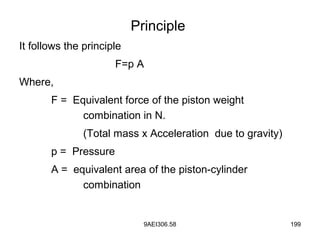
It follows the principle
F=p A
Where,
F = Equivalent force of the piston weight
combination in N.
(Total mass x Acceleration due to gravity)
p = Pressure
A = equivalent area of the piston-cylinder
combination
9AEI306.58 200
• By changing the weights appropriately the sensor can be
calibrated.
• Its range is 50 to 50 x 106
pa
Principle
9AEI306.58 201
Description
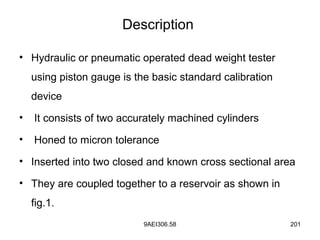
• Hydraulic or pneumatic operated dead weight tester
using piston gauge is the basic standard calibration
device
• It consists of two accurately machined cylinders
• Honed to micron tolerance
• Inserted into two closed and known cross sectional area
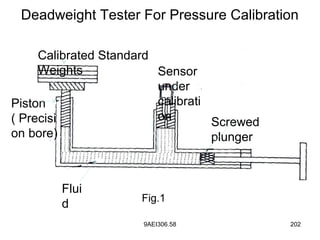
• They are coupled together to a reservoir as shown in
fig.1.
9AEI306.58 202
Deadweight Tester For Pressure Calibration
Calibrated Standard
Weights
Piston
( Precisi
on bore)
Sensor
under
calibrati
on Screwed
plunger
Flui
d Fig.1
9AEI306.58 203
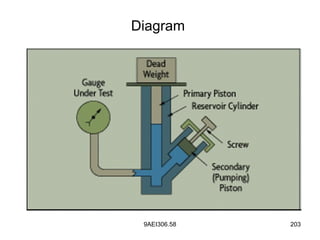
Diagram
9AEI306.58 204
• One of the cylinders is fitted with a close fitting precision
piston
• It will have a top platform
• Where accurately known weights can be loaded
• Another cylinder is connected with the transducer under
test
Description
9AEI306.58 205
Operation
• The fluid pressure is then gradually applied
• Until the force is large enough to just lift the precision
weight combination
• Piston floats freely
• Piston gauge with arranged weights are in equilibrium
with the pressure developed in the cylinder

Pressure measurement