Mandibular Fractures
• A tubular long bone, which is bent into a blunt V-
shape.
• Mandible is strongest anteriorly in midline with
progressively less strength towards condyle .
• Mandible is one of the strongest bones, the energy
required to # it being of the order of 44.6 –74.4 Kg /
M(425Lb), which is about same as zygoma and about
½ that of frontal bone
08-03-2017Mandibular Fractures 2
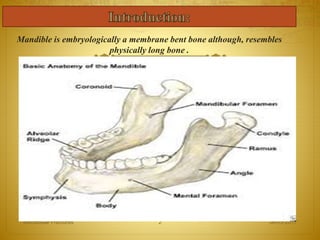
Mandible is embryologically a membrane bent bone although, resembles
physically long bone .
08-03-2017Mandibular Fractures 3
ETIOLOGY OF MANDIBULAR FRACTURES
 Vehicular accidents
 Altercation,assaults,
interpersonel violence
 Fall
 Sporting accidents
 Industrial mishaps or work
accidents
 Pathological fractures or
miscellaneous
08-03-2017Mandibular Fractures 4
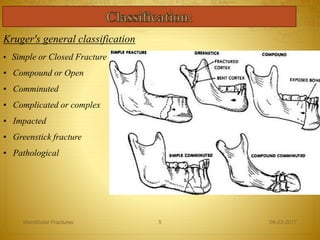
Kruger's general classification
• Simple or Closed Fracture
• Compound or Open
• Comminuted
• Complicated or complex
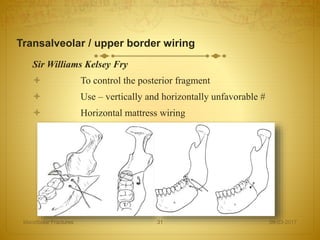
• Impacted
• Greenstick fracture
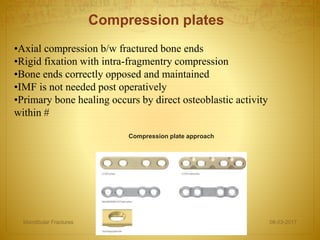
• Pathological
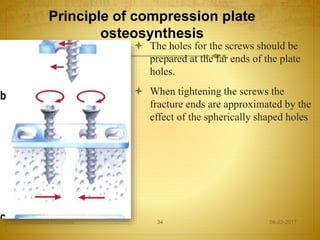
08-03-2017Mandibular Fractures 5
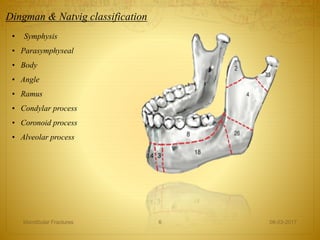
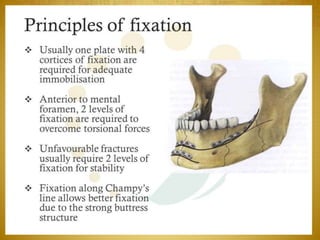
Dingman & Natvig classification
• Symphysis
• Parasymphyseal
• Body
• Angle
• Ramus
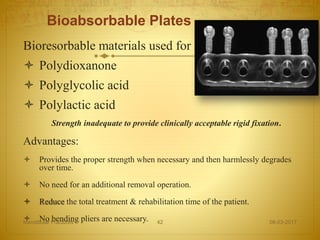
• Condylar process
• Coronoid process
• Alveolar process
08-03-2017Mandibular Fractures 6
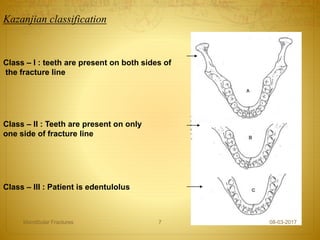
Kazanjian classification
Class – III : Patient is edentulolus
Class – I : teeth are present on both sides of
the fracture line
Class – II : Teeth are present on only
one side of fracture line
08-03-2017Mandibular Fractures 7
08-03-2017Mandibular Fractures 8
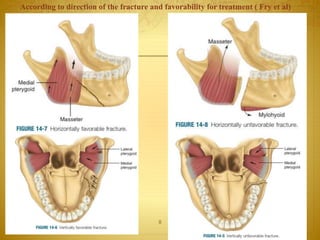
According to direction of the fracture and favorability for treatment ( Fry et al)

08-03-2017Mandibular Fractures 9
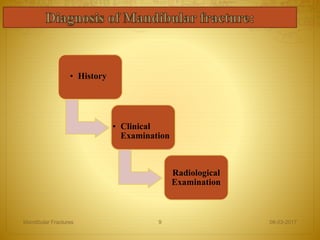
• History
• Clinical
Examination
Radiological
Examination
History
Focussed questioning should reveal following:
 Mechanism of injury
 Previous facial fracture
08-03-2017Mandibular Fractures 10
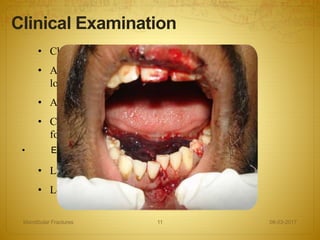
• Change in occlusion
• Anesthesia, Paresthesia or Dysesthesia of
lower lip
• Abnormal mandibular movements
• Change in facial contour and mandibular arch
form
• Extensive edema,tenderness.
• Laceration, Hematoma and Ecchymosis
• Loose teeth and crepitation on palpation
Clinical Examination
08-03-2017Mandibular Fractures 11
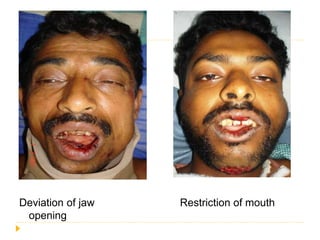
Deviation of jaw Restriction of mouth
opening
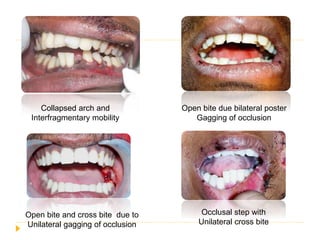
Collapsed arch and
Interfragmentary mobility
Open bite due bilateral poster
Gagging of occlusion
Open bite and cross bite due to
Unilateral gagging of occlusion
Occlusal step with
Unilateral cross bite
Radiological examination
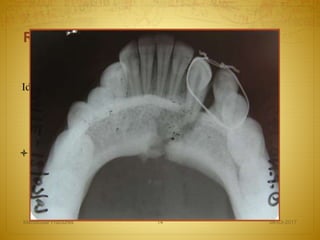
Ideally need 2 radiographic views of the fracture that are
oriented 90’ from one another to properly work up
fractures
 Single view can lead to misdiagnosis and complications
with treatment
08-03-2017Mandibular Fractures 14
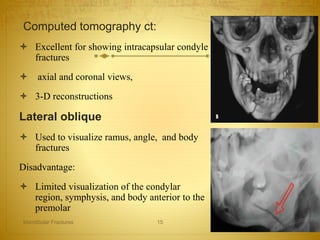
Computed tomography ct:
 Excellent for showing intracapsular condyle
fractures
 axial and coronal views,
 3-D reconstructions
Lateral oblique
 Used to visualize ramus, angle, and body
fractures
Disadvantage:
 Limited visualization of the condylar
region, symphysis, and body anterior to the
premolar
08-03-2017Mandibular Fractures 15
1. The patient’s general physical status
2. Diagnosis and treatment of mandibular fractures should be
approached methodically not with an “emergency-type” mentality
3. Dental injuries should be evaluated and treated concurrently with
treatment of mandibular fractures
4. Re-establishment of occlusion is the primary goal in the
treatment of mandibular fracture.
5. With multiple facial fracture mandibular fracture should be
treated first.
6. Intermaxillary fixation time should vary according to the type,
location, number severity of the mandibular fracture as well as the
patient’s age and health.
7. Prophylactic antibiotics should be used for compound fractures.
General principles in the treatment of
mandibular fracture
08-03-2017Mandibular Fractures 16
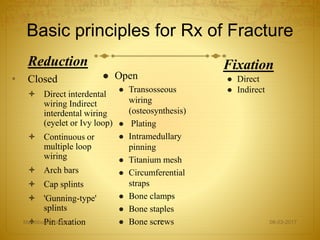
Basic principles for Rx of Fracture
Reduction
• Closed
 Direct interdental
wiring Indirect
interdental wiring
(eyelet or Ivy loop)
 Continuous or
multiple loop
wiring
 Arch bars
 Cap splints
 'Gunning-type'
splints
 Pin fixation 08-03-2017Mandibular Fractures 17
 Open
 Transosseous
wiring
(osteosynthesis)
 Plating
 Intramedullary
pinning
 Titanium mesh
 Circumferential
straps
 Bone clamps
 Bone staples
 Bone screws
Fixation
 Direct
 Indirect
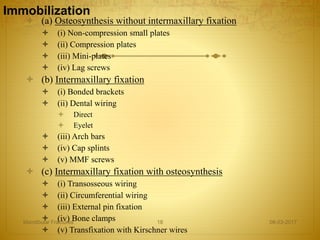
Immobilization
 (a) Osteosynthesis without intermaxillary fixation
 (i) Non-compression small plates
 (ii) Compression plates
 (iii) Mini-plates
 (iv) Lag screws
 (b) Intermaxillary fixation
 (i) Bonded brackets
 (ii) Dental wiring
 Direct
 Eyelet
 (iii) Arch bars
 (iv) Cap splints
 (v) MMF screws
 (c) Intermaxillary fixation with osteosynthesis
 (i) Transosseous wiring
 (ii) Circumferential wiring
 (iii) External pin fixation
 (iv) Bone clamps
 (v) Transfixation with Kirschner wires
08-03-2017Mandibular Fractures 18
08-03-2017Mandibular Fractures 19
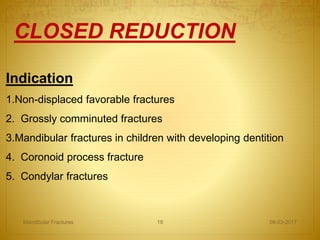
CLOSED REDUCTION
Indication
1.Non-displaced favorable fractures
2. Grossly comminuted fractures
3.Mandibular fractures in children with developing dentition
4. Coronoid process fracture
5. Condylar fractures
08-03-2017Mandibular Fractures 21
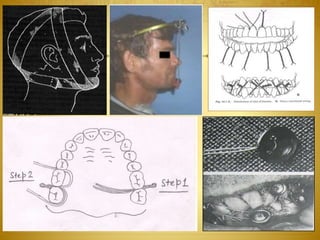
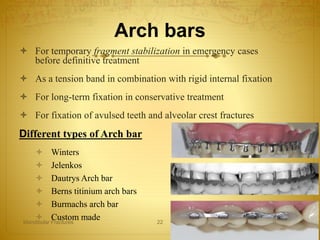
Arch bars
 For temporary fragment stabilization in emergency cases
before definitive treatment
 As a tension band in combination with rigid internal fixation
 For long-term fixation in conservative treatment
 For fixation of avulsed teeth and alveolar crest fractures
Different types of Arch bar
 Winters
 Jelenkos
 Dautrys Arch bar
 Berns titinium arch bars
 Burmachs arch bar
 Custom made 08-03-2017Mandibular Fractures 22
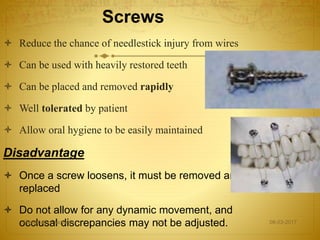
Screws
 Reduce the chance of needlestick injury from wires
 Can be used with heavily restored teeth
 Can be placed and removed rapidly
 Well tolerated by patient
 Allow oral hygiene to be easily maintained
Disadvantage
 Once a screw loosens, it must be removed and
replaced
 Do not allow for any dynamic movement, and
occlusal discrepancies may not be adjusted. 08-03-2017Mandibular Fractures 23
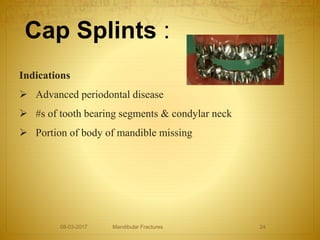
Cap Splints :
Indications
 Advanced periodontal disease
 #s of tooth bearing segments & condylar neck
 Portion of body of mandible missing
08-03-2017 Mandibular Fractures 24
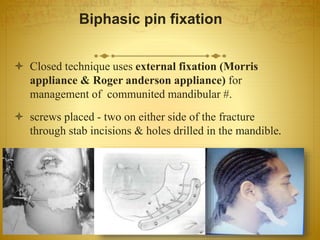
Biphasic pin fixation
 Closed technique uses external fixation (Morris
appliance & Roger anderson appliance) for
management of communited mandibular #.
 screws placed - two on either side of the fracture
through stab incisions & holes drilled in the mandible.
08-03-2017Mandibular Fractures 25
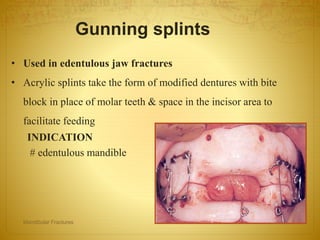
• Used in edentulous jaw fractures
• Acrylic splints take the form of modified dentures with bite
block in place of molar teeth & space in the incisor area to
facilitate feeding
INDICATION
# edentulous mandible
Gunning splints
08-03-2017Mandibular Fractures 26
Indications
1. Displaced unfavorable fracture of the
mandible
2. Multiple fractures of the facial bones
3. Fractures of the edentulous mandible with
severe displacement of fragments
4. Edentulous maxilla opposing a mandibular
fracture
5. Delay of treatment and interposition of soft
tissue between noncontacting displaced
fracture fragments.
6. Special systemic conditions
contraindicating intermaxillary fixation
/Malunion
Contraindications
G.A / more prolonged procedure
is not advisable
Gross infections at the # site
Severe comminution with loss of
soft tissue
08-03-2017Mandibular Fractures 28
OPEN REDUCTION
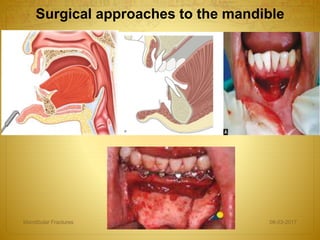
Surgical approaches to the mandible
08-03-2017Mandibular Fractures 29
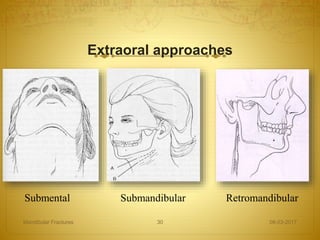
Extraoral approaches
08-03-2017Mandibular Fractures 30
Submental Submandibular Retromandibular
Transalveolar / upper border wiring
Sir Williams Kelsey Fry
 To control the posterior fragment
 Use – vertically and horizontally unfavorable #
 Horizontal mattress wiring
08-03-2017Mandibular Fractures 31
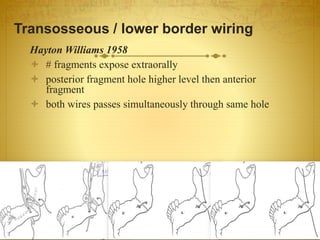
Transosseous / lower border wiring
Hayton Williams 1958
 # fragments expose extraorally
 posterior fragment hole higher level then anterior
fragment
 both wires passes simultaneously through same hole
08-03-2017Mandibular Fractures 32
Compression plates
•Axial compression b/w fractured bone ends
•Rigid fixation with intra-fragmentry compression
•Bone ends correctly opposed and maintained
•IMF is not needed post operatively
•Primary bone healing occurs by direct osteoblastic activity
within #
Compression plate approach
08-03-2017Mandibular Fractures 33
Principle of compression plate
osteosynthesis
 The holes for the screws should be
prepared at the far ends of the plate
holes.
 When tightening the screws the
fracture ends are approximated by the
effect of the spherically shaped holes
08-03-2017Mandibular Fractures 34
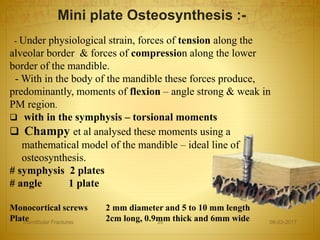
Mini plate Osteosynthesis :-
- Under physiological strain, forces of tension along the
alveolar border & forces of compression along the lower
border of the mandible.
- With in the body of the mandible these forces produce,
predominantly, moments of flexion – angle strong & weak in
PM region.
 with in the symphysis – torsional moments
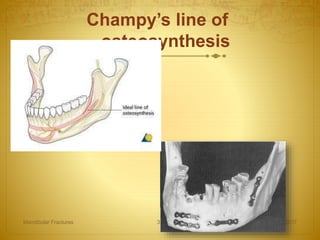
 Champy et al analysed these moments using a
mathematical model of the mandible – ideal line of
osteosynthesis.
# symphysis 2 plates
# angle 1 plate
Monocortical screws 2 mm diameter and 5 to 10 mm length
Plate 2cm long, 0.9mm thick and 6mm wide 08-03-2017Mandibular Fractures 35
08-03-2017Mandibular Fractures 36
Champy’s line of
osteosynthesis
08-03-2017Mandibular Fractures 37
Advantages of monocortical
miniplate osteosynthesis over
bicortical compression plates.
Monocortical
 Requires minimal dissection.
 Less technique sensitive
 Less chances of complications
Bicortical
 Extra oral approach
 Nerve injury
 Difficult to adapt
08-03-2017Mandibular Fractures 38
3-D plate ostesynthesis
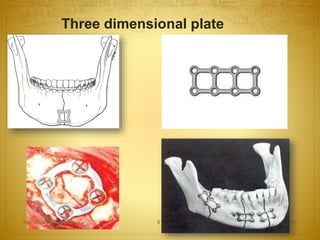
 The 3-D miniplate is a misnomer as the plates are not three
dimensional, but hold the fracture fragments rigidly by resisting
the forces in three dimensions, namely, shearing, bending, and
torsional forces.
 The basic concept is ----- geometrically closed quadrangular
plate secured with bone screws creates stability in three
dimensions. The stability is gained over a defined surface
area and is achieved by its configuration and not by its
thickness or length.
08-03-2017Mandibular Fractures 39
Three dimensional plate
08-03-2017Mandibular Fractures 41
Bioabsorbable Plates
Bioresorbable materials used for rigid fixation
 Polydioxanone
 Polyglycolic acid
 Polylactic acid
Strength inadequate to provide clinically acceptable rigid fixation.
Advantages:
 Provides the proper strength when necessary and then harmlessly degrades
over time.
 No need for an additional removal operation.
 Reduce the total treatment & rehabilitation time of the patient.
 No bending pliers are necessary. 08-03-2017Mandibular Fractures 42
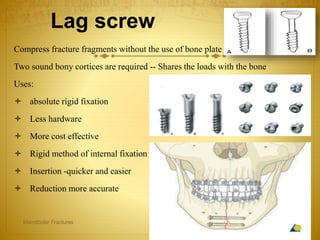
Lag screw
Compress fracture fragments without the use of bone plate
Two sound bony cortices are required -- Shares the loads with the bone
Uses:
 absolute rigid fixation
 Less hardware
 More cost effective
 Rigid method of internal fixation
 Insertion -quicker and easier
 Reduction more accurate
08-03-2017Mandibular Fractures 43
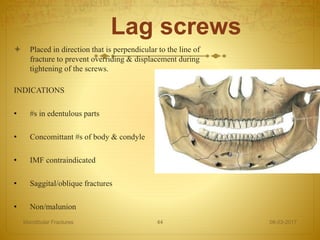
Lag screws
 Placed in direction that is perpendicular to the line of
fracture to prevent overriding & displacement during
tightening of the screws.
INDICATIONS
• #s in edentulous parts
• Concomittant #s of body & condyle
• IMF contraindicated
• Saggital/oblique fractures
• Non/malunion
08-03-2017Mandibular Fractures 44
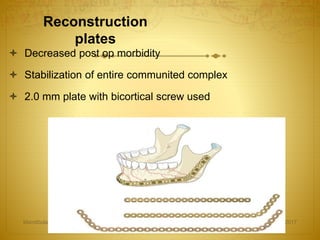
Reconstruction
plates
08-03-2017Mandibular Fractures 45
 Decreased post op morbidity
 Stabilization of entire communited complex
 2.0 mm plate with bicortical screw used
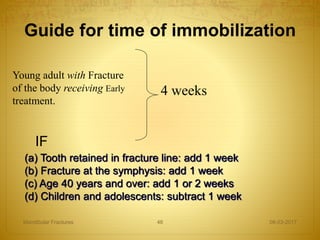
Young adult with Fracture
of the body receiving Early
treatment.
4 weeks
Guide for time of immobilization
08-03-2017Mandibular Fractures 46
(a) Tooth retained in fracture line: add 1 week
(b) Fracture at the symphysis: add 1 week
(c) Age 40 years and over: add 1 or 2 weeks
(d) Children and adolescents: subtract 1 week
IF
Thank you
08-03-2017Mandibular Fractures 47

Mandible # brief

  • 1.
  • 2.
    • A tubularlong bone, which is bent into a blunt V- shape. • Mandible is strongest anteriorly in midline with progressively less strength towards condyle . • Mandible is one of the strongest bones, the energy required to # it being of the order of 44.6 –74.4 Kg / M(425Lb), which is about same as zygoma and about ½ that of frontal bone 08-03-2017Mandibular Fractures 2 Mandible is embryologically a membrane bent bone although, resembles physically long bone .
  • 3.
  • 4.
    ETIOLOGY OF MANDIBULARFRACTURES  Vehicular accidents  Altercation,assaults, interpersonel violence  Fall  Sporting accidents  Industrial mishaps or work accidents  Pathological fractures or miscellaneous 08-03-2017Mandibular Fractures 4
  • 5.
    Kruger's general classification •Simple or Closed Fracture • Compound or Open • Comminuted • Complicated or complex • Impacted • Greenstick fracture • Pathological 08-03-2017Mandibular Fractures 5
  • 6.
    Dingman & Natvigclassification • Symphysis • Parasymphyseal • Body • Angle • Ramus • Condylar process • Coronoid process • Alveolar process 08-03-2017Mandibular Fractures 6
  • 7.
    Kazanjian classification Class –III : Patient is edentulolus Class – I : teeth are present on both sides of the fracture line Class – II : Teeth are present on only one side of fracture line 08-03-2017Mandibular Fractures 7
  • 8.
    08-03-2017Mandibular Fractures 8 Accordingto direction of the fracture and favorability for treatment ( Fry et al)
  • 9.
     08-03-2017Mandibular Fractures 9 •History • Clinical Examination Radiological Examination
  • 10.
    History Focussed questioning shouldreveal following:  Mechanism of injury  Previous facial fracture 08-03-2017Mandibular Fractures 10
  • 11.
    • Change inocclusion • Anesthesia, Paresthesia or Dysesthesia of lower lip • Abnormal mandibular movements • Change in facial contour and mandibular arch form • Extensive edema,tenderness. • Laceration, Hematoma and Ecchymosis • Loose teeth and crepitation on palpation Clinical Examination 08-03-2017Mandibular Fractures 11
  • 12.
    Deviation of jawRestriction of mouth opening
  • 13.
    Collapsed arch and Interfragmentarymobility Open bite due bilateral poster Gagging of occlusion Open bite and cross bite due to Unilateral gagging of occlusion Occlusal step with Unilateral cross bite
  • 14.
    Radiological examination Ideally need2 radiographic views of the fracture that are oriented 90’ from one another to properly work up fractures  Single view can lead to misdiagnosis and complications with treatment 08-03-2017Mandibular Fractures 14
  • 15.
    Computed tomography ct: Excellent for showing intracapsular condyle fractures  axial and coronal views,  3-D reconstructions Lateral oblique  Used to visualize ramus, angle, and body fractures Disadvantage:  Limited visualization of the condylar region, symphysis, and body anterior to the premolar 08-03-2017Mandibular Fractures 15
  • 16.
    1. The patient’sgeneral physical status 2. Diagnosis and treatment of mandibular fractures should be approached methodically not with an “emergency-type” mentality 3. Dental injuries should be evaluated and treated concurrently with treatment of mandibular fractures 4. Re-establishment of occlusion is the primary goal in the treatment of mandibular fracture. 5. With multiple facial fracture mandibular fracture should be treated first. 6. Intermaxillary fixation time should vary according to the type, location, number severity of the mandibular fracture as well as the patient’s age and health. 7. Prophylactic antibiotics should be used for compound fractures. General principles in the treatment of mandibular fracture 08-03-2017Mandibular Fractures 16
  • 17.
    Basic principles forRx of Fracture Reduction • Closed  Direct interdental wiring Indirect interdental wiring (eyelet or Ivy loop)  Continuous or multiple loop wiring  Arch bars  Cap splints  'Gunning-type' splints  Pin fixation 08-03-2017Mandibular Fractures 17  Open  Transosseous wiring (osteosynthesis)  Plating  Intramedullary pinning  Titanium mesh  Circumferential straps  Bone clamps  Bone staples  Bone screws Fixation  Direct  Indirect
  • 18.
    Immobilization  (a) Osteosynthesiswithout intermaxillary fixation  (i) Non-compression small plates  (ii) Compression plates  (iii) Mini-plates  (iv) Lag screws  (b) Intermaxillary fixation  (i) Bonded brackets  (ii) Dental wiring  Direct  Eyelet  (iii) Arch bars  (iv) Cap splints  (v) MMF screws  (c) Intermaxillary fixation with osteosynthesis  (i) Transosseous wiring  (ii) Circumferential wiring  (iii) External pin fixation  (iv) Bone clamps  (v) Transfixation with Kirschner wires 08-03-2017Mandibular Fractures 18
  • 19.
    08-03-2017Mandibular Fractures 19 CLOSEDREDUCTION Indication 1.Non-displaced favorable fractures 2. Grossly comminuted fractures 3.Mandibular fractures in children with developing dentition 4. Coronoid process fracture 5. Condylar fractures
  • 20.
  • 21.
    Arch bars  Fortemporary fragment stabilization in emergency cases before definitive treatment  As a tension band in combination with rigid internal fixation  For long-term fixation in conservative treatment  For fixation of avulsed teeth and alveolar crest fractures Different types of Arch bar  Winters  Jelenkos  Dautrys Arch bar  Berns titinium arch bars  Burmachs arch bar  Custom made 08-03-2017Mandibular Fractures 22
  • 22.
    Screws  Reduce thechance of needlestick injury from wires  Can be used with heavily restored teeth  Can be placed and removed rapidly  Well tolerated by patient  Allow oral hygiene to be easily maintained Disadvantage  Once a screw loosens, it must be removed and replaced  Do not allow for any dynamic movement, and occlusal discrepancies may not be adjusted. 08-03-2017Mandibular Fractures 23
  • 23.
    Cap Splints : Indications Advanced periodontal disease  #s of tooth bearing segments & condylar neck  Portion of body of mandible missing 08-03-2017 Mandibular Fractures 24
  • 24.
    Biphasic pin fixation Closed technique uses external fixation (Morris appliance & Roger anderson appliance) for management of communited mandibular #.  screws placed - two on either side of the fracture through stab incisions & holes drilled in the mandible. 08-03-2017Mandibular Fractures 25
  • 25.
    • Used inedentulous jaw fractures • Acrylic splints take the form of modified dentures with bite block in place of molar teeth & space in the incisor area to facilitate feeding INDICATION # edentulous mandible Gunning splints 08-03-2017Mandibular Fractures 26
  • 26.
    Indications 1. Displaced unfavorablefracture of the mandible 2. Multiple fractures of the facial bones 3. Fractures of the edentulous mandible with severe displacement of fragments 4. Edentulous maxilla opposing a mandibular fracture 5. Delay of treatment and interposition of soft tissue between noncontacting displaced fracture fragments. 6. Special systemic conditions contraindicating intermaxillary fixation /Malunion Contraindications G.A / more prolonged procedure is not advisable Gross infections at the # site Severe comminution with loss of soft tissue 08-03-2017Mandibular Fractures 28 OPEN REDUCTION
  • 27.
    Surgical approaches tothe mandible 08-03-2017Mandibular Fractures 29
  • 28.
    Extraoral approaches 08-03-2017Mandibular Fractures30 Submental Submandibular Retromandibular
  • 29.
    Transalveolar / upperborder wiring Sir Williams Kelsey Fry  To control the posterior fragment  Use – vertically and horizontally unfavorable #  Horizontal mattress wiring 08-03-2017Mandibular Fractures 31
  • 30.
    Transosseous / lowerborder wiring Hayton Williams 1958  # fragments expose extraorally  posterior fragment hole higher level then anterior fragment  both wires passes simultaneously through same hole 08-03-2017Mandibular Fractures 32
  • 31.
    Compression plates •Axial compressionb/w fractured bone ends •Rigid fixation with intra-fragmentry compression •Bone ends correctly opposed and maintained •IMF is not needed post operatively •Primary bone healing occurs by direct osteoblastic activity within # Compression plate approach 08-03-2017Mandibular Fractures 33
  • 32.
    Principle of compressionplate osteosynthesis  The holes for the screws should be prepared at the far ends of the plate holes.  When tightening the screws the fracture ends are approximated by the effect of the spherically shaped holes 08-03-2017Mandibular Fractures 34
  • 33.
    Mini plate Osteosynthesis:- - Under physiological strain, forces of tension along the alveolar border & forces of compression along the lower border of the mandible. - With in the body of the mandible these forces produce, predominantly, moments of flexion – angle strong & weak in PM region.  with in the symphysis – torsional moments  Champy et al analysed these moments using a mathematical model of the mandible – ideal line of osteosynthesis. # symphysis 2 plates # angle 1 plate Monocortical screws 2 mm diameter and 5 to 10 mm length Plate 2cm long, 0.9mm thick and 6mm wide 08-03-2017Mandibular Fractures 35
  • 34.
  • 35.
  • 36.
    Advantages of monocortical miniplateosteosynthesis over bicortical compression plates. Monocortical  Requires minimal dissection.  Less technique sensitive  Less chances of complications Bicortical  Extra oral approach  Nerve injury  Difficult to adapt 08-03-2017Mandibular Fractures 38
  • 37.
    3-D plate ostesynthesis The 3-D miniplate is a misnomer as the plates are not three dimensional, but hold the fracture fragments rigidly by resisting the forces in three dimensions, namely, shearing, bending, and torsional forces.  The basic concept is ----- geometrically closed quadrangular plate secured with bone screws creates stability in three dimensions. The stability is gained over a defined surface area and is achieved by its configuration and not by its thickness or length. 08-03-2017Mandibular Fractures 39
  • 38.
  • 39.
    Bioabsorbable Plates Bioresorbable materialsused for rigid fixation  Polydioxanone  Polyglycolic acid  Polylactic acid Strength inadequate to provide clinically acceptable rigid fixation. Advantages:  Provides the proper strength when necessary and then harmlessly degrades over time.  No need for an additional removal operation.  Reduce the total treatment & rehabilitation time of the patient.  No bending pliers are necessary. 08-03-2017Mandibular Fractures 42
  • 40.
    Lag screw Compress fracturefragments without the use of bone plate Two sound bony cortices are required -- Shares the loads with the bone Uses:  absolute rigid fixation  Less hardware  More cost effective  Rigid method of internal fixation  Insertion -quicker and easier  Reduction more accurate 08-03-2017Mandibular Fractures 43
  • 41.
    Lag screws  Placedin direction that is perpendicular to the line of fracture to prevent overriding & displacement during tightening of the screws. INDICATIONS • #s in edentulous parts • Concomittant #s of body & condyle • IMF contraindicated • Saggital/oblique fractures • Non/malunion 08-03-2017Mandibular Fractures 44
  • 42.
    Reconstruction plates 08-03-2017Mandibular Fractures 45 Decreased post op morbidity  Stabilization of entire communited complex  2.0 mm plate with bicortical screw used
  • 43.
    Young adult withFracture of the body receiving Early treatment. 4 weeks Guide for time of immobilization 08-03-2017Mandibular Fractures 46 (a) Tooth retained in fracture line: add 1 week (b) Fracture at the symphysis: add 1 week (c) Age 40 years and over: add 1 or 2 weeks (d) Children and adolescents: subtract 1 week IF
  • 44.

Editor's Notes

  • #3 [Swearingen 1965, Hodgson 1967, Nahum 1975a, Luce et al 1979]
  • #17 should be carefully evaluated and monitored prior to any consideration of treating mandibular fracture.
  • #24 A small 2-mm incision can be made in the mucosa and down through periosteum
  • #43 poly(L-lactide) (PLLA) Biodegradable materials usually degrade in vivo through a two-phase process. During phase 1, water molecules hydrolytically attack the chemical bonds, cutting long polymer chains to many short chains Phase 2 involves the cellular response whereby macrophages and giant cells metabolize the products of phase 1 degrada- tion into substances, such as water and carbon dioxide
  • #44 In contrast, a true lag screw has threads only at its termi- nal end. When used, the threads engage the distant cortex and the head sits against the proximal cortex, resulting in compression and mechanical resthe Eckelt technique for treatment of condylar neck The Krenkel technique for treatment of condylar neck fractures.