Name: Prahlad
Roll No:201710101130017
Group; BCA(61)
Why Study ERP
Architecture?
• Help management and the implementation teams
understand in detail the features and components of
the enterprise system.
• Provide a visual representation of the complex
system interfaces among the ERP application and
databases, operating systems, legacy applications,
and networking.
• Management can develop a better IT plan if the
requirements for system infrastructure, training,
change management, and business process
reengineering are clarified.
Components of the Enterprise Systems
Architecture
• Functional
– Defines the ERP modules that support the various business
functions of the organization. Examples include:
• Accounting
• Human Resources
• Procurement
• Fulfillment
• Etc.
• System
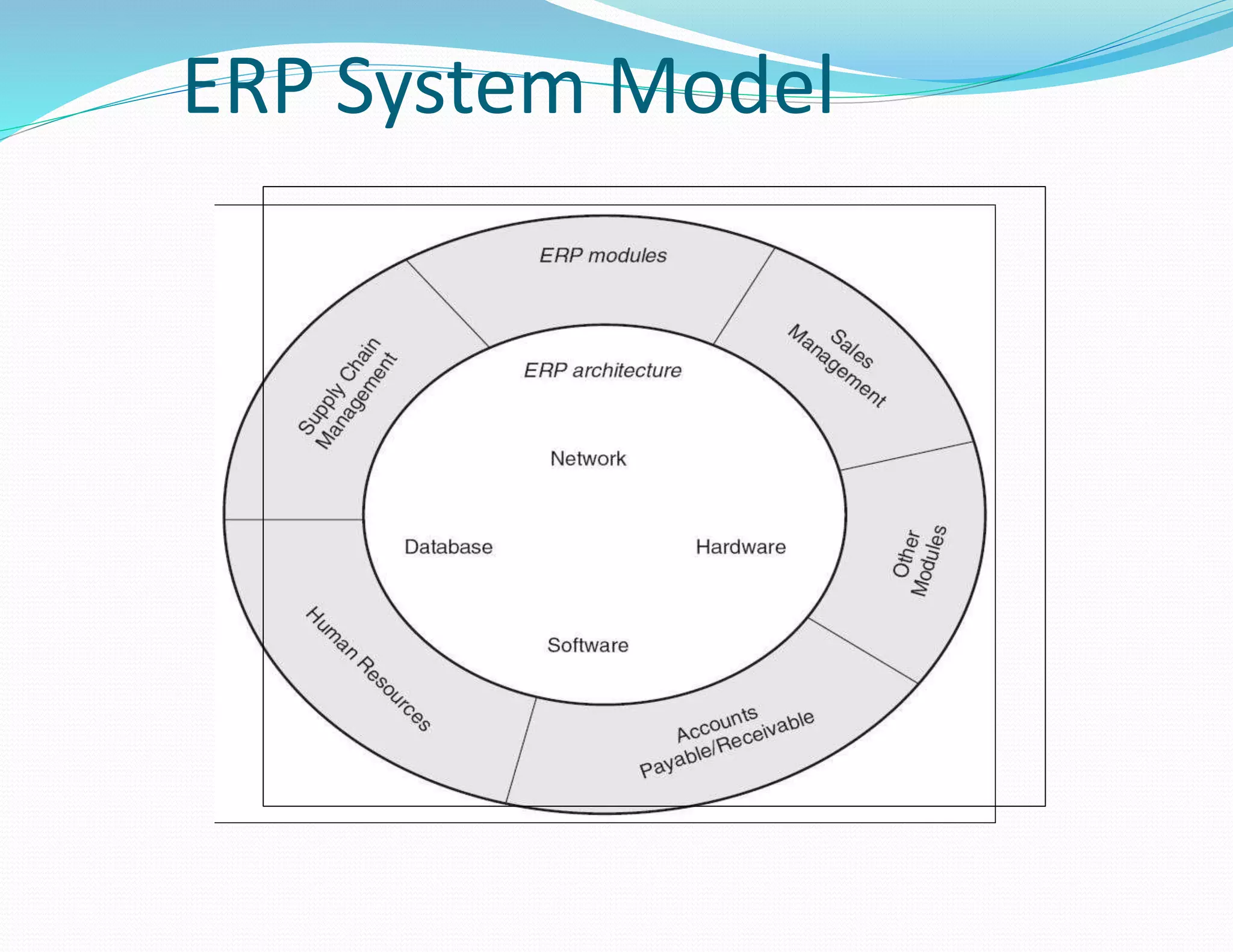
– Defines the ERP architecture through the physical components
of hardware, software, and networking angle.
ERP System Model
ERP System Module
• The key role of an ERP system is to provide support
for such business functions as accounting, sales,
inventory control, and production.
• ERP vendors, including SAP, Oracle, and Microsoft,
etc. provide modules that support the major
functional areas of a business.
• The ERP software embeds best business practices
that implement the organization’s policy and
procedure via business rules.
Typical ERP Modules
ERP Modules From Three
Vendors
Function SAP Oracle/
PeopleSoft
Microsoft
Dynamics
Sales Sales and
Distribution, Sales
Opportunity
Marketing and
Sales, Supply Chain
Management
Retail POS,
Field Service
Management
Procurement Purchasing, Supplier
Relationship
Management
Procurement and
Supplier
Relationship
Management
Supply Chain
Management
Production MRP, Product Life
Cycle Management
Manufacturing Manufacturing
Accounting FinancialAccounting Financial
Management
Financial
Management
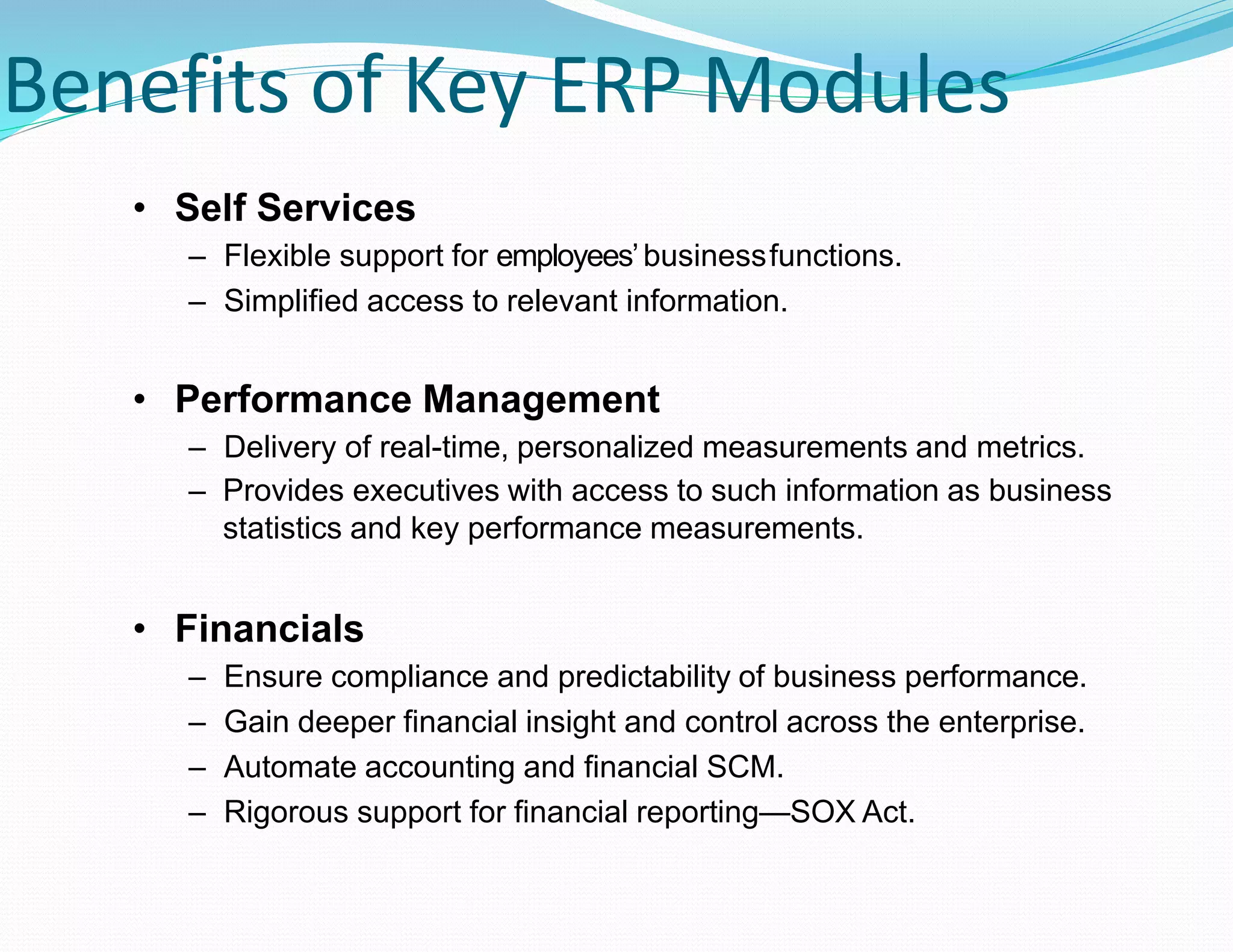
Benefits of Key ERP Modules
• Self Services
– Flexible support for employees’businessfunctions.
– Simplified access to relevant information.
• Performance Management
– Delivery of real-time, personalized measurements and metrics.
– Provides executives with access to such information as business
statistics and key performance measurements.
• Financials
– Ensure compliance and predictability of business performance.
– Gain deeper financial insight and control across the enterprise.
– Automate accounting and financial SCM.
– Rigorous support for financial reporting—SOX Act.
ERP Architecture
• ERP system architecture is organized in layers or
tiers to manage system complexity in order to
provide scalability and flexibility.
• Three-layer architecture (the most reliable, flexible,
and scalable architecture) is the most prevalent
today and includes:
– Web Servers.
– Application Servers.
– Database Servers.
ERP Tiers
• The Web Tier
– Web-based portal allows users the ability to access and analyze
information through their Web browser.
• The Application Tier
– Consists of a Web browser and reporting tool where business
processes and end-users interact with the system.
– It shields the business users from the inner workings of an ERP
system, but still provides the information relevant to their job
and business process.
• The Data Tier
– Focus is on structure of all organizational data and its
relationships with both internal and external systems.
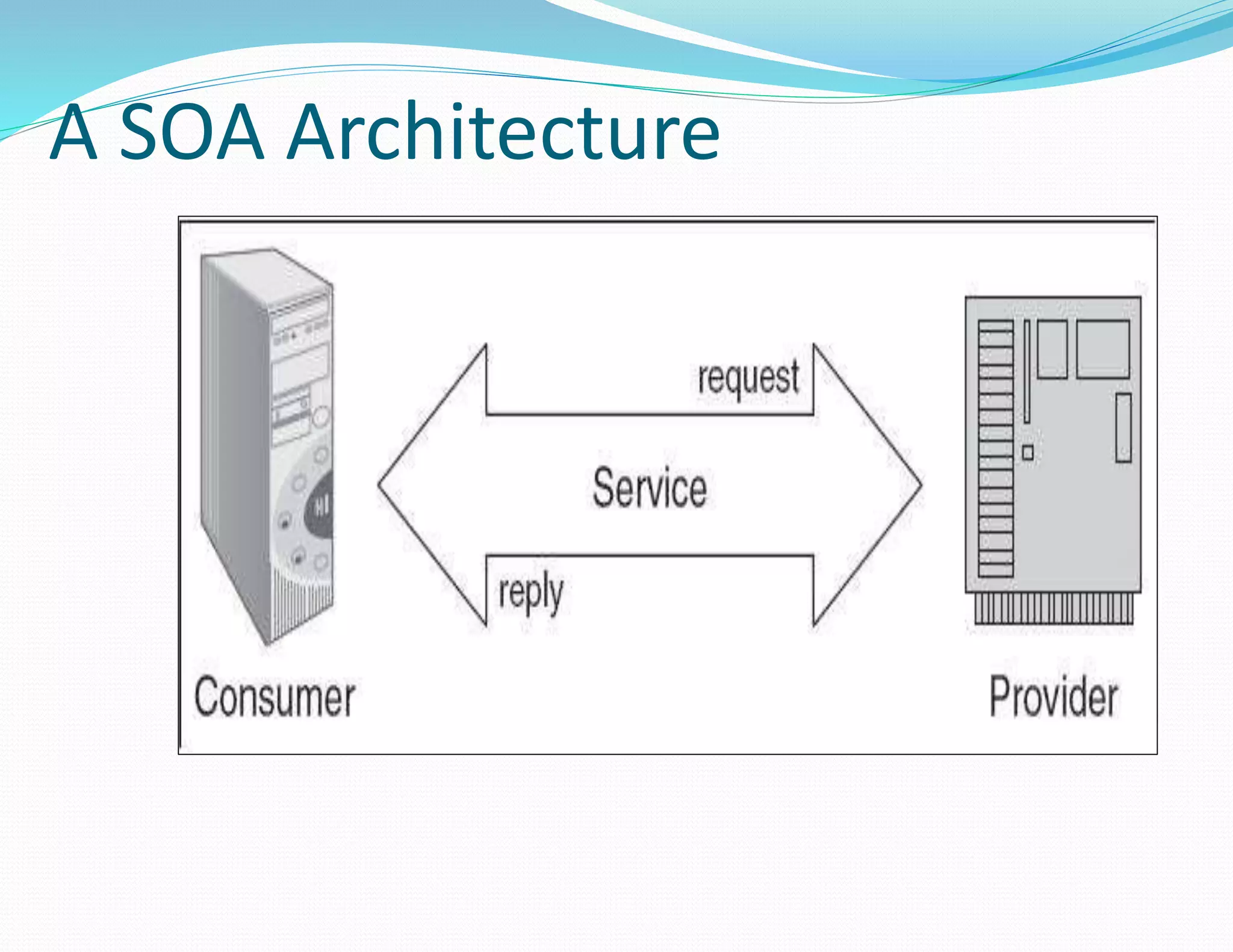
A SOA Architecture
Benefits of Service-Oriented Architectures
• Business-level software services across
heterogeneous platforms.
• Complete location independence of business logic.
• Services can exist anywhere (any system, any
network).
• Loose coupling across application services.
• Granular authentication and authorization support.
• Dynamic search and connectivity to other services.
• Enhances reliability of the architecture.
• Reduces hardware acquisition costs.

Architures of ERP System

  • 1.
  • 2.
    Why Study ERP Architecture? •Help management and the implementation teams understand in detail the features and components of the enterprise system. • Provide a visual representation of the complex system interfaces among the ERP application and databases, operating systems, legacy applications, and networking. • Management can develop a better IT plan if the requirements for system infrastructure, training, change management, and business process reengineering are clarified.
  • 3.
    Components of theEnterprise Systems Architecture • Functional – Defines the ERP modules that support the various business functions of the organization. Examples include: • Accounting • Human Resources • Procurement • Fulfillment • Etc. • System – Defines the ERP architecture through the physical components of hardware, software, and networking angle.
  • 4.
  • 5.
    ERP System Module •The key role of an ERP system is to provide support for such business functions as accounting, sales, inventory control, and production. • ERP vendors, including SAP, Oracle, and Microsoft, etc. provide modules that support the major functional areas of a business. • The ERP software embeds best business practices that implement the organization’s policy and procedure via business rules.
  • 6.
  • 7.
    ERP Modules FromThree Vendors Function SAP Oracle/ PeopleSoft Microsoft Dynamics Sales Sales and Distribution, Sales Opportunity Marketing and Sales, Supply Chain Management Retail POS, Field Service Management Procurement Purchasing, Supplier Relationship Management Procurement and Supplier Relationship Management Supply Chain Management Production MRP, Product Life Cycle Management Manufacturing Manufacturing Accounting FinancialAccounting Financial Management Financial Management
  • 8.
    Benefits of KeyERP Modules • Self Services – Flexible support for employees’businessfunctions. – Simplified access to relevant information. • Performance Management – Delivery of real-time, personalized measurements and metrics. – Provides executives with access to such information as business statistics and key performance measurements. • Financials – Ensure compliance and predictability of business performance. – Gain deeper financial insight and control across the enterprise. – Automate accounting and financial SCM. – Rigorous support for financial reporting—SOX Act.
  • 9.
    ERP Architecture • ERPsystem architecture is organized in layers or tiers to manage system complexity in order to provide scalability and flexibility. • Three-layer architecture (the most reliable, flexible, and scalable architecture) is the most prevalent today and includes: – Web Servers. – Application Servers. – Database Servers.
  • 10.
    ERP Tiers • TheWeb Tier – Web-based portal allows users the ability to access and analyze information through their Web browser. • The Application Tier – Consists of a Web browser and reporting tool where business processes and end-users interact with the system. – It shields the business users from the inner workings of an ERP system, but still provides the information relevant to their job and business process. • The Data Tier – Focus is on structure of all organizational data and its relationships with both internal and external systems.
  • 11.
  • 12.
    Benefits of Service-OrientedArchitectures • Business-level software services across heterogeneous platforms. • Complete location independence of business logic. • Services can exist anywhere (any system, any network). • Loose coupling across application services. • Granular authentication and authorization support. • Dynamic search and connectivity to other services. • Enhances reliability of the architecture. • Reduces hardware acquisition costs.