CHAPTER 1.  THE INFORMATION SYSTEMS REVOLUTION TRANSFORMING BUSINESS AND MANAGEMENT EXPOSITOR: M.Sc. Víctor Pando Beltrán [email_address]
Learning objectives (#1) Define information systems COMPUTER LITERACY versus INFORMATION SYSTEMS LITERACY Explain impact of information systems on organization & management *
Learning objectives (#2) Compare electronic commerce & electronic business, relationship to internet & digital technology Identify major management challenges to building, using information systems *
Management challenges (Sections) Why information systems? Contemporary approaches to information systems New role of info systems in organizations Learning to use info systems: new opportunities with technology *
Business Environment (sections) Globalization Industrial economies Transformation of the enterprise *
Globalization Future Success Factor (Globalization) Management & control (IT) Competition in world markets Global work groups (SW Team) Global delivery systems (Real and Virtual) *
Transformation of Industrial Economies Knowledge- (Info-) based economies Productivity (System Quality) New products & services Knowledge as an asset Time-based competition Shorter product life Turbulent environment Limited employee knowledge base *
Transformation of enterprise Flattening Decentralization Flexibility Location independence Low transaction costs Empowerment (Electric-Firms) Collaborative work *
Knowledge- and information-intense products Products that require a great deal of learning & knowledge to produce Employing Millions of People Optimize within Organization and Maximize Firm’s Knowledge Resources *
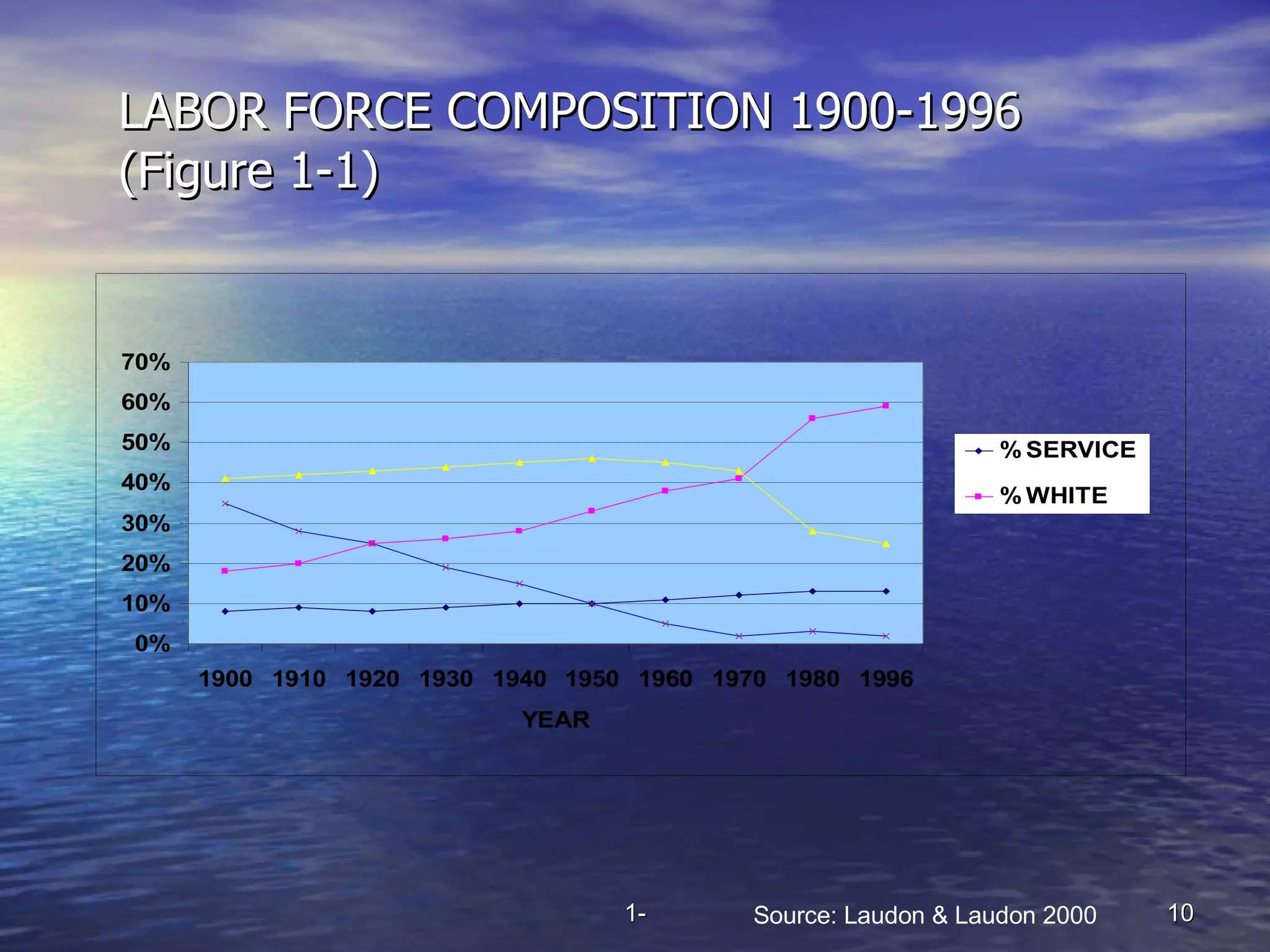
LABOR FORCE COMPOSITION 1900-1996 (Figure 1-1) Source: Laudon & Laudon 2000
What is SYSTEM ? INPUT OUTPUT PROCESS FEEDBACK
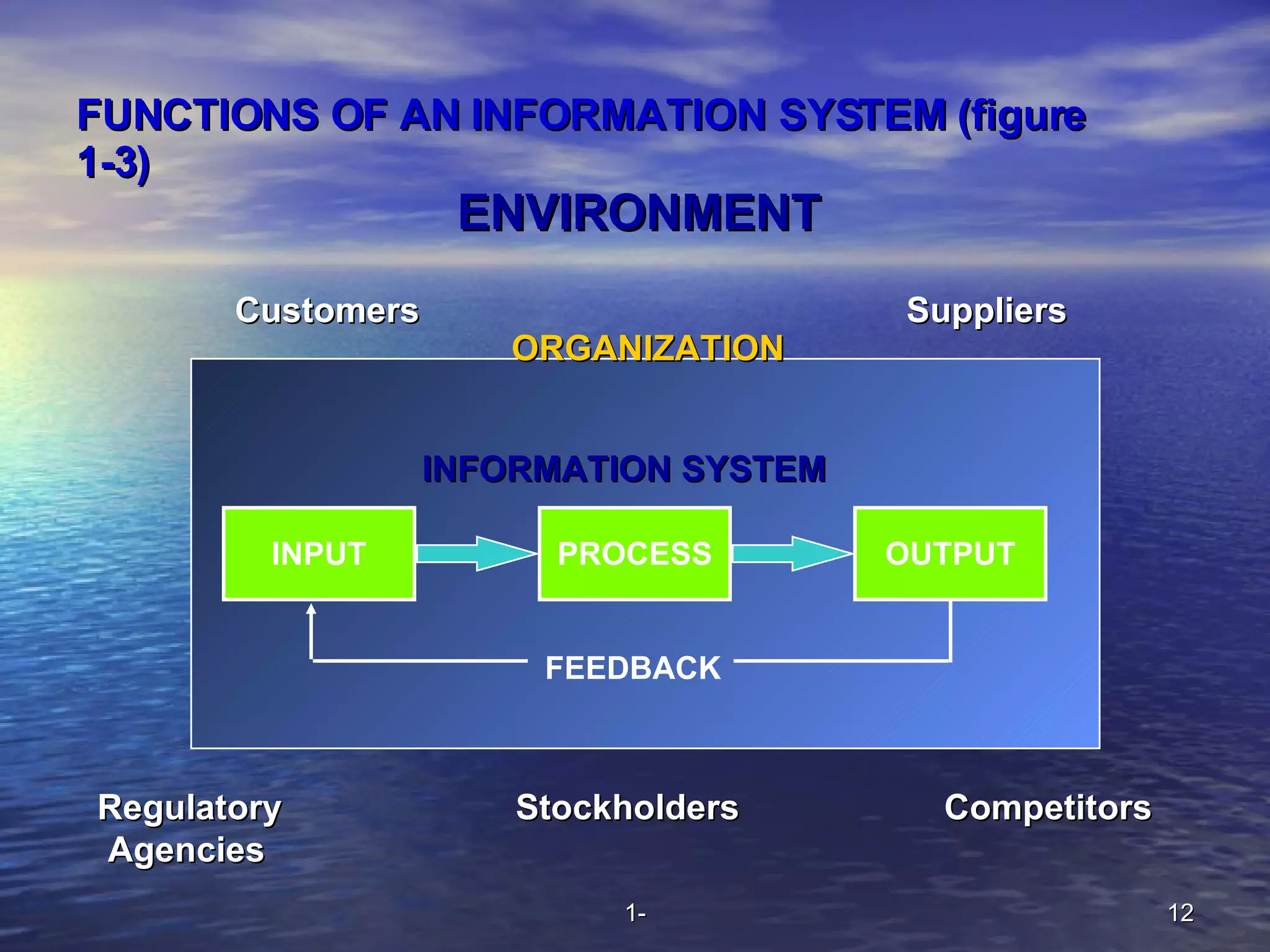
FUNCTIONS OF AN INFORMATION SYSTEM (figure 1-3) ORGANIZATION INPUT OUTPUT PROCESS FEEDBACK INFORMATION SYSTEM ENVIRONMENT Customers  Suppliers  Regulatory  Stockholders  Competitors Agencies
INFORMATION SYSTEMS (Figure 1-4) ORGANIZATIONS TECHNOLOGY MANAGEMENT INFORMATION SYSTEMS
Computer-based information systems  (CBIS) Formal systems Fixed definitions of data, procedures Collecting, storing, processing, disseminating, using data *
A Business Perspective on Information Systems Organizational and Management Solution, based on IT, posed by Env. Information Systems Literacy – Computer Literacy SOPs (Standard Operation Procedures)
Major organizational functions (Table 1-2) Sales & marketing Manufacturing Finance Accounting Human resources *
Computer technology Hardware Software Storage Communications Network *
APPROACHES TO INFO SYSTEMS (#1) (Figure 1-5) COMPUTER  SCIENCE OPERATIONS  RESEARCH MANAGEMENT SCIENCE TECHNICAL APPROACHES BEHAVIORAL APPROACHES SOCIOLOGY POLITICAL SCIENCE PSYCHOLOGY MIS
APPROACHES TO INFO SYSTEMS (#2) Techincal Approach Computer science Management Science Operations Research Behavioral Approaches Sociologists Psychologists Economists
Sociotechnical perspective (#1) Optimize system performance: Technology & organization mutually adjust to one another Until fit is satisfactory * SOURCE: Liker, et al, 1987
A Sociotechnical Perspective on IS (#2) (Figure 1-6)
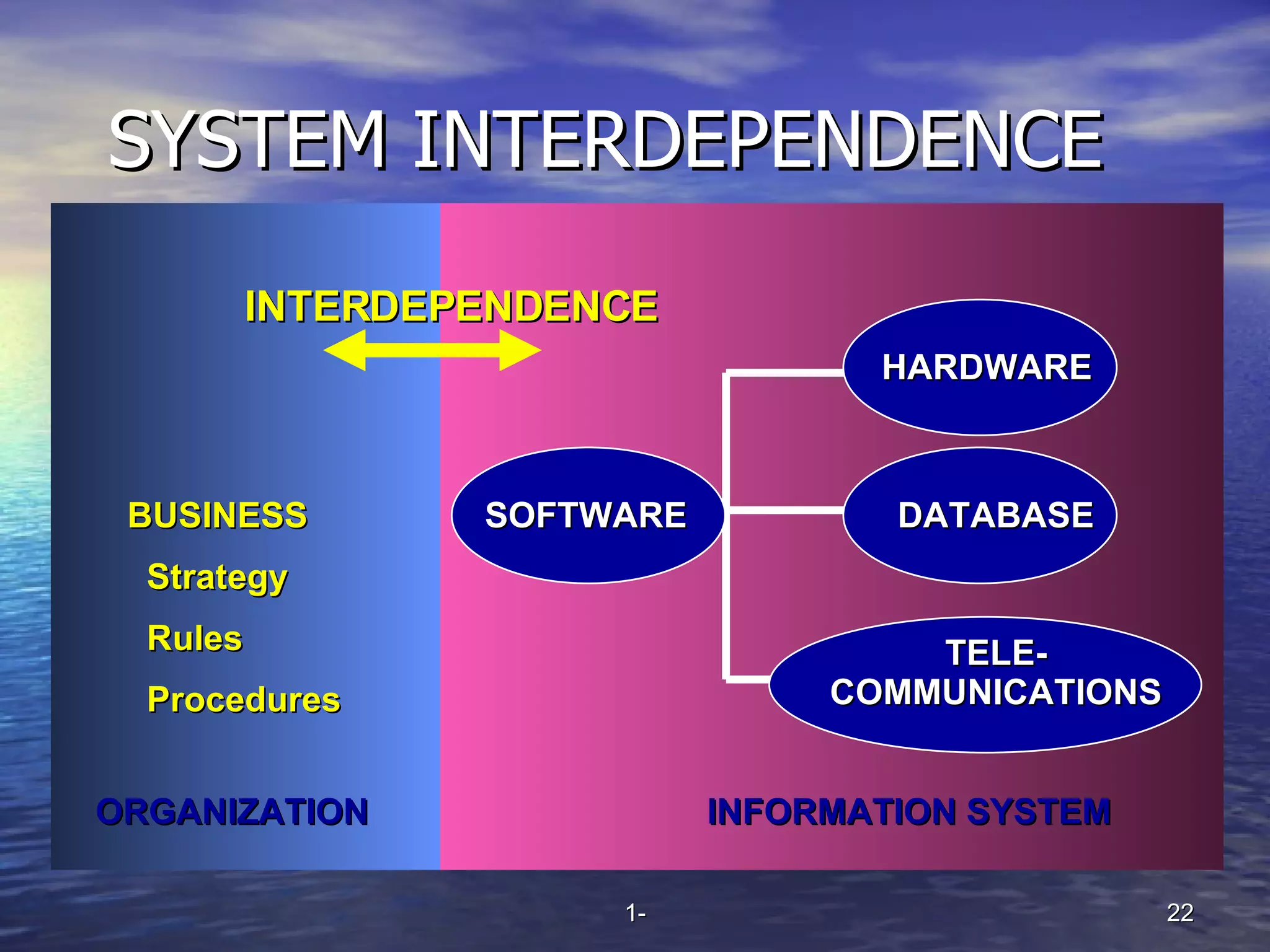
SYSTEM INTERDEPENDENCE BUSINESS Strategy Rules Procedures ORGANIZATION  INFORMATION SYSTEM HARDWARE SOFTWARE DATABASE TELE-COMMUNICATIONS INTERDEPENDENCE
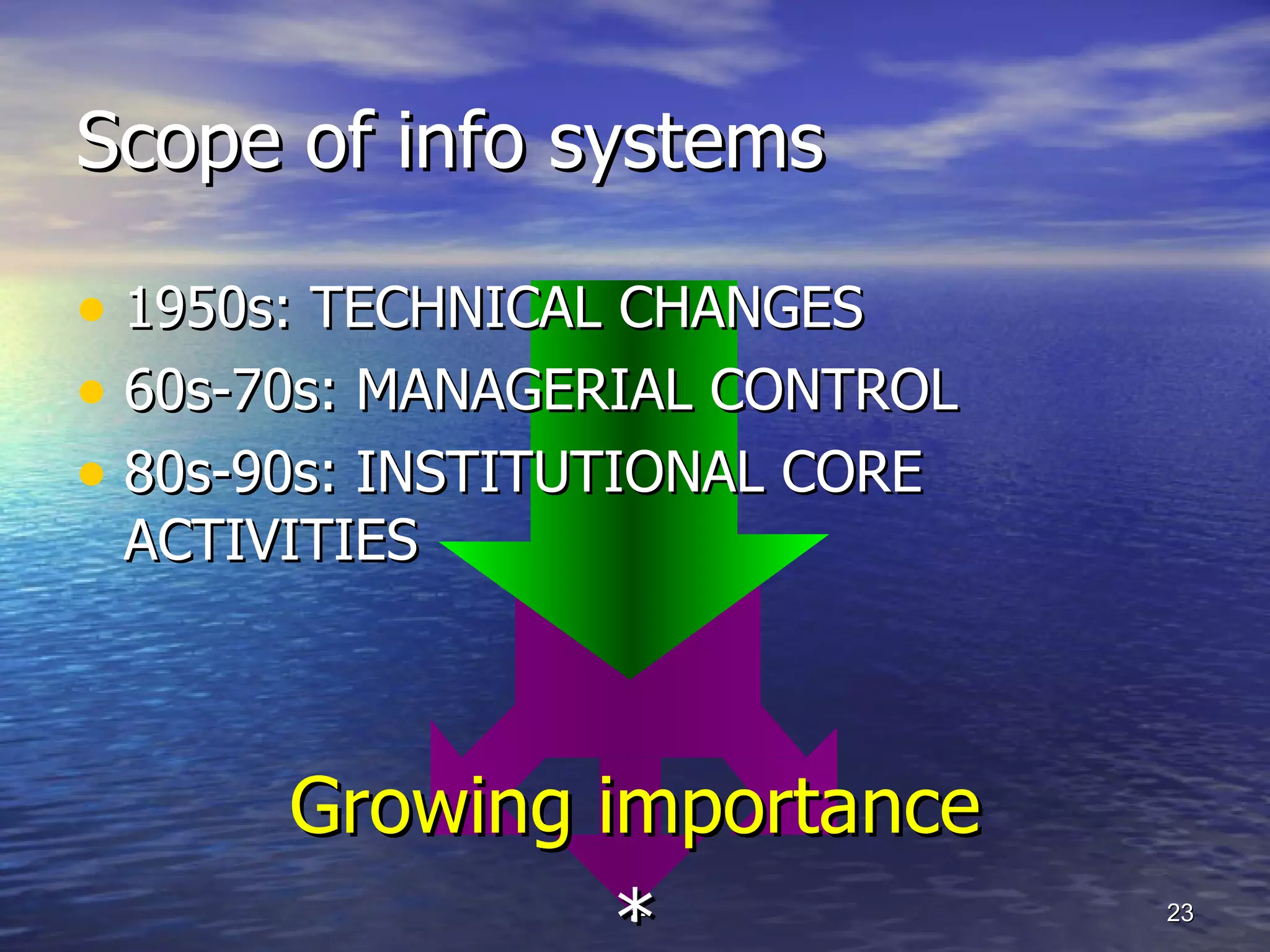
1950s: TECHNICAL CHANGES 60s-70s: MANAGERIAL CONTROL 80s-90s: INSTITUTIONAL CORE ACTIVITIES Growing importance * Scope of info systems
Network Revolution & Internet Network Internet    Platform New Business Models
What you can do on the internet Communicate & collaborate Access information Discuss Obtain information Entertainment Transact business  *
New options for organizational design (sections) Flattening organizations Separating work from location Reorganizing work-flows Increasing flexibility Redefining organizational  boundaries *
Flattening Organizations
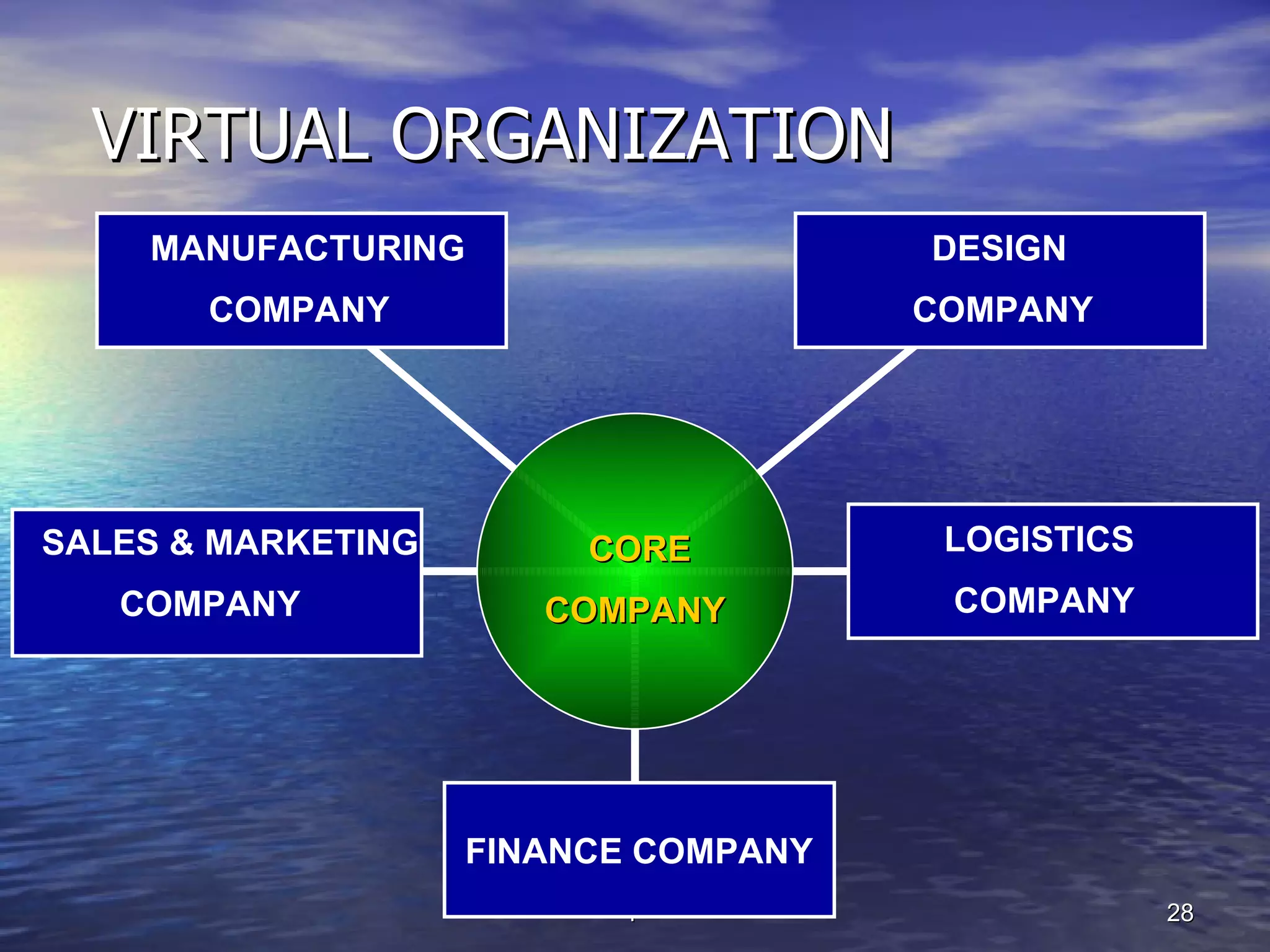
VIRTUAL ORGANIZATION SALES & MARKETING COMPANY   FINANCE COMPANY LOGISTICS COMPANY DESIGN COMPANY MANUFACTURING COMPANY CORE COMPANY
The changing management process (sections) Electronic commerce Electronic business Electronic market *
Electronic Market Exchange Information, Products, Services, and Payments Retail (exp. AllBook.com.tw) Wholesale (exp. ChinaSteel)
Electronic commerce Internet links buyers, sellers Lowers transaction costs Goods & services  advertised, bought, exchanged worldwide Business-to-business transactions  increasing *
Electronic business Intranet: business builds private, secure network E-mail, web documents, group software extends effective  communication &  control Virtual organization *
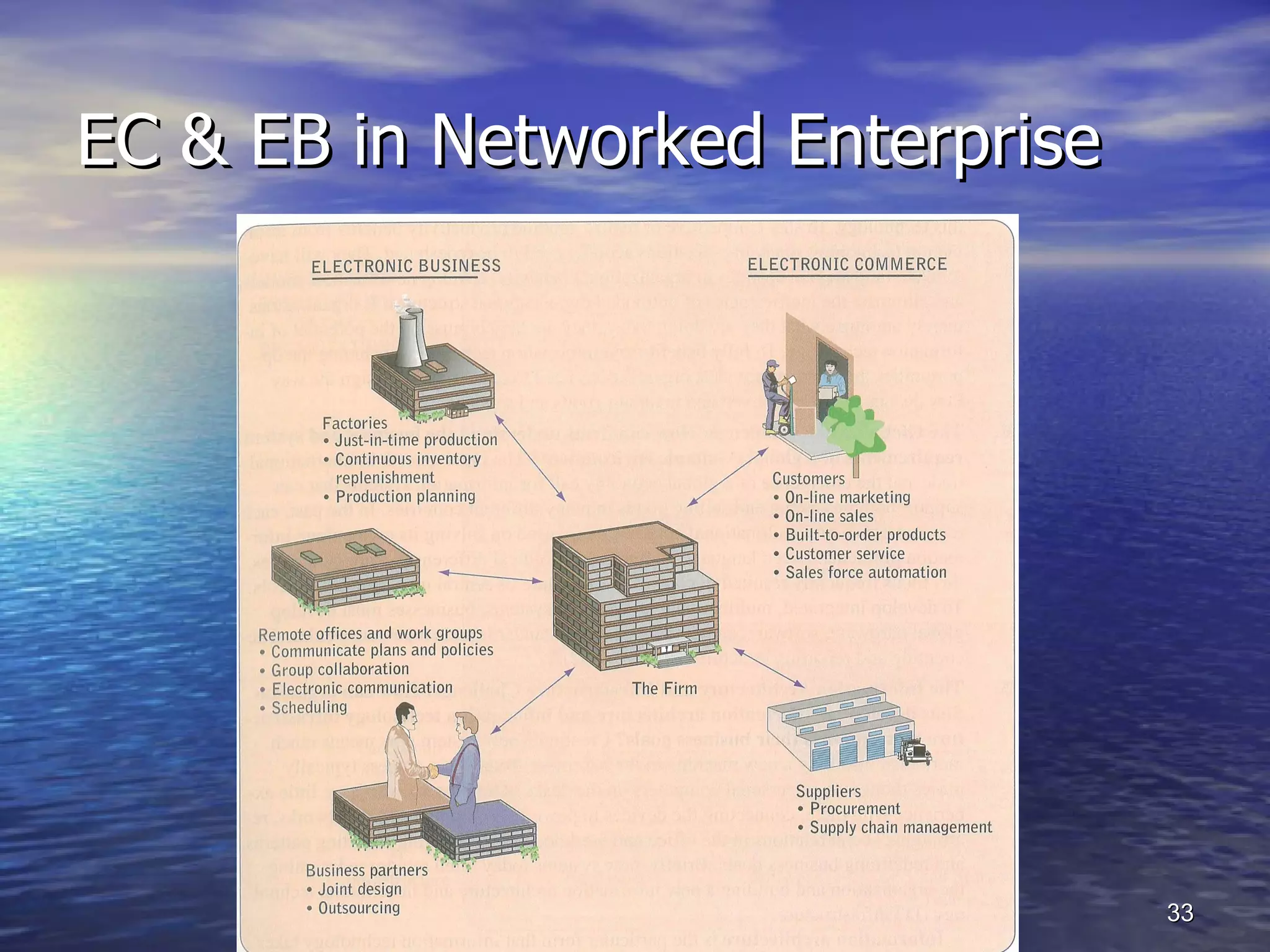
EC & EB in Networked Enterprise
Challenge of info systems Strategic: competitive & effective Globalization: multinational info Info architecture: support goals Investment: value of information Responsibility & control: ethics *
Connect to the INTERNET Laudon/Laudon Web site:  	http:// www.prenhall.com/laudon Additional Internet Resources related to this chapter: 	http://www.dell.com http://www.amazon.com   	http:// www.firstunion.com   http:// www.intel.com   	 http:// www.clemson.edu / http:// www.gatech.edu 	 http:// www.bath.ac.uk   http://www.intranet.com 	 http://www.ascusc.org/jcmc/vol1/issue1/index.html © 2001 Laudon & Laudon, Essentials of Management Information Systems 4/e
CHAPTER 1.  THE INFORMATION SYSTEMS REVOLUTION TRANSFORMING BUSINESS AND MANAGEMENT EXPOSITOR: M.Sc. Víctor Pando Beltrán [email_address]

Administración de Sistemas de Información

  • 1.
    CHAPTER 1. THE INFORMATION SYSTEMS REVOLUTION TRANSFORMING BUSINESS AND MANAGEMENT EXPOSITOR: M.Sc. Víctor Pando Beltrán [email_address]
  • 2.
    Learning objectives (#1)Define information systems COMPUTER LITERACY versus INFORMATION SYSTEMS LITERACY Explain impact of information systems on organization & management *
  • 3.
    Learning objectives (#2)Compare electronic commerce & electronic business, relationship to internet & digital technology Identify major management challenges to building, using information systems *
  • 4.
    Management challenges (Sections)Why information systems? Contemporary approaches to information systems New role of info systems in organizations Learning to use info systems: new opportunities with technology *
  • 5.
    Business Environment (sections)Globalization Industrial economies Transformation of the enterprise *
  • 6.
    Globalization Future SuccessFactor (Globalization) Management & control (IT) Competition in world markets Global work groups (SW Team) Global delivery systems (Real and Virtual) *
  • 7.
    Transformation of IndustrialEconomies Knowledge- (Info-) based economies Productivity (System Quality) New products & services Knowledge as an asset Time-based competition Shorter product life Turbulent environment Limited employee knowledge base *
  • 8.
    Transformation of enterpriseFlattening Decentralization Flexibility Location independence Low transaction costs Empowerment (Electric-Firms) Collaborative work *
  • 9.
    Knowledge- and information-intenseproducts Products that require a great deal of learning & knowledge to produce Employing Millions of People Optimize within Organization and Maximize Firm’s Knowledge Resources *
  • 10.
    LABOR FORCE COMPOSITION1900-1996 (Figure 1-1) Source: Laudon & Laudon 2000
  • 11.
    What is SYSTEM? INPUT OUTPUT PROCESS FEEDBACK
  • 12.
    FUNCTIONS OF ANINFORMATION SYSTEM (figure 1-3) ORGANIZATION INPUT OUTPUT PROCESS FEEDBACK INFORMATION SYSTEM ENVIRONMENT Customers Suppliers Regulatory Stockholders Competitors Agencies
  • 13.
    INFORMATION SYSTEMS (Figure1-4) ORGANIZATIONS TECHNOLOGY MANAGEMENT INFORMATION SYSTEMS
  • 14.
    Computer-based information systems (CBIS) Formal systems Fixed definitions of data, procedures Collecting, storing, processing, disseminating, using data *
  • 15.
    A Business Perspectiveon Information Systems Organizational and Management Solution, based on IT, posed by Env. Information Systems Literacy – Computer Literacy SOPs (Standard Operation Procedures)
  • 16.
    Major organizational functions(Table 1-2) Sales & marketing Manufacturing Finance Accounting Human resources *
  • 17.
    Computer technology HardwareSoftware Storage Communications Network *
  • 18.
    APPROACHES TO INFOSYSTEMS (#1) (Figure 1-5) COMPUTER SCIENCE OPERATIONS RESEARCH MANAGEMENT SCIENCE TECHNICAL APPROACHES BEHAVIORAL APPROACHES SOCIOLOGY POLITICAL SCIENCE PSYCHOLOGY MIS
  • 19.
    APPROACHES TO INFOSYSTEMS (#2) Techincal Approach Computer science Management Science Operations Research Behavioral Approaches Sociologists Psychologists Economists
  • 20.
    Sociotechnical perspective (#1)Optimize system performance: Technology & organization mutually adjust to one another Until fit is satisfactory * SOURCE: Liker, et al, 1987
  • 21.
    A Sociotechnical Perspectiveon IS (#2) (Figure 1-6)
  • 22.
    SYSTEM INTERDEPENDENCE BUSINESSStrategy Rules Procedures ORGANIZATION INFORMATION SYSTEM HARDWARE SOFTWARE DATABASE TELE-COMMUNICATIONS INTERDEPENDENCE
  • 23.
    1950s: TECHNICAL CHANGES60s-70s: MANAGERIAL CONTROL 80s-90s: INSTITUTIONAL CORE ACTIVITIES Growing importance * Scope of info systems
  • 24.
    Network Revolution &Internet Network Internet  Platform New Business Models
  • 25.
    What you cando on the internet Communicate & collaborate Access information Discuss Obtain information Entertainment Transact business *
  • 26.
    New options fororganizational design (sections) Flattening organizations Separating work from location Reorganizing work-flows Increasing flexibility Redefining organizational boundaries *
  • 27.
  • 28.
    VIRTUAL ORGANIZATION SALES& MARKETING COMPANY FINANCE COMPANY LOGISTICS COMPANY DESIGN COMPANY MANUFACTURING COMPANY CORE COMPANY
  • 29.
    The changing managementprocess (sections) Electronic commerce Electronic business Electronic market *
  • 30.
    Electronic Market ExchangeInformation, Products, Services, and Payments Retail (exp. AllBook.com.tw) Wholesale (exp. ChinaSteel)
  • 31.
    Electronic commerce Internetlinks buyers, sellers Lowers transaction costs Goods & services advertised, bought, exchanged worldwide Business-to-business transactions increasing *
  • 32.
    Electronic business Intranet:business builds private, secure network E-mail, web documents, group software extends effective communication & control Virtual organization *
  • 33.
    EC & EBin Networked Enterprise
  • 34.
    Challenge of infosystems Strategic: competitive & effective Globalization: multinational info Info architecture: support goals Investment: value of information Responsibility & control: ethics *
  • 35.
    Connect to theINTERNET Laudon/Laudon Web site: http:// www.prenhall.com/laudon Additional Internet Resources related to this chapter: http://www.dell.com http://www.amazon.com http:// www.firstunion.com http:// www.intel.com http:// www.clemson.edu / http:// www.gatech.edu http:// www.bath.ac.uk http://www.intranet.com http://www.ascusc.org/jcmc/vol1/issue1/index.html © 2001 Laudon & Laudon, Essentials of Management Information Systems 4/e
  • 36.
    CHAPTER 1. THE INFORMATION SYSTEMS REVOLUTION TRANSFORMING BUSINESS AND MANAGEMENT EXPOSITOR: M.Sc. Víctor Pando Beltrán [email_address]