Consumer & Business Buying
Behaviour
1
Road Map: Previewing the Concepts
• Understand the consumer market and the major factors
that influence consumer buyer behavior.
• Identify and discuss the stages in the buyer decision
process.
• Describe the adoption and diffusion process for new
products.
• Define the business market and identify the major
factors that influence business buyer behavior.
• List and define the steps in the business buying decision
process.
2
Consumer Buying Behavior
• Consumer Buying Behavior refers to the
buying behavior of final consumers -
individuals & households - who buy goods and
services for personal consumption.
• These final consumers make up the consumer
market.
• The central question for marketers is:
– “How do consumers respond to various marketing
efforts the company might use?”
3
Model of Buyer Behavior
4
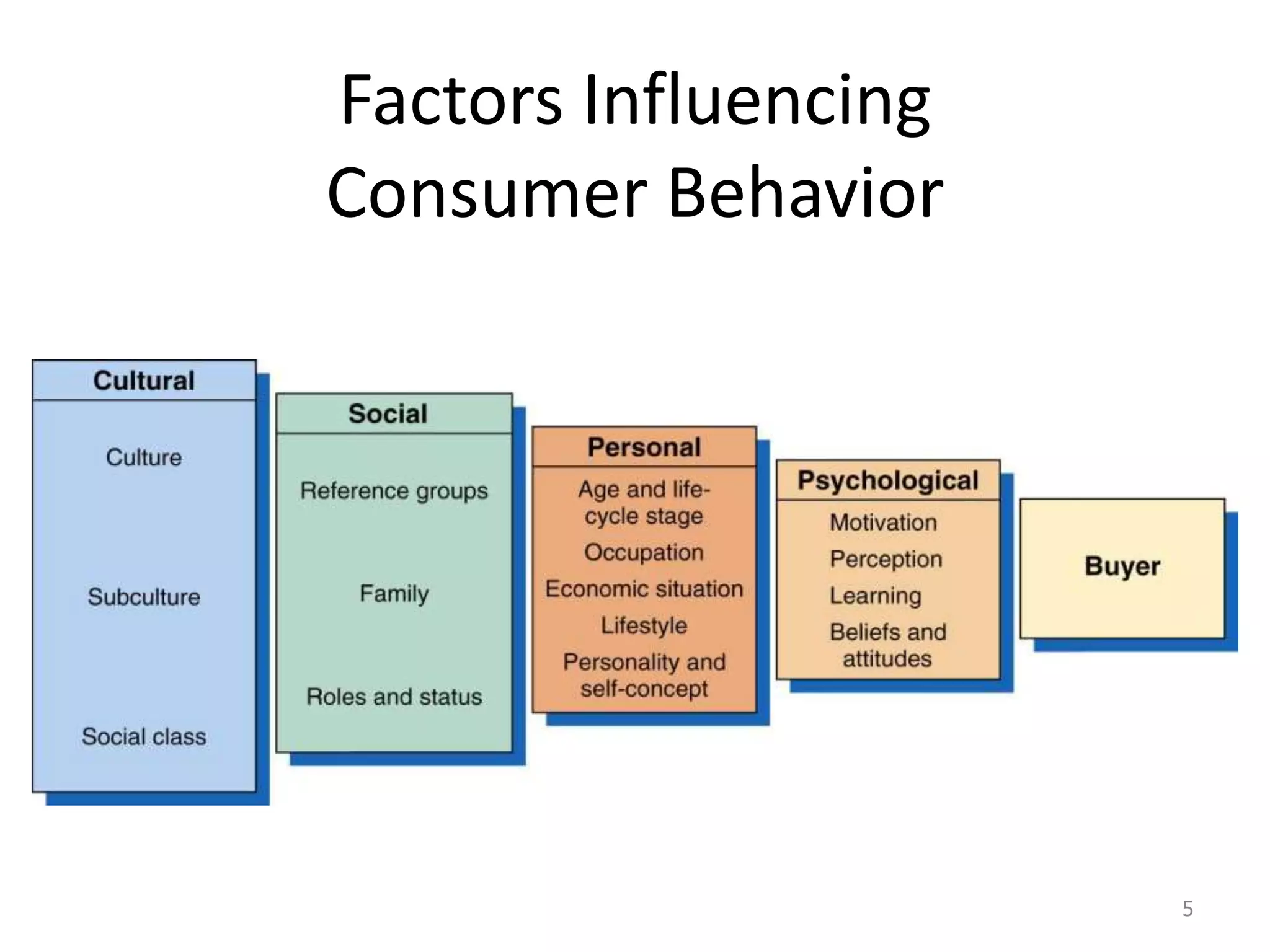
Factors Influencing
Consumer Behavior
5
Factors Affecting Consumer
Behavior: Culture
6
Subculture
• Groups of people with shared
value systems based on common
life experiences.
• AFRICAN CONSUMERS
• ASIAN CONSUMERS
• EUROPEAN CONSUMERS
• MATURE CONSUMERS
Culture is the Most Basic Cause of a Person's
Wants and Behavior.
Factors Affecting
Consumer Behavior:
Culture
Social Class
• Society’s relatively permanent
& ordered divisions whose
members share similar values,
interests, and behaviors.
• Measured by a Combination of:
Occupation, Income,
Education, Wealth and Other
Variables.
7
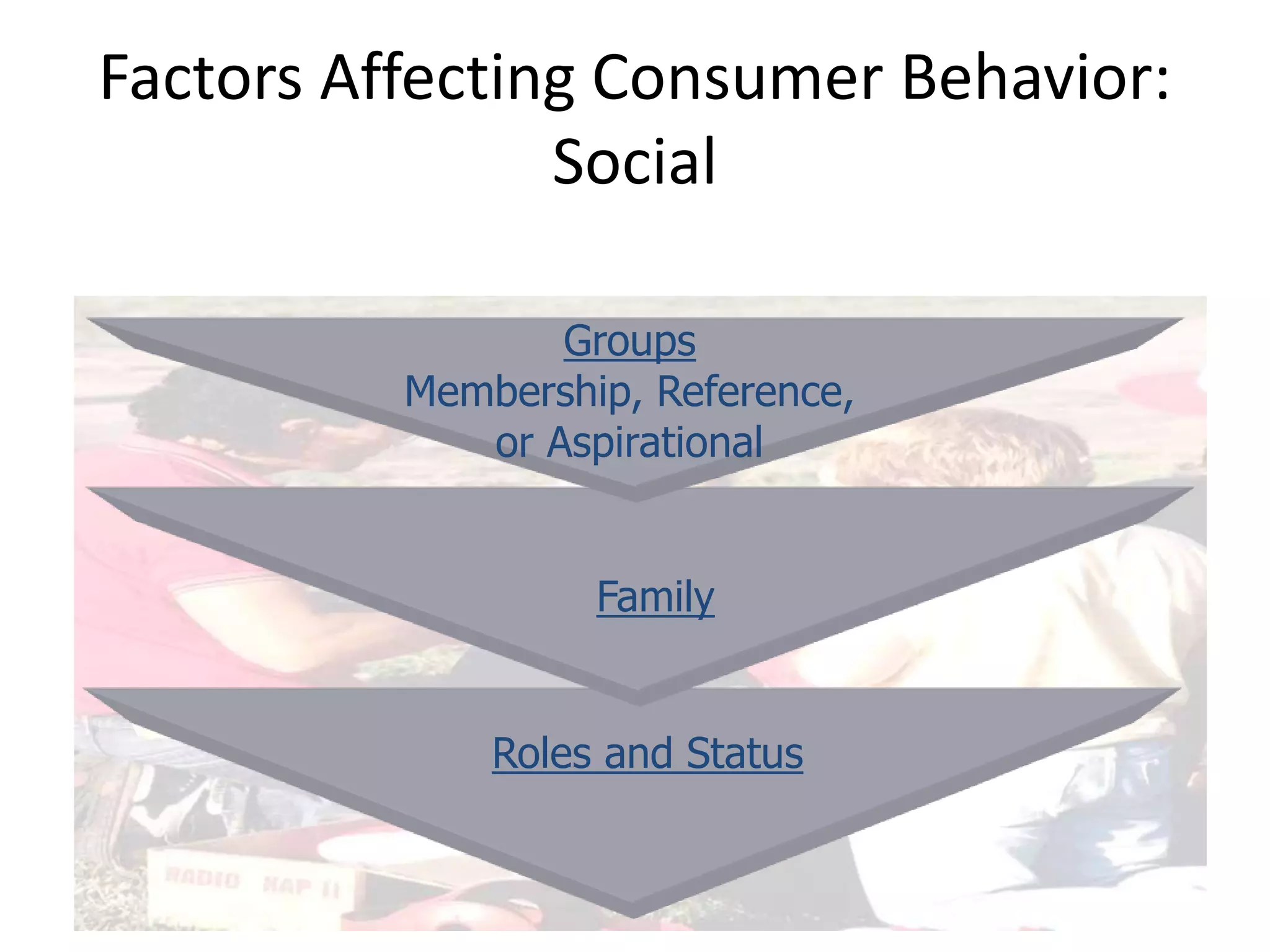
Factors Affecting Consumer Behavior:
Social
8
Roles and Status
Family
Groups
Membership, Reference,
or Aspirational
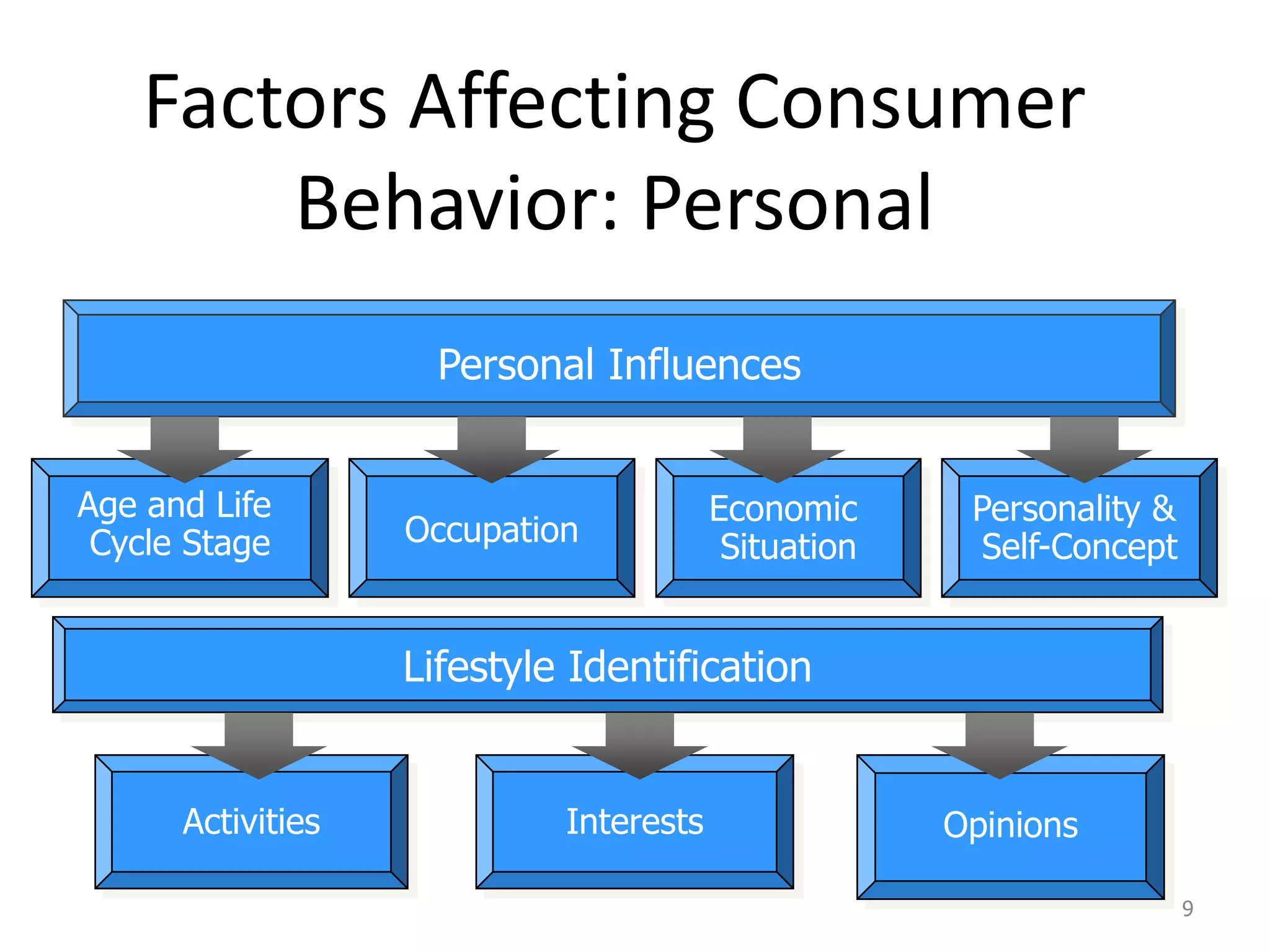
Factors Affecting Consumer
Behavior: Personal
9
Personal Influences
Age and Life
Cycle Stage Occupation
Personality &
Self-Concept
Economic
Situation
Activities Interests
Lifestyle Identification
Opinions
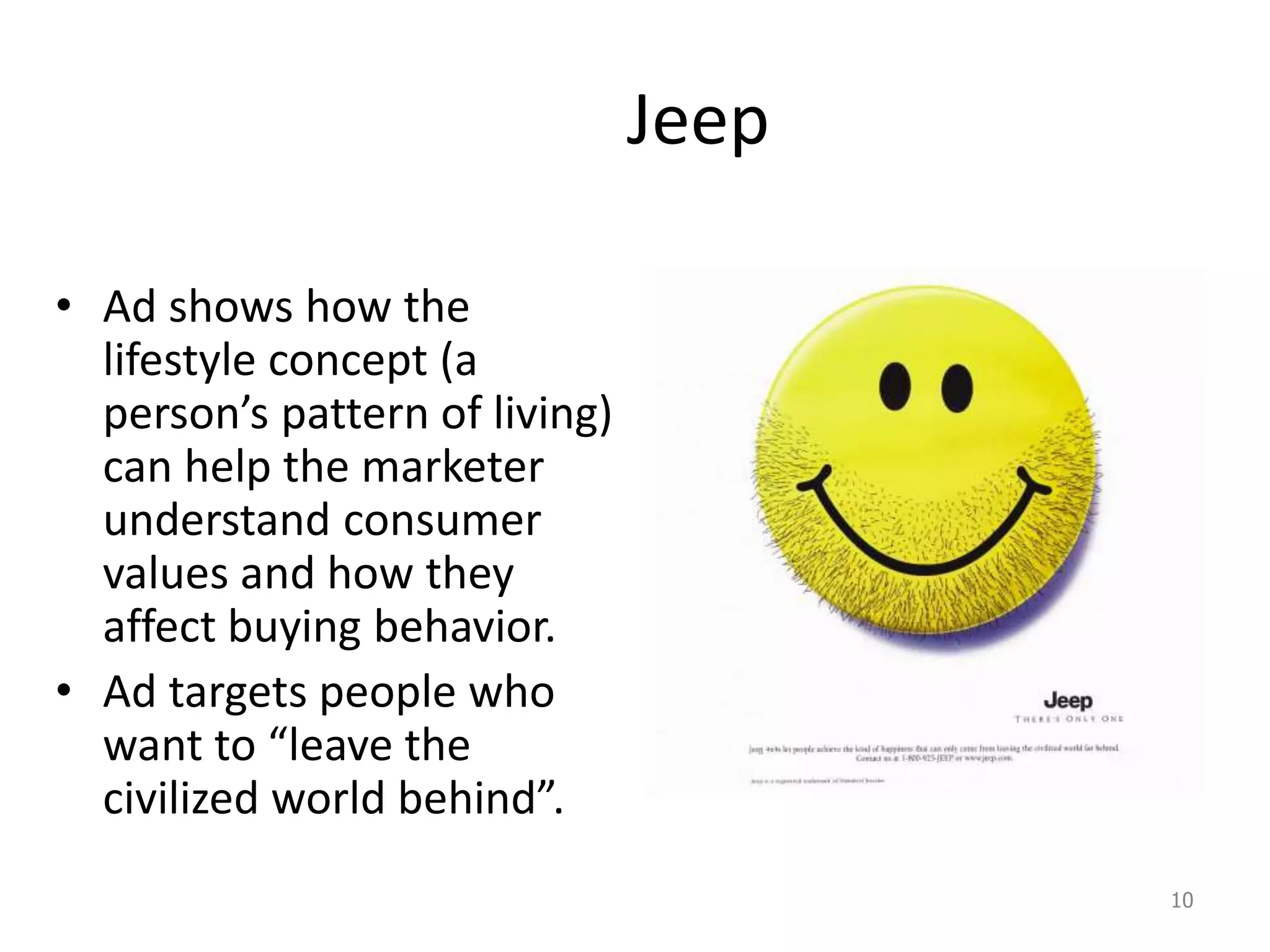
Jeep
• Ad shows how the
lifestyle concept (a
person’s pattern of living)
can help the marketer
understand consumer
values and how they
affect buying behavior.
• Ad targets people who
want to “leave the
civilized world behind”.
10
Factors Affecting Consumer Behavior:
Psychological
11
Psychological
Factors
Affecting
Buyers
Choices
Motivation
Perception
Learning
Beliefs and
Attitudes
Maslow’s Hierarchy of Needs
12
Buyer Decision Process
13
Buyer Decision Process
Step 1. Need Recognition
14
Internal Stimuli –
Hunger
External Stimuli-
Friends
Buyer
Recognizes
a
Problem
or a
Need
Arising
From:
The Buyer Decision Process
Step 2. Information Search
15
•Family, friends, neighbors
•Most effective source of
information
•Advertising, salespeople
•Receives the most information
from these sources
•Mass Media
•Consumer-rating groups
•Handling the product
•Examining the product
•Using the product
Personal Sources
Commercial Sources
Public Sources
Experiential Sources
The Buyer Decision Process
Step 4. Evaluation of Alternatives
16
Consumer May Use Careful
Calculations & Logical Thinking
Consumers May Buy on Impulse and
Rely on Intuition
Consumers May Make Buying Decisions
on Their Own
Consumers May Make Buying Decisions
Only After Consulting Others
Marketers Must Study Buyers to Find Out
How They Evaluate Brand Alternatives
The Buyer Decision Process
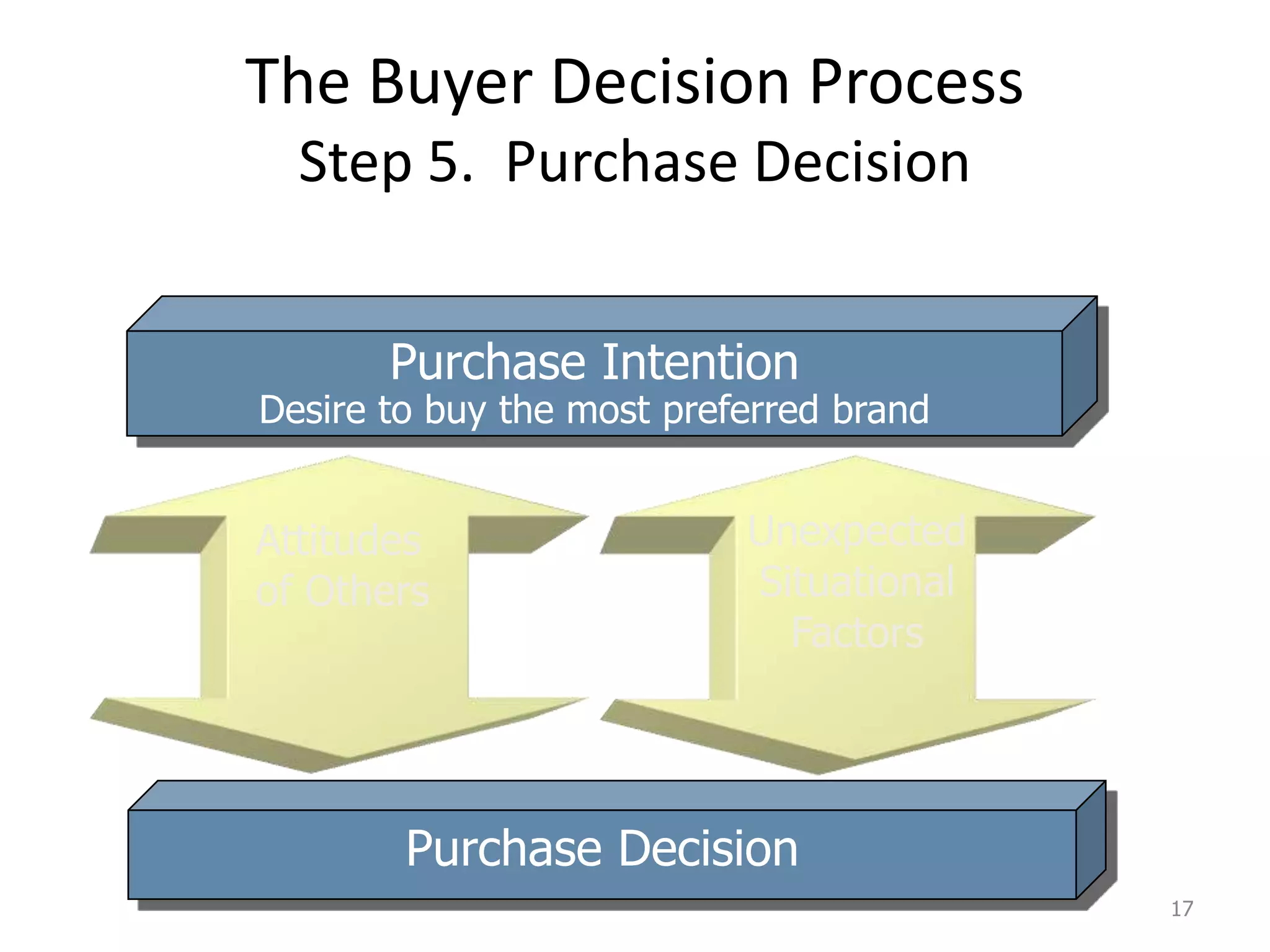
Step 5. Purchase Decision
17
Purchase Intention
Desire to buy the most preferred brand
Purchase Decision
Unexpected
Situational
Factors
Attitudes
of Others
The Buyer Decision Process
Step 6. Postpurchase Behavior
18
Consumer’s
Expectations of Product’s Performance
Product’s Perceived
Performance
Dissatisfied Customer
Satisfied Customer!
Cognitive
Dissonance
• Pair with the student on your right. Trace a
recent purchase each of you have made. Be
sure to examine each of the five stages of the
buyer decision process and detail your
experiences in each stage.
• What could the seller have done to make your
buying experience better?
19
Stages in the Adoption Process
• Awareness: Consumer becomes aware of the new
product, but lacks information about it.
• Interest: Consumer seeks information about new
product.
• Evaluation: Consumer considers whether trying the
new product makes sense.
• Trial: Consumer tries new product on a small scale
to improve his or her estimate of its value.
• Adoption: Consumer decides to make full and
regular use of the new product.
20
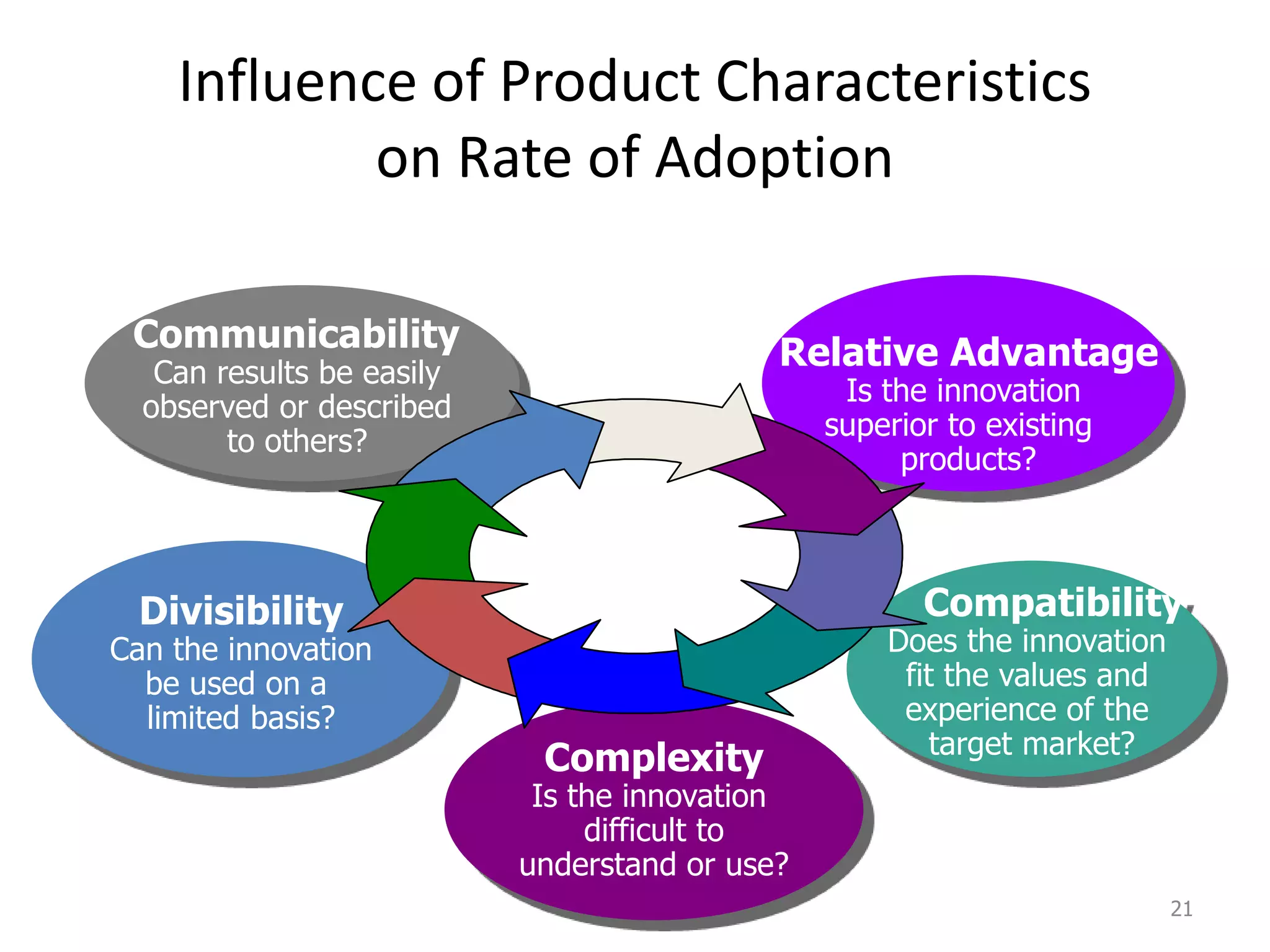
Influence of Product Characteristics
on Rate of Adoption
21
Divisibility
Can the innovation
be used on a
limited basis?
Complexity
Is the innovation
difficult to
understand or use?
Communicability
Can results be easily
observed or described
to others?
Compatibility
Does the innovation
fit the values and
experience of the
target market?
Relative Advantage
Is the innovation
superior to existing
products?
Characteristics of Business Markets
• Market Structure and
Demand
– Contain far fewer, but
larger buyers,
– Customers are more
geographically
concentrated,
– Business demand is
derived from final
consumer demand.
• Nature of the Buying
Unit
– Business purchases
involve more buyers.
– Business buying involves
a more professional
purchasing effort.
22
Characteristics of Business Markets
23
Business
buyers
usually
face more
complex
buying
decisions.
Business
buying
process is
more
formalized.
Types of Decisions and the
Decision Process
Buyers and
sellers are
more
dependent on
each other.
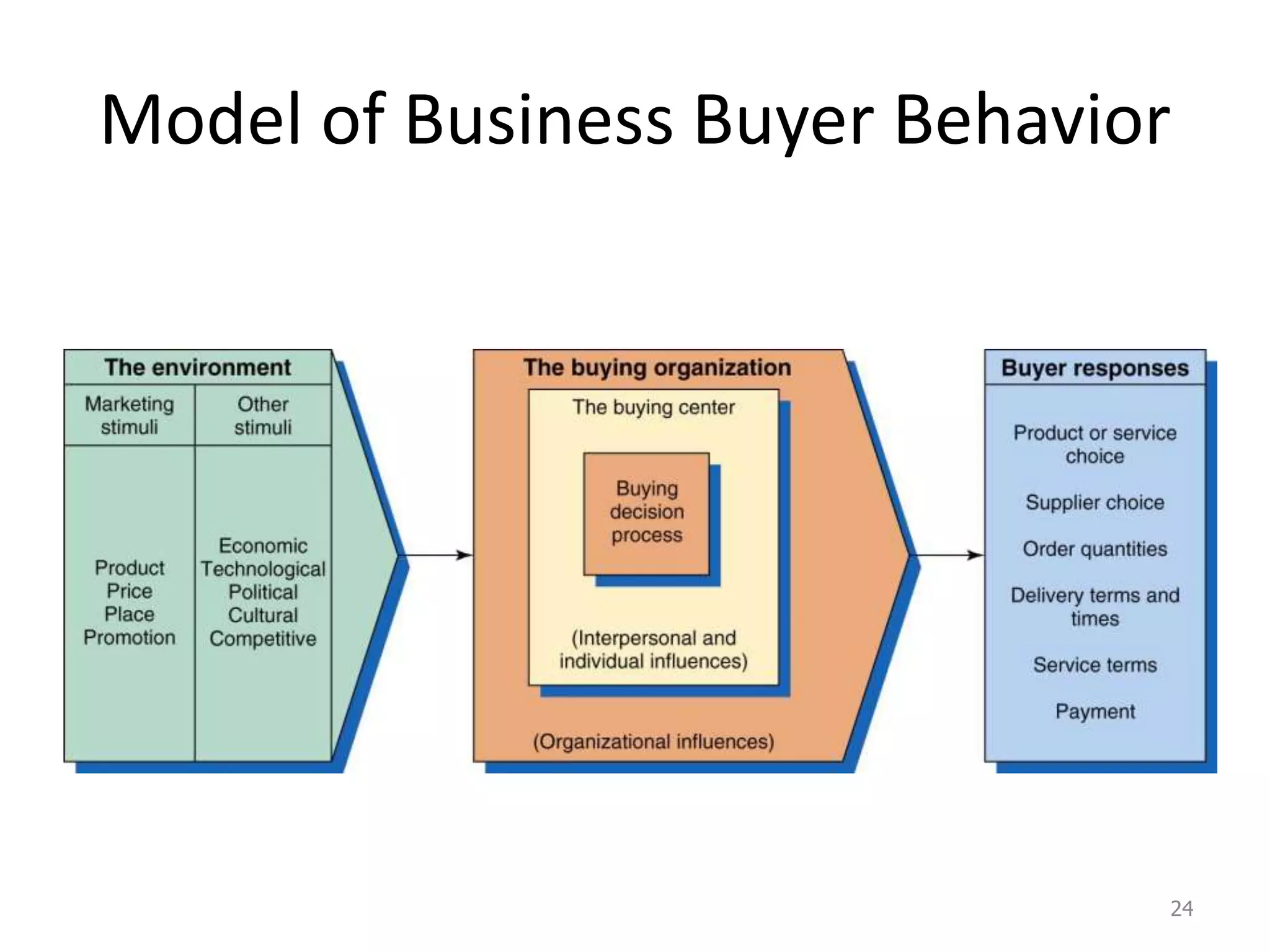
Model of Business Buyer Behavior
24
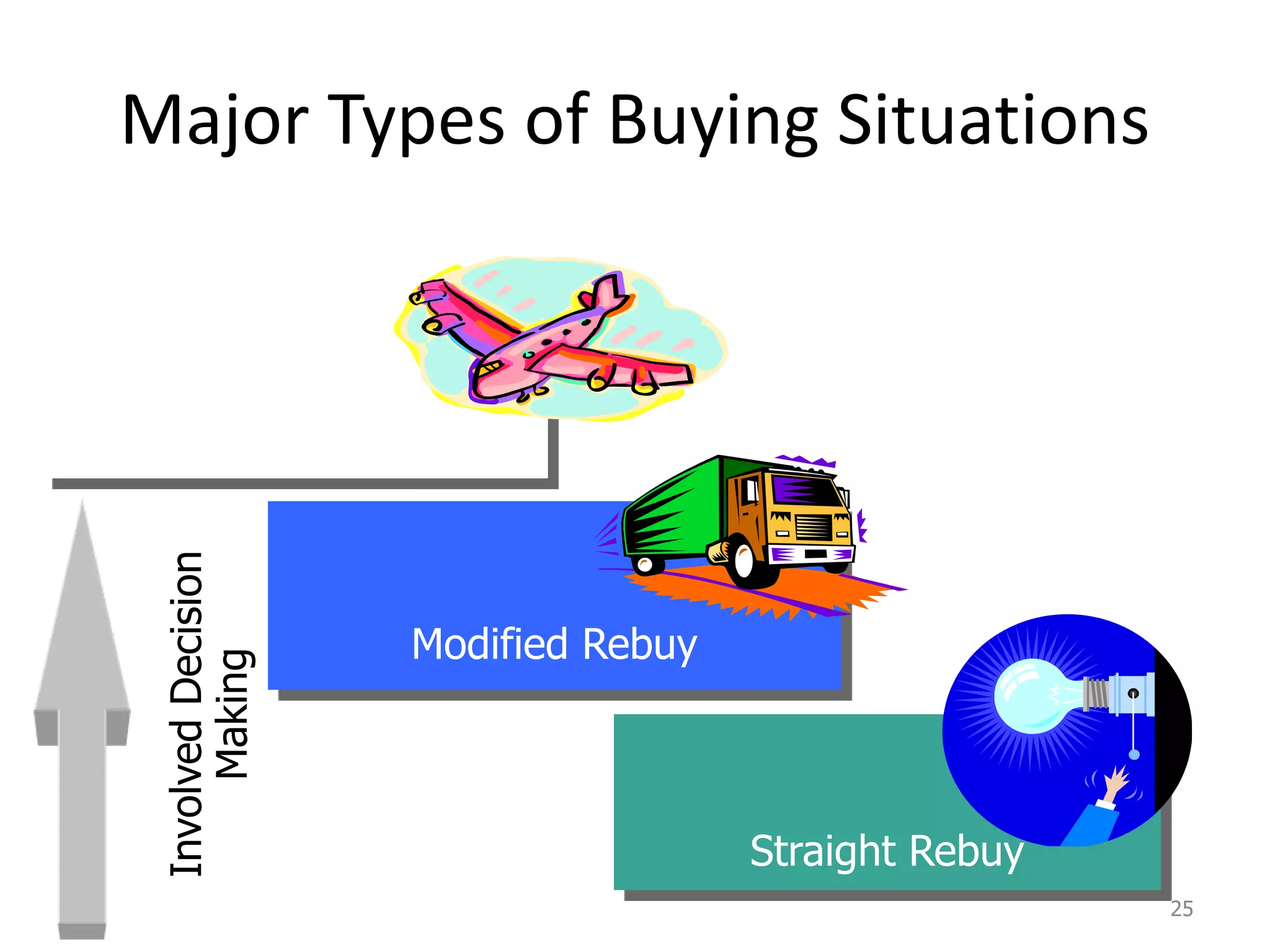
Major Types of Buying Situations
25
New Task Buying
Involved
Decision
Making
Modified Rebuy
Straight Rebuy
• Identify which of the major types of business
buying situations is represented by the
following:
– Chrysler’s purchase of computers that go in cars
and adjust engine performance to changing
driving conditions.
26
Participants in the Business Buying
Process
• Decision-making unit of a
buying organization is
called its buying center.
• Not a fixed and formally
identified unit.
• Will vary for different
products and buying
situations.
• Major challenge for the
marketer to find out:
– Who is part of the
decision?
– What decisions do they
influence?
– What is their relative
degree of influence?
– What evaluative criteria
does each decision
participant use?
27
Major Influences on Business Buyer
Behavior
28
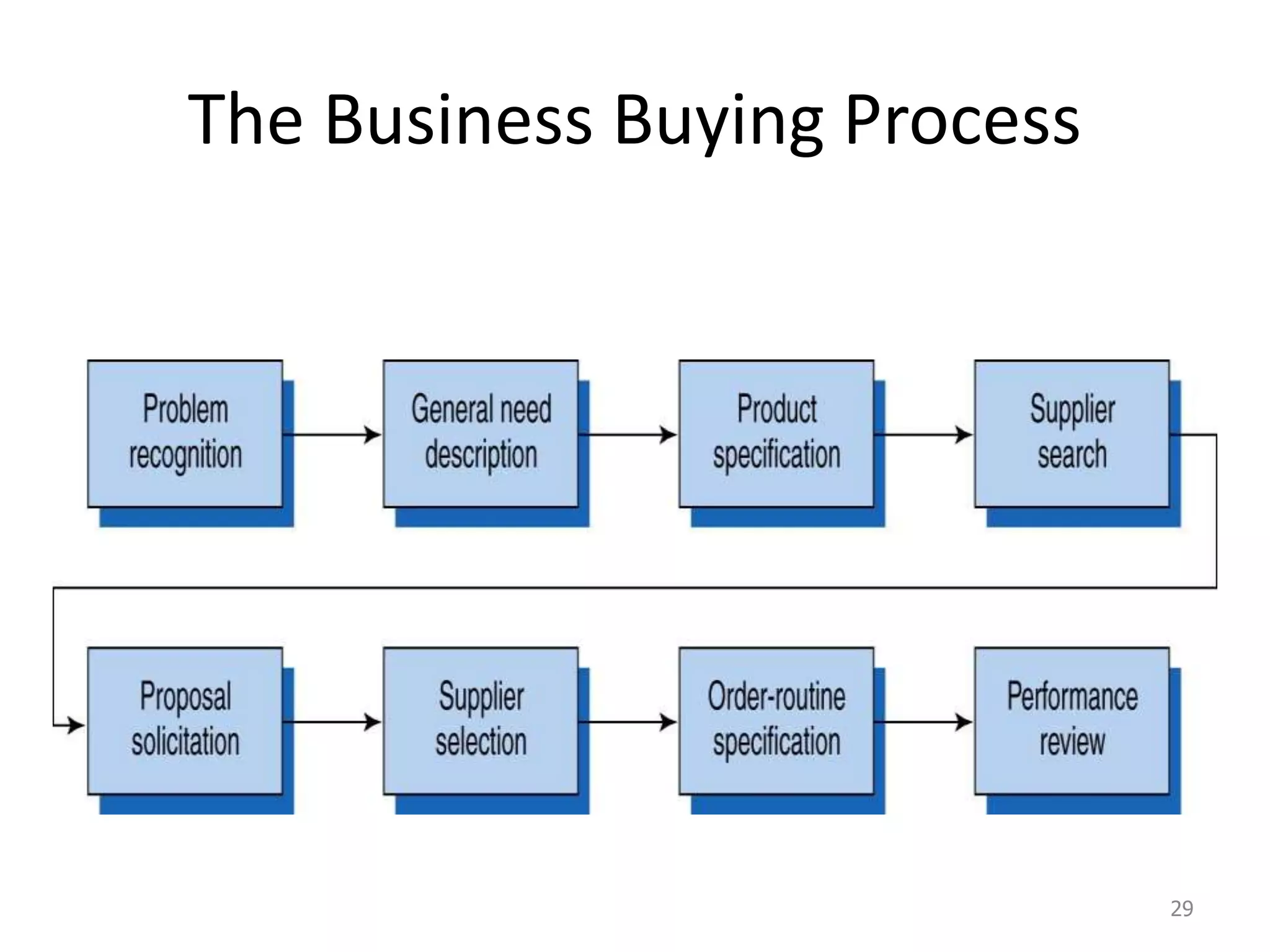
The Business Buying Process
29
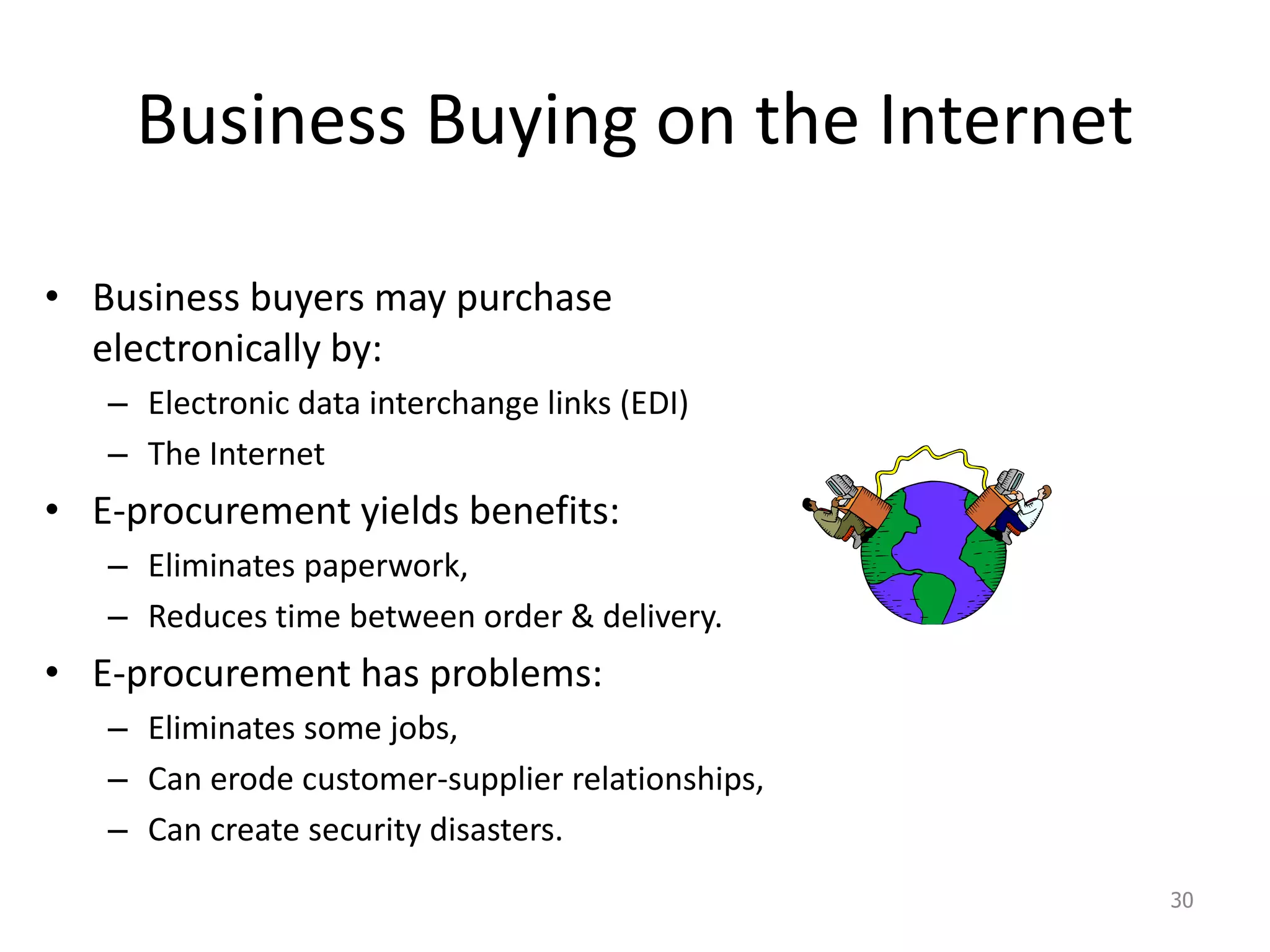
Business Buying on the Internet
• Business buyers may purchase
electronically by:
– Electronic data interchange links (EDI)
– The Internet
• E-procurement yields benefits:
– Eliminates paperwork,
– Reduces time between order & delivery.
• E-procurement has problems:
– Eliminates some jobs,
– Can erode customer-supplier relationships,
– Can create security disasters.
30
Road Map: Reviewing the Concepts
• Understand the consumer market and the major factors
that influence consumer buyer behavior.
• Identify and discuss the stages in the buyer decision
process.
• Describe the adoption and diffusion process for new
products.
• Define the business market and identify the major
factors that influence business buyer behavior.
• List and define the steps in the business buying decision
process.
31

Consumer behaviour

  • 1.
    Consumer & BusinessBuying Behaviour 1
  • 2.
    Road Map: Previewingthe Concepts • Understand the consumer market and the major factors that influence consumer buyer behavior. • Identify and discuss the stages in the buyer decision process. • Describe the adoption and diffusion process for new products. • Define the business market and identify the major factors that influence business buyer behavior. • List and define the steps in the business buying decision process. 2
  • 3.
    Consumer Buying Behavior •Consumer Buying Behavior refers to the buying behavior of final consumers - individuals & households - who buy goods and services for personal consumption. • These final consumers make up the consumer market. • The central question for marketers is: – “How do consumers respond to various marketing efforts the company might use?” 3
  • 4.
    Model of BuyerBehavior 4
  • 5.
  • 6.
    Factors Affecting Consumer Behavior:Culture 6 Subculture • Groups of people with shared value systems based on common life experiences. • AFRICAN CONSUMERS • ASIAN CONSUMERS • EUROPEAN CONSUMERS • MATURE CONSUMERS Culture is the Most Basic Cause of a Person's Wants and Behavior.
  • 7.
    Factors Affecting Consumer Behavior: Culture SocialClass • Society’s relatively permanent & ordered divisions whose members share similar values, interests, and behaviors. • Measured by a Combination of: Occupation, Income, Education, Wealth and Other Variables. 7
  • 8.
    Factors Affecting ConsumerBehavior: Social 8 Roles and Status Family Groups Membership, Reference, or Aspirational
  • 9.
    Factors Affecting Consumer Behavior:Personal 9 Personal Influences Age and Life Cycle Stage Occupation Personality & Self-Concept Economic Situation Activities Interests Lifestyle Identification Opinions
  • 10.
    Jeep • Ad showshow the lifestyle concept (a person’s pattern of living) can help the marketer understand consumer values and how they affect buying behavior. • Ad targets people who want to “leave the civilized world behind”. 10
  • 11.
    Factors Affecting ConsumerBehavior: Psychological 11 Psychological Factors Affecting Buyers Choices Motivation Perception Learning Beliefs and Attitudes
  • 12.
  • 13.
  • 14.
    Buyer Decision Process Step1. Need Recognition 14 Internal Stimuli – Hunger External Stimuli- Friends Buyer Recognizes a Problem or a Need Arising From:
  • 15.
    The Buyer DecisionProcess Step 2. Information Search 15 •Family, friends, neighbors •Most effective source of information •Advertising, salespeople •Receives the most information from these sources •Mass Media •Consumer-rating groups •Handling the product •Examining the product •Using the product Personal Sources Commercial Sources Public Sources Experiential Sources
  • 16.
    The Buyer DecisionProcess Step 4. Evaluation of Alternatives 16 Consumer May Use Careful Calculations & Logical Thinking Consumers May Buy on Impulse and Rely on Intuition Consumers May Make Buying Decisions on Their Own Consumers May Make Buying Decisions Only After Consulting Others Marketers Must Study Buyers to Find Out How They Evaluate Brand Alternatives
  • 17.
    The Buyer DecisionProcess Step 5. Purchase Decision 17 Purchase Intention Desire to buy the most preferred brand Purchase Decision Unexpected Situational Factors Attitudes of Others
  • 18.
    The Buyer DecisionProcess Step 6. Postpurchase Behavior 18 Consumer’s Expectations of Product’s Performance Product’s Perceived Performance Dissatisfied Customer Satisfied Customer! Cognitive Dissonance
  • 19.
    • Pair withthe student on your right. Trace a recent purchase each of you have made. Be sure to examine each of the five stages of the buyer decision process and detail your experiences in each stage. • What could the seller have done to make your buying experience better? 19
  • 20.
    Stages in theAdoption Process • Awareness: Consumer becomes aware of the new product, but lacks information about it. • Interest: Consumer seeks information about new product. • Evaluation: Consumer considers whether trying the new product makes sense. • Trial: Consumer tries new product on a small scale to improve his or her estimate of its value. • Adoption: Consumer decides to make full and regular use of the new product. 20
  • 21.
    Influence of ProductCharacteristics on Rate of Adoption 21 Divisibility Can the innovation be used on a limited basis? Complexity Is the innovation difficult to understand or use? Communicability Can results be easily observed or described to others? Compatibility Does the innovation fit the values and experience of the target market? Relative Advantage Is the innovation superior to existing products?
  • 22.
    Characteristics of BusinessMarkets • Market Structure and Demand – Contain far fewer, but larger buyers, – Customers are more geographically concentrated, – Business demand is derived from final consumer demand. • Nature of the Buying Unit – Business purchases involve more buyers. – Business buying involves a more professional purchasing effort. 22
  • 23.
    Characteristics of BusinessMarkets 23 Business buyers usually face more complex buying decisions. Business buying process is more formalized. Types of Decisions and the Decision Process Buyers and sellers are more dependent on each other.
  • 24.
    Model of BusinessBuyer Behavior 24
  • 25.
    Major Types ofBuying Situations 25 New Task Buying Involved Decision Making Modified Rebuy Straight Rebuy
  • 26.
    • Identify whichof the major types of business buying situations is represented by the following: – Chrysler’s purchase of computers that go in cars and adjust engine performance to changing driving conditions. 26
  • 27.
    Participants in theBusiness Buying Process • Decision-making unit of a buying organization is called its buying center. • Not a fixed and formally identified unit. • Will vary for different products and buying situations. • Major challenge for the marketer to find out: – Who is part of the decision? – What decisions do they influence? – What is their relative degree of influence? – What evaluative criteria does each decision participant use? 27
  • 28.
    Major Influences onBusiness Buyer Behavior 28
  • 29.
  • 30.
    Business Buying onthe Internet • Business buyers may purchase electronically by: – Electronic data interchange links (EDI) – The Internet • E-procurement yields benefits: – Eliminates paperwork, – Reduces time between order & delivery. • E-procurement has problems: – Eliminates some jobs, – Can erode customer-supplier relationships, – Can create security disasters. 30
  • 31.
    Road Map: Reviewingthe Concepts • Understand the consumer market and the major factors that influence consumer buyer behavior. • Identify and discuss the stages in the buyer decision process. • Describe the adoption and diffusion process for new products. • Define the business market and identify the major factors that influence business buyer behavior. • List and define the steps in the business buying decision process. 31