The process of
making
decision
Workshop 5
5th of March 2014
An analysis by:
Claude Dorliat
David José Espitia
Andres Montealegre
Jose Miguel Peaa
Carolina Pereira
Products
Workshop Objective
Register the decision making
process of consumers.
“ ”
Coat
as garment product
TV set
as electric appliance product
Method
In-depth interviews to three
different consumer targets.
“ ”
Interviewed panel
Interviewee 1
Age: 24
Job: student and teacher
Gender: male
Social status: 6
Interviewee 2
Age: 48
Job: housewife
Gender: female
Social status: 6
Interviewee 3
Age: 56
Job: lawyer
Gender: male
Social status: 6
Deep description of the decision process
Need recognition
Discrepancy between actual
and ideal state
Search of information
External Sources
Internal Sources
Choice
Post-purchase Evaluation
Evaluation
Decisionmakingprocess
The iterative way consumers decide how,
when and what products to buy.
Cognitive-based decisions
Affective-based decisions
Feedback and Satisfaction
Heuristics
Algorithms
Analysis
and
Results
Comparing the
decision making process
Interviewee 1
24 year old man
Interviewee 2
48 year old woman
Fashion
Protection from weather
Interviewee 3
56 year old man
Protection from weather Being well dressed
Fill the room
Decoration
Entertainment
Information
Entertainment
Information
Need Recognition
Entertainment
Information
Decoration
Hedonic Need
Utalitarian Need
Protection from weather
Being well dressed
Utilitarian Need
Symbolic Need
Long-Term purchase
Short-term Purchase
Need Recognition
Interviewee 1
24 year old man
Interviewee 2
48 year old woman
Magazines, Tunways,
Boutiques, Friends,
Experience
Interviewee 3
56 year old man
Store, Trying on clothes,
Previous experience
Store, Trying on clothes,
Previous experience
Internet First on Internet and then
with a Proffesional.
Previous experience
Friends and consumers
Internet
Precious experience
Source of Information
TV
Previous experience with brand
(Tradition, reliability, familiarity)
Internal Source
External Source Objective, High quality information
(Store, professionals, internet, family
and friends)
Coat
Internal Source
External Source
Previous experience with brand
(Tradition, reliability, familiarity)
Objective, High quality information
(Store, magazines, boutiques)
Source of Information
TV
Previous experience with brand
(Tradition, reliability, familiarity)
Internal Source
External Source Objective, High quality information
(Store, professionals, internet, family
and friends)
Coat
Internal Source
External Source
Previous experience with brand
(Tradition, reliability, familiarity)
Objective, High quality information
(Store, magazines, boutiques)
WHY?
Perceived Risk
- Financial Risk
- Performance Risk
- Risk Aversion
WHY?
Perceived Risk
- Financial Risk
- Performance Risk
- Risk Aversion
Degree of Expertise
Knowledge External Sources
WHY?
Perceived Risk
- Financial Risk
- Performance Risk
- Risk Aversion
Degree of Expertise
Knowledge External Sources
Involvement
Involvement External Sources
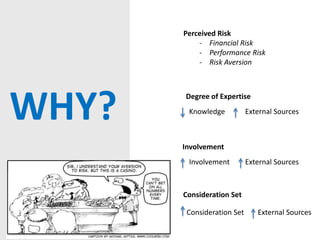
WHY?
Perceived Risk
- Financial Risk
- Performance Risk
- Risk Aversion
Degree of Expertise
Knowledge External Sources
Involvement
Involvement External Sources
Consideration Set
Consideration Set External Sources
Bounded Rationality
- Incomplete or imperfect information
- Cognitive Processing Capacity
Evaluation of
Alternatives
Heuristics
- Availability: basing judgments on events
that are easier to recall.
- Representativeness: making a judgment
by simply comparing a stimulus with the
category prototype or exemplar
Interviewee 1
24 year old man
Interviewee 2
48 year old woman
None
Interviewee 3
56 year old man
None None
Availability and
Representativeness
Evaluation of Alternatives
Algorithms
Availability and
Representativeness
Availability and
RepresentativenessHeuristics
Interviewee 1
24 year old man
Interviewee 2
48 year old woman
None
Interviewee 3
56 year old man
Availability and
Representativeness
Evaluation of Alternatives
Algorithms
Availability
(Brand Loyalty)
Availability and
RepresentativenessHeuristics
“I first search on Internet
for the product, compare
brands, go to the store,
receive help form specialist,
look at the product in real
life and buy it”
“I visits the general store,
examine all brands, go to
specialized stores I
consider best, search for
word of mouth information
and look in the Internet“
Choice
Cognitive Decision Models
- By brand or attribute at a given time
- Whether compensatory or non-compensatory
Compensatory Non-Compensatory
By Brand MAUT Conjunctive/Disjunctuve
By Attribute Additive Difference
Weighted Additive
Difference
Lexicographic
Elimination by aspects
Take the best
Choice
Cognitive Decision Models
- By brand or attribute at the same time
- Whether compensatory or non-compensatory
- Compensatory: a mental cost benefit analysis in which negative features
can be compensated by positive ones.
- Noncompensatory:a simple decision model in which negative information
leads to rejection of the option.
- Multi-attribute Model: consumer focus on brands but face tradeoffs
between conflicting attributes.
- Disjunctive: a non compensatory model that sets acceptable cutoffs to
find options that are good
Interviewee 1
24 year old man
Interviewee 2
48 year old woman
Interviewee 3
56 year old man
Choice
Brand and attributes
Cognitive processing
Brand
Cognitive processing
Brand
Cognitive processing
Brand and multi-attributes
Cognitive processing
Brand and multi-attributes
Cognitive processing
Brand disjunctive
Cognitive processing
Satisfaction
Importance of Feedback
- Determining and facilitating future decision processes
Related to Satisfaction
- Use of internal sources  previous experience
- Use of external sources  reduce risk
- Heuristics  not necessarily lead to biases
If dissatisfied
- Return or change product
- Buy a alternative or similar brand
• Decision process varies according to the product and the consumer
• Individual differences (personal interests and goals) may explain
discrepancies in the process
• Commonalities:
• Needs being satisfied
• Use of primarily external sources
• Use of heuristics
• Differences:
• Cognitive choice rules
• Product attributes considered
• All consumers appeared to be processing by brand, they differed
regarding the compensatory or non-compensatory processing of
attributes.
Conclusions
Marketing strategies and recommendations
Coat
TV
1) Lots of information regarding
product characteristics.
1) Present information consistently
across different media.
1) Word of mouth  potential target
for marketing strategies to spread
information of product
characteristics.
Marketing strategies and recommendations
Coat
TV
4) Emphasize the brand’s tradition,
reliability and quality.
5) Emphasize positive consumption
experiences through advertising
(availability heuristic).
6) Brand that does not dominate the
TV market  present itself as similar
to the category prototype.
7) Product as the perfect tradeoff
between price and quality
Any
questions ?
Thank you
Workshop 5
5th of March 2014
An analysis by:
Claude Dorliat
David José Espitia
Andres Montealegre
Jose Miguel Peaa
Carolina Pereira

Workshop 5 - Consumer Decision Making Process

  • 1.
    The process of making decision Workshop5 5th of March 2014 An analysis by: Claude Dorliat David José Espitia Andres Montealegre Jose Miguel Peaa Carolina Pereira
  • 2.
    Products Workshop Objective Register thedecision making process of consumers. “ ” Coat as garment product TV set as electric appliance product Method In-depth interviews to three different consumer targets. “ ”
  • 3.
    Interviewed panel Interviewee 1 Age:24 Job: student and teacher Gender: male Social status: 6 Interviewee 2 Age: 48 Job: housewife Gender: female Social status: 6 Interviewee 3 Age: 56 Job: lawyer Gender: male Social status: 6
  • 4.
    Deep description ofthe decision process Need recognition Discrepancy between actual and ideal state Search of information External Sources Internal Sources Choice Post-purchase Evaluation Evaluation Decisionmakingprocess The iterative way consumers decide how, when and what products to buy. Cognitive-based decisions Affective-based decisions Feedback and Satisfaction Heuristics Algorithms
  • 5.
  • 6.
    Interviewee 1 24 yearold man Interviewee 2 48 year old woman Fashion Protection from weather Interviewee 3 56 year old man Protection from weather Being well dressed Fill the room Decoration Entertainment Information Entertainment Information Need Recognition
  • 7.
    Entertainment Information Decoration Hedonic Need Utalitarian Need Protectionfrom weather Being well dressed Utilitarian Need Symbolic Need Long-Term purchase Short-term Purchase Need Recognition
  • 8.
    Interviewee 1 24 yearold man Interviewee 2 48 year old woman Magazines, Tunways, Boutiques, Friends, Experience Interviewee 3 56 year old man Store, Trying on clothes, Previous experience Store, Trying on clothes, Previous experience Internet First on Internet and then with a Proffesional. Previous experience Friends and consumers Internet Precious experience Source of Information
  • 9.
    Source of Information TV Previousexperience with brand (Tradition, reliability, familiarity) Internal Source External Source Objective, High quality information (Store, professionals, internet, family and friends) Coat Internal Source External Source Previous experience with brand (Tradition, reliability, familiarity) Objective, High quality information (Store, magazines, boutiques)
  • 10.
    Source of Information TV Previousexperience with brand (Tradition, reliability, familiarity) Internal Source External Source Objective, High quality information (Store, professionals, internet, family and friends) Coat Internal Source External Source Previous experience with brand (Tradition, reliability, familiarity) Objective, High quality information (Store, magazines, boutiques)
  • 11.
    WHY? Perceived Risk - FinancialRisk - Performance Risk - Risk Aversion
  • 12.
    WHY? Perceived Risk - FinancialRisk - Performance Risk - Risk Aversion Degree of Expertise Knowledge External Sources
  • 13.
    WHY? Perceived Risk - FinancialRisk - Performance Risk - Risk Aversion Degree of Expertise Knowledge External Sources Involvement Involvement External Sources
  • 14.
    WHY? Perceived Risk - FinancialRisk - Performance Risk - Risk Aversion Degree of Expertise Knowledge External Sources Involvement Involvement External Sources Consideration Set Consideration Set External Sources
  • 15.
    Bounded Rationality - Incompleteor imperfect information - Cognitive Processing Capacity Evaluation of Alternatives Heuristics - Availability: basing judgments on events that are easier to recall. - Representativeness: making a judgment by simply comparing a stimulus with the category prototype or exemplar
  • 16.
    Interviewee 1 24 yearold man Interviewee 2 48 year old woman None Interviewee 3 56 year old man None None Availability and Representativeness Evaluation of Alternatives Algorithms Availability and Representativeness Availability and RepresentativenessHeuristics
  • 17.
    Interviewee 1 24 yearold man Interviewee 2 48 year old woman None Interviewee 3 56 year old man Availability and Representativeness Evaluation of Alternatives Algorithms Availability (Brand Loyalty) Availability and RepresentativenessHeuristics “I first search on Internet for the product, compare brands, go to the store, receive help form specialist, look at the product in real life and buy it” “I visits the general store, examine all brands, go to specialized stores I consider best, search for word of mouth information and look in the Internet“
  • 18.
    Choice Cognitive Decision Models -By brand or attribute at a given time - Whether compensatory or non-compensatory Compensatory Non-Compensatory By Brand MAUT Conjunctive/Disjunctuve By Attribute Additive Difference Weighted Additive Difference Lexicographic Elimination by aspects Take the best
  • 19.
    Choice Cognitive Decision Models -By brand or attribute at the same time - Whether compensatory or non-compensatory - Compensatory: a mental cost benefit analysis in which negative features can be compensated by positive ones. - Noncompensatory:a simple decision model in which negative information leads to rejection of the option. - Multi-attribute Model: consumer focus on brands but face tradeoffs between conflicting attributes. - Disjunctive: a non compensatory model that sets acceptable cutoffs to find options that are good
  • 20.
    Interviewee 1 24 yearold man Interviewee 2 48 year old woman Interviewee 3 56 year old man Choice Brand and attributes Cognitive processing Brand Cognitive processing Brand Cognitive processing Brand and multi-attributes Cognitive processing Brand and multi-attributes Cognitive processing Brand disjunctive Cognitive processing
  • 21.
    Satisfaction Importance of Feedback -Determining and facilitating future decision processes Related to Satisfaction - Use of internal sources  previous experience - Use of external sources  reduce risk - Heuristics  not necessarily lead to biases If dissatisfied - Return or change product - Buy a alternative or similar brand
  • 22.
    • Decision processvaries according to the product and the consumer • Individual differences (personal interests and goals) may explain discrepancies in the process • Commonalities: • Needs being satisfied • Use of primarily external sources • Use of heuristics • Differences: • Cognitive choice rules • Product attributes considered • All consumers appeared to be processing by brand, they differed regarding the compensatory or non-compensatory processing of attributes. Conclusions
  • 23.
    Marketing strategies andrecommendations Coat TV 1) Lots of information regarding product characteristics. 1) Present information consistently across different media. 1) Word of mouth  potential target for marketing strategies to spread information of product characteristics.
  • 24.
    Marketing strategies andrecommendations Coat TV 4) Emphasize the brand’s tradition, reliability and quality. 5) Emphasize positive consumption experiences through advertising (availability heuristic). 6) Brand that does not dominate the TV market  present itself as similar to the category prototype. 7) Product as the perfect tradeoff between price and quality
  • 25.
    Any questions ? Thank you Workshop5 5th of March 2014 An analysis by: Claude Dorliat David José Espitia Andres Montealegre Jose Miguel Peaa Carolina Pereira