June 28, 2005. Call in at 12:55 p.m. Eastern Time Mark Dixon Bünger  Claire Schooley Principal Analyst  Senior Analyst Forrester Research ForrTel: eLearning For Auto Retail Success
Theme Fast, efficient learning is good for business
Agenda Drivers for learning online or with mixed media Costs of using non-traditional learning approaches Technology required and benefits Case Studies: AutoNation, Toyota, and Volvo Construction Equipment Business case development  Some vendors in the eLearning space
Auto retail needs to get smarter every day . . . New products New promotions Sales techniques Legal and regulatory requirements Customer service Maintenance, diagnostics, and warranty
. . . for thousands of current and new employees Auto dealerships employ 1,129,600 employees* Turnover averages 92% annually, highest in sales† Tech retirements increasing; 12,000-35,000 new mechanics needed annually (of 820k total)‡ * Source: NADA Data 2005 †   Source: CNW 2001 ‡  Sources: Automotive Youth Educational Systems (AYES), Association for Career and Technical Education  (ACTE), Bureau of Labor Statistics
There is a need for more learning Tom Purves, CEO of BMW of North America, said dealers are  clamoring for "more training than we can actually provide .” “ Ford Motor Credit Co. will  reassign about 75 salespeople to train dealership finance and insurance managers  . . . Captive finance customers are 20% more likely to buy another Ford; for lease customers, owner loyalty is 32% higher. Of Ford and Lincoln-Mercury retail customers, 59% signed up for vehicle loans with Ford Motor Credit.” Source:  Automotive News , February 07, 2005
So how do you do it? Determine whether it’s a training problem Build the business case on hard savings Determine the need for an LMS Evaluate proposals and make your choice
Determine whether it’s a training problem Why is the employee not performing? Willing Able Allowed Aware = motivation problem    change compensation = skills problem    train! = policy problem    change rules = information problem    change communication
Tools for learning Very scalable Not scalable Very scalable Scalable Not scalable Scalability Continual content updates Additional wages High upfront cost of applications, infrastructure, content Expensive to develop; can’t update easily Materials, duplication, travel, instructor, per diem, location costs Costs Self-reporting Database LMS, LCMS, authoring tools, learning objects, competency mgmt. skill gaps, analytics Checklist Database  Database,   LMS Tracking PDA Review material just-in-time On-the-job learning Shadow and work with others Self-paced eLearning; simulations Work independently; interact with online content Videos Watch in viewing room Books ,  Classroom manuals,  instruction workbooks Read on own  Attend class,  discussions  Material
Three delivery methods in a blended environment Instructor-led training Virtual classroom Self-paced training
Determine the need for an LMS Number of learners Number of learning experiences Dispersed learner locations Record maintenance Certification Customer learning
Basic LMS Functionality From:  Managing Learning: An Essential Component To Business Success,  September 2004
Common components of an eLearning integrated suite From:  Managing Learning: An Essential Component To Business Success,  September 2004
Learning… Where it comes from and where it’s going Classroom On-the-job Computer-based training Integrated learning and work Point A Point B Point C
AutoNation (Case study)
Case Study: AutoNation “Knowledge Central” “ How are you going to train 28,000 people to perform standardized processes? . . . and there are thousands of new people every year.” In the past Text-based, video, and classroom training 16-20 booklets (one for each process) as well as VHS videotapes. “A 6,000-page manual written by some marketing guy that nobody’s going to read.”
Now Created series of online courses covering wide range of standard operating processes CRM tools Inventory management . . . even “How to answer the phone” Launched with six modules in Q2; goal is 15 modules (60-90 minutes each) in 2005 All employees, including legacy, will be retrained
The high points Vendors: Sparrow Interactive and ADP “ (ADP) have some pretty slick stuff.  They developed an interactive module for their custom inventory management tool. They trained our people and they LOVED it.”  Training distributed via Citrix-based DealerCentral (AN portal); available to users via tab called Knowledge Central. Training available at any time, at users’ fingertips The business case: KISS “ It used to be $100k per online module hour; now it’s $45k. We keep it simple; not like an OEM that might spend $1 million to include a bunch of video.”
Volvo Construction Equipment (Case Study)
Case study  —  Volvo Construction Equipment A worldwide provider of large construction equipment with 8,000 employees in the US Frequent changes in product and service strategy High turnover in sales staff in North America Needs fast training because of expanded product Traditional instructor training too erratic, time-intensive, and costly
Original model of sales training Front-line sales staff VCE product specialists VCE district manager VCF finance specialists Regional and dealer product specialists Dealer  sales manager Dealer  finance specialists Training on all products, processes, and support Train the trainer Etc.
New system installed QuickTrack  —  33 course sales-training modules  linked with hands-on training Filled a learning vacuum for sales personnel and managers Cultural issues addressed with one-on-one help Development cost $500,000 over two years  District managers can focus on other areas of need
eLearning structure: Dealership personnel Front-line sales staff VCE product specialists VCE district manager VCF finance specialists Regional and dealer product specialists Dealer  sales manager Dealer  finance specialists Etc. QuickTrack basics
Market share growth percentage Market share growth percentage (YR 2003 vs. YR 2002) Branch salespeople split into three categories — no training, Web training, and Web and hands-on training 101 110 131 Not trained Web only Web and hands-on
Toyota (Case study)
Case study: Toyota Dealer Simulations 4. Action plan 2. “Discovery Session” 3. Feedback 1. Dealer simulation
Dealership simulation: Parts and service department Service revenue is currently dependent on warranty But warranty work is declining as vehicle quality is improving Customer-pay work is declining Independent repair shops are a threat to customer-pay Capacity is constrained Improve shop productivity and technician efficiency  Brick and mortar investment in more service stalls
Parts and service (cont.) Parts: Potentially higher margin business Inventory management: Low inventory turns Same day fill rate vs. obsolescence expense Low accessory sales Retail and wholesale parts sold


Developing a business case Must show that eLearning will be worth the investment Look for a learning situation that lends itself to learning online Establish measurable outcomes
Developing a succinct business case What is important is not what is spent, but what the organization gets in return We want THIS number “ We are doing to make better, as measured by , which is worth $
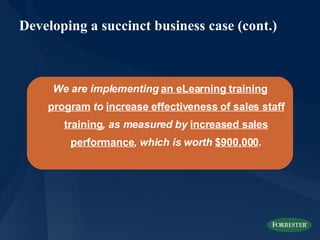
Developing a succinct business case (cont.) We are implementing  an eLearning training program  to  increase effectiveness of sales staff training , as measured by  increased sales performance , which is worth  $900,000 .
Vendors Learning management system (LMS) vendors SumTotal, Saba, Pathlore, Plateau Systems, WBT Systems, GeoLearning Virtual classroom and rapid eLearning vendors Macromedia Breeze, WebEx, Brainshark Dealer training specialists ADP, Reynolds and Reynolds
Recommendations Determine what part of the performance problem is truly a training issue Establish an eLearning program for consistent, fast distribution of informal and formal learning to distributed learners Prepare the learning culture for the online learning experience . . . it can make or break the program Track employee learning through a learning management system Use authoring tools consistent with the nature of the content (and keep it simple) Integrate learning with everyday work  —  don’t make it something dealer employees must “go away” to do Mix training, practice, and simulation online Use eLearning to prepare employees for real-world simulations and OTJ practice Let eLearning outcomes drive OTJ to-dos/actions Measure performance improvement in operational and dollar terms
Selected bibliography March 29, 2005, Tech Choices “Learning Simulations: From Simple Tools To Custom Solutions” March 29, 2005, Trends “Simulations: An Emerging Technology For Building Employee Skills” January 12, 2005, Best Practices “Driving eLearning Through The Dealer Portal”
Thank you Mark Dixon Bünger [email_address] Claire Schooley [email_address] www.forrester.com Entire contents © 2005 Forrester Research, Inc. All rights reserved.

Sales Training

  • 1.
    June 28, 2005.Call in at 12:55 p.m. Eastern Time Mark Dixon Bünger Claire Schooley Principal Analyst Senior Analyst Forrester Research ForrTel: eLearning For Auto Retail Success
  • 2.
    Theme Fast, efficientlearning is good for business
  • 3.
    Agenda Drivers forlearning online or with mixed media Costs of using non-traditional learning approaches Technology required and benefits Case Studies: AutoNation, Toyota, and Volvo Construction Equipment Business case development Some vendors in the eLearning space
  • 4.
    Auto retail needsto get smarter every day . . . New products New promotions Sales techniques Legal and regulatory requirements Customer service Maintenance, diagnostics, and warranty
  • 5.
    . . .for thousands of current and new employees Auto dealerships employ 1,129,600 employees* Turnover averages 92% annually, highest in sales† Tech retirements increasing; 12,000-35,000 new mechanics needed annually (of 820k total)‡ * Source: NADA Data 2005 † Source: CNW 2001 ‡ Sources: Automotive Youth Educational Systems (AYES), Association for Career and Technical Education (ACTE), Bureau of Labor Statistics
  • 6.
    There is aneed for more learning Tom Purves, CEO of BMW of North America, said dealers are clamoring for "more training than we can actually provide .” “ Ford Motor Credit Co. will reassign about 75 salespeople to train dealership finance and insurance managers . . . Captive finance customers are 20% more likely to buy another Ford; for lease customers, owner loyalty is 32% higher. Of Ford and Lincoln-Mercury retail customers, 59% signed up for vehicle loans with Ford Motor Credit.” Source: Automotive News , February 07, 2005
  • 7.
    So how doyou do it? Determine whether it’s a training problem Build the business case on hard savings Determine the need for an LMS Evaluate proposals and make your choice
  • 8.
    Determine whether it’sa training problem Why is the employee not performing? Willing Able Allowed Aware = motivation problem  change compensation = skills problem  train! = policy problem  change rules = information problem  change communication
  • 9.
    Tools for learningVery scalable Not scalable Very scalable Scalable Not scalable Scalability Continual content updates Additional wages High upfront cost of applications, infrastructure, content Expensive to develop; can’t update easily Materials, duplication, travel, instructor, per diem, location costs Costs Self-reporting Database LMS, LCMS, authoring tools, learning objects, competency mgmt. skill gaps, analytics Checklist Database Database, LMS Tracking PDA Review material just-in-time On-the-job learning Shadow and work with others Self-paced eLearning; simulations Work independently; interact with online content Videos Watch in viewing room Books , Classroom manuals, instruction workbooks Read on own Attend class, discussions Material
  • 10.
    Three delivery methodsin a blended environment Instructor-led training Virtual classroom Self-paced training
  • 11.
    Determine the needfor an LMS Number of learners Number of learning experiences Dispersed learner locations Record maintenance Certification Customer learning
  • 12.
    Basic LMS FunctionalityFrom: Managing Learning: An Essential Component To Business Success, September 2004
  • 13.
    Common components ofan eLearning integrated suite From: Managing Learning: An Essential Component To Business Success, September 2004
  • 14.
    Learning… Where itcomes from and where it’s going Classroom On-the-job Computer-based training Integrated learning and work Point A Point B Point C
  • 15.
  • 16.
    Case Study: AutoNation“Knowledge Central” “ How are you going to train 28,000 people to perform standardized processes? . . . and there are thousands of new people every year.” In the past Text-based, video, and classroom training 16-20 booklets (one for each process) as well as VHS videotapes. “A 6,000-page manual written by some marketing guy that nobody’s going to read.”
  • 17.
    Now Created seriesof online courses covering wide range of standard operating processes CRM tools Inventory management . . . even “How to answer the phone” Launched with six modules in Q2; goal is 15 modules (60-90 minutes each) in 2005 All employees, including legacy, will be retrained
  • 18.
    The high pointsVendors: Sparrow Interactive and ADP “ (ADP) have some pretty slick stuff. They developed an interactive module for their custom inventory management tool. They trained our people and they LOVED it.” Training distributed via Citrix-based DealerCentral (AN portal); available to users via tab called Knowledge Central. Training available at any time, at users’ fingertips The business case: KISS “ It used to be $100k per online module hour; now it’s $45k. We keep it simple; not like an OEM that might spend $1 million to include a bunch of video.”
  • 19.
  • 20.
    Case study — Volvo Construction Equipment A worldwide provider of large construction equipment with 8,000 employees in the US Frequent changes in product and service strategy High turnover in sales staff in North America Needs fast training because of expanded product Traditional instructor training too erratic, time-intensive, and costly
  • 21.
    Original model ofsales training Front-line sales staff VCE product specialists VCE district manager VCF finance specialists Regional and dealer product specialists Dealer sales manager Dealer finance specialists Training on all products, processes, and support Train the trainer Etc.
  • 22.
    New system installedQuickTrack — 33 course sales-training modules linked with hands-on training Filled a learning vacuum for sales personnel and managers Cultural issues addressed with one-on-one help Development cost $500,000 over two years District managers can focus on other areas of need
  • 23.
    eLearning structure: Dealershippersonnel Front-line sales staff VCE product specialists VCE district manager VCF finance specialists Regional and dealer product specialists Dealer sales manager Dealer finance specialists Etc. QuickTrack basics
  • 24.
    Market share growthpercentage Market share growth percentage (YR 2003 vs. YR 2002) Branch salespeople split into three categories — no training, Web training, and Web and hands-on training 101 110 131 Not trained Web only Web and hands-on
  • 25.
  • 26.
    Case study: ToyotaDealer Simulations 4. Action plan 2. “Discovery Session” 3. Feedback 1. Dealer simulation
  • 27.
    Dealership simulation: Partsand service department Service revenue is currently dependent on warranty But warranty work is declining as vehicle quality is improving Customer-pay work is declining Independent repair shops are a threat to customer-pay Capacity is constrained Improve shop productivity and technician efficiency Brick and mortar investment in more service stalls
  • 28.
    Parts and service(cont.) Parts: Potentially higher margin business Inventory management: Low inventory turns Same day fill rate vs. obsolescence expense Low accessory sales Retail and wholesale parts sold
  • 29.
  • 30.
  • 31.
  • 32.
    Developing a businesscase Must show that eLearning will be worth the investment Look for a learning situation that lends itself to learning online Establish measurable outcomes
  • 33.
    Developing a succinctbusiness case What is important is not what is spent, but what the organization gets in return We want THIS number “ We are doing to make better, as measured by , which is worth $
  • 34.
    Developing a succinctbusiness case (cont.) We are implementing an eLearning training program to increase effectiveness of sales staff training , as measured by increased sales performance , which is worth $900,000 .
  • 35.
    Vendors Learning managementsystem (LMS) vendors SumTotal, Saba, Pathlore, Plateau Systems, WBT Systems, GeoLearning Virtual classroom and rapid eLearning vendors Macromedia Breeze, WebEx, Brainshark Dealer training specialists ADP, Reynolds and Reynolds
  • 36.
    Recommendations Determine whatpart of the performance problem is truly a training issue Establish an eLearning program for consistent, fast distribution of informal and formal learning to distributed learners Prepare the learning culture for the online learning experience . . . it can make or break the program Track employee learning through a learning management system Use authoring tools consistent with the nature of the content (and keep it simple) Integrate learning with everyday work — don’t make it something dealer employees must “go away” to do Mix training, practice, and simulation online Use eLearning to prepare employees for real-world simulations and OTJ practice Let eLearning outcomes drive OTJ to-dos/actions Measure performance improvement in operational and dollar terms
  • 37.
    Selected bibliography March29, 2005, Tech Choices “Learning Simulations: From Simple Tools To Custom Solutions” March 29, 2005, Trends “Simulations: An Emerging Technology For Building Employee Skills” January 12, 2005, Best Practices “Driving eLearning Through The Dealer Portal”
  • 38.
    Thank you MarkDixon Bünger [email_address] Claire Schooley [email_address] www.forrester.com Entire contents © 2005 Forrester Research, Inc. All rights reserved.