Past and Perspective
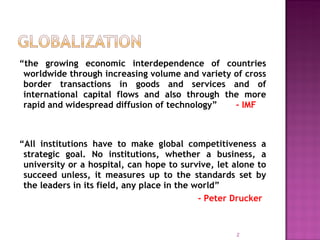
“ the growing economic interdependence of countries worldwide through increasing volume and variety of cross border transactions in goods and services and of international capital flows and also through the more rapid and widespread diffusion of technology”  - IMF  “ All institutions have to make global competitiveness a strategic goal. No institutions, whether a business, a university or a hospital, can hope to survive, let alone to succeed unless, it measures up to the standards set by the leaders in its field, any place in the world” - Peter Drucker
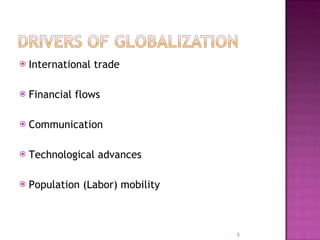
International trade Financial flows Communication Technological advances Population (Labor) mobility
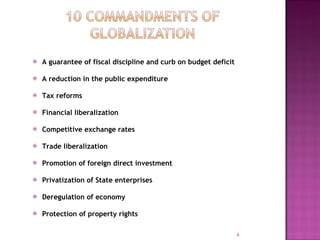
A guarantee of fiscal discipline and curb on budget deficit A reduction in the public expenditure Tax reforms Financial liberalization Competitive exchange rates Trade liberalization Promotion of foreign direct investment Privatization of State enterprises Deregulation of economy Protection of property rights
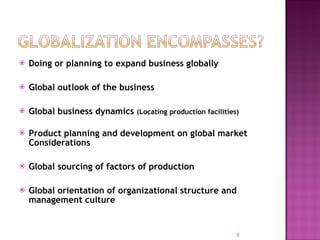
Doing or planning to expand business globally Global outlook of the business Global business dynamics  (Locating production facilities) Product planning and development on global market Considerations Global sourcing of factors of production Global orientation of organizational structure and management culture
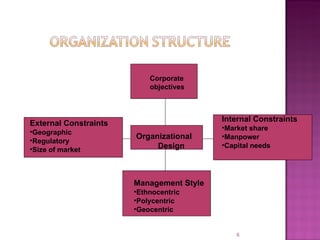
Organizational  Design External Constraints Geographic Regulatory Size of market Internal Constraints Market share Manpower Capital needs Management Style Ethnocentric Polycentric Geocentric Corporate objectives
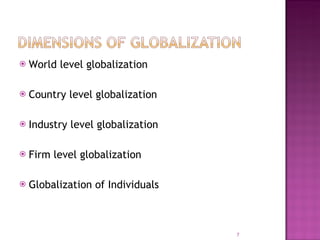
World level globalization Country level globalization Industry level globalization Firm level globalization Globalization of Individuals
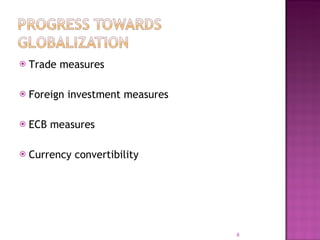
Trade measures Foreign investment measures ECB measures Currency convertibility
Competition and Learning Technological gains Larger markets Outsourcing and subcontracting advantage Greater specialization Price stabilization International investments International economic co-operation International economic problems and crises Industrial and employment restructuring Lesser control over domestic economy Readymade technology Drain of basic raw materials Consumerism Shift in the pattern of industrialization Erosion of domestic production base
“ the essential nature of the multinational enterprises lies in the fact that its managerial headquarter are located in one country (home country) while the enterprise carries out operations in a number of other countries (host countries) as well.” “ a corporation that controls production facilities in more than one country, such facilities having been acquired through the process of foreign direct investment. Firms that participate in international business, how large they may be, solely by exporting or by licensing technology are not multinational enterprises.”
70,000 MNCs with 9,50,950 affiliates Only about 12 per cent of these affiliates are in the developed countries The top 100 TNCs are the principal drivers of international production Their foreign affiliates employ about 6 million people with foreign sales of about $2trillion  Concentrated on electronics and electrical, automobiles, petroleum, chemicals and pharmaceuticals. increasing number of Japan and European MNCs Japan has the largest number, i.e., 10 in the top 20 MNCs MNCs are growing from developing countries too. South Korea has MNCs like Samsung, LG, Hyundai.
Why do companies go global? Money in the overseas markets Rapid shrinking of time and distance Domestic markets are no longer adequate and rich Raymond Vernon theory Petroleum and mining companies go global very often Nationality of the company affect the decision of going global To save high transportation cost Try to remain nearer to sources of raw material and labor Motivation to go global for high-tech companies
Manifestation to go global Configuration anywhere in the world Interlinked and independent economies Lowering of trade and tariff barriers Effect on related industries and ancillaries Infrastructural resources and input at international prices Increasing trend towards privatization Entrepreneur and his unit enjoy a central economic role Mobility of skilled resources Market-side efficiency Formation of regional blocks
Transfer of technology, capital and entrepreneurship Improvement in the balance of payment Creation of local jobs and career opportunities Competition and better utilization available resources Greater availability of products and services to local people High quality managerial talent Step towards world economy
Acquisition of Raw material and other resources Acquisition of technologies and management expertise form other markets Export of product to other markets Inflow of the income from overseas profits Better job opportunities in the home countries.
Host country may loose its economic sovereignty MNC’S objectives may be guided by world wide trend and developments  Problem of balance  of payment Acquisition of local business Exploitation of local labor Sudden exit from local markets (FIIs) Cultural issues
Whether to go global? Which market to enter? Deciding the mode of entry Learning to handle differences Adjusting to the management process Selecting a managerial approach Deciding an organization structure
“ Thanks to economic reforms, Indian businessmen are now compelled to come out of their shell and see beyond the physical boundaries of the country. From now onwards our captains of industries must think and act, both actions being guided by international perspective”
A large market A strong legal system Well developed capital markets A class of private sector partners English speaking human resources Democratic setup Booming economy Huge skilled manpower Opportunities to diversify portfolio risks

Globalisation

  • 1.
  • 2.
    “ the growingeconomic interdependence of countries worldwide through increasing volume and variety of cross border transactions in goods and services and of international capital flows and also through the more rapid and widespread diffusion of technology” - IMF “ All institutions have to make global competitiveness a strategic goal. No institutions, whether a business, a university or a hospital, can hope to survive, let alone to succeed unless, it measures up to the standards set by the leaders in its field, any place in the world” - Peter Drucker
  • 3.
    International trade Financialflows Communication Technological advances Population (Labor) mobility
  • 4.
    A guarantee offiscal discipline and curb on budget deficit A reduction in the public expenditure Tax reforms Financial liberalization Competitive exchange rates Trade liberalization Promotion of foreign direct investment Privatization of State enterprises Deregulation of economy Protection of property rights
  • 5.
    Doing or planningto expand business globally Global outlook of the business Global business dynamics (Locating production facilities) Product planning and development on global market Considerations Global sourcing of factors of production Global orientation of organizational structure and management culture
  • 6.
    Organizational DesignExternal Constraints Geographic Regulatory Size of market Internal Constraints Market share Manpower Capital needs Management Style Ethnocentric Polycentric Geocentric Corporate objectives
  • 7.
    World level globalizationCountry level globalization Industry level globalization Firm level globalization Globalization of Individuals
  • 8.
    Trade measures Foreigninvestment measures ECB measures Currency convertibility
  • 9.
    Competition and LearningTechnological gains Larger markets Outsourcing and subcontracting advantage Greater specialization Price stabilization International investments International economic co-operation International economic problems and crises Industrial and employment restructuring Lesser control over domestic economy Readymade technology Drain of basic raw materials Consumerism Shift in the pattern of industrialization Erosion of domestic production base
  • 10.
    “ the essentialnature of the multinational enterprises lies in the fact that its managerial headquarter are located in one country (home country) while the enterprise carries out operations in a number of other countries (host countries) as well.” “ a corporation that controls production facilities in more than one country, such facilities having been acquired through the process of foreign direct investment. Firms that participate in international business, how large they may be, solely by exporting or by licensing technology are not multinational enterprises.”
  • 11.
    70,000 MNCs with9,50,950 affiliates Only about 12 per cent of these affiliates are in the developed countries The top 100 TNCs are the principal drivers of international production Their foreign affiliates employ about 6 million people with foreign sales of about $2trillion Concentrated on electronics and electrical, automobiles, petroleum, chemicals and pharmaceuticals. increasing number of Japan and European MNCs Japan has the largest number, i.e., 10 in the top 20 MNCs MNCs are growing from developing countries too. South Korea has MNCs like Samsung, LG, Hyundai.
  • 12.
    Why do companiesgo global? Money in the overseas markets Rapid shrinking of time and distance Domestic markets are no longer adequate and rich Raymond Vernon theory Petroleum and mining companies go global very often Nationality of the company affect the decision of going global To save high transportation cost Try to remain nearer to sources of raw material and labor Motivation to go global for high-tech companies
  • 13.
    Manifestation to goglobal Configuration anywhere in the world Interlinked and independent economies Lowering of trade and tariff barriers Effect on related industries and ancillaries Infrastructural resources and input at international prices Increasing trend towards privatization Entrepreneur and his unit enjoy a central economic role Mobility of skilled resources Market-side efficiency Formation of regional blocks
  • 14.
    Transfer of technology,capital and entrepreneurship Improvement in the balance of payment Creation of local jobs and career opportunities Competition and better utilization available resources Greater availability of products and services to local people High quality managerial talent Step towards world economy
  • 15.
    Acquisition of Rawmaterial and other resources Acquisition of technologies and management expertise form other markets Export of product to other markets Inflow of the income from overseas profits Better job opportunities in the home countries.
  • 16.
    Host country mayloose its economic sovereignty MNC’S objectives may be guided by world wide trend and developments Problem of balance of payment Acquisition of local business Exploitation of local labor Sudden exit from local markets (FIIs) Cultural issues
  • 17.
    Whether to goglobal? Which market to enter? Deciding the mode of entry Learning to handle differences Adjusting to the management process Selecting a managerial approach Deciding an organization structure
  • 18.
    “ Thanks toeconomic reforms, Indian businessmen are now compelled to come out of their shell and see beyond the physical boundaries of the country. From now onwards our captains of industries must think and act, both actions being guided by international perspective”
  • 19.
    A large marketA strong legal system Well developed capital markets A class of private sector partners English speaking human resources Democratic setup Booming economy Huge skilled manpower Opportunities to diversify portfolio risks