International business International Business     The exchange of products and services among countries Transaction that are carried out across national borders to satisfy the objectives of individuals and organization
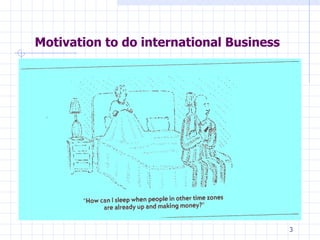
Motivation to do international Business
Motivation to do international Business   Proactive: to increase profit  to take advantage of product life cycle to achieve Economies of scale Reactive: Competitive pressures Overproduction and excess capacity Declining domestic sales saturated domestic markets
Considering International Expansion Gauging international demand Is there any demand for the company’s products abroad? Adapting to customer needs If so, must those products be adapted for international consumptions? Entry strategies How to entry into foreign markets?
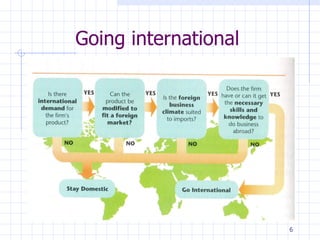
Going international
Gauging international demand Preliminary screening for attractive country markets Assessment of industry market potential Identify the potential demand for the company products and services Forecasting the company selling Assessment of the company market share
Adapting to customer needs Products and Services should meet to foreign market Price adjustments by considering the cost of foreign trade, such as transportation, taxes, exchange rate Distribution system through existing transportation system, suppliers and stores Promotion should be modified based on different languages, law, and culture from country to country
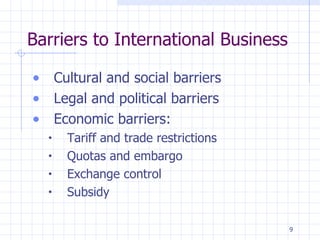
Barriers to International Business Cultural and social barriers Legal and political barriers Economic barriers: Tariff and trade restrictions Quotas and embargo Exchange control Subsidy
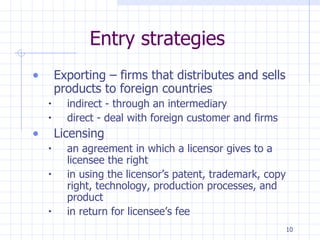
Entry strategies Exporting – firms that distributes and sells products to foreign countries indirect - through an intermediary direct - deal with foreign customer and firms Licensing  an agreement in which a licensor gives to a licensee the right  in using the licensor’s patent, trademark, copy right, technology, production processes, and product  in return for licensee’s fee
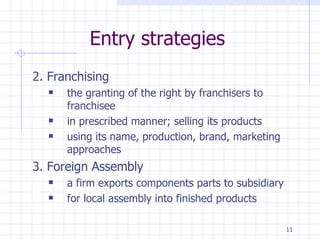
Entry strategies 2. Franchising  the granting of the right by franchisers to franchisee  in prescribed manner; selling its products  using its name, production, brand, marketing approaches 3. Foreign Assembly a firm exports components parts to subsidiary for local assembly into finished products
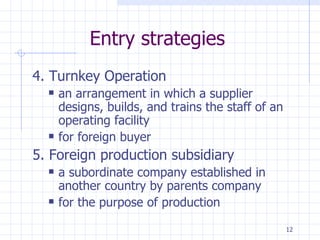
Entry strategies 4. Turnkey Operation an arrangement in which a supplier designs, builds, and trains the staff of an operating facility  for foreign buyer 5. Foreign production subsidiary a subordinate company established in another country by parents company for the purpose of production
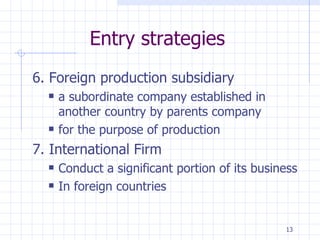
Entry strategies 6. Foreign production subsidiary a subordinate company established in another country by parents company for the purpose of production 7. International Firm Conduct a significant portion of its business In foreign countries
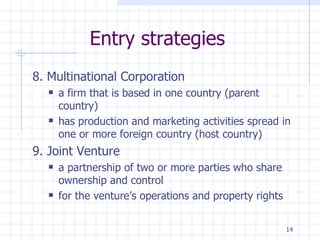
Entry strategies 8. Multinational Corporation a firm that is based in one country (parent country)  has production and marketing activities spread in one or more foreign country (host country) 9. Joint Venture a partnership of two or more parties who share ownership and control for the venture’s operations and property rights
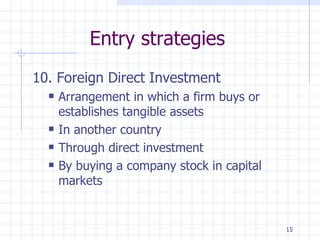
Entry strategies 10. Foreign Direct Investment Arrangement in which a firm buys or establishes tangible assets In another country Through direct investment By buying a company stock in capital markets
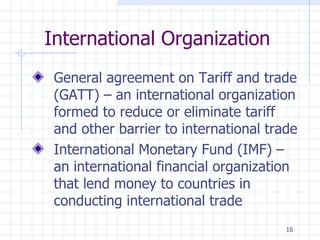
International Organization General agreement on Tariff and trade (GATT) – an international organization formed to reduce or eliminate tariff and other barrier to international trade International Monetary Fund (IMF) – an international financial organization that lend money to countries in conducting international trade
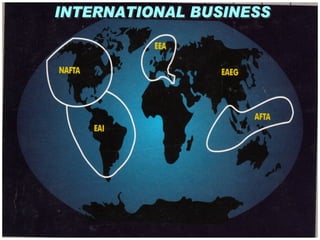
International Organization World Bank – an international financial organization that lend money to underdeveloped and developing countries for development Economic Communities – the creation of common economic policies World Trade Organization (WTO) European Community (EC) North American Free Trade Agreement (NAFTA) Asian Free Trade Agreement (AFTA)

03-International Business

  • 1.
  • 2.
    International business InternationalBusiness   The exchange of products and services among countries Transaction that are carried out across national borders to satisfy the objectives of individuals and organization
  • 3.
    Motivation to dointernational Business
  • 4.
    Motivation to dointernational Business Proactive: to increase profit to take advantage of product life cycle to achieve Economies of scale Reactive: Competitive pressures Overproduction and excess capacity Declining domestic sales saturated domestic markets
  • 5.
    Considering International ExpansionGauging international demand Is there any demand for the company’s products abroad? Adapting to customer needs If so, must those products be adapted for international consumptions? Entry strategies How to entry into foreign markets?
  • 6.
  • 7.
    Gauging international demandPreliminary screening for attractive country markets Assessment of industry market potential Identify the potential demand for the company products and services Forecasting the company selling Assessment of the company market share
  • 8.
    Adapting to customerneeds Products and Services should meet to foreign market Price adjustments by considering the cost of foreign trade, such as transportation, taxes, exchange rate Distribution system through existing transportation system, suppliers and stores Promotion should be modified based on different languages, law, and culture from country to country
  • 9.
    Barriers to InternationalBusiness Cultural and social barriers Legal and political barriers Economic barriers: Tariff and trade restrictions Quotas and embargo Exchange control Subsidy
  • 10.
    Entry strategies Exporting– firms that distributes and sells products to foreign countries indirect - through an intermediary direct - deal with foreign customer and firms Licensing an agreement in which a licensor gives to a licensee the right in using the licensor’s patent, trademark, copy right, technology, production processes, and product in return for licensee’s fee
  • 11.
    Entry strategies 2.Franchising the granting of the right by franchisers to franchisee in prescribed manner; selling its products using its name, production, brand, marketing approaches 3. Foreign Assembly a firm exports components parts to subsidiary for local assembly into finished products
  • 12.
    Entry strategies 4.Turnkey Operation an arrangement in which a supplier designs, builds, and trains the staff of an operating facility for foreign buyer 5. Foreign production subsidiary a subordinate company established in another country by parents company for the purpose of production
  • 13.
    Entry strategies 6.Foreign production subsidiary a subordinate company established in another country by parents company for the purpose of production 7. International Firm Conduct a significant portion of its business In foreign countries
  • 14.
    Entry strategies 8.Multinational Corporation a firm that is based in one country (parent country) has production and marketing activities spread in one or more foreign country (host country) 9. Joint Venture a partnership of two or more parties who share ownership and control for the venture’s operations and property rights
  • 15.
    Entry strategies 10.Foreign Direct Investment Arrangement in which a firm buys or establishes tangible assets In another country Through direct investment By buying a company stock in capital markets
  • 16.
    International Organization Generalagreement on Tariff and trade (GATT) – an international organization formed to reduce or eliminate tariff and other barrier to international trade International Monetary Fund (IMF) – an international financial organization that lend money to countries in conducting international trade
  • 17.
    International Organization WorldBank – an international financial organization that lend money to underdeveloped and developing countries for development Economic Communities – the creation of common economic policies World Trade Organization (WTO) European Community (EC) North American Free Trade Agreement (NAFTA) Asian Free Trade Agreement (AFTA)