Retailing Management 8e © The McGraw-Hill Companies, All rights reserved. 12 -
CHAPTER 2
CHAPTER 1
CHAPTER 1
CHAPTER 12
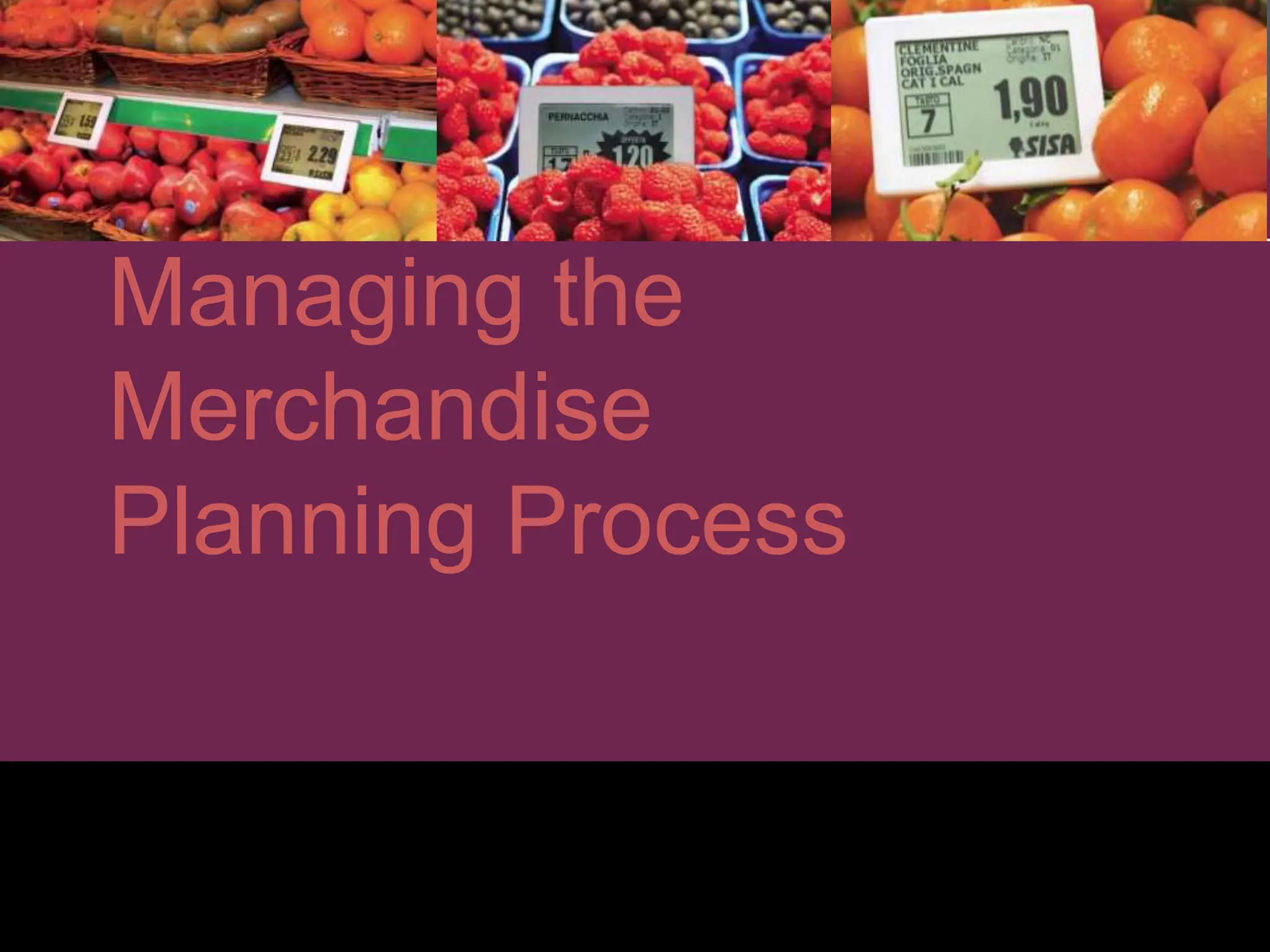
Managing the
Merchandise
Planning Process
12 -
CHAPTER 2
CHAPTER 1
Merchandise Management
12 -
CHAPTER 2
CHAPTER 1
CHAPTER 1
Merchandise Management
• Process by which a retailer offers the correct
quantity of the right merchandise in the right place
at the right time and meets the company’s financial
goals.
• Sense market trends
• Analyze sales data
• Make appropriate adjustments
in prices and inventory levels c) image100/PunchStock
12 -
CHAPTER 2
CHAPTER 1
CHAPTER 1
• Dollars to invest in inventory
• Invest in “hot” merchandise
• Save a little for opportunities
(open to buy)
• Monitor portfolio of
merchandise (stocks)
• Sell losers (markdowns)
Merchandise Management and
Investment Portfolio Management
Traders on the stock exchange floor
manage a portfolio of stocks, and retail
buyers manage a portfolio of merchandise inventory. Both
continuously assess the risks associated with their purchase
decisions.
12 -
CHAPTER 2
CHAPTER 1
CHAPTER 1
Buying Organization
Merchandise Group
Department
Classification
Category
SKU
Each merchandise group is managed by a general
merchandise manager (GMM),senior VP
Departments are managed by a divisional merchandise
manager (DMM),
A group of items targeting the same customer type, such
as girls’ sizes 4-6
Each buyer manages several merchandise categories
(e.g., sportswear, dresses, swimwear, outerwear
categories for girls’ sizes 4-6
The smallest unit available for inventory control
Size, color, style
12 -
CHAPTER 2
CHAPTER 1
CHAPTER 1
Evaluating Merchandise
Management Performance -
GMROI
• Merchandise managers have control over
• The merchandise they buy
• The price at which the merchandise is sold
• The cost of the merchandise
• Merchandise managers do not have control over
• Operating expenses
• Human resources
• Real estate
• Supply chain management
• Information systems
• SO HOW ARE MERCHANTS EVALUATED?
12 -
CHAPTER 2
CHAPTER 1
CHAPTER 1
Measuring Sales-to-Stock Ratio
• Net Sales/Average Inventory at Cost
• Retailers report on an annual basis
• If the sales-to-stock ratio for a three-month season
is 2.3, the annual sales-to-stock ratio will be 9.2
• Estimation of average inventory
• Use information system: averaging the inventory
in stores and distribution centers at the end of
each day
• Divide the sum of the end-of-month (EOM)
inventories for several months by the number of
12 -
CHAPTER 2
CHAPTER 1
CHAPTER 1
Merchandise Planning Process
12 -
CHAPTER 2
CHAPTER 1
CHAPTER 1
Types of Merchandise Management
Planning Processes
Two distinct types of merchandise management systems for managing
•Staple (Basic) Merchandise Categories
• Continuous demand over an extended time period
• Limited number of new product introductions
• Hosiery, basic casual apparel
• Easy to forecast demand
• Continuous replenishment
•Fashion Merchandise Categories
• In demand for a relatively short period of time
• Continuous introductions of new products, making existing products
obsolete
• Athletic shoes, laptop computers, women’s apparel
12 -
CHAPTER 2
CHAPTER 1
CHAPTER 1
Merchandise Management Process
1. Forecasting sales
2. Developing an assortment plan
3. Determining the appropriate inventory level
12 -
CHAPTER 2
CHAPTER 1
CHAPTER 1
Developing a Sales Forecast
• Understanding the nature of the product life cycle
• Collecting data on sales of product and
comparable products
• Using statistical techniques to project sales
• Work with vendors to coordinate manufacturing
and merchandise delivery with forecasted demand
(CPFR)
12 -
CHAPTER 2
CHAPTER 1
CHAPTER 1
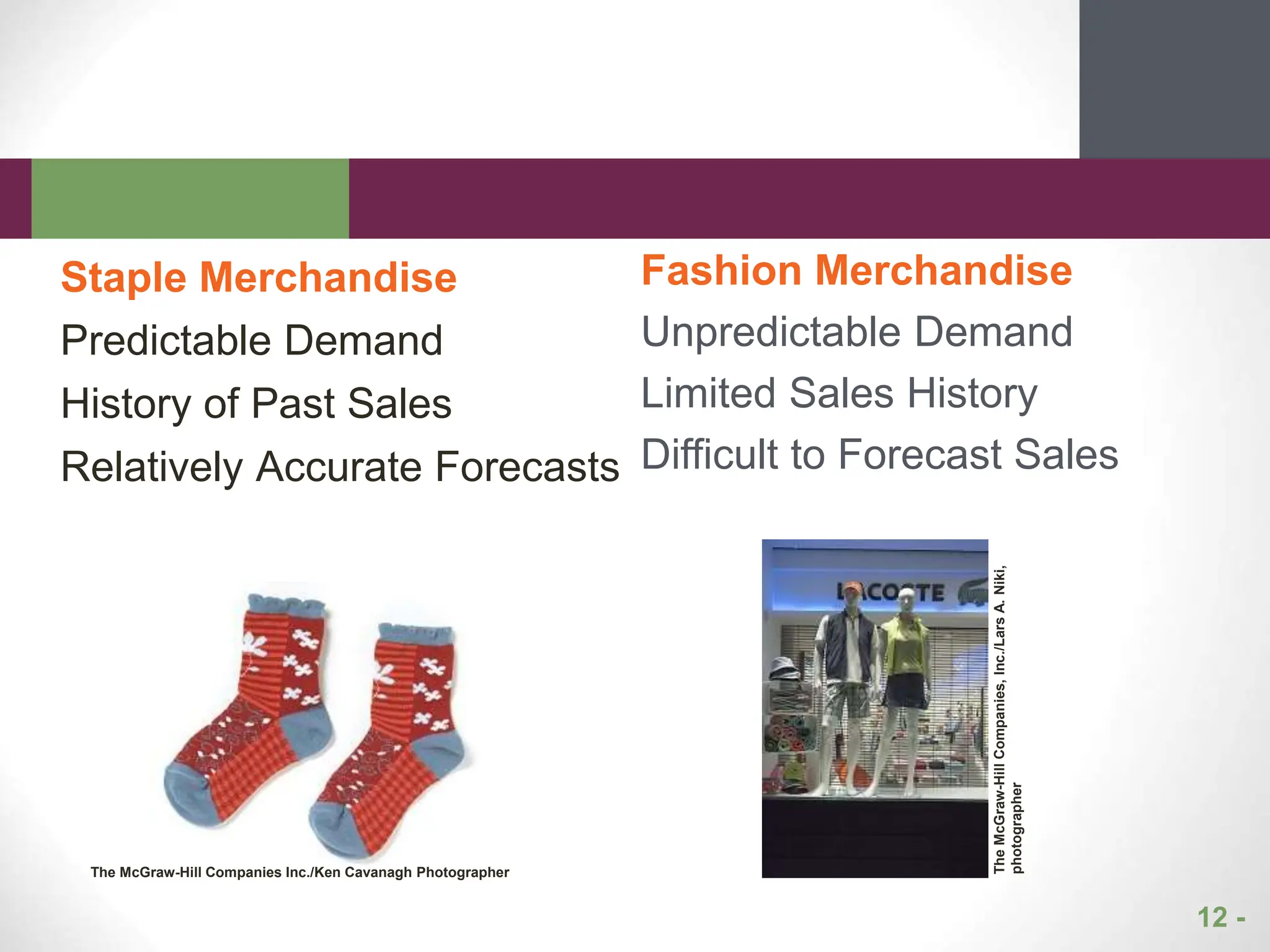
Staple Merchandise
Predictable Demand
History of Past Sales
Relatively Accurate Forecasts
Fashion Merchandise
Unpredictable Demand
Limited Sales History
Difficult to Forecast Sales
The McGraw-Hill Companies Inc./Ken Cavanagh Photographer
The
McGraw-Hill
Companies,
Inc./Lars
A.
Niki,
photographer
12 -
CHAPTER 2
CHAPTER 1
CHAPTER 1
Factors Affecting Sales Projections
Controllable
• Promotions
• Store Locations
• Merchandise Placement
• Cannibalization
Uncontrollable
• Seasonality
• Weather
• Competitive Activity
• Product Availability
• Economic Conditions
12 -
CHAPTER 2
CHAPTER 1
CHAPTER 1
Retailers develop
fashion forecasts by
relying on:
• Previous sales data
• Market research
• Fashion and trend
services
• Vendors
Forecasting
Fashion Merchandise Categories
12 -
CHAPTER 2
CHAPTER 1
CHAPTER 1
Forecasting
Fashion Merchandise Categories
• Previous sales data
• Many items in a fashion category are often
similar to items sold in previous years.
• Market research
• Activities range from informal, qualitative
research about trends affecting the category to
more formal experiments and surveys.
12 -
CHAPTER 2
CHAPTER 1
CHAPTER 1
Forecasting
Fashion Merchandise Categories
• Fashion and trend services
• There are many services that buyers can
subscribe to that forecast the latest fashions,
colors, and styles.
• Vendors
• Vendors have proprietary information about their
marketing plans and tend to be very
knowledgeable about market trends.
12 -
CHAPTER 2
CHAPTER 1
CHAPTER 1
Forecasting
Service Retailers
• Due to the perishable nature of services, service
retailers face more challenges than fashion
retailers.
• Offerings perishes at the end of the day, not at the
end of the season.
• Must devised approaches for managing demand so
that it meets, but does not exceed capacity.
12 -
CHAPTER 2
CHAPTER 1
CHAPTER 1
Developing an Assortment Plan
• Assortment plan is a list of the SKUs that a
retailer will offer in a merchandise category and
reflects the variety and assortment that the retailer
plans to offer in a merchandise category
• Variety (breadth) is the number of different
merchandising categories within a store or
department
• Assortment (depth) is the number of SKUs within
a category.
• Product availability defines the percentage of
demand for a particular SKU that is satisfied.
12 -
CHAPTER 2
CHAPTER 1
CHAPTER 1
Determining Variety and
Assortment
Buyers consider
•Retail strategy
• The number of SKUs to offer in a merchandise category is a strategic
decision
•GMROI of the merchandise mix
•Trade-off between too much versus too little assortment
• Increasing sales by offering more breadth and depth can potentially
reduce inventory turnover and GMROI by stocking more SKUs
•Physical characteristics of the store
•Complementary Merchandise
PhotoLink/Getty
Images
12 -
CHAPTER 2
CHAPTER 1
CHAPTER 1
Product Availability
• The percentage of demand for a particular SKU
that is satisfied
• Level of support or service level
• The backup (buffer) stock in the model stock plan
determine product availability
• The higher product availability, the higher the
amount of backup stock necessary to ensure that
the retailer won’t be out of stock on a particular
SKU when consumers demand it
12 -
CHAPTER 2
CHAPTER 1
CHAPTER 1
Product Availability
Factors considered to determine the appropriate
level of buffer stock and thus the product availability
for each SKU
•ABC Classification of merchandise (inventory)
• A – higher product availability
• B – medium product availability
• C – lower product availability is acceptable
•Fluctuations in demand
•Lead time for deliver from the vendor
•Frequency of store deliveries
12 -
CHAPTER 2
CHAPTER 1
CHAPTER 1
Staple Merchandise Planning
• Buyer Determines:
• Basic Stock or Assortment Plan
• Level of Backup Inventory
• System:
• Monitors Inventory levels
• Automatically reorders when inventory gets
below a specified level
12 -
CHAPTER 2
CHAPTER 1
CHAPTER 1
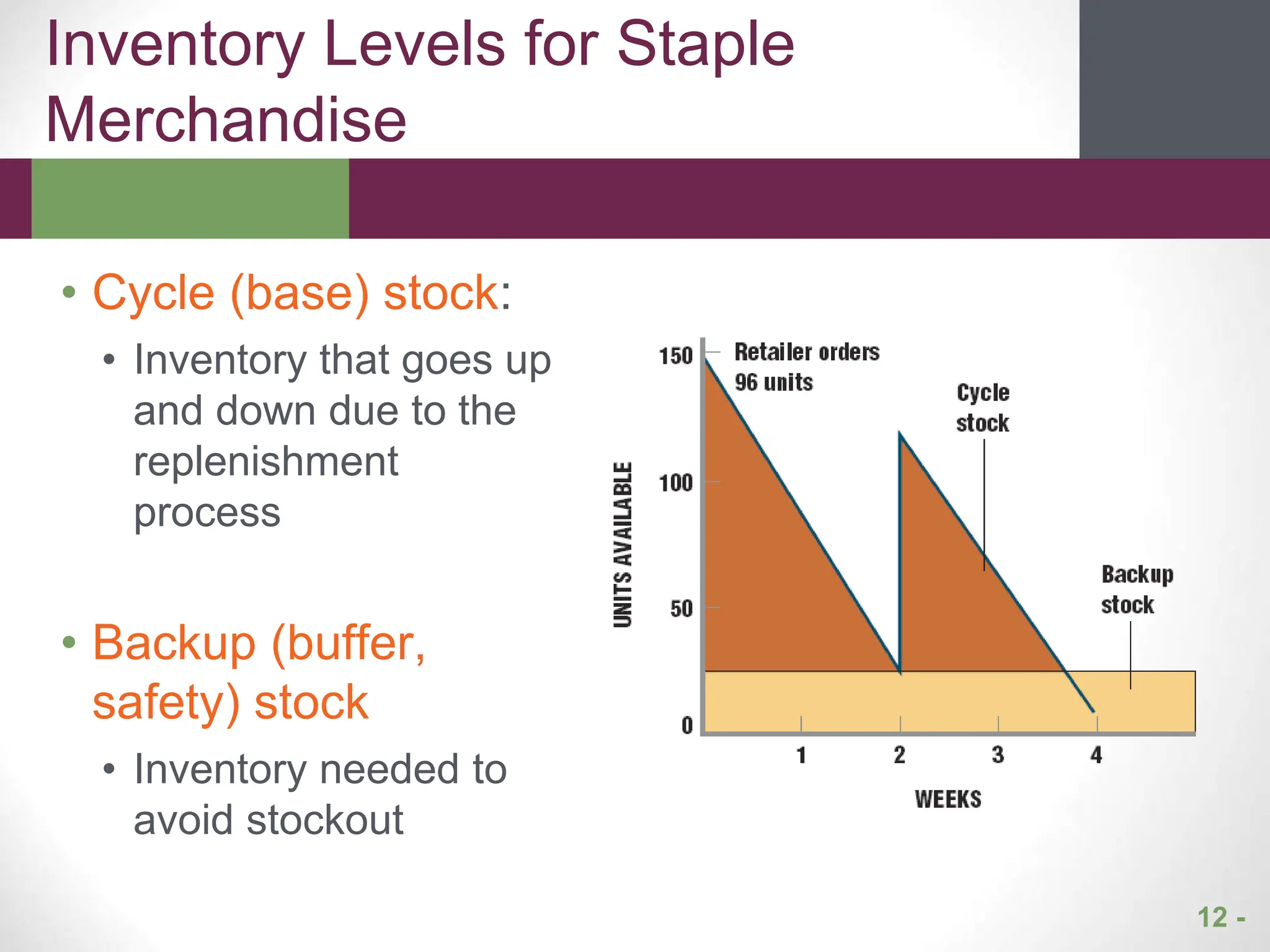
• Cycle (base) stock:
• Inventory that goes up
and down due to the
replenishment
process
• Backup (buffer,
safety) stock
• Inventory needed to
avoid stockout
Inventory Levels for Staple
Merchandise
12 -
CHAPTER 2
CHAPTER 1
CHAPTER 1
Basic Stock
• Indicates the Desired Inventory Level for Each
SKU
Cost of Carrying
Inventory
Lost Sale Due
to Stockout
12 -
CHAPTER 2
CHAPTER 1
CHAPTER 1
• Higher product availability (service
level) retailer wishes to provide to
customers
• Greater the fluctuation in demand
• Longer lead time from the vendor
• More fluctuations in lead time
• Lower vendor’s Fill rate (% of
complete orders received from a
vendor)
Determining the Level of Backup
Stock
More
Backup
Stocks
Needed
with
12 -
CHAPTER 2
CHAPTER 1
CHAPTER 1
Fashion Merchandise
Management Systems
• The system for managing fashion merchandise
categories is typically called a Merchandise Budget
Plan
12 -
CHAPTER 2
CHAPTER 1
CHAPTER 1
Plan for the financial aspects
of a merchandise category
•Specifies how much money
can be spent each month to
achieve the sales, margin,
inventory turnover, and
GMROI objectives
•Not a complete buying plan--
doesn’t indicate what specific
SKUs to buy or in what
quantities
Merchandise Budget Plan
Royalty-Free/CORBIS
12 -
CHAPTER 2
CHAPTER 1
CHAPTER 1
Evaluating the
Merchandise Budget Plan
• Inventory turnover GMROI, sales forecast are used
for both planning and control
• After the selling season, the actual performance is
compared with the plan
• Why did performance exceed or fall short of the
plan?
• Was the deviation from the plan due to
something under the buyer’s control?
• Did the buyer react quickly to changes in demand
by either purchasing more or having a sale?
12 -
CHAPTER 2
CHAPTER 1
CHAPTER 1
Analyzing
Merchandise Management Performance
Three types of analyses related to the
monitoring and adjustment step are:
• Sell through analysis
• ABC analysis of assortments
• Multiattribute analysis of vendors
12 -
CHAPTER 2
CHAPTER 1
CHAPTER 1
Sell Through Analysis
Evaluating Merchandise Plan
• A sell-through analysis compares actual and planned sales
to determine whether more merchandise is needed to
satisfy demand or whether price reductions are required.
12 -
CHAPTER 2
CHAPTER 1
CHAPTER 1
ABC Analysis
• An ABC analysis identifies the performance of individual
SKUs in the assortment plan.
• Rank - orders merchandise by some performance measure
determine which items:
• should never be out of stock
• should be allowed to be out of stock occasionally
• should be deleted from the stock selection.
• A items: 5% of SKUs, represent 70% of sales
• B items: 10% of SKUs, represent 20% of sales
• C items: 65% of SKUs, represent 10% of sales
• D items: 20% of SKUs, represent 10% of sales
12 -
CHAPTER 2
CHAPTER 1
CHAPTER 1
The multiattribute method
for evaluating vendors
uses a weighted average
score for each vendor.
The score is based on the
importance of various
issues and the vendor’s
performance on those
issues.
Multiattribute Method
for Evaluating Vendors
C Squared Studios/Getty Images
12 -
CHAPTER 2
CHAPTER 1
CHAPTER 1
Evaluating Vendors
• A buyer can evaluate vendors by using the
following five steps:
1. Develop a list of issues to consider in the evaluation (column 1)
2. Importance weights for each issue in column 1 are determined by
the buyer/planner in conjunction with the GMM (column 2)
3. Make judgments about each individual brand’s performance on
each issue (the remaining columns)
4. Develop an overall score by multiplying the importance of each
issue by the performance of each brand or its vendor
5. Determine a vendor’s overall rating, add the products for each
brand for all issues
12 -
CHAPTER 2
CHAPTER 1
CHAPTER 1
Keywords
• Inventory turnover Net sales divided by average retail inventory; used to
evaluate how effectively managers utilize their investment in inventory.
• gross margin return on investment (GMROI) Gross margin dollars
divided by average (cost) inventory.
• return on assets Net profit after taxes divided by total assets.
• sales-to-stock ratio The net sales divided by average inventory at cost.
It is one component of GMROI and is similar in concept to inventory
turnover except the numerator is expressed at retail (net sales) rather
than at cost (cost of good sold)
• staple merchandise Inventory that has continuous demand by
customers over an extended period of time. Also known as basic
merchandise.
• fashion merchandise Category of merchandise that typically lasts
several seasons, and sales can vary dramatically from one season to the
next.

6. Managing the Merchandise Planning Process.ppt

  • 1.
    Retailing Management 8e© The McGraw-Hill Companies, All rights reserved. 12 - CHAPTER 2 CHAPTER 1 CHAPTER 1 CHAPTER 12 Managing the Merchandise Planning Process
  • 2.
    12 - CHAPTER 2 CHAPTER1 Merchandise Management
  • 3.
    12 - CHAPTER 2 CHAPTER1 CHAPTER 1 Merchandise Management • Process by which a retailer offers the correct quantity of the right merchandise in the right place at the right time and meets the company’s financial goals. • Sense market trends • Analyze sales data • Make appropriate adjustments in prices and inventory levels c) image100/PunchStock
  • 4.
    12 - CHAPTER 2 CHAPTER1 CHAPTER 1 • Dollars to invest in inventory • Invest in “hot” merchandise • Save a little for opportunities (open to buy) • Monitor portfolio of merchandise (stocks) • Sell losers (markdowns) Merchandise Management and Investment Portfolio Management Traders on the stock exchange floor manage a portfolio of stocks, and retail buyers manage a portfolio of merchandise inventory. Both continuously assess the risks associated with their purchase decisions.
  • 5.
    12 - CHAPTER 2 CHAPTER1 CHAPTER 1 Buying Organization Merchandise Group Department Classification Category SKU Each merchandise group is managed by a general merchandise manager (GMM),senior VP Departments are managed by a divisional merchandise manager (DMM), A group of items targeting the same customer type, such as girls’ sizes 4-6 Each buyer manages several merchandise categories (e.g., sportswear, dresses, swimwear, outerwear categories for girls’ sizes 4-6 The smallest unit available for inventory control Size, color, style
  • 6.
    12 - CHAPTER 2 CHAPTER1 CHAPTER 1 Evaluating Merchandise Management Performance - GMROI • Merchandise managers have control over • The merchandise they buy • The price at which the merchandise is sold • The cost of the merchandise • Merchandise managers do not have control over • Operating expenses • Human resources • Real estate • Supply chain management • Information systems • SO HOW ARE MERCHANTS EVALUATED?
  • 7.
    12 - CHAPTER 2 CHAPTER1 CHAPTER 1 Measuring Sales-to-Stock Ratio • Net Sales/Average Inventory at Cost • Retailers report on an annual basis • If the sales-to-stock ratio for a three-month season is 2.3, the annual sales-to-stock ratio will be 9.2 • Estimation of average inventory • Use information system: averaging the inventory in stores and distribution centers at the end of each day • Divide the sum of the end-of-month (EOM) inventories for several months by the number of
  • 8.
    12 - CHAPTER 2 CHAPTER1 CHAPTER 1 Merchandise Planning Process
  • 9.
    12 - CHAPTER 2 CHAPTER1 CHAPTER 1 Types of Merchandise Management Planning Processes Two distinct types of merchandise management systems for managing •Staple (Basic) Merchandise Categories • Continuous demand over an extended time period • Limited number of new product introductions • Hosiery, basic casual apparel • Easy to forecast demand • Continuous replenishment •Fashion Merchandise Categories • In demand for a relatively short period of time • Continuous introductions of new products, making existing products obsolete • Athletic shoes, laptop computers, women’s apparel
  • 10.
    12 - CHAPTER 2 CHAPTER1 CHAPTER 1 Merchandise Management Process 1. Forecasting sales 2. Developing an assortment plan 3. Determining the appropriate inventory level
  • 11.
    12 - CHAPTER 2 CHAPTER1 CHAPTER 1 Developing a Sales Forecast • Understanding the nature of the product life cycle • Collecting data on sales of product and comparable products • Using statistical techniques to project sales • Work with vendors to coordinate manufacturing and merchandise delivery with forecasted demand (CPFR)
  • 12.
    12 - CHAPTER 2 CHAPTER1 CHAPTER 1 Staple Merchandise Predictable Demand History of Past Sales Relatively Accurate Forecasts Fashion Merchandise Unpredictable Demand Limited Sales History Difficult to Forecast Sales The McGraw-Hill Companies Inc./Ken Cavanagh Photographer The McGraw-Hill Companies, Inc./Lars A. Niki, photographer
  • 13.
    12 - CHAPTER 2 CHAPTER1 CHAPTER 1 Factors Affecting Sales Projections Controllable • Promotions • Store Locations • Merchandise Placement • Cannibalization Uncontrollable • Seasonality • Weather • Competitive Activity • Product Availability • Economic Conditions
  • 14.
    12 - CHAPTER 2 CHAPTER1 CHAPTER 1 Retailers develop fashion forecasts by relying on: • Previous sales data • Market research • Fashion and trend services • Vendors Forecasting Fashion Merchandise Categories
  • 15.
    12 - CHAPTER 2 CHAPTER1 CHAPTER 1 Forecasting Fashion Merchandise Categories • Previous sales data • Many items in a fashion category are often similar to items sold in previous years. • Market research • Activities range from informal, qualitative research about trends affecting the category to more formal experiments and surveys.
  • 16.
    12 - CHAPTER 2 CHAPTER1 CHAPTER 1 Forecasting Fashion Merchandise Categories • Fashion and trend services • There are many services that buyers can subscribe to that forecast the latest fashions, colors, and styles. • Vendors • Vendors have proprietary information about their marketing plans and tend to be very knowledgeable about market trends.
  • 17.
    12 - CHAPTER 2 CHAPTER1 CHAPTER 1 Forecasting Service Retailers • Due to the perishable nature of services, service retailers face more challenges than fashion retailers. • Offerings perishes at the end of the day, not at the end of the season. • Must devised approaches for managing demand so that it meets, but does not exceed capacity.
  • 18.
    12 - CHAPTER 2 CHAPTER1 CHAPTER 1 Developing an Assortment Plan • Assortment plan is a list of the SKUs that a retailer will offer in a merchandise category and reflects the variety and assortment that the retailer plans to offer in a merchandise category • Variety (breadth) is the number of different merchandising categories within a store or department • Assortment (depth) is the number of SKUs within a category. • Product availability defines the percentage of demand for a particular SKU that is satisfied.
  • 19.
    12 - CHAPTER 2 CHAPTER1 CHAPTER 1 Determining Variety and Assortment Buyers consider •Retail strategy • The number of SKUs to offer in a merchandise category is a strategic decision •GMROI of the merchandise mix •Trade-off between too much versus too little assortment • Increasing sales by offering more breadth and depth can potentially reduce inventory turnover and GMROI by stocking more SKUs •Physical characteristics of the store •Complementary Merchandise PhotoLink/Getty Images
  • 20.
    12 - CHAPTER 2 CHAPTER1 CHAPTER 1 Product Availability • The percentage of demand for a particular SKU that is satisfied • Level of support or service level • The backup (buffer) stock in the model stock plan determine product availability • The higher product availability, the higher the amount of backup stock necessary to ensure that the retailer won’t be out of stock on a particular SKU when consumers demand it
  • 21.
    12 - CHAPTER 2 CHAPTER1 CHAPTER 1 Product Availability Factors considered to determine the appropriate level of buffer stock and thus the product availability for each SKU •ABC Classification of merchandise (inventory) • A – higher product availability • B – medium product availability • C – lower product availability is acceptable •Fluctuations in demand •Lead time for deliver from the vendor •Frequency of store deliveries
  • 22.
    12 - CHAPTER 2 CHAPTER1 CHAPTER 1 Staple Merchandise Planning • Buyer Determines: • Basic Stock or Assortment Plan • Level of Backup Inventory • System: • Monitors Inventory levels • Automatically reorders when inventory gets below a specified level
  • 23.
    12 - CHAPTER 2 CHAPTER1 CHAPTER 1 • Cycle (base) stock: • Inventory that goes up and down due to the replenishment process • Backup (buffer, safety) stock • Inventory needed to avoid stockout Inventory Levels for Staple Merchandise
  • 24.
    12 - CHAPTER 2 CHAPTER1 CHAPTER 1 Basic Stock • Indicates the Desired Inventory Level for Each SKU Cost of Carrying Inventory Lost Sale Due to Stockout
  • 25.
    12 - CHAPTER 2 CHAPTER1 CHAPTER 1 • Higher product availability (service level) retailer wishes to provide to customers • Greater the fluctuation in demand • Longer lead time from the vendor • More fluctuations in lead time • Lower vendor’s Fill rate (% of complete orders received from a vendor) Determining the Level of Backup Stock More Backup Stocks Needed with
  • 26.
    12 - CHAPTER 2 CHAPTER1 CHAPTER 1 Fashion Merchandise Management Systems • The system for managing fashion merchandise categories is typically called a Merchandise Budget Plan
  • 27.
    12 - CHAPTER 2 CHAPTER1 CHAPTER 1 Plan for the financial aspects of a merchandise category •Specifies how much money can be spent each month to achieve the sales, margin, inventory turnover, and GMROI objectives •Not a complete buying plan-- doesn’t indicate what specific SKUs to buy or in what quantities Merchandise Budget Plan Royalty-Free/CORBIS
  • 28.
    12 - CHAPTER 2 CHAPTER1 CHAPTER 1 Evaluating the Merchandise Budget Plan • Inventory turnover GMROI, sales forecast are used for both planning and control • After the selling season, the actual performance is compared with the plan • Why did performance exceed or fall short of the plan? • Was the deviation from the plan due to something under the buyer’s control? • Did the buyer react quickly to changes in demand by either purchasing more or having a sale?
  • 29.
    12 - CHAPTER 2 CHAPTER1 CHAPTER 1 Analyzing Merchandise Management Performance Three types of analyses related to the monitoring and adjustment step are: • Sell through analysis • ABC analysis of assortments • Multiattribute analysis of vendors
  • 30.
    12 - CHAPTER 2 CHAPTER1 CHAPTER 1 Sell Through Analysis Evaluating Merchandise Plan • A sell-through analysis compares actual and planned sales to determine whether more merchandise is needed to satisfy demand or whether price reductions are required.
  • 31.
    12 - CHAPTER 2 CHAPTER1 CHAPTER 1 ABC Analysis • An ABC analysis identifies the performance of individual SKUs in the assortment plan. • Rank - orders merchandise by some performance measure determine which items: • should never be out of stock • should be allowed to be out of stock occasionally • should be deleted from the stock selection. • A items: 5% of SKUs, represent 70% of sales • B items: 10% of SKUs, represent 20% of sales • C items: 65% of SKUs, represent 10% of sales • D items: 20% of SKUs, represent 10% of sales
  • 32.
    12 - CHAPTER 2 CHAPTER1 CHAPTER 1 The multiattribute method for evaluating vendors uses a weighted average score for each vendor. The score is based on the importance of various issues and the vendor’s performance on those issues. Multiattribute Method for Evaluating Vendors C Squared Studios/Getty Images
  • 33.
    12 - CHAPTER 2 CHAPTER1 CHAPTER 1 Evaluating Vendors • A buyer can evaluate vendors by using the following five steps: 1. Develop a list of issues to consider in the evaluation (column 1) 2. Importance weights for each issue in column 1 are determined by the buyer/planner in conjunction with the GMM (column 2) 3. Make judgments about each individual brand’s performance on each issue (the remaining columns) 4. Develop an overall score by multiplying the importance of each issue by the performance of each brand or its vendor 5. Determine a vendor’s overall rating, add the products for each brand for all issues
  • 34.
    12 - CHAPTER 2 CHAPTER1 CHAPTER 1 Keywords • Inventory turnover Net sales divided by average retail inventory; used to evaluate how effectively managers utilize their investment in inventory. • gross margin return on investment (GMROI) Gross margin dollars divided by average (cost) inventory. • return on assets Net profit after taxes divided by total assets. • sales-to-stock ratio The net sales divided by average inventory at cost. It is one component of GMROI and is similar in concept to inventory turnover except the numerator is expressed at retail (net sales) rather than at cost (cost of good sold) • staple merchandise Inventory that has continuous demand by customers over an extended period of time. Also known as basic merchandise. • fashion merchandise Category of merchandise that typically lasts several seasons, and sales can vary dramatically from one season to the next.