Applied Forest Ecology: An Introduction to Silviculture Eli Sagor [email_address]
Thanks to Dan Gilmore, UMN College  of Natural Resources
Outline What is “silviculture?” Values of the forest Forest structure Silvicultural systems Q&A
Definitions of Silviculture The art and science of controlling the establishment, growth, composition, and health of forests and woodlands  to meet the diverse needs of landowners and society on a sustainable basis. (J. Helms 1998)
Definitions of Silviculture The art and science of  controlling the establishment, growth, composition, and health  of forests and woodlands  to meet the diverse needs of landowners and society on a sustainable basis. (J. Helms 1998)
Definitions of Silviculture The art and science of controlling the establishment, growth, composition, and health   of forests and woodlands  to meet the  diverse needs  of landowners and society on a sustainable basis. (J. Helms 1998)
Definitions of Silviculture The  art and science  of controlling the establishment, growth, composition, and health of forests and woodlands  to meet the diverse needs of landowners and society on a sustainable basis. (J. Helms 1998)
Purpose of Silviculture To create and maintain the kind of forest that will best fulfill the objectives of the owner and governing society. (DM Smith et al. 1997)
Limits of Silviculture Working  with  the forces of nature:  sailing analogy
Values we derive from forests Common forest products: Timber, game wildlife, recreation...
Values we derive from forests Common forest products Timber, game wildlife, recreation... Specialty forest products: Berries & nuts, birch bark, balsam boughs...
Values we derive from forests Non-market values: Ecological, habitat Aesthetics Watershed protection Spiritual, existence values
Forest Structure
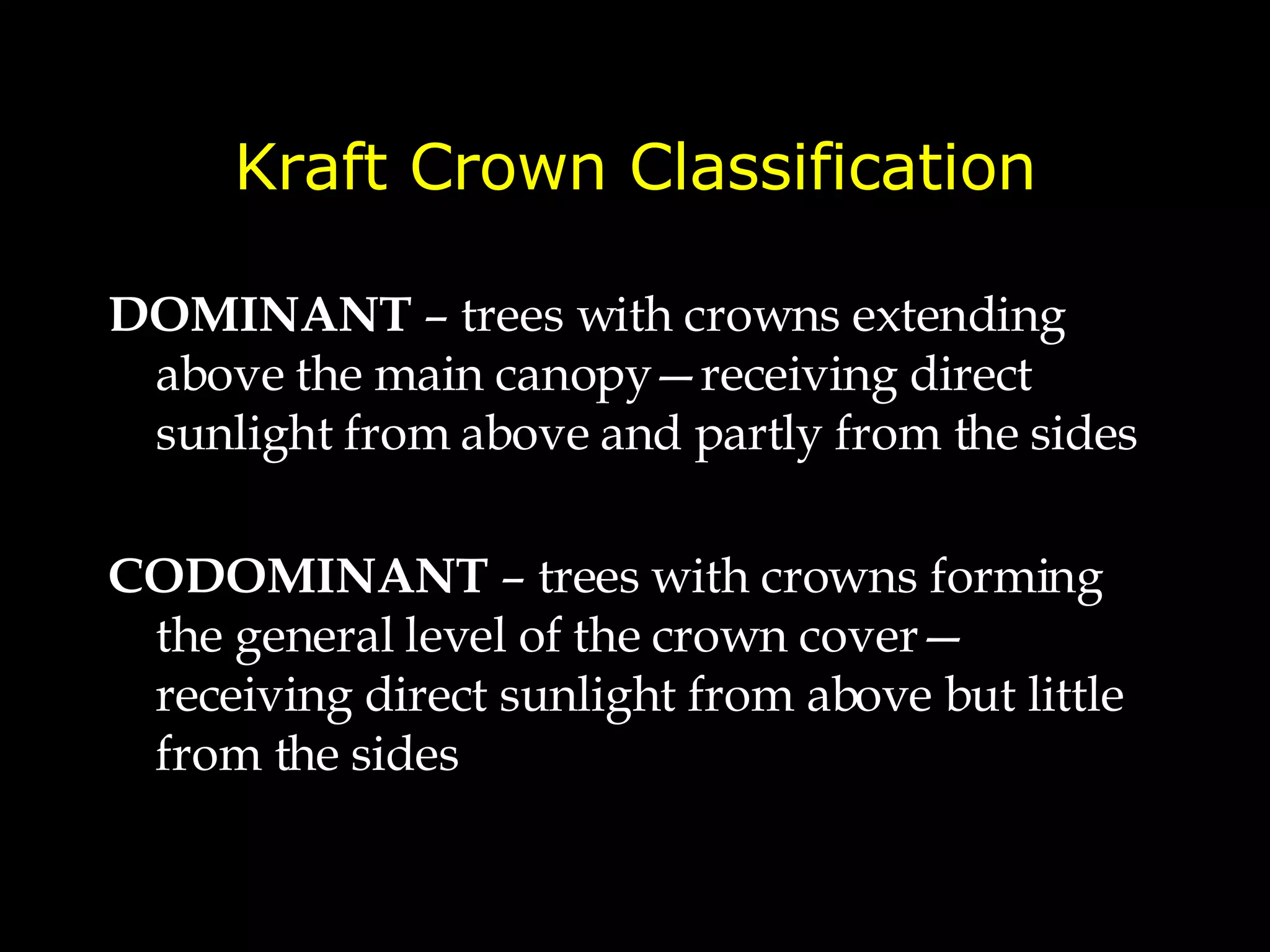
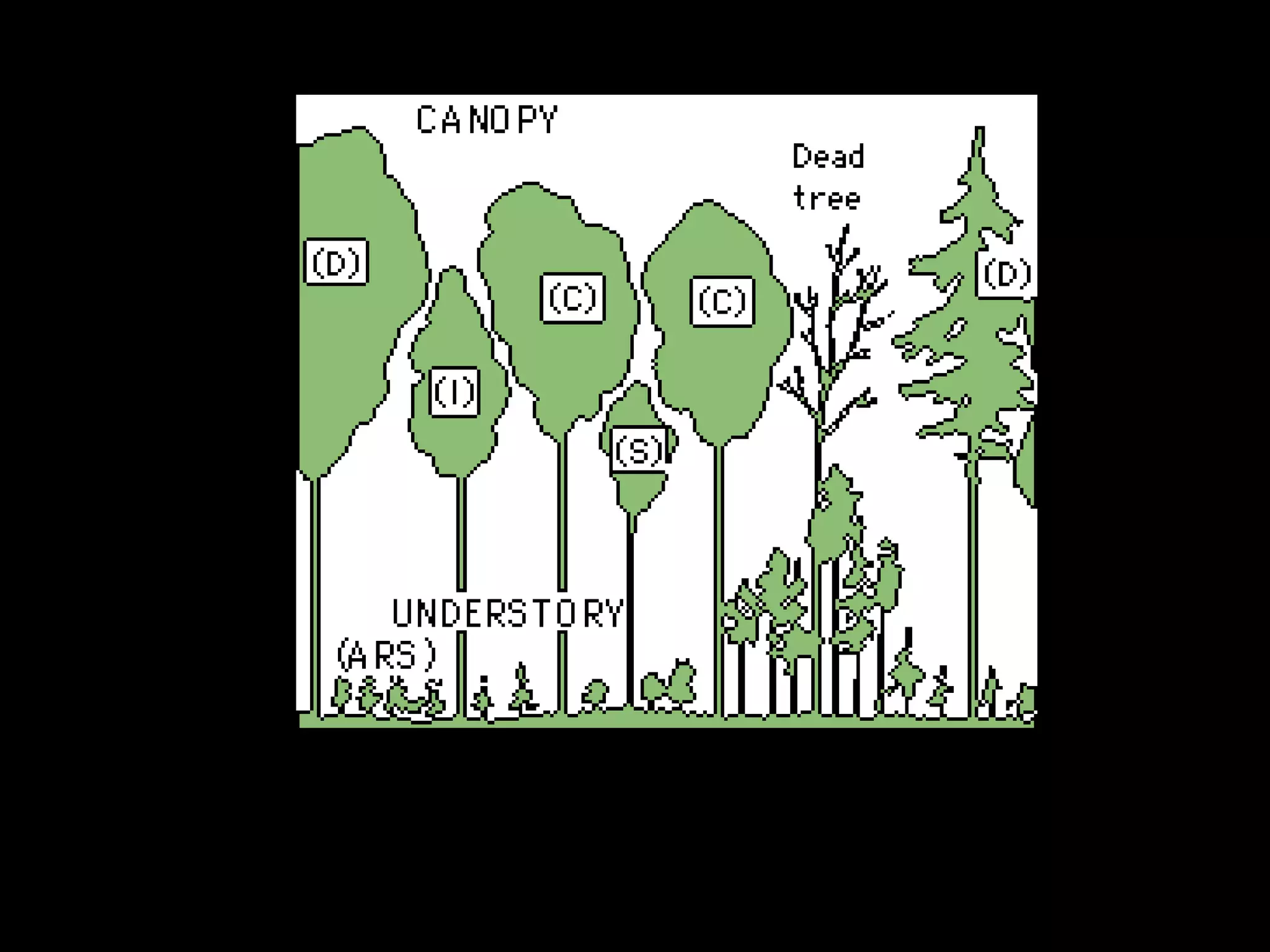
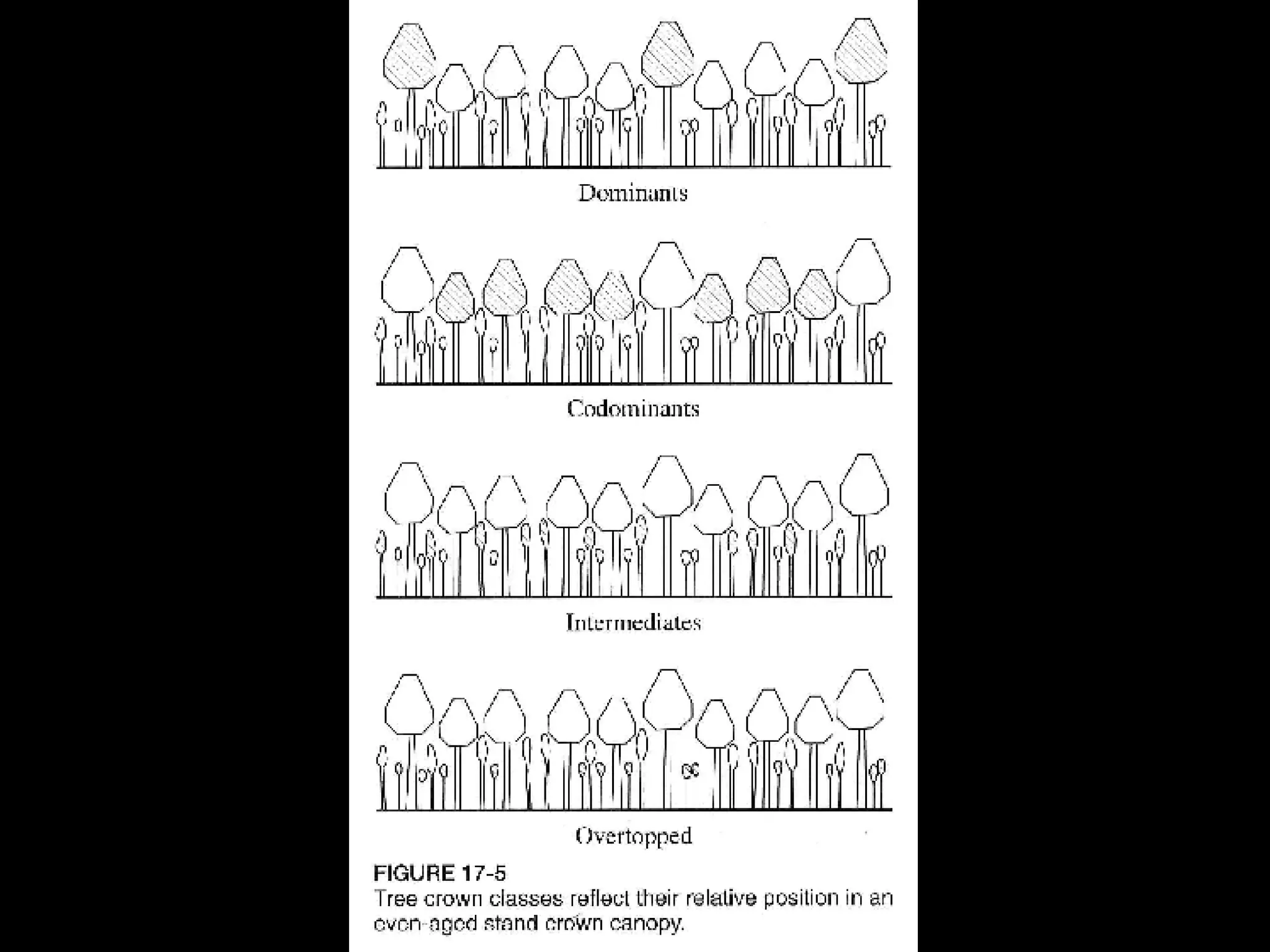
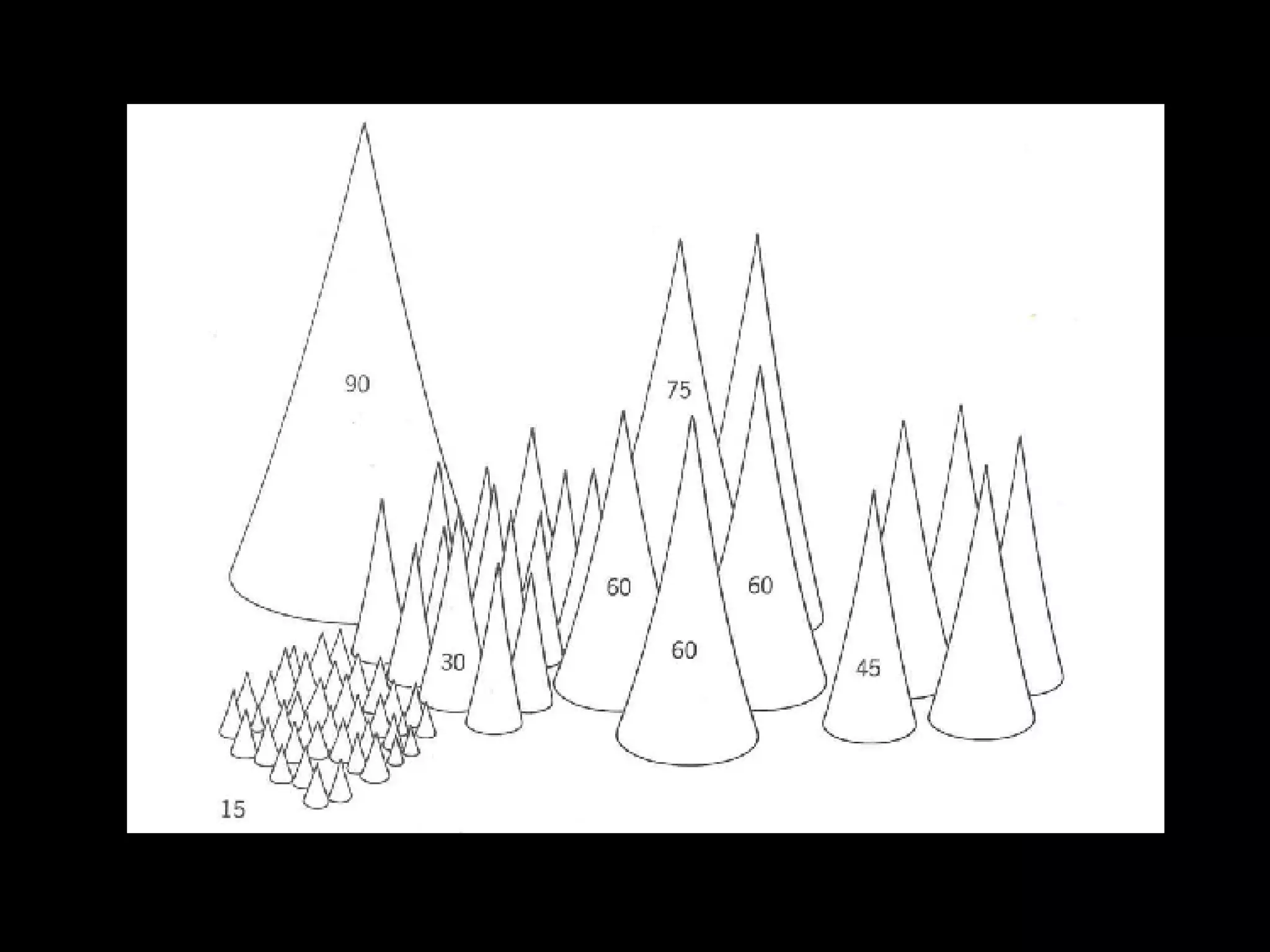
Kraft Crown Classification DOMINANT  – trees with crowns extending above the main canopy—receiving direct sunlight from above and partly from the sides CODOMINANT  – trees with crowns forming the general level of the crown cover—receiving direct sunlight from above but little from the sides
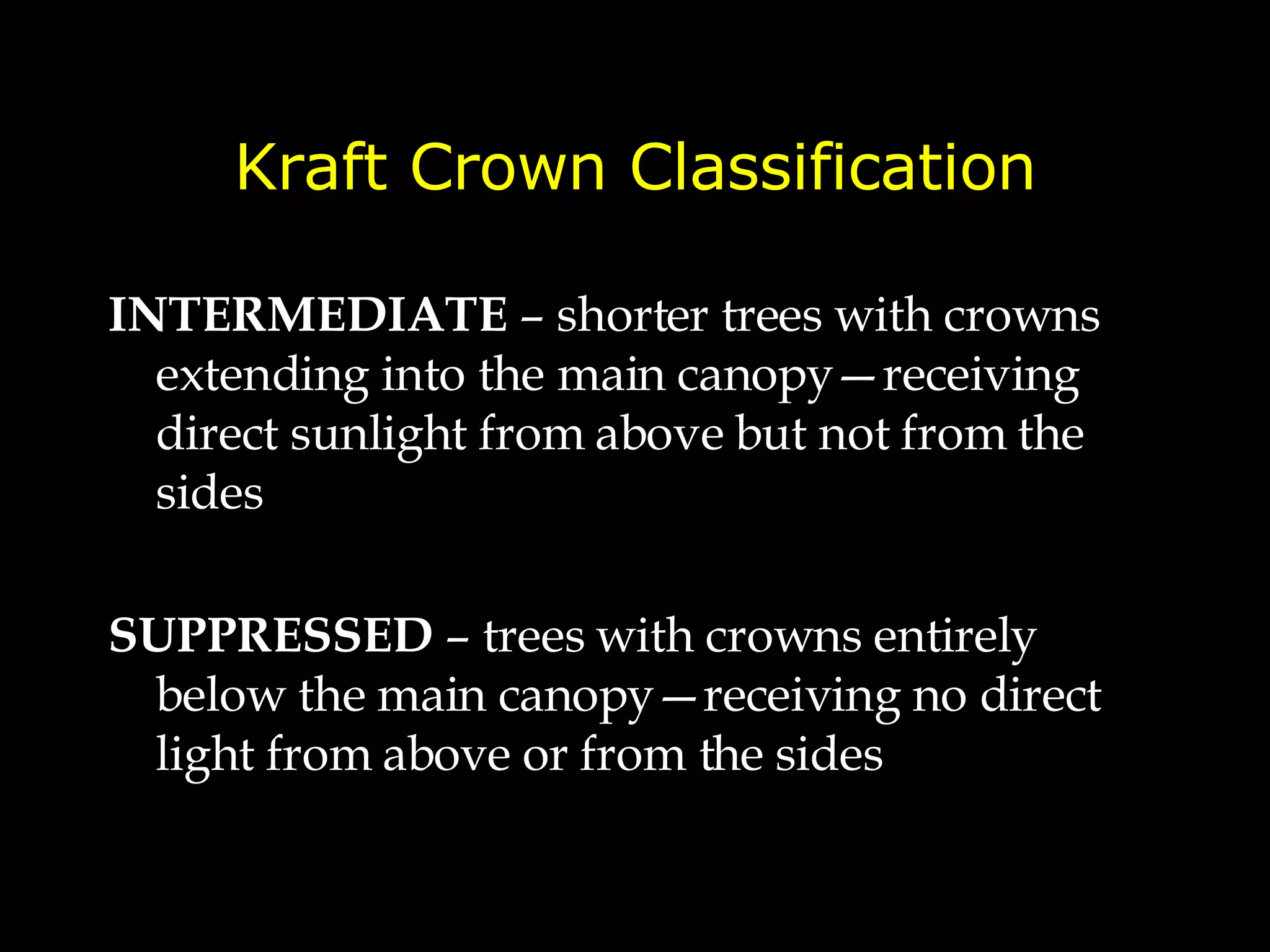
Kraft Crown Classification INTERMEDIATE  – shorter trees with crowns  extending into the main canopy—receiving direct sunlight from above but not from the sides SUPPRESSED  – trees with crowns entirely below the main canopy—receiving no direct light from above or from the sides
 
 
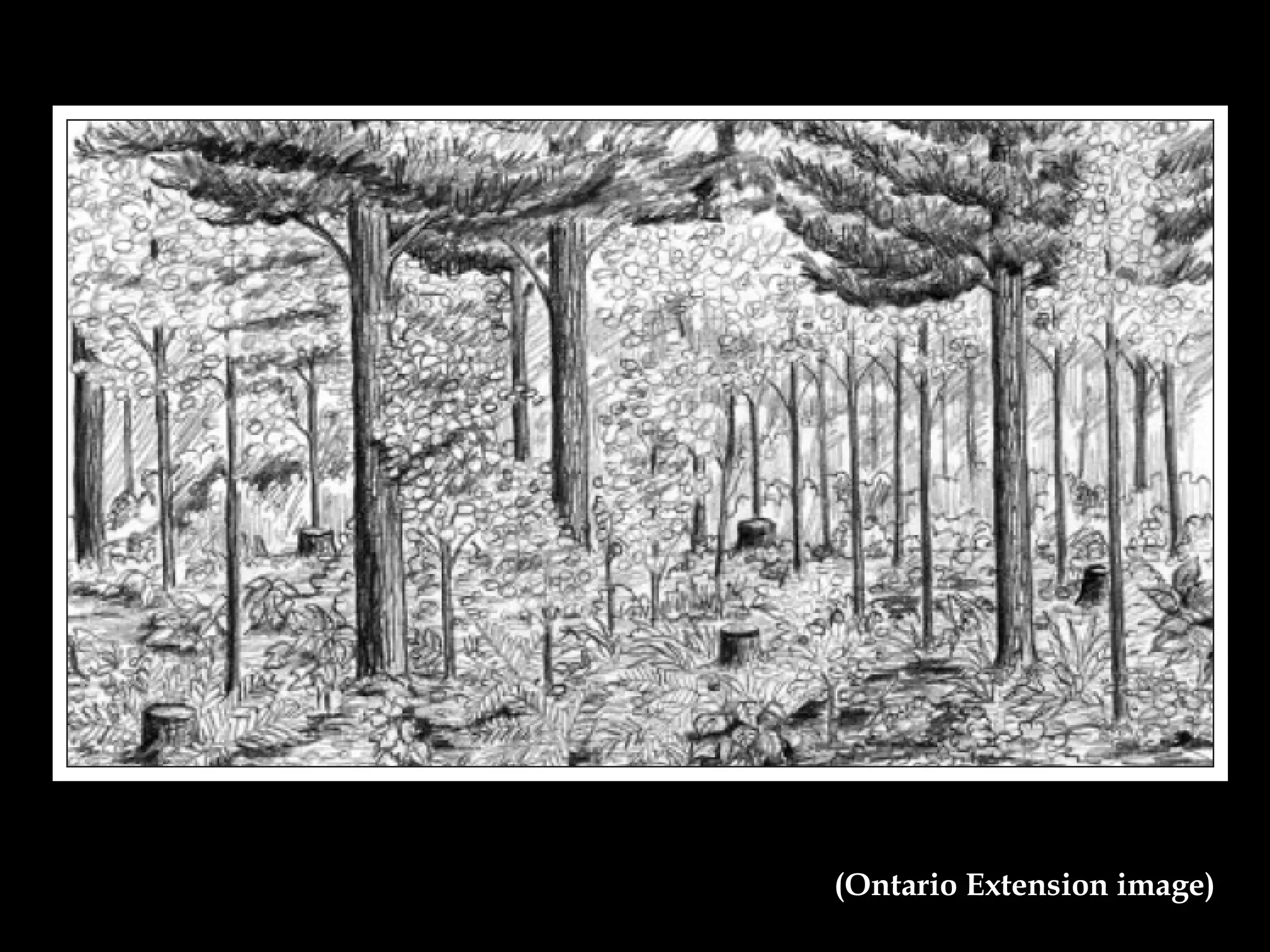
Age classes and cohorts EVEN-AGED:   the difference in age between the youngest and oldest trees does not exceed 20% of the total rotation age. TWO-AGED:   stands contain two distinct age classes. UNEVEN-AGED:   stands contain at least three distinct age classes.
(Ontario Extension image)
The toolbox
The toolbox Clearcut harvesting “ Selective” or partial harvesting Prescribed burning:  to control understory competition to prepare a cleared site for planting to favor natural regeneration of desired species to reduce fuel loads Planting of desired species and/or genetically improved stock Protecting stands from damage from wildlife (deer!) Thinning at various times in the rotation Pruning: to improve log quality to reduce disease effects Spraying herbicides or pesticides Cutting to reduce insect threats  Salvage cutting  Fire suppression And more…
Silvicultural System Components Age classes (cohorts) Regeneration method  Natural (from seed or sprout) Artificial (planted) Species composition pure or mixed
Silviculture  ≠  Harvesting A silvicultural system applies to the  whole rotation . A harvesting system applies only to the  harvest .
Silvicultural Systems Clearcutting Seed tree Shelterwood Group selection Single-tree selection Intermediate treatments
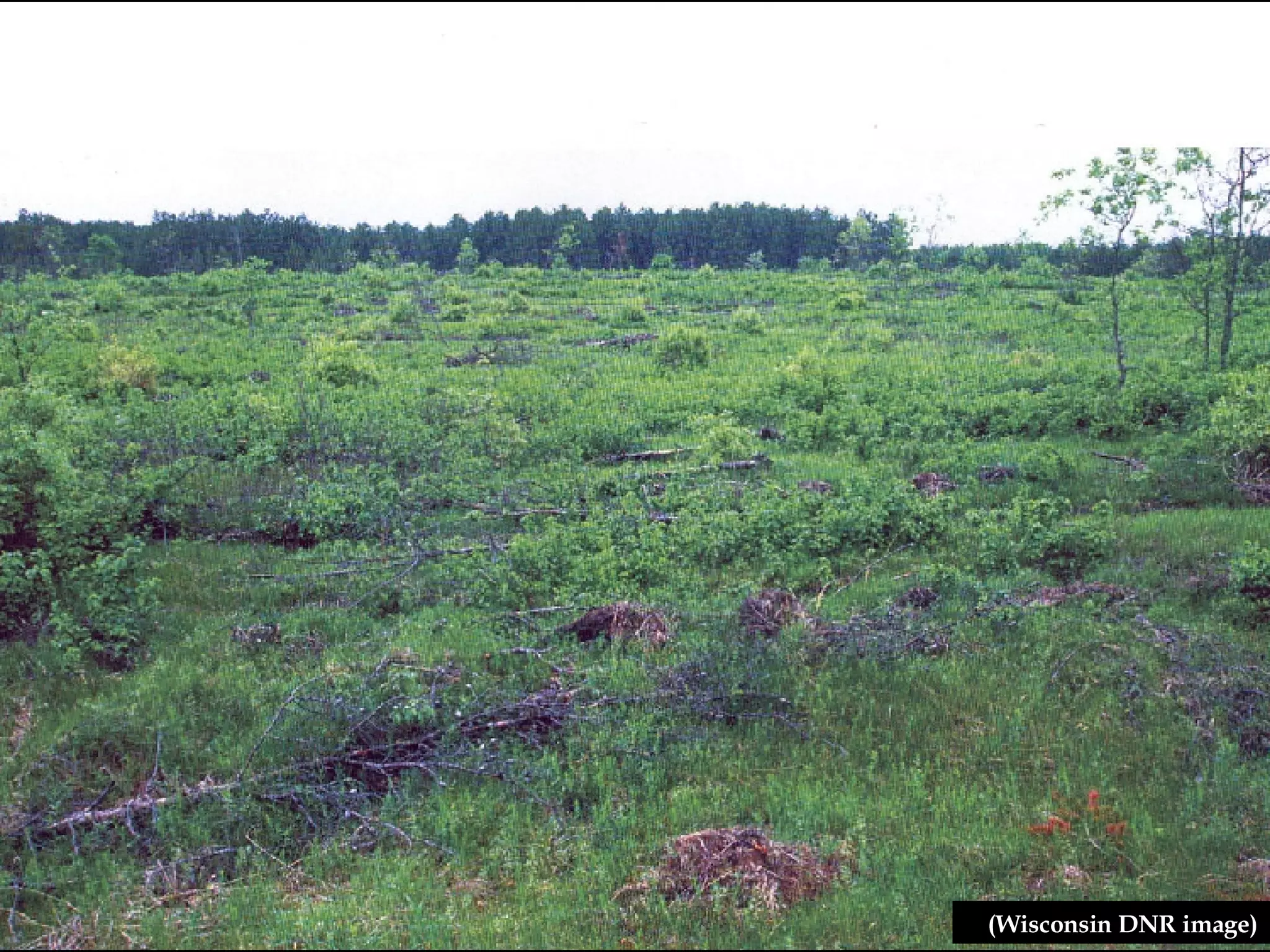
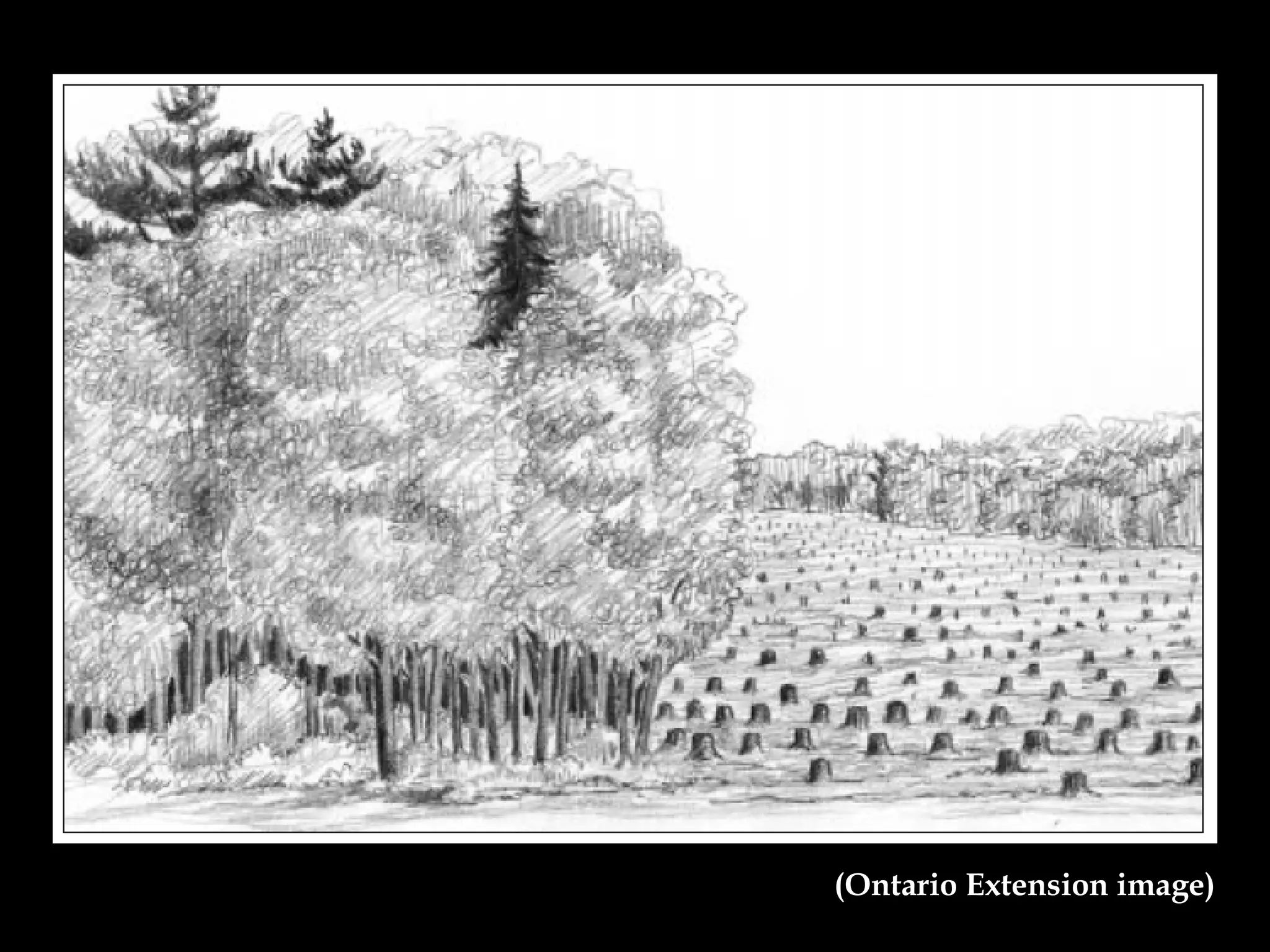
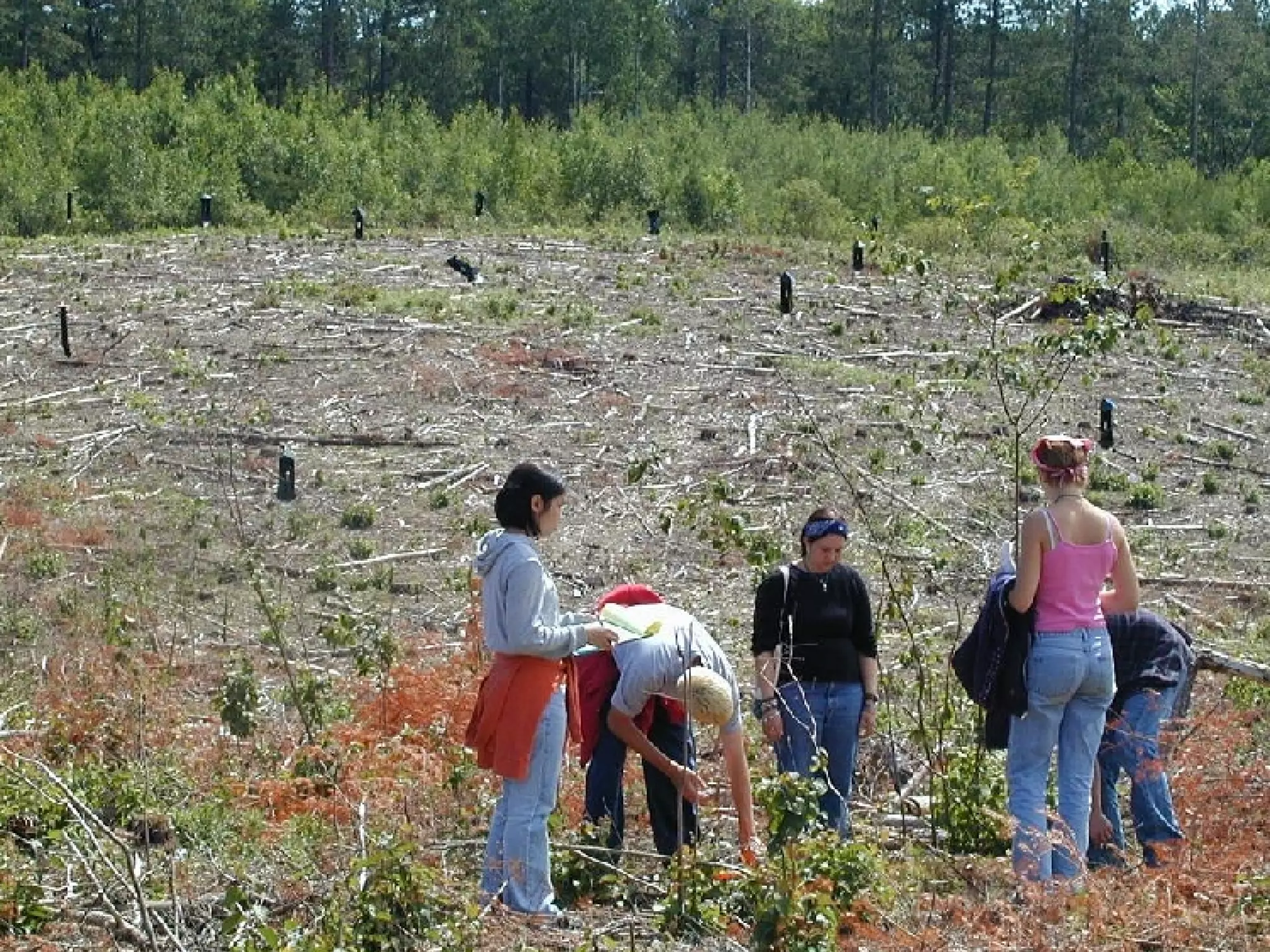
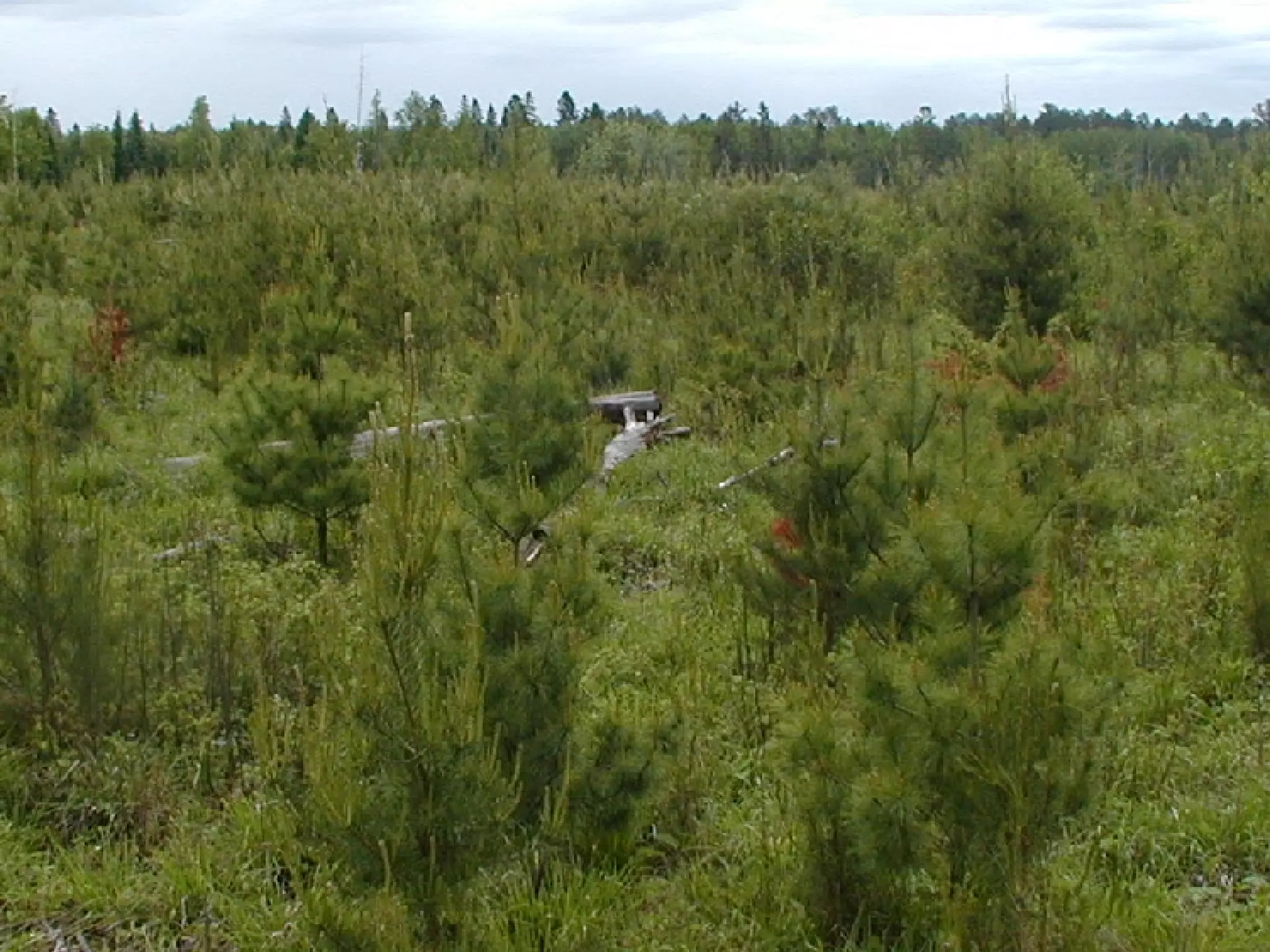
Clearcutting Method Clear all vegetation Prepare the site Plant trees (generally) Spray herbicide to control competition Thin (generally) Clearcut, and start over
(Wisconsin DNR image)
(Ontario Extension image)
 
 
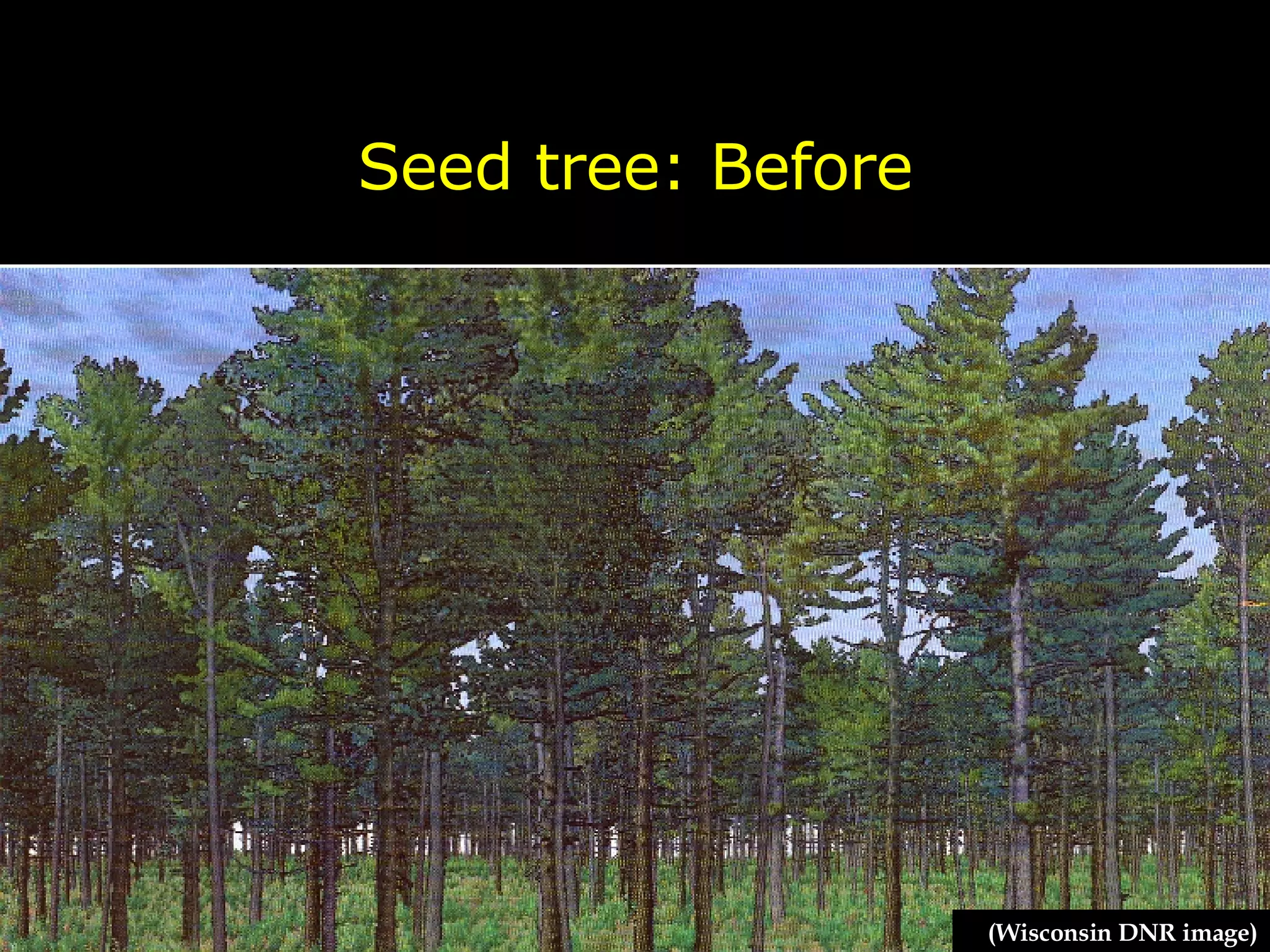
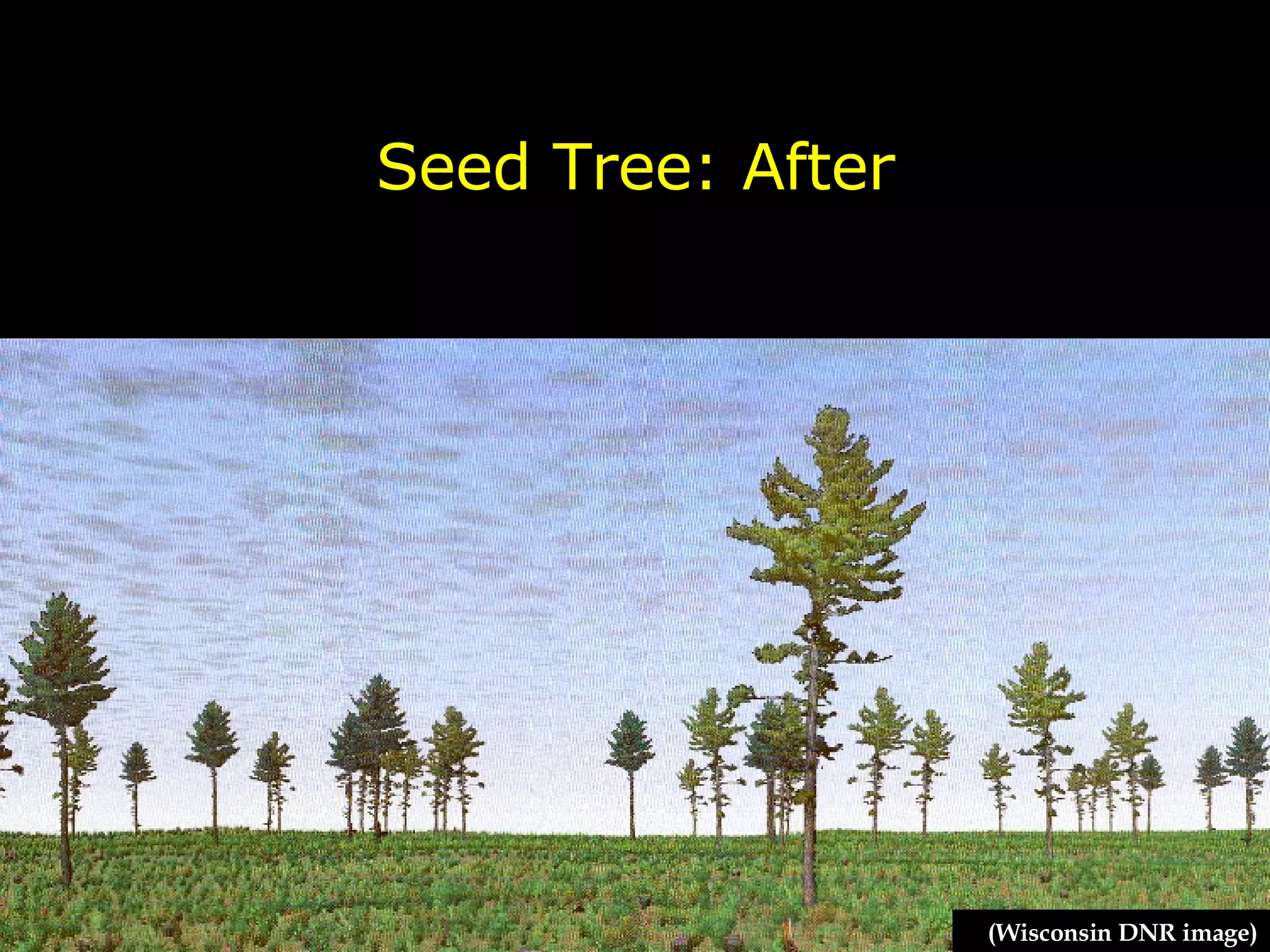
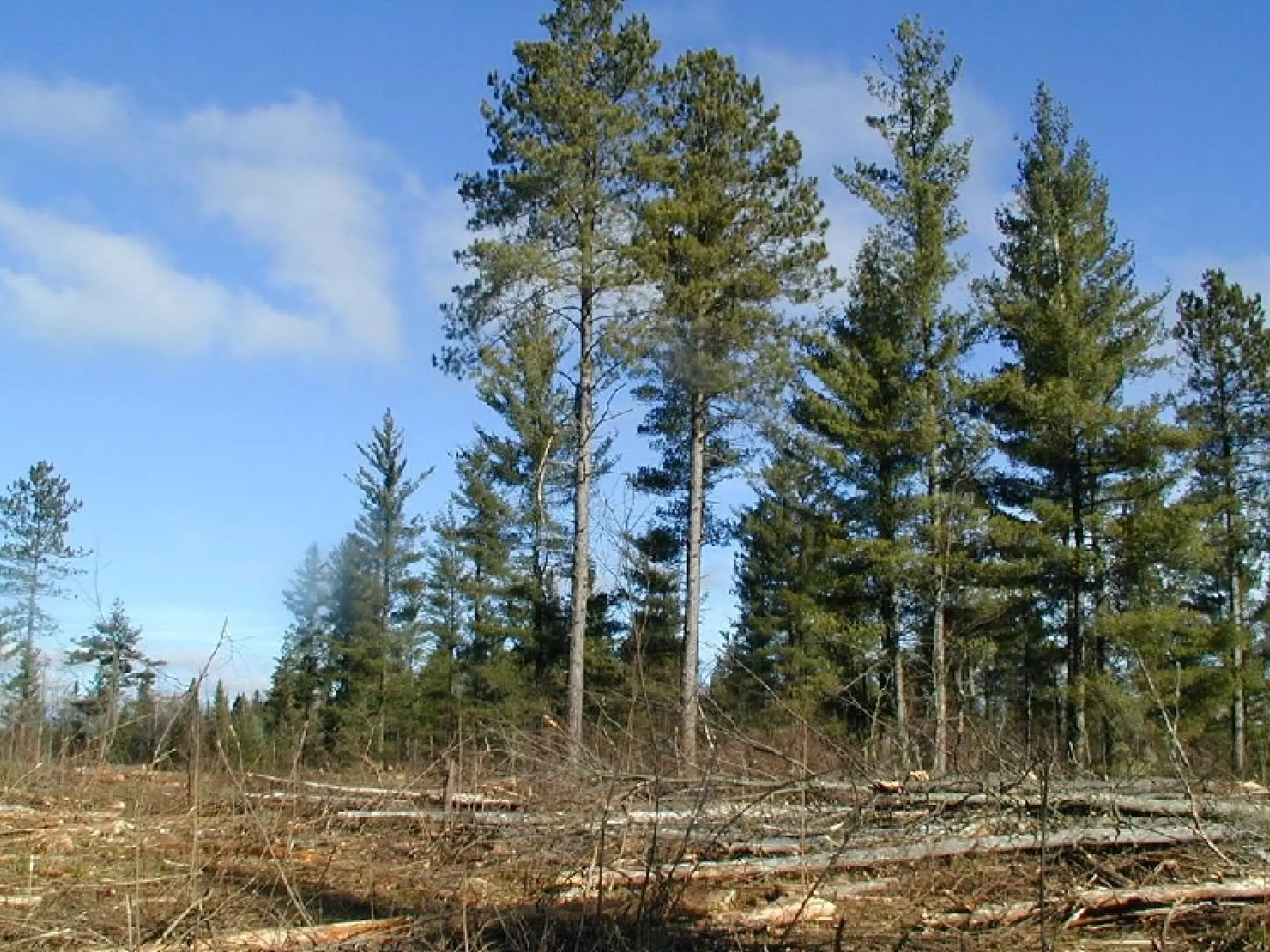
Seed Tree Method Start with a mature stand Harvest all but a few large trees per acre of desired species to drop seed Retain or remove seed trees Thin, etc Harvest
Seed tree: Before (Wisconsin DNR image)
Seed Tree: After (Wisconsin DNR image)
 
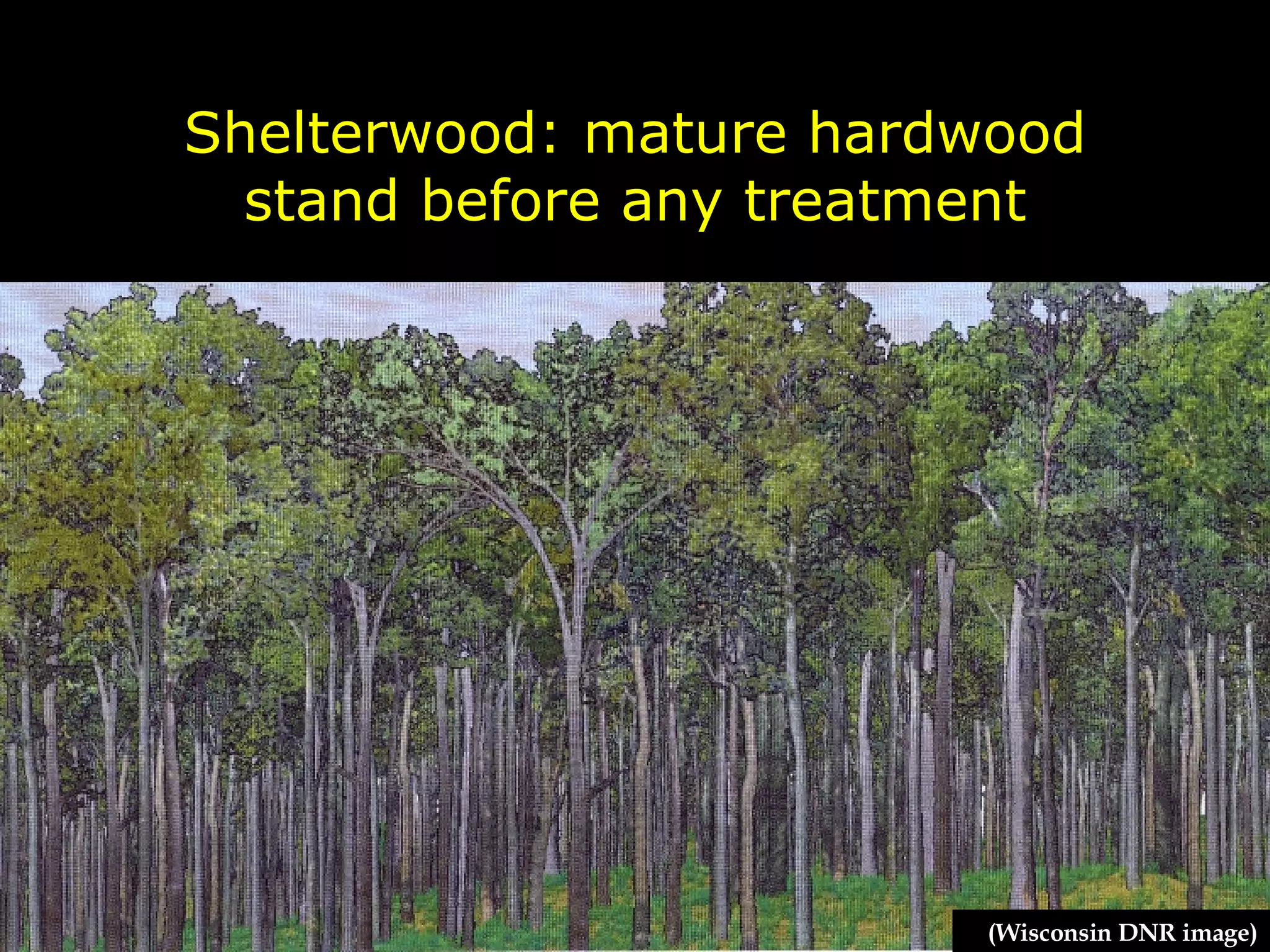
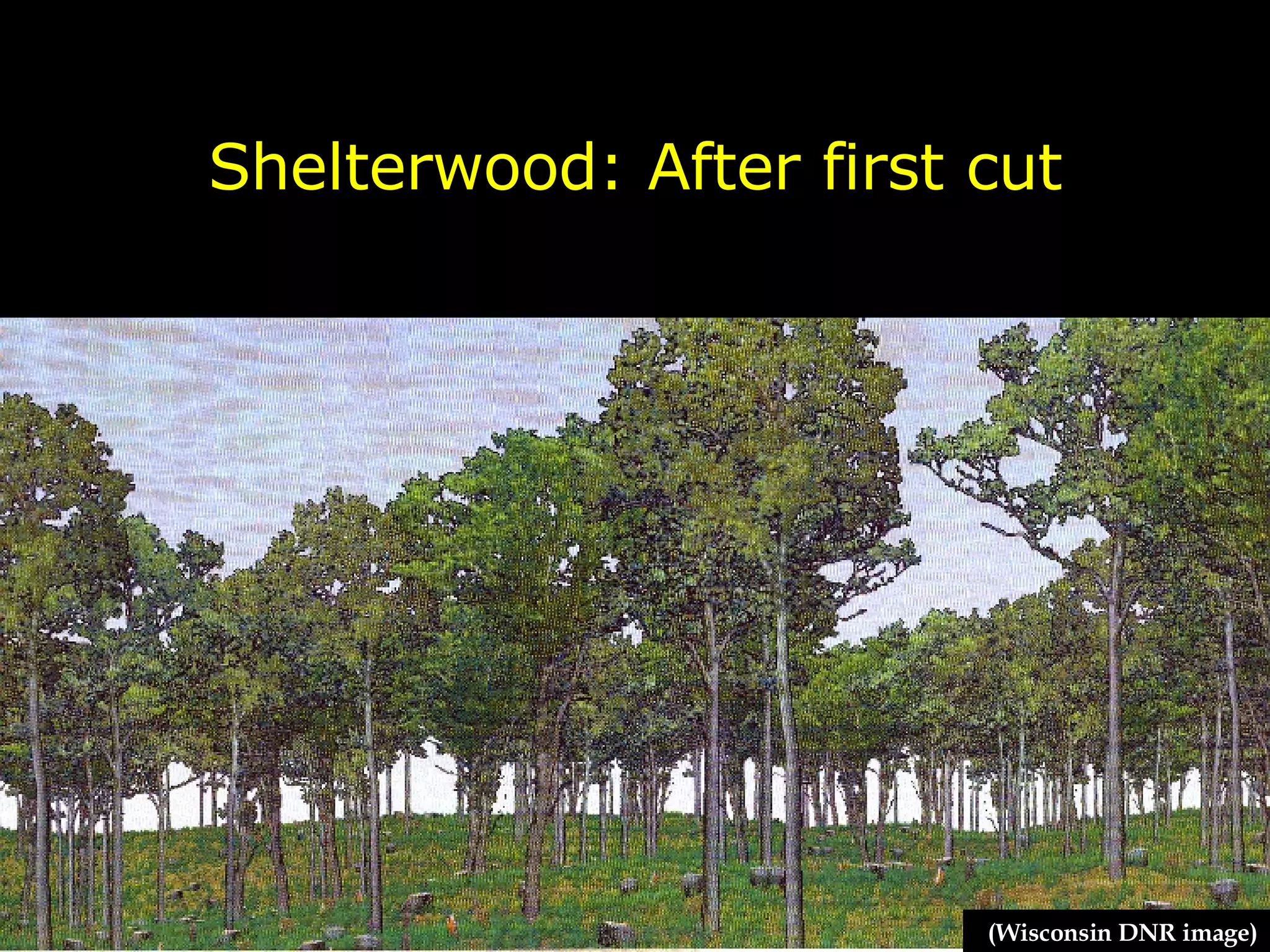
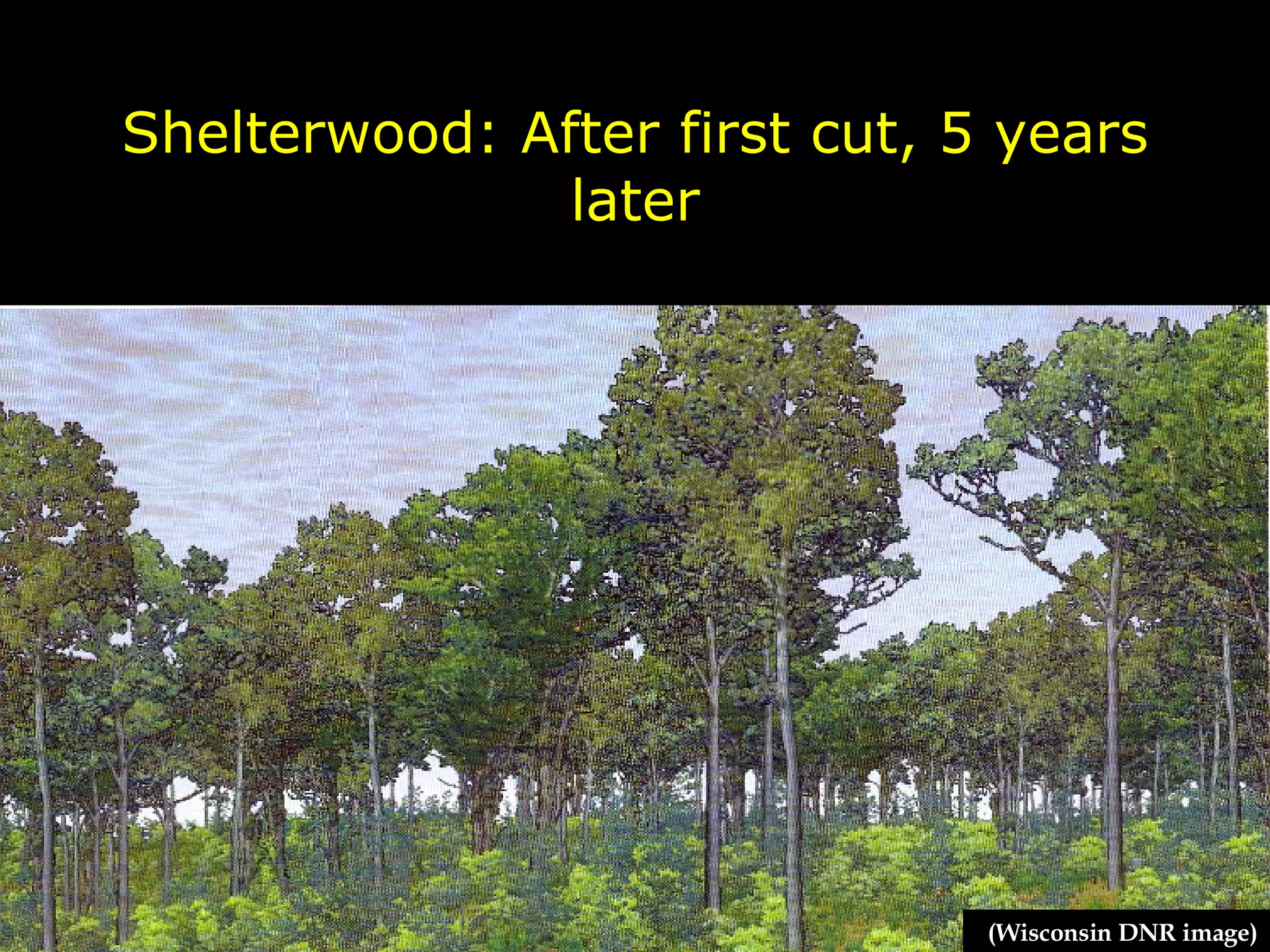
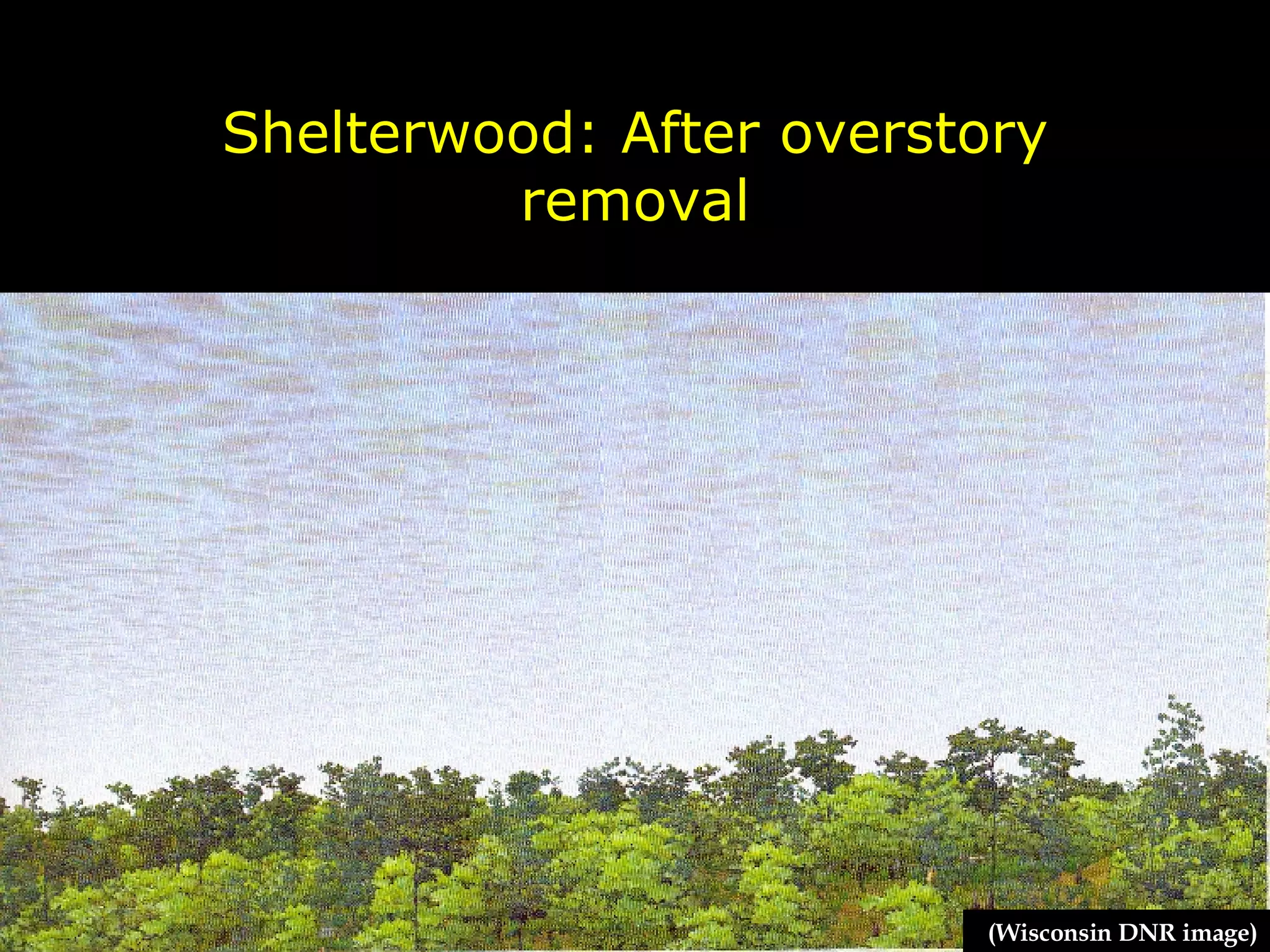
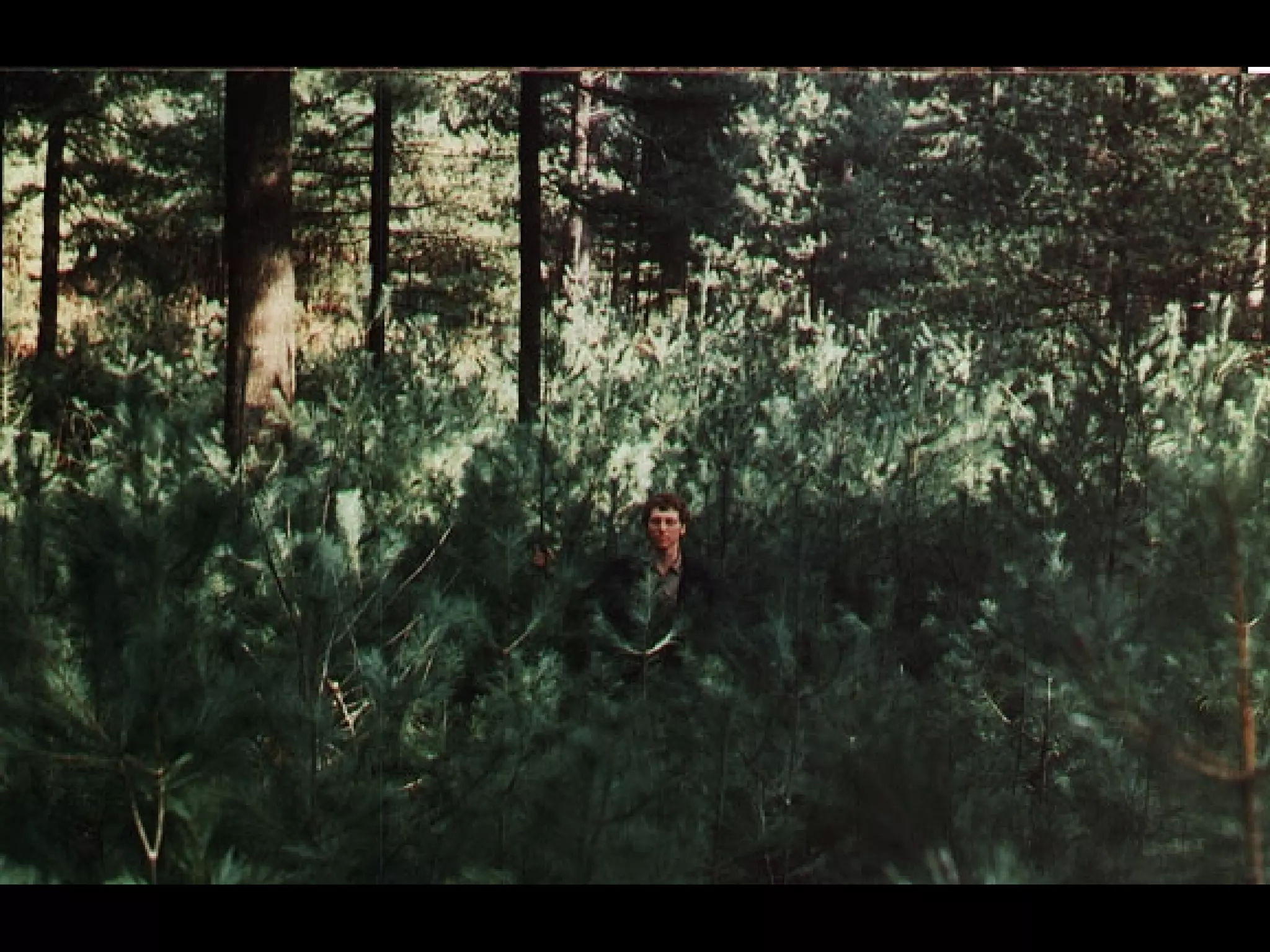
Shelterwood Method Start with a mature stand Partial harvest New seedlings are established Remove canopy, “release the advance regeneration”
Shelterwood: mature hardwood stand before any treatment (Wisconsin DNR image)
Shelterwood: After first cut (Wisconsin DNR image)
Shelterwood: After first cut, 5 years later (Wisconsin DNR image)
Shelterwood: After overstory removal (Wisconsin DNR image)
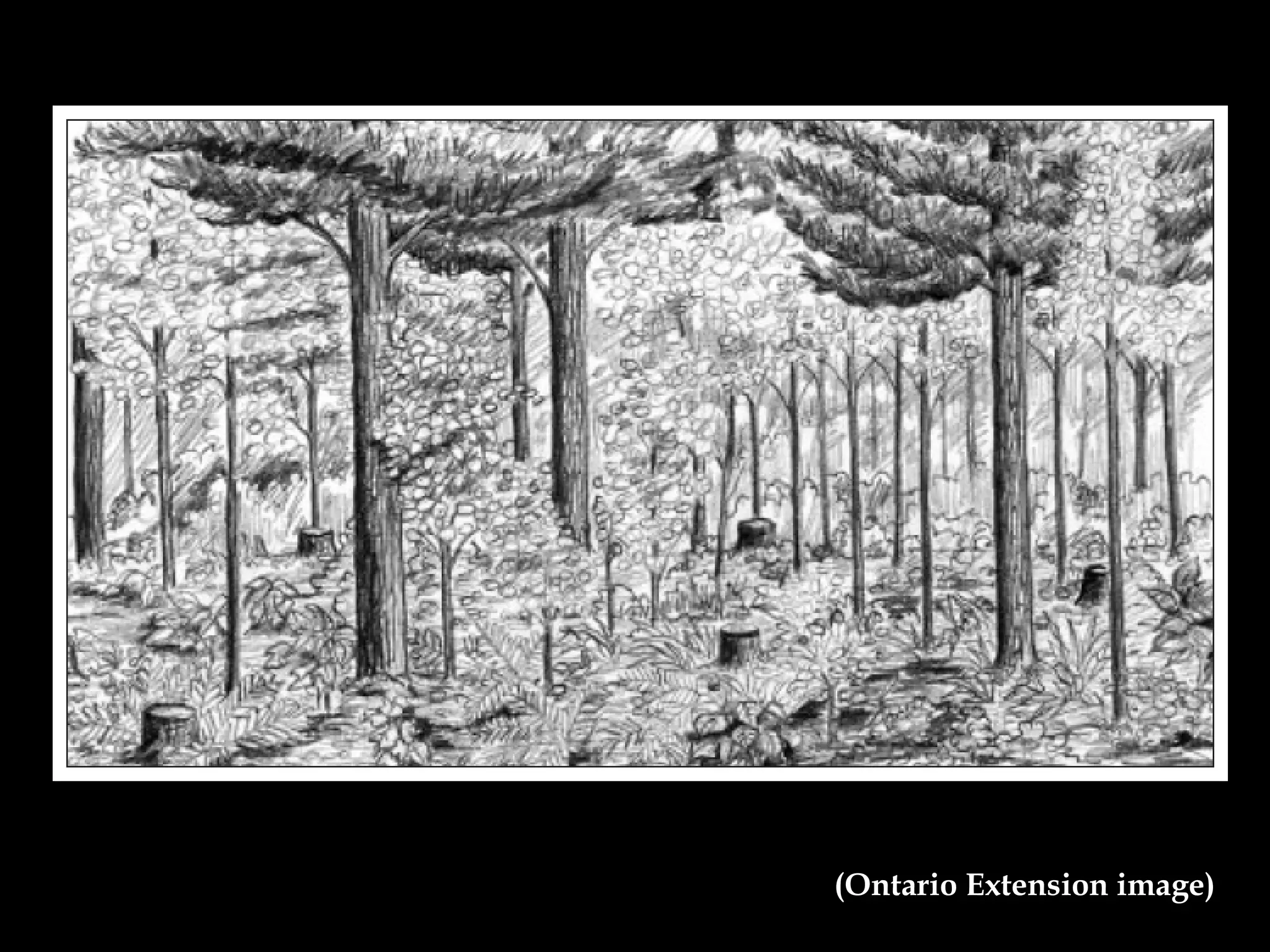
(Ontario Extension image)
 
 
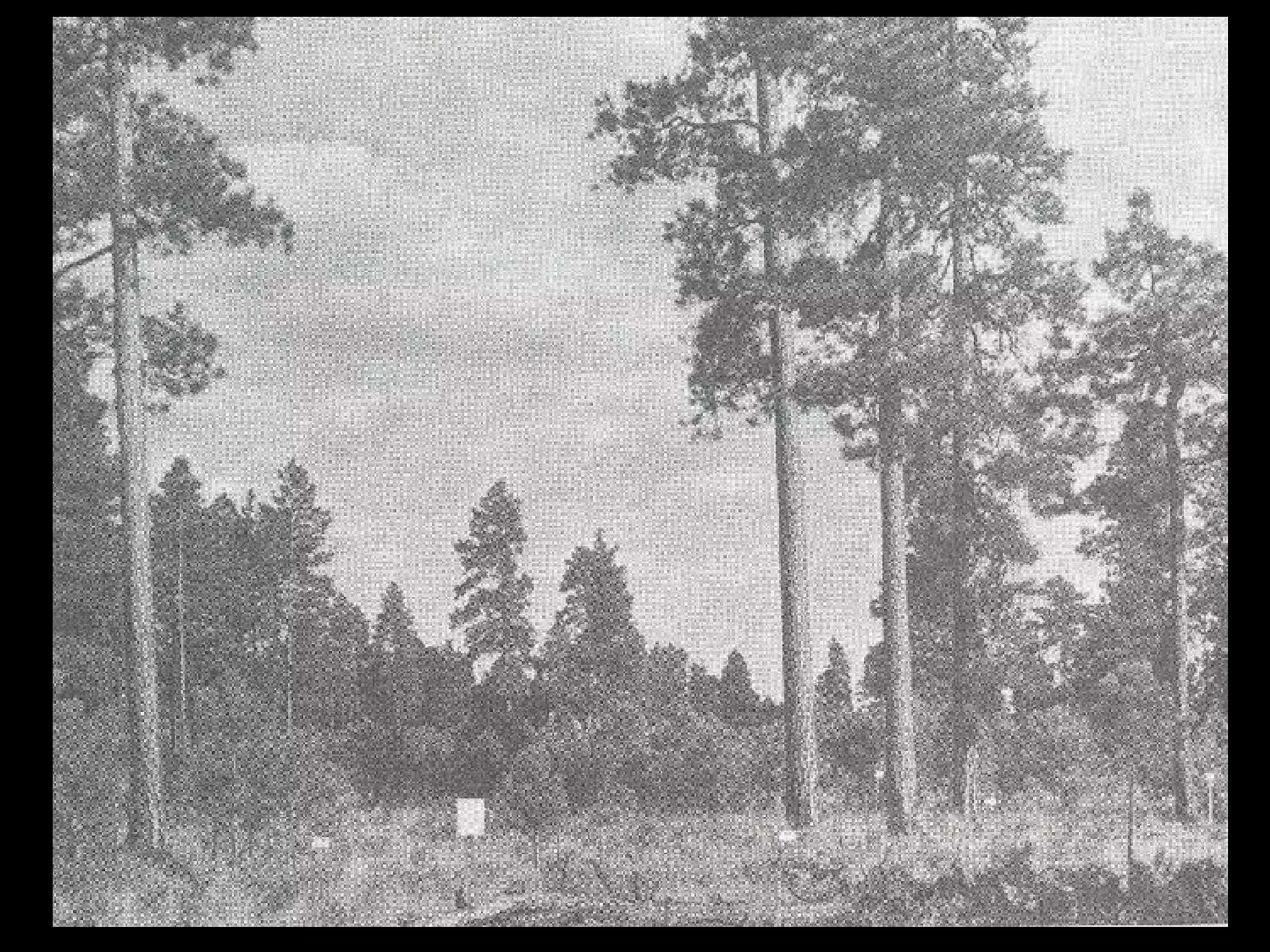
Group Selection Start with a mature stand Remove small groups of trees to create patches of regeneration Repeat periodically in different areas
 
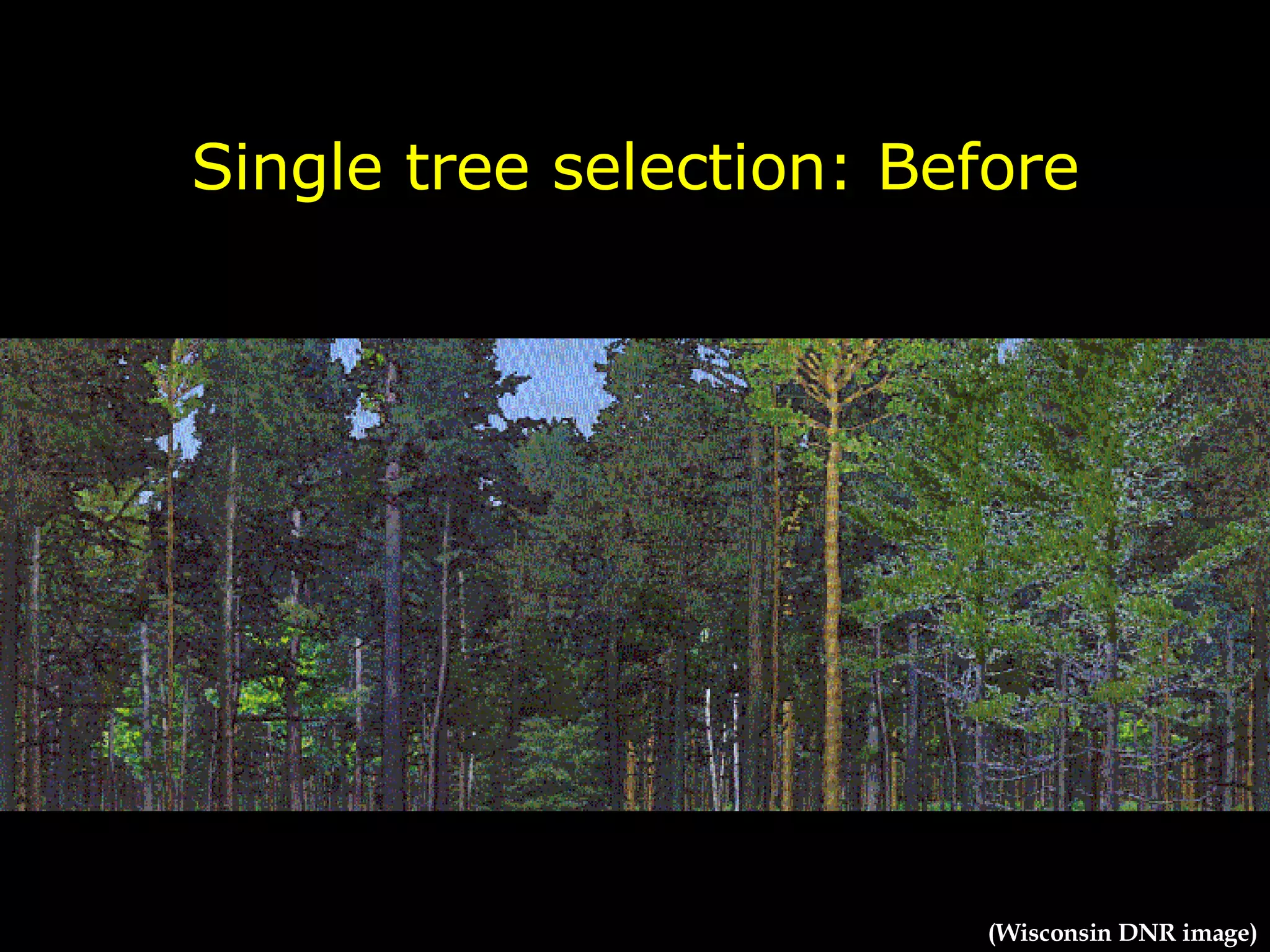
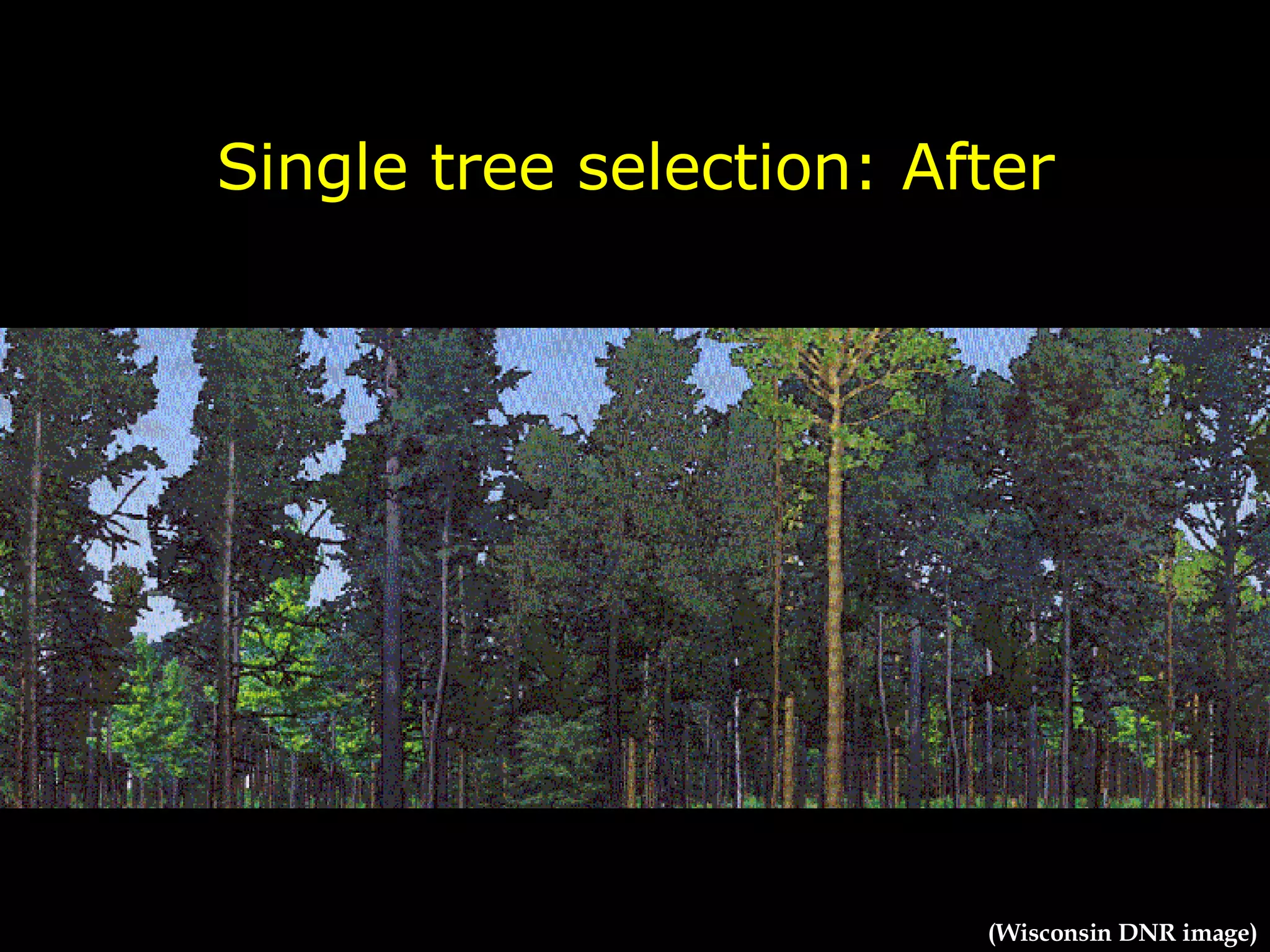
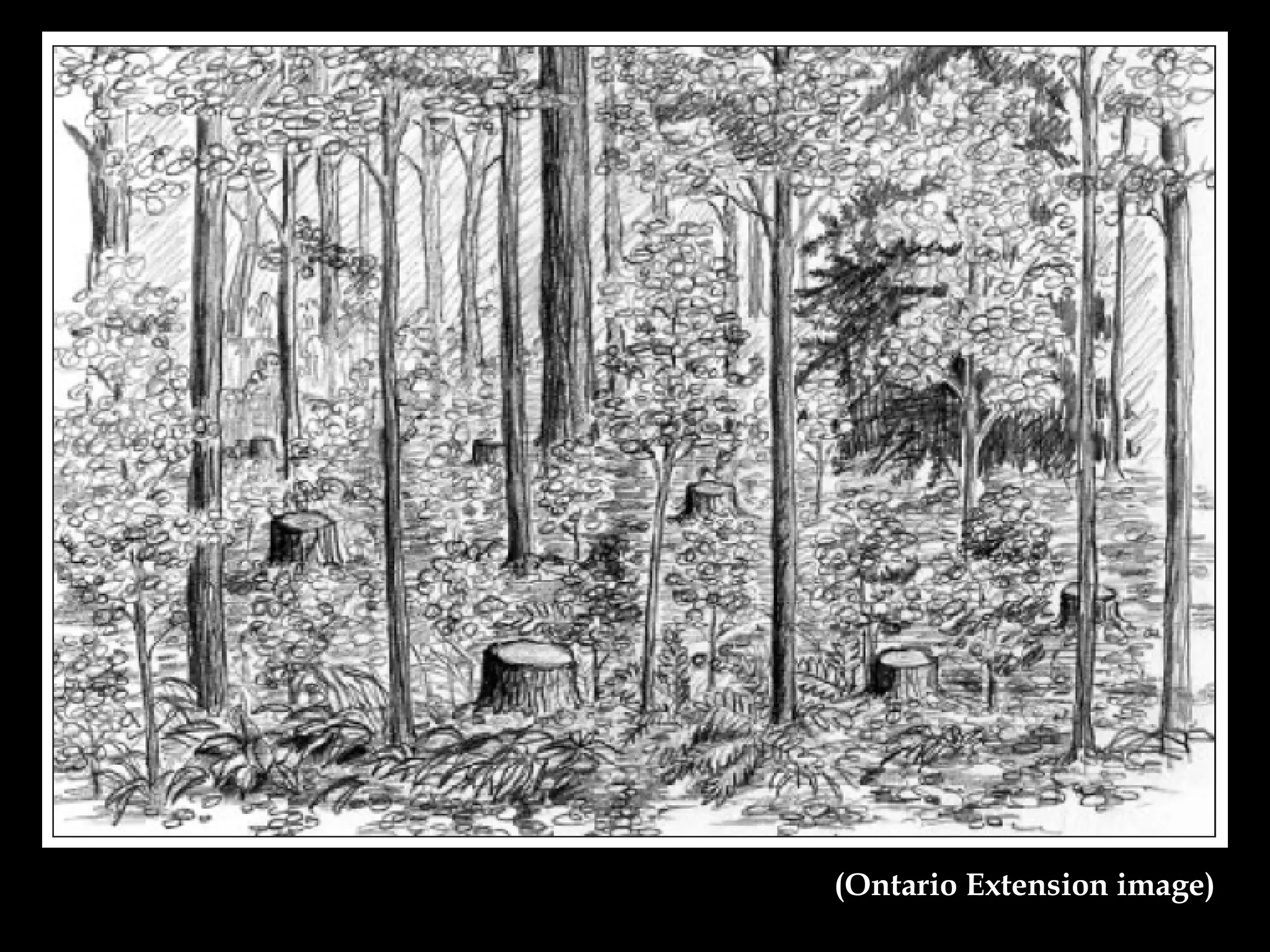
Selection System Start with mature stand Remove single trees or small groups Repeat as needed
Single tree selection: Before (Wisconsin DNR image)
Single tree selection: After (Wisconsin DNR image)
(Ontario Extension image)
 
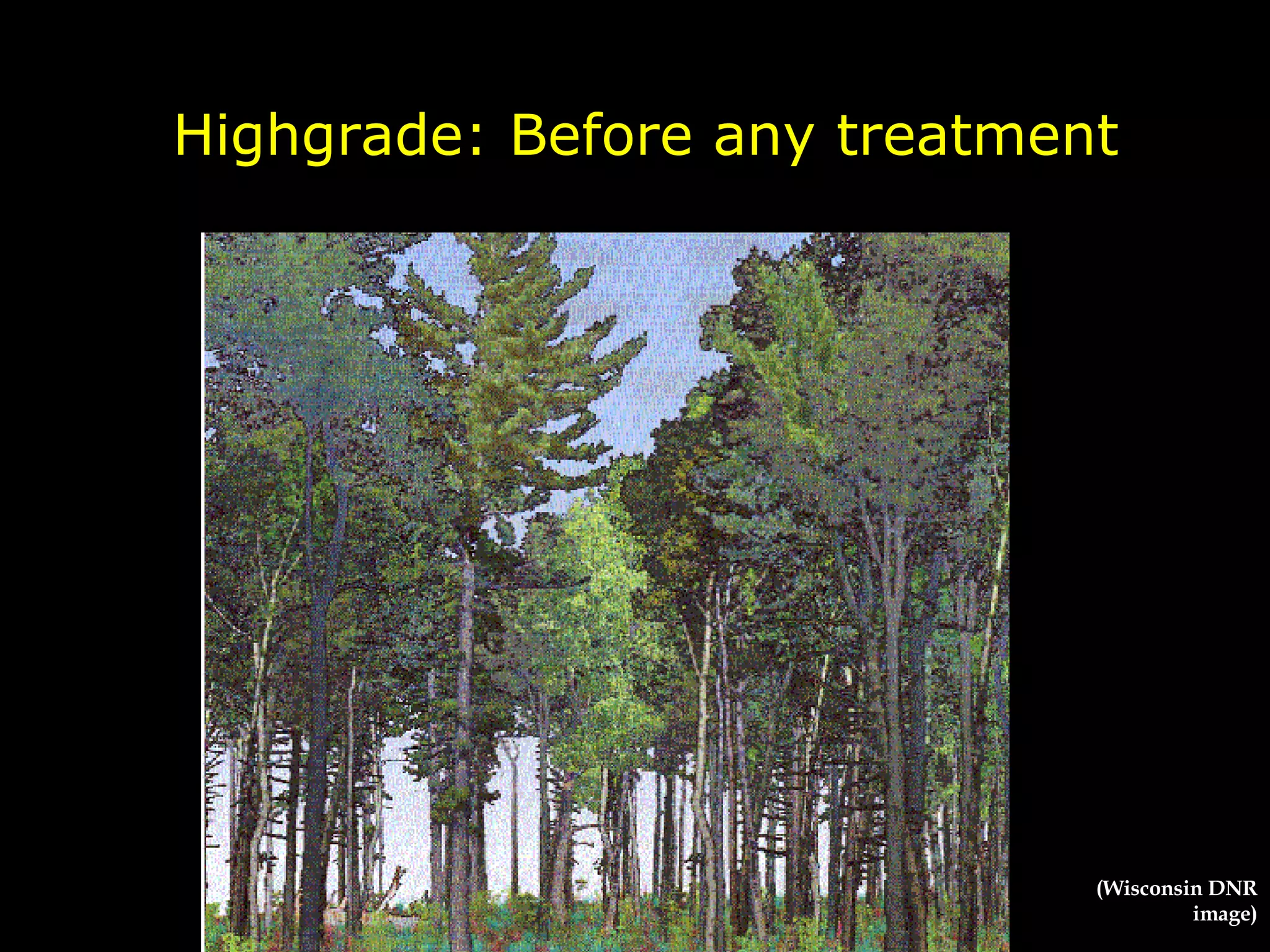
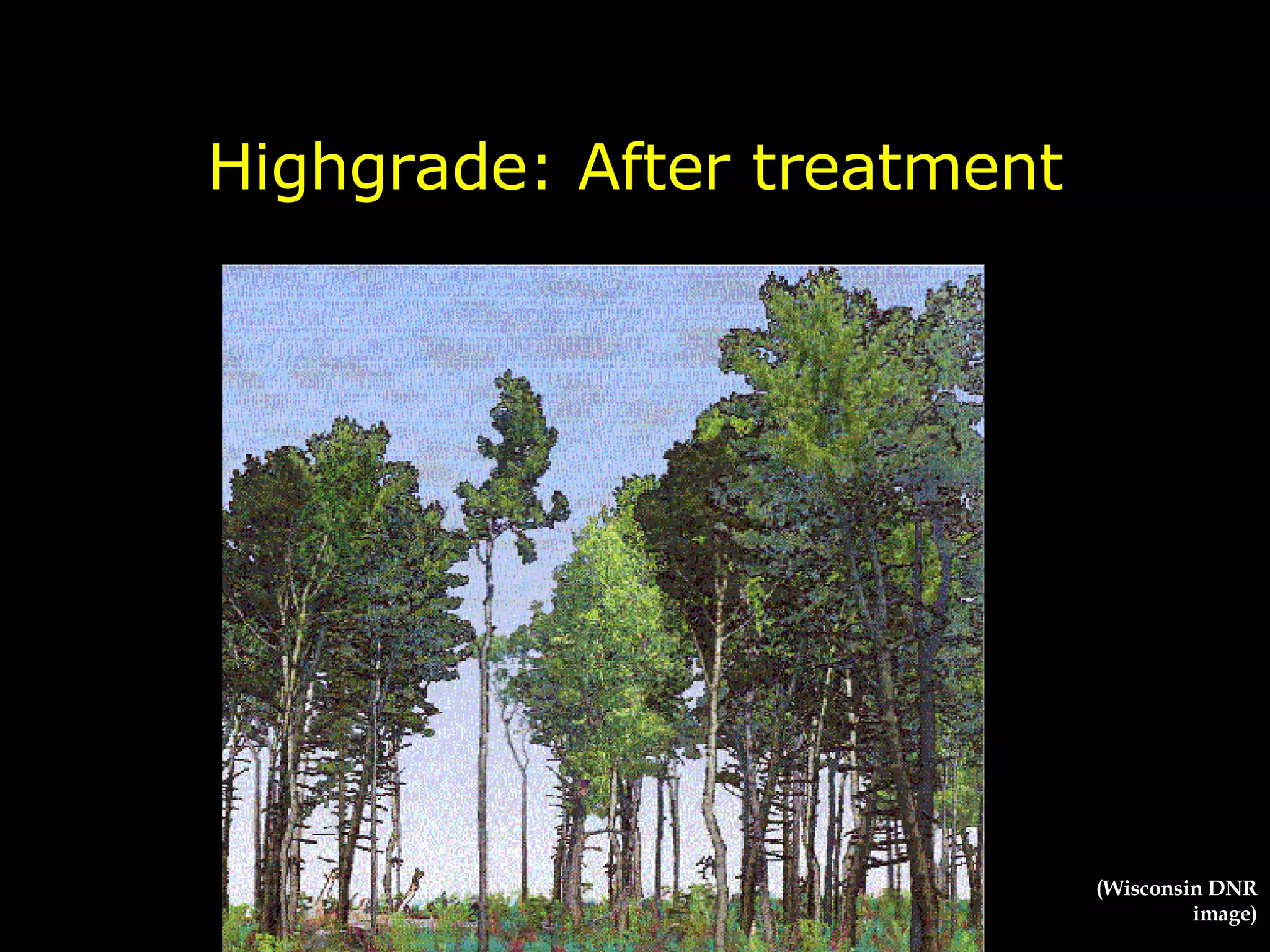
High-Grading Treatment occurs when landowner is strapped for cash  Best trees removed, worst left, with little consideration for regeneration Future of the stand?
Highgrade: Before any treatment (Wisconsin DNR image)
Highgrade: After treatment (Wisconsin DNR image)
High-Grading Treatment occurs when landowner is strapped for cash  Best trees removed, worst left, with little consideration for regeneration Future of the stand? Is high-grading a silvicultural system?
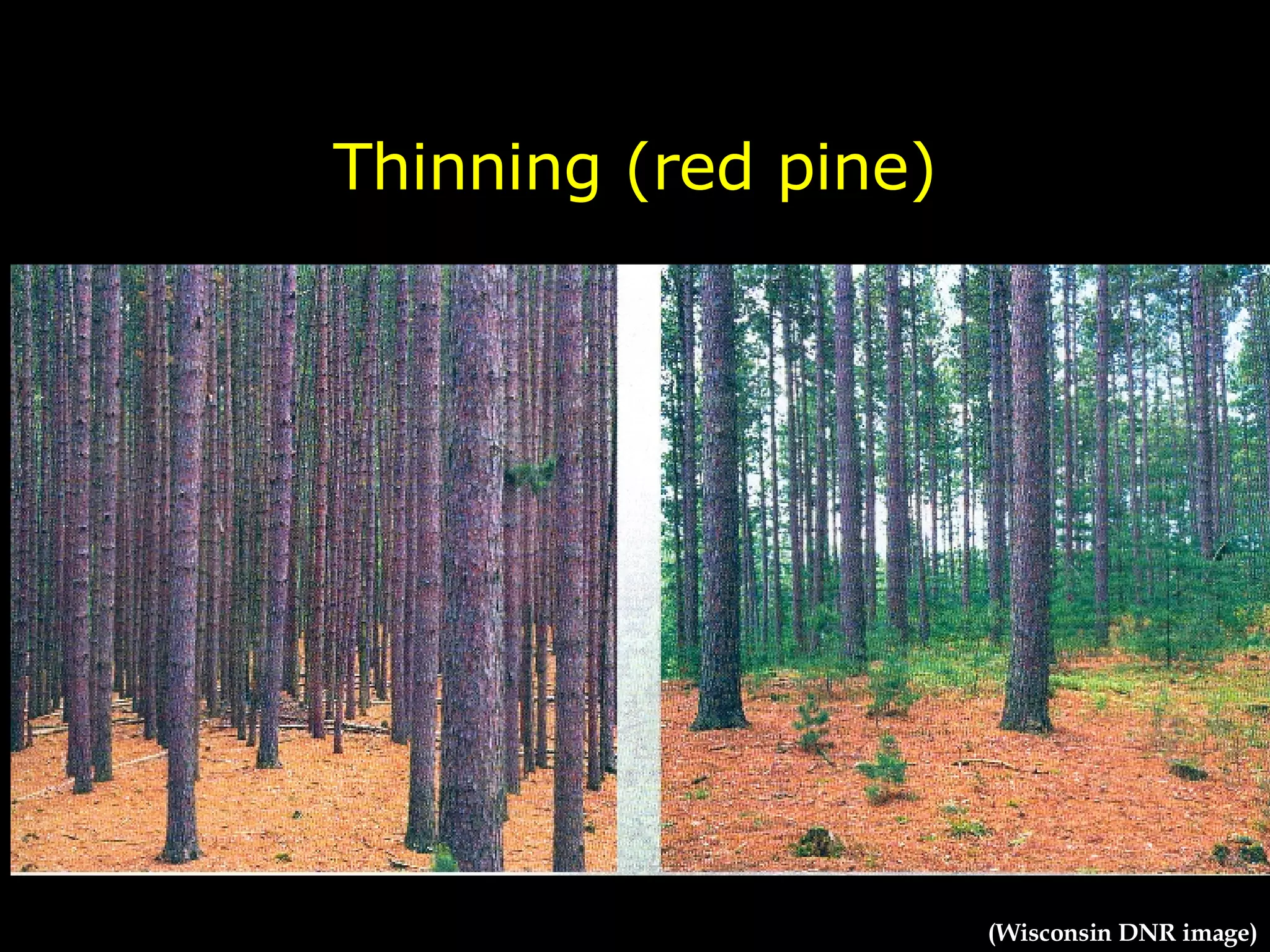
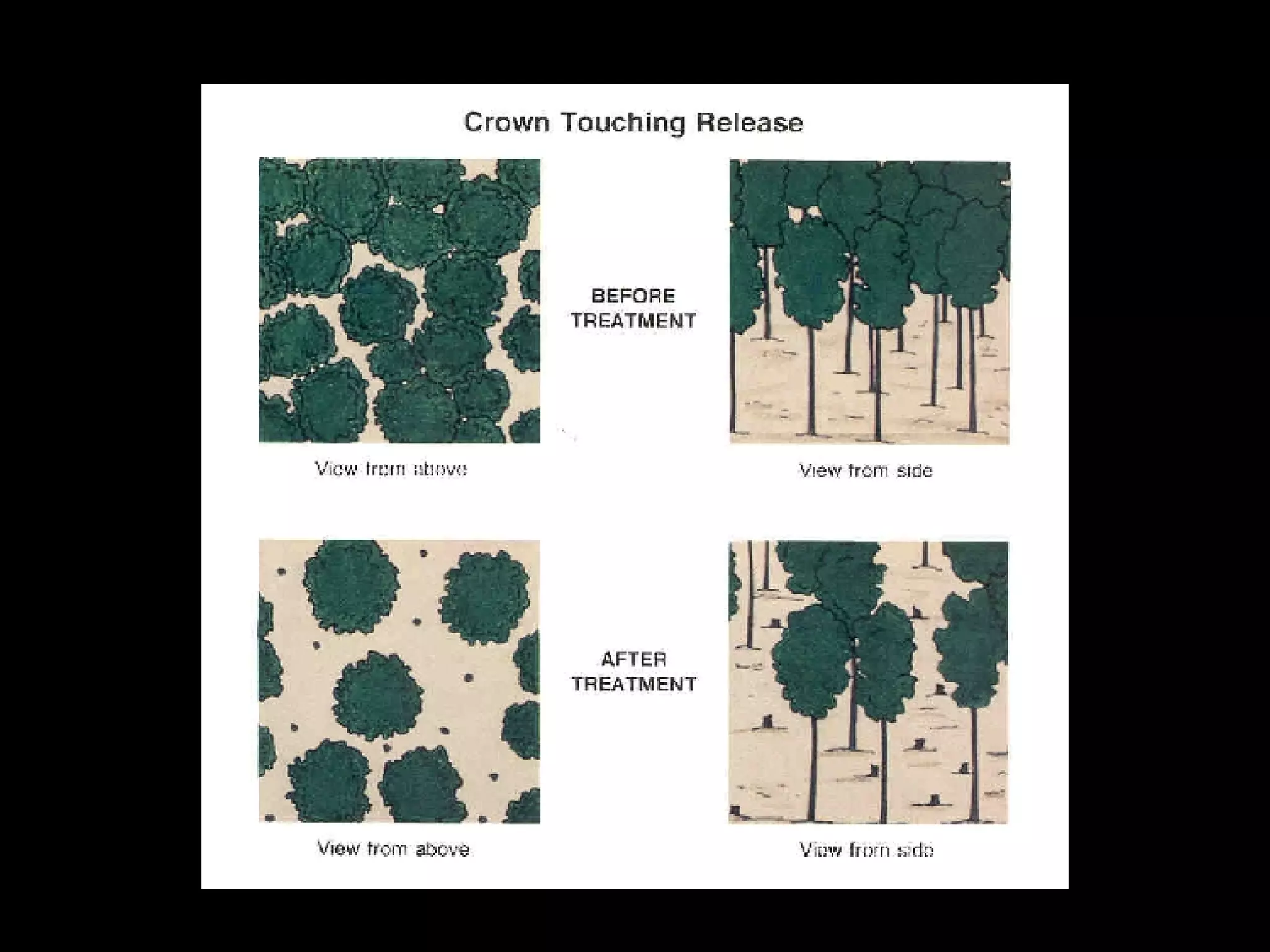
Intermediate Treatments Timber Stand Improvement (TSI) Thinning Pre-commercial Commercial Salvage cutting Sanitation cutting
 
 
Thinning (red pine) (Wisconsin DNR image)
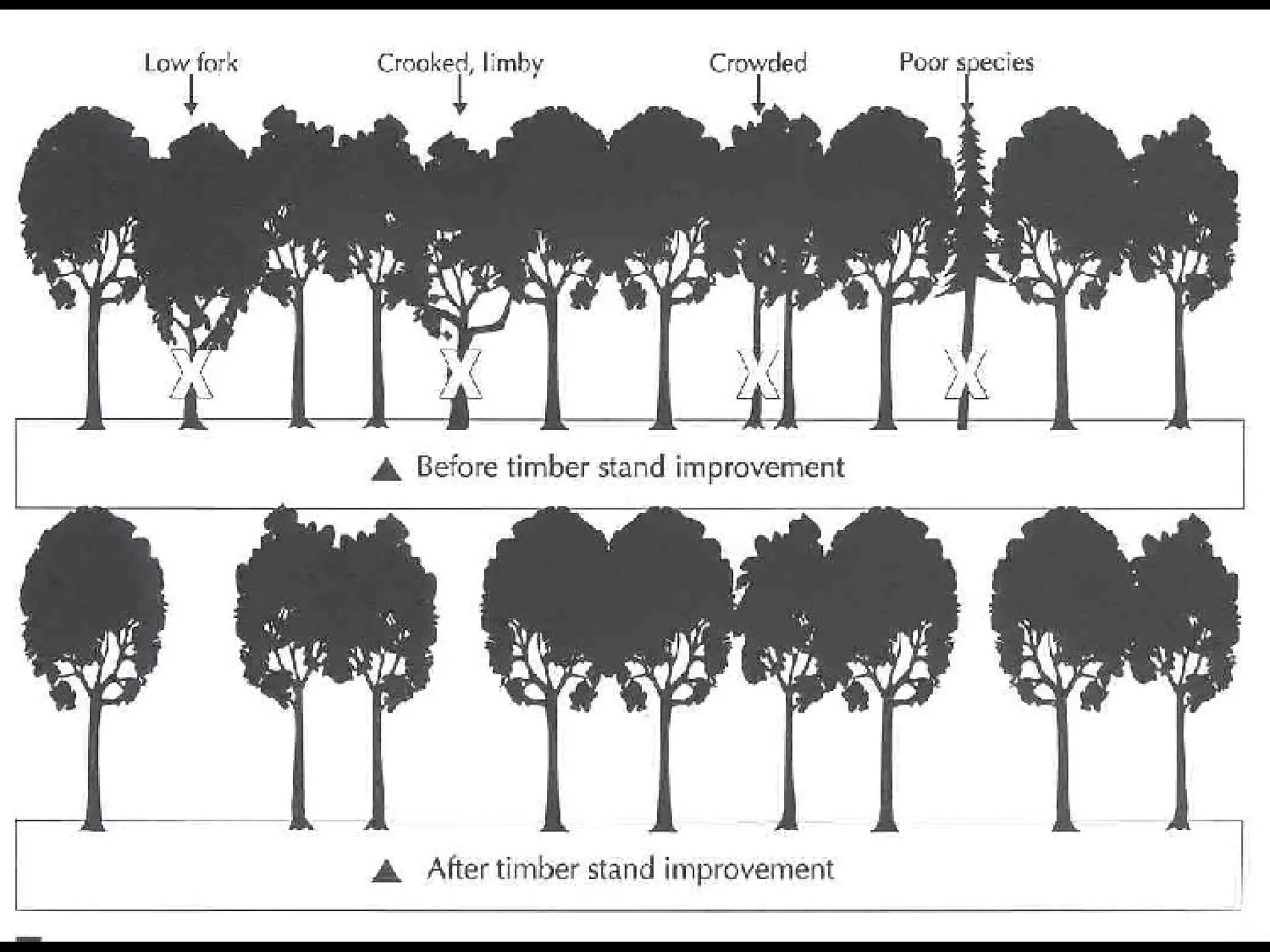
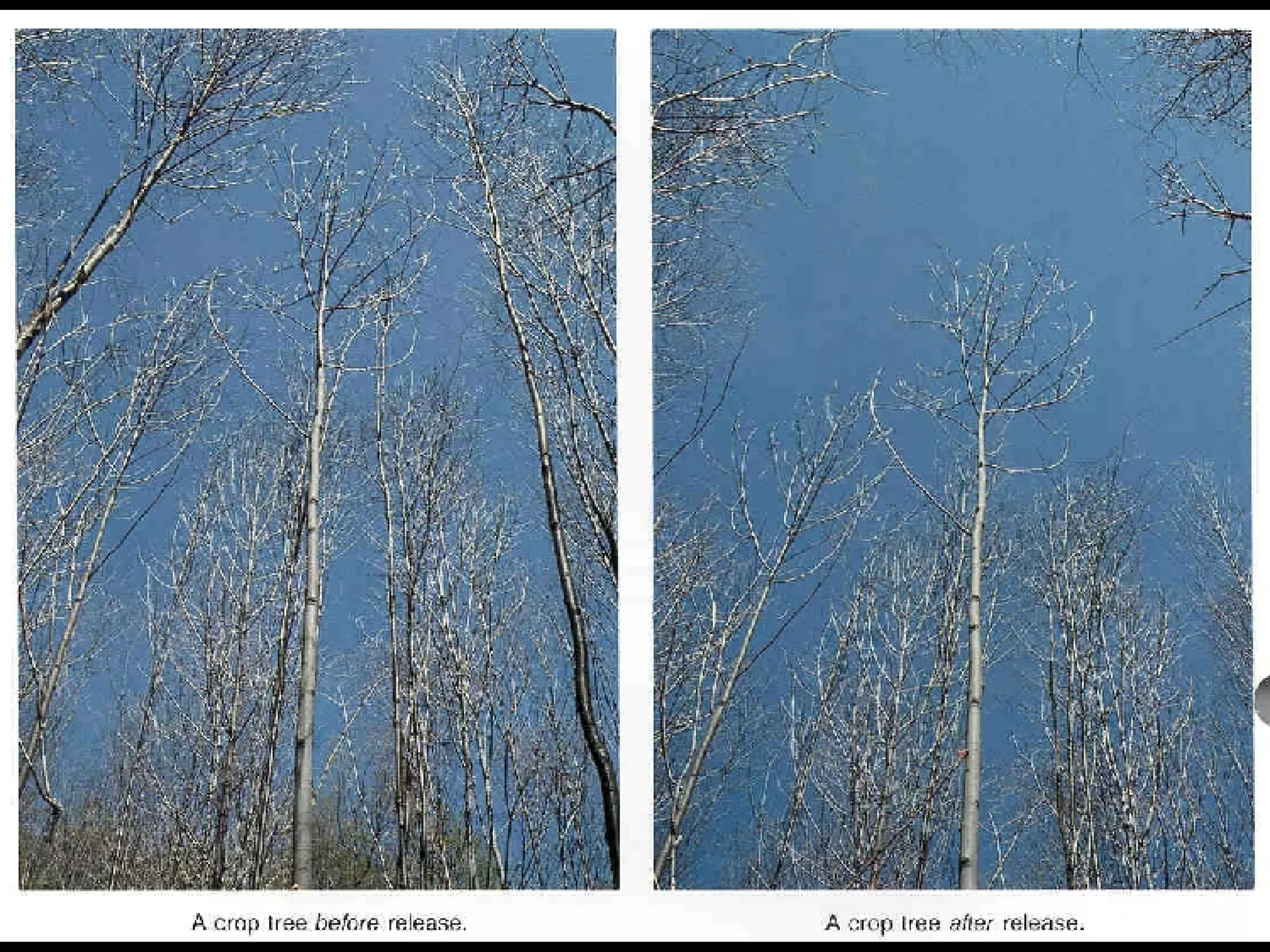
More on Timber Stand Improvement (TSI) When choosing trees to cut, pay attention to: Tree form  Crown class Desired future condition of stand
How to get it done Long view Work with a professional forester May need to invest Ask around!
 
Prescriptions Inventory:  What do you have to work with? OBJECTIVES Available options?
Review Art and science: be creative! Desired future condition? Work WITH nature Many different options
Questions? Eli Sagor [email_address] (651) 624-6948

Growing and Tending Your Forest: An introduction to silviculture

  • 1.
    Applied Forest Ecology:An Introduction to Silviculture Eli Sagor [email_address]
  • 2.
    Thanks to DanGilmore, UMN College of Natural Resources
  • 3.
    Outline What is“silviculture?” Values of the forest Forest structure Silvicultural systems Q&A
  • 4.
    Definitions of SilvicultureThe art and science of controlling the establishment, growth, composition, and health of forests and woodlands to meet the diverse needs of landowners and society on a sustainable basis. (J. Helms 1998)
  • 5.
    Definitions of SilvicultureThe art and science of controlling the establishment, growth, composition, and health of forests and woodlands to meet the diverse needs of landowners and society on a sustainable basis. (J. Helms 1998)
  • 6.
    Definitions of SilvicultureThe art and science of controlling the establishment, growth, composition, and health of forests and woodlands to meet the diverse needs of landowners and society on a sustainable basis. (J. Helms 1998)
  • 7.
    Definitions of SilvicultureThe art and science of controlling the establishment, growth, composition, and health of forests and woodlands to meet the diverse needs of landowners and society on a sustainable basis. (J. Helms 1998)
  • 8.
    Purpose of SilvicultureTo create and maintain the kind of forest that will best fulfill the objectives of the owner and governing society. (DM Smith et al. 1997)
  • 9.
    Limits of SilvicultureWorking with the forces of nature: sailing analogy
  • 10.
    Values we derivefrom forests Common forest products: Timber, game wildlife, recreation...
  • 11.
    Values we derivefrom forests Common forest products Timber, game wildlife, recreation... Specialty forest products: Berries & nuts, birch bark, balsam boughs...
  • 12.
    Values we derivefrom forests Non-market values: Ecological, habitat Aesthetics Watershed protection Spiritual, existence values
  • 13.
  • 14.
    Kraft Crown ClassificationDOMINANT – trees with crowns extending above the main canopy—receiving direct sunlight from above and partly from the sides CODOMINANT – trees with crowns forming the general level of the crown cover—receiving direct sunlight from above but little from the sides
  • 15.
    Kraft Crown ClassificationINTERMEDIATE – shorter trees with crowns extending into the main canopy—receiving direct sunlight from above but not from the sides SUPPRESSED – trees with crowns entirely below the main canopy—receiving no direct light from above or from the sides
  • 16.
  • 17.
  • 18.
    Age classes andcohorts EVEN-AGED: the difference in age between the youngest and oldest trees does not exceed 20% of the total rotation age. TWO-AGED: stands contain two distinct age classes. UNEVEN-AGED: stands contain at least three distinct age classes.
  • 19.
  • 20.
  • 21.
    The toolbox Clearcutharvesting “ Selective” or partial harvesting Prescribed burning: to control understory competition to prepare a cleared site for planting to favor natural regeneration of desired species to reduce fuel loads Planting of desired species and/or genetically improved stock Protecting stands from damage from wildlife (deer!) Thinning at various times in the rotation Pruning: to improve log quality to reduce disease effects Spraying herbicides or pesticides Cutting to reduce insect threats Salvage cutting Fire suppression And more…
  • 22.
    Silvicultural System ComponentsAge classes (cohorts) Regeneration method Natural (from seed or sprout) Artificial (planted) Species composition pure or mixed
  • 23.
    Silviculture ≠ Harvesting A silvicultural system applies to the whole rotation . A harvesting system applies only to the harvest .
  • 24.
    Silvicultural Systems ClearcuttingSeed tree Shelterwood Group selection Single-tree selection Intermediate treatments
  • 25.
    Clearcutting Method Clearall vegetation Prepare the site Plant trees (generally) Spray herbicide to control competition Thin (generally) Clearcut, and start over
  • 26.
  • 27.
  • 28.
  • 29.
  • 30.
    Seed Tree MethodStart with a mature stand Harvest all but a few large trees per acre of desired species to drop seed Retain or remove seed trees Thin, etc Harvest
  • 31.
    Seed tree: Before(Wisconsin DNR image)
  • 32.
    Seed Tree: After(Wisconsin DNR image)
  • 33.
  • 34.
    Shelterwood Method Startwith a mature stand Partial harvest New seedlings are established Remove canopy, “release the advance regeneration”
  • 35.
    Shelterwood: mature hardwoodstand before any treatment (Wisconsin DNR image)
  • 36.
    Shelterwood: After firstcut (Wisconsin DNR image)
  • 37.
    Shelterwood: After firstcut, 5 years later (Wisconsin DNR image)
  • 38.
    Shelterwood: After overstoryremoval (Wisconsin DNR image)
  • 39.
  • 40.
  • 41.
  • 42.
    Group Selection Startwith a mature stand Remove small groups of trees to create patches of regeneration Repeat periodically in different areas
  • 43.
  • 44.
    Selection System Startwith mature stand Remove single trees or small groups Repeat as needed
  • 45.
    Single tree selection:Before (Wisconsin DNR image)
  • 46.
    Single tree selection:After (Wisconsin DNR image)
  • 47.
  • 48.
  • 49.
    High-Grading Treatment occurswhen landowner is strapped for cash Best trees removed, worst left, with little consideration for regeneration Future of the stand?
  • 50.
    Highgrade: Before anytreatment (Wisconsin DNR image)
  • 51.
    Highgrade: After treatment(Wisconsin DNR image)
  • 52.
    High-Grading Treatment occurswhen landowner is strapped for cash Best trees removed, worst left, with little consideration for regeneration Future of the stand? Is high-grading a silvicultural system?
  • 53.
    Intermediate Treatments TimberStand Improvement (TSI) Thinning Pre-commercial Commercial Salvage cutting Sanitation cutting
  • 54.
  • 55.
  • 56.
    Thinning (red pine)(Wisconsin DNR image)
  • 57.
    More on TimberStand Improvement (TSI) When choosing trees to cut, pay attention to: Tree form Crown class Desired future condition of stand
  • 58.
    How to getit done Long view Work with a professional forester May need to invest Ask around!
  • 59.
  • 60.
    Prescriptions Inventory: What do you have to work with? OBJECTIVES Available options?
  • 61.
    Review Art andscience: be creative! Desired future condition? Work WITH nature Many different options
  • 62.
    Questions? Eli Sagor[email_address] (651) 624-6948